Determining Tenacity and Elongation Limits for Fine Wet Spun Linen Warp Yarns
Fine wet spun linen warp yarns demand a minimum unsized tenacity of 19 cN/tex and a Weibull modulus above 9.0 to survive loom shedding strain without snap.
Trough
Physical Softening of Middle Lamella Pectins in Hot Water Baths
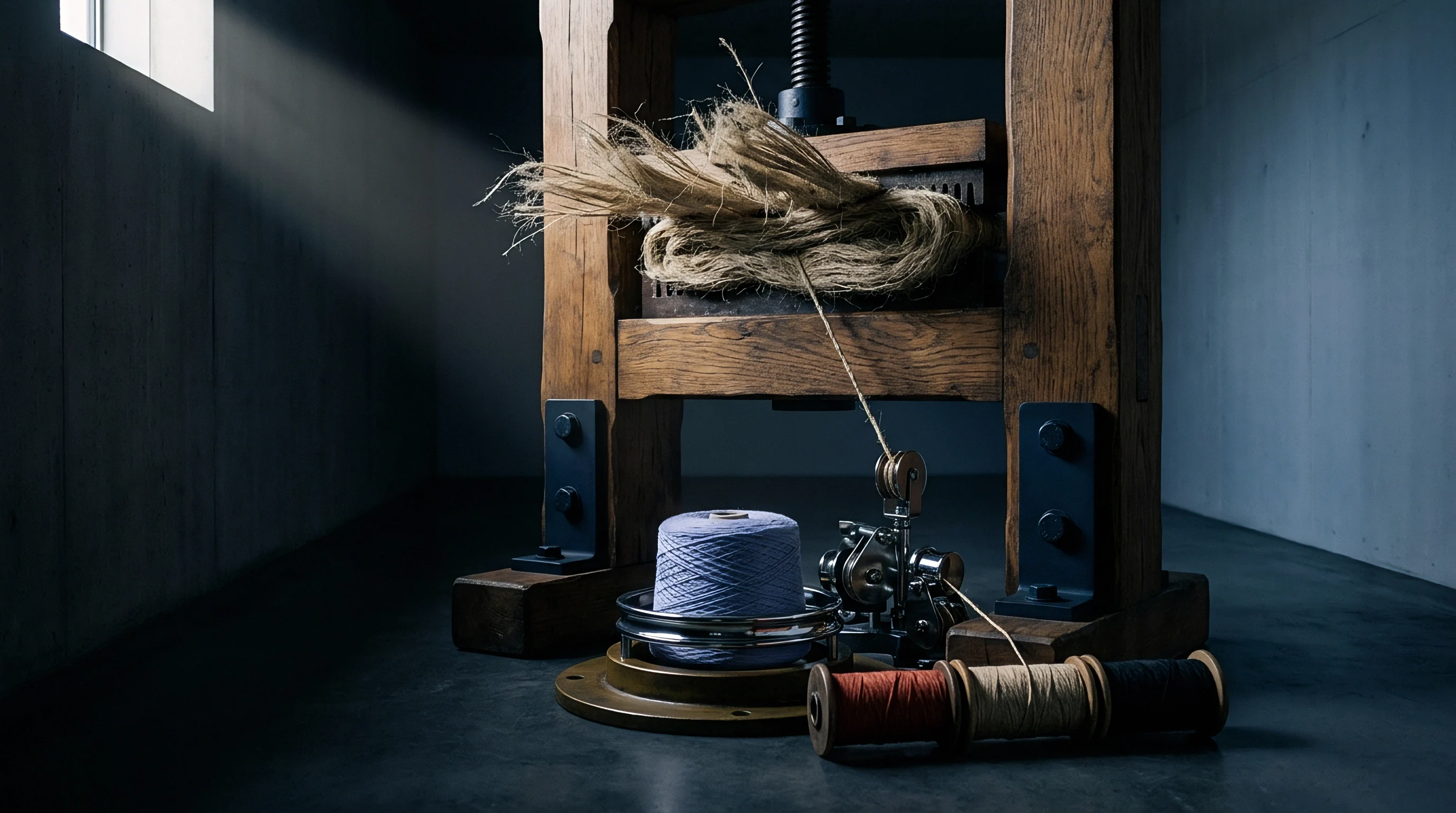
Spinning fine linen warp yarns ~ from Lea 40 (NeL 40, or 20.7 tex) up to Lea 100 (NeL 100, or 8.28 tex) ~ requires thermal and chemical modification of inter-fiber pectins during processing. Flax technical fibers exist as bundles of elementary cellulose cells bound together by hemicellulose and pectin compounds. Dry spinning leaves these bundles intact as they enter drafting, producing coarse, stiff yarns.
Wet spinning passes the fiber through a hot water bath just before final drafting. Holding this bath between 60 degrees Celsius and 70 degrees Celsius softens the calcium and magnesium pectate complexes that hold the technical bundles together.
Once softened, individual ultimate cells ~ typically 15 to 25 millimetres long and 12 to 20 micrometres across ~ slide past one another under drafting rollers. This draws the roving down into thin, uniform strands before the flyer or ring spindle inserts true twist. Ultimate yarn tenacity depends directly on how thoroughly these bundles divide.
Smaller, fully separated fibers offer more surface area per unit mass, increasing friction when twist locks the yarn together. If trough temperatures fall below 55 degrees Celsius, the pectins fail to liquefy completely. Coarse technical bundles then pass intact through the drafting nip, causing thick spots, poor twist liveliness, and premature breaks under tensile stress.
Hot water drafting at 65 degrees Celsius divides flax bundle structures down to elemental fiber units, raising fine yarn tenacity potential to a target range between 18 cN/tex and 24 cN/tex.

Bundle Division Mechanics and Baseline Tenacity Profiles
Draft ratio, twist factor, and breaking tenacity operate within a narrow balance in wet spun linen. Fine counts demand higher twist multipliers (α metric of 115 to 135) to build radial pressure along the yarn axis, compensating for ultimate fibers that are short compared to long-staple synthetics. Strength relies on two mechanisms: the crystalline cellulose microfibrils themselves (with theoretical moduli exceeding 80 cN/tex) and inter-fiber friction across overlapping fiber ends.
Breaking elongation in fine wet spun linen warp is low, staying strictly between 1.5 percent and 2.8 percent. Unlike cotton or wool, whose natural crimp straightens under load, flax ultimate cells lie nearly parallel to the yarn axis from the start. The microfibrils feature a tight spiral angle of just 6 degrees to 10 degrees.
With almost no geometric slack to pull out under tension, the load-elongation curve climbs steeply and linearly, showing little yield before sudden fiber slippage or total failure.
| Yarn Count (Lea / NeL) | Linear Density (tex) | Nominal Twist (TPM) | Mean Tenacity (cN/tex) | Breaking Elongation (%) | CV of Tenacity (%) |
|---|---|---|---|---|---|
| 40 NeL | 20.67 tex | 580 TPM | 22.5 cN/tex | 2.4 % | 11.2 % |
| 60 NeL | 13.78 tex | 710 TPM | 21.0 cN/tex | 2.1 % | |
| 80 NeL | 10.33 tex | 820 TPM | 19.2 cN/tex | 1.8 % | 13.8 % |
| 100 NeL | 8.27 tex | 930 TPM | 17.5 cN/tex | 1.5 % | 15.5 % |
Twist Liveability and Critical Strain Thresholds
Pushing twist higher does not automatically yield stronger fine linen warps. Over-twisting generates severe migration stresses and subjects outer fibers to constant lateral shear. Past an α metric of 140, outer fibers stretch beyond their strain limits right on the spinning frame, weakening the final yarn.
Critical elongation falls below 1.4 percent, leaving the strand brittle enough to snap under sudden tension spikes during warping.
Raw, unsized 80 NeL yarns hit an elongation ceiling that mechanical adjustments on the frame cannot overcome ~ the limit is set by the fiber’s crystalline structure. Evaluations focus more reliably on uniform fiber division than on high twist numbers. Over-twisted fine warps often show impressive static strength on single-strand testers, only to shatter under dynamic, cyclic loads on high-speed looms.
Low tenacity often stems from seasonal crop variation, where aggressive retting microflora damaged fiber cell walls long before the roving reached the drafting trough.
Rupture
Single-Strand Tensile Verification under Standard Testing Protocols
Single-strand testing of fine wet spun linen warp requires compliance with ISO 2062 (Method A), conducted at 20 degrees Celsius (± 2°) and 65 percent relative humidity (± 4%). Samples need at least 24 hours on open wire racks to reach moisture equilibrium. Moisture regain alters flax properties significantly: unsized yarn at 12 percent regain can test up to 20 percent stronger than the same yarn at 6 percent regain because absorbed water plasticizes inter-microfibrillar pectins.
Gauge length governs how breaking force data distributes statistically. Standard procedures specify a 500-millimetre gauge length at a constant rate of extension (CRE) of 500 millimetres per minute ~ a strain rate of 100 percent per minute. On fine counts from 60 NeL to 100 NeL, this 500-millimetre length exposes defects like periodic drafting waves, thin spots, and undivided bundles.
Shortening gauge length to 250 millimetres artificially inflates mean tenacity by 8 to 14 percent while masking variability (CV), giving an overly optimistic picture of yarn quality before warping.
Pneumatic Clamping Dynamics and Jaw Break Exclusions
Testing high-modulus linen yarn frequently introduces clamping artifacts. Smooth steel pneumatic jaws permit slippage above 150 cN, generating false elongation plateaus on load curves. Excessive clamping force, on the other hand, pinches and cuts outer fibers at the grip line.
Any test where the yarn breaks within 5 millimetres of the jaw edge must be systematically discarded from the final dataset.
Reliable testing calls for capstan grips or rubber-faced pneumatic jaws clamped at 0.3 MPa to 0.4 MPa. For fine counts, load cell capacity should stay under 50 Newtons ~ giving 0.01 Newton resolution to resolve minor yield points. A full test run requires at least 50 breaks per lot to establish reliable averages for tenacity (in cN/tex or grams per denier) and breaking elongation.
Single-strand tensile testing of fine wet spun linen under ISO 2062 demands a 500-millimetre gauge length and rubber-faced pneumatic clamping to prevent jaw-line shear and artificial inflation of breaking elongation figures.
Weibull Modulus Application to Yarn Weak-Link Distributions
Linen breaking strength follows weak-link mechanics modeled by Weibull statistics. Because flax cell lengths vary and pectin distributions are irregular, simple mean tenacity figures cannot predict how often a warp will break during shedding. A two-parameter Weibull model accounts for this by calculating survival probabilities across stress levels.
The cumulative failure probability P for a yarn subjected to tensile stress sigma is expressed by the equation:
P(sigma) = 1 – exp
where sigma_0 represents the characteristic tenacity (the stress level at which 63.2 percent of test specimens fail) and m represents the Weibull modulus. A higher Weibull modulus indicates structural uniformity across the yarn batch. Fine wet spun linen yarns suitable for warp beams must achieve a Weibull modulus m greater than 9.5.
Batches exhibiting an m value below 7.5 contain severe weak-link clusters, leading to unacceptably high warp end breakage rates regardless of how high the average tenacity appears on paper.
- Specimen Selection ~ Extract 100 random yarn samples from ten distinct packages per spinning lot, avoiding outer layer yarn damaged during transport.
- Conditioning Calibration ~ Verify ambient room condition using a calibrated sling psychrometer and hold yarn packages at 65 percent relative humidity for 24 hours.
- Instrument Parameter Verification ~ Set CRE tester gauge length to 500 millimetres, crosshead speed to 500 millimetres per minute, and pneumatic jaw pressure to 0.35 MPa.
- Data Separation Routine ~ Exclude all breaks occurring within 5 millimetres of clamp faces and record breaking force (cN), elongation (%), and work-to-break (cN·cm).
- Weibull Parameter Extraction ~ Plot natural logarithm of stress against double natural logarithm of survival probability to extract shape parameter m and scale parameter sigma_0.
Procurement contracts for fine wet spun linen warp yarn must specify that breaking tenacity compliance is calculated on the fifth percentile lower tolerance limit rather than the lot mean value.
Size
Polyvinyl Alcohol and Modified Starch Formulations
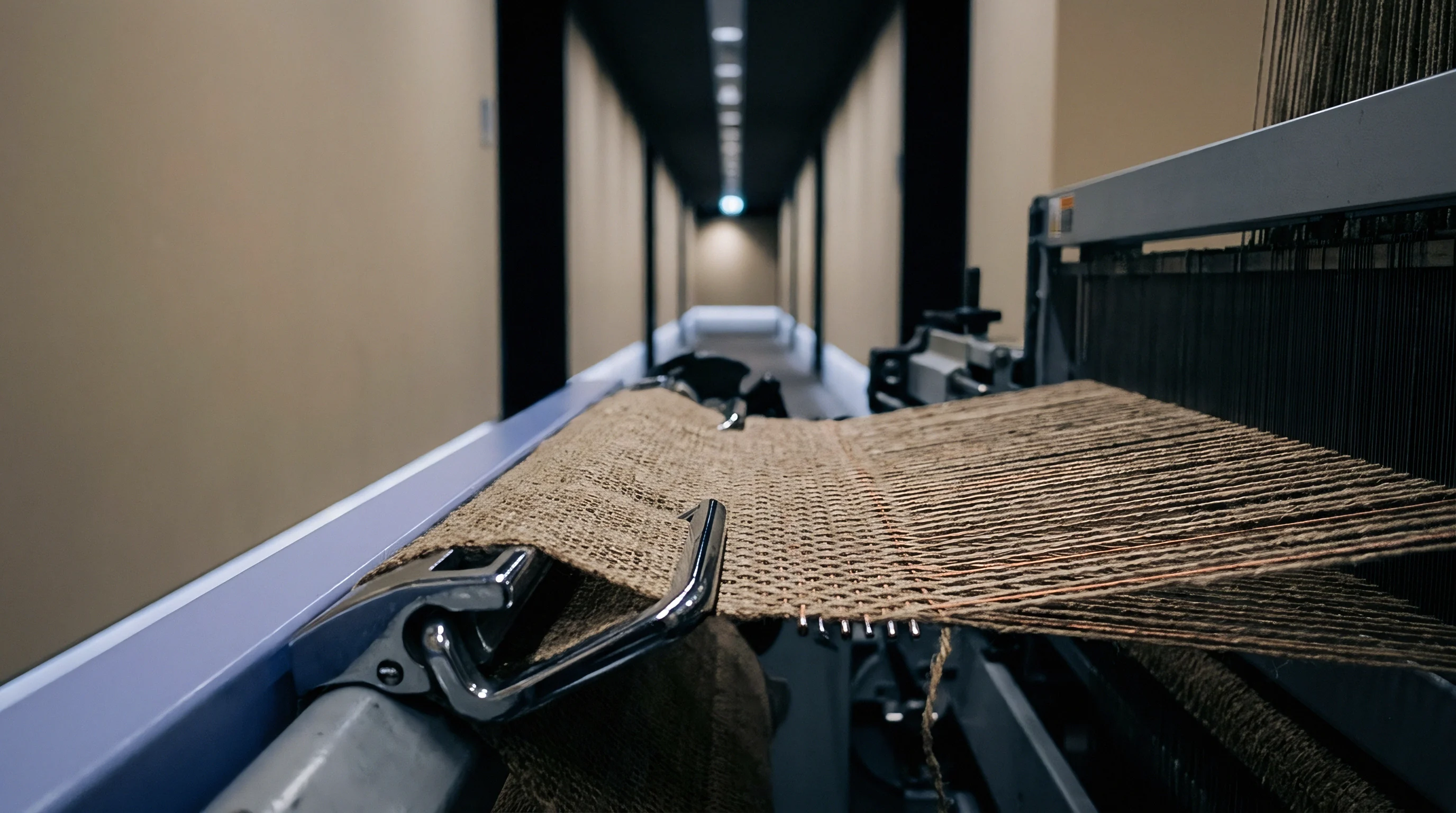
Unsized fine wet spun linen yarn cannot endure the friction and repeated stretching of modern high-speed weaving. Sizing coats the yarn stem with a protective film while sinking slightly into the surface to anchor protruding fiber ends to the core. Sizing recipes for fine counts (60 NeL to 100 NeL) must balance high tensile film strength with enough flexibility to yield under tension.
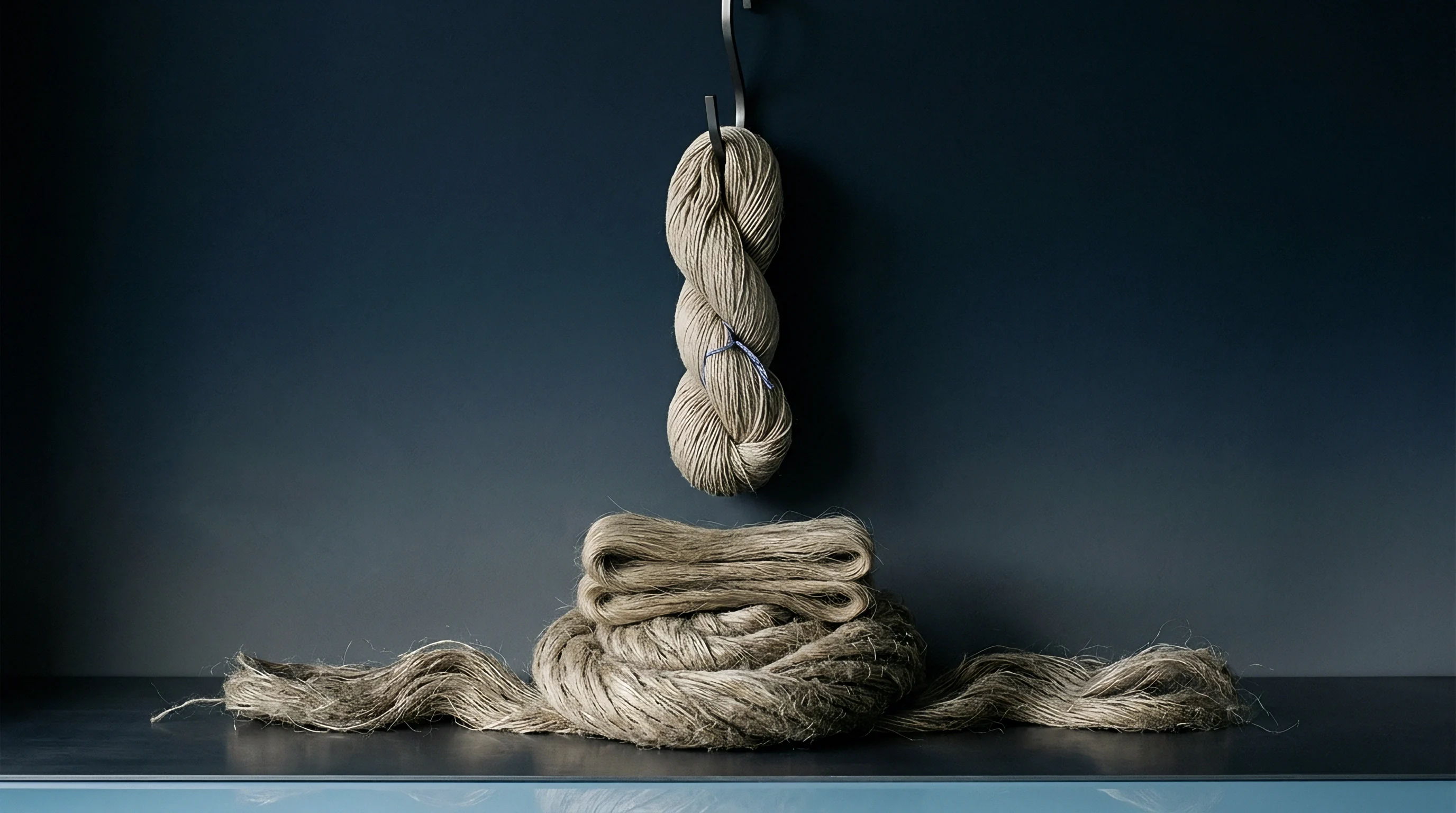
Low-viscosity, fully hydrolyzed Polyvinyl Alcohol (PVA) forms the primary film when blended with depolymerized corn or potato starches. PVA brings high tensile strength, strong adhesion to cellulose, and flexibility under bending. Thin-boiling starches cut formulation costs and lower viscosity, helping the liquor enter tight linen bundles.
Synthetic lubricants like hydrogenated tallow or tallow wax lower friction against reed wires and drop wires. Wax must stay under 3.0 percent of total dry solids ~ anything higher weakens film adhesion and leaves sticky deposits on loom shedding parts.
Penetration Depth versus Surface Coating Mechanics
Performance on the loom comes down to the balance between size penetration and surface coating. Total core penetration cements every fiber into a rigid structure, raising tensile strength by up to 35 percent but crashing breaking elongation below 1.0 percent. A yarn with no stretch left snaps under dynamic loom loading.
On the flip side, coating only the surface without penetration leaves a loose shell that rubs off quickly in the heddle eyes.
Ideal sizing penetrates 15 to 25 percent of the yarn radius. This anchors the surface while leaving core fibers free to micro-slip under strain, retaining natural spring. Size pick-up (dry add-on weight over dry yarn weight) must be held in narrow ranges depending on count.
| Yarn Count (NeL) | Size Pick-Up (%) | Size Cook Solids (%) | Viscosity (mPa·s at 85°C) | Tenacity Increase (%) | Elongation Retention (%) |
|---|---|---|---|---|---|
| 40 NeL | 8.5 – 10.0 % | 10.0 % | 25 – 30 mPa·s | + 20 % | 85 % |
| 60 NeL | 10.0 – 12.0 % | 12.0 % | 20 – 25 mPa·s | + 25 % | 80 % |
| 80 NeL | 11.5 – 13.5 % | 13.5 % | 18 – 22 mPa·s | + 28 % | 75 % |
| 100 NeL | 13.0 – 15.0 % | 15.0 % | 15 – 18 mPa·s | + 30 % | 70 % |
Sizing Box Conditions and Moisture Control
Holding size box temperatures between 85 degrees Celsius and 90 degrees Celsius maintains consistent liquor viscosity and penetration. Fine warps require dual-squeeze boxes to avoid yarn rolling and uneven nip pressure. Squeeze roll pneumatic pressure must scale with machine speed to keep wet pick-up uniform across the entire sheet.
Graduated cylinder temperatures prevent film skinning and thermal shock. The first cans run at 60 to 70 degrees Celsius to stop size from migrating outward, ramping to 110 degrees Celsius on middle cylinders before cooling to 40 degrees Celsius ahead of dry splitting. Target moisture on the sized beam must hit 7.5 to 8.5 percent.
Drying below 6.0 percent crystallizes the size film and makes flax fibers brittle, while moisture over 10.0 percent encourages mildew on beams and makes size sticky during weaving.
Excess size solids will boost static breaking strength on test reports, but they destroy the residual elongation needed to survive shed opening.
Beam
Creel Tensioning and Section Warping Control
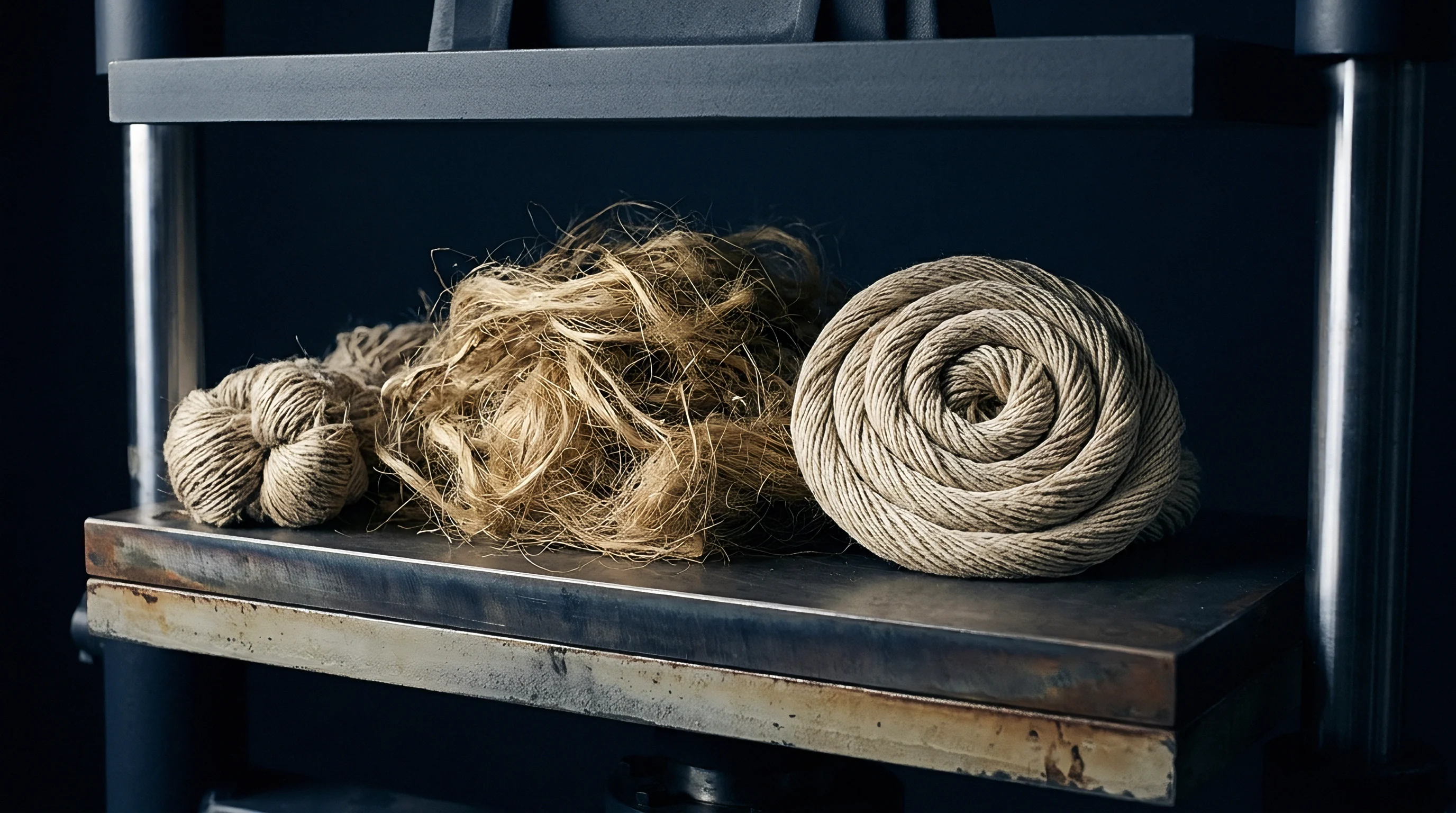
Winding fine linen packages into dense warp beams requires strict control of end tension. Section warping is vastly preferred over direct beaming for high-density apparel or jacquard fabrics. Because flax combines high inter-yarn friction with low stretch, tiny friction differences along creel thread paths multiply into major tension variations across the sheet.
Creel positions require active compensating tensioners or micro-disc units calibrated to 0.15 ~ 0.20 cN per tex. On an 80 NeL yarn (10.33 tex), individual tension should stay strictly between 1.55 cN and 2.06 cN, with variation across the creel held within ±5 percent. Stretching the yarn during warping pulls out up to 0.5 percent of its precious elongation before it ever sees a sizing machine or loom.
Warp Density and Thread Alignment Mechanics
Winding bands onto a section warping drum requires exact incline table settings matched to yarn buildup rates. If the slope setting misses the actual layer thickness, edge ends spill over section shoulders or crowd against neighboring bands, causing tight or slack threads along the borders. Tight ends start with heavy static preload on the loom, pushing them past critical strain limits when the shed opens.
At warping speeds above 400 metres per minute, static build-up makes loose surface fibers balloon and catch. Ionization bars at the lease reed and expansion comb dissipate static charge to keep thread paths clear. During beaming-off, press rollers must apply even hydraulic force across the full width to reach a beam hardness of 80 to 85 Shore D. Softer beams let warp ends sink into underlying layers under heavy let-off tension, triggering sharp tension spikes and breaks on the loom.
Warping-Induced Micro-Damage and Yield Loss
Unsized flax yarn wears constantly against guidance elements. Ceramic guides, tension discs, and reed wires must maintain a surface roughness Ra below 0.2 micrometres. Scratched hardware peels fibers off the yarn stem, creating tiny clusters or fuzz-balls that gather behind the lease reed and roll onto the warp beam as physical defects.
When a slub hits a heddle eye on the loom, it jams in the opening. Tension spikes instantly, pulling the yarn past its breaking strain. Warping plants use optical sensors set to catch slubs down to 1.5 times nominal yarn diameter, stopping the drum so operators can fix the flaw before it winds onto the section drum.
Miscalibrated section tables during warping create unequal path lengths that consume the slim elongation budget fine linen relies on during weaving.
Shedding
Cyclic Tensile Strain Profile of Modern Looms
In weaving, warp yarns take repetitive tensile punishment from shed movement along with friction from drop wires, heddles, and reed dents. Opening the shed stretches the warp path, adding 1.2 to 2.2 percent strain on top of static tension.
With fine wet spun linen breaking at just 2.0 to 2.5 percent elongation, cyclic shed opening eats up almost the entire elastic allowance. Static tension from the let-off must be set as low as possible without allowing the warp to sag or distort shed clearance ~ typically 3.0 to 4.5 cN per end for fine counts. Adding dynamic strain pushes peak tension to 75 to 85 percent of total yarn strength.
Beat-Up Dynamic Strain and Warp Resistance
Beat-up drives the pick into the cloth fell, sending a high tension pulse through the warp sheet. Force increases with pick density and fabric cover. In dense linen constructions (like 35 ends/cm of 60 NeL with 30 picks/cm), fell resistance reflects a sharp shockwave back toward the warp beam.
If the yarn lacks dynamic work-to-break (the area under the stress-strain curve), this impact snaps warp threads right at the fell. Weavers offset high beat-up resistance by running asymmetrical sheds ~ where upper and lower sheets carry different tensions at crossing ~ or using yielding back-rest rollers that flex slightly on beat-up to absorb tension spikes.
Rapier versus Air-Jet Insertion Impact on Fine Linen
Rapier and air-jet insertion place very different stresses on fine linen. Flexible rapiers carry the pick mechanically, allowing lower shed heights (24 to 28 millimetres at the reed). Lower sheds reduce cyclic stretching, saving strain budget and cutting warp breaks.
Rapiers handle fine linen warps comfortably at 350 to 500 picks per minute.
Air-jets operate faster (600 to 800 picks per minute) but demand a wider shed opening and high air pressure. High-velocity air strips surface fibers, erodes size films, and abrades the yarn shaft. Air turbulence also vibrates neighboring ends, causing tangles and poor shed clearance.
Because of this, linen finer than 60 NeL is seldom woven on air-jets without specialized size formulas fortified with high-molecular-weight synthetic polymers.
- Asymmetrical Shed Setup ~ Raise the back-rest roller 10 to 15 millimetres above the level line to equalize beat-up strain across top and bottom warp sheets.
- Late Shedding Timing ~ Adjust shed closure timing closer to cloth fell beat-up (between 300 degrees and 320 degrees of main shaft rotation) to reduce peak warp tension during crossing.
- Heddle Density Optimization ~ Utilize 4-shaft or 6-shaft dobby harness layouts even for plain weave structures to distribute heddle frame packing and reduce yarn-to-yarn abrasion.
- Drop Wire Weight Selection ~ Mandate ultra-light drop wires weighing no more than 0.7 to 0.9 grams per pin to prevent premature yarn sagging and false warp stops.
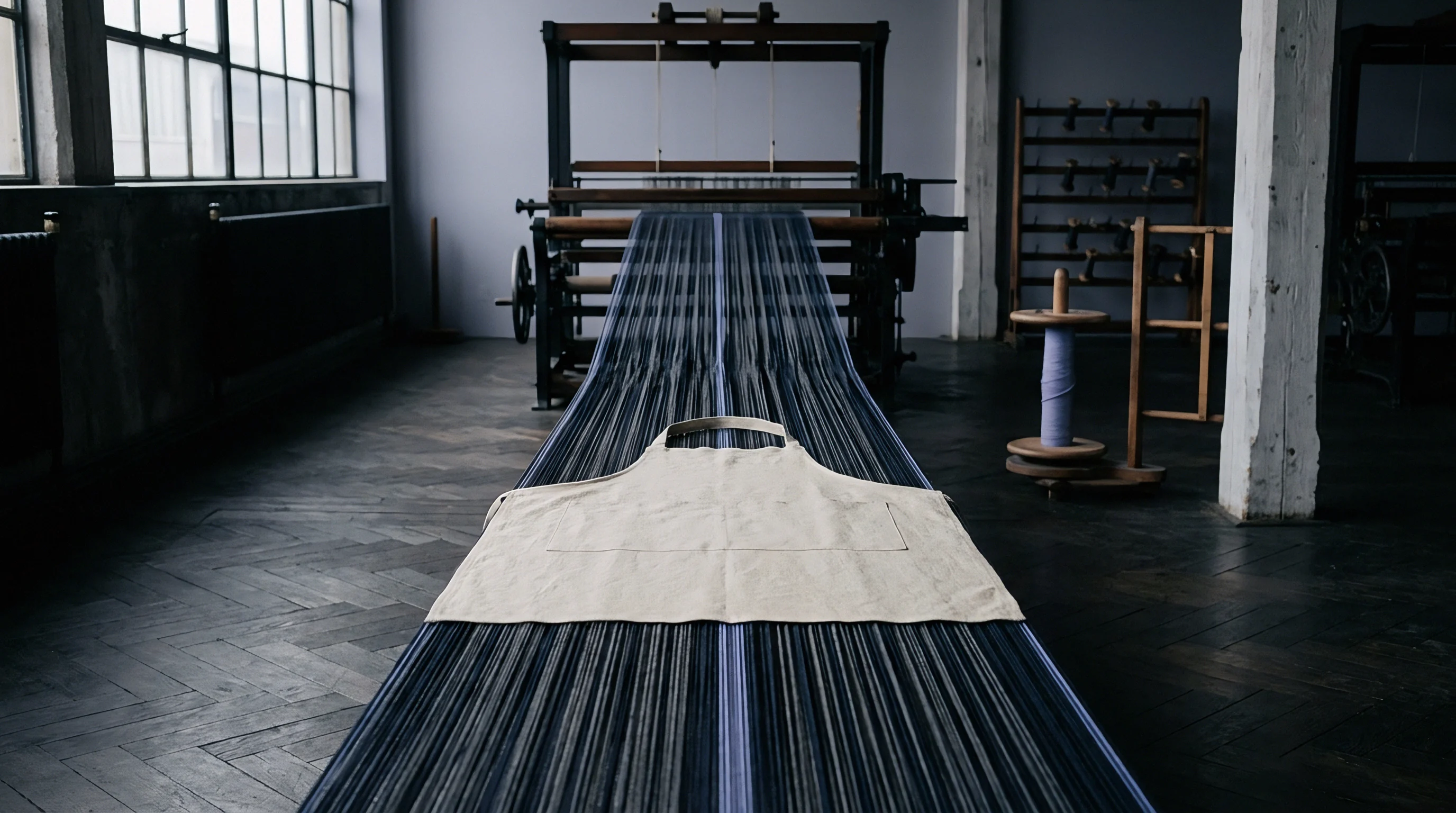
What Tensile Threshold Prevents Shed Opening Snap?
To stop threads from snapping as the shed opens, sized fine linen warp must retain at least 0.8 percent breaking elongation and a single-strand tenacity of at least 24.0 cN/tex. If size over-stiffens the yarn so remaining elongation drops below 0.6 percent, breakage spikes past 5 stops per 100,000 picks ~ ruining weaving efficiency no matter how impressive static strength looks in lab reports.
Will future developments in cold-water-soluble polyurethane sizing films allow fine linen warps to retain 90 percent of their un-sized breaking elongation while improving abrasion resistance past present loom limits?
Costing
Loom-Hour Calculations and Efficiency Penalties
Commercial viability hinges on converting tensile test performance into mill productivity. Operating costs run on hourly rates: running fine linen on a modern wide rapier loom costs 18.00 USD to 24.00 USD per loom-hour, factoring in depreciation, power, direct labor, and overhead.
Warp breaks hit efficiency directly. Every stop requires an operator to piece the end, re-thread it through drop wire, heddle, and reed, and restart. Fixing a broken fine linen end takes 1.5 minutes on average.
At 450 picks per minute, three stops per loom-hour cut shed efficiency by 3.4 percent. If weak or poorly sized yarn pushes breaks to eight stops per hour, efficiency plunges below 70 percent, erasing profitability.
| Warp Quality Grade | Tenacity (cN/tex) | Warp Stops / 10^5 Picks | Shed Efficiency (%) | Daily Output (Metres/Loom) | Direct Weaving Cost (USD/Metre) |
|---|---|---|---|---|---|
| Premium (Grade A) | 26.5 cN/tex | 0.8 stops | 92.5 % | 240 m | 2.10 USD/m |
| Standard (Grade B) | 22.0 cN/tex | 2.1 stops | 86.0 % | 223 m | 2.26 USD/m |
| Marginal (Grade C) | 18.5 cN/tex | 5.4 stops | 74.0 % | 192 m | 2.62 USD/m |
| Sub-Standard | 15.0 cN/tex | 11.2 stops | 58.0 % | 150 m | 3.36 USD/m |
Landed Cost Modeling and Yarn Count Price Premiums
Linen yarn prices climb rapidly as counts get finer, driven by slower spinning delivery speeds, higher raw fiber grading requirements, and increased roving waste. Unsized 40 NeL wet spun flax averages 14.50 USD per kilogram, while 80 NeL reaches 32.00 USD per kilogram and 100 NeL tops 55.00 USD per kilogram.
Landed fabric cost calculations must account for sizing waste, creel remnants, and selvage trim. In high-density 80 NeL warps (like 32 ends/cm at 160 cm reed width), warp yarn makes up as much as 65 percent of raw fabric cost. If yarn arrives with tenacity variability (CV) over 14 percent, frequent loom stops introduce start marks, density bars, and loose ends ~ downgrading fabric from First Quality to Seconds and triggering 30 to 50 percent price discounts.
Cost modeling for a 110 g/m² apparel fabric (80 NeL warp and weft) across three tenacity tiers shows that paying a 15 percent premium for strong, low-CV warp yarn actually reduces finished fabric cost by 0.38 USD per metre by eliminating loom downtime and quality downgrades.
Purchase Order Technical Specifications and Sourcing Clauses
Protecting a mill when purchasing fine linen warps requires strict mechanical tolerances directly in the contract. Generic purchase orders specifying only count and average static strength leave buyers exposed. Specifications must define minimum individual values, maximum acceptable variability, and Weibull distribution parameters.
A solid fine wet spun linen warp contract should specify: Nominal Count under ISO 2060 within ±2.5 percent; Minimum Single-Strand Tenacity (unsized, ISO 2062 Method A) of 22.0 cN/tex for 40 to 60 NeL and 19.0 cN/tex for 61 to 100 NeL; Maximum Tenacity CV of 11.5 percent; Minimum Breaking Elongation of 1.8 percent; Weibull Modulus m greater than 9.0; and Thin Places (-50%) below 15 per 1,000 metres on an Uster Tester. Shipments failing any single parameter remain subject to rejection at the supplier’s expense, including freight and wasted warp setup labor.
Sourcing teams enforce these specific metrics on purchase orders to clear up supplier ambiguity and base commercial claims on objective lab testing before yarn packages ever reach the creel.