Optimizing Loom Shed Geometry Geometry Settings for High End Density Linen Warps
Asymmetric shed geometry and early crossover timing reduce flax peak tension, preventing end breakage on high-density linen warps without sacrificing speed.
Asymmetry
Positioning the whip roll eighteen millimeters above the breast beam level shifts mechanical strain during shed opening on high-sett flax lot runs. Wet-spun linen yarns possess an ultimate elongation between 1.8 percent and 2.6 percent. Flax fibers tolerate minimal stretch.
Brittle nodes fracture under strain. When heddle frames pull the warp sheets apart in a symmetric shed line, both sheets experience equal displacement distance from the center line. Equal displacement generates severe peak tension cycles that coincide directly with maximum shed lift.
Raising the backrest redistributes this path length across the division of sheets. The lower sheet goes taut. The top sheet slacks.
Slackening the top warp sheet allows adjacent fibrous linen ends to slide past one another without clinging during the changeover. Flax yarns carry surface fibrils that entangle aggressively when sett exceeds 24 ends per centimeter in fine counts such as Nm 39 or Nm 50. In a symmetric setup, clinging ends fail to clear, holding the shed partially closed when the insertion rapier enters the shed tunnel.
The rapier tape clips the obstructed ends, causing immediate warp breaks or micro-fraying that registers as fuzzy streaks on the inspection perch. Elevating the whip roll creates an unequal tension differential between the upper and lower sheets. The higher tension in the bottom sheet pulls the interlacing points crisp, while the slacker upper sheet absorbs movement without yarn-on-yarn sawing.
A thirty-millimeter upward shift on the whip roll reduces upper-sheet peak cyclic tension by twenty-two percent at 420 picks per minute on Nm 39 wet-spun flax.
Altering the horizontal position of the backrest changes the length of the free warp span between the beam delivery point and the drop wires. Extending this span softens the spring rate of the entire warp sheet. Linen lacks the elastomeric recovery found in wool or synthetic polymers.
A short warp span amplifies every millimeter of frame movement into extreme gram-force spikes. Moving the backrest outward toward the rear frame of the machine increases the elastic buffer of the yarn sheet. This modification suppresses cyclic tension spikes during dobby frame lift cycles.

Whip Roll Elevation and Warp Line Split
Operating a high-density linen warp with a flat, straight warp line concentrates beat-up impact directly into the fell without dampening. The backrest absorbs cycle shocks. Lowering or raising the roll off the horizontal breast beam plane forces the two sheets to travel distinct path lengths during frame separation.
When the heddle eyes reach full separation, the bottom sheet traverses a steeper angle relative to the reed line than the upper sheet. This geometry alters the distribution of yarn-to-metal friction across the drop wires, heddles, and reed blades.
Mechanical failure modes emerge rapidly when warp line geometry fails to accommodate the low elasticity of flax:
- Heddle eye abrasive grooving develops when unequal yarn angles generate severe localized contact pressure against nickel-plated steel eyes during fast shedding cycles.
- Reed mark striping occurs when dense linen ends fail to space evenly across the dents during beat-up because the warp sheets lack tension differentiation.
- Loom stop frequency surges appear when clinging fibrils in a slackened sheet wrap around adjacent ends behind the harness frame instead of separating cleanly.
- Selvage curl distortion arises from unmanaged tension imbalances between the body warp sheet and independent leno binder mechanisms.

Tension Differentiation between Shed Sheets
Quantifying the force gap between upper and lower sheds requires tensiometric monitoring during machine rotation. The load cell mounted to the back support captures dynamic cyclic curves throughout the 360-degree loom cycle. When the backrest sits elevated, the lower sheet records peak tension during the beat-up phase, reaching up to 85 centinewtons per end on an Nm 39/1 flax warp.
The upper sheet registers less than 45 centinewtons at that same crank angle. This tension gap prevents structural jamming at the cloth fell.
| Backrest Height Setting (mm Relative to Center) | Upper Sheet Peak Tension (cN/end) | Lower Sheet Peak Tension (cN/end) | Tension Differential Ratio | End Breaks Per 100,000 Picks |
|---|---|---|---|---|
| 0 (Coplanar Neutral) | 76 | 78 | 1.02 | 8.4 |
| +15 (Moderate Elevation) | 58 | 82 | 1.41 | 3.1 |
| +30 (Pronounced Asymmetry) | 44 | 86 | 1.95 | 1.2 |
| +45 (Extreme Elevation) | 31 | 98 | 3.16 | 4.7 |
| Test baseline established across 50,000 meters of continuous rapier production using 100 percent European wet-spun scutched line flax. | ||||
Failing to establish sufficient sheet tension differential leaves the dense linen warp vulnerable to severe structural clumping, which generates persistent reed striping, broken ends at the cross, and irreversible visual barre faults throughout the finished linen rolls.

Fell
Displacement of the cloth boundary during reed contact dictates pick spacing consistency in compact linen structures. When packing high pick densities into wet-spun flax warps, beat-up resistance mounts exponentially as the sett approaches structural limits. Linen yarn possesses a high bending modulus, resisting the tight undulations required by plain interlacement.
When the reed strikes the loose pick, the cloth boundary shunts forward. If warp tension lacks sufficient firmness at impact, the fell rebounds backward immediately upon reed retreat, producing uneven pick spacing and horizontal banding.
Clean separation stops fiber cling. Tension balances across the fell. Beat-up execution on an open shed stabilizes the new pick by clamping it between crossing warp ends before the reed withdraws.
In contrast, beat-up on a closed shed permits the newly inserted weft yarn to slip backward toward the reed, losing the density achieved by the beat-up motion. For dense linen fabrics such as 26 picks per centimeter of Nm 39 linen weft, closing the shed early, between 310 and 330 degrees of machine rotation, prevents pick rebound entirely.
A stable fell position eliminates start marks across loom shutdown intervals.
Early shed closure increases the mechanical force required from the sley. As the shed closes prior to reed contact, the crossing warp sheets exert friction on the newly introduced pick, demanding greater drive torque to press the yarn into position. The stiffness of linen fibers converts this mechanical load into substantial yarn abrasion unless warp tension settings compensate accurately.
Adjusting the shed crossover timing directly alters the energy transfer between the reed and the cloth boundary.

Where Does Warp Line Deflection Alter Cleanness?
Modifying the vertical angle between the breast beam and the heddle eyes repositions the cloth line relative to the reed motion path. When the cloth passes over the front support at an inclined angle, the reed touches the upper warp sheet slightly ahead of the lower sheet. This staggered contact splits the mechanical impact into two successive micro-events.
Instead of displacing all ends simultaneously against heavy friction, the reed seats the pick against half the warp ends first, followed immediately by the second half. Pick insertion resistance falls substantially under this split geometry.
Crossover Timing Relative to Reed Impact
Changing the shed crossing point from 360 degrees to 320 degrees transforms the physical state of the warp at the moment of beat-up. Early crossing traps the pick. Late timing causes warp snap.
At 320 degrees, the warp sheets have already crossed and begun opening in the opposite direction when the reed face reaches front dead center. The newly created shed geometry locks the weft pick mechanically between upper and lower sheets. The pick cannot shift backward when the reed recedes.
Setting crossover later, such as 355 to 5 degrees, suits delicate filament yarns but causes severe defects in dense linen. On high-sett linen warps, late crossing leaves the shed open or parallel at reed impact. The stiff flax yarns offer maximum resistance to displacement, causing the pick to bounce off the fell boundary.
The resulting cloth displays irregular pick counts, cloudy surface texture, and reduced tensile strength along the warp axis.
A firm shed at reed contact preserves pick placement integrity regardless of operating speed shifts.

Stroke
Vertical travel of the harness frames dictates the total strain applied to each linen warp end during the shed opening cycle. Modern negative and positive cam motions or electronic dobbies allow adjustments to the heddle frame lift amplitude. Standard settings designed for cotton or synthetic fibers lift heddles excessively to create large shed clearances for insertion elements.
Subjecting wet-spun linen to wide lift amplitudes stretches the flax fibers beyond their elastic threshold. End breakage rates climb directly as frame stroke increases.
Minimizing the frame stroke preserves yarn tensile integrity. For rapier insertion systems, the shed opening at the rapier guide path must provide only enough clearance to permit the heads to enter and exit without contacting the upper or lower warp sheets. Every millimeter of unnecessary heddle travel introduces severe cyclic fatigue into the low-elongation flax fibers.
Setting the shed opening height to the absolute mechanical minimum reduces the peak strain experienced by the yarn by fifteen to twenty-five percent.
Harness stroke settings calibrated above fifty-two millimeters on the front frame trigger immediate warp end peeling in linen counts finer than Nm 50.
Drafting order across the harness frames determines the individual stroke height requirements. The front frames, positioned closest to the cloth fell, need the shortest stroke distance to generate the required opening angle. The rear frames, located further back toward the whip roll, demand significantly longer strokes to produce the identical clearance at the rapier track.
Arranging the densest sections of the warp draft on the front frames minimizes overall yarn extension across the set.
Opening Angle Limits for Low Elongation Flax
Determining the safe shed angle requires calculating the geometry of the triangle formed by the fell, the heddle eye at peak lift, and the backrest support. Flax fibers exhibit high modulus and break abruptly without necking. An opening angle of eighteen to twenty degrees provides adequate insertion clearance on rapier looms without exceeding the 1.8 percent safe strain ceiling of wet-spun flax.
Exceeding twenty-two degrees of total shed opening causes microscopic fiber splitting and rapid surface fraying.
- Mount the front heddle frame in the lowest drive hole on the dobby connecting lever to establish the shortest possible vertical throw.
- Adjust the shed height scale on the machine frame until the vertical gap at the insertion line measures two millimeters above the top profile of the rapier head.
- Step the progressive lift levers for rear frames upward by two millimeters per frame position to compensate for the geometric angle from the fell.
- Rotate the loom main drive manually through 360 degrees while observing the clearance between the lower shed sheet and the raceboard surface.
- Lock the harness drive turnbuckles with counter-nuts to prevent vibration-induced stroke drift during high-speed production runs.

What Sett Level Triggers Insertion Stoppage?
Increasing warp density beyond 26 ends per centimeter in Nm 39 wet-spun linen reduces the clear air space between adjacent ends to microscopic tolerances during shedding. When the harness frames lift, protruding surface fibers from neighboring yarns interlock. The physical opening of the shed becomes sluggish.
The insertion sensor registers an obstructed shed tunnel and aborts the pick insertion cycle, triggering a machine stoppage.
| Frame Position (Front to Back) | Heddle Stroke Distance (mm) | Shed Opening Angle (Degrees) | Rapier Head Clearance (mm) | Calculated Yarn Strain (Percent) |
|---|---|---|---|---|
| Frame 1 (Front) | 46 | 18.2 | 2.1 | 1.15 |
| Frame 2 | 49 | 18.4 | 2.2 | 1.28 |
| Frame 3 | 52 | 18.5 | 2.4 | 1.42 |
| Frame 4 | 55 | 18.6 | 2.5 | 1.58 |
| Frame 5 | 58 | 18.8 | 2.7 | 1.75 |
| Frame 6 (Rear) | 62 | 19.1 | 2.9 | 1.96 |
According to international supply contracts specifying greige cloth parameters, warp break levels exceeding 1.5 stops per 100,000 picks authorize the buyer to invoke formal technical audits and deduct associated machine downtime charges from final invoices.

Stop
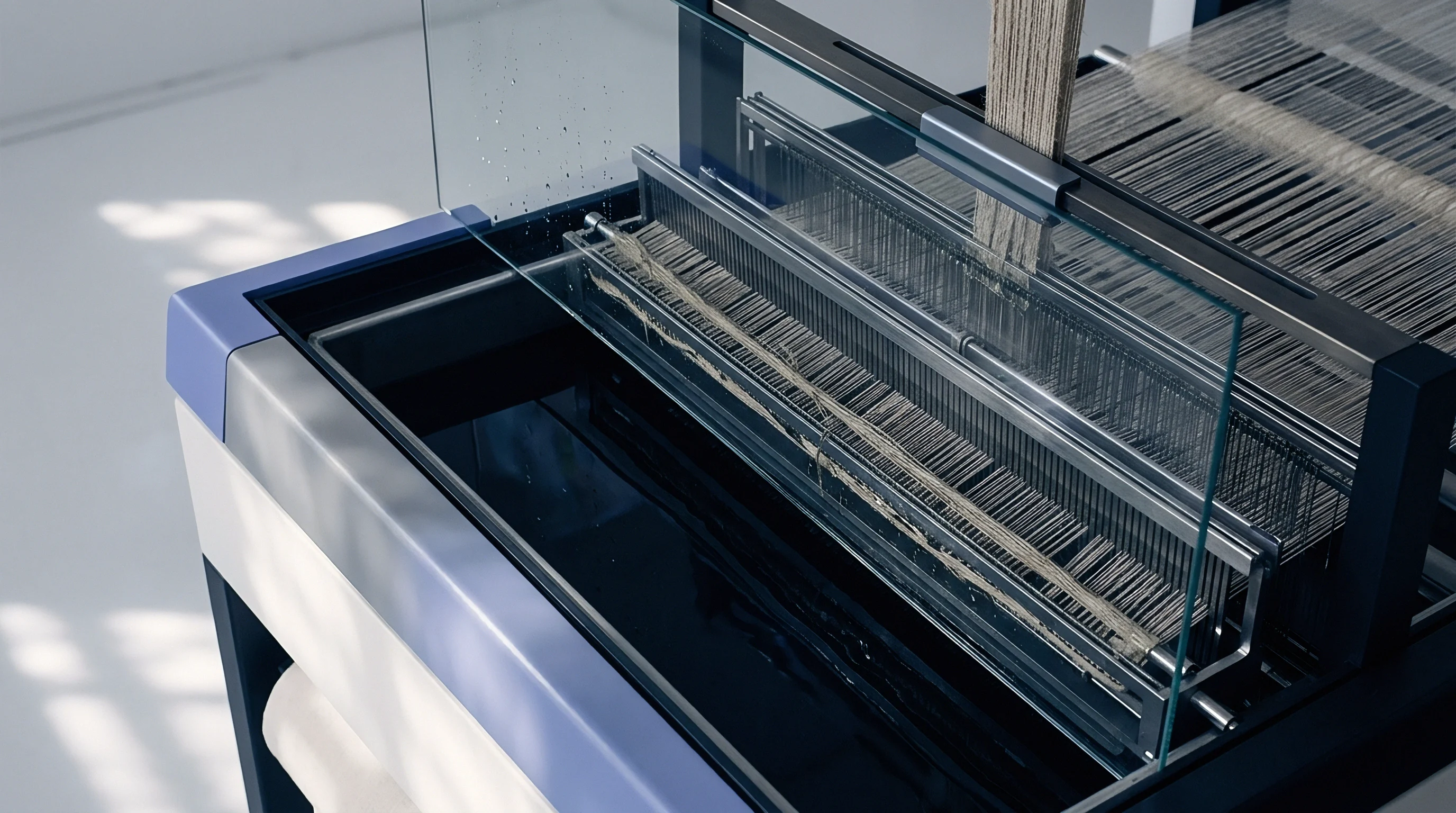
Configuring the electrical warp stop motion system requires precise mechanical spacing to prevent false machine halts while ensuring immediate cutoff upon true yarn rupture. Dense linen warps generate substantial airborne lint and localized fly during heddle reciprocation. Flax lint contains natural pectin and short bast fragments that accumulate rapidly inside the drop wire contact banks.
If lint bridges the gap between an open drop wire and the grounded contact bar, the loom halts falsely, creating starting marks and lowering shed output.
Rigid yarns demand exact alignment. Stop marks spoil greige bolts. Drop wire selection governs the balance between detection reliability and yarn abrasion.
High-density linen demands lightweight, open-ended drop wires with polished inner eyes. Heavy drop wires depress the low-tension upper shed sheet during asymmetrical shedding, dragging ends out of alignment and causing rapier collisions. Using drop wires weighing between 0.7 and 1.1 grams provides reliable gravitational drop without imposing excess parasitic drag on the delicate flax yarns.
Drop wires weighing more than 1.4 grams create visible sag streaks on the upper warp sheet during asymmetric shedding cycles.
Positioning the drop wire box too close to the rear harness frame subjects the drop wires to violent angular oscillations as the heddles cycle up and down. This movement causes the drop wires to dance on the warp ends, chafing the yarn surface and shaving off fibers that turn into lint. Increasing the distance between the drop box and the first harness frame stabilizes the drop wires, keeping them vertical and calm throughout the weaving cycle.
Dropper Bank Spacing and Drop Wire Selection
Spreading the warp ends across six or eight contact rows reduces the physical packing density of the drop wires. In a high-sett linen warp carrying 32 ends per centimeter, crowding all ends into a four-row drop box forces the drop wires to touch each other continuously. Metal-on-metal contact causes adjacent wires to bind, preventing broken ends from dropping freely to trigger the stop circuit.
Setting up the warp stop motion for dense linen requires strict technical choices:
- Drop wire weight specification matches yarn count precisely, using 0.9-gram closed-eye wires for counts between Nm 39 and Nm 60 to prevent yarn depression.
- Contact bar spacing distance expands across eight distinct banks to provide adequate clearance between adjacent vibrating drop wires.
- Drop box horizontal location sits at least 180 millimeters behind the rearmost harness frame to isolate the wires from shedding vibration.
- Air blow-off nozzle alignment directs low-pressure continuous clean air streams through the dropper banks to blow away accumulated pectin dust.
Lint Accumulation and Mechanical Cleanness
Extracting flax dust before it packs into the stop motion bars requires dedicated localized air filtration or automated traveling cleaners. When wet-spun flax runs through heddles and drop wires, mechanical shear strips away dry external fibrils. These fibrils form hard, dense pills rather than soft lint balls.
As these pills lodge between the drop wire guides, they lock the drop wires in an elevated position, blinding the safety mechanism. An undetected broken end then weaves into adjacent ends, creating massive multi-yarn smashes that take hours to draw in and repair.
Mill technical supervisors frequently argue that excessive end breakage in dense linen warps stems entirely from substandard yarn sizing rather than improper dropper spacing and shed geometry.


Yield
Converting loom capacity into financial return depends entirely on maintaining operational running efficiency above eighty-five percent on dense linen constructions. A loom booked to run an Nm 39 plain linen cloth with 28 ends and 24 picks per centimeter at 450 picks per minute produces a theoretical output of 11.25 meters of greige cloth per hour. Every warp stop requires an operator to locate the break, draw the end through the drop wire, pull it through the heddle eye, dent it through the reed, and restart the loom.
Average stop repair time on high-sett linen sits between 45 and 90 seconds.
Loom efficiency drops twelve percent. Unsold loom hours destroy margins. If poor shed geometry induces four warp breaks per hour, the machine loses up to six minutes of productive run time every sixty minutes.
Output drops from 11.25 meters to under 10 meters per hour. Fixed room overhead costs, including facility power, climate control humidification, and technical labor, distribute across fewer delivered meters, raising the landed manufacturing cost per finished meter by nine to fifteen percent.
Optimizing the whip roll asymmetry, minimizing harness stroke, and fine-tuning crossover timing directly protects the machine booking schedule. The financial stakes of loom shed settings emerge clearly when calculating capacity across a standard manufacturing order.

Machine Speed against Finished Metre Quotations
Running high-sett linen at excessive speeds often proves commercially counterproductive. Operating a rapier machine at 550 picks per minute on Nm 39 flax warps increases fiber abrasion and yarn peak tension exponentially. End breaks multiply, slashing efficiency down to 72 percent.
Throttling machine speed back to 420 picks per minute reduces dynamic peak tension, drops warp breaks to less than one per hour, and lifts real operational efficiency to 89 percent. The slower running speed yields higher total daily meterage at significantly lower greige defect rates.
| Operating Speed (Picks/Min) | Operational Efficiency (%) | Actual Output (Meters/Hour) | Warp Stops Per Shift (8 Hours) | Landed Loom Cost Per Meter (USD) |
|---|---|---|---|---|
| 380 | 91.2 | 8.66 | 6 | 2.42 |
| 420 | 88.5 | 9.29 | 9 | 2.28 |
| 460 | 81.4 | 9.36 | 22 | 2.35 |
| 500 | 73.1 | 9.14 | 38 | 2.54 |
| 550 | 64.8 | 8.91 | 59 | 2.78 |
Cost Impact of Warp Stoppage Frequencies
Analyzing costs across production volumes reveals the financial penalties associated with uncorrected loom settings. Consider a contract for 20,000 meters of dense linen fabric running across ten rapier looms. At an optimized speed of 420 picks per minute and 88.5 percent efficiency, the plant consumes 2,152 loom hours to complete the run over 21 working days.
If the shed geometry is poorly configured, running at the same speed with 75 percent efficiency due to repeated clinging and breakage, total required time balloons to 2,540 loom hours. The buyer faces four extra days of delayed delivery, while the production facility absorbs 388 unbilled loom hours, wiping out the operating margin on the order.
The calculation proves the point. Friction accumulates across the heddles. When shed geometry matches the low elasticity and high fiber friction of wet-spun flax, production runs smoothly at target speeds, delivering uniform cloth fell formation, precise pick spacing, clean selvages, and predictable commercial margins.