Predicting Viscoelastic Stress Decay in High Speed Linen Loom Warps
Predicting viscoelastic stress decay in high-speed linen warps prevents harness-dwell tension sags and end breaks, securing loom speed and conversion margins.


Shed
High-speed rapier and air-jet machines strain flax warp yarns at frequencies exceeding ten cycles per second. Peak tension occurs during harness motion when warp ends clear the shed clearance angle for pick insertion. Because wet-spun flax fibers exhibit pronounced viscoelastic behavior, instantaneous stress spikes decay rapidly over short dwell periods.
Predicting this tension dissipation prevents warp end breakage and unstable cloth construction.

Dynamic Tension Profiles in High Speed Linen Weaving
Yarns experience cyclic peak loads during frame lift, followed by rapid stress decay during harness dwell. Yarn strain changes rapidly. A rapier loom operating at six hundred picks per minute provides a total cycle duration of one hundred milliseconds per insertion.
Harness opening occupies approximately thirty-five milliseconds, shed dwell absorbs thirty-five milliseconds, and shed closure consumes thirty milliseconds. Peak tension hits flax yarns at the maximum opening amplitude, reaching values between fourteen and twenty-two centinewtons per tex depending on warp pretension and shed height settings.
Stress relaxation occurs immediately after the harness reaches peak separation. Peak strain damages fibers. The mechanical energy absorbed by the cell wall structure during frame lift dissipates through internal molecular rearrangement.
If tension drops too quickly during the dwell period, warp sags occur in the lower shed sheet. Lower shed slackening causes rapier head interference, mis-picks, and uneven beat-up line force distribution across the reed width.
Shed Dwell Cycles and Tensile Energy Dissipation
Motion profiles on electronic dobby drives hold harnesses at maximum separation for thirty to fifty milliseconds per pick insertion. During this dwell window, sized flax yarn relaxes viscoelastically, losing fifteen to thirty-five percent of its peak tensile stress. The extent of decay depends on yarn twist multiplier, size penetration, and moisture content within the weave room.
Inadequate relaxation leaves residual tension high, driving brittle flax end breakage during shedding frame collapse. Excessive relaxation allows warp slackening that disrupts clean shed separation.
| Loom Mechanism | Machine Speed (ppm) | Shed Open Dwell (ms) | Peak Warp Tension (cN/tex) | Residual Tension After Dwell (cN/tex) |
|---|---|---|---|---|
| Rapier Frame | 600 | 35 | 18.5 | 13.2 |
| Air-Jet Frame | 800 | 26 | 21.0 | 16.4 |
| Projectile Frame | 450 | 50 | 15.0 | 9.8 |
Excessive stress decay in warp ends during harness dwell causes lower shed slackening that disrupts pick insertion.
Failing to predict tension decay rates across high-speed shedding cycles leads to incorrect warp pretension selection on the let-off motion, producing persistent floating ends, reed marks, and unplanned loom stoppages.

Polymer
Wet-spun flax consists of highly oriented crystalline cellulose microfibrils embedded within an amorphous matrix of hemicellulose and pectin. Crystalline cellulose domains provide structural stiffness, while amorphous pectins dictate time-dependent viscoelastic relaxation. Under tensile strain, microfibrils slide along the amorphous interface, causing rapid stress dissipation followed by slow, logarithmic strain recovery.
Amorphous Matrix Plasticization and Moisture Equilibrium
Relative humidity inside the weave room controls the glass transition temperature of non-crystalline pectins. Pectin dictates molecular mobility. Moisture softens bast bundles.
At relative humidity levels between sixty-five and seventy percent, absorbed water acts as an internal plasticizer within flax technical fibers. Moisture molecules weaken hydrogen bonds within hemicellulose networks, lowering viscosity and accelerating stress relaxation under cyclic tension.
When relative humidity drops below fifty-five percent, the amorphous matrix stiffens into a glass-like state. Reduced molecular mobility prevents stress relaxation during harness dwell, forcing the full mechanical load onto rigid crystalline microfibrils. Sudden tensile spikes during high-speed shed opening snap rigid bundles without plastic deformation.

Microfibrillar Orientation under Cycling Loads
Repeated extension shifts intra-fiber alignment along the long axis of the bast cell bundle. Microfibrils oriented at spiral angles between eight and eleven degrees relative to the fiber axis straighten under tension, generating instantaneous elastic resistance. Continued tension forces microfibrillar rotation, transferring shear stresses to adjacent cell wall layers.
This structural transition manifests as non-linear viscoelastic stress decay on dynamic tension recording frames.
- Harness side snap back ~ Yarn breaks during shedding frame collapse when rapid strain recovery exceeds yarn resilience limits.
- Fell position drift ~ Progressive tension loss moves the cloth beat-up point toward the reed, causing irregular pick density across the warp.
- Floating end entrapment ~ Slackened top shed ends dip into the shed opening path and catch moving rapier heads.
- Reed mark generation ~ Uneven viscoelastic relaxation across warp ends causes clustered yarn grouping inside reed dents.
Flax yarns conditioned at sixty-five percent relative humidity exhibit a fourteen percent faster stress relaxation rate over a fifty millisecond harness dwell than yarns woven at fifty-five percent relative humidity.
Yarn spinners attribute batch-to-batch tension variance to uneven flax retting, stating that raw fiber stiffness shifts reflect seasonal harvest conditions rather than mill sizing chemistry.

Maxwell
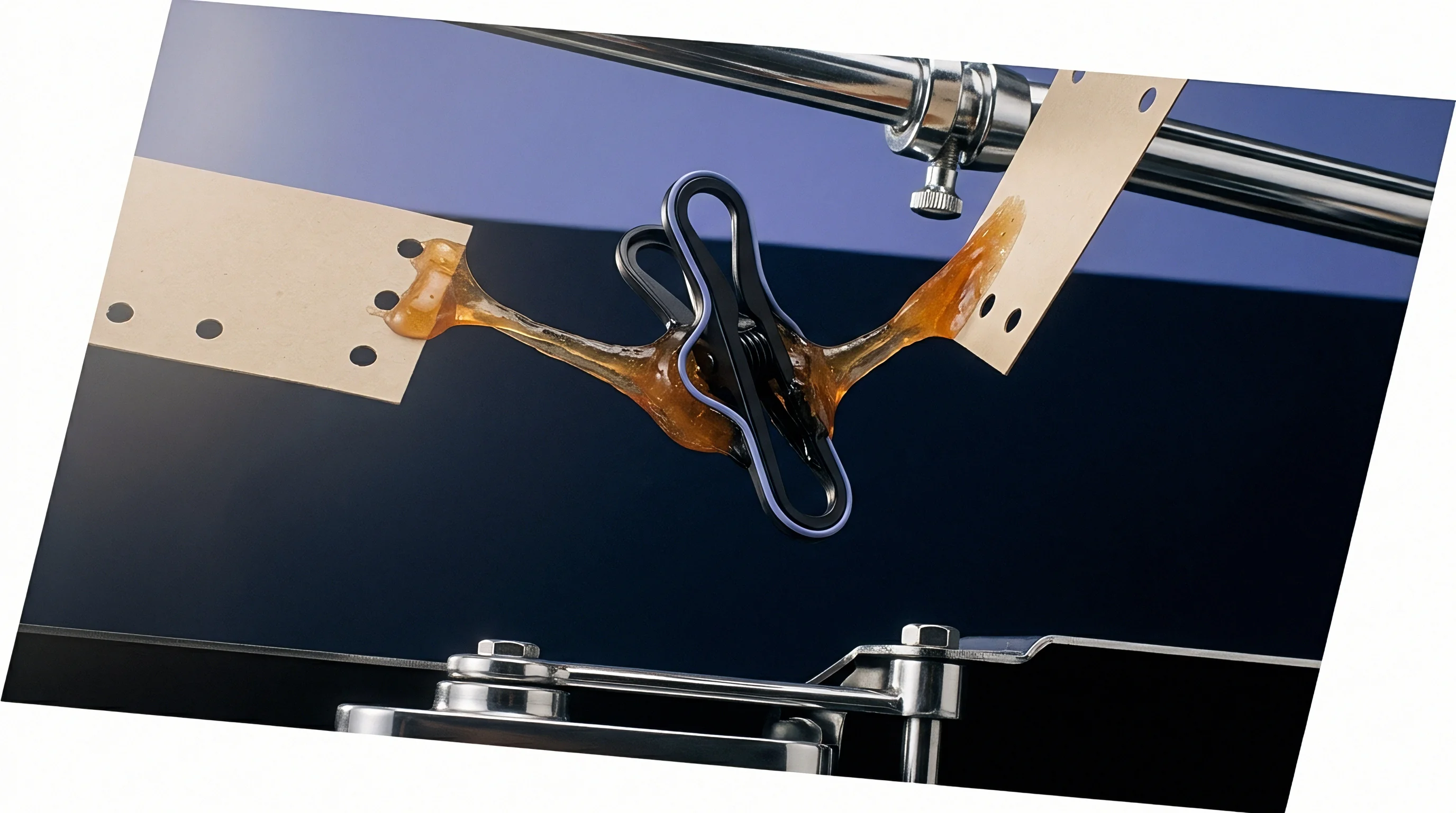
Characterizing flax viscoelasticity requires multi-element mechanical analogs capable of capturing exponential stress decay across logarithmic time scales. Standard linear elastic models fail because flax displays non-linear stress-strain relationships under transient cyclic loading. A generalized Maxwell-Weichert model represents yarn dynamic behavior by combining parallel spring-dashpot elements with varying relaxation time constants.
Which Viscoelastic Parameters Control Warp Breakage on High Speed Looms?
Quantitative evaluation relies on identifying instantaneous elasticity alongside relaxation time constants. Relaxation times dictate shed dynamics. Initial peak tension drops fast.
The generalized Maxwell equation models total stress σ(t) as a function of continuous strain ε0 over time t:
σ(t) = ε0 · left
In this equation, Einfty represents equilibrium elastic modulus after complete relaxation, Ei defines the elastic modulus of individual Maxwell arms, and τi represents relaxation time constants associated with specific molecular mechanisms inside the flax cell wall.

Maxwell Weichert Modeling for Dynamic Shedding Frequencies
Mathematical representation combines a spring in parallel with multiple Maxwell elements to account for short-term and long-term yarn relaxation spectra. Short relaxation constants between ten and forty milliseconds capture fast stress decay occurring during harness dwell. Long relaxation constants ranging from one hundred to five hundred milliseconds reflect structural creep accumulating across successive shedding cycles.
| Yarn Count (Lea) | Size Add-on (%) | Instantaneous Modulus E0 (cN/tex) | Maxwell Modulus E1 (cN/tex) | Time Constant tau1 (ms) | Equilibrium Modulus E-inf (cN/tex) |
|---|---|---|---|---|---|
| 26 Lea | 10.5 | 1050 | 280 | 18 | 450 |
| 40 Lea | 12.0 | 1200 | 300 | 15 | 500 |
| 60 Lea | 14.0 | 1450 | 350 | 12 | 610 |

Calculated Residual Tension after Shed Dwell
Evaluating a 40 Lea wet-spun flax warp subjected to a peak shedding strain of two percent illustrates the relaxation magnitude. Tensile parameters obtained via dynamic mechanical analysis yield an instantaneous modulus E0 of 1200 cN/tex, an equilibrium modulus Einfty of 500 cN/tex, a short-term modulus E1 of 300 cN/tex with τ1 = 15 ms, and a mid-term modulus E2 of 400 cN/tex with τ2 = 100 ms.
At shed opening peak (t = 0), initial peak stress evaluates to:
σ(0) = 0.02 · (500 + 300 + 400) = 24.0 cN/tex
During a forty-millisecond harness dwell (t = 40 ms), stress decays according to the exponential terms:
expleft(-frac4015right) = 0.0695
expleft(-frac40100right) = 0.6703
Inserting these values into the relaxation sum yields residual stress at shed closure:
σ(40) = 0.02 · = 0.02 · = 15.78 cN/tex
Initial warp tension drops from 24.0 cN/tex to 15.78 cN/tex, representing a 34.25 percent stress reduction during dwell. Unrelaxed peak tension forces end breakage, while over-relaxation drops residual tension below 12.0 cN/tex, inducing shed sags.
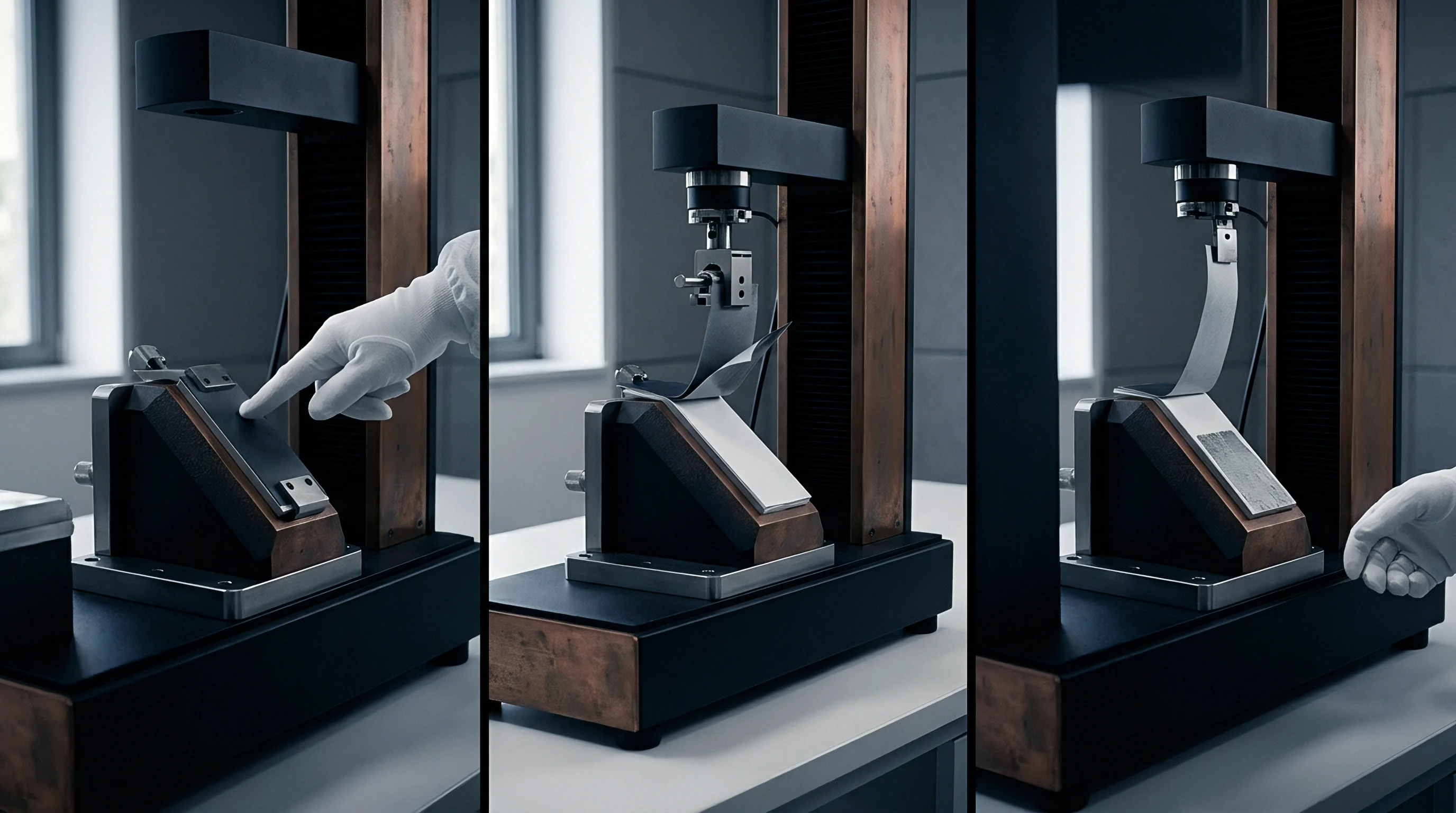
- Mount a twenty-centimeter length of sized warp yarn in an electro-dynamic tensile testing frame.
- Apply a step strain of two percent within a rise time of five milliseconds to mimic harness opening speed.
- Record warp load continuously at a sampling rate of ten kilohertz for one second.
- Fit the raw force-time curve to a two-term Prony series using non-linear least squares regression.
- Extract the instantaneous elastic modulus and relaxation time constants to calculate shed dwell tension decay.
ISO 13934 tensile verification protocol mandates continuous tension logging across a minimum one hundred shed cycles to isolate viscoelastic decay from permanent plastic elongation.
Uncertainty remains regarding how non-linear strain amplitude shifts alter viscoelastic relaxation rates when machine operating speeds surpass nine hundred picks per minute on ultra-wide looms.


Draft
Warp preparation establishes the physical boundaries within which viscoelastic stress decay operates during weaving. Warping tension, sizing film penetration, and moisture content fix the baseline elasticity of flax ends before beams enter the weave room. Inconsistent warping creel tension creates end-to-end variance in yarn strain history, causing localized relaxation rates to diverge during shedding.

Sizing Additives and Matrix Plasticization Control
Formulations containing modified starches and synthetic binders alter the strain absorption capacity of wet-spun yarn bundles. Size formula alters film elasticity. Native potato starch creates a stiff external envelope that restricts inter-fiber sliding, reducing stress decay and increasing yarn brittleness.
Formulations incorporating polyvinyl alcohol and softeners penetrate the bundle core, coating individual flax fibers.
Internal lubrication allows controlled microfibrillar micro-slippage during peak shed strain. Controlled micro-slippage increases viscoelastic energy dissipation without structural bundle rupture. Size add-on levels maintained between eleven and thirteen percent provide maximum fatigue protection on high-speed rapier equipment.
Creel Tension Uniformity across Warp Beams
Friction variations on section warping creels introduce end-to-end differences in baseline pretension. High tension accelerates fiber fatigue. Shed sags cause weave faults.
Ends drawn off creel positions with binding tensioners suffer permanent plastic strain during warping, depleting their viscoelastic relaxation capacity before loom loading.
- Binder selection ratio ~ Balancing polyvinyl alcohol against carboxymethyl starch sets the flexibility threshold of the surface sizing film.
- Squeeze roll pressure ~ Applying high pneumatic nip forces drives size solution into the core to lock internal bundle fibers.
- Moisture target setting ~ Maintaining seven percent residual moisture on the warp beam prevents brittle fiber snapping during high-speed shedding.
- Warping speed cap ~ Limiting creel drawdown speeds to six hundred metres per minute prevents pre-straining yarns before sizing.
| Size Formulation | Size Add-on (%) | Beam Pretension (cN/tex) | Relaxation Decay at 40ms (%) | Stop Rate per 10^5 Picks |
|---|---|---|---|---|
| Native Starch Only | 9.5 | 4.2 | 12.8 | 4.8 |
| Starch / PVA Blend | 12.0 | 3.5 | 28.5 | 0.7 |
| Modified Starch + Softener | 11.0 | 3.8 | 22.1 | 1.4 |
Standard master agreements specify that warp beams must maintain dynamic viscoelastic relaxation parameters within a ten percent band across the entire beam width upon delivery to the weave room floor.
Tariff
Uncontrolled tension decay converts machine investment directly into unrecoverable shed downtime. Unplanned stops consume mill profit. Loom hours determine fabric margin.
Efficiency losses drop net output. When viscoelastic relaxation modeling is omitted from warp setup calculations, stop frequencies rise beyond acceptable commercial thresholds.
Machine Stop Rates and Mill Capacity Erosion
Frequent end breaks caused by viscoelastic fatigue force operator intervention and drop weave room efficiency. A rapier loom operating at six hundred picks per minute running a twenty picks-per-centimeter plain linen construction generates thirty meters of greige cloth per hour at one hundred percent efficiency. Mill conversion costs average eighteen euros and fifty cents per loom hour.
Elevated stop rates caused by poor stress decay management force loom speed derating. Dropping loom speed from six hundred to five hundred picks per minute to control warp breakage directly inflates machine time costs per linear meter of cloth produced.
Metre Cost Arithmetic under Stress Relaxation Losses
Quantifying financial damage requires mapping warp stoppage frequency against hourly machine rates. An optimized warp displaying twenty-eight percent viscoelastic stress decay achieves an operating efficiency of ninety-two percent at six hundred picks per minute, yielding 16.56 meters per hour. The resulting weaving conversion cost equals 1.117 EUR per meter.
An un-optimized warp exhibiting only twelve percent stress decay generates excessive brittle end snaps, raising stop rates to 4.2 stops per hundred thousand picks. Operating efficiency collapses to seventy-six percent, dropping output to 13.68 meters per hour. Weaving conversion cost increases to 1.352 EUR per meter, representing a 21 percent conversion price penalty on every finished meter.
Setting warp tension without measuring viscoelastic decay forces mills to trade weave room speed against greige fault generation.
Matching warp pretension to measured yarn stress decay rate stabilizes beat-up lines and protects machine conversion margins.