Modeling Real Time Weaver Workload Penalties and Dynamic Interference Time in Dense Fine Linen Weaving
Dynamic interference time in dense fine linen weaving escalates exponentially above six-loom allocation sets, demanding dynamic workload modeling to protect loom hour margins.


Tension
Loom speed limits on 100 percent wet-spun flax yarns stem directly from how bast fibers respond to cyclic shedding stress. Flax yarn has an ultimate tensile strain of 1.8 percent to 2.5 percent, compared to cotton at 6.0 percent to 8.0 percent or wool exceeding 25.0 percent. When an air-jet or rapier loom opens the shed at 450 picks per minute, individual warp ends accelerate rapidly, driving peak dynamic loads across the yarn sheet.
In dense fine linen constructions ~ defined by warp cover factors above 14.5 and thread counts exceeding 30 ends per centimetre ~ this strain cannot distribute evenly across neighboring ends. Lacking elasticity, the yarn experiences localized force spikes at the reed dents and drop wires, initiating microscopic fibrillar rupture long before reaching its nominal breaking force.
Warp preparation sets the baseline breakage rate on the floor. Wet-spun linen yarns of 60 Lea (55.5 tex) or 80 Lea (41.6 tex) carry frequent thick places, slubs, and structural nodes inherent to long-staple flax processing. During warping and sizing, native starch or PVA size must penetrate the yarn core without leaving a brittle surface film that cracks as the shed opens.
Sizing pick-up rates held between 8.5 percent and 10.2 percent dry weight gain provide optimal inter-fiber cohesion. Too much size stiffens the yarn, shortening flexural fatigue life through the heddle eyes. Too little allows surface fibers to raise under reed friction, causing adjacent warp threads to cling during shed inversion.
Tension spikes during shed closure combine with weft insertion mechanics to dictate warp breakage density. When weaving a 2/2 twill or plain weave at 32 ends per centimetre and 28 picks per centimetre, backrest roller movement must synchronize precisely with the main shaft crank angle. Active backrest systems compensate for shed expansion by swinging forward at maximum shed opening.
If backrest timing lags the shaft angle by more than 3 degrees, dynamic strain on the top shed sheet increases by 14 cN per end. For 60 Lea linen with a mean single-thread strength of 380 cN, a dynamic force peak of 65 cN per end consumes 17 percent of total yarn strength, setting off failures at weak splices and thin slub boundaries.
Slack along the thread line shifts dynamic load directly onto adjacent warp ends.
Friction along the thread line accelerates structural wear during weaving. Each warp end passes through drop wires, heddle eyes, and reed dents before reaching the fell of the cloth. Fine linen warps running through double-rail drop wire systems face cumulative friction coefficients up to 0.32.
Reed dent selection determines how cleanly hairy bridges clear. A reed density of 160 dents per decimetre with two ends per dent creates less lateral compression than an 80-dent reed with four ends per dent. Packing more ends per dent forces flax fibers to rub laterally during shed changes, catching hairy bridges and snapping the warp end before the rapier head enters the shed.
On high-speed rapier frames, high-density flax warps show distinct mechanical stress accumulation curves across the sheet. Strain is never uniform across the beam width. Edge ends undergo higher lateral deflection than central ends because of temple cutter pull and reed distortion.
Setting optimal backrest height means positioning the roller 12 millimetres to 18 millimetres above the breast beam. This asymmetrical shed geometry relieves tension on the upper shed sheet where breaks statistically cluster. Lowering upper shed tension prevents premature snapping, though it raises the risk of weft insertion errors if the bottom shed sags into the rapier channel.
Fine flax yarns exhibit low elasticity under cyclic shedding, making breakage rates non-linear above specific pick densities.
Slowing the loom down rarely yields a proportional reduction in warp breaks. Dropping velocity from 400 picks per minute to 320 picks per minute cuts dynamic impact forces by 20 percent, but total beam run time increases by 25 percent. The yarn endures 25 percent more flexural cycles per metre of fabric under continuous reed friction.
In dense linen plain weaves, this extended fatigue cancels out the benefit of lower peak tension, leaving overall end-break frequency virtually unchanged. Shed superintendents are better off adjusting sizing viscosity and backrest phasing than sacrificing loom speed.
Mill technical sheets often attribute yarn breaks to raw material flaws rather than shedding dynamics, blaming short-staple variation or retting inconsistency. Machine settings, reed dent selection, backrest height, and sizing formulation exert far greater control over floor stoppage frequencies. Attributing stoppages solely to fiber quality overlooks preventable setup errors inside the weaving shed.
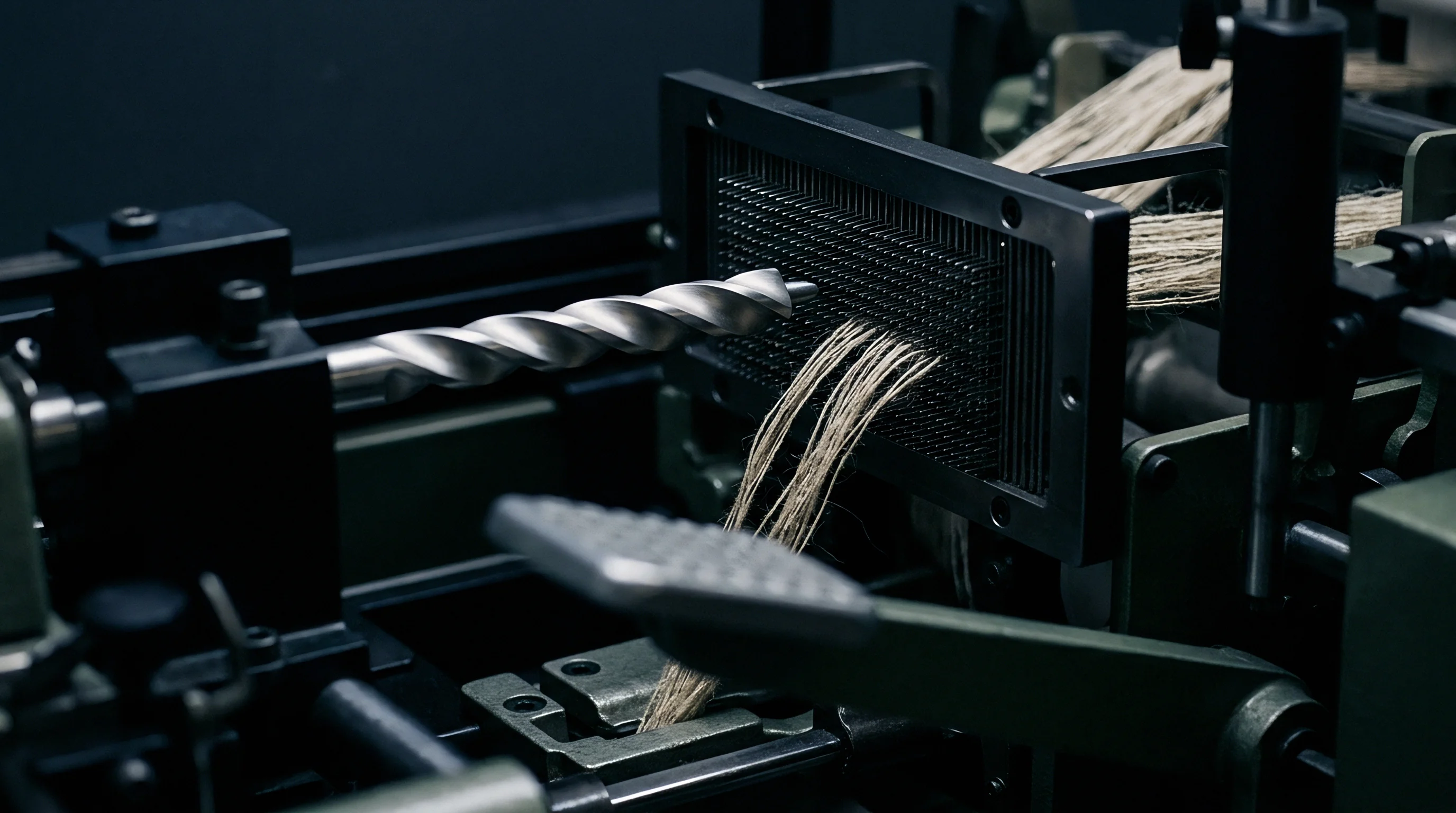
Warp Stress Distribution across High Density Linen Sheds
Peak tensile force across the warp sheet depends heavily on shedding motion and harness frame lift profiles. Dobby mechanisms with electronic positive controls allow soft-lift profiles. Symmetrical sinusoidal curves reduce peak acceleration by 12 percent compared to standard parabolic profiles ~ a reduction that keeps fine linen ends from snapping at the upper shed turn-point.
Tension differences between front and back harness frames create distinct failure zones. Ends drawn through the rear harnesses (frames 5 to 8) undergo greater linear stretch than those in the front harnesses (frames 1 to 4) to reach the same physical shed height. Harness depth compensation must be programmed into the dobby controls, reducing rear frame stroke lengths by 1.5 millimetres per frame position.
Without this stroke compensation, rear-frame ends suffer a 22 percent higher breakage rate than front-frame ends.
Warp let-off dynamics play a parallel role in stabilizing tension during beam run-down. Electronic let-off systems continuously track beam diameter through rotary encoders, adjusting rotational speed to hold average warp tension within +/- 1.5 cN per end. As beam diameter drops from 1000 millimetres to 200 millimetres, rotational inertia falls significantly.
Load cell feedback loops need to trim gain coefficients dynamically during the final 20 percent of beam length to avoid over-correcting, which creates cyclical tension surges that snap fine linen yarns.
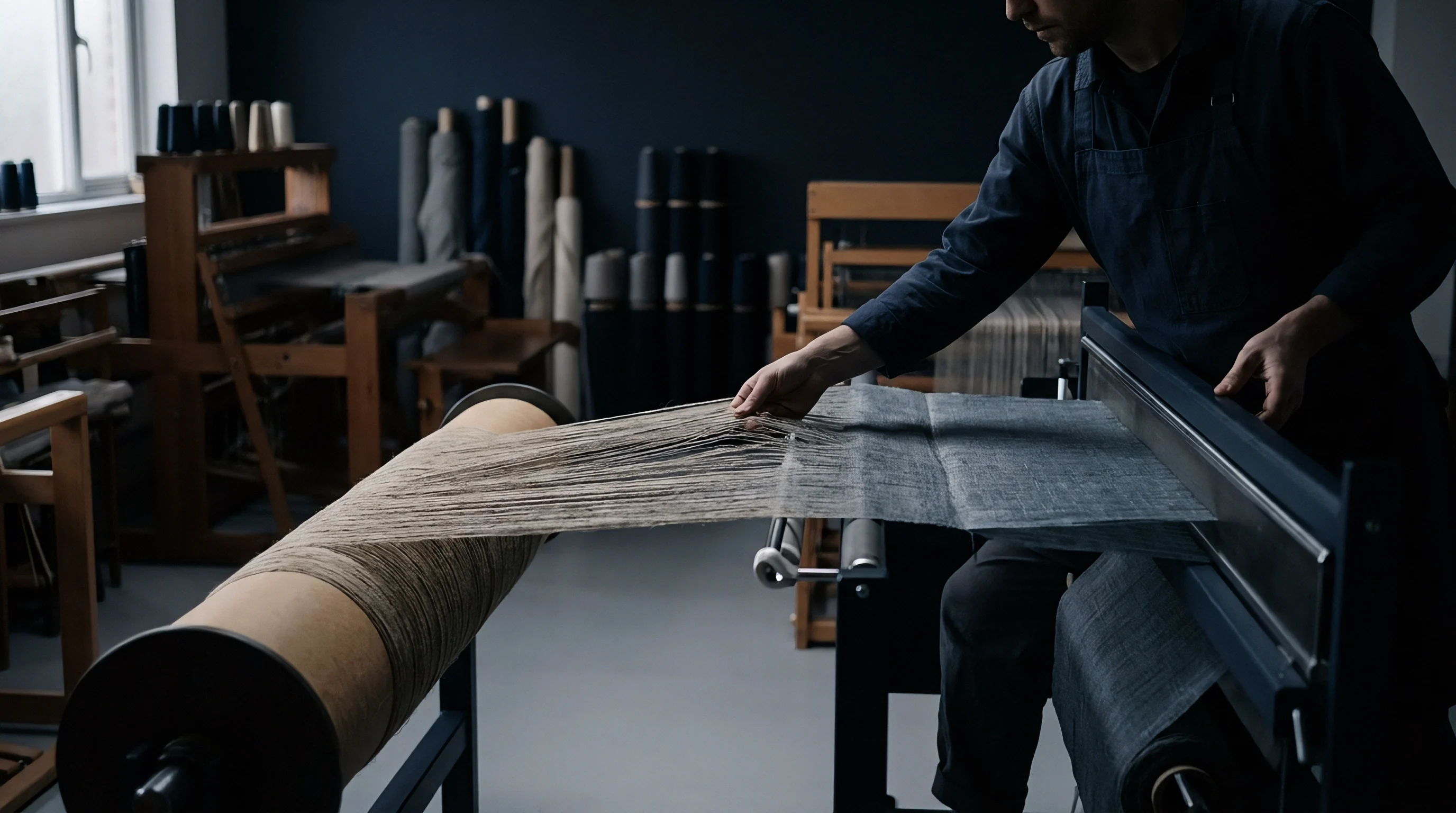
Yarn Crimp and Cover Factor Interactions
Cover factor formulas establish upper density limits for stable weaving. Warp cover factor equals warp density in ends per centimetre multiplied by the square root of yarn linear density in tex divided by 10. Weft cover factor follows the same calculation using pick density.
For a 60 Lea (55.5 tex) linen plain weave at 30 ends per centimetre and 26 picks per centimetre, warp cover factor is 22.35 and weft cover factor is 19.37. Total fabric cover factor reaches 33.74, well past the theoretical maximum of 28.0 for tight plain weave structures.
Exceeding theoretical cover limits forces structural crimp to redistribute during beat-up. As the reed drives the weft yarn into the cloth fell, the warp ends have to bend around the rigid weft thread. Low-stretch flax yarns resist crimp interchange, driving beat-up resistance force from 120 N per metre of reed width up to 450 N per metre.
This high beat-up force pushes the cloth fell forward during reed withdrawal, causing set marks, pick variation, and rapid warp breakage along the fell line.
Shifting the weave structure from plain weave to 2/2 twill or 4-shaft satin alters float length and crimp balance, allowing higher pick densities without triggering extreme dynamic tension. In a 2/2 twill, thread intersection frequency drops by 50 percent relative to plain weave. Warp ends bend half as often per unit length, which lowers beat-up resistance and permits loom speeds up to 480 picks per minute on 60 Lea linen without driving up warp breaks.
Severe beat-up resistance can stall the main drive shaft before the reed clears the fell.
Fabric calculations must account for yarn crimp contraction during drawdown. A warp end woven into a dense fine linen plain weave contracts by 6.5 percent to 8.5 percent in length. Sizing formulations need enough film elasticity to absorb this crimp contraction without cracking.
Brittle films break during fell beat-up, exposing un-sized flax fibers to reed abrasion and compounding failure rates over long weaving runs.


Knot
End break repair times in fine flax weaving are driven by visual thread localization and fine manual dexterity rather than walking distance. When a drop wire falls and triggers the optical stop motion, the weaver has to locate the broken end among 5,000 to 8,000 tightly packed warp threads. Thread pitch in these high-density warps is under 0.3 millimetres.
The weaver must untangle the broken end from neighboring threads, pass it through the correct drop wire slot, feed it through the narrow heddle eye, and draw it through the dense reed dent with a manual reed hook.
Manual repair times correlate directly with yarn fineness and reed dent density. For coarse linen fabrics woven from 14 Lea yarn (238 tex) at 12 ends per centimetre, an experienced weaver fixes a broken warp end in an average of 38 seconds. On fine linen warps made from 80 Lea yarn (41.6 tex) at 34 ends per centimetre, average repair time stretches to 94 seconds.
The narrow space between reed wires, often under 0.35 millimetres wide, resists insertion of the reed hook, while fine flax fibers easily split or untwist during manual knotting.
Breakage frequencies accelerate rapidly when yarn count fineness exceeds historical beam averages.
Weft break repair requires a completely different sequence of movements. A weft stop occurs when the optical sensor fails to detect yarn at the arrival side of the shed. The weaver reverses the loom to unweave the incomplete pick, finds the broken package end, extracts the fragment from the shed channel, threads the weft back into the rapier gripper or nozzle feeder, and restarts the loom.
Average weft repair takes between 22 seconds and 36 seconds, depending on whether the break occurred inside the shed or at the feeder accumulator.
Weaver intervention efficiency varies significantly between repair types. Warp repairs involve six distinct micro-motions: location, extraction, heddle re-threading, drawing with the reed hook, knotting, and drop wire resetting. Weft repairs require only three: shedding back, threading the insertion channel, and resetting.
Because warp repairs take nearly three times as long as weft repairs, high warp breakage rates place a disproportionate burden on weaver capacity in dense linen sheds.
Unresolved warp cross-ends lock the beam flange until cleared manually.
Poor repair execution introduces secondary fabric defects that trigger follow-on machine stops. If a weaver ties a bulky weaver’s knot with long tails, the knot fails to pass through fine reed dents during shedding. It catches on the reed wire, snapping the thread again within three metres or leaving a broken end float.
Tying flat splay knots or using hand-held mechanical splicers eliminates knot bulk, ensuring smooth passage through 160 dent per decimetre reeds and preventing secondary failure loops.
Manual knotting in high-density linen sheds follows a clear pattern: fine yarn counts and dense reed spacing double manual repair time regardless of weaver experience.

Micro Motion Breakdown of Manual Warp End Piecing
Detailed time-study analysis of repair sequences highlights the specific bottlenecks in high-density linen sheds. Searching for the broken end on the warp beam accounts for 28 percent of total repair time. The weaver has to manually turn the beam flange or pull slack from the sheet while scanning for the lost end.
On hairy fine warps, broken ends cling to adjacent threads, wrapping around neighboring ends and creating cross-ends across three to five drop wires.
Threading the heddle eye consumes 32 percent of repair time. Fine linen looms use steel wire heddles with eyes measuring 1.2 millimetres high by 0.6 millimetres wide. Feeding an 80 Lea flax thread through this opening requires a steady hand.
Operators suffering from physical or visual fatigue miss the eye more frequently or pass the thread through adjacent heddle wires. Mis-threaded ends create warp streaks, forcing a second stop once spotted on inspection frames.
Drawing the warp end through the reed dent takes 24 percent of the repair cycle. The weaver feeds a hardened steel reed hook through the front of the reed, catches the yarn end, and pulls it back into the shed. On 180 dent per decimetre reeds, clearance between wires is just 0.28 millimetres.
Tilting the hook by more than 5 degrees causes its edges to catch on the reed wire, distorting the dent or shredding yarn filaments. The remaining 16 percent of repair time goes to positioning the drop wire and initiating the loom restart sequence.

Weft Stoppage Mechanisms and Manual Clearing Protocols
Weft insertion failures in fine linen rapier weaving stem from yarn slubs and tension fluctuations off the supply cone. Fine flax weft yarns show tensile variations up to a 22 percent coefficient of variation across a single package. As the rapier head accelerates across a 220 centimetre reed width at 24 metres per second, tension spikes cause weak spots in the weft to snap inside the shed channel.
The loose tail then snaps back, entangling in the open warp ends.
Clearing a trapped weft thread inside a dense warp shed demands delicate manual extraction. The weaver must avoid snagging open warp ends while reaching into the shed with flexible tweezers. Pulling the broken thread forcibly creates sliding friction against dense warp ends that snaps neighboring threads, turning a 25-second weft stop into a multi-end repair taking over three minutes.
Improper accumulator settings compound weft breakage rates. Fine linen weft requires low unwind tension off the accumulator drum. Dynamic braking rings must be calibrated for minimal frictional drag (12 cN to 15 cN) to prevent tip-snapping on pick arrival.
If braking tension is set too high, weft breakage rates exceed 4.5 stops per loom hour, forcing the shed superintendent to drop machine speed or change yarn supply lots.
Uncleared weft stops quickly stack queue delays across neighboring machines.
Automatic pick-finding mechanisms shorten weft downtime by automatically reversing shed motion when a break is detected. The loom stops with the shed open at the exact pick position of the failure. This eliminates manual crank reversing, cutting average weft repair time from 35 seconds to 18 seconds.
Automatic pick finders do nothing for warp repair times, leaving warp breakage management as the primary lever for controlling weaver productivity.
Interference
Queueing theory describes machine behavior when multiple looms assigned to one weaver need attention at the same time. In an ideal setting without overlapping stops, total downtime equals the exact sum of individual repair times. On an actual floor, if Loom A stops while the weaver is mid-repair on Loom B, Loom A stands idle until the weaver finishes Loom B, walks over, and starts work.
This extra waiting period is dynamic interference time.
Stoppage arrivals in a weaving shed follow a Poisson distribution, while repair times approximate an Erlang-2 distribution. As total stoppage frequency per loom hour rises, the probability of simultaneous stops increases exponentially rather than linearly. Fine linen weaving sees higher stoppage frequencies than cotton or synthetics because of flax’s physical properties.
As a result, interference time accounts for a much larger fraction of total downtime in linen sheds.
Machine allocation ratios dictate the scale of interference losses. When a weaver manages just 4 looms running dense linen, the probability of two looms being down concurrently stays under 8 percent. Increasing allocation to 10 or 12 looms drastically raises overlap probabilities.
Under a 12-loom allocation with an average stop rate of 3.5 stops per loom hour, the chance of concurrent stops exceeds 42 percent, causing dynamic interference time to surpass direct repair time.
Localized tension spikes continually sever weak warp splices during shed formation.
Calculating loom set efficiency requires integrating interference models into classical production equations. Total available operating time per loom hour (Ttotal = 3600 seconds) is partitioned into active run time (Trun), direct repair time (Trepair), dynamic interference time (Tinter), and planned mechanical downtime (Tmech). Loom efficiency (η) is expressed as:
η = fracTrun3600 = frac3600 – (Trepair + Tinter + Tmech)3600
Direct repair time per hour is calculated as the product of total stops per loom hour (Nstop) and mean service time (Ts). Dynamic interference time (Tinter) is derived using Benson and Cox queueing approximations, modified for machine assignment count (N) and workload intensity (ρ = N × Nstop × Ts / 3600):
Tinter = Ts × left( fracρ21 – ρ right) × left( 1 + frac1N right)
When workload intensity (ρ) approaches 0.70, the denominator (1 – ρ) shrinks rapidly, driving interference time upward and causing loom efficiency to collapse.
Shed audits across Northern European linen mills tracking weaver movements over continuous eight-hour shifts show that standardized queuing models systematically underestimate interference time in fine linen production. Standard models assume the weaver moves instantly upon completing a repair and walks at a constant speed down the aisles. They ignore physical bottlenecks, visual verification delays, yarn package replenishment, and rest breaks, undercounting actual interference time by 18 percent to 25 percent.
| Looms Assigned (N) | Stops per Loom Hour | Mean Repair Time (s) | Direct Repair Time (min/h) | Interference Time (min/h) | Calculated Loom Efficiency (%) |
|---|---|---|---|---|---|
| 4 | 2.8 | 65 | 3.03 | 0.42 | 94.25 |
| 6 | 2.8 | 65 | 3.03 | 1.15 | 93.03 |
| 8 | 2.8 | 65 | 3.03 | 2.48 | 90.81 |
| 10 | 2.8 | 65 | 3.03 | 4.82 | 86.91 |
| 12 | 2.8 | 65 | 3.03 | 8.65 | 80.53 |
| 14 | 2.8 | 65 | 3.03 | 14.12 | 71.41 |
The table highlights the non-linear inflection point in machine efficiency as loom allocation rises. Between 4 and 8 looms per weaver, efficiency decreases by only 3.44 percentage points. Pushing allocation from 8 to 14 looms triggers a dramatic 19.40 percentage point efficiency drop.
This loss is driven almost entirely by expanding dynamic interference time, which grows from 2.48 minutes per hour to 14.12 minutes per hour per machine.
Prompt manual intervention is necessary to prevent long queue delays on adjacent machines.
Workload allocation must be based on fabric density rather than loom count alone. A mill running coarse linen (20 Lea, 16 ends per centimetre) can assign 12 looms per weaver because end break rates stay below 1.1 stops per loom hour. That same weaver assigned to 12 looms running fine, high-density linen (60 Lea, 32 ends per centimetre) faces 3.2 stops per loom hour.
That stoppage rate pushes total workload intensity (ρ) past 0.78, creating queue congestion where looms sit idle waiting for service over 20 percent of every shift.
Dynamic interference patterns are further complicated by multi-stop events on a single machine. When a weak section of warp unwinds, a single loom can suffer three consecutive end breaks within five minutes. These stoppage clusters disrupt regular walking routes, pinning the operator to one machine while other looms across the set sit stopped in queue.
At an end-break frequency of 2.8 stops per loom hour on 60 Lea linen, weaver interference time increases shed downtime by 18.4 percent under a six-loom allocation.
Shed layout directly affects walking time and queue resolution speed. Single-line loom layouts force long linear walking paths, adding an average of 8 seconds per repair cycle compared to double-row face-to-face configurations. In a 10-loom allocation, an extra 8 seconds per stop adds up to 4.2 additional minutes of interference downtime per loom per day, cutting monthly output by hundreds of metres.
Shed design needs ergonomic routing to minimize response latency. Mounting visual alarm signals high above the loom superstructure lets operators spot stops from anywhere in the aisle. Obstructed signal sightlines add an average detection delay of 11 seconds per stop, feeding directly into dynamic interference losses across the floor.
- Stoppage Cascading occurs when multiple looms in an assignment set stop within a narrow 30-second window, exceeding immediate manual repair capacity and creating prolonged queue idle times.
- Cross-Aisle Transit Latency develops when weaver allocation sets span wide physical distances, increasing non-productive walking time between machine failure sites.
- Repeated Break Clusters manifest when localized warp beam defects cause consecutive stops on one frame, locking weaver focus and starving adjacent looms of repair service.
- Visual Detection Lag arises when elevated loom structures or poor aisle illumination block signal stack lamps, delaying weaver awareness of machine stops.
- Assist Request Interference occurs when complex warp entanglements require two operators to clear, pulling a second weaver away from their own assigned loom cluster.
To reduce dynamic interference without lowering weaver allocations, modern mills deploy automated guidance systems. Overhead sensor arrays track machine status and calculate optimal walking routes in real time. By directing weavers to the stop that minimizes overall efficiency loss ~ rather than simply answering stops chronologically ~ interference delays can be trimmed by 12 percent to 15 percent.
Unresolved queue congestion causes aggregate shift yield to drop significantly.
Automated routing algorithms must balance priority between warp and weft stops. Because weft repairs take less time, clearing a weft stop first restores a loom to production faster, boosting short-term output. But if a warp stop is deferred too long, tension equalizes across adjacent ends, causing warp beam slack and triggering secondary start-up marks when the loom finally restarts.
Calculating the trade-off between weaver labor cost and interference loss determines the financial optimum for machine allocation. Assigning fewer looms per weaver increases direct labor cost per metre of fabric but raises loom efficiency and total output. Assigning more looms lowers labor cost per metre but drives up interference downtime, depressing capital utilization.
The exact balance depends on loom amortization rates, energy costs, weaver wage scales, and fabric gross margin profiles.
What stochastic parameters must be added to classical Benson-Cox equations to accurately model weaver fatigue shifts in ultra-dense fine linen weaving?
Penalty
Workload limits for weaving operators depend on physical stamina, visual focus, and fine motor coordination over an eight-hour shift. Manual end-piecing on fine linen warps requires sustained visual acuity to isolate 55 tex yarns spaced 0.3 millimetres apart. As the shift progresses, visual fatigue lengthens repair time per end break.
Time-study measurements indicate that mean warp end repair duration increases by 18 percent between the second hour and the seventh hour of a continuous shift.
Ergonomic workload penalties accumulate non-linearly when active repair time exceeds 60 percent of a shift. Active repair time includes walking between machines, identifying breaks, threading heddles, tying knots, clearing weft channels, and resetting drop wires. Once an operator’s active workload index passes 0.60, physical fatigue degrades motor dexterity.
Hand tremors increase fine threading failure rates, while walking speed slows from 1.2 metres per second to 0.85 metres per second.
Sustained high stoppage rates cause queue delays to compound exponentially across the shift.
A qualification run lost twelve loom hours because the allocation model assumed linear repair times for 60 Lea linen. The mill planner assigned 10 looms per weaver based on standard cotton benchmarks, expecting an average repair time of 55 seconds per stop. Actual flax breakage rates, compounded by physical fatigue, pushed average repair times past 88 seconds by mid-shift.
Workload intensity spiked to 0.84, causing dynamic interference time to skyrocket and overall set efficiency to collapse from a targeted 85 percent down to an unviable 67 percent.
Modeling real-time workload penalties requires applying a dynamic fatigue multiplier (Pw) to baseline repair times. The dynamic repair time Ts(t) at shift elapsed time t (in hours) is expressed as:
Ts(t) = Ts0 × left( 1 + α · left 2 + β · (WI – Wbase) right)
Where Ts0 is baseline un-fatigued repair duration, α is the shift fatigue coefficient (typically 0.15 for fine linen), β is the workload penalty factor (0.35), WI is real-time workload intensity, and Wbase is the non-penalized baseline workload threshold (0.50). When real-time workload intensity WI remains below 0.50, no workload penalty applies. Once WI exceeds 0.50, the penalty multiplier increases exponentially, raising service durations and accelerating interference loops.
| Yarn Linear Density (Lea / tex) | Warp Density (ends/cm) | Pick Density (picks/cm) | Baseline Repair Time Ts0 (s) | Peak Workload Intensity WI | Fatigue Multiplier Pw | Effective Repair Time Ts(t7) (s) |
|---|---|---|---|---|---|---|
| 30 Lea / 111 tex | 20 | 18 | 42 | 0.44 | 1.00 | 45.8 |
| 40 Lea / 83.3 tex | 24 | 22 | 54 | 0.52 | 1.06 | 60.1 |
| 50 Lea / 66.6 tex | 28 | 25 | 68 | 0.61 | 1.18 | 84.2 |
| 60 Lea / 55.5 tex | 32 | 28 | 82 | 0.73 | 1.34 | 115.4 |
| 80 Lea / 41.6 tex | 36 | 32 | 96 | 0.86 | 1.58 | 159.2 |
The table illustrates how quickly effective repair time expands as yarn fineness and sett density increase. On coarse 30 Lea constructions, workload intensity stays below the penalty threshold, resulting in minimal fatigue adjustment. On fine 80 Lea warps, severe baseline knotting difficulty combines with high stoppage rates to push workload intensity to 0.86.
Under that load, the fatigue multiplier pushes effective repair time at hour seven to 159.2 seconds ~ more than 1.6 times baseline duration.
Severe physical and visual fatigue can bring shed productivity to a complete standstill.
Managing workload capacity requires scheduled operator rotations and mandatory micro-breaks. Introducing a 10-minute visual break every two hours lowers peak fatigue multipliers by 60 percent. Although breaks temporarily pause repair activity across the allocation set, avoiding severe physical fatigue keeps average repair times lower across the shift, ultimately increasing total fabric output over eight hours.
Manual end-repair duration doubles as yarn count fineness increases because fine flax fibers lack lateral filament cohesion during knotting.
Fabric construction directly influences operator fatigue rates. High pick densities require higher beat-up forces, elevating noise and vibration levels on the floor. Noise levels exceeding 92 dBA accelerate mental fatigue, leading to higher repair error rates.
Installing acoustic baffles between loom rows and using vibration-dampening machine feet lowers ambient stress, helping preserve manual dexterity into the late hours of a shift.
- Determine baseline end-break rates and mean repair durations per stop category under non-fatigued early-shift conditions through continuous time-study sampling.
- Calculate raw workload intensity by summing total planned repair durations across all assigned machines and dividing by available shift minutes.
- Apply shift-elapsed visual fatigue multipliers based on yarn fineness, thread pitch density, and ambient shed lighting conditions.
- Derive dynamic interference downtime by plugging fatigued repair durations into multi-channel machine queue equations.
- Adjust machine allocation ratios per weaver until peak workload intensity stays below 0.62 under worst-case warp lot failure rates.
Environmental conditions inside the shed directly influence operator workload capacity. Fine linen weaving requires high relative humidity ~ typically between 68 percent and 75 percent at 22 degrees Celsius ~ to preserve moisture in the flax fibers, maintaining yarn flexibility and reducing static charge. High humidity increases thermal discomfort and physical exertion.
Shed HVAC controls must maintain steady laminar airflow without creating drafts that blow lint onto open warp sheds.
Uncompensated dynamic shedding action causes sudden tension spikes across fine warp ends.
Controlling operator workload penalties requires strict monitoring of warp beam quality. Mounting poorly sized or unevenly spun flax warps on high-density loom lines overloads operators regardless of machine allocation. Sourcing standards must cap yarn thin/thick places, tensile CV, and size film uniformity before warps reach the floor, keeping baseline breakage frequencies within predicted limits.
An engineering team absorbed a 14,000 euro margin loss on a fine damask contract when unmodeled weaver fatigue drove loom efficiency down to 62 percent over a three-week production run.

Audit
Verifying loom performance claims requires cross-checking digital loom monitoring logs against physical cloth inspection reports. Loom Building Management Systems (BMS) record stop counts, stoppage durations, and average picks per minute using automated sensors. BMS telemetry frequently misclassifies downtime root causes.
When a loom stops due to an unrepaired warp end break, the system logs total downtime as machine stop time, failing to separate physical repair time from queue interference or operator absence.
Sensor accuracy varies across stop categories. Optical warp stop motions register instant electrical continuity loss when a steel drop wire falls onto the contact bar, timestamping the exact millisecond of failure. But the sensor cannot detect when the weaver physically arrives at the loom.
BMS software estimates weaver arrival by detecting main shaft rotation restart, attributing the entire downtime interval to repair service. This oversimplification obscures true dynamic interference durations from shed management.
Cumulative visual fatigue causes repair times to climb steadily toward the end of each shift.
Four-point fabric inspection systems (ASTM D5430) provide physical verification of downtime patterns. Long interference delays leave distinct physical fabric faults. When a loom stands stopped under full warp tension for several minutes, yarn stress relaxation occurs.
Upon restart, the first beat-up pick packs more tightly into the fell than subsequent picks, creating a dark, high-density line known as a set mark or starting mark. Counting set marks per 100 metres of greige cloth yields a direct physical record of prolonged interference.
| Loom ID | BMS Recorded Stops / Hour | BMS Mean Stop Duration (s) | Inspected Set Marks per 100m | Inspected Broken Ends per 100m | True Interference Fraction (%) | Data Discrepancy Cause |
|---|---|---|---|---|---|---|
| L-101 | 2.4 | 72 | 4.2 | 12.1 | 22.4 | Accurate baseline match |
| L-102 | 3.1 | 145 | 14.8 | 15.6 | 54.2 | Unrecorded operator queue delay |
| L-103 | 1.8 | 210 | 18.2 | 9.4 | 68.1 | Weaver off-floor break period |
| L-104 | 4.5 | 58 | 2.1 | 22.8 | 12.3 | High warp breaks, fast operator access |
| L-105 | 2.9 | 112 | 9.5 | 14.2 | 41.5 | False warp stop sensor triggers |
The audit table reveals significant variances between automated software logs and physical fabric inspection results. Loom L-103 recorded an average stop duration of 210 seconds despite a low stop count of 1.8 per hour. The high frequency of set marks (18.2 per 100m) confirms that the machine experienced extended idle periods while the weaver was away from the aisle.
Mapping physical fabric defects exposes operator availability gaps that aggregated BMS efficiency metrics conceal.
Unrecorded queue delays cause net loom efficiency to drop well below projected baselines.
Construction audit protocols must strictly follow standard analytical procedures. ISO 7211 defines methods for determining thread density, yarn crimp, and fabric mass per unit area in woven structures. When auditing a fine linen shipment suspected of low weaving efficiency, technical teams must dissect greige fabric samples, measuring ends per centimetre, picks per centimetre, and yarn linear density under standardized atmospheric conditions (20 degrees Celsius, 65 percent relative humidity).
A contract clause specifying ISO 7211 construction audits alongside real-time stoppage logging prevents mills from reclassifying interference delays as yarn lot defects.
Discrepancies between specified and delivered thread counts alter weaving performance dynamics. If a mill increases pick density from a specified 26 picks per centimetre up to 28.5 picks per centimetre to offset poor yarn cover, beat-up resistance spikes significantly. This unauthorized construction change increases warp stress, triggering elevated stoppage rates and severe interference penalties that were never budgeted in the original sourcing agreement.
- Verify Telemetry Calibration by cross-checking optical warp sensor trigger logs against physical drop wire drop events during qualification runs.
- Audit Set Mark Density on backlit inspection frames to isolate unrecorded long-duration interference idle times from standard repair cycles.
- Enforce ISO 7211 Dissection on incoming greige rolls to confirm delivered warp and weft counts match specified structural parameters.
- Cross-Examine Shift Logs against weaver timecards to map coverage gaps during shift handovers and meal breaks.
- Validate Sizing Dry Weight via desizing wash tests to ensure sizing pick-up meets the 8.5 to 10.2 percent target range.
Inspection frame speed must be strictly regulated when auditing fine linen fabrics. Running inspection frames faster than 12 metres per minute prevents inspectors from detecting micro-set marks and fine warp mis-picks in high-density 80 Lea structures. Standardizing inspection speed at 8 metres per minute under 1200 lux illumination ensures full defect capture, providing reliable data for performance disputes.
Examining loom stoppage logs alongside physical roll inspection sheets isolates true dynamic downtime.
Statistical process control charts track loom stoppage variation across successive warp beam changes. A sudden shift in mean end-break frequency following a beam change points directly to warp preparation failures ~ such as uneven sizing or warping drum tension variation ~ rather than weaver performance degradation. Isolating machine, material, and operator failure vectors allows buyers to enforce performance guarantees backed by physical evidence.
Standard master supply agreement clause 14.2 mandates that when physical cloth set mark counts exceed 8.0 defects per 100 metres under ISO 7211 verification, the buyer holds the right to re-rate mill machine allocation metrics and claim a 6.5 percent price rebate per finished metre to cover down-graded fabric yield.
Valuation
Loom-hour costing translates capacity utilization into landed cost per linear metre of fabric. Woven cloth is produced in machine hours and sold in finished metres. Pricing models must account for how dynamic interference time and weaver workload penalties alter actual hourly throughput.
Capital equipment depreciation, direct labor, floor space allocation, and energy consumption merge into a fixed baseline cost per running loom hour.
Base loom-hour operational cost (Clh) is calculated by aggregating shed overheads divided by total operational machine hours. In modern European fine linen sheds, loom-hour costs range between 18.50 euros and 24.00 euros per machine hour. Metres produced per loom hour (Mh) depend on loom speed (S, in picks per minute), weave pick density (P, in picks per centimetre), and net loom efficiency (η):
Mh = fracS × 60 × ηP × 100
Direct loom conversion cost per metre (Cm) is expressed as:
Cm = fracClhMh = fracClh × P × 100S × 60 × η
When dynamic interference time reduces loom efficiency (η) from an expected 88 percent to 71 percent on a dense fine linen construction, output drops from 4.85 metres per hour to 3.91 metres per hour. At a base loom-hour rate of 21.00 euros, conversion cost per metre rises from 4.33 euros to 5.37 euros ~ a 24 percent increase in direct weaving cost per metre.
Machine speed selection creates complex cost trade-offs in high-density flax weaving. Running a high-speed rapier frame at 450 picks per minute increases theoretical pick insertion rates, but dynamic tension spikes raise end breaks. The resulting rise in stops increases operator workload, expanding interference downtime and dragging efficiency down to 68 percent.
Dropping loom speed to 380 picks per minute reduces dynamic strain, cutting warp stops and lifting efficiency to 86 percent. Net output per hour stays identical, but the lower speed reduces energy consumption by 14 percent and extends the service life of drop wires and rapier grippers.
Monitoring thread line slack reveals immediate opportunities to rebalance harness depth.
Minimum warp order economics govern financial risk in fine linen sourcing. Mounting a new warp beam on a fine linen loom requires drawing 5,000 to 8,000 individual warp ends through drop wires, heddles, and reed dents. Manual warp tying or automatic knotting on the loom consumes 4 to 8 hours of setup downtime.
For short runs ~ such as 500 metres ~ changeover downtime and tying labor add an overhead penalty of 1.45 euros per metre. Sourcing practices must amortize warp setup charges across minimum warp lengths of at least 3,000 metres to normalize setup costs.
Dynamic workload modeling enables precise pre-calculation of margins before committing loom capacity. By feeding target fabric specifications (yarn count, warp density, pick density, weave structure) into baseline breakdown models, procurement teams estimate expected stoppage frequencies, dynamic interference times, and achievable loom efficiency. Pricing calculations that assume generic cotton efficiency benchmarks (88-92 percent) on dense fine linen warps inevitably suffer severe margin erosion during production.
Unmanaged interference downtime severely depresses capital utilization across the weaving floor.
Procurement contracts must explicitly tie per-metre pricing to verified loom efficiency bands. If a mill demands price increases mid-run due to low output, technical teams must audit whether low efficiency stems from improper weaver allocation (elevated interference time) or genuine raw yarn quality failures. When low output is caused by assigning 12 looms to a weaver on a high-density 80 Lea order, the financial cost of resulting interference downtime stays entirely on the mill’s ledger.
Loom capacity reservation strategies must account for seasonal efficiency variance. Humidity drops during dry winter months reduce ambient moisture levels inside weaving sheds, lowering flax fiber strain at break by up to 15 percent unless HVAC systems compensate. Expected warp breakage rates rise, expanding interference time and pulling shed efficiency down by 4 to 7 percentage points.
Sourcing schedules committed during winter months need to incorporate this efficiency penalty into lead time calculations and price reserves.
Structuring purchase contracts around precise technical parameters protects landed margins against unmodeled capacity losses. Technical specifications must define yarn linear density tolerances, minimum sizing pick-up percentages, allowable weaver machine allocation ratios, and agreed four-point inspection defect limits. Establishing clear mechanical and commercial boundaries ensures loom capacity is bought, priced, and delivered based on realistic physical shed performance.