Modeling Capstan Tension Amplification in High Density Wet Spun Linen Sheds under Non Isothermal Humidity Gradients
Non-isothermal humidity gradients drive non-linear capstan tension amplification in high-density linen sheds, increasing end break rates unless controlled.
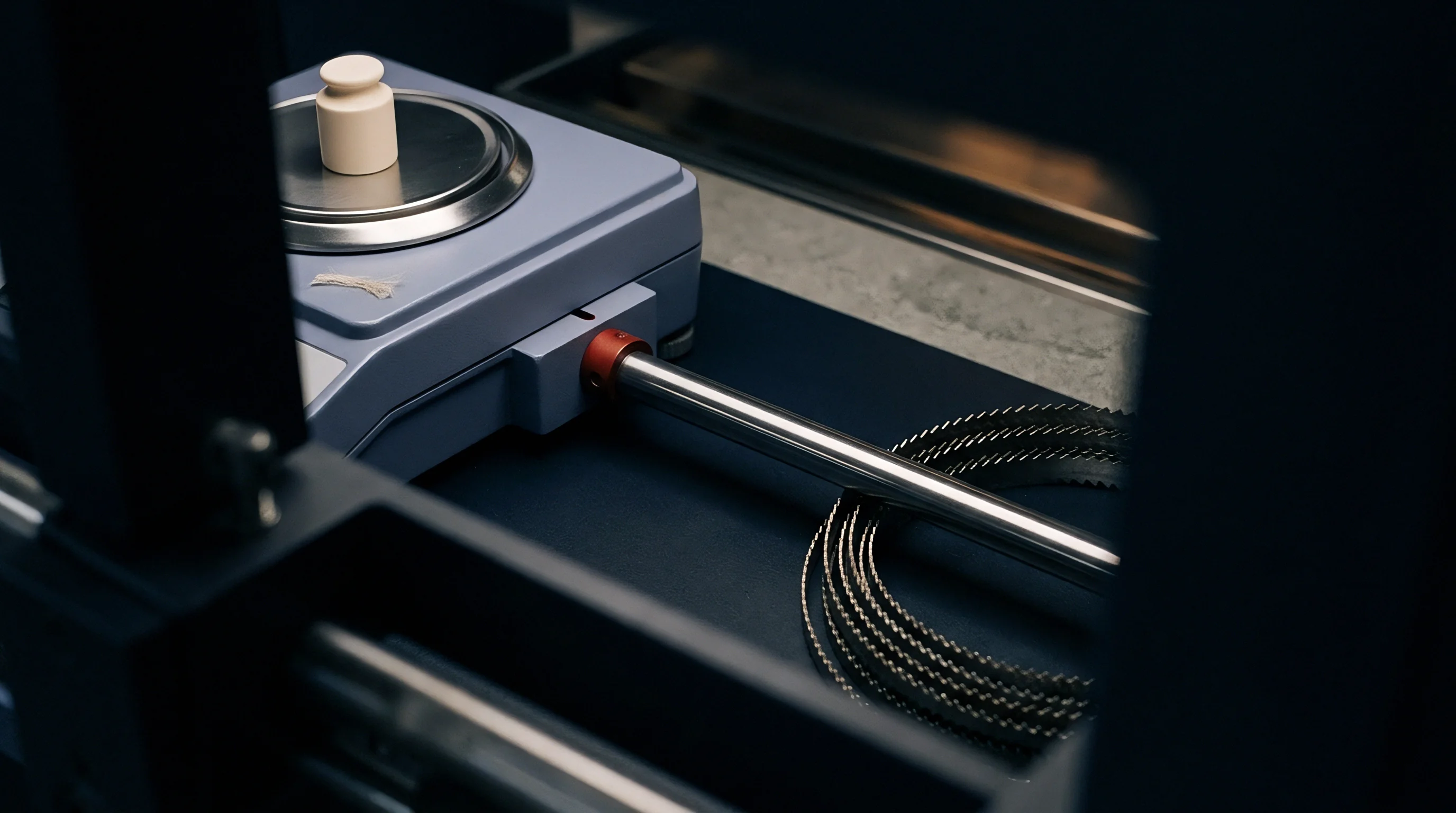
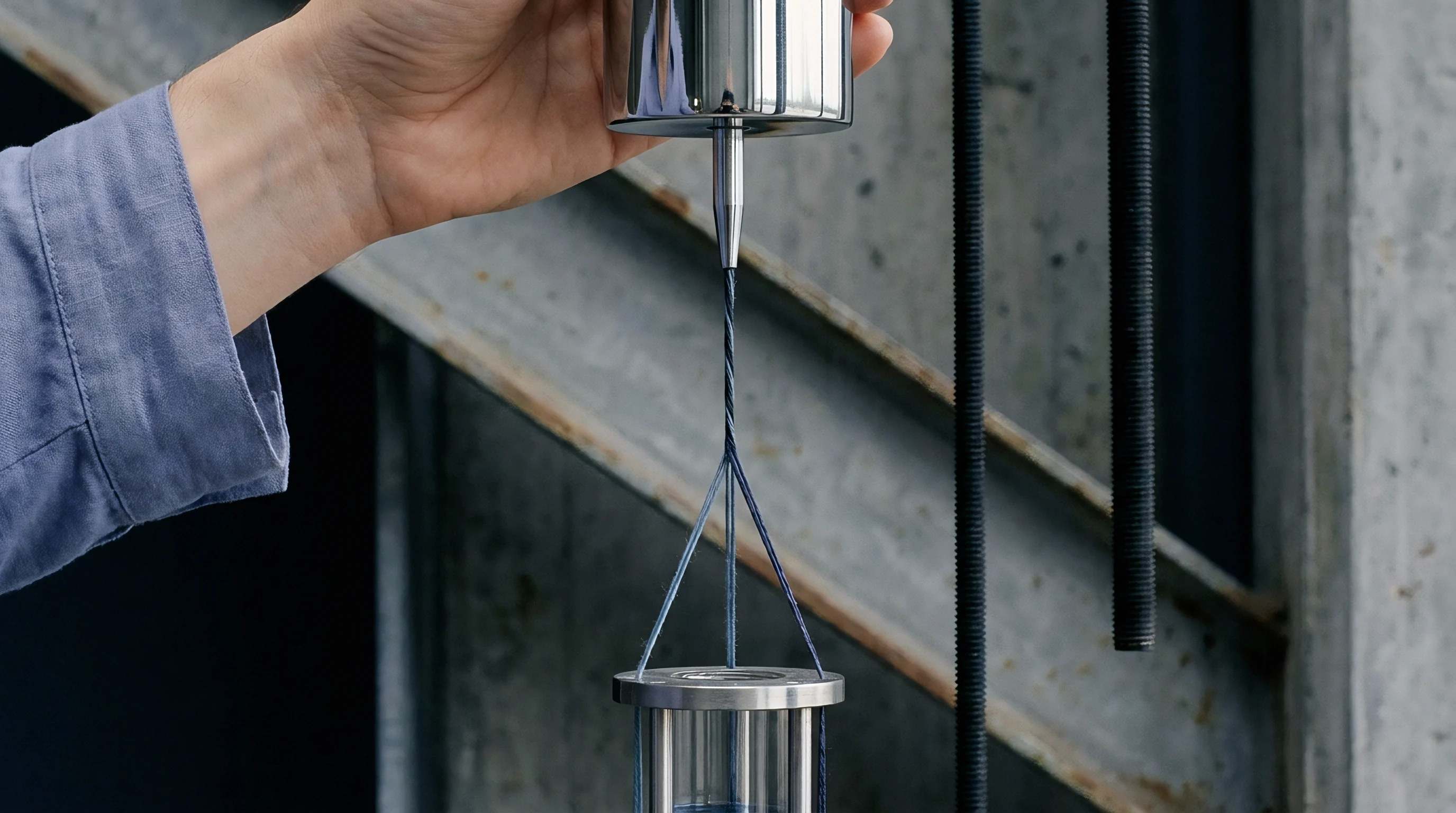
Friction
Wet-spun flax yarns present a distinct surface topology dictated by remnant pectins and aligned ultimate fibers along the bundle axis. During the wet-spinning process, roving passes through a hot water bath heated to 60 or 70 degrees Celsius. This thermal exposure softens middle-lamella pectins, permitting individual flax ultimate fibers to draft cleanly and consolidate into a smooth, highly oriented yarn structure.
Upon drying and subsequent rewinding, the re-solidified pectin matrix forms a semi-continuous surface veneer over the cellulosic fiber core. In a high-density loom shed where warp yarn sett exceeds 28 ends per centimetre, this surface veneer interacts continuously with metal and ceramic yarn guides, drop wires, heald eyes, and reed wires.
Water molecules adsorb rapidly into the amorphous cellulose zones of flax filaments during high-humidity exposure. As moisture content within the yarn increases, the surface pectin layer shifts from a glass-like state to a viscoelastic, rubbery state. This structural softening alters the mechanical contact mechanics between the moving warp strand and fixed loom components.
The coefficient of friction does not remain static during weaving operations. Instead, friction varies as a direct function of local moisture content, yarn speed, contact pressure, and contact geometry.
Surface Hydrodynamics in Wet Spun Flax
Flax fibers absorb moisture rapidly. Below 65 percent relative humidity, wet-spun linen demonstrates predictable dry sliding contact mechanics against polished stainless steel or glazed ceramic surfaces. The dynamic coefficient of friction remains bounded between 0.22 and 0.28.
Within this dry regime, surface roughness dominates sliding resistance, and yarn tension increases moderately across guiding elements. Pectin binders remain firm, holding micro-fibrils flat against the yarn body and preserving a low contact real surface area.
Elevated ambient moisture alters this contact interface fundamentally. When localized relative humidity rises above 75 percent, liquid water films condense within microscopic surface crevices along the flax strand. Pectin softens above sixty degrees.
Softened surface pectins deform under mechanical normal forces, increasing the real contact area between the yarn and the guide element. Dynamic friction rises sharply from 0.28 to values exceeding 0.45. Liquid meniscus bridges form across contact points, introducing viscous hydrodynamic drag forces that combine with adhesive sliding friction.

Frictional Thresholds across Moisture Regimes
Measurements of yarn resistance over polished chrome contact points reveal non-linear resistance jumps beyond seventy-five percent relative humidity. Temperature shifts modify this frictional response by changing both relative humidity and pectin viscoelasticity. Under isothermal conditions at 20 degrees Celsius, an increase in relative humidity from 60 percent to 85 percent doubles the measured coefficient of friction for Nm 60 wet-spun linen.
When thermal gradients exist across the loom shed, localized variations in yarn moisture content produce rapid shifts in friction along the warp path.
| Relative Humidity (%) | Temperature (°C) | Dynamic Friction Coefficient (μ_d) | Static Friction Coefficient (μ_s) | Surface Pectin State |
|---|---|---|---|---|
| 55 | 20 | 0.23 | 0.29 | Vitreous and Rigid |
| 65 | 22 | 0.26 | 0.33 | Vitreous and Rigid |
| 75 | 24 | 0.34 | 0.42 | Viscoelastic Transition |
| 85 | 26 | 0.48 | 0.59 | Softened and Sticky |
| 85 | 20 | 0.52 | 0.66 | Hydrated Viscous Film |
Shed supervisors frequently attribute cluster end breaks to yarn batch spin-finish irregularity rather than localized thermal stratification above the harness cords.

Microclimate
Convective air movement within a weaving shed creates severe spatial variations in relative humidity across a ten-meter loom line. High-density linen sheds operate under elevated ambient humidity targets, typically 70 to 80 percent relative humidity, to maintain flax fiber flexibility and prevent static charge accumulation. Thermal energy generated by loom drive motors, main shafts, shedding mechanisms, and electronic control cabinets disrupts ambient uniformity.
Heat dissipated from underneath the warp line creates thermal plumes that rise directly through the rear warp sheet and harness area.
Local relative humidity decreases as air temperature rises, following standard psychrometric relationships when absolute moisture content remains constant. A air temperature increase of 3 degrees Celsius near the harness zone depresses local relative humidity by 10 to 12 percent. Consequently, warp strands experience a constantly changing microclimate as they travel from the backrest roller, through the drop wires, across the heald frames, and into the reed line.
Moisture gradients ruin shed stability.

Thermal Stratification above the Warp Sheet
Electric motor drives and shedding motion gearboxes release constant thermal energy directly beneath the heald frames. Temperatures recorded directly under the warp harness frequently reach 27 to 30 degrees Celsius, while overhead supply air arrives at 21 degrees Celsius. This vertical thermal gradient drives localized air warming precisely where warp ends pass through drop wire eyes and heald eyes.
Moisture content inside the wet-spun linen yarn responds dynamically to these air temperature changes, desorbing water vapor within seconds as strands enter warm micro-zones.
Air velocity directly over the warp line removes surface moisture faster than the core fibers can redistribute water.
Relative Humidity Drops across the Shed Line
Sensors positioned along the warp path from backrest beam to reed line record ambient drops exceeding fifteen percent. Warping beam packages situated at the loom rear remain exposed to cooler, higher-humidity room air. As individual ends draw off the beam and pass over the backrest roller into the harness region, elevated motor temperatures warm the surrounding air layer.
Local relative humidity falls from 78 percent at the backrest to 63 percent inside the heald frame zone, before rising again near the fell of the cloth due to atomized water sprays mounted over the reed path.
This microclimatic variation imposes rapid sorption cycles on the wet-spun flax fiber structure. Desorption dries the outer pectin surface while the fiber core retains higher moisture levels. The resulting moisture gradient within the yarn cross-section alters both flexural stiffness and surface tackiness during active shedding operations.
Air movement velocity through the open warp sheet accelerates localized moisture transport, establishing dynamic moisture equilibria that vary with weaving speed and loom downtime interruptions.

Deflection
Every bending point along the warp path alters yarn path geometry and forces the strand against solid surfaces. In high-density wet-spun linen weaving, warp strands make physical contact with backrest rollers, lease rods, drop wires, heald eyelets, and reed wires before reaching the cloth fell. Each contact point introduces a specific angular deflection, denoted as wrap angle theta.
The classic capstan mechanical relationship governs tension amplification across each deflecting element, expressing output tension T2 as input tension T1 multiplied by the exponential power of the friction coefficient mu and wrap angle theta.
Multi-point deflection systems act as series tension multipliers. In a high-density shed running a 4-shaft twill or an 8-shaft damask satin construction, total cumulative wrap angle theta across all guiding elements reaches 1.2 to 2.5 radians during peak shedding lift. When localized microclimates alter the coefficient of friction mu simultaneously, tension amplification turns non-linear and escalates rapidly across the harness assembly.

Which Warp Contact Angles Generate Peak Capstan Tension Amplification in Dense Sheds?
Geometric contact arc sum reaches maximum values during the fully open shed phase of weave cycles. In a high-density linen shed running 32 ends per centimetre, the total deflection angle consists of distinct angular components at each guiding stage along the warp path line:
Deflection angle at the lease rods ranges from 0.15 to 0.35 radians, depending on lease rod spacing and shed height settings. Drop wire eyelets contribute an additional 0.10 to 0.25 radians of deflection during lower shed dwell. Heald eyes generate the primary deflection point, contributing between 0.40 and 1.10 radians when heald frames reach peak upper or lower shed positions.
Reed wire entry deflection adds 0.05 to 0.20 radians during beat-up angular motion. Shed geometry dictates contact arc.
Consider an input tension T1 of 35 grams per end measured at the backrest roller on a yarn of count Nm 50. Under uniform ambient conditions of 65 percent relative humidity, the coefficient of friction mu remains steady at 0.25 across all steel contact surfaces. The total cumulative wrap angle theta across lease rods, drop wire, heald eye, and reed equals 1.20 radians at maximum shed opening.
The calculated output tension T2 at the fell equals 35 multiplied by e to the power of (0.25 times 1.20), yielding 47.2 grams per end. The total tension amplification ratio T2 divided by T1 equals 1.35.
Under non-isothermal operating conditions where local relative humidity spikes to 85 percent inside the heald harness zone, the local friction coefficient mu increases to 0.48 due to pectin softening. Assuming identical geometric deflection angles totaling 1.20 radians, output tension T2 increases to 35 multiplied by e to the power of (0.48 times 1.20), yielding 62.3 grams per end. The tension amplification ratio rises to 1.78.
If local deflection at a misaligned heald eye increases theta to 1.60 radians under this high-moisture state, output tension T2 reaches 75.3 grams per end, representing a 115 percent tension amplification over input tension T1.
A local friction increase from 0.25 to 0.48 across a 1.2-radian contact arc increases yarn output tension by thirty-two percent.
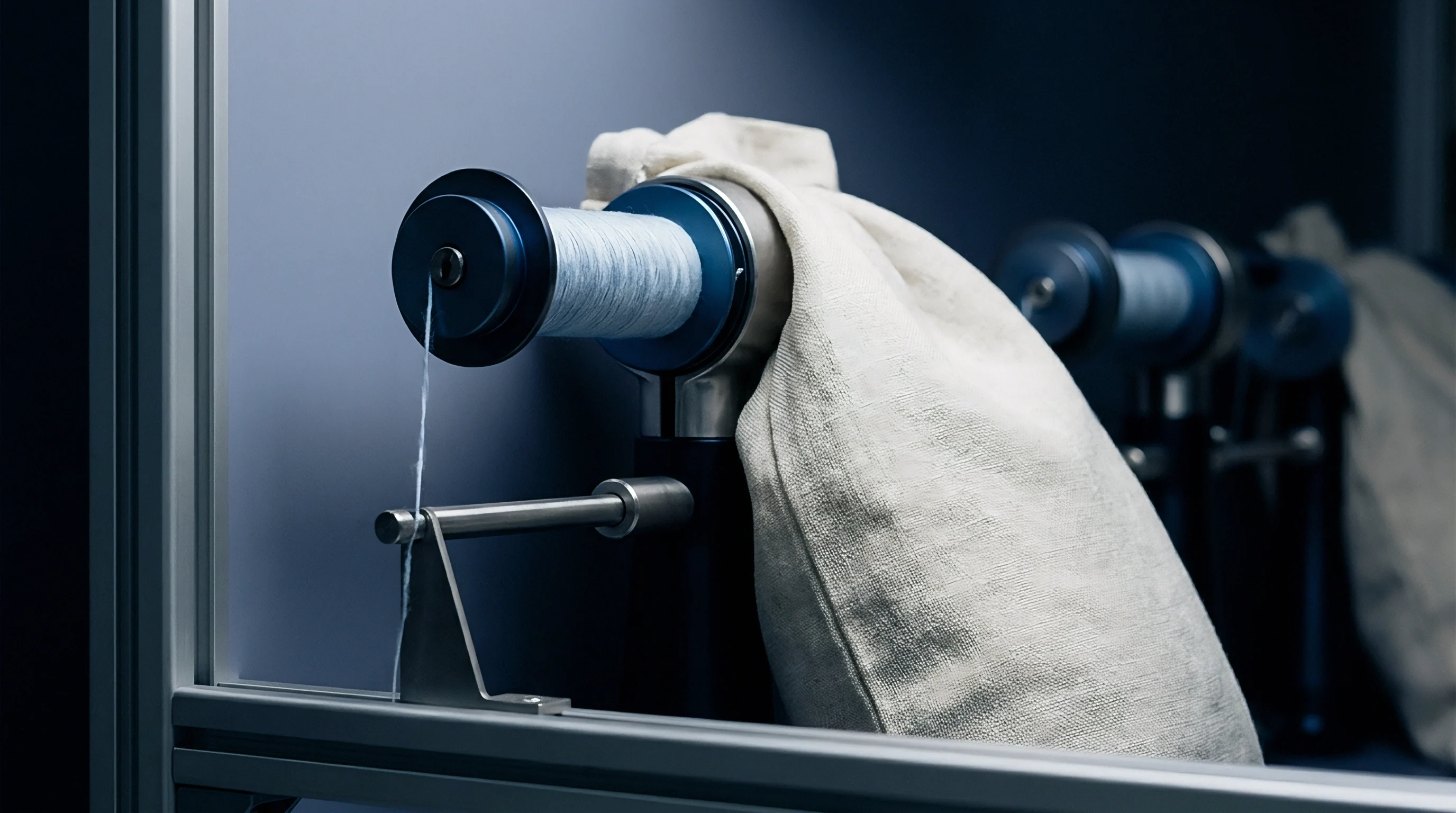
Cumulative Wrap Angles in Harness Geometry
Sequential guiding components act as a series of connected mechanical resistance multipliers. The output tension from the drop wire serves as the input tension to the heald eye, and the output tension from the heald eye feeds directly into the reed dent. In high-density linen sheds, tight warp spacing increases sideways contact against adjacent strands and harness eye edges, introducing secondary capstan contacts along the strand flanks.
| Weave Structure | Sett (ends/cm) | Cumulative Angle θ (rad) | Base Friction μ | Local RH (%) | Amplification Ratio (T2/T1) |
|---|---|---|---|---|---|
| 1/1 Plain Weave | 28 | 1.10 | 0.25 | 60 | 1.32 |
| 1/1 Plain Weave | 28 | 1.10 | 0.48 | 85 | 1.69 |
| 2/2 Twill | 34 | 1.35 | 0.25 | 60 | 1.40 |
| 2/2 Twill | 34 | 1.35 | 0.48 | 85 | 1.91 |
| 5-End Satin | 38 | 1.65 | 0.25 | 60 | 1.51 |
| 5-End Satin | 38 | 1.65 | 0.52 | 85 | 2.36 |
In order to qualify greige production lots for high-density technical requirements, buyers enforce specific verification protocols governing loom environment data streams.
- Harness Calibration Log documenting individual heald frame lift heights, drop wire bank clearance angles, and lease rod positions measured under static load.
- Shed Microclimate Records tracking continuous multi-point temperature and relative humidity values across the warp line during full-speed weaving runs.
- Tension Profile Telemetry recording peak fell tension values and end break frequencies per hundred thousand picks across every active loom line.
- Yarn Moisture History detailing incoming package moisture regain percentages, sizing add-on rates, and re-humidification dwell times prior to beam mounting.
Purchasing contracts incorporating ISO 13934 tension tolerances require shed climate log submissions alongside greige delivery notes to validate break rate claims.
Stiffness
Flax yarns exhibit rapid structural alterations when ambient moisture shifts the internal hydrogen bonding network. Fiber transverse swelling occurs rapidly upon water absorption, increasing yarn diameter while shortening effective strand length. In wet-spun linen strands, swelling forces elementary flax fibrils outward, increasing outer yarn density and altering flexural rigidity.
Higher flexural stiffness increases the force required to bend yarn around drop wire eyes and heald loops, effectively adding a mechanical bending moment component to classic capstan friction models.
Transverse swelling reduces physical clearance inside reed dents and drop wire eyelets. In high-density reed setups, such as a reed count of 140 dents per ten centimetres with two ends per dent, yarn diametral expansion of 15 percent reduces available air gap space by more than 40 percent. Warp strands pinch against reed wires, creating lateral normal forces that further amplify sliding tension.

Transverse Fiber Swelling in High Sett Reed Dents
Cross-sectional expansion of wet-spun strands reduces effective air gaps inside tight reed passages. When relative humidity spikes inside the shed zone, flax yarn diameter increases from an initial dry value of 0.18 millimetres to a hydrated value of 0.21 millimetres for Nm 60 count. Moisture swelling reduces reed clearance.
This dimensional expansion increases lateral friction against reed wires during sley movement. As the sley moves forward to beat up the pick, swollen warp strands drag forcefully along dent surfaces. The combination of capstan deflection tension and lateral swelling pressure creates extreme localized stress concentrations along the yarn sheath.
Standard ISO 3801 mass calculations fail when localized humidity variations alter yarn crimp and warp consumption per woven metre.

Dynamic Flexural Rigidity and Hysteresis
Bending resistance during rapid shed opening cycles depends directly on the moisture sorption history of the cellulose filaments. Wet-spun linen demonstrates distinct mechanical hysteresis during wetting and drying cycles. When absorbing moisture from an ambient environment, flexural rigidity drops initially as water acts as a plasticizer within amorphous cellulose zones.
However, as moisture content exceeds 12 percent by weight, transverse fiber crowding inside the twisted yarn geometry increases internal fiber-to-fiber pressure, increasing overall strand bending stiffness.
Higher flexural stiffness prevents the yarn from conforming smoothly to small guide radii. The yarn acts like a stiff beam rather than a flexible filament, shifting the physical contact point forward and increasing effective wrap angle theta. Bending stiffness hysteresis creates dynamic tension asymmetry between shed opening and shed closing strokes.
- Heald Eye Pinching occurs when transverse swelling drives yarn diameter beyond eyelet width tolerances, causing severe abrasion and filament stripping.
- Drop Wire Drag Spikes emerge when increased flexural rigidity prevents drop wire eyelets from aligning freely along the oscillating warp thread path.
- Reed Dent Binding develops as swollen adjacent strands contact each other inside dense reed dents, creating inter-yarn friction points.
- Static Shedding Floats result when high bending stiffness prevents warp threads from returning cleanly to the bottom shed line during harness lowering.
Whether enzymatic surface smoothing permanent treatments eliminate moisture-induced capstan amplification without degrading flax wet-tenacity remains unproven at production speeds exceeding six hundred picks per minute.

Breakage
Excessive yarn tension peaks frequently exceed the ultimate tensile boundary of fine wet-spun linen strands. Wet-spun linen exhibits high tenacity but extremely low tensile strain at break, typically between 1.8 and 2.5 percent elongation. Unlike elastomeric or synthetic yarns that yield under tension spikes, flax yarn breaks abruptly once load exceeds elastic limits.
Capstan tension amplification converts moderate backrest tensions into destructive stress peaks at the heald eye and beat-up points. Higher friction escalates end breaks.
Tension spikes cause warp stops. Accumulated capstan amplification along the warp line triggers end breakage clusters during peak shedding movements. Repeated mechanical stress combined with friction-induced surface abrasion weakens outer yarn fibrils, causing bundle disruption, slub formation, and eventual tensile collapse.
Peak Tension Dynamics during Beat Up
Shed movement combines with sley acceleration to create sharp stress transients at the fell of the cloth. Beat up forces peak stress. During beat up, the sley pushes the newly inserted weft thread into the cloth fell while heald frames cross to lock the pick.
The simultaneous geometric deflection of warp threads creates peak wrap angles theta across all guiding elements.
When relative humidity gradients elevate local friction mu during this critical crossing millisecond, tension amplification reaches maximum severity. Dynamic strain sensors record transient tension spikes exceeding 180 grams per end on Nm 60 linen. Because single-thread tensile strength for Nm 60 flax averages 210 grams, these capstan-amplified spikes consume over 85 percent of total yarn strength margins, driving premature strand failure.
Uncontrolled loom microclimates increase warp end break frequency from two stops per loom hour to over twelve stops per loom hour.

Stop Rates and Greige Quality Degradation
Automatic loom sensors trip when single strands fail, halting the weaving cycle and leaving visible horizontal marks across the web. High warp stop rates destroy loom shed operating efficiency and severely impair finished cloth appearance. Every automatic stop creates potential starting marks, pick bars, or density variations in the greige fabric.
To reduce moisture-driven tension amplification and restore acceptable end break rates, loom technicians follow a standard shed optimization sequence.
- Lower backrest roller height by ten millimetres to reduce total shed opening stroke deflection angle theta across active harness frames.
- Adjust lease rod positioning rearward toward the warp beam to distribute deflection arcs over longer yarn lengths.
- Increase ultrasonic misting humidification misting rates directly beneath the warp sheet to maintain uniform seventy percent relative humidity.
- Reduce loom operational speed from 550 picks per minute to 460 picks per minute, decreasing dynamic strain rates during beat up.
| Shed RH Control Strategy | Loom Speed (ppm) | Warp Breaks per 10^5 Picks | Loom Efficiency (%) | Yield Cost per Metre (USD) |
|---|---|---|---|---|
| Uncontrolled Ambient (55-85% RH Gradient) | 520 | 14.8 | 64.2 | 4.18 |
| Standard Overhead Air Conditioning (65% RH) | 500 | 8.2 | 76.5 | 3.51 |
| Localized Under-Warp Ultrasonic Mist (72% RH) | 500 | 2.1 | 89.4 | 3.02 |
| Optimized Microclimate + Reduced Lift Angle | 460 | 0.9 | 93.1 | 2.88 |
Uncontrolled capstan tension amplification elevates warp break rates above tolerable thresholds, converting premium loom hours into high-defect clearance greige.
Allowance
Shed managers account for localized moisture variations when calculating loom hour targets and setting production quotes. Weaving high-density wet-spun linen requires precise physical plant environmental engineering coupled with conservative loom capacity booking calculations. Relying on general room HVAC sensors leads to underestimated warp stop rates and unexpected margin erosion during seasonal climate shifts.
Accounting for capstan amplification requires integrating microclimate controls directly onto loom frames. Modern high-density linen sheds deploy targeted micro-zone conditioning units beneath each warp line, ensuring stable relative humidity levels along the entire yarn path. These investments protect yarn structural integrity, stabilize capstan amplification ratios, and maintain scheduled weaving output speeds.
Environmental Shed Control Engineering
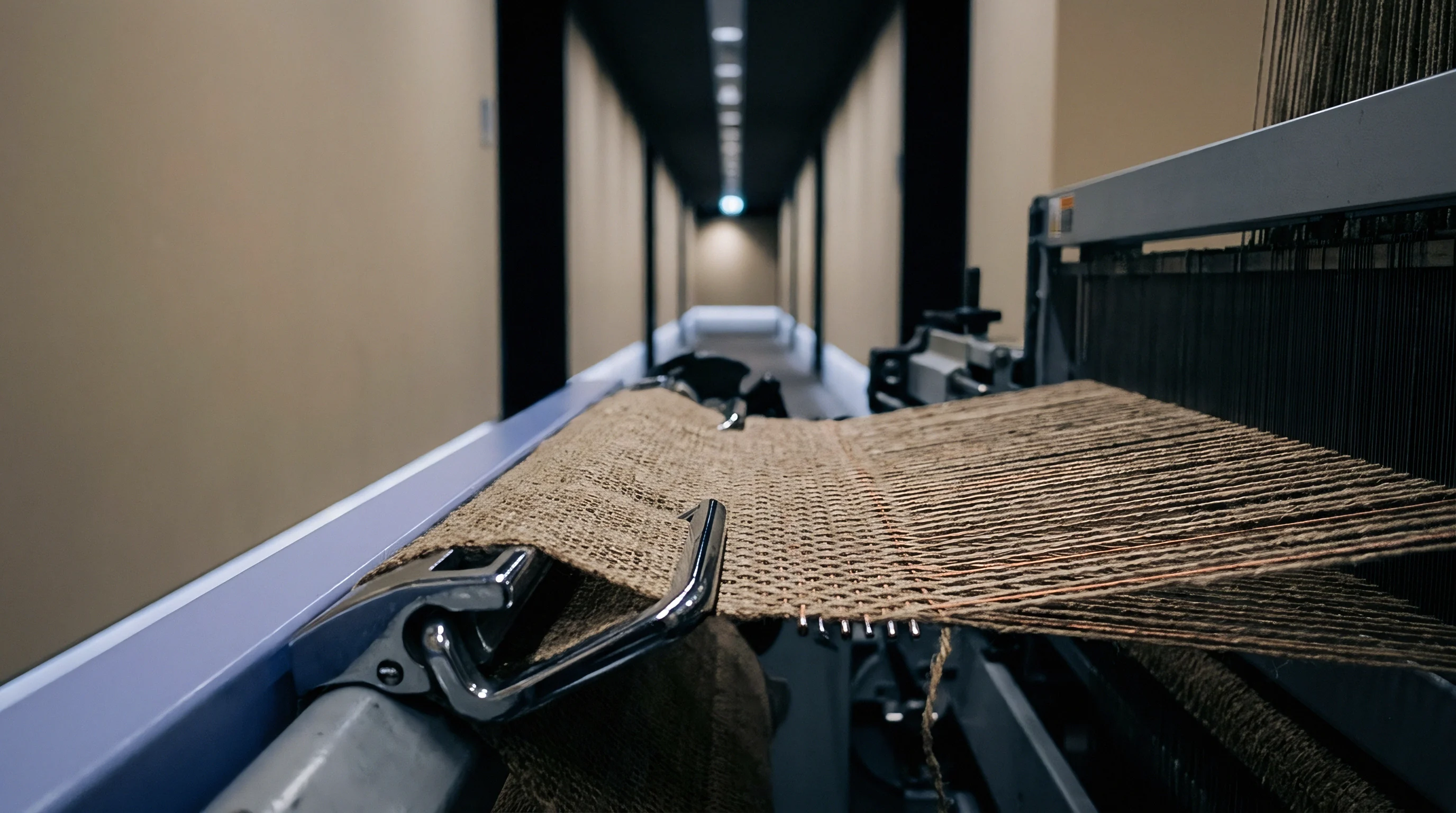
High-pressure atomizing nozzles mounted directly under the loom arch stabilize local moisture levels surrounding the harness. Maintaining relative humidity within a tight band between 68 and 72 percent prevents pectin softening while preserving flax fiber suppleness. Direct air velocity over the warp sheet must stay under 0.2 metres per second to eliminate evaporation rate spikes.
Thermal isolation shielding placed between loom drive motors and rear warp sheets prevents thermal plumes from establishing microclimatic gradients across drop wire banks. Eliminating vertical temperature shifts maintains consistent yarn moisture content throughout active weaving cycles.

Commercial Capacity and Loom Hour Surcharges
Weaving mills charge higher hourly machine rates for dense wet-spun linen orders to offset reduced operating speeds. When running sett densities exceeding 30 ends per centimetre in fine linen counts, loom hour bookings must incorporate a 15 to 25 percent capacity allowance for speed reductions and weaver interventions. Pricing structures reflect this loom time consumption directly on quotation line items.
Sourcing managers evaluate supplier shed capabilities using a strict qualification checklist before committing long-run production orders for fine wet-spun linen fabrics.
Verification of under-warp ultrasonic humidification capacity ensures the shed maintains stable relative humidity across every harness zone. Inspection of drop wire bank geometric alignments confirms contact angle theta remains minimized throughout shedding lifts. Verification of automated tension logging telemetry guarantees continuous monitoring of peak fell loads during beat up cycles.
Confirmation of scheduled loom speed derating policies verifies the mill operates high-density linen warps within safe tensile strain limits.
Factoring microclimate stability and capstan tension amplification into initial construction specifications prevents costly delivery delays, protects greige quality standards, and secures predictable landed costs per metre across complex cross-border supply chains.