Predictive Weibull Failure Modeling of Wet Spun Bast Yarns under High Tension Shedding
Predictive Weibull modeling identifies weak-link bast yarn flaws to optimize shed tension, preventing warp breaks and protecting high-speed loom yield.
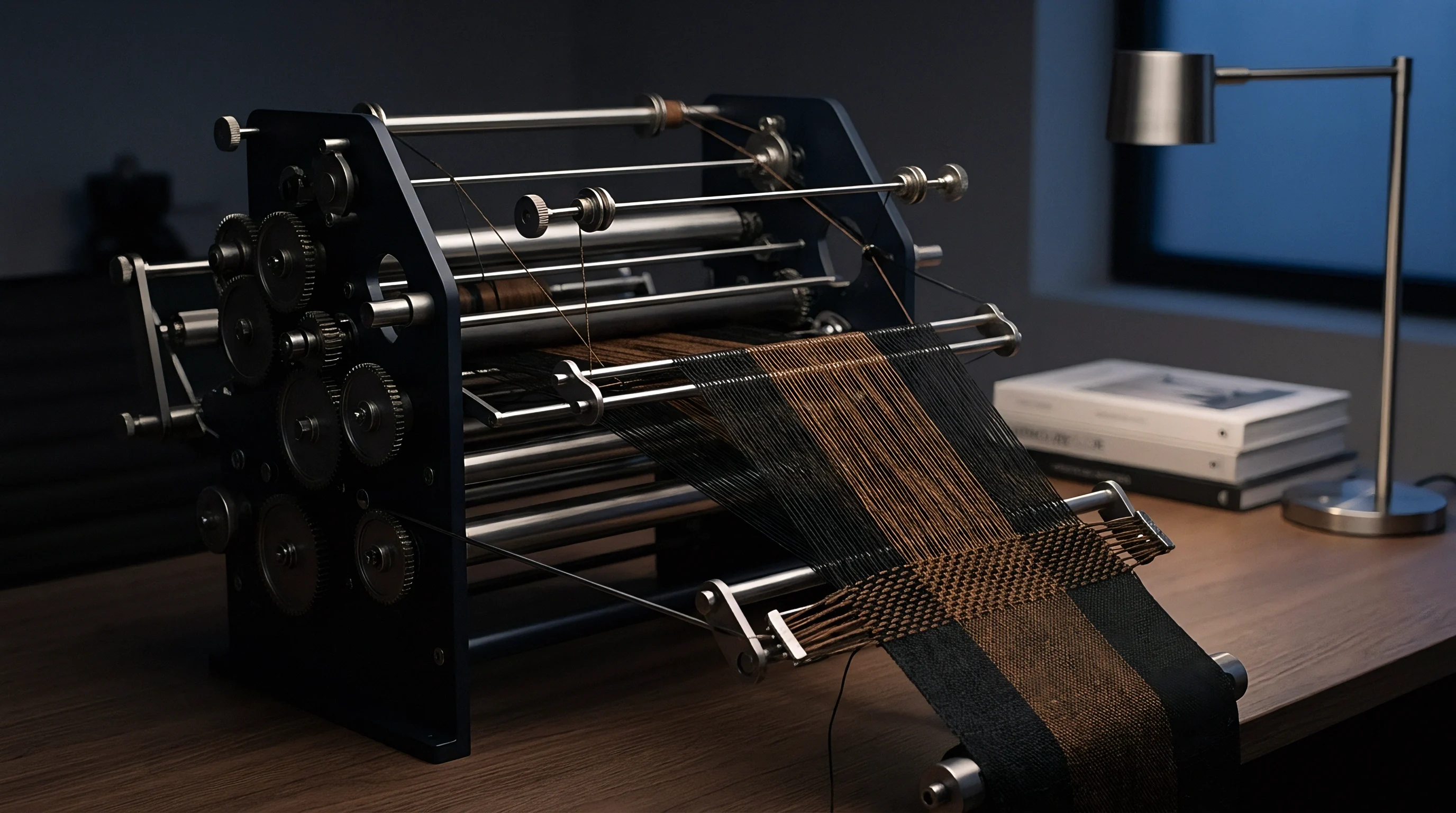

Flaw
The mechanical response of wet spun bast yarn comes down to its internal hierarchy. Continuous synthetics run uniform throughout, and ring-spun cotton relies on predictable staple lengths, but wet spun flax is assembled from short ultimate fibers encased in a matrix of non-cellulosic pectins and hemicellulose. Passing the roving through a hot water bath softens those pectins, allowing the ultimates to slide past one another and align axially before twist is inserted.
That rearrangement yields high tensile alignment, but it leaves irregularities down the length of the strand. Defects bunch up where ultimate fiber tips terminate, or where scutching and decortication crushed kink bands into the cell walls.
Under axial load, tension transfers across adjacent ultimates through shear stresses within the middle lamella. When the local pectin matrix yields, or where fiber orientation angles away from the strand axis, stress concentrates directly on individual fiber tips. Tensile failure begins at these weak points well before the cross-section approaches its theoretical average strength.
| Yarn Count (Nm) | Linear Density (tex) | Mean Tenacity (cN/tex) | Tenacity Mass CV (%) | Defect Density (per 1000m) |
|---|---|---|---|---|
| Nm 26 | 38.5 | 24.2 | 14.8 | 18.5 |
| Nm 39 | 25.6 | 26.8 | 16.2 | 24.1 |
| Nm 50 | 20.0 | 28.5 | 17.5 | 31.0 |
| Nm 60 | 16.7 | 29.1 | 19.1 | 42.3 |
Irregular linear density magnifies these localized stress peaks during weaving. Finer yarns like Nm 60 carry a broader mass CV than coarser counts, packing more defects into every kilometer and shrinking the spacing between structural flaws. High defect density lowers the minimum load needed to trigger a catastrophic break across the yarn diameter.
The physical strength of wet spun flax depends on the shear integrity of the inter-fiber pectin matrix rather than the ultimate tensile limit of individual cellulose fibrils.
Bundle length distributions create additional mechanical instability. Long technical fibers carry dislocation nodes that focus stress under lateral pressure, while uneven twist distribution leaves alternating zones of hard and soft compaction. In those looser spots, friction between ultimates collapses, leaving the strand vulnerable to inter-fiber pull-out under tension.
Draft zones set incorrectly during spinning multiply these structural voids through the package. Static lab tests regularly miss their operational consequences; mills that gauge yarn quality strictly by mean tenacity routinely overestimate warp performance on high-speed looms.
Overlooking the low-tenacity tail of the distribution leads straight to shedding breaks, persistent loom downtime, and downgraded greige rolls.

Cyclics
Shedding on a high-speed loom hammers warp ends with rapid, cyclic extension. Where cotton or wool yields elastically, flax has almost no give, reaching ultimate tensile extension between 1.5 and 2.5 percent strain. Without elastomeric recovery, the yarn must absorb every dynamic cycle through inter-fiber friction and slight elastic deformation within its crystalline cellulose regions.
Peak dynamic tension hits the ends during three distinct phases: shed opening, open-shed dwell, and beat-up. Opening forces the threads apart across the shed angle. Dwell sustains that maximum extension while the insertion element traverses the warp sheet.
Then beat-up drives a sharp lateral strain pulse into the yarn as the reed pushes the pick into the cloth fell.
- Inter-fiber slip accumulation loosens the mechanical interlock between ultimate fibers, causing the yarn to neck down incrementally over successive cycles.
- Structural fibrillation splits fiber bundles lengthwise along the middle lamella under tension and friction across the backrest.
- Abrasion fatigue strips size off the yarn surface, letting loose fiber ends fluff out and snare neighboring ends.
- Flexural micro-cracking fractures brittle nodes as ends bend sharply through drop wires, heddle eyes, and reed dents.
Warp failure during shedding is rarely a single-overload event. Dynamic fatigue degrades internal yarn cohesion across thousands of cycles, letting micro-cracks propagate at defect sites until the remaining intact cross-section snaps under peak shed tension.
ISO 2062 single end tensile testing fails to predict dynamic weaving break rates because standard static pull methods ignore structural fatigue from cyclic shed opening.
Loom speed directly interferes with stress relaxation in the yarn. Above 400 picks per minute, the interval between shed openings falls below the relaxation time constant of wet bast fiber. Residual tension carries over into the subsequent stroke, stacking stress until baseline operating tension drifts well above design targets.
High sizing add-on is often expected to stop shedding fatigue breaks, yet while starch coats the yarn exterior, it cannot shield the core from cyclic shear failure between ultimate fibers under repeated strain.
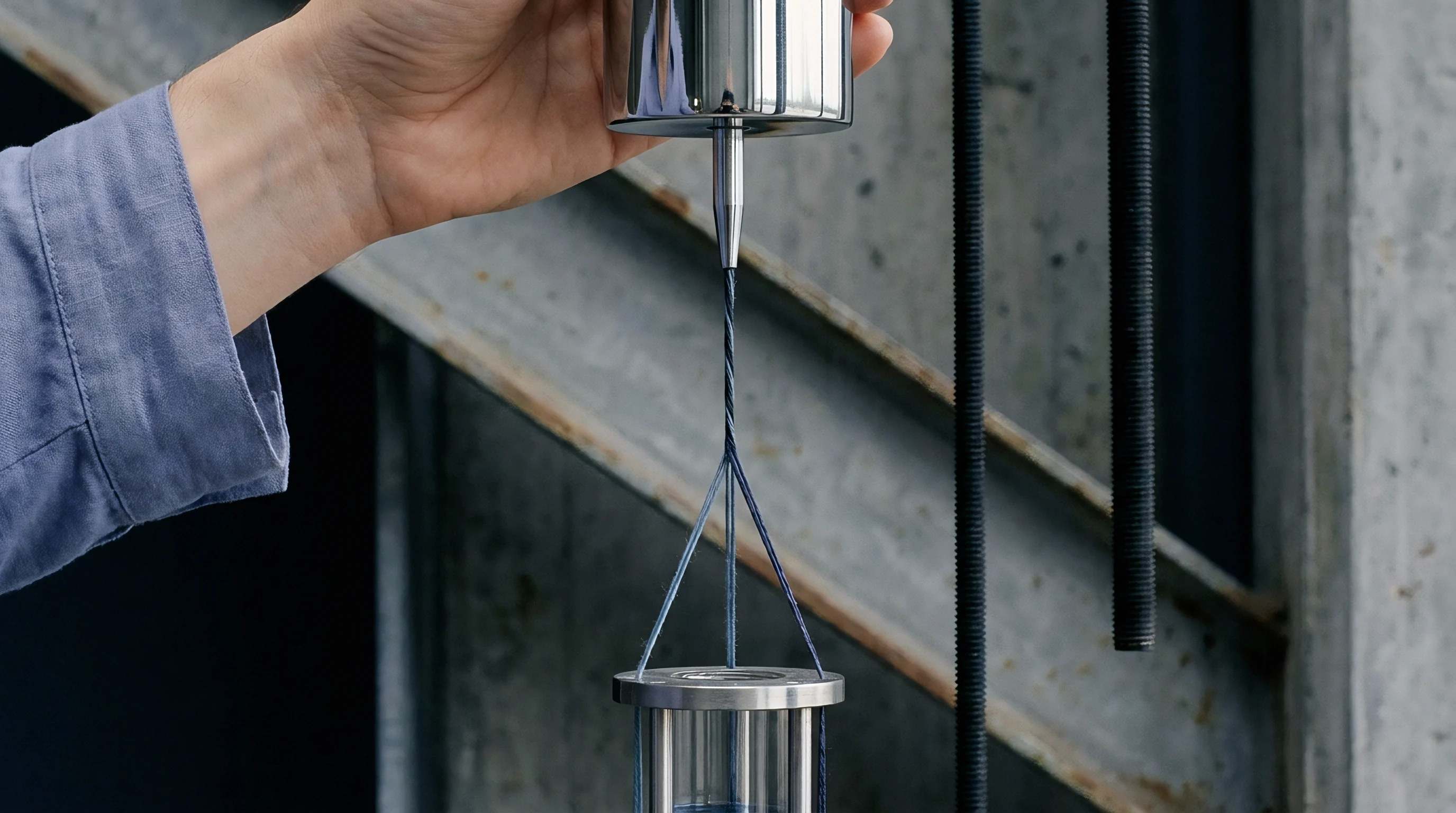
Weibull
Assessing break rates in wet spun bast yarn calls for statistics geared toward skewed defect distributions. Standard Gaussian models fall flat here because yarn breaks follow weakest-link mechanics rather than mean strength. A two-parameter Weibull distribution gives a more realistic framework for evaluating failure under cyclic loom loads.
The cumulative failure probability of a yarn thread line under applied tensile stress is expressed by the standard two-parameter Weibull distribution function:
P_f = 1 – exp( – ( sigma / sigma_0 )^m )
Here, m is the Weibull modulus ~ a dimensionless shape factor that reflects strength consistency. Lower values point to high defect variance and broad scatter, while higher values mean a more uniform yarn. The scale parameter, sigma_0, represents the characteristic stress level where 63.2 percent of tested specimens fail.
Wet spun bast yarns post exceptionally low shape values compared to synthetics. Where continuous filaments typically score an m between 12 and 18, wet spun linen lands between 2.8 and 5.2. Natural fluctuations in fiber length, uneven pectin distribution, and scutching bruises all contribute to this wide spread.
An Nm 39 warp running under shedding load highlights just how sensitive the distribution is. Given a characteristic strength scale parameter of 30.0 cN/tex and a Weibull modulus of 3.6, the cumulative failure probability at a peak shedding stress of 18.0 cN/tex evaluates as:
P_f = 1 – exp( – ( 18.0 / 30.0 )^3.6 )
P_f = 1 – exp( – ( 0.6 )^3.6 )
P_f = 1 – exp( – 0.1585 ) = 0.1465
At 18.0 cN/tex, roughly 14.65 percent of yarn segments exposed to the tension pulse will snap. Lowering peak shed tension to 12.0 cN/tex changes the picture entirely:
P_f = 1 – exp( – ( 12.0 / 30.0 )^3.6 )
P_f = 1 – exp( – ( 0.4 )^3.6 )
P_f = 1 – exp( – 0.0362 ) = 0.0356
Shaving 33 percent off peak tension slashes the break probability by 75 percent ~ a direct consequence of the power-law scaling set by m.
| Peak Dynamic Stress (cN/tex) | Weibull Modulus m = 3.0 | Weibull Modulus m = 4.0 | Weibull Modulus m = 5.0 | Weibull Modulus m = 6.0 |
|---|---|---|---|---|
| 10.0 | 0.0360 | 0.0122 | 0.0041 | 0.0014 |
| 14.0 | 0.0965 | 0.0463 | 0.0219 | 0.0103 |
| 18.0 | 0.1942 | 0.1215 | 0.0744 | 0.0450 |
| 22.0 | 0.3253 | 0.2507 | 0.1883 | 0.1396 |
| 26.0 | 0.4784 | 0.4300 | 0.3813 | 0.3347 |
Whether a two-parameter equation adequately captures a non-zero minimum strength threshold, or whether weaving mills require a three-parameter Weibull model with a location parameter sigma_u, remains an active area of investigation.
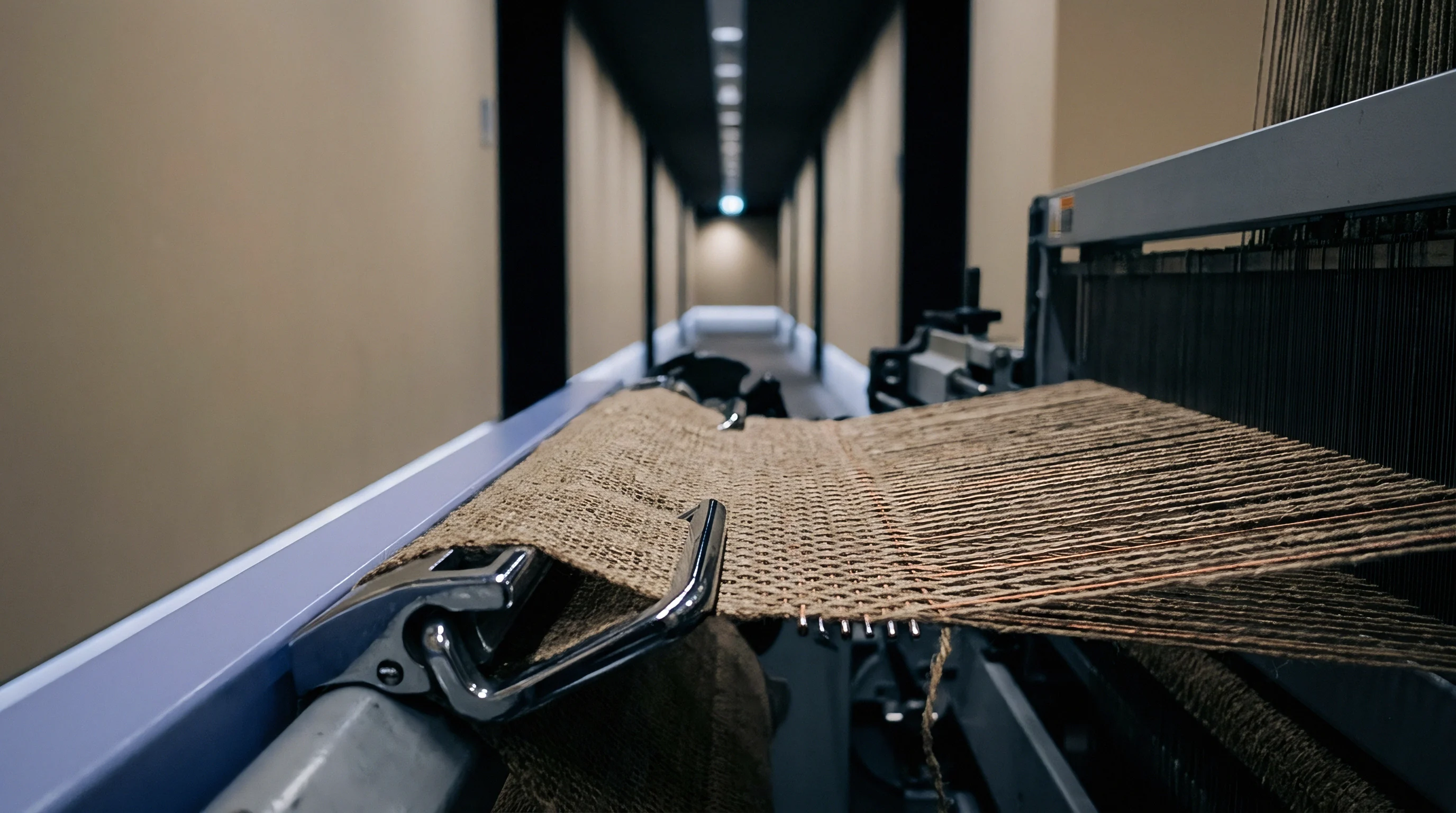

Tension
Loom geometry determines the dynamic tension spikes hitting the warp ends during weaving. Backrest height and depth, shed angle, harness stroke, and let-off rates establish the strain profile along the line. Wet spun linen demands fairly stiff static tension just to pull a clean shed, since taut ends are less likely to cling together when surface fuzz bridges the clearance space.
Raising static tension shifts the baseline upward, compounding the dynamic strain pulse generated as the harnesses open. Once that combined load presses into the lower tail of the Weibull curve, end breaks climb exponentially.
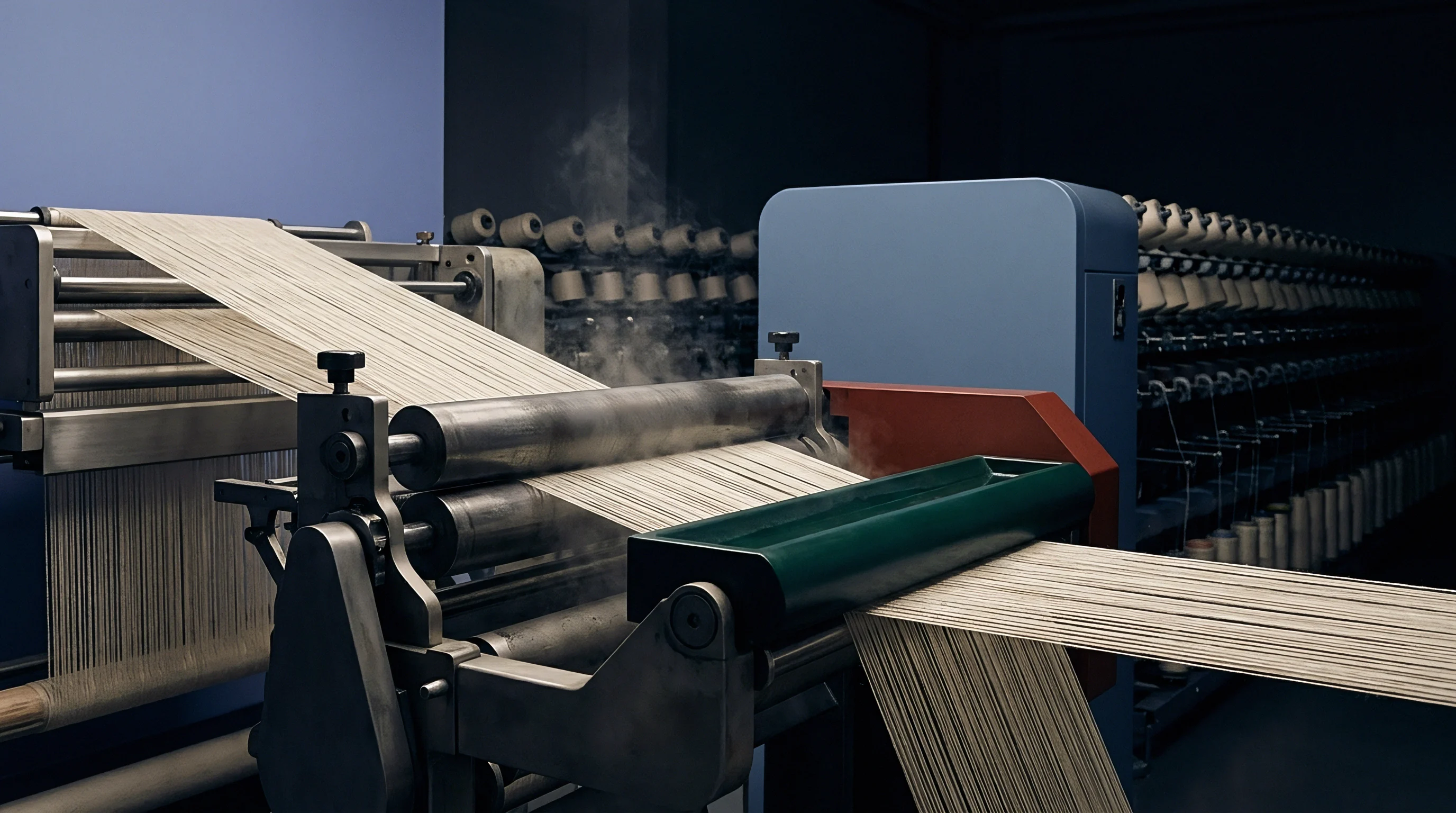
At What Peak Stress Does Bast Yarn Scale Fail?
Breakage takes off when combined static tension, shed lift, and beat-up cross the point where flaws propagate freely along fiber interfaces. In high-speed rapier and air-jet weaving, beat-up produces transient spikes lasting under ten milliseconds. These brief pulses frequently exceed static break values because the inelastic bast bundles cannot relax quickly enough to share load across adjacent threads.
| Shed Depth (mm) | Backrest Displacement (mm) | Static Tension (cN/tex) | Dynamic Peak Stress (cN/tex) | Calculated Failure Rate (P_f) |
|---|---|---|---|---|
| 65 | 12 | 4.5 | 13.2 | 0.022 |
| 72 | 10 | 5.5 | 16.8 | 0.054 |
| 80 | 8 | 6.5 | 21.0 | 0.142 |
| 88 | 5 | 8.0 | 26.4 | 0.318 |
Mitigating these spikes requires an active backrest. Synchronizing backrest oscillation with the harness cycle feeds slack into the warp as the shed widens, paring peak dynamic strain by up to 35 percent. If the backrest slips out of phase with the main shaft, however, tension peaks hit while ends are half-open, accelerating reed chafing.
As an operating rule, opening shed height to clear clinging ends inflates breakage rates much faster than fine-tuning warp let-off tension.
Tolerances
Lab tensile figures cannot be applied directly to loom settings without gauge length corrections. ISO 2062 tests run at a 500-millimeter gauge length, but in the loom, warp ends carry active cyclic tension across the entire span from backrest roller to cloth fell ~ a working zone of 1200 to 1800 millimeters.
Pierce weakest-link theory dictates that longer yarn segments possess a higher probability of containing a severe structural flaw. To scale the Weibull characteristic parameter from laboratory test length to active loom gauge length, the theoretical scaling equation applies:
sigma_{L2} = sigma_{L1} ( L_1 / L_2 )^( 1 / m )
For an Nm 39 linen yarn with m = 3.8 and a characteristic strength of 28.0 cN/tex at 500 mm (L1), the projected strength across a 1500 mm active span (L2) scales down accordingly:
sigma_{1500} = 28.0 ( 500 / 1500 )^( 1 / 3.8 )
sigma_{1500} = 28.0 ( 0.3333 )^0.2632
sigma_{1500} = 28.0 0.7475 = 20.93 text{ cN/tex}
That 25.2 percent drop in effective strength is purely a function of the longer active span. Quality specifications that overlook length scaling systematically overestimate what long warp ends can bear.
- Sample at least 100 individual package ends per yarn lot using automated high-speed single yarn tensile testers to capture low-probability tail flaws.
- Fit tensile break data to a two-parameter Weibull model using maximum likelihood estimation methods to isolate the shape parameter m and scale parameter sigma_0.
- Scale calculated scale parameters to active loom shed gauge length using Pierce length transformation formulas before finalizing loom setup limits.
- Calculate maximum allowable peak dynamic shed tension based on a target failure threshold under 0.005 breaks per thousand meters run.
- Audit sizing take-up percentage and moisture regain levels prior to beam winding to confirm uniformity of yarn modulus.
Under international linen trade regulations, warp-grade purchasing contracts specify single-end strength compliance via ISO 2062 testing, setting a minimum accepted Weibull modulus of 3.5.
Yield
The commercial reality of weaving linen hinges on how these break probabilities translate into loom uptime. Every warp stop generates a fabric defect and ties up an operator. Weaving mills track stops per 100,000 picks; when that figure creeps up, allocations shrink, weavers attend fewer machines, and landed cost per meter rises quickly.
Loom stops per 100,000 picks increase exponentially when warp yarn Weibull shape parameters drop below 3.2 under standard shed operating tensions.
Loom efficiency measures picks inserted over a shift against theoretical machine capacity. Each broken end requires a weaver to trace the failure, draw the yarn through drop wire, heddle eye, and reed dent, and either knot or thermally bond the tail. Repair downtime typically ranges from one to three minutes depending on warp density and harness accessibility.
| Weibull Modulus (m) | Warp Breaks per 10^5 Picks | Loom Efficiency (%) | Daily Output per Loom (m) | Weaving Cost per Metre (USD) |
|---|---|---|---|---|
| 2.8 | 14.2 | 71.5 | 185 | 2.48 |
| 3.4 | 6.8 | 83.2 | 215 | 2.13 |
| 4.0 | 3.1 | 90.4 | 234 | 1.96 |
| 4.6 | 1.2 | 94.8 | 245 | 1.87 |
An efficiency drop from 90.4 percent to 71.5 percent raises weaving costs by 26.5 percent per meter. The higher break frequency forces management to cut weaver assignments from 16 looms down to 8, effectively doubling direct labor overhead on every meter of greige cloth.
Warp allocation comes down to pairing Weibull parameters with machine capabilities. Air-jets combine high dynamic insertion tension with aggressive shedding cycles, demanding tighter yarn consistency ~ and thus a higher modulus ~ than slower rapier looms. Sizing formulations have to compensate where possible, gluing down protruding fuzz and reinforcing weak spots to lift effective yarn uniformity.
Weaving economics balance raw yarn invoice prices against calculated shed losses. Buying cheaper wet spun yarn with an m of 3.0 rather than a premium lot at 4.2 cuts initial purchasing outlay, but elevated stops, lost production, and weaver re-draws wipe out those procurement savings within the first twenty thousand meters.
- Yarn selection limit requires a certified minimum Weibull modulus m of 3.8 for rapier sheds operating at speeds above 350 picks per minute.
- Shed geometry setting caps peak dynamic warp strain below 65 percent of length-scaled characteristic strength sigma_0.
- Moisture control target holds weaving shed relative humidity between 70 and 75 percent to preserve inter-fiber pectin toughness in wet spun flax.
- Efficiency floor baseline rejects warp yarn lots whose predicted stop rate exceeds 4.5 breaks per 100,000 picks under target loom speeds.
Weave structure also alters dynamic strain across the reed width. A tight plain weave creates far more beat-up resistance than an open twill, sending heavier shock pulses back to the fell. Tuning warp sett and pick density adjusts the peak forces hitting flawed segments.
Integrating Weibull failure estimates into fabric development helps confirm that a construction can actually run at industrial speeds without overstressing the yarn or stalling the shed.