Modeling Cyclic Strain Rupture Mechanisms in Fine Wet Spun Linen Shedding Operations
Fine wet spun linen warp breaks are minimized by capping dynamic shed strain below 2.0% through asymmetric back-rest tuning and controlled relative humidity.

Kinematics
Fine wet spun linen yarns show marked rigidity under dynamic tension during high-speed weaving. Flax fibers have a steep initial modulus and an ultimate elongation that usually tops out between 1.8 percent and 2.2 percent. At four hundred picks per minute, harness frames complete full shedding cycles every one hundred and fifty milliseconds, stretching warp ends cyclically according to shed geometry and frame position.

Geometry of Harness Displacement
Calculating yarn displacement requires measuring the runs from the drop-wire box to the heald eye, and from the eye forward to the cloth fell. Fine wet spun yarns of count Nm 60 (16.6 tex) have a tight, smooth cross-section because the pectin binder resolidifies during processing. This structure cannot easily distribute sudden local stresses across neighboring bundles.
Linear strain rises sharply as the crank angle approaches ninety degrees and two hundred and seventy degrees, where the shed reaches peak opening.
Lifting the front harness frame twenty-two millimeters for rapier insertion stretches the yarn along a lengthened path. With a nine hundred millimeters span from back-rest roller to fell, that twenty-two millimeters lift adds roughly 1.85 millimeters of geometric stretch per cycle. Across the active shedding zone, baseline static tension accounts for 1.45 percent strain, but dynamic effects from electronic let-off response drive transient peaks beyond 2.1 percent.
Cyclic tensile extensions above two point three percent on Nm 60 wet spun flax generate cumulative micro-damage that reduces residual single-end break strength within four thousand cycles.

Peak Extension Calculations
Modeling cyclic warp strain divides the sheet into three distinct regions: the back-rest span, the harness zone, and the beat-up zone at the reed. Differences between dry and conditioned states shift how much stress individual ends absorb. At twenty degrees Celsius and sixty-five percent relative humidity, moisture regain settles near twelve percent, yielding the maximum plastic strain possible before fibrils begin slipping.
Running at higher speeds accelerates strain delivery. At five hundred picks per minute, deformation across the opening shed hits 0.35 meters per second. Because the pectin binder cannot flow on millisecond timescales, fine wet spun yarns respond with elevated peak stress.
| Shed Lift (mm) | Loom Speed (rpm) | Static Tension (cP/end) | Dynamic Peak Strain (%) | Calculated Stress (cN/tex) |
|---|---|---|---|---|
| 18.0 | 350 | 45 | 1.32 | 14.8 |
| 20.0 | 400 | 50 | 1.68 | 18.5 |
| 22.0 | 450 | 55 | 2.05 | 22.1 |
| 24.0 | 500 | 60 | 2.42 | 26.4 |
Shedding geometry also disrupts tension balance between the front and rear frames. Rear harnesses must travel further vertically to clear the shed line at the fell, loading extra strain onto frames five through eight in dense plain or twill weaves.
Hysteresis
Cycling linen warp yarns below their ultimate tensile limit still alters their internal structure. Flax is composed of crystalline cellulose microfibrils encased in an amorphous pectin and hemicellulose matrix. In slow static tests, it strains linearly before showing mild yield, but during rapid shedding cycles, the brief dwell at full extension leaves too little time for the fibers to recover before the next cycle starts.

Viscoelastic Energy Dissipation
Energy delivered during shed opening splits between elastic storage and frictional heat dissipation. The area within the dynamic stress-strain loop reflects this cycle-by-cycle energy loss. Fine wet spun linen dissipates substantial energy here because the individual technical fibers are locked tightly into place during spinning.
Unrecovered strain slowly turns into permanent thread creep. Over tens of thousands of cycles, baseline tension drops, shrinking the working shed opening and gradually throwing off shed geometry.
Moisture Sensitivity in Wet Spun Fibres
Weave room humidity governs this hysteretic behavior. Water molecules enter the amorphous zones of the flax, softening inter-fibrillar pectin bonds so crystalline regions can slide more smoothly under tension.
Operating outside a fifty-eight percent to seventy-five percent relative humidity band degrades shedding immediately. Drier air leaves the pectin stiff and brittle, turning what would be gradual fatigue into sudden yarn fractures. Excessive moisture makes the pectin tacky, causing adjacent warp ends to cling during the harness cross.
- Inter-fiber shear yield occurs when high peak strain forces technical fiber bundles to slip past one another within the yarn core, permanently thinning the thread cross-section.
- Pectin matrix crystallization develops under localized thermal energy buildup during continuous high-frequency extension cycles, causing micro-fractures in the binder layer.
- Fibril decohesion manifests as longitudinal splitting along single fiber walls, producing fine surface micro-flaws that catch on adjacent heald wires.
- Permanent tension decay results from accumulated unrecovered viscous flow, reducing warp sheet stiffness and causing drop-wire mechanical faults.
Under international contract terms based on ISO 13934-1 testing standards, grey linen cloth tensile specifications demand minimum un-aged breaking force thresholds that accounts for dynamic fatigue degradation occurring during weaving.
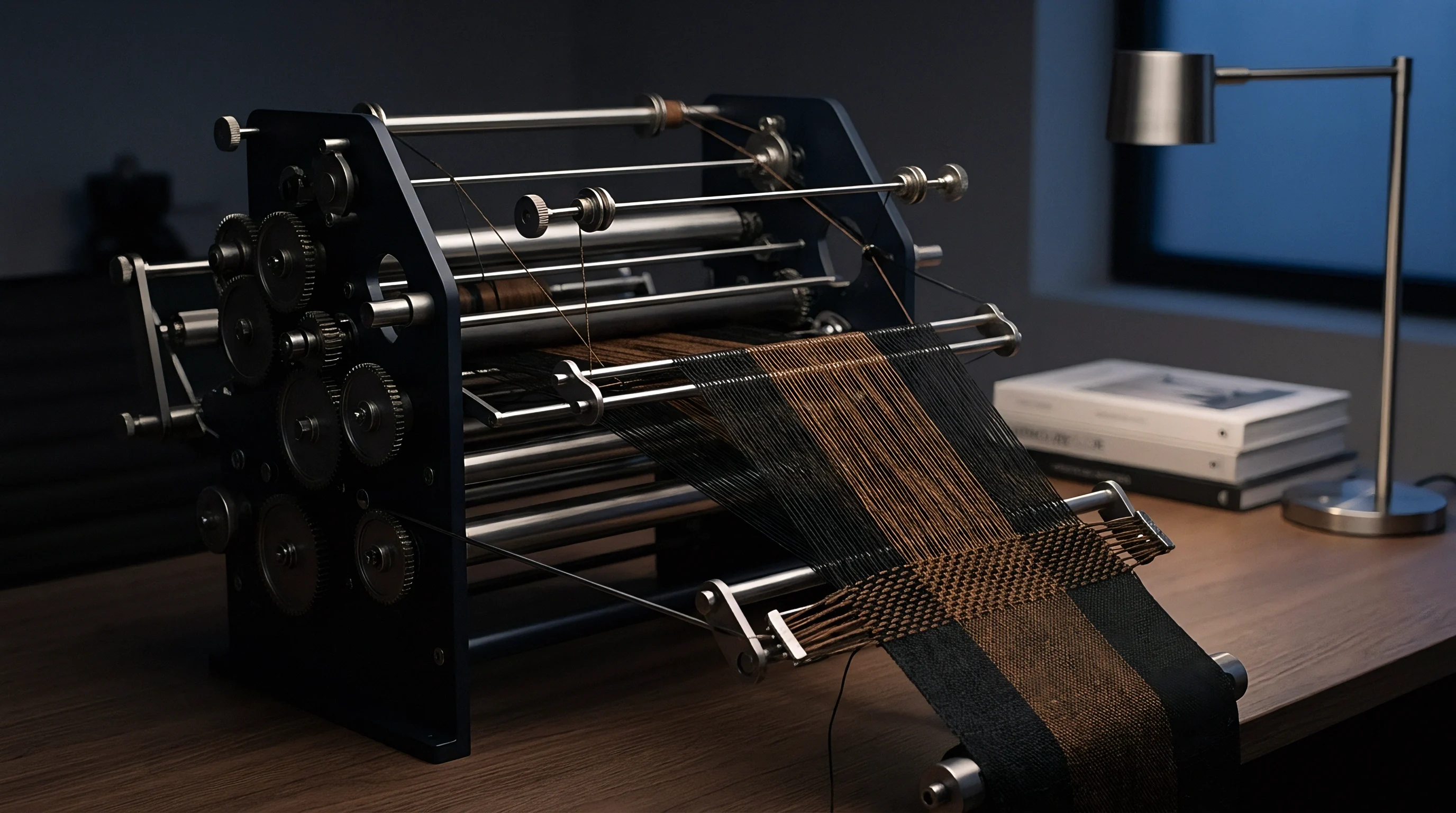

Reed
Friction against metal loom components compounds the mechanical stress on warp ends as they move through drop wires, healds, and reed dents. In fine linen, reed counts frequently exceed two hundred ends per ten centimeters, leaving narrow clearances between adjacent wires.
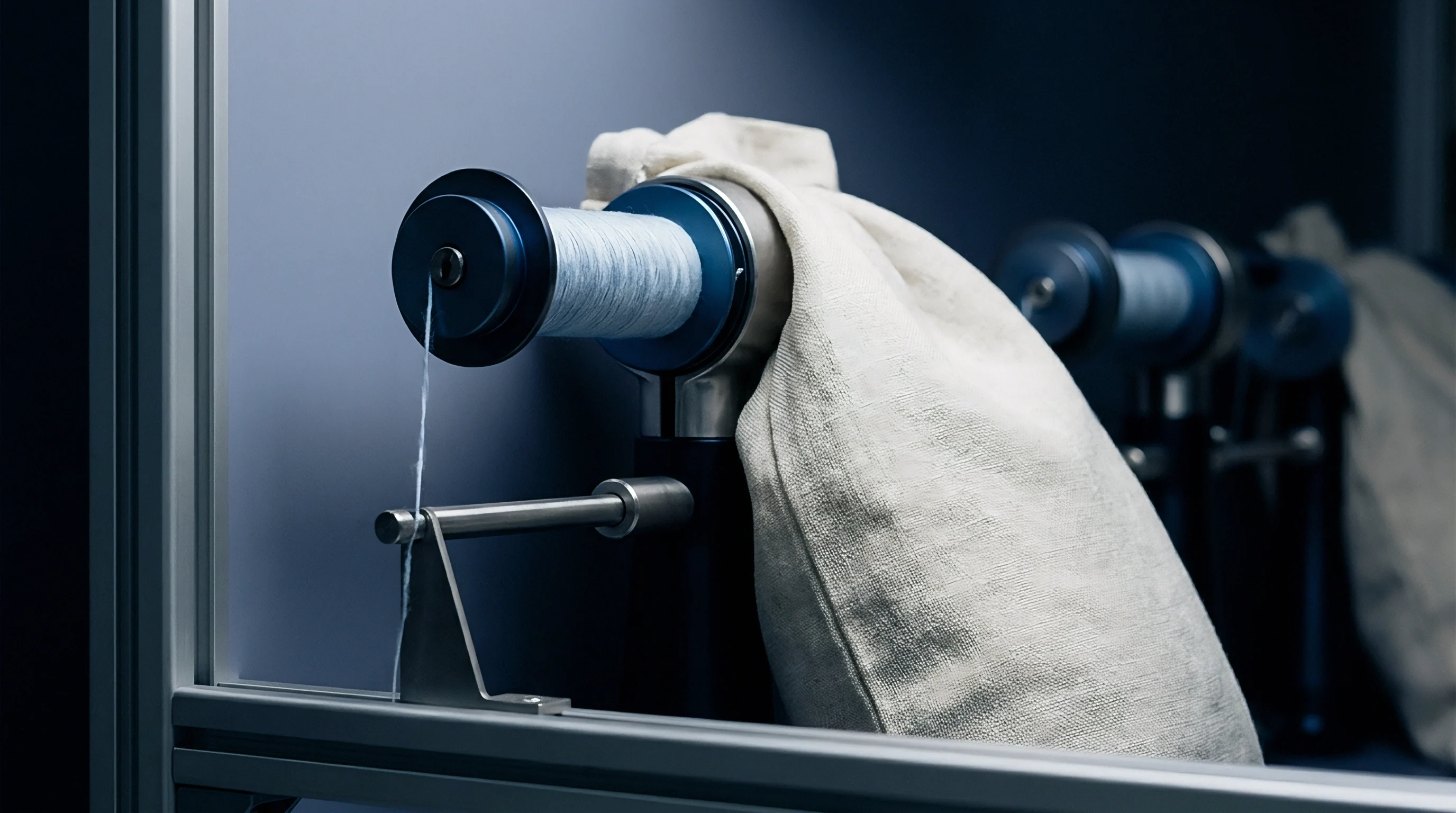
Frictional Drag across Dents
Reeds subject yarns to sliding friction during beat-up and lateral pressure as the shed opens. Even with smooth, low-roughness stainless steel wires, the uneven surface of wet spun flax creates localized pressure points that wear down protective sizing.
Once the size film rubs away, bare flax contacts the metal directly. The coefficient of friction jumps from 0.18 on sized yarn to 0.34 on bare thread, driving up effective tension between the harness frame and the fell.
Does Asymmetric Shed Geometry Mitigate Peak Tensile Load?
Setting the back-rest lower than the breast beam skews the neutral warp line, splitting tension unevenly between the top and bottom sheets. The slacker top sheet lets ends cross without binding, while the tighter bottom sheet keeps ends rigid enough to avoid reed marks at beat-up.
Specification of warp tension limits in accordance with ISO 13934-1 prevents commercial disputes over warp-way streakiness in dense plain weaves.
Excessive shed asymmetry causes early fatigue on the lower sheet. Concentrating extra strain on half the active warp accelerates micro-crack growth through thinner spots, driving up stops over an eight-hour shift.

Fatigue
Cyclic yarn breaks follow probabilistic distributions rather than fixed breaking limits. Ends vary naturally in count, twist, and localized flaw frequency, meaning failure happens wherever local stresses outstrip available strength under repeated loading.

Weibull Distributions of End Breaks
Two-parameter Weibull distributions describe this fatigue life mathematically. The scale parameter identifies the characteristic cycle count at which 63.2 percent of samples fail under a given strain. The shape parameter indicates failure behavior, with values above one pointing to progressive fatigue wear-out.
| Count (Nm) | Strain Amplitude (%) | Relative Humidity (%) | Scale Parameter (Cycles) | Shape Parameter (Beta) |
|---|---|---|---|---|
| 50 | 1.5 | 65 | 18,400 | 1.82 |
| 50 | 2.0 | 65 | 6,100 | 2.15 |
| 60 | 1.5 | 65 | 12,300 | 1.64 |
| 60 | 2.0 | 65 | 3,800 | 2.08 |
| 60 | 2.0 | 55 | 1,900 | 2.45 |
Finer yarns yield lower scale parameters because their cross-sections contain fewer fibers. An Nm 60 wet spun yarn typically holds seventy to eighty technical fibers; losing five to a localized defect immediately sheds over six percent of the load-bearing cross-section.
Accumulated Microstructural Damage
Fatigue develops as micro-cracks work through the pectin layer between fibers. Early cycles break minor surface hairs, causing slight shedding, while subsequent tension peaks drive cracks along the fiber interfaces until the remaining yarn core can no longer support static tension.
- Evaluation of baseline yarn elasticity establishes maximum allowable extension thresholds prior to committing warp beams to high-speed sheds.
- Optimization of sizing film formulation applies modified potato starches and synthetic lubricants to increase yarn surface abrasion resistance without increasing bending stiffness.
- Adjustment of harness frame dwell angle minimizes the total time warp ends remain under maximum extension during weft insertion.
- Implementation of continuous humidity monitoring maintains ideal viscoelastic response along the entire weaving channel.
Modifying fiber cohesion in wet spun flax could potentially isolate tensile strength from cyclic fatigue, though practical chemical methods remain limited.

Tolerance
Preventing warp breaks requires dialing loom settings into tight tolerances. Moving a back-rest roller by just three millimeters alters dynamic strain profiles enough to double break rates on fine warps.
Calibration of Back-Rest Rollers
High-speed looms use sprung or electronically controlled oscillating back-rests to buffer tension spikes during shedding. The roller shifts forward as the shed opens to ease warp length into the shed, then pulls back during closing to keep ends taut.
- Position the back-rest roller to neutral height alignment relative to the fell of the cloth and breast beam axis.
- Set the back-rest spring load pre-tension to match the calculated static tension requirement of forty-five grams per end for Nm 60 yarn.
- Adjust the eccentric drive lever phase angle so back-rest peak forward displacement coincides exactly with maximum harness lift at one hundred and eighty degrees crank position.
- Verify total back-rest displacement amplitude using digital dial indicators, maintaining two millimeters of mechanical damping travel.
- Check drop-wire depth clearance to prevent mechanical chatter during rapid back-rest oscillations.
Higher back-rest positions equalize top and bottom shed tensions at the expense of increasing peak shedding strain on the lower warp sheet.
Dropper Wire Response Parameters
Drop-wire stop motions depend on warp tension to stay upright. Violent tension surges make droppers bounce and trigger false stops, while insufficient tension recovery leaves slack ends that let droppers fall during normal shedding cycles.
Drop-wire weights must be matched to yarn count. Fine wet spun linen typically runs on 0.7 grams to 1.2 grams droppers. Overly heavy pins introduce drag that causes fatigue breaks back at the lease rods.
Damping the back-rest against real-time tension readings keeps dynamic strain peaks under two percent as loom speeds shift.

Outlay
Cyclic breaks cut into weaving margins through lost loom efficiency and weaver labor. When an end snaps, the fallen drop wire grounds the circuit and stops the loom instantly. The weaver must locate the broken end, draw it through the drop wire, heald eye, and reed dent, tie a weaver’s knot, and restart.
Cost Dynamics of Loom Stoppages
Mending a single break takes between forty-five seconds and two minutes depending on harness access and operator speed. On rapier looms running forty euros per hour in total overhead allocation, every stop directly inflates unit downtime cost while depressing throughput.
| Loom Speed (rpm) | Breaks per Loom Hour | Efficiency (%) | Output (m/loom hr) | Manufacturing Cost (€/m) |
|---|---|---|---|---|
| 350 | 0.6 | 93.5 | 10.2 | 3.92 |
| 400 | 1.1 | 89.2 | 11.1 | 3.60 |
| 450 | 2.4 | 78.4 | 10.9 | 3.67 |
| 500 | 4.8 | 62.1 | 9.6 | 4.17 |
Running at rated mechanical limits can easily drive up the cost per meter. Pushing past four hundred picks per minute to five hundred picks per minute causes a steep rise in end breaks as dynamic tension hits the fatigue limit of weaker yarn sections. Lost efficiency wipes out the theoretical speed advantage, yielding fewer meters at higher unit costs.
Weaving mills running high-speed rapier looms on wet spun linen absorb heavy financial penalties when stop frequencies exceed one point five breaks per loom hour.

Speed Optimization versus Financial Yield
Finding the right running speed means balancing hourly operating costs against usable fabric output. Plant depreciation, floor heating, and base wages run continuously regardless of output, while variable expenses for sizing, replacement drop wires, healds, and repair labor rise with every stop.
Using higher-grade long-line wet spun warp yarns lowers defect counts, allowing higher operating speeds at low stop frequencies. The yarn costs more per kilogram, but high-efficiency weaving runs offset the difference in landed cost per meter.
Calculating total landed cost requires balancing upfront yarn premiums against efficiency gains across multi-thousand meter production runs.