Viscoelastic Creep Deformation Phase Boundaries in Wet-Spun Linen Yarns
Sustained warp tension forces wet-spun linen yarns into non-recoverable tertiary creep, requiring strict moisture controls to prevent off-quality marks and loom downtime.

Rheology
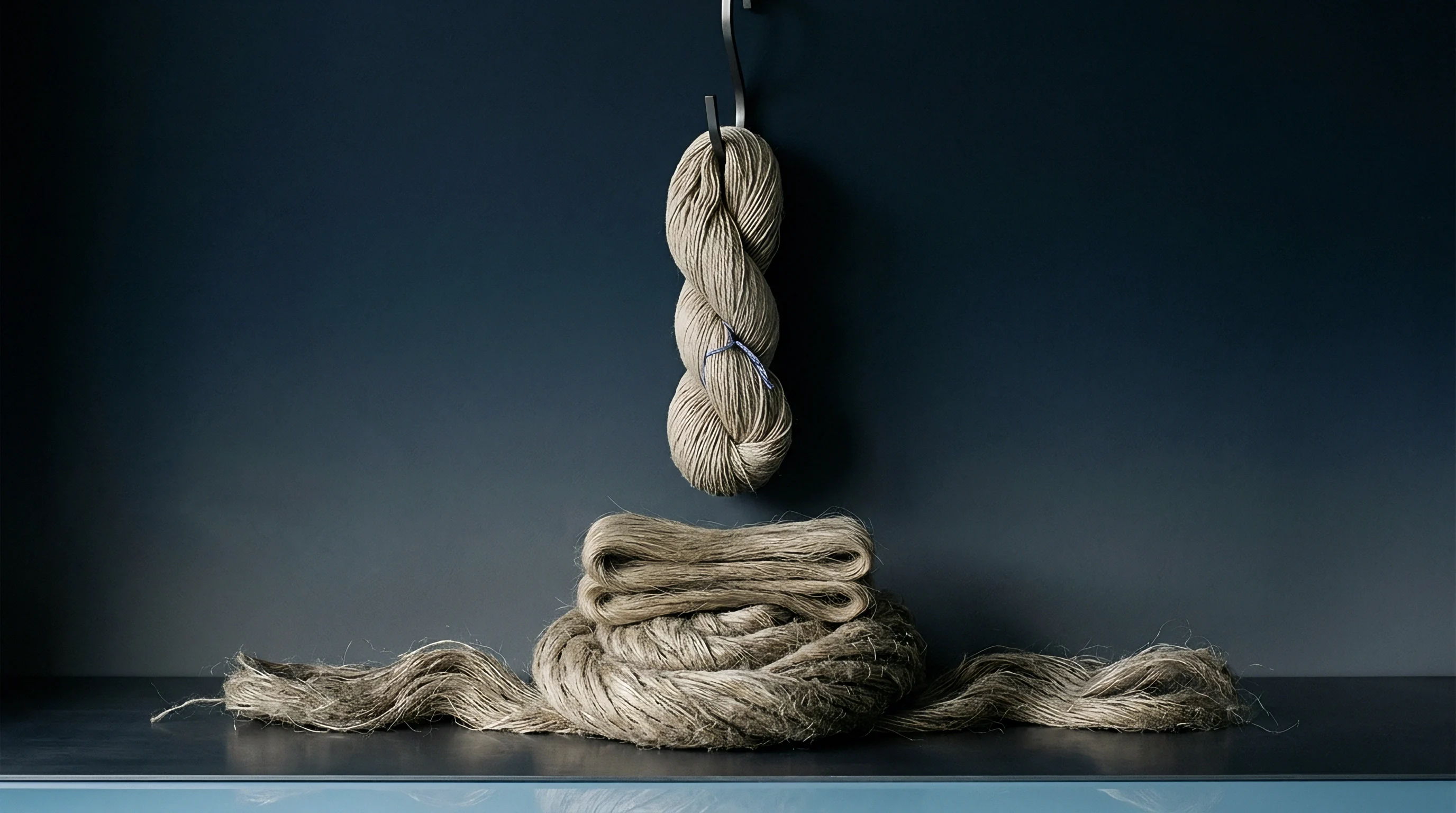
Flax bundles inside wet-spun flax yarn exhibit time-dependent mechanical strain under continuous axial loads during warping and weaving. Wet spinning passes flax rovings through a water bath near 60 degrees Celsius before twisting, partially dissolving and redistributing the intracellular pectin and hemicellulose binders that hold elementary fibers together. This leaves crystalline cellulose microfibrils embedded within a hydrated, gel-like polysaccharide matrix.
Under tension on the loom, the composite structure undergoes an immediate elastic stretch followed by slow, unrecoverable extension, governed by three distinct viscoelastic creep phases.
Primary Strain and Pectin Matrix Shear
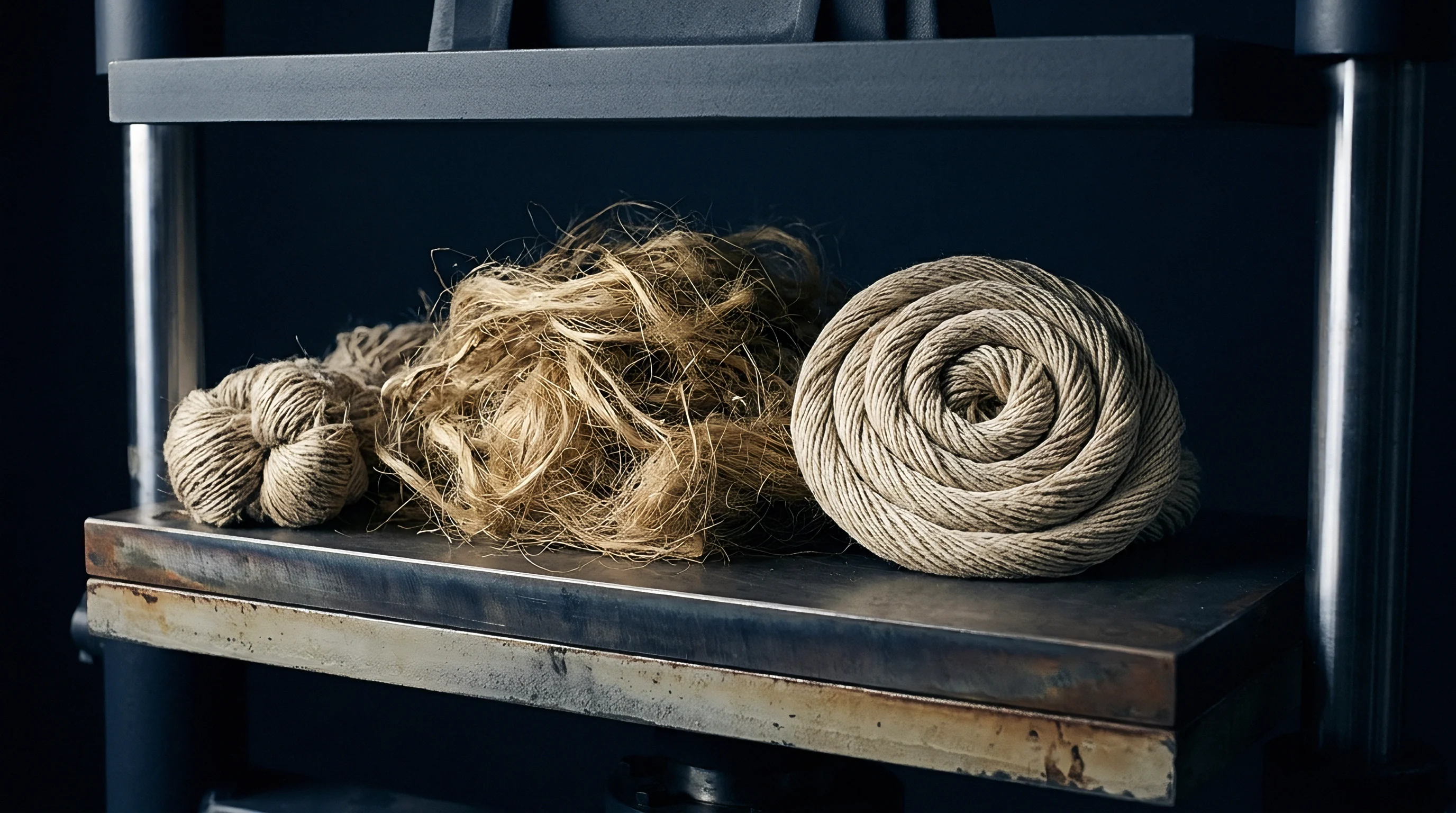
Deformation begins the instant tension reaches the warp sheet during beam let-off. Initial strain develops through instant elastic stretching of the crystalline cellulosic core combined with rapid viscoelastic extension within the amorphous matrix. Hydrogen bonds between hemicellulose chains unzip under load, allowing temporary displacement of adjacent amorphous regions without rupturing the main fiber structure.
This primary creep phase shows a decreasing strain rate over time as mechanical resistance builds within the inter-fiber matrix.
In wet-spun yarns, primary strain typically accounts for 0.4 percent to 0.8 percent elongation under standard weaving tensions of 15 to 22 centinewtons per tex. This transient phase is brief, usually ending within 30 to 120 seconds after load application. If tension releases during this window, the yarn recovers most of its extension through immediate elastic spring-back and delayed viscoelastic recoil over several hours.
Sustained tension, however, pulls polymer chains past their elastic recovery threshold into steady-state viscous flow.
A sustained tensile load exceeding 22 percent of ultimate breaking force at 65 percent relative humidity initiates irreversible viscous flow inside wet-spun flax yarn bundles.
Fibril Interlocking in Secondary Creep Regimes
Extending load duration past the primary transition initiates secondary creep, where the strain rate settles into a nearly constant minimum. Inside the yarn, elementary fibers measuring 10 to 40 millimeters in length and 15 to 30 micrometers in diameter begin sliding past one another within the technical bundle. Mechanical interlocking between adjacent fibers provides the primary resistance against catastrophic slip during this steady state.
Secondary creep represents the stable operating window in flat weaving, provided cumulative strain remains bounded. At standard loom speeds of 400 to 600 picks per minute, cyclic shedding imposes transient peak forces above baseline static warp tension, driving micro-displacements between elementary fiber ends. Crystalline cellulose microfibrils in the cell walls resist longitudinal extension, but the surrounding inter-crystalline matrix continues to shear.
The rate of secondary strain accumulation depends directly on ambient relative humidity, yarn moisture regain, size film integrity, and mean warp sheet tension.
The central constraint remains how far the pectin matrix can shear before structural fiber bundles lose cohesion across adjacent warp ends.
Tension
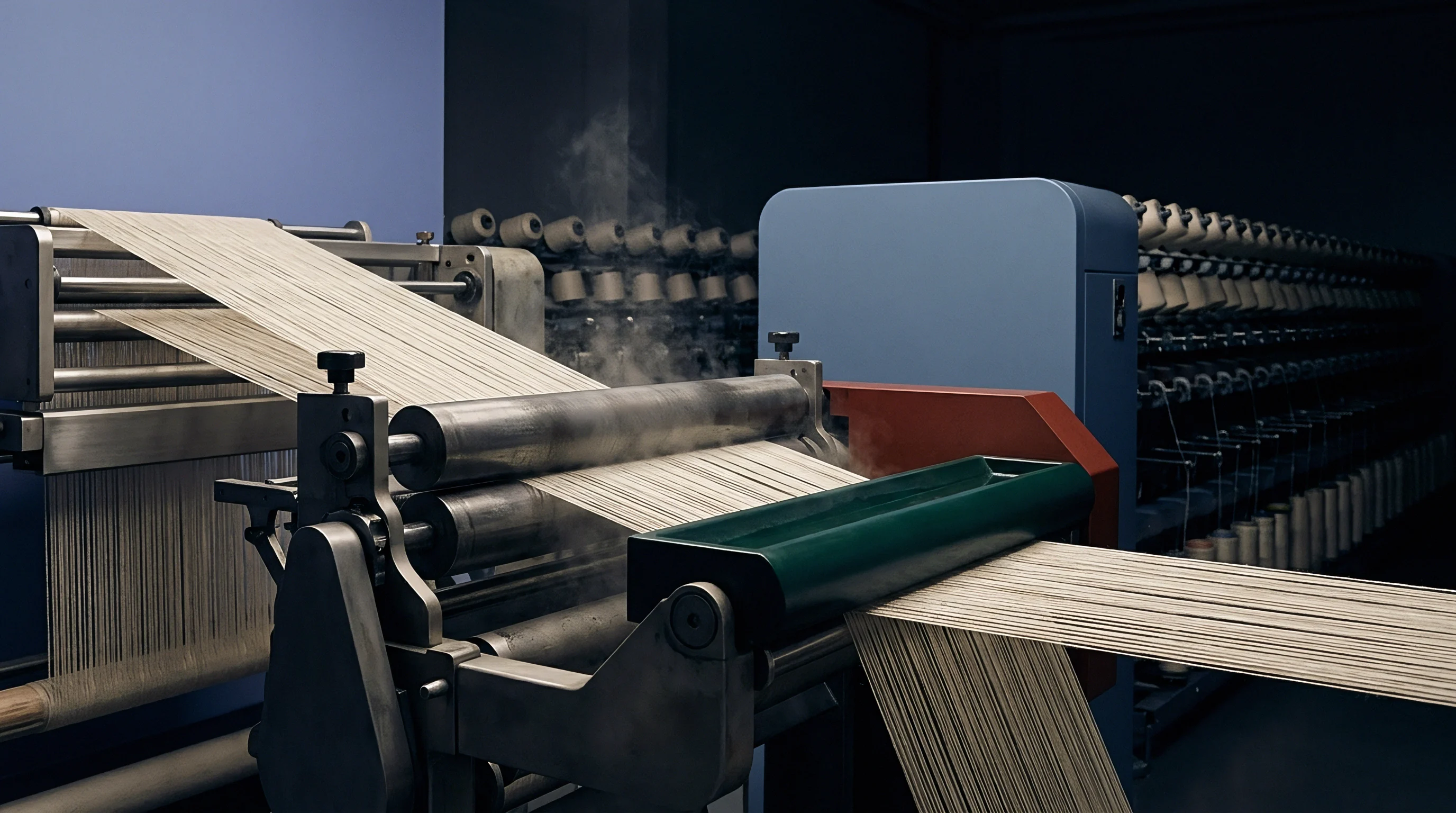
Mechanical stress on high-speed rapier and air-jet looms pushes wet-spun linen yarns directly across their viscoelastic phase boundaries. Shedding geometry creates asymmetric tensile peaks, stretching upper and lower shed lines differently during every revolution of the drive shaft. Static tension set by the back-rest roller is only the baseline; dynamic acceleration from the heald frames adds localized spikes that drive yarn past its yield point.
Cyclic Shedding Loads and Peak Stresses
Operating a loom at 550 picks per minute subjects warp yarn to roughly nine tension cycles every second. As the heald frames split the warp sheet to form the shed opening, warp length between the breast beam and warp beam expands by 1.2 to 2.5 percent depending on shed height and dwell settings. With an ultimate elongation at break of only 2.0 to 3.2 percent, wet-spun linen offers minimal compliance to absorb these dimensional shifts.
During shed opening, instantaneous peak stresses regularly exceed 35 percent of ultimate tensile strength. If baseline static tension sits too high, these cyclic peaks force yarn out of steady-state secondary creep and into tertiary creep. This brings exponential strain rates, localized necking of the cross-section, micro-void formation along fiber boundaries, and eventual warp end rupture.
Empirical boundaries established under varying loom loads mark the transitions between steady-state creep and accelerated failure.
| Creep Phase Boundary | Stress Threshold (% UTS) | Strain Accumulation Rate (%/hr) | Dominant Physical Mechanism | Loom Floor Manifestation |
|---|---|---|---|---|
| Primary to Secondary | 14 – 18% | 0.05 – 0.12 | Amorphous polysaccharide chain alignment and reversible hydrogen bond cleavage | Initial warp stretch during let-off, full elastic recovery upon tension release |
| Secondary to Tertiary | 42 – 52% | 0.85 – 2.40 | Pectin matrix shear, elementary fibril slippage, and irreversible micro-voiding | Dropper drops, loose warp ends, end breaks during restart, high reed mark frequency |
| Hydrothermal Yield Shift | 28 – 34% | 0.40 – 0.95 | Moisture-assisted matrix glass transition and starch size breakdown | Permanent striping, uneven cover factor across wide cloth widths |
Static Warp Dwell during Loom Stoppages
Unplanned machine stoppages introduce a failure mode driven by static stress relaxation and localized creep. When a loom stops for a filling break or warp fault, the warp sheet remains locked under full shedding tension where the main shaft halted, leaving ends in the open shed under prolonged static load at maximum displacement.
Over dwell periods exceeding 15 minutes, static loads force stressed warp ends deep into secondary creep, accumulating non-recoverable plastic strain. Once repaired and restarted, these strained ends show altered crimp behavior and reduced modulus. The section held in the open shed produces a horizontal bar across the fabric, marked by altered pick spacing, localized width variations, and visible shade differences after dyeing.
Unmanaged warp tension thresholds on the loom floor produce immediate structural defect modes:
- Creep-induced end breakage occurs when localized tertiary deformation reduces yarn cross-sectional area below the minimum load-bearing limit required for shedding.
- Reed mark streakiness develops when differential permanent elongation across warp ends alters dent spacing dynamics inside the reed blade channels.
- Width loss at the fell arises from excessive longitudinal permanent set that prevents crosswise filling crimp balance during beat-up.
- Starting mark formation results from the uneven stress relaxation of warp ends positioned in the open shed during extended stoppage dwell times.
Setting static warp tension above 28 centinewtons per tex to prevent shed sagging accelerates matrix slippage, generating over 14 warp breaks per hundred thousand picks run.
Swell
Water sorption alters the viscoelastic response of wet-spun flax yarns by swelling the amorphous matrix and lowering its glass transition temperature. Flax fibers absorb water up to 12 percent of dry weight under ambient laboratory conditions, and up to 30 percent under high relative humidity or liquid immersion. This plasticization shifts the yield point, causing yarn to transition from primary elastic response to secondary viscous creep at lower stress thresholds.

Glass Transition Shifts in Wet Fiber Networks
Absorbed water molecules insert between adjacent hydrophilic hydroxyl groups on hemicellulose and pectin polymer chains. This hydrogen bond replacement expands free volume within the amorphous matrix, lowering the effective glass transition temperature of the inter-cellular pectin layer from above 80 degrees Celsius when dry to below 18 degrees Celsius at 80 percent relative humidity.
When weave room temperature exceeds this lowered glass transition threshold, the matrix transforms from a rigid, glassy solid into a compliant viscoelastic gel. Consequently, wet-spun linen yarns woven in unconditioned environments above 70 percent relative humidity undergo accelerated creep under standard warp tension, as elementary fibers slide past each other under loads that remain in the primary elastic zone when dry. Managing ambient relative humidity and yarn moisture regain is critical to preventing uncontrolled warp elongation.
Standard delivery terms specifying ambient moisture regain above 12 percent trigger rapid sizing film decay during long-term beam storage.

Size Film Plasticization and Hydrothermal Softening
Protective sizing films applied to wet-spun linen warps must mirror or compensate for the moisture sensitivity of the underlying flax core. Formulations combining native potato starch, polyvinyl alcohol, and carboxymethyl cellulose create a sheath around the spun bundle, binding surface fibers down and increasing cohesion. High moisture regain, however, plasticizes the size film alongside the fiber matrix.
Hydrothermal softening degrades both native starch and synthetic binder components. When ambient relative humidity rises above 75 percent, the size film loses tensile strength and storage modulus, developing high ductility and sticky surface friction. It no longer anchors the outer fibers of the technical bundle, allowing slip to initiate at the surface and creep strain to propagate inward toward the core under lower cyclic shedding loads.
Managing hydrothermal creep risks across warping and sizing requires verifying six critical processing variables:
- Verify that size box temperatures remain within a tight tolerance of 82 to 85 degrees Celsius to preserve sizing polymer length.
- Measure yarn moisture regain continuously at the cylinder dryer exit using high-frequency capacitive sensors calibrated for pure flax.
- Maintain loom shed relative humidity strictly between 62 percent and 66 percent at 21 degrees Celsius to prevent matrix glass transition dropping below room temperature.
- Audit warp beam storage zones for temperature excursions that exceed 25 degrees Celsius over prolonged dwell times.
- Check sizing pick-up percentage on dry yarn mass, holding target solid content between 8.5 percent and 10.0 percent.
- Test size film solubility and mechanical film strength under variable humidity conditions prior to committing high-density warps to the sizing range.
Persistent warp streaking and loose ends often stem from moisture control failures inside the sizing range rather than natural crop variations in flax fiber length.

Yield
Evaluating viscoelastic deformation in wet-spun linen requires quantifying tension decay and permanent elongation under continuous strain. Structural models treat the yarn as a parallel combination of elastic springs and viscous dashpots, representing crystalline cellulose fibrils and the amorphous pectin matrix. When a warp sheet is held at a fixed length during a stoppage, stress relaxation causes tension to decay exponentially as plastic strain accumulates within the fiber core.

How Do Loom Stoppages Trigger Tertiary Creep in Fine Linen Warps?
Sustained tensile displacement on a stopped loom transfers mechanical energy from elastic elements into the viscous matrix. Consider a representative high-density linen construction running a 26 tex wet-spun single yarn on a 220 centimeter wide air-jet loom. The warp specification requires 4,800 ends operating at a nominal static warp tension of 18 centinewtons per end, yielding a total warp sheet tension of 864 newtons across the back-rest roller.
During a 48-hour weekend shutdown, warp ends remain locked at maximum shed opening displacement, imposing a constant initial strain (varε0) of 1.4 percent. Stress relaxation follows a generalized Maxwell model governed by two relaxation times corresponding to short-term matrix flow (τ1 = 0.5 hours) and long-term fibril realignments (τ2 = 18.0 hours).
| Dwell Time (Hours) | Remaining Tension (cN/end) | Elastic Residual Strain (%) | Plastic Permanent Set (%) | Viscoelastic Phase State |
|---|---|---|---|---|
| 0.0 | 18.00 | 1.40 | 0.00 | Primary Elastic Response |
| 0.5 | 14.12 | 1.10 | 0.30 | Primary to Secondary Transition |
| 2.0 | 11.85 | 0.92 | 0.48 | Secondary Creep Steady Flow |
| 12.0 | 8.45 | 0.66 | 0.74 | Secondary Creep Steady Flow |
| 24.0 | 6.20 | 0.48 | 0.92 | Secondary to Tertiary Boundary |
| 48.0 | 3.80 | 0.30 | 1.10 | Tertiary Permanent Degradation |
At a constant 20 degrees Celsius and 65 percent relative humidity, tension decays from 18.00 to 3.80 centinewtons per end over 48 hours. Elastic strain drops from 1.40 percent to 0.30 percent, while plastic permanent set increases from 0.00 percent to 1.10 percent. The yarn permanently lengthens by 1.10 percent while locked in the shed.
When restarted, this section lacks sufficient elastic recovery to maintain beat-up resistance, causing severe fell displacement and loose weave structure over the first three centimeters of production.
When a static warp beam remains under full shedding tension over a weekend shutdown, every end shifts permanently toward tertiary extension.

Relaxation Kinetics and Warp Crimp Balance
Stress relaxation alters the relationship between warp crimp and filling crimp during fabric formation. In a balanced plain weave (tabby) construction, warp and filling yarns bend around one another, sharing the structural crimp needed for cohesive fabric geometry. When viscoelastic creep permanently lengthens warp ends, warp yarn rigidity drops sharply relative to the un-stretched filling yarn.
During beat-up at the fell, the softened, creep-extended warp yarn absorbs excess crimp from the filling. The filling yarn stays straight while the elongated warp bends excessively over and under the picks. This crimp inversion causes finished fabric to shrink in width across the reed while extending in length, missing off-loom dimensional specifications.
Re-establishing balance requires adjusting back-rest roller height and advancing shedding phase to force crimp back into the filling, though this raises peak shedding tension and end breakage risk.
Any wet-spun warp experiencing over one percent permanent set requires immediate let-off readjustment and two centimeters of manual cloth fell advance before restarting the main loom drive.
Proof
Verifying viscoelastic creep boundaries in wet-spun linen requires test procedures that separate elastic strain from permanent plastic set under controlled hydrothermal conditions. Standard tensile tests using constant rate of extension (CRE) instruments break yarn within seconds, failing to capture time-dependent creep deformation. Reliable quality assurance relies on dynamic mechanical analysis (DMA) and long-term creep-recovery testing under constant loads specified in ISO standards.

Bench Creep Testing under Iso-Strain Standard ISO 3341
Verification requires placing yarn samples under sustained static load inside environmental chambers with controlled temperature and humidity. The apparatus applies a dead-weight load equal to 20 percent of yarn breaking force for 24 hours, followed by a 24-hour tension-free recovery period. Automated optical extensometers measure yarn length changes at 0.001 millimeter resolution without contacting the specimen.
The creep curve generated by this procedure isolates instantaneous elastic strain (varεe), viscoelastic delayed strain (varεve), and unrecoverable plastic deformation (varεp). A batch of wet-spun linen yarn passes technical qualification only if plastic permanent set remains below 0.35 percent after 24 hours of recovery. Batches exceeding this threshold exhibit matrix instability, causing reed marks and width variations on high-speed weaving equipment.

Four Point Defect Mapping from Viscoelastic Set
When creep-damaged yarn is woven into fabric, structural variations translate into visual faults graded under ASTM D5430 standard four-point inspection systems. Viscoelastic failure modes leave clear physical signatures mapped during greige cloth qualification.
Diagnosing and scoring creep-related fabric faults on the inspection table follows six steps:
- Position the greige fabric roll on a variable-speed inspection frame equipped with top and bottom diffuse LED illumination operating at 1,500 lux.
- Locate horizontal band defects running pick-wise across the full fabric width and inspect for pick density variations using a counting glass.
- Identify starting marks characterized by localized high pick density immediately adjacent to open, low-density bands corresponding to loom stoppage zones.
- Measure the width of the affected zone along the warp direction to determine whether the fault resulted from short-term primary creep or long-term static stress relaxation.
- Check warp-wise streaks for dent alignment to verify whether localized tertiary creep caused individual ends to narrow in cross-section.
- Assign penalty points per linear meter based on defect length: one point for defects under 3 inches, two points between 3 and 6 inches, three points between 6 and 9 inches, and four points for defects exceeding 9 inches or spanning full cloth width.
Standard sales contracts specify that any shipment containing over 28 penalty points per hundred square meters permits the buyer to reject the lot or apply a minimum 8 percent invoice penalty per affected bolt.

Booking
Viscoelastic creep behavior directly influences loom-shed productivity, shed efficiency, and the final landed cost per finished meter of wet-spun linen cloth. When yarn enters tertiary creep, end breakage rates escalate exponentially, forcing automatic stops, increasing weaver workload, and dropping shed efficiency. Commercial success requires pricing this technical risk into the loom-hour calculation before committing warp beams to production.
Beam Dwell Degradation and Loom Efficiency Loss
Modern weaving sheds price production capacity in machine hours rather than linear meters. An air-jet or rapier loom represents a fixed overhead cost per operating hour, covering capital depreciation, electric power, conditioned air maintenance, and direct labor. When creep-induced warp breaks increase downtime, lost loom hours cannot be recovered.
Stacking warp beams in staging areas under improper humidity allows matrix creep to begin prior to loom loading. A warp beam held under high flange tension for 30 days in a non-climate-controlled warehouse loses up to 25 percent of its initial winding tension through stress relaxation. When mounted on the loom, this slack beam causes irregular let-off motion, let-off hunting, and frequent low-tension stops that destroy shed efficiency.
| Loom Type & Speed | Warp Creep Failure Rate (Breaks/100k picks) | Shed Operating Efficiency (%) | Net Loom Output (Metres/Loom Hour) | Landed Cost Adjustment (€/Metre) |
|---|---|---|---|---|
| Rapier Loom @ 420 PPM | 1.2 (Controlled Baseline) | 91.5% | 18.4 | Base Price (€4.10) |
| Rapier Loom @ 420 PPM | 4.8 (Secondary Creep Excess) | 82.0% | 16.5 | + €0.47 per metre |
| Air-Jet Loom @ 580 PPM | 2.1 (Controlled Baseline) | 88.0% | 24.4 | Base Price (€3.65) |
| Air-Jet Loom @ 580 PPM | 8.5 (Tertiary Creep Breakout) | 69.5% | 19.3 | + €0.96 per metre |
Landed Metre Arithmetic for Viscoelastic Fault Margins
Calculating the true landed cost of wet-spun linen requires incorporating scrap factors, efficiency surcharges, and downtime penalties into the financial model. Take a standard 10,000 meter purchase order for 220 GSM wet-spun plain weave linen destined for high-end shirting. Standard production assumes a loom hour rate of €38.00 per hour on a 220 centimeter wide rapier weaving machine operating at 420 picks per minute.
Under optimal conditions with secondary creep controlled within 0.10 percent per hour, the shed operates at 91.5 percent efficiency, delivering 18.4 finished meters per loom hour. The base weaving cost calculates to €2.06 per meter. Adding yarn material costs at €1.60 per meter and finishing charges at €0.44 per meter yields the target landed price of €4.10 per meter.
If humidity fluctuations or improper sizing allow yarn to cross into tertiary creep, warp break rates rise from 1.2 to 4.8 breaks per hundred thousand picks. Loom efficiency collapses to 82.0 percent, reducing output to 16.5 meters per loom hour. Weaving cost jumps to €2.30 per meter.
Fabric defects from stoppage marks increase off-quality second-choice goods from 2.0 percent to 8.5 percent, pushing total landed cost up by €0.47 per meter across the production run.
Uncompensated viscoelastic lengthening during weaving converts directly into width loss and reed marks at the inspection table.
Shed managers adjust for this exposure by imposing warp beam dwell limits of seven days maximum in staging zones and enforcing mandatory relative humidity caps inside warping and weaving halls. Sourcing contracts shift the financial burden of creep-induced efficiency losses back to the spinner whenever incoming yarn tests show unrecoverable plastic set exceeding 0.35 percent under standard ISO 3341 bench testing.