Evaluating Dynamic Friction Limits in Fine Wet Spun Linen Warps under Varying Humidity
Fine wet spun linen warps perform best between 68 and 72 percent relative humidity, capping dynamic friction below 0.35 to prevent warp tension breaks.
Swell
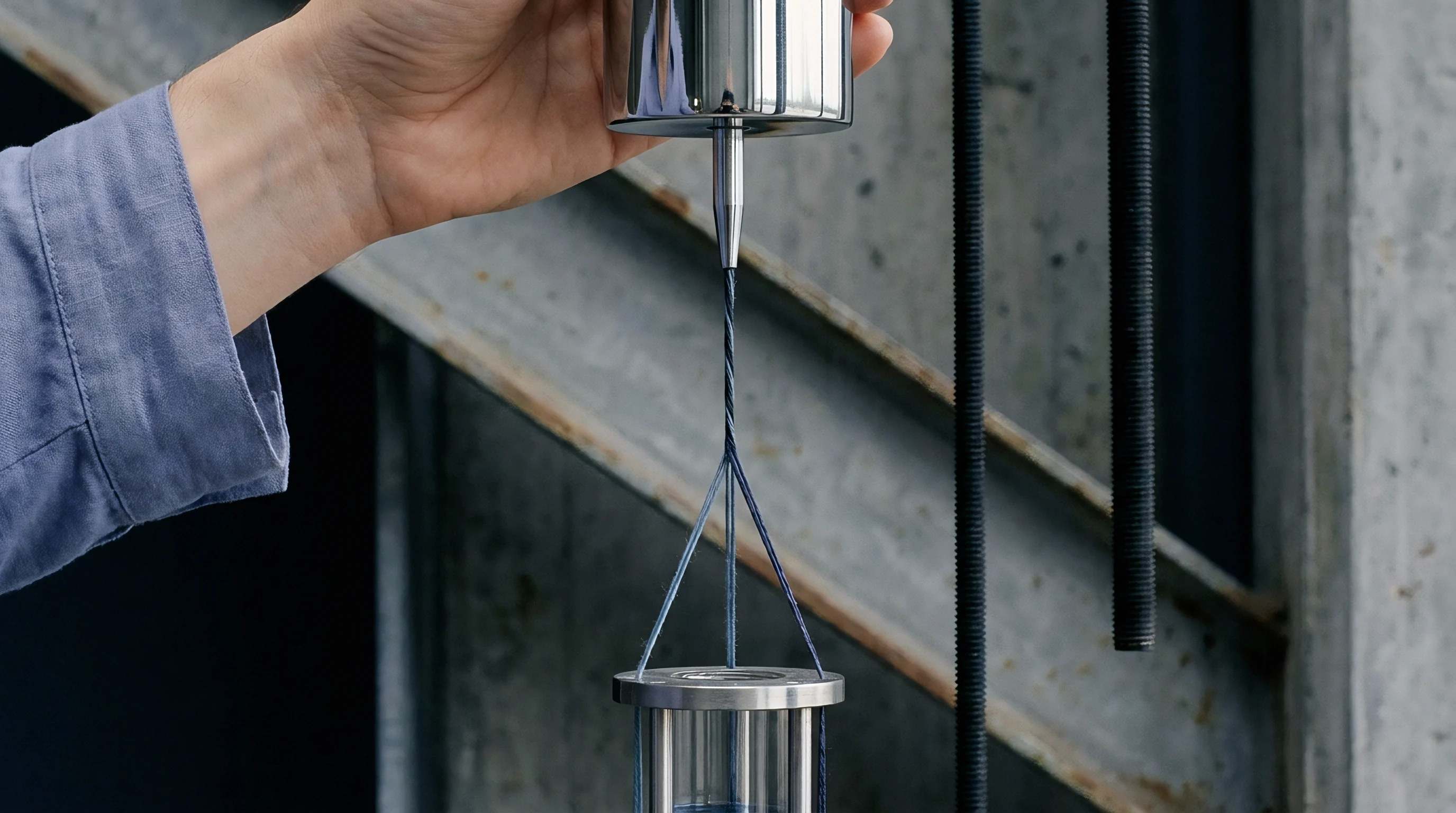
Water uptake in long-staple flax strands alters the mechanical interface between warp ends and metallic loom parts during high-speed shed opening. Wet-spun flax yarns, produced by drawing roved flax through a hot water bath prior to twisting, have a compact structural core wrapped in fine surface fibrils. When ambient humidity rises inside the weaving shed, both the crystalline and amorphous regions of the cellulosic matrix absorb moisture.
Incoming water molecules break existing hydrogen bonds between cellulose chains and form new hydroxyl bonds, expanding the fiber cross-section while leaving strand length largely unchanged. This asymmetrical dimensional shift increases the physical diameter of 60 Lea (100 Nm) wet-spun yarn by up to 14 percent as ambient relative humidity climbs from 50 percent to 82 percent at 21 degrees Celsius. As the cross-sectional profile widens, total contact area against neighboring ends, drop wires, heddle eyes, and reed dents grows accordingly.
The dynamic friction coefficient of wet-spun flax does not follow a linear path across varying moisture levels. Between 45 percent and 60 percent relative humidity, the yarn surface remains rigid, maintaining a dry contact boundary governed by classical Amontons-Coulomb mechanics. In this dry regime, kinetic friction between yarn and polished stainless steel heddle eyes sits between 0.22 and 0.27.
Once ambient shed moisture enters the 65 percent to 75 percent zone, water plasticizes residual pectins and hemicelluloses on the fiber surface, creating a thin, highly viscous liquid film along the interface. Contact then shifts into a mixed lubrication regime shaped by capillary attraction and hydrodynamic shear forces, raising the dynamic kinetic friction coefficient to between 0.34 and 0.42.
A fine wet spun flax warp measuring 60 Lea exhibits a 42 percent increase in yarn-to-metal dynamic friction when ambient shed moisture rises from 65 percent to 80 percent relative humidity at 21 degrees Celsius.
Wet-spun linen filaments retain residual pectins along their outer boundary that swell in humid air, creating localized viscous drag against ceramic guide pins and steel drop wires. Beyond 78 percent relative humidity, water condenses inside microscopic surface crevices on the yarn. Friction reaches a critical ceiling where sticky gum deposits detach from warp ends and accumulate inside the heddle eyes.
This buildup transforms sliding contact into abrasive rubbing, driving peak tension spikes during harness lift phases up by as much as 65 percent.
Moisture saturation reduces the single-end tenacity of wet-spun linen warps, counteracting the tensile gains typical of wet cotton yarns. Flax fibers depend on intermolecular hydrogen bonding across microfibrillar bundle walls to maintain structural integrity. Hydrodynamic shear forces within the high-friction contact zone cause outer microfibrils to peel away from the main yarn stem, creating microscopic loops known as abrasive fuzz balls.
As fuzz balls gather, they stall warp movement through reed dents, causing end breakage, uneven pick insertion, and persistent loom stoppage.
The operational risks associated with dynamic friction escalation are cataloged by shed mechanics during high-density linen runs:
- Micro-Fibrillation Shedding creates loose cellulose dust that mixes with native surface wax, clogging heddle alignment grooves and multiplying yarn-to-yarn abrasion.
- Sticky Reed Choking occurs when softened pectin film transfers from warp threads to metallic reed dents, increasing drag forces on filling insertion elements.
- Drop Wire Sticking emerges when liquid capillary bridges pin low-tension warp drop wires against neighboring threads, causing false loom stop signals.
- Harness Lift Tension Spikes generate localized strain peaks that exceed the single-yarn rupture limit at the fell of the cloth.
- Inter-Warp Entanglement causes warp threads in adjacent harnesses to cling together during shed formation, leading to skipped ends and floats in plain weave patterns.
Sub-optimal climate control settings in the warp preparation zone introduce structural damage before the beam reaches the loom frame. Warps exposed to uncontrolled humidity fluctuations during sectional warping develop irregular yarn diameter profiles across the beam width. When high friction zones encounter the peak strain of beat-up, yarn tension surges past the elastic recovery limit, producing permanent elongation in individual ends.
Operating a weaving shed above the dynamic friction saturation threshold leads to irreparable warp end degradation, elevated greige defect counts, and permanent structural weakening across the entire woven lot.
Contact
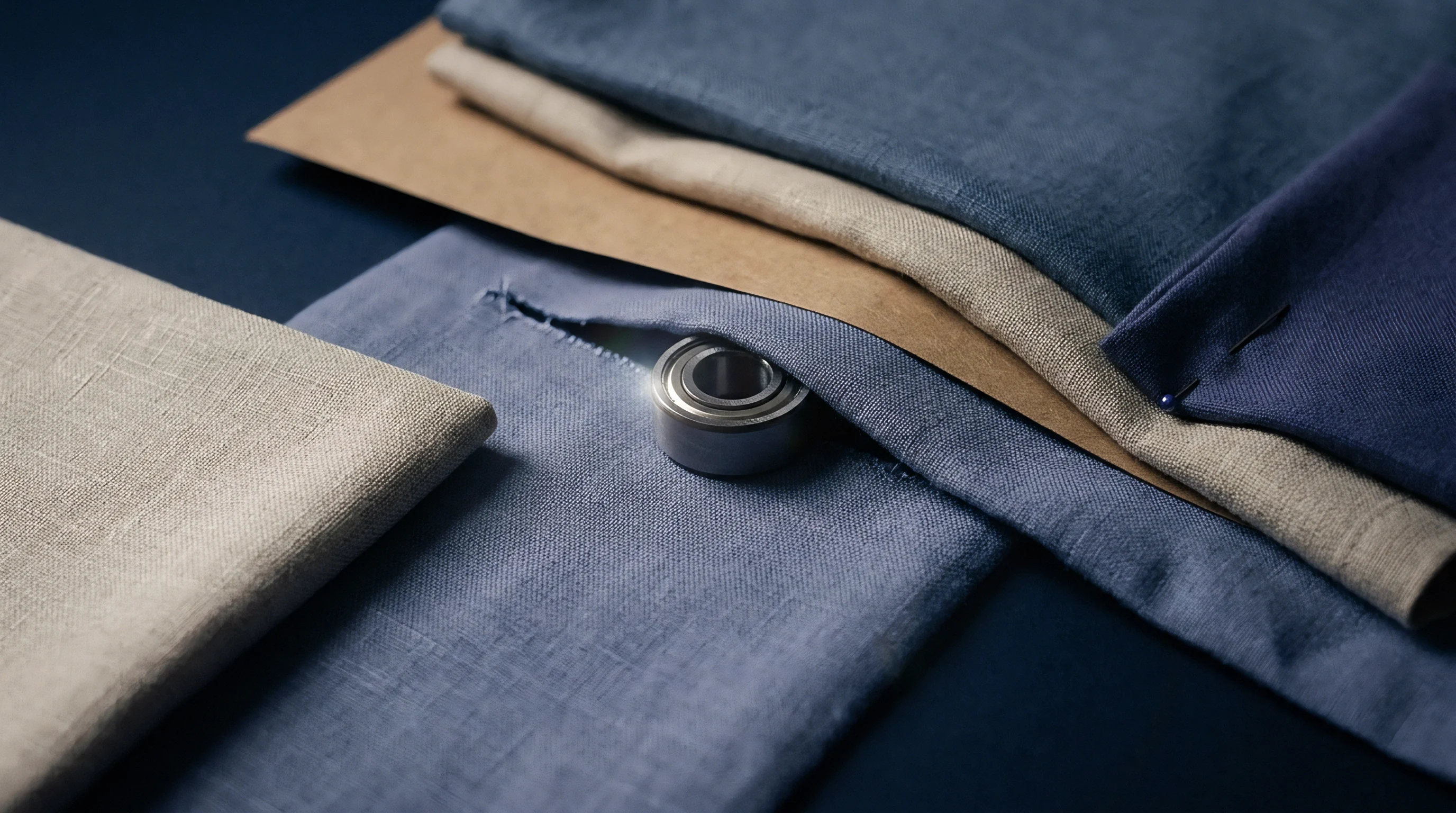
Tribological measurement of fine wet-spun linen warps requires strict laboratory simulation of the mechanical contact points found inside modern high-speed rapier and air-jet looms. Standard static friction tests fail to capture the complex behavior of moving warp ends subjected to high-frequency tension oscillations and high-speed directional changes. Determining the kinetic friction coefficient demands specialized capstan and line-contact testing equipment capable of maintaining continuous yarn motion at speeds matching shed opening velocities between 0.8 meters per second and 2.5 meters per second.
The testing apparatus passes single wet-spun warp threads over polished ceramic pins, stainless steel wires, and adjacent yarn strands at controlled wrap angles while recording tension inputs and tension outputs in real time.
Dynamic kinetic friction calculations rely on the modified capstan equation accounting for yarn deformability and contact surface flattening:
T2 = T1 exp(mu theta)
Where T1 represents the incoming warp tension, T2 represents the outgoing tension after contact, mu is the dynamic kinetic coefficient of friction, and theta is the contact wrap angle in radians. In fine wet-spun linen warps measuring 60 Lea to 80 Lea, yarn flattening under tension increases the contact wrap angle beyond the nominal geometrical contact arc. When relative humidity rises, the yarn modulus of elasticity decreases, leading to higher lateral deformation under contact pressure.
This structural flattening expands the true contact area, amplifying total friction forces past theoretical capstan predictions.
Modern sizing formulations engineered for fine wet-spun linen utilize modified potato starches, polyvinyl alcohol (PVA), and carboxymethyl cellulose (CMC) combined with synthetic wax emulsions to lower surface friction. Starch-based sizes form a protective outer film that shields delicate flax fibrils from metallic abrasion. The hygroscopic nature of these sizing polymers renders them sensitive to ambient relative humidity changes.
Below 60 percent relative humidity, starch sizes turn brittle, flaking off under heddle eye abrasion. Between 68 percent and 72 percent relative humidity, sizing films achieve optimum plasticity, presenting a smooth outer coating with a low kinetic friction coefficient of 0.20 to 0.24. Above 76 percent relative humidity, PVA and starch coatings absorb excess water, softening into a tacky hydrogel that drastically elevates dynamic friction.
Under ISO 13934 tensile verification protocols, exceeding a dynamic kinetic coefficient of 0.38 across ceramic guide pins triggers micro-fibrillation along the strand boundary.
Running rapier insertion frames at dynamic friction levels above 0.41 results in 14 warp breaks per hundred thousand picks. Evaluation of dynamic friction limits must account for contact element material composition and surface roughness parameters. Polished mirror-finish ceramic pins exhibit higher dynamic friction against wet-spun linen in high humidity environments than satin-finish ceramic elements.
The mirror surface promotes liquid capillary bridge formation with moisture-saturated flax fibers, generating strong adhesive contact forces. Satin-finish surfaces with controlled micro-roughness (Ra values between 0.4 and 0.6 micrometers) disrupt water film continuity, maintaining low friction coefficients across variable climate conditions.
The standard procedure for measuring the dynamic friction coefficient of wet-spun linen warps under controlled environmental conditions follows a sequential testing protocol:
- Condition yarn packages inside an environmental test chamber at 20 degrees Celsius and 65 percent relative humidity for 24 hours to establish baseline moisture equilibrium.
- Thread the single wet-spun end through the dynamic tension sensor array, wrapping the yarn around a certified stainless steel test pin at a precise 180-degree contact angle.
- Calibrate the incoming tension pretensioner to deliver a uniform baseline tension equivalent to 0.5 grams per tex.
- Drive the yarn transport system at a linear motion velocity of 1.5 meters per second while continuously recording incoming and outgoing tension values.
- Increase the chamber relative humidity incrementally by 5 percent steps across the range from 50 percent to 85 percent, maintaining a 30-minute stabilization hold at each stage.
- Calculate the dynamic kinetic friction coefficient for each humidity increment using the natural logarithm of the tension ratio divided by the contact arc angle.
- Inspect the test contact pin for size polymer deposition, fiber lint accumulation, and liquid film separation after each test run.
The table below summarizes dynamic friction coefficient data recorded across varying relative humidity levels for 60 Lea wet-spun linen yarn interacting with different guide materials at 1.5 meters per second linear speed:
| Relative Humidity (%) | Stainless Steel Pin (Ra 0.2 µm) | Satin Ceramic Pin (Ra 0.5 µm) | Mirror Ceramic Pin (Ra 0.05 µm) | Yarn-to-Yarn Contact |
|---|---|---|---|---|
| 55 | 0.24 | 0.22 | 0.25 | 0.31 |
| 65 | 0.26 | 0.23 | 0.27 | 0.33 |
| 70 | 0.29 | 0.25 | 0.31 | 0.36 |
| 75 | 0.35 | 0.28 | 0.39 | 0.43 |
| 80 | 0.42 | 0.32 | 0.48 | 0.52 |
| 85 | 0.51 | 0.37 | 0.59 | 0.64 |
| Test parameters: 60 Lea wet-spun linen yarn, 0.5 g/tex pretension, 1.5 m/s yarn velocity, 180-degree contact wrap angle, 21 degrees Celsius ambient temperature. | ||||
Determining true dynamic limits requires measuring stick-slip friction amplitude during direction reversal at shed closure. High stick-slip ratios point to localized binding between warp ends, resulting in irregular beat-up tension and horizontal bar faults in high-density greige linen fabrics. Keeping dynamic friction below critical thresholds maintains stable warp tension across high-speed loom cycles.


Vapour
Atmospheric moisture inside a linen weaving shed is rarely uniform. Air supply ducts mounted above the looms drop conditioned air downward, creating steep temperature and humidity gradients between the top of the warp creel, the harness frame zone, and the cloth fell. Water vapor sorption kinetics in wet-spun flax depend heavily on local airflow velocity, air density, and yarn density.
Fine yarns absorb atmospheric moisture quickly, hitting 90 percent of their equilibrium regain capacity within 45 seconds in a high-humidity air stream. Because sorption kinetics are so fast, localized pockets of moist or dry air instantly alter the friction profile of individual warp ends running through the harness assemblies.
Humidity control systems in high-capacity linen sheds maintain local micro-climates around the warp sheet, and tracking moisture distribution from the rear shed roller to the fell prevents local desiccation. When dry air currents hit the high-tension warp area behind the harnesses, yarn moisture drops quickly below the plasticization threshold. The protective size coating stiffens and turns brittle, causing micro-cracking on the outer yarn shell under the bending strain of shed opening.
Conversely, direct water droplet misting from ultrasonic humidifiers leaves wet spots on the warp beam, triggering pectin dissolution and friction surges that stop the loom.
Shed humidity held above the dew point threshold prevents surface gum softening while keeping the cellulose core flexible enough to absorb beat-up impact.
Entanglement between hairy warp ends intensifies when vapor sorption inflates surface fibrils. Wet-spun linen yarns naturally contain protruding fiber tails that entwine inside high-density reed dents. When ambient relative humidity exceeds 74 percent, high vapor pressure forces water molecules into the amorphous regions of these fibrils, lowering their bending stiffness.
Softened, moist fibrils wrap around neighboring warp ends like microscopic hooks, forming structural bridges across the open shed. As harness frames move in opposite directions, these bridges pull adjacent ends out of their assigned shed planes, creating warp floats and split end defects across plain weave constructions.
Which Relative Humidity Level Maximizes Weaving Efficiency?
Operating fine wet-spun linen warps within an optimal climate band balances yarn flexibility against surface friction risks. The target operational window sits between 68 percent and 72 percent relative humidity at ambient room temperatures of 20 to 22 degrees Celsius. Within this targeted range, moisture regain in the warp yarn stabilizes at roughly 9.5 to 10.5 percent by weight.
This regain level provides sufficient internal cellulose lubrication to maximize energy absorption during beat-up, preventing brittle tensile fractures. Simultaneously, surface pectin films remain firm, keeping yarn-to-metal kinetic friction below 0.28 and preventing sticky deposits inside heddle eyes.
Managing shed climate requires dedicated air distribution hoods positioned directly over the harness frames and reed tracks. These hoods supply laminar air streams conditioned to exact temperature and moisture specifications, isolating the mechanical friction zone from wider room fluctuations. Maintaining a slight positive air pressure above the warp sheet blocks external dry drafts, suppressing micro-climate variance across the full weaving width.
Deviations from target humidity bands trigger immediate mill-floor performance complaints, summarized by shed managers seeking technical support:
High break frequencies during humid summer runs are frequently blamed on deficient raw fiber tenacity, whereas excessive shed moisture drives dynamic friction beyond machine tolerances.
Stiffness
Flexural rigidity dictates how wet-spun linen yarns conform to mechanical contact points during shed formation. Yarn stiffness correlates directly with Lea count, fiber cross-sectional symmetry, internal twist, and absorbed moisture volume. A 60 Lea (100 Nm) fine wet-spun yarn exhibits much lower flexural rigidity than a 25 Lea (42 Nm) coarse warp end, bending easily around small-radius heddle eyes and drop wires.
Lower bending stiffness reduces the normal contact force exerted by the tensioned yarn against guide surfaces, decreasing frictional resistance under classical contact mechanics. However, fine yarns possess smaller absolute cross-sectional areas, rendering them far more vulnerable to single-filament tensile rupture during localized dynamic friction spikes.
Tension buildup along the warp path follows an additive and multiplicative progression from the warp beam to the cloth fell. As warp threads travel from the back rest roller through lease rods, drop wires, heddle eyes, and reed dents, each mechanical interface adds incremental drag. Cumulative warp end tension (T_total) at the fell of the cloth is calculated across these sequential contact points:
T_total = T_initial prod(exp(mu_i theta_i)) + sum(F_flexure_j)
Where T_initial represents primary warp beam let-off tension, mu_i is the dynamic friction coefficient at contact point i, theta_i is the contact angle in radians at point i, and F_flexure_j represents the force consumed in overcoming flexural rigidity at deflection point j. In high-density plain weave linens with cover factors over 62 percent, cumulative tension spikes during shed opening can amplify baseline let-off tension by a factor of 3.8 when relative humidity raises the dynamic friction coefficient past 0.36.
Capstan friction across heddle eyes scales exponentially with wrap angle, converting minor moisture fluctuations into cataclysmic tension spikes.
Worked calculations illustrate how sensitive warp end tension is to small changes in dynamic friction under realistic high-speed rapier loom conditions. Consider a 60 Lea wet-spun linen warp operating at a baseline let-off tension (T_initial) of 25 grams force (cN) per end, running at 550 picks per minute with a total wrap arc of 0.85 radians across heddle eyes and drop wires.
The mathematical model compares tension accumulation across three distinct shed relative humidity environments:
| Parameter | Case A: Low RH (58%) | Case B: Optimal RH (70%) | Case C: High RH (82%) | |||
|---|---|---|---|---|---|---|
| Dynamic Friction Coefficient (mu) | 0.24 | 0.27 | 0.44 | |||
| Contact Wrap Angle (rad) | 0.85 | 0.85 | 0.85 | |||
| Capstan Multiplier exp(mu theta) | 1.226 | 1.258 | 1.454 | |||
| Heddle Contact Tension (cN) | 30.65 | 31.45 | 36.35 | |||
| Reed Dent Friction Drag (cN) | 4.20 | 4.80 | 11.50 | |||
| Flexural Rigidity Drag (cN) | 3.10 | 2.60 | 2.10 | |||
| Total Peak Tension at Fell (cN) | 37.95 | 38.85 | 49.95 | |||
| Single Yarn Tenacity Limit (cN) | 42.00 | 44.50 | 40.20 | |||
| Tension Safety Margin (%) | +9.6 | +12.7 | -24.3 | |||
| Model inputs: 60 Lea (100 Nm) wet-spun flax warp, baseline let-off tension 25 cN, single yarn tenacity measured according to ISO 2062 standard conditions. | ||||||
In Case C, high relative humidity elevates the dynamic friction coefficient to 0.44 while softening the yarn structure and reducing single end tenacity to 40.20 cN. Cumulative tension at the cloth fell reaches 49.95 cN, exceeding yarn tensile capacity by 24.3 percent. This catastrophic deficit causes immediate end breakage across the warp sheet, forcing automated loom shutdown.
Calculating friction limits for industrial linen production requires accounting for density variations in the warp sheet. High end-density weaves intensify yarn-to-yarn rubbing during harness motion, introducing a secondary internal friction factor that scales non-linearly with warp sett. When specifying fine linen fabrics, engineers adjust warp sett to keep total frictional load below critical machine stress thresholds.
What structural modifications can yarn draughtsmen implement to offset dynamic friction surges when shed humidity control systems fail?
Booking
Loom allocation and production cost calculations for fine wet-spun linen fabrics depend on maintaining shed efficiency above 88 percent. A high-density linen warp running on a modern 220-centimeter wide rapier loom at 550 picks per minute represents a significant daily financial commitment in depreciation, power, climate control, and labor. When dynamic friction spikes push warp break frequency above 3.5 breaks per hundred thousand picks, downtime sharply erodes production yield.
Every loom stop leaves a visible defect risk ~ such as a start mark or reed mark ~ that lowers greige cloth valuation under standard four-point inspection systems like ASTM D5430.
Continuous logging of the weaving environment is required to manage capacity. Structuring warp allocations around seasonal summer humidity shifts preserves shedding speed, since loom-hour costs scale inversely with shedding efficiency. A standard rapier loom allocated to a 60 Lea linen warp runs at a baseline operating cost of 28.50 EUR per loom hour.
At 92 percent shed efficiency, the loom produces 14.8 meters of fabric per hour, resulting in a machine weaving cost of 1.93 EUR per finished meter. If dynamic friction rises unchecked and efficiency drops to 74 percent, hourly output falls to 11.9 meters, driving weaving costs up to 2.39 EUR per meter before accounting for lost scrap and repair labor.
Financial impacts of humidity-induced friction variance are demonstrated across three loom shed efficiency tiers in the table below:
| Shed Climate Condition | Dynamic Friction (mu) | Warp Breaks per 100k Picks | Shed Efficiency (%) | Output (m/loom-hr) | Weaving Cost (EUR/m) |
|---|---|---|---|---|---|
| Controlled (70% RH) | 0.26 | 1.2 | 93.5 | 15.0 | 1.90 |
| Moderate Shift (76% RH) | 0.34 | 3.8 | 84.2 | 13.5 | 2.11 |
| Severe Humidity (82% RH) | 0.46 | 11.4 | 68.0 | 10.9 | 2.61 |
Sourcing contracts for wet-spun linen greige fabrics must include specific environmental control clauses binding the mill to maintain defined humidity and temperature bounds during warp preparation and weaving. Buyers specifying high-density fine linen warps protect their financial interest by incorporating strict qualification protocols covering dynamic friction verification, sizing compound composition, and maximum allowable break rates per beam run.
Shed efficiency losses carry into downstream wet processing phases. Fabrics woven under high dynamic friction carry latent micro-structural damage, including uneven yarn crimp distribution and broken outer fibrils. When these greige rolls enter bleaching and dyeing, local variations in fiber density cause uneven dye liquor absorption, generating streaks and color bands.
Technical purchase orders guard against these latent defects by defining precise acceptance limits based on standardized dynamic friction and climate stability testing protocols.
Standard commercial supply agreements for fine wet-spun linen cloth incorporate mandatory environmental control compliance terms:
The contract clause dictates that the supplier shall continuously record relative humidity and temperature levels within the weaving shed using calibrated digital sensors, guaranteeing that ambient moisture remains within 68 percent to 72 percent relative humidity; any fabric lot woven when shed humidity exceeds 76 percent for more than two consecutive operating hours shall be subject to mandatory four-point inspection at the supplier expense, with the buyer retaining absolute rights of rejection for rolls exceeding 15 defect points per one hundred square meters.