Pneumatic Energy Consumption versus Mechanical Stoppage Rate Tradeoffs in Industrial Linen Air Jet Weaving
Throttling air jet pressure below 0.54 MPa on linen weft cuts compressor load but spikes stoppage rates, raising net weaving cost per metre.
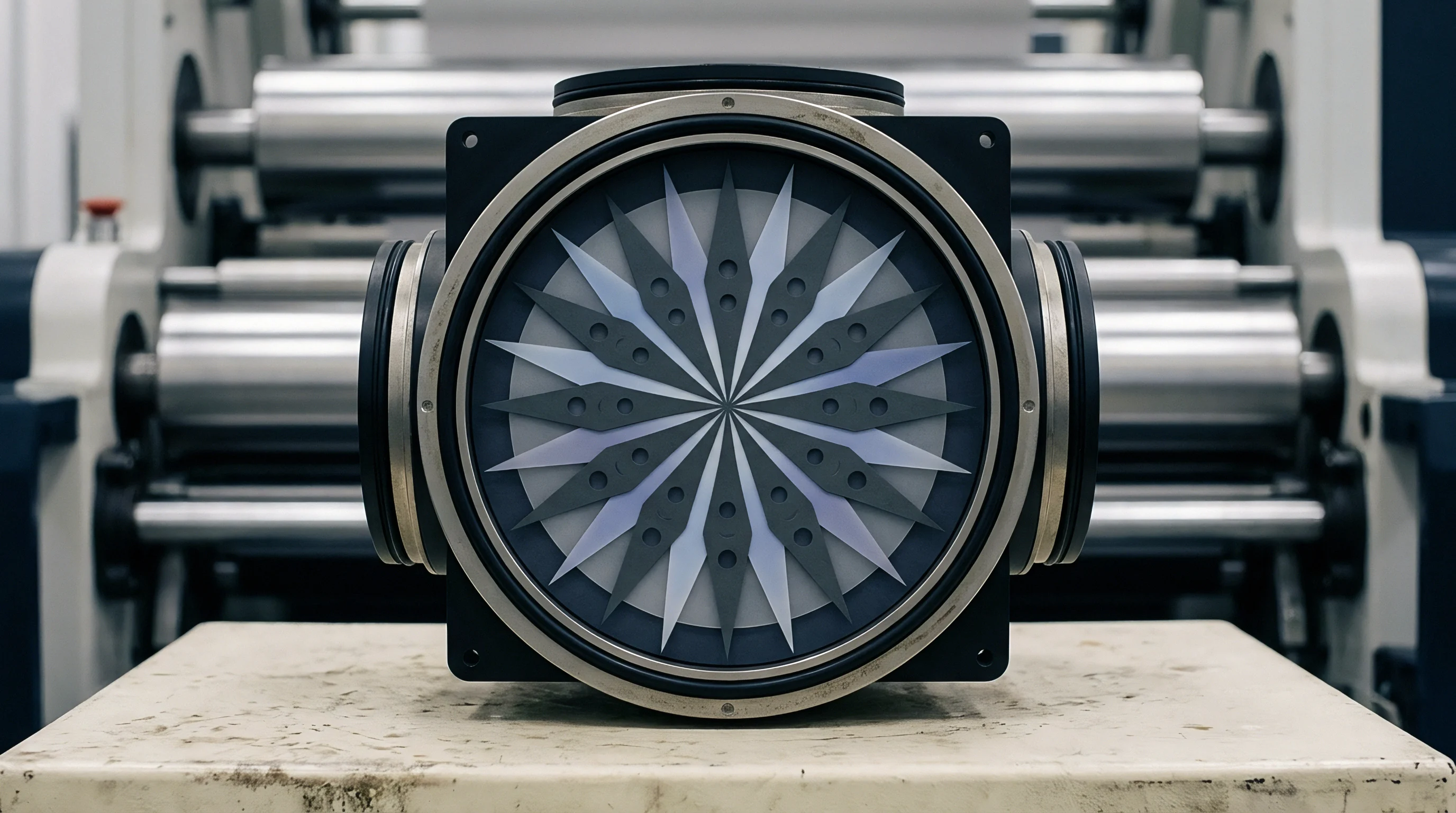
Nozzle
Loom speed on a 190-centimetre profile reed air jet running wet-spun flax tops out where air velocity no longer pulls the yarn tail cleanly across the shed. Main nozzles running 100 percent bleached linen weft at metric count Nm 26 (38.5 tex) draw compressed air at 0.55 to 0.70 megapascals, consuming 18 to 26 normal cubic metres per loom hour. Dropping main nozzle supply pressure to 0.45 megapascals trims compressor power by 19 percent, but weft insertion stops jump from 1.2 to 4.8 per 100,000 picks.
Flax lacks the uniform crimp and elongation of ring-spun cotton; linen yarn exhibits pronounced surface hairiness, slubs, and low ultimate strain, rarely exceeding 2.2 percent elongation at break under dry shed conditions.
The profile reed forms a guiding channel across the warp sheet. Tandem main nozzles accelerate the pick off the prewinder drum once a magnetic stopper releases the measured length. Relay nozzles spaced at 65-millimetre pitch along the sley pulse compressed air in sequential banks of four, keeping weft tip velocity above 45 metres per second through the reed tunnel.
If air speed drops below that threshold, the pick stalls before reaching the right-hand selvedge cutters.
Compressor electrical draw drops by 0.22 kilowatt-hours per woven metre when relay nozzle supply pressure falls from 0.60 to 0.48 megapascals under continuous 700 picks per minute insertion.
Pick velocity curves show deceleration zones right at shedding transitions. Insertion takes up roughly 165 to 175 degrees of the total mainshaft rotation cycle. If the linen weft enters the profile reed channel when the warp shed opening offers less than 28 millimetres of clear vertical throat height, protruding flax fibrils drag against the moving warp ends and bleed off airstream momentum.
Pneumatic Delivery Pressures across Wet Spun Counts
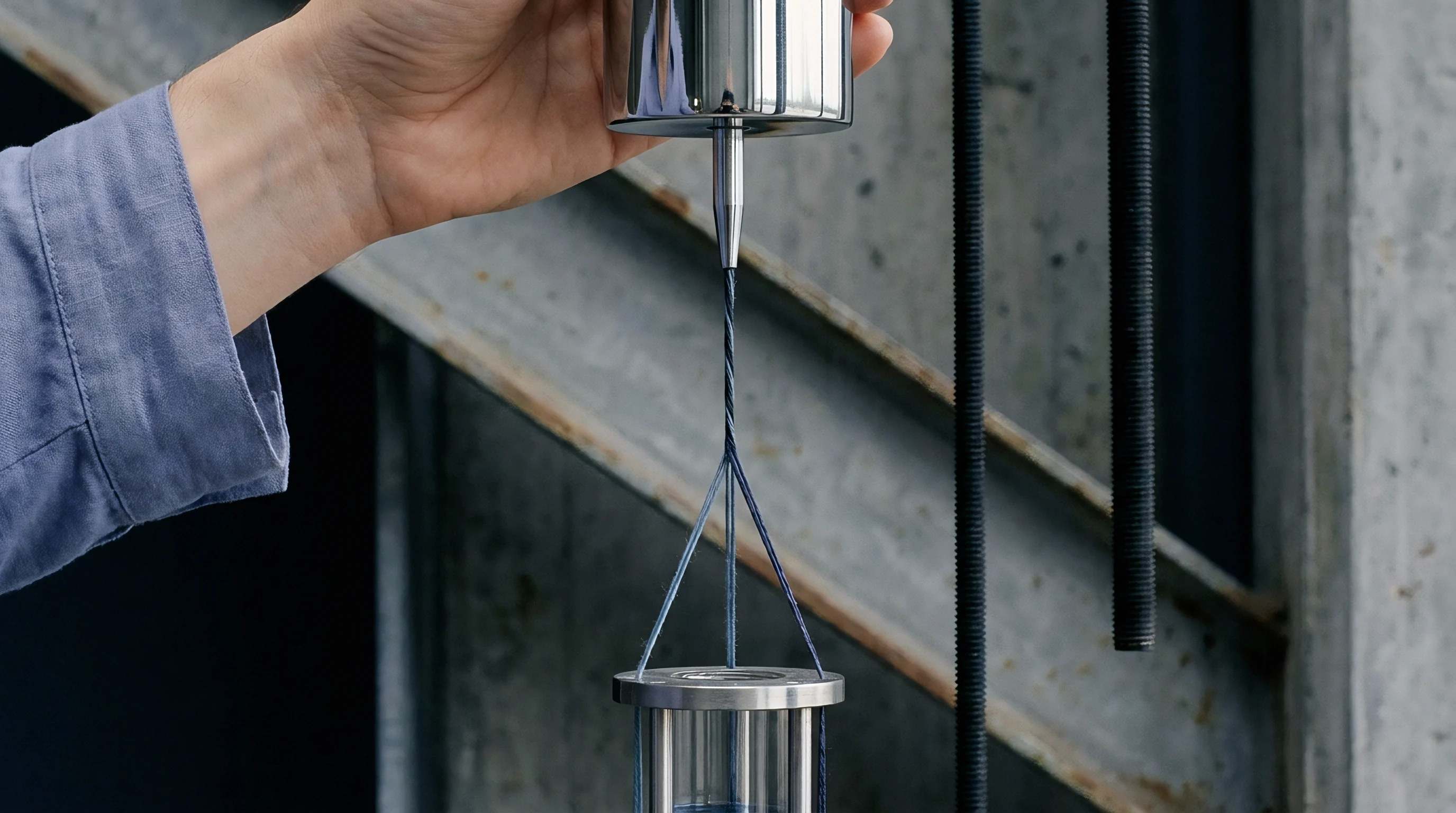
Yarn count determines required nozzle pressure. Finer wet-spun counts have less mass per unit length, so they need less kinetic energy to accelerate but tolerate less force from the main nozzle blast. Coarser yarns require higher pneumatic push to clear the shed at speed, which drives compressor air demand up accordingly.
| Yarn Count (Nm) | Linear Density (tex) | Main Nozzle (MPa) | Relay Pressure (MPa) | Air Intake (Nm³/hr) | Weft Stops (per 100k picks) |
|---|---|---|---|---|---|
| Nm 14 | 71.4 | 0.68 | 0.62 | 28.4 | 2.1 |
| Nm 26 | 38.5 | 0.58 | 0.52 | 22.1 | 1.4 |
| Nm 36 | 27.8 | 0.50 | 0.44 | 17.8 | 1.8 |
| Nm 44 | 22.7 | 0.45 | 0.38 | 14.6 | 3.6 |
Dropping main nozzle pressure below 0.42 megapascals on Nm 44 yarn leads to loops inside the profile reed. The tip folds over and triggers optical filling detector stops at the arrival end. Increasing relay nozzle pressure straightens the flight path, but forces compressor load toward unsustainable levels.

Warp
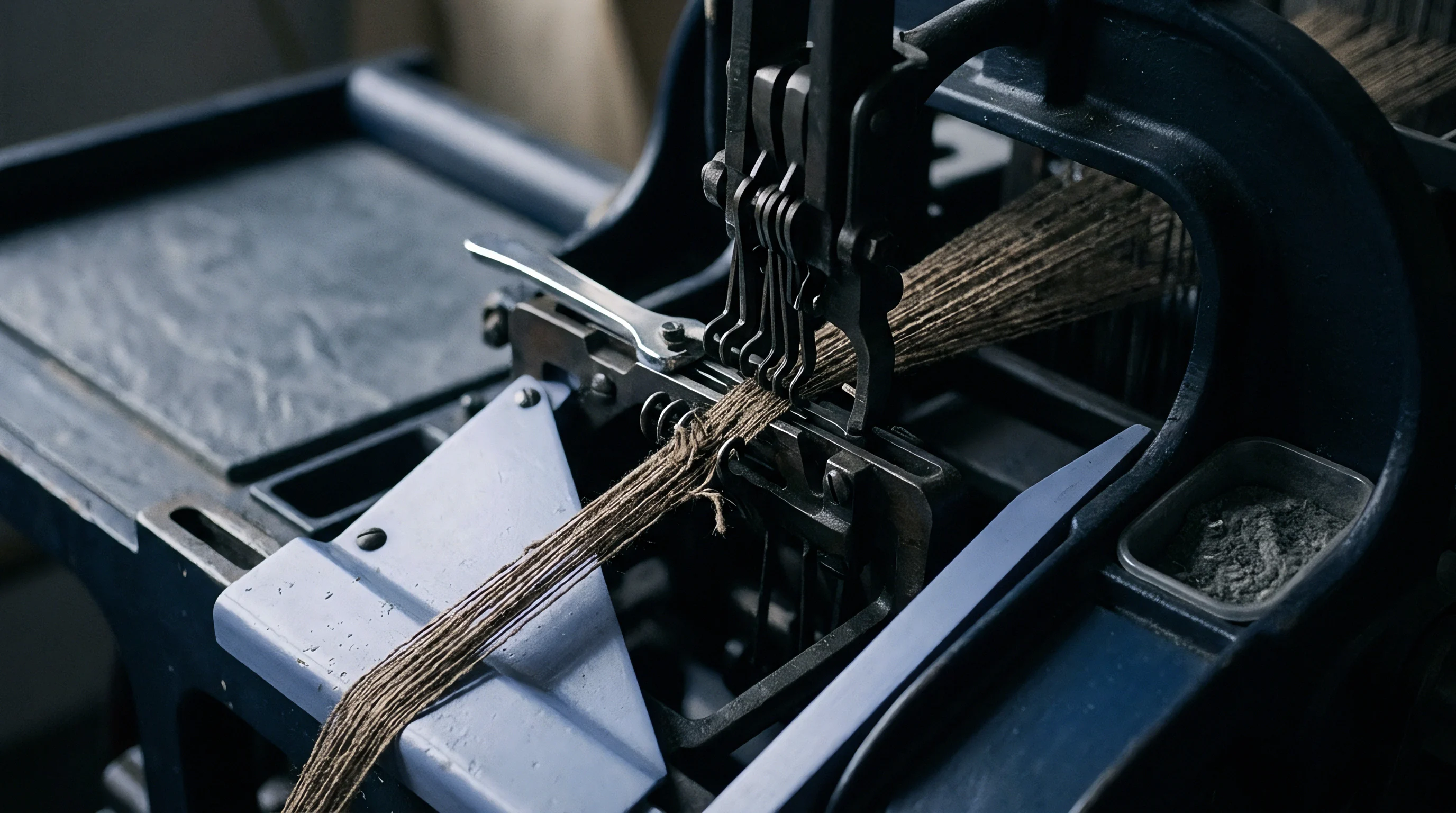
Loom stops frequently trace back to warp preparation and shed mechanics. Flax warp beams wound with uneven tension produce slack ends that dip directly into the insertion line. A standard plain weave at 18 ends per centimetre and 16 picks per centimetre across a 145-centimetre finished width uses 2,880 active ends.
If sizing fails to lay protruding fibrils flat against the yarn core, neighboring ends cling together as the shed reverses.
Clinging fibrils restrict the open shed, and air jet insertion tolerates no mechanical obstruction in the reed profile. Sizing recipes for linen warps balance film coherence against washability during desizing, combining modified potato starches, synthetic acrylic binders, and lubricating wax emulsions. Skimping on binder leaves the yarn exposed to abrasive friction across drop wires, heald eyes, and reed dents.
Warp breaks on linen air jets generally point to structural defects in the fiber bundle. Wet spinning relies on high temperatures to soften pectin during drafting; incomplete pectin removal leaves rigid nodes that concentrate stress when tension peaks. Strain from the heald frames reaches its maximum at shed crossover, where thread tension spikes by 35 to 50 centinewtons.
Static friction between adjacent ends produces shedding drag. Flax fibers are notably stiffer than cotton, so when warp density exceeds 24 ends per centimetre in dense shirting fabrics, mechanical clashing strips dry size off the yarn and deposits abrasive lint on the sley guide brackets.
- Sizing concentration verification requires checking refractometer solids percentages across every size-box immersion sector before running flax beams through the cylinder dryer.
- Lease rod alignment stabilizes individual thread paths between the back rest roller and the droppers, preventing twisting of loose slubs.
- Heald frame timing adjustment ensures the shed opens fully at 80 degrees of loom cycle rotation, granting the pneumatic plume clear passage.
- Warp stop motion sensitivity calibration avoids false mechanical cutouts caused by momentary tension drops during harness frame inversion.
Lint buildup inside the reed profile alters air trajectories. A single bit of packed lint in a relay nozzle orifice can widen the jet expansion angle from 12 degrees to 23 degrees, dropping dynamic pressure before the air stream reaches the profile channel. Keeping air lines clear and maintaining consistent warp tension are critical to preserving the path.
Plume
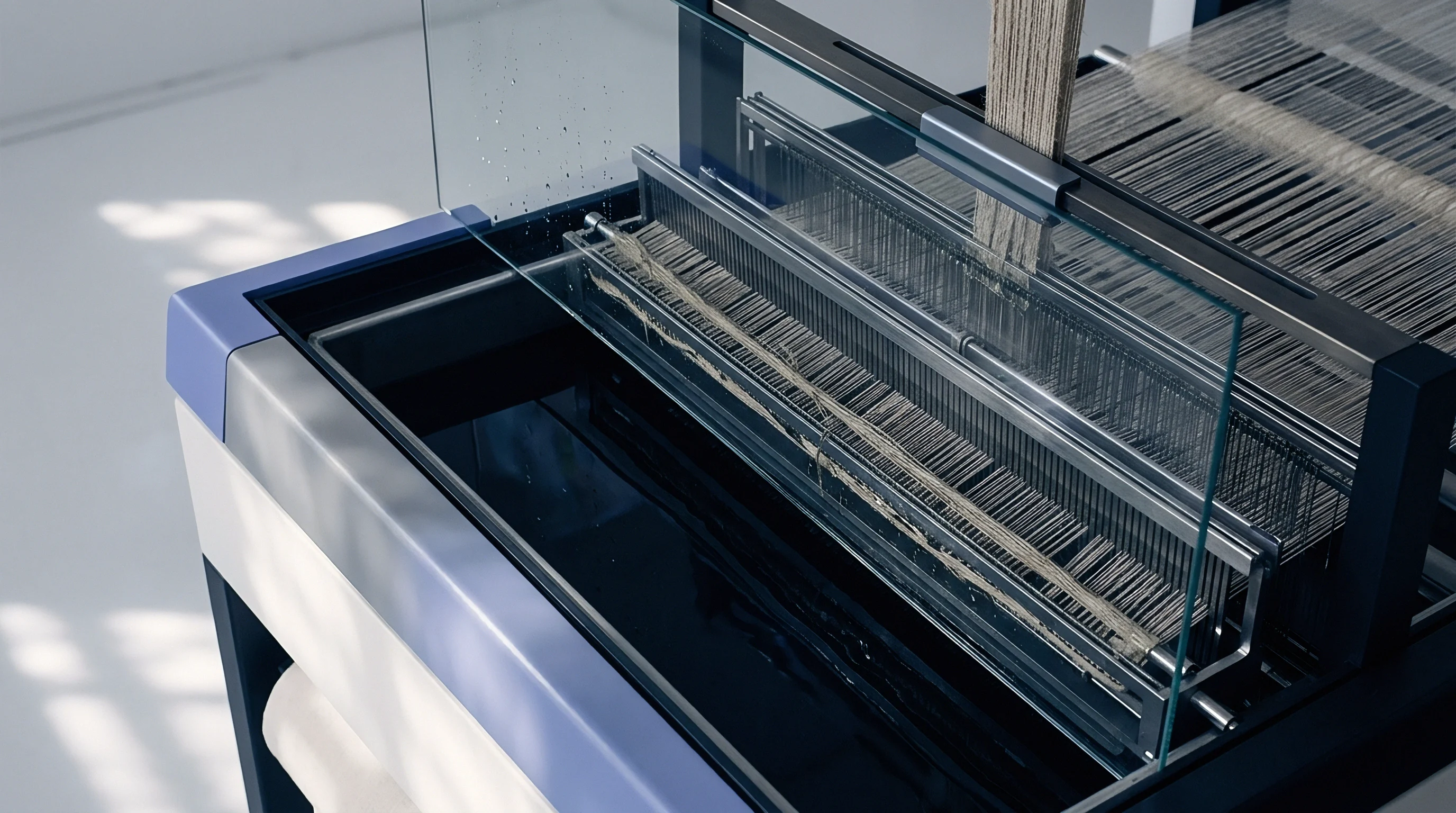
Air expanding through a convergent-divergent nozzle creates a high-velocity core surrounded by a turbulent boundary layer. Main nozzle orifices of 1.8 to 2.2 millimetres generate supersonic velocity at the exit plane when supply pressure exceeds 0.50 megapascals, though the stream decays into subsonic turbulence within 40 millimetres. As it expands, the jet entrains ambient air, drawing room moisture and floating flax dust into the profile channel.
Pneumatic momentum transfers to the weft via skin friction along the yarn surface. Surface roughness and protruding fibrils give linen an effective aerodynamic drag coefficient of 0.045, compared to 0.018 for smooth spun polyester under the same conditions. That higher drag helps linen accelerate quickly at lower air speeds, but the irregular fibril surface also creates uneven lift forces that wobble the pick flight and whip the yarn tail into the reed teeth.
A linen yarn drag coefficient of 0.045 generates erratic tip trajectories when relay nozzle pressures exceed 0.58 megapascals inside an unconditioned loom shed.
Compressor load tracks total air consumption across the manifold system. A shed of 60 air jet looms running linen requires screw compressors producing 1,400 normal cubic metres per hour at 0.8 megapascals line pressure, consuming roughly 175 kilowatts per hour during continuous operation. Dropping operating line pressure by just 0.05 megapascals cuts compressor motor draw by 4.2 percent.
Velocity Profiles across the Loom Reed Width
Air velocity along the reed channel drops as distance from an active relay nozzle increases. Keeping pick speed stable requires overlapping the firing windows of consecutive nozzle pairs by 15 to 20 degrees of mainshaft rotation. Extending blowing duration simply wastes compressed air without adding to peak yarn velocity.
| Distance from Main Nozzle (mm) | Peak Centerline Velocity (m/s) | Static Air Pressure (kPa) | Weft Flight Time (ms) | Yarn Tail Stability Index |
|---|---|---|---|---|
| 150 | 68.2 | 124.5 | 2.4 | 0.94 |
| 600 | 54.1 | 108.2 | 9.8 | 0.88 |
| 1050 | 47.6 | 102.1 | 18.6 | 0.81 |
| 1500 | 43.2 | 98.4 | 28.5 | 0.74 |
| 1850 | 39.8 | 94.7 | 38.1 | 0.66 |
When weft yarn carries coarse spin irregularities that jam the reed, cross-sectional mass spikes abruptly. Pneumatic energy becomes insufficient to push the thickened section through the channel before the harness closes. Whether continuous variable-pressure blowing can compensate for these flax irregularities without driving compressor power bills past commercial viability remains an open question.
Downtime
A stopped loom accumulates overhead without producing fabric. When an air jet halts on a weft arrival fault, the automated repair sequence reverses the sley, engages the pneumatic pick extractor, pulls the damaged or short pick into a waste canister, and resets the warp shed ~ a cycle taking 14 to 22 seconds before the main motor restarts.
Flax fibers break during insertion and shed lint over machine parts. Manual intervention is required when picks snap inside the tandem nozzle tube or wrap around the prewinder balloon breaker ring. Splicing flax yarn by hand takes 45 to 90 seconds per incident, pushing loom efficiency down rapidly; an operator running 24 air jet looms quickly gets overwhelmed if stoppage rates climb past 3.5 stops per loom hour.
- Short pick arrivals stem from insufficient relay nozzle pressure or excessive mechanical yarn brake resistance on the feeder drum.
- Nozzle threading blocks happen when loose bast fiber clusters detach from the yarn body and wedge inside the delivery tube orifice.
- Blown-apart picks arise from excessive main nozzle peak blast pressure exceeding the low tensile cohesion of carded flax roving blends.
- Warp path cutouts develop when abraded flax slubs catch adjacent warp ends, preventing drop wire descent on actual breaks.
Energy savings achieved by dialing back manifold pressure disappear as soon as stoppage rates climb. Every shutdown lowers overall shed efficiency and drags out production schedules. Running 100 air jet looms on Nm 26 linen at 70 percent efficiency rather than 85 percent increases facility energy costs per linear metre by 21.4 percent, since baseline power for chillers, dust extraction, and idling compressors runs continuously regardless of output.
Setting manifold pressure too low compromises machine output and causes yarn waste. Clearing short picks creates starting marks and filling variations on finished fabric rolls, risking failure under ASTM D5430 four-point visual inspection standards.

Balance
Commercial viability comes down to cost per woven metre. Every air jet room operates on a balance between compressor power, warp preparation, weaving speed, and floor labor. Sourcing managers purchasing greige linen need to look closely at the machine settings behind quoted prices to see whether lower figures reflect real process efficiency or disguised waste.
Inelastic flax yarn snaps easily when dry, splitting reed wires and forcing operators to rethread manual drop wires. Sizing must balance film protection against shed clearance; when binder content is cut to trim chemical costs, weavers often crank up air pressure to force hairy yarn through sticky warps. Electrical consumption spikes simply to cover up inadequate warp sizing.
| Operational Model | Manifold Pressure (MPa) | Loom Stops (per 100k picks) | Shed Efficiency (%) | Pneumatic Cost (USD/m) | Labor Cost (USD/m) | Total Loom Cost (USD/m) |
|---|---|---|---|---|---|---|
| Low Pressure | 0.45 | 5.8 | 76.4 | 0.082 | 0.145 | 0.485 |
| Balanced Standard | 0.54 | 1.8 | 86.2 | 0.108 | 0.078 | 0.412 |
| Over-Blown Stable | 0.65 | 1.4 | 88.1 | 0.146 | 0.065 | 0.448 |
The balanced standard configuration operates at 0.54 megapascals, yielding 1.8 weft stops per 100,000 picks at an overall shed efficiency of 86.2 percent. The low-pressure setup reduces compressor costs to 0.082 dollars per metre, but the resulting surge in mechanical stops drops efficiency to 76.4 percent and drives direct labor up to 0.145 dollars per metre. Total weaving cost under low pressure reaches 0.485 dollars per finished metre ~ a net penalty of 0.073 dollars compared to the balanced baseline.
The over-blown model pushes pressure to 0.65 megapascals to cut stops to 1.4 per 100,000 picks, raising mechanical efficiency to 88.1 percent and minimizing labor. However, higher air consumption increases pneumatic cost to 0.146 dollars per metre, pushing overall production expense to 0.448 dollars per linear metre. Excessive air velocity can also snap delicate linen picks, causing filling defects that downgrade finished rolls to secondary markets.
A contract clause specifying maximum allowable pick stops per hundred thousand picks protects greige cloth buyers from mills running under-pressured air systems to save electricity.
Weaving linen profitably on air jets depends heavily on atmospheric control in the weave room. Holding ambient conditions at 22 degrees Celsius and 72 percent relative humidity preserves moisture in the flax core, keeping fiber bundles pliable and preventing static build-up. Well-conditioned yarn unwinds smoothly off prewinder packages, lowering the required yarn brake tension.
Routing compressor thermal exhaust away from intake air filters improves mass-flow efficiency, supplying denser air charges to main manifold valves. Combining proper sizing formulations, controlled shed humidity, and calibrated relay pressures maintains yarn integrity without pushing electrical costs beyond profitable limits.