Micro-Cellulosic Sludge Deposition Kinetics across European Flax Retting Origin Certifications
Dew-retted European flax exhibits low surface sludge deposits below 3.5 mg/g, providing physical verification to validate origin claims against fraud.


Silt
Separating flax bast fibres from the outer epidermal layers relies on enzymatically dissolving middle lamella pectins. In traditional aquatic retting, anaerobic bacteria such as Clostridium felsineum and Clostridium acetobutylicum break down calcium pectate complexes, releasing free cortical parenchyma cells, cuticle flakes, and short cellulosic fines under 150 micrometres long. These insoluble remnants form a suspended bio-sludge in the retting liquid.
When retting happens in static ponds, sluggish water turnover lets micro-cellulosic particles settle back onto stem surfaces, embedding fine debris into the outer fiber bundle structure before mechanical scutching.
Field dew retting operates under entirely different physical conditions. Soil-borne fungi, including Epicoccum nigrum and Cladosporium herbarum, colonize harvested flax stalks laid out in Western European fields. Cycles of atmospheric moisture drive fungal pectinase activity without ever submerging the stems in a liquid bath.
As a result, debris generated during dew retting consists mainly of dry fungal mycelia fragments and crumbling cortical dust that drop off easily during mechanical decortication. Fiber lots from field dew retting show far lower surface levels of re-deposited cellulosic sludge than fibers retted in water basins.

Pectinolysis and Micro-Cellulosic Fragment Liberation
Enzymatic hydrolysis of polygalacturonan chains in the plant cell wall releases structural fragments into the surrounding fluid. Microbial pectin lyase and polygalacturonase attack the galacturonan backbone, loosening the bond between bast fiber bundles and surrounding cortical tissues. This breakdown releases micro-cellulosic debris made up of fragmented primary cell walls, crystalline cellulose microfibril clusters, and un-degraded pectin residues.
How fast these micro-particles form depends directly on bath temperature, enzyme concentration, and retting time.
Continuous immersion retting generates substantial particulate loads per dry metric ton of processed straw. Anaerobic fermentation turns the bath acidic, driving pH down from 6.8 to 4.5 over a seventy-two hour cycle. As acidity rises, solubility thresholds for certain hemicellulosic fractions shift, causing fine suspended solids to precipitate back onto the exposed cortical walls.
This secondary coating forms a microscopic film that changes fiber friction, moisture regain rates, and performance during spinning. Keeping particulate levels under control requires steady liquor exchange or continuous mechanical decantation.
Dew-retted flax straw yields under 1.8 percent total micro-cellulosic silt mass per dry fibre metric ton during scutching separation.
Aquatic retting systems yield different particle distributions depending on water flow velocity. Stagnant ponds keep high concentrations of suspended solids, so fine cell wall debris settles by gravity directly onto submerged flax bundles. Recirculated tank systems use driven fluid flow to scour debris from stalk surfaces, channeling sludge into external settling tanks.
Ultimately, the physical setup of the retting vessel determines whether micro-cellulosic debris stays in suspension or forms a dense sediment layer over the crop.

Dew Retting Dynamics in Western European Agricultural Zones
Maritime weather across Northern France, Flanders, and the Netherlands offers a distinct mix of night dew and daytime sun. Fungal hyphae penetrate the outer epidermis without damaging the primary crystalline cellulose core inside the bast fiber bundles. Dew retting leaves no standing bath.
Micro-cellulosic debris stays on the outer stalk skin, where wind and rain wash lighter particles down onto the soil before harvest.
Scutching dew-retted straw pulls away mechanical shives and dust using dry pneumatic extraction. Turbine scutching rollers beat the dry stems, breaking brittle cortical tissue away from flexible fiber ribbons without mashing wet sludge into the fiber surface. Dust collection figures from Normandy scutching plants show that more than eighty-two percent of non-fibrous plant material separates cleanly as coarse shive or fine dust.
Remaining micro-cellulosic surface contamination on scutched flax sliver stays below fixed thresholds, acting as a physical indicator of field-retted origin.
| Retting Method | Primary Micro-Particle Size (µm) | Mean Sludge Mass Yield (% dry fibre) | Surface Adsorption Density (mg/m²) | Predominant Biological Vector |
|---|---|---|---|---|
| Field Dew Retting (Normandy/Flanders) | 45 to 180 | 0.45 to 0.85 | 12 to 28 | Epicoccum nigrum / Cladosporium |
| Stagnant Pond Retting (Aqueous) | 5 to 65 | 2.80 to 4.50 | 110 to 240 | Clostridium felsineum |
| Enclosed Tank Retting (Recirculated) | 10 to 90 | 1.10 to 1.90 | 45 to 85 | Pectinase / Cellulase Enzyme Complexes |
| Enzymatic Accelerated Retting (Warm Water) | 2 to 40 | 1.60 to 2.30 | 65 to 120 | Exogenous Polygalacturonase Formulations |
Commercial certifications for European origin depend on the physical reality of these retting processes. Western European flax rules ban traditional pond retting under strict water quality regulations enforced by regional environmental agencies. European Flax certification schemes log the field-retting cycle across approved communes, building a paper trail that matches physical fiber metrics.
Clean fiber surfaces with minimal colloidal sludge distinguish genuine European dew-retted fiber from imported stocks subjected to cheap tank or pond retting where environmental discharge limits are lax.
European scutching mills track dust generation ratios as a key quality metric. Fiber lots that were incompletely dew-retted retain excess green bark parenchyma, creating heavy dust during hackling. Over-retted fiber, on the other hand, suffers cellulolytic damage that breaks down fiber fines and inflates micro-cellulosic sludge yields during wet spinning.
Getting the field pectinolysis timing right preserves fiber tensile strength while keeping particle redeposition to a minimum.
Thick particulate crusts on raw fiber sliver reflect improper aquatic processing rather than natural field retting variations in Northern France.


Decantation
Settling of insoluble organic debris in retting liquor follows classical particulate dynamics, altered somewhat by colloidal surface forces. Sub-micron cellulosic fines suspended in water carry negative electrical charges because of exposed carboxyl and hydroxyl groups. This zeta potential creates electrostatic repulsion between particles, delaying natural flocculation and keeping fine cell wall fragments suspended.
As organic acids accumulate and increase the liquor’s ionic strength, electrostatic double layers compress, allowing van der Waals forces to draw particles into larger flocs that fall to the basin floor.
Settling rates for cellulosic particles depend on particle shape, liquid viscosity, and local fluid movement. Drag forces acting on irregular cell wall fragments yield lower terminal settling velocities than Stokes’ law predicts for spherical particles. Continuous circulation inside retting tanks stops fine particles from dropping out, increasing how often they collide with exposed flax stems.
Fiber bundle surfaces then act like a filter bed, trapping suspended fines through physical retention and van der Waals adsorption.

Stokesian Sedimentation and Cellulosic Fine Zeta Potential
Modeling micro-particulate settling velocity mathematically requires shape correction factors for non-spherical cell wall fragments. Drag coefficients rise sharply when aspect ratios exceed five to one, as seen in liberated bast micro-fibril clusters. Calculating terminal velocity vs involves accounting for fluid density ρf, particle density ρp, dynamic viscosity μ, particle equivalent diameter dp, and the dimensionless shape factor φ:
vs = fracg dp2 (ρp – ρf)18 μ φ
Experiments show that the density of hydrated cellulosic fines falls between 1.35 and 1.42 grams per cubic centimetre. Because this sits fairly close to the density of water, faint convection currents or thermal gradients in retting basins can stop settling altogether. Sub-micron fines stay suspended indefinitely unless chemical coagulants or biological flocculants alter their surface charges.
If solids do not settle as pectin breaks down over time, continuous retting systems build up heavy suspended loads that deposit onto processing equipment and raw flax stalks.
Zeta potential measurements of flax retting liquor particulates show negative values between -18 mV and -32 mV across neutral to acidic pH ranges. Adding divalent cations like calcium or magnesium compresses the diffuse double layer around the particles. Coagulation happens quickly once zeta potential moves closer to zero than -10 mV, forming dense flocs that settle faster.
Decantation systems use forced laminar flow channels to encourage aggregation, stripping out micro-cellulosic sludge before recirculating wash liquor through raw straw beds.
- Zeta potential stabilization prevents micro-particle aggregation when wash water lacks enough divalent cations, keeping turbidity high throughout continuous liquid retting circuits.
- Thermal convection eddies inside uninsulated outdoor retting tanks stir up settled sludge layers, resuspending micro-cellulosic fines and fouling incoming straw charges.
- Boundary layer entrapment happens when fast fluid flow forces suspended cellulosic debris through dense flax straw bundles, turning the raw crop into a depth filter bed.
- Acidic precipitation of hemicellulose below pH 4.8 forms sticky, insoluble surface films that bind micro-cellulosic fines directly to the outer bast fiber walls.
- Inadequate residence times in primary settling decanters let sub-micron cell wall fragments recirculate into processing basins, worsening surface deposits across successive production lots.

Interfacial Adsorption Kinetics on Cortical Fiber Boundaries
Adsorption of suspended micro-cellulosic debris onto flax fiber surfaces fits Langmuir or Freundlich isotherm models, depending on surface heterogeneity. Fiber surfaces feature active binding sites made up of un-esterified galacturonic acid groups, exposed hydroxyl groups, and residual lignin structures. Suspended micro-particles attach to these sites through hydrogen bonding and hydrophobic interactions.
Adsorption happens quickly during initial immersion, reaching equilibrium within six to ten hours depending on fluid turbulence and particle concentration.
Quantifying surface deposition requires evaluating kinetic rate constants with pseudo-second-order sorption models. The mass of adsorbed sludge per unit fiber weight qt at time t relates to equilibrium capacity qe and kinetic rate constant k2 through the governing rate expression:
fractqt = frac1k2 qe2 + fractqe
Higher temperatures increase kinetic rate constants, speeding up particle deposition onto cortical surfaces. Fiber lots processed in warm aquatic retting systems (30circC to 38circC) carry noticeably denser particle coverage than cold-water lots (12circC to 18circC). Rougher surfaces caused by these deposits increase friction during carding and hackling, causing more fiber breakage and shortening mean fiber length in spun yarn.
Excessive fluid velocity inside retting basins transforms flax straw bundles into depth filters that capture suspended cellulosic debris.
Decantation mechanics directly affect wastewater treatment requirements for commercial retting operations. Retting effluent carries total suspended solids (TSS) concentrations between 1,500 and 4,200 milligrams per litre, composed mostly of micro-cellulosic debris and soil particles. European Union environmental rules require treatment systems to bring TSS below 35 milligrams per litre before river discharge.
Meeting this threshold takes multi-stage processing, including mechanical screening, chemical flocculation, primary decantation, and biological oxidation. These heavy treatment costs pushed the Western European flax sector to abandon aquatic retting for field dew retting in the late twentieth century.
Field dew retting avoids concentrated liquid effluent by letting natural soil microbiota degrade organic waste directly on agricultural land. Microbes break down liberated pectin and cellular debris without generating liquid sludge streams. What micro-cellulosic fragments stay on dew-retted straw exist as dry, un-adsorbed dust flakes that separate easily during mechanical scutching.
Clean scutching yields high-purity flax ribbons free of the dense colloidal sludge crusts typical of poorly decanted tank-retted imports.
Keeping particulate concentrations low in retting fluids prevents surface deposition, preserving natural fiber luster and overall yield.


Regime
Provenance certification frameworks for European flax govern chain of custody from farm GPS coordinates through finished yarn and fabric. The European Flax standard, managed by the Alliance for European Flax-Linen and Hemp, mandates zero-irrigation farming, 100% field dew retting, and strict origin boundaries covering France, Belgium, and the Netherlands. Certification rules ban liquid aquatic retting outright, making dew retting mandatory.
Scope certificates confirm farm compliance, while transaction certificates (TCs) track fiber volumes as they move through scutchers, hacklers, spinners, and weavers.
Masters of Linen certification adds processing location limits beyond farm origin. While European Flax permits spinning and weaving outside Europe if the chain of custody stays audited, Masters of Linen requires every step from scutching to finished fabric to happen within European territory. This rule removes the blending risks and lack of transparency that come with shipping raw fiber offshore, where aquatic retting or uncertified fiber dilution might take place during mill operations.

Traceability Frameworks of Western European Fiber Standards
Documentary audits rely on mass-balance reconciliation at every processing stage. Scutching mills take in raw straw shipments tied to farm plot numbers and weighbridge tickets. Typical scutching yields run 18% to 22% long line fiber, 10% to 15% short fiber (tow), and 45% to 50% shives by weight.
Certifiers check incoming straw tonnage against outgoing long line fiber certificates. Any gap beyond standard yield ranges triggers a physical audit and can suspend certification.
OEKO-TEX Standard 100 provides a separate layer of safety verification, focusing on chemical residue limits rather than geographic origin. It screens finished goods for harmful substances like heavy metals, pesticide residues, and extractable organochlorines. OEKO-TEX certification does not verify field dew retting or European origin; yarn made from offshore aquatic-retted flax can pass OEKO-TEX Standard 100 if washed free of processing chemicals.
Sourcing managers must distinguish chemical safety standards from origin and agricultural certifications.
- Verify scope certificate validity against the issuing body’s official online register before signing fiber supply contracts.
- Reconcile transaction certificate lot numbers with physical bale tags, shipping bills, and customs declarations when material arrives.
- Confirm 100% dew retting declarations on processing documentation to ensure compliance with European environmental and agricultural standards.
- Audit spinning mill mass balances by comparing certified raw fiber purchase volumes against certified spun yarn delivery invoices across matching reporting windows.
- Cross-check non-preferential origin criteria under Union Customs Code rules to verify that substantial transformation thresholds match declared customs tariff codes.

Which Retting Effluent Markers Confirm European Origin?
Physically verifying European dew-retted origin relies on testing residual organic compounds on raw fiber surfaces. Dew-retted flax retains specific microbial lipophilic markers, such as ergosterol from fungal cell membranes, which do not appear in bacterial aquatic retting systems. Gas chromatography-mass spectrometry (GC-MS) analysis of surface lipid extracts identifies fungal biomarker ratios unique to Western European soil microbial communities, providing biochemical signatures that confirm origin and validate paper transaction certificates.
Analyzing inorganic ash content provides a second physical test. Aquatic tank and pond retting leach mineral ions from flax stems while depositing waterborne sediment fines onto fiber surfaces. Dew-retted European flax shows low total ash content (0.7% to 1.1% by dry weight) alongside specific calcium-to-potassium ratios.
Higher ash levels point to aquatic pond retting with accumulated sediment, exposing false origin claims on fiber paperwork.
| Standard / Certification | Mandatory Retting Method | Geographic Sourcing Restriction | Chain of Custody Model | Offshore Processing Permitted |
|---|---|---|---|---|
| European Flax | 100% Field Dew Retting | France, Belgium, Netherlands | Physical Segregation / TCs | Yes (with audited TCs) |
| Masters of Linen | 100% Field Dew Retting | 100% European Territory | Physical Segregation / TCs | No (Europe transformation only) |
| GOTS (Organic Textile) | Not Specified (Eco-compliant) | Global (Certified Organic Farms) | Transaction Certificates | Yes (Audited facilities) |
| OEKO-TEX Standard 100 | Not Restricted | Global (No geographic rules) | Batch Chemical Testing | Yes (Global testing nodes) |
Customs classification and non-preferential origin rules under the Union Customs Code (UCC Article 60) set the legal framework for origin determination. Scutching raw flax straw into fiber counts as a substantial transformation, conferring origin where scutching takes place. However, spinning raw fiber into yarn (HS 5306) or weaving yarn into fabric (HS 5309) shifts origin under tariff shift rules.
Importing European raw flax fiber into China for spinning yields yarn with Chinese non-preferential origin under EU and US customs law, even if the raw material holds European Flax certification.
Under European Flax Standard Clause 4.2.1, blending certified field-retted European fiber with uncertified or aquatic-retted fiber during spinning preparation instantly revokes certified status for that batch, forcing a full downgrade to conventional fiber classification.


Gravimetry
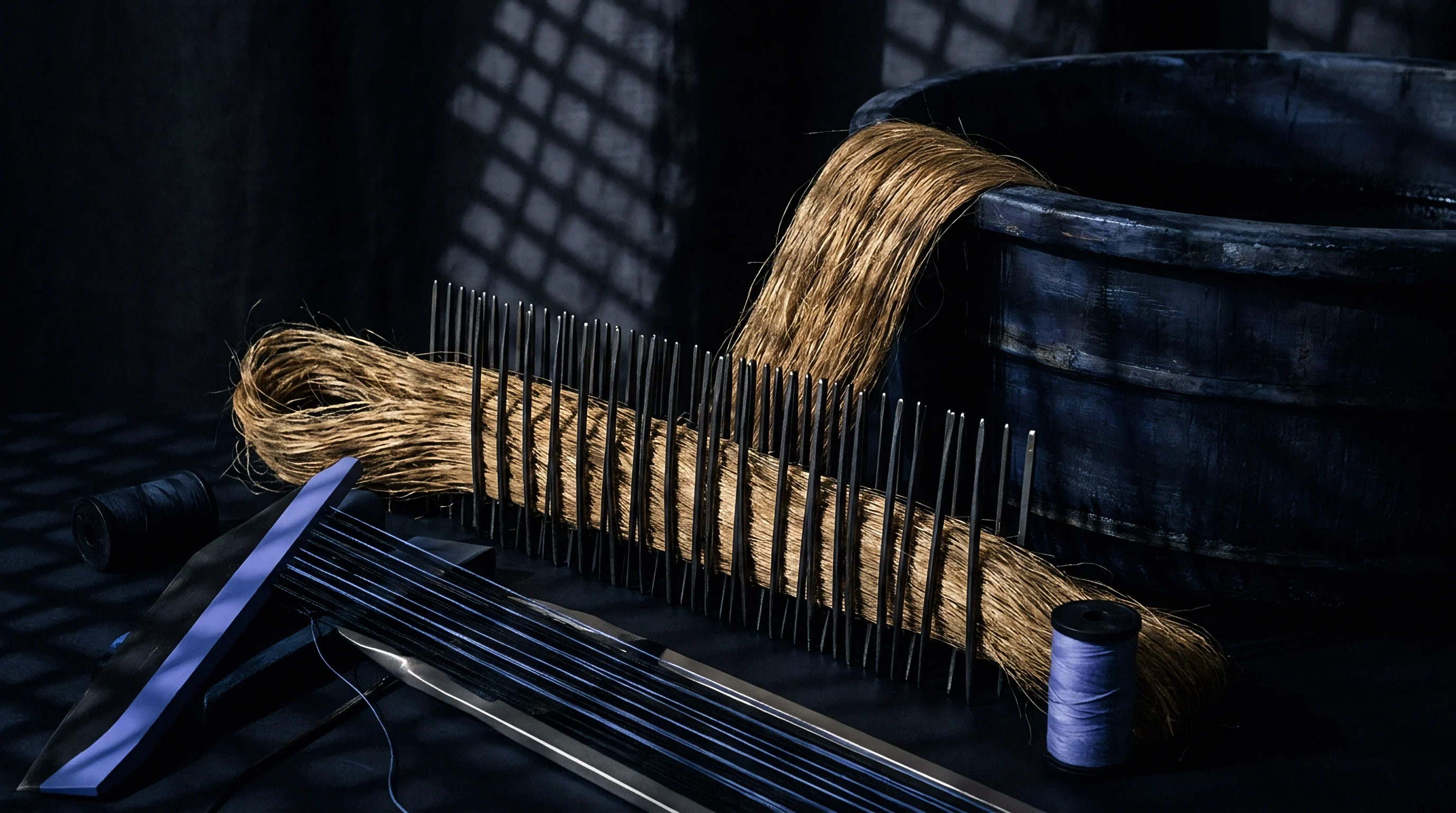
Measuring micro-cellulosic particulate contamination on processed flax fiber calls for standardized gravimetric and analytical protocols. Suspended solids testing follows adapted ISO 11923 and EN 872 methods, using ultrasonic water extraction to free surface-adsorbed fines from fiber samples. The extraction fluid is vacuum-filtered through binder-free glass fiber discs with a nominal pore rating of 0.7 micrometres.
Drying the retained solids at 105circC to constant weight gives the total surface particulate load per dry mass of fiber.
Thermogravimetric analysis (TGA) separates organic cellulosic sludge fines from inorganic soil minerals in extracted residue. Cellulosic material breaks down thermally between 280circC and 380circC under a nitrogen atmosphere, leaving carbonaceous char that oxidizes completely when switched to air at 550circC. Remaining inorganic ash above 600circC consists of soil minerals, silica flakes, and clay particles, yielding a thermal profile that reveals origin and precise mass fractions for micro-cellulosic fines versus environmental dust.
Gravimetric Suspended Solids Differentiation Protocols
Analytical extraction starts with ten-gram fiber samples taken from the core of audited bales. Samples undergo controlled washing in ultrapure water containing 0.05% non-ionic surfactant under high-intensity ultrasonic treatment (40 kHz) for fifteen minutes. This cavitation energy strips away surface cell wall debris, parenchyma fragments, and fungal hyphae without damaging primary bast fiber walls.
The wash liquor then moves directly to analytical filtration.
Calculating total suspended particulate deposit Sp in milligrams per gram of dry fiber uses initial dry sample mass mf, filter tare weight m1, and dried filter weight m2:
Sp = fracm2 – m1mf
Fibers from controlled Western European dew-retting operations consistently yield Sp values between 1.2 and 3.5 mg/g. By contrast, aquatic pond-retted flax samples routinely show Sp values between 12.8 and 34.2 mg/g because of heavy surface adsorption of biological retting sludge. This gravimetric gap serves as a reliable screening test during mill audits to spot unannounced substitution with aquatic-retted fiber.
- Extract a representative 10.0-gram specimen from the core bale mass using a random multi-point sampling protocol.
- Dry the specimen at 105 degrees Celsius for 120 minutes in a forced-draft oven to establish dry baseline mass.
- Submerge the specimen in 500 millilitres of ultrapure water containing non-ionic surfactant in an ultrasonic bath vessel.
- Apply ultrasonic cavitation at 40 kilohertz for 15 minutes to release surface-bound micro-particulates into the liquid phase.
- Pass wash fluid through a pre-weighed 0.7-micrometre glass fibre filter disc under 70 kilopascals of vacuum pressure.
- Dry the filter assembly at 105 degrees Celsius to constant mass and calculate the gravimetric particulate yield ratio.

Thermogravimetric Profiling of Cortical Deposition Fines
Coupling thermogravimetric analysis with mass spectrometry (TGA-MS) identifies specific organic compounds given off during thermal breakdown. Cellulosic fines release characteristic volatile fragments, including levoglucosan, furfural, and carbon dioxide at 330circC. Residual pectin binders decompose at lower temperature steps (220circC to 270circC), producing distinct acetic acid mass peaks.
Dew-retted European fiber deposits show minimal pectin volatile peaks thanks to thorough fungal pectinase breakdown in the field.
Scanning electron microscopy paired with energy-dispersive X-ray spectroscopy (SEM-EDS) confirms particle shape and elemental distribution on fiber surfaces. Dew-retted fibers display clean, smooth longitudinal walls with occasional dry fungal spore clusters. Aquatic-retted fibers show continuous, rough coatings of collapsed parenchymal cell walls embedded with clay particles high in silicon and aluminum.
Quantitative image analysis of SEM micrographs provides surface coverage percentages that corroborate gravimetric results.
ISO 1151 ash determination above 1.2 percent by dry weight invalidates pure dew-retting origin declarations.
Comparing lab metrics against mill production records flags supply chain anomalies before yarn production begins. When gravimetric sludge yields exceed 5.0 mg/g on fiber batches accompanied by European Flax TCs, auditors flag the lot for origin verification. Particle size distribution analysis under a microscope clarifies whether high particulate loads stem from field dirt or biological retting sludge.
Inorganic dirt washes out during early carding, whereas sticky retting sludge stays bound to fiber surfaces right through spinning preparation.
Laboratory testing takes time and money, leading buyers to weigh how many batch samples are needed to build statistical confidence across multi-container fiber purchases.

Indemnity
Commercial sourcing contracts for European flax yarn command price premiums of 15% to 35% over conventional uncertified yarn. This surcharge covers farm certification costs, harvest yield risks, and complete chain-of-custody tracking. When spinning mills deliver yarn backed by forged or invalid transaction certificates, buyers face commercial losses, regulatory liabilities, and customer claims.
Sourcing managers mitigate these risks through strict origin indemnification clauses and mandatory lab verification gates.
Customs enforcement under non-preferential origin rules and forced labor legislation, such as the US Uyghur Forced Labor Prevention Act (UFLPA), demands strict proof for imported linen goods. Authorities require documented tracing down to farm coordinates, leaving the buyer responsible for duty if documentation fails. Discrepancies between certified purchase orders and physical fiber metrics can trigger shipment detention, seizure, and civil fines up to twice the domestic value of the goods.

Financial Mechanics of Fiber Surcharges and Audit Fees
Certified fiber costs cover direct farm inspection fees, scutching mill chain-of-custody audits, and transaction certificate fees. Scutching mills pay annual scope certification fees between 2,500 and 5,000 Euros, plus transaction certificate fees averaging 45 to 75 Euros per lot. Spinning mills pass these overhead costs along with raw material premiums, adding roughly 0.40 to 0.85 Euros per kilogram to finished yarn prices.
Audit fees accumulate fast. Commercial disputes over suspected fiber substitution require third-party analytical testing. Standard lab sequences ~ including gravimetric extraction, TGA-MS thermal profiling, and SEM-EDS analysis ~ cost between 1,200 and 2,800 Euros per audited lot.
In a three-container yarn dispute involving forty metric tons of fiber, total lab fees can surpass 15,000 Euros. Contracts must assign responsibility for these audit costs based on test results.
| Sourcing Configuration | Yarn Base Cost (€/kg) | Certification Premium (€/kg) | Audit / Verification Risk (€/kg) | Customs Detention Exposure Level |
|---|---|---|---|---|
| Direct European Spinner (Masters of Linen) | 14.50 | 2.20 | 0.05 | Low (Full EU domestic documentation) |
| Offshore Spinner (European Flax Raw Material) | 11.80 | 0.85 | 0.35 | Moderate (Requires offshore TC tracking) |
| Uncertified Asian Spinner (Conventional Flax) | 8.90 | 0.00 | 1.20 | High (Unverified retting & farm origin) |
| Offshore Blended Batch (Diluted Certified) | 10.20 | 0.40 (Fraudulent) | 2.80 | Severe (Seizure risk & duty re-assessment) |
Evaluating total landed cost requires factoring in defect rates and origin exposure alongside invoice prices. Calculating total risk-adjusted yarn cost Cr uses base price Pb, certification surcharge Sc, audit allocation Aa, failure probability pf, and penalty cost Cp according to the commercial valuation model:
Cr = Pb + Sc + Aa + (pf × Cp)
Offshore spinning options often look cheaper on initial invoice prices. Higher failure probabilities pf linked to offshore documentation gaps, however, raise the true risk-adjusted cost Cr above European spinning baselines. Sourcing strategy needs to incorporate these risk parameters into procurement decisions.

Contractual Allocation of Origin Compliance Liabilities
Drafting defensive yarn purchase agreements calls for unambiguous language placing origin warranty liabilities on the seller. Contracts should state that delivering yarn that fails chemical, biological, or gravimetric origin verification triggers immediate rejection, seller-funded return shipping, and full refund of certification surcharges. Liquidated damages clauses ought to explicitly cover downstream production losses, customer cancellation penalties, and customs audit fees born by the buyer.
Origin compliance warranties must survive material acceptance and payment, extending for twenty-four months to cover multi-tier supply chain audits. Standard contract terms require sellers to keep physical retention samples from every delivered spinning lot for three years, enabling retrospective gravimetric and TGA testing if customs authorities challenge import documentation, establishing clear governance where missing retain samples or incomplete transaction records automatically assign liability to the supplier.
Failing to establish clear analytical origin criteria in supply agreements leaves buyers fully exposed to customs detentions, re-testing expenses, and margin write-offs if certified fiber claims collapse under third-party audit.