Modeling Non-Cellulosic Pectin Dissolution Impact on Technical Bundle Linear Density in Flax Wet Spinning
Hot water pectin dissolution in the wet-spinning trough cleaves coarse flax bundles to single cells, enabling fine lea counts and stable ring-frame drafting.

Matrix
Flax bast tissue arrives at the wet-spinning frame as multicellular technical bundles bound together by an inter-elementary middle lamella. This binding layer consists primarily of calcium-bridged homogalacturonan, highly branched rhamnogalacturonan-I with galactan and arabinan side chains, and hemicellulosic xyloglucans. Technical bundle linear density directly dictates drafting behavior, minimum spinnable yarn count, and tensile regularity in the finished wet-spun yarn.
Dissolving these non-cellulosic polysaccharides thermally and chemically ~ during roving pretreatment and hot-water trough immersion ~ drives the lateral division of coarse bundles into fine elementary fibers.
Elementary flax fibers have an average individual linear density between 1.2 and 2.5 dtex, with transverse diameters ranging from 12 to 22 micrometres. Technical bundles entering the wet-spinning system from hackled line roving exhibit linear densities from 15 to 45 dtex, combining 8 to 25 elementary cells bonded across their lateral surfaces. Dissolving pectin within the aqueous drafting zone reduces bundle cohesion, enabling inter-fiber sliding and lateral bundle cleavage under applied roller draft.
Incomplete pectin removal forces drafting rollers to fracture intact cellulosic cell walls rather than separate middle lamellae, creating thick slubs and elevated end-breakage rates.
A sixty-minute roving immersion at sixty-five degrees Celsius reduces technical bundle linear density from twenty-eight dtex to four point two dtex.
The process follows pseudo-first-order dissolution kinetics governed by bath temperature, fluid exchange rate, roving twist factor, and the native crop’s degree of methyl esterification. Calcium cross-linked pectins resist neutral aqueous solubilization at ambient temperatures. Heating the wet-spinning trough water past fifty-five degrees Celsius destabilizes divalent calcium bridges through thermal expansion and kinetic dissociation, accelerating the migration of solubilized galacturonan fragments into the liquor bath.
Polyuronide Solubilization Kinetics
The rate of pectin mass loss from the roving bundle correlates directly with tank temperature. Experimental extraction curves establish that pectin mass fraction drops exponentially during initial fluid contact. The governing dissolution rate equation defines the remaining non-cellulosic binding mass fraction over contact time:
C(t) = C_inf + (C_0 – C_inf) exp(-k_d t)
Here, C_0 represents initial non-cellulosic bundle mass content at zero seconds, C_inf denotes the residual insoluble pectin fraction bonded to primary cell walls, and k_d is the temperature-dependent dissolution rate constant governed by Arrhenius kinetics. The parameter k_d varies across typical mill processing temperatures:
- Ambient Trough Temperature produces a dissolution rate constant below zero point zero zero zero five inverse seconds, leaving technical bundles largely intact throughout the drafting cycle.
- Standard Mill Temperature at sixty degrees Celsius yields a rate constant of zero point zero零 three eight inverse seconds, sufficient for fifty lea yarn production.
- Elevated Spin Temperature at seventy-five degrees Celsius drives the constant to zero point zero零 eight two inverse seconds, enabling bundle separation down to single-cell limits.
- Caustic Fortified Liquor containing zero point five grams per litre sodium tripolyphosphate increases the reaction velocity beyond zero point zero one two inverse seconds.
Extractive concentration in the trough effluent is measured using standard colorimetric carbazole assays for D-galacturonic acid content. High bath temperatures lower liquor viscosity, promoting rapid capillary penetration into the twisted roving structure. Dense roving packaging restricts liquor ingress, generating radial dissolution gradients across the strand cross-section.

Middle Lamella De-Adhesion
Cohesion along the middle lamella relies on coordination bonds between calcium ions and non-methylesterified carboxyl groups of adjacent polygalacturonic chains. Water-retting and dew-retting alter the starting degree of esterification, creating variable responsiveness to hot water drafting. Highly esterified pectins dissolve readily under hot neutral conditions, while low-ester calcium pectates require either elevated thermal energy or mild chelating agents to disrupt.
Technical bundle diameter decreases alongside the progressive loss of middle lamella shear modulus. Micro-mechanical testing of individual flax bundles demonstrates that wet shear strength drops from twelve megapascals in a dry ambient state down to zero point four megapascals after twenty minutes in water at sixty-five degrees Celsius. This reduction allows drafting forces to remain below the tensile breaking load of elementary cellulosic walls.
Inadequate pectin dissolution shows up commercially as uneven drafting waves across the drawing zone, elevating the mass coefficient of variation on the resulting yarn package.
Cleavage
Bundle division under longitudinal shear forces occurs simultaneously with chemical softening in the wet drafting zone. As roving enters the back drafting rollers, individual technical bundles experience tensile and shear loads imposed by the surface speed differential between the back and front pairs. When shear stress transferred through the middle lamella exceeds the temperature-dependent yield threshold of the softened pectin, the technical bundle cleaves along its longitudinal axis into two or more slender daughter bundles.
The mechanical efficiency of this cleavage depends directly on the ratio between inter-fiber shear resistance and single-cell tensile failure load. Dry or insufficiently heated flax bundles exhibit inter-fiber shear strengths exceeding sixty percent of elementary cell ultimate tensile capacity. Under those conditions, mechanical drafting fractures individual fibers transversely, shortening mean staple length and generating floating short-fiber debris inside the spinning zone.
Proper hydrothermal dissolution reduces inter-fiber shear strength below five percent of elementary tensile capacity, allowing clean lateral delamination without fiber breakage.
| Processing Stage | Bundle Linear Density (tex) | Mean Fibre Count per Cross Section | Inter-Fibre Shear Strength (MPa) | Tensile Tenacity (cN/tex) |
|---|---|---|---|---|
| Dry Line Roving Input | 0.72 | 22.4 | 11.8 | 58.2 |
| Trough Entry Wetting | 0.68 | 21.8 | 8.4 | 52.1 |
| Pre-Draft Softening Zone | 0.44 | 14.1 | 2.1 | 46.8 |
| Primary Cleavage Zone | 0.18 | 5.8 | 0.45 | 44.2 |
| Front Roller Output Nip | 0.08 | 2.6 | 0.12 | 42.5 |
Mathematical formulations of bundle cleavage model the reduction in average bundle cross-sectional area as a function of cumulative mechanical shear work and chemical dissolution fraction. Let A(z) represent the average bundle cross-sectional area at distance z along the drafting zone length L. The cleavage rate along the drafting trajectory follows:
dA/dz = -gamma (v(z) / v_back) (A(z) – A_single)
The term gamma represents the mechanical shear cleavage coefficient determined by fluted roller geometry and drafting pressure. The velocity profile v(z) reflects draft acceleration between rollers, and A_single defines the physical cross-sectional area of an elementary single cell. Bundle division ceases naturally once the technical bundle reaches single elementary dimensions.
Drafting Zone Velocity Profiles
Roller nip geometry controls the distribution of shear stress across the drafting span. In flax wet spinning, the drafting zone length is set shorter than typical long-staple dry frames, usually between forty and seventy-five millimetres. This tight setting ensures that both ends of longer technical bundles remain under positive mechanical grip during initial division, forcing longitudinal slippage along the softened middle lamella.
If the distance between roller nips exceeds the longest technical bundle span, floating bundles draft uncontrolled, producing repetitive thick-and-thin periodic irregularities known as drafting waves. The presence of residual unhydrolysed pectin broadens the amplitude of these waves. The drafting force recorded by piezoelectric load cells on the saddle assembly reveals periodic force spikes corresponding to the passage of uncleaved bundle clusters through the front nip.
Fibre Alignment and Tenacity Retention
Elementary flax fibers align parallel to the yarn axis as non-cellulosic matrices dissolve. Intact technical bundles contain natural twists and branchings that prevent complete axial orientation during drawing. Dissolving thirty to forty-five percent of total initial pectin mass allows elementary fibers to rotate and pack tightly under yarn twist insertion.
Tenacity measurements on spun yarns demonstrate that higher cleavage efficiency yields superior yarn breaking tenacity despite the reduction in initial bundle mass. Highly cleaved structures distribute axial tensile loads across hundreds of overlapping elementary cells locked by friction, whereas poorly cleaved yarns concentrate stress at the rigid boundaries of coarse technical bundles.
Failure to achieve uniform cleavage produces excessive count variation, causing automatic winding systems to clear dozens of thin-place defects per thousand metres of wound cone.

Trough
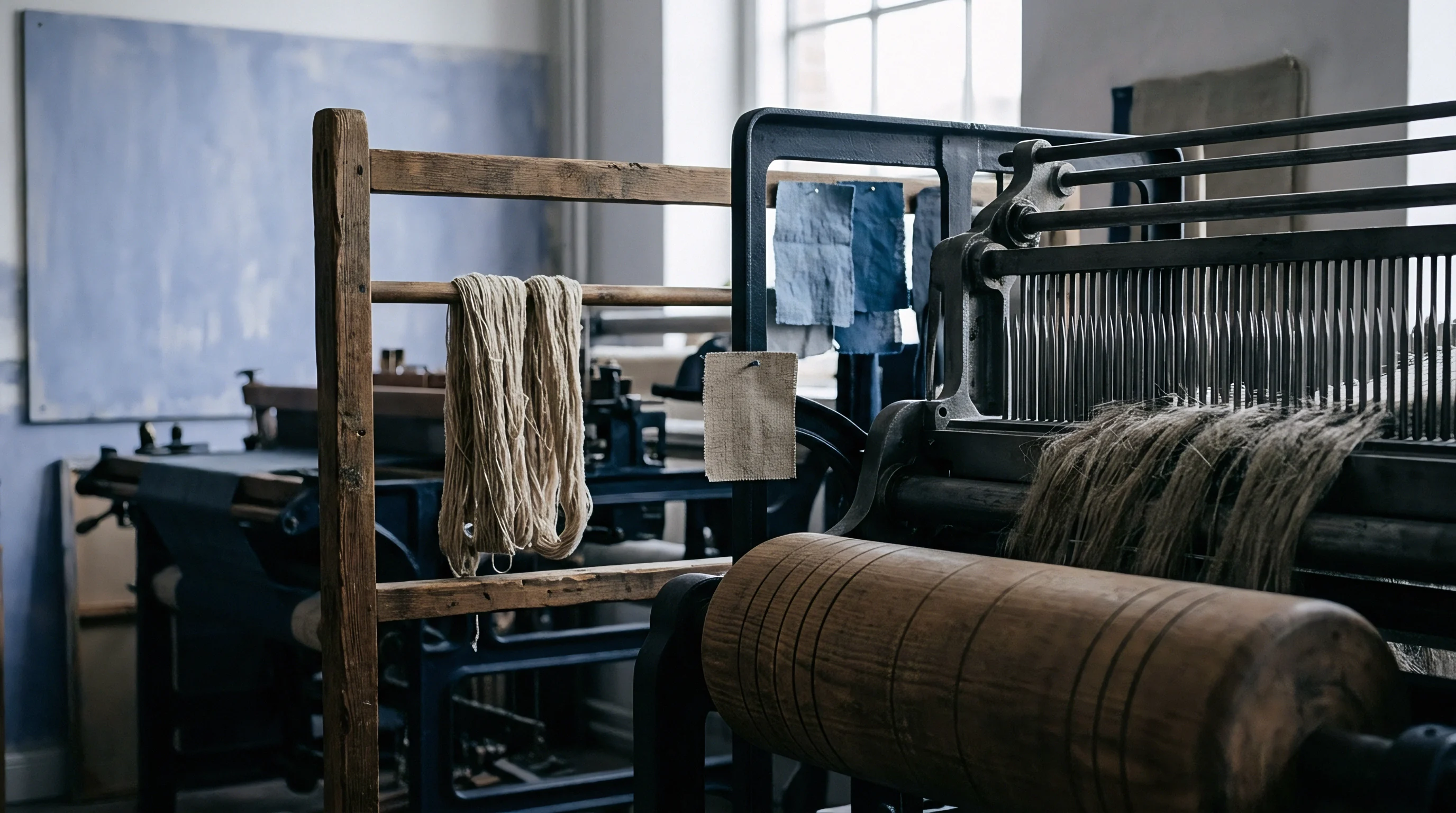
The immersion trough on a wet-spinning frame serves as the direct chemical and thermal reactor for the moving roving strand. Hot water contained in stainless steel or copper troughs must transfer thermal energy through the roving core within a contact time determined by machine delivery speed and path length. Typical trough lengths range from zero point six to one point two metres, establishing residential wetting times between three and ten seconds at standard production speeds.
Rapid fluid saturation represents the primary physical barrier in the trough. Sized or hard-twisted rovings carry air bubbles entrapped within inter-bundle capillaries, preventing instantaneous liquor contact with internal middle lamellae. Water temperature must be held within strict tolerances across the entire machine length to prevent spindle-to-spindle count divergence.
A temperature drop of five degrees along the trough rail raises yarn linear density by two lea across thirty adjacent spindles.
Liquor replenishment rates require continuous monitoring across commercial spinning shifts. Stagnant trough liquor accumulates dissolved galacturonans, arabinogalactans, and calcium ions extracted from passing roving. As polyuronide concentration climbs, the chemical equilibrium shifts, reducing the net dissolution rate of incoming fiber bundles.

Which Fluid Parameters Govern Dissolution?
Controlling bath chemistry requires active regulation of four interdependent variables: bath temperature, water hardness, pH balance, and active wetting agent dosing. Industrial spinning trials prove that deviations in any of these parameters alter the degree of bundle split achieved at the drafting nip.
- Immersion Temperature Regulation maintains the bath between sixty-two and sixty-eight degrees Celsius, preventing premature starch sizing breakdown while ensuring complete pectin plasticization.
- Chelating Agent Concentration controls free polyvalent cations using organic polyphosphates or ethylenediaminetetraacetic acid derivatives at dosages between zero point two and zero point five grams per litre.
- Bath Liquor Turnover Frequency replaces twenty to thirty percent of trough volume per operating hour, keeping dissolved sugar concentrations below two grams per litre.
- Wetting Agent Additions lower surface tension below thirty-five millinewtons per metre to eliminate dry-core roving defects.
Hard process water containing high concentrations of calcium and magnesium ions suppresses pectin dissolution. Divalent cations in the water displace monovalent sodium ions and rebuild calcium pectate gels inside the technical bundle, stiffening the middle lamella during the drafting pass.
Process water entering the trough system undergoes demineralization down to a total hardness below zero point five French degrees. The addition of non-ionic surfactants accelerates wetting by lowering the contact angle between liquor and the hydrophobic waxy cuticle remaining on raw scutched flax bundles.
Thermal Gradients across Moving Roving
Heat transfer into the moving flax strand follows transient conduction through a porous cylinder. The core temperature of a two-kilotex roving strand immersed in water at sixty-five degrees Celsius requires approximately two point four seconds to reach ninety-five percent of fluid temperature. At high spindle delivery rates, the interior of coarse rovings reaches the front drafting roller before full thermal equilibration occurs.
Spindles running at high delivery speeds generate cooler internal bundle cores. These under-heated cores fail to reach the activation energy required for rapid pectin hydrolysis, resulting in incomplete bundle cleavage and elevated yarn hairiness.
Uneven yarn count is often attributed to raw fiber retting variability, even though uneven steam heating along the spinning trough rail is frequently the actual cause.


Fineness
Verifying bundle division requires testing methods capable of isolating technical bundle linear density from overall yarn count. Traditional air-flow fineness testers, calibrated according to ISO 2370, measure specific surface area by determining resistance to air passage through a compressed plug of fiber. As non-cellulosic pectins dissolve and bundles cleave, total external surface area per unit mass increases significantly, driving up measured metric fiber numbers.
Direct linear density determination by the gravimetric cut-and-weigh method or single-fiber vibroscope testing under ISO 1973 reveals the true structural distribution. Commercial hackled line flax before wet processing displays a wide multimodal distribution of bundle linear densities, skewed heavily toward values above twenty tex. Following complete hydrothermal dissolution and drafting, the distribution tightens into a unimodal curve centered below four tex.
| Residual Pectin Content (% Mass) | Mean Bundle Fineness (ISO 2370 Nm) | Coefficient of Variation (%) | Maximum Spinnable Count (Lea) | Yarn Unevenness (Uster CVm %) |
|---|---|---|---|---|
| 4.8 (Untreated Line) | 850 | 48.2 | 24 | 24.5 |
| 3.6 (Cold Water Soaked) | 1240 | 41.6 | 36 | 21.2 |
| 2.4 (Standard 60°C Trough) | 2100 | 31.5 | 60 | 16.4 |
| 1.5 (Boiled Roving 75°C) | 3450 | 22.8 | 80 | 13.8 |
| 0.8 (Chemical Degummed) | 4800 | 18.2 | 120 | 11.6 |
Microscopic cross-sectional analysis provides direct geometric validation of the cleavage process. Technicians embed yarn specimens in epoxy resin, section them at three-micrometre thickness using a microtome, and count the number of individual elementary cells present in each bundle cluster under polarized light microscopy. The area ratio of middle lamella matrix to total fiber cross-section serves as a direct indicator of processing quality.
The Uster evenness of wet-spun flax yarn is directly constrained by the average number of discrete entities present in the yarn cross-section. Martindale limit calculations state that theoretical minimum variation for a yarn depends on the number of individual fiber units per cross-section:
CV_lim = 100 / sqrt(N_units)
When pectin dissolution fails, N_units reflects coarse technical bundles rather than fine elementary fibers. A sixty-lea yarn spun from coarse ten-tex bundles contains fewer than fifteen entities in its cross-section, yielding poor yarn regularity and severe weakness at thin spots.

Air Permeability and Specific Surface
Air-flow instruments register the progressive splitting of flax bundles as an increase in hydraulic flow resistance. For a constant mass of test specimen, total surface area exposed to laminar air flow increases proportionally to the square root of bundle count. Air permeability differential pressure converts into equivalent bundle diameter using the Kozeny-Carman relationship.
Air-flow testing on raw scutched line flax yields baseline values between one thousand and one thousand four hundred metric numbers. After optimal roving boiling and trough drafting, the measured fineness of the extracted fiber material shifts to values exceeding three thousand five hundred metric numbers. This shift confirms physical separation of elementary fibers.
Cross-Sectional Morphology
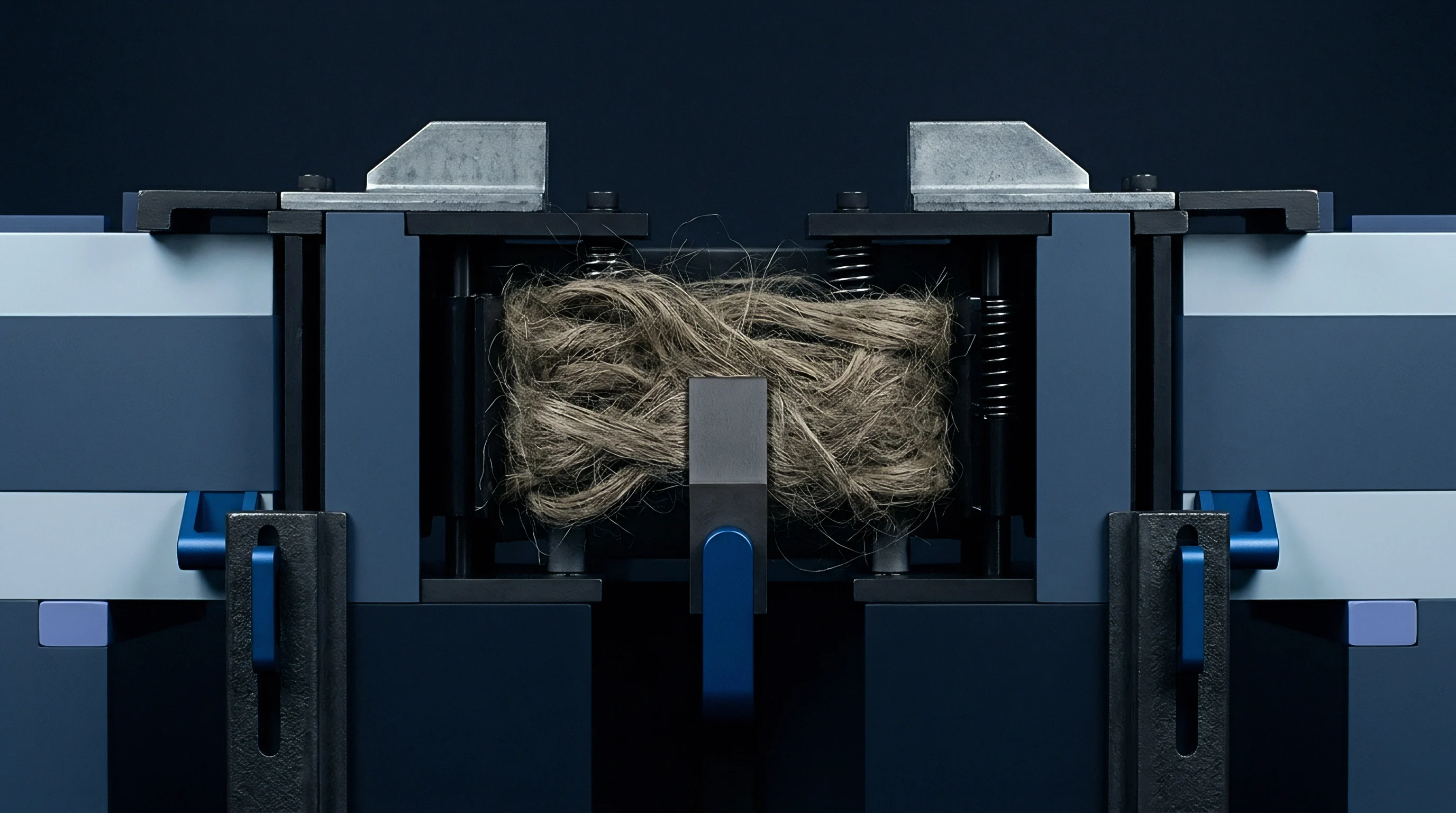
Scanning electron microscopy of yarn fractured under tension illustrates the boundary conditions of failure. Insufficiently extracted fibers show bundle pull-out where entire clusters detach from the yarn matrix with clean, smooth transverse breaks. Fibers processed through properly controlled pectin dissolution troughs display fibrillated, feathered breakages characterized by extensive elementary cell slippage and longitudinal delamination.
Polarized light examination detects residual crystalline pectin pockets between cell corners. These residual deposits prevent localized fiber bending, increasing the flexural rigidity of the finished dry linen yarn and compromising fabric hand.
A contract clause specifying maximum residual pectin content below two percent mass eliminates fine-count drafting failures on European line flax.
Standard procurement specifications should define the extraction verification method, citing chemical gravimetry alongside optical cross-section image analysis to settle disputes regarding delivered fiber quality.

Yield
Pectin dissolution directly influences commercial spinning yields, mill efficiency, and the final landed cost per finished linear metre of woven or knitted linen. In flax wet spinning, processing losses divide into two distinct categories: chemical mass extraction loss occurring in roving preparation and trough baths, and mechanical waste generated by drafting breaks and ring frame end-breakage. Balancing these two loss mechanisms determines commercial profitability in fine-count yarn spinning.
Chemical dissolution of non-cellulosic pectins causes an unavoidable mass loss of two point five to five point zero percent of incoming dry roving weight. If a spinner suppresses chemical extraction to maximize dry weight yield, mechanical waste at the spinning frame escalates exponentially. Uncleaved technical bundles jam drafting flutes, snap under tension at thread guides, and create ring rail fly waste that fouls adjacent spindles.
Ring frame end-breakage rates serve as the primary operational barometer of bundle cleavage efficiency. In fine wet spinning of seventy-lea line flax, an end-breakage rate below thirty breaks per one thousand spindle-hours indicates optimal pectin dissolution and uniform drafting. If trough temperatures drop or extraction times shorten, breakage rates climb rapidly above one hundred breaks per one thousand spindle-hours, halting productive frame output.

Spinning Room Economics
Every break on a wet-spinning frame requires immediate operator intervention to piece the broken strand back together. High breakage rates reduce spindle operational efficiency from standard ninety-two percent levels down to sixty-five percent. The piecing process introduces coarse knots or splices that must subsequently be cut and cleared on automatic winding machines, generating yarn package waste and reducing cone yield.
A comprehensive economic model evaluates the financial trade-off between roving chemical preparation costs, raw fiber mass loss, and downstream weaving performance. High-grade French water-retted flax line roving costing ten dollars per kilogram produces significant value improvements when properly processed to high fineness:
- Low Extraction Strategy minimizes chemical loss to two percent, but restricts maximum yarn count to thirty lea with twelve percent mechanical winding waste.
- Standard Trough Dissolution loses three point five percent chemical mass, achieving sixty lea count at five percent winding waste and ninety percent machine efficiency.
- Intensive Boiling Protocol sacrifices five point two percent chemical mass, enabling eighty lea production with winding waste held below three percent.
- Enzymatic Degumming Route removes seven percent mass, allowing ultra-fine one hundred lea spinning at premium finished fabric pricing.
The cost of yarn per kilogram reflects cumulative yield losses across hackling, roving preparation, wet spinning, and winding. High-count yarns carry much higher proportions of conversion cost relative to raw material expense, making high spindle efficiency the decisive economic factor.

Delivered Cost per Linear Metre
The financial impact carries directly into finished fabric weaving specifications. Consider a standard plain weave linen fabric specified at one hundred and forty grams per square metre with twenty-four warp ends and twenty-two weft picks per centimetre across a finished width of one hundred and fifty centimetres. This construction requires sixty lea wet-spun line flax yarn for both warp and weft systems.
If raw roving undergoes incomplete pectin dissolution, yarn hairiness increases and tenacity drops from thirty-eight cN/tex down to twenty-six cN/tex. On high-speed air-jet or rapier weaving looms running at six hundred picks per minute, this tenacity deficit increases warp stop frequencies from zero point eight stops per hundred thousand picks up to five point four stops. Each loom stoppage damages fabric visual grading, creating weaving defects that downgrade first-quality fabric yield.
The financial consequence surfaces on the final commercial invoice. Weaving efficiency drops increase conversion costs by zero point forty-five dollars per linear metre, while greige fabric downgrades from first quality to seconds reduce realized sales value by fifteen to twenty-five percent across the production dye-lot.
A fundamental physical rule dictates that fiber fineness achieved through chemical dissolution cannot be compensated for by increasing mechanical twist at the spinning frame.