Flax Fibre Non Cellulosic Content Impact on Hackling Yield
Non-cellulosic content above 3.5% lowers hackling line yield, increasing tow waste and landed line fibre cost per finished metre.


Pectin
In unretted bast fibre tissue, individual elementary cells sit embedded within a dense polymer complex dominated by acidic polysaccharides. Together with hemicellulose, lignin, and lipophilic waxes, these matrix substances form the middle lamella that glues ultimate fibres into multi-cellular technical strands. Controlled biological degradation by dew or water microflora breaks down specific pectic fractions, loosening inter-bundle cohesion while leaving crystalline cellulose microfibrils intact.
High residual binder leaves the bundle rigid, coarse, and tough to separate mechanically. If unretted or under-retted scutched flax enters mechanical processing, pins meet high resistance because those intercellular cements stay unbroken. Non-cellulosic fractions are determined through gravimetric solvent extraction followed by enzymatic titration.
Raw scutched flax arriving at the mill carries non-cellulosic content anywhere from 8 percent up to 22 percent dry weight, driven by climate, field retting duration, and harvest conditions. Homogalacturonan and rhamnogalacturonan chains within the middle lamella create a hydrated gel cross-linked by calcium bridges, a structure that dictates the flexural rigidity of the scutched strick. If non-cellulosic material exceeds target thresholds, mechanical combs fail to split individual technical strands along natural lamellar interfaces.
Pins shear right through full bundle structures, snapping ultimate cells and turning potential long line fibre into short, tangled combing waste. Non-cellulosic binder content ultimately sets the boundary between clean mechanical bundle splitting and destructive cell fracture.

Biochemical Middle Lamella Architecture
Galacturonic acid residues form long polygalacturonan chains cross-linked by divalent calcium cations within the intercellular space. This matrix integrates xyloglucan and galactan side-chains into an interlocking network between adjacent primary cell walls. Hemicellulosic polymers, predominantly glucuronarabinoxylan, interpenetrate this pectic network and bond covalently to elementary cellulose microfibril surfaces.
Lignin deposits later as the plant matures, forming an amorphous phenolic umbrella over the pectin-hemicellulose complexes. High lignin fractions stiffen the lamellar junction, leaving the composite bundle hydrophobic and brittle. During mechanical combing, this stiff interface resists pin penetration; instead of sliding between technical strands, needles apply lateral shear stress directly across the cellulose cell walls.
Fibre bundle cohesion depends on the degree of esterification in the polygalacturonan chains. High methyl-esterification limits calcium cross-linking, yielding a soft lamella that degrades easily during retting. Low esterification drives dense calcium pectate gel formation, requiring prolonged exposure to microflora before polymer chains cleave.
Under-retted flax thus retains intact polygalacturonan structures with heavy calcium pectate concentrations. When combing pins strike these under-retted bundles, they encounter steep cleavage resistance and fail to divide technical strands into finer elements, generating excessive frictional heat and snapping technical fibres into short fragments.
A residual pectin concentration exceeding 4.2 percent by dry weight reduces long line hackling yield below 52 percent under standard atmospheric conditions of 20 degrees Celsius and 65 percent relative humidity.

Quantifying Non Cellulosic Fractions
Standard gravimetric extraction protocols isolate lipophilic waxes with petroleum ether before treating the insoluble residue with neutral detergents. Solubilization in warm ammonium oxalate solution selectively extracts pectin compounds without dissolving cellulose microfibrils. Subsequent acid hydrolysis isolates hemicellulose, while Klason lignin determination measures the insoluble phenolic residue left after digestion in concentrated sulfuric acid.
Laboratory evaluation uses Fourier transform infrared spectroscopy to quantify ester carbonyl stretching peaks, establishing non-cellulosic ratios across incoming commercial lots.
Analysis of commercial scutched flax shipments reveals distinct chemical profiles tied to the retting method and its duration. Dew-retted European flax typically shows non-cellulosic levels between 10 percent and 14 percent of total dry weight. Incomplete field retting leaves non-cellulosic content above 16 percent, dominated by uncleaved polygalacturonans.
Controlled enzyme-retted flax, by contrast, achieves precise non-cellulosic extraction, bringing matrix material down to 8 percent without degrading structural cellulose chains.
- Under-retted dew flax retains residual pectin above 5.5 percent, producing coarse technical bundles coarser than Nm 180 fineness that resist splitting during combing.
- Target dew-retted flax holds pectin between 2.2 percent and 3.4 percent, allowing technical strands to split cleanly into fine Nm 320 sliver structures with minimal comb waste.
- Over-retted dew flax drops pectin below 1.2 percent, triggering middle lamella collapse as elementary fibres detach, which results in low tensile strength and high fly waste.
- Enzyme-treated scutched flax achieves uniform pectin removal down to 1.8 percent, ensuring predictable pin penetration and maximum long line recovery.
Non-cellulosic content directly shifts physical bundle dimensions. Coarse technical bundles rich in pectin retain average diameters exceeding 120 micrometres after scutching. Target retting reduces average bundle diameter down to 45 micrometres, presenting a larger effective surface area per unit mass.
These fine bundles engage smoothly with comb needles. When non-cellulosic impurities remain high, bundle diameters vary widely, leading to uneven pin resistance, irregular sliver thickness, and frequent end breaks during drawing.
| Retting Classification | Total Non-Cellulosic Mass (%) | Residual Pectin Fraction (%) | Klason Lignin Fraction (%) | Mean Bundle Diameter (µm) | Technical Strand Tenacity (cN/tex) |
|---|---|---|---|---|---|
| Under-Retted Dew | 17.8 | 5.8 | 3.9 | 125 | 38.2 |
| Optimal Dew | 11.4 | 2.8 | 2.6 | 48 | 54.6 |
| Over-Retted Dew | 7.2 | 0.9 | 1.8 | 22 | 26.4 |
| Enzyme Processed | 9.1 | 1.9 | 2.1 | 35 | 51.2 |
Dark, stiff stricks often reflect a structural excess of pectin that limits hackling yield rather than benign weather variations during field retting.

Comb
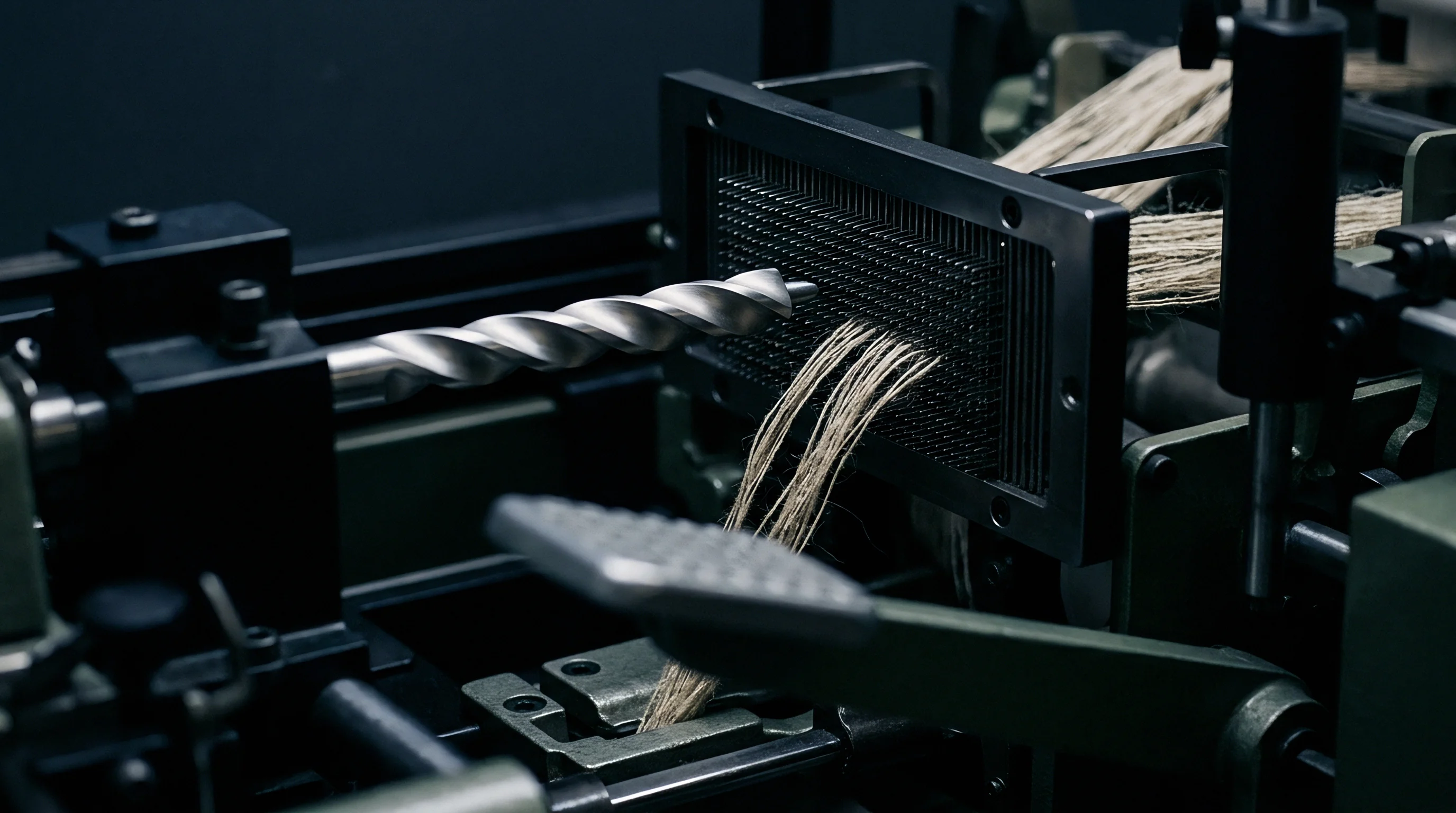
Mechanical refinement converts raw scutched strands into uniform, parallel long-staple technical assemblies. An industrial hackling machine processes clamped stricks through a continuous sequence of rotating comb beds set with steel pins. Pin density increases progressively through the machine, starting with coarse needles spaced wide apart to open tangled strick heads before advancing to dense pin fields that divide technical strands into ultra-fine bundles.
Non-cellulosic cements govern how these pin fields engage the fibre. When middle lamella polymers remain rigid, pins cannot penetrate between technical strands; instead of sliding along natural cleavage planes, needles strike structural barriers, tearing long line fibres out of their clamps and dragging them into combing tow boxes.
Hackling pin geometry and penetration depth rely on precise mechanical clearances. A strick presented to the comb bed takes thousands of pin impacts every minute. If non-cellulosic binder levels are low and flexible, incoming pins split technical bundles longitudinally with minimal force.
The strick separates cleanly, dropping shive debris while keeping unbroken long line strands anchored in the top clamp. If non-cellulosic content runs high, friction between pin surfaces and fibre walls rises sharply. Pins act like micro-wedges, generating concentrated lateral forces that snap rigid bundles across their transverse axes.

Pin Density Progression
Rotary drums equipped with steel needles operate in phased zones where needle frequency increases from two per centimetre up to thirty per centimetre. Initial coarse zones strip away outer epidermal tissue, remaining woody shive particles, and heavily tangled root ends. Intermediate zones bring in finer pin gauges set at narrow pitch angles to begin splitting strands longitudinally.
Final refining zones use dense needle arrays to comb technical elements down to the target linear densities required for fine yarn spinning. Elevated non-cellulosic content disrupts this phased mechanical attenuation.
Fibre flexural rigidity determines pin insertion depth. High pectin concentrations increase bundle stiffness, causing strick ends to deflect away from rotating pin beds. Stricks ride over needle tips rather than embedding deep in the pin field.
To force penetration, technicians increase clamp pressure and tighten bed clearances ~ an adjustment that drives steel pins into rigid, unyielding bundle structures. High non-cellulosic binder forces comb needles to shear through primary cell walls, turning valuable long line fibre into short combing tow.
Under-retted fibre stricks with stiff middle lamellae require gentler initial hackling pin engagement to prevent catastrophic bundle snapping.

Mechanical Splitting versus Fibre Rupture
Stiff technical bundles that resist needle penetration absorb heavy axial tensile loads during high-speed engagement. Splitting a technical flax strand into finer sub-units depends on shearing middle lamella pectin bonds. Cleaving these pectin interfaces takes significantly less energy than fracturing cellulose microfibrils, but high residual pectin pushes lamellar cleavage energy above the microfibril fracture threshold.
When that happens, energy from the hackling pins dissipates by snapping microfibrils, turning potential line flax into comb waste.
A sequence of operational steps governs incoming strick preparation and comb bed setup on the mill floor.
- Inspect incoming scutched stricks for moisture equilibrium, confirming water content resides between 11.5 percent and 13.0 percent to prevent brittle fibre shattering during initial pin contact.
- Sort stricks by weight and root-end alignment, trimming excessively frayed root zones to ensure uniform clamping density across the hackling bar.
- Set initial coarse comb bed pin density to 2.5 pins per centimetre, establishing a 4.0 millimetre tip clearance from the clamp path.
- Calibrate intermediate comb bed pin density steps across twelve graduating bars, advancing pin frequency systematically from 6.0 to 18.0 pins per centimetre.
- Adjust final fine refining zone pin density to 26.0 pins per centimetre, setting needle tip penetration depth to achieve full strick immersion without pin-to-clamp contact.
- Monitor comb tow collection trays under initial coarse bars, weighing short-fibre drop every two operating hours to detect abnormal bundle snapping caused by high non-cellulosic content.
Optimal hackling pin performance requires balancing mechanical shear stress against middle lamella bond strength. When processing low non-cellulosic fibre lots, comb beds achieve clean longitudinal splitting at high throughput speeds. High non-cellulosic content forces mill operators to slow comb drum rotation by up to 35 percent to avoid catastrophic line fibre loss ~ a slowdown that cuts hourly throughput without fully recovering long line extraction efficiency.
Coarse stricks with residual intercellular cement split smoothly when pin density advances gradually, avoiding sudden steps in needle frequency.

Cleavage
Interfacial polymer debonding dictates whether applied mechanical shear splits a composite bundle or fractures individual cell walls. Pectin bonds inside the middle lamella act as structural adhesives. When tensile stress from hackling pins exceeds middle lamella shear strength, technical bundles split cleanly down their longitudinal axes.
If non-cellulosic content remains unretted, middle lamella shear strength surpasses microfibril ultimate tensile strength. The applied mechanical work breaks cell walls instead, shortening staple lengths, raising dust generation, and cutting long line yield. FTIR analysis of under-retted flax lots reveals distinct absorption bands at 1735 reciprocal centimetres.
The ratio of pectin to lignin concentration governs fracture mechanics during mechanical combing. Pectin offers shear compliance, allowing middle lamella polymers to yield under controlled pin drag, while lignin adds flexural stiffness to resist bending forces as stricks wrap over comb drums. High lignin fractions combined with elevated residual pectin create a brittle inter-fibre matrix.
Micro-cracks started by pin impact travel transversely through elementary cell walls rather than longitudinally through matrix tissue, generating high short-fibre fractions, shortening sliver staple length, and hurting downstream wet-spinning performance.

Spectroscopic Quantification Methods
Fourier transform infrared analysis reveals specific carbonyl ester vibrations at seventeen thirty-five wave numbers alongside aromatic ring stretches at fifteen ninety-five wave numbers. The ratio between peak intensities at these wave numbers serves as an indicator of pectin esterification and lignin concentration. A high seventeen thirty-five peak intensity correlates directly with unretted galacturonic acid methyl esters.
Thermogravimetric analysis provides secondary validation by measuring mass loss steps during controlled pyrolysis. Hemicellulose decomposes between 220 degrees Celsius and 315 degrees Celsius, while cellulose breakdown occurs between 315 degrees Celsius and 400 degrees Celsius. Lignin undergoes slow, broad thermal degradation extending beyond 450 degrees Celsius.
Thermogravimetric mass loss profiles reflect how thoroughly flax has been retted. Scutched flax showing high thermal mass loss below 300 degrees Celsius holds significant non-cellulosic hemicellulose fractions. Standard analytical protocols isolate these thermal signature zones to predict hackling performance before committing material to full-scale mill combing.
Lots with elevated low-temperature mass loss consistently yield poor long line recovery percentages during mechanical processing.

Why Do Residual Lignin Peaks Drive Excessive Combing Tow Production?
High phenolic concentrations stiffen intercellular regions and prevent smooth needle penetration during mechanical processing. Lignin polymers form cross-linked aromatic networks that encapsulate middle lamella polysaccharides. This phenolic shield prevents comb needles from deforming intercellular tissue, converting pin impact force into transverse impact stress that shatters elementary cell walls.
Lignin concentrations above 3.5 percent by dry weight double comb tow generation in fine hackling zones, depleting long line recovery and filling collection chutes with fractured fibre debris.
Over-retting presents a different fracture mode. Lignin stiffens technical walls, but when biological retting goes too far, microflora consume middle lamella pectins completely and begin secreting cellulase enzymes that attack crystalline cellulose microfibrils. The cellulosic degree of polymerization drops from standard values above 2,500 down below 1,200.
Although middle lamella separation resistance is near zero, elementary cell wall tenacity plummets. Comb pins strike weakened technical strands and snap elementary microfibrils effortlessly, generating high quantities of fine, low-strength short fibre combings.
- High pectin, high lignin lots carry high matrix shear strength, forcing hackling pins to snap brittle bundles transversely and producing heavy, coarse comb tow.
- High pectin, low lignin lots show tough matrix compliance, resisting pin insertion and dragging long unseparated stricks into coarse comb drop boxes.
- Low pectin, optimal lignin lots allow effortless longitudinal shear along middle lamellae, yielding fine line sliver structures and high long line recovery.
- Low pectin, zero lignin over-retted lots suffer from cellulose degradation, causing elementary cell walls to disintegrate under minimal comb force.
Quantifying matrix polymers allows mill managers to predict long line recovery limits. Combining infrared peak ratios with bundle tenacity testing establishes clear operational boundaries. When laboratory analysis identifies high residual pectin and elevated phenolic content, technicians must widen machine clearances, lower line speeds, and adjust target sliver linear density expectations before processing begins.
| Sample State | FTIR Ester Ratio (1735/1595 cm⁻¹) | TGA Mass Loss 220-315°C (%) | TGA Mass Loss 315-400°C (%) | Middle Lamella Shear Stress (MPa) | Calculated Hackling Yield (%) |
|---|---|---|---|---|---|
| Unretted Raw | 2.45 | 18.4 | 52.1 | 18.5 | 42.8 |
| Under-Retted | 1.82 | 14.2 | 58.6 | 14.2 | 51.5 |
| Optimal Dew | 0.94 | 9.8 | 68.2 | 6.8 | 66.4 |
| Over-Retted | 0.31 | 6.2 | 61.0 | 2.1 | 44.2 |
Whether enzymatic pretreatment of scutched stricks can selectively dissolve pectin middle lamellae without degrading crystalline cellulose microfibrils remains an open question in industrial processing.

Sliver
Continuous untwisted ribbons of parallel long-staple flax form the direct output of mechanical refining. These hackled slivers collect at the delivery end of the machine, where drawing frames draft them to improve mass uniformity. Non-cellulosic content remaining in the sliver governs downstream drafting performance, roving integrity, and wet-spinning throughput.
High residual pectin causes individual technical strands to cling together irregularly. Pinned drafting zones encounter sticky, high-friction bundle clusters that resist drafting roll attenuation, producing mass variation, thin places, and thick nep structures in the drawn ribbon.
Fine yarn production relies on achieving high strand parallelization and low linear density in the hackled sliver. Non-cellulosic impurities increase inter-strand cohesion unpredictably. When drawing rollers apply drafting draft ratios, high-pectin zones refuse to slide smoothly over adjacent strands.
Drafting force spikes, pulling large bundle aggregates through drafting aprons at once. This sticky drafting mechanism creates drafting waves, resulting in high yarn count variability (CV percent) at the spinning frame.

Linear Density and Bundle Fineness
Technical strand fineness expressed in metric number ranges from Nm 200 for coarse unrefined bundles up to Nm 800 for fine long-staple units. Non-cellulosic matrix mass accounts for a substantial percentage of total strand weight in unrefined flax. Removing pectin and hemicellulose during processing reduces technical strand cross-sectional area without reducing structural cellulose microfibril mass.
Fine bundles with low residual non-cellulosic content pack more individual strands into a given sliver cross-section, improving sliver tensile strength and mass uniformity through better statistical fibre distribution.
Fibre bundle fineness distribution dictates the minimum spinning limit. A sliver containing coarse, unretted technical strands with an average linear density of 25 tex cannot spin into fine counts above Nm 50. Fine wet spinning demands strand fineness below 8 tex, which requires clean middle lamella separation during hackling.
High non-cellulosic content locks technical strands into coarse 20 to 35 tex bundle structures, restricting manufacturing to heavy, coarse dry-spun yarns.
Compliance with ISO 2370 linear density standards guarantees that hackled long line sliver meets minimum parallelization thresholds required for high-count wet spinning.

Drafting Stability in Drawing Frames
Frictional engagement between overlapping technical strands governs mass variation across successive attenuations. Standard drawing frame layouts pass hackled long line slivers through faller beds equipped with fine steel pins that control fibre movement as drafting rolls pull strands forward. High non-cellulosic content alters fibre surface friction.
Residual waxes create sticky surface deposits under the heat generated by high-speed drafting rolls. Meanwhile, pectin accumulations form hard micro-nodules along technical strands, catching on faller pins and creating neps in the drafted sliver.
Downstream roving operations require boiling in alkaline solutions to remove residual non-cellulosic matrix polymers prior to fine wet spinning. If hackled slivers carry excessive pectin and hemicellulose, roving packages resist liquor penetration during hot alkali boiling. Core layers of the bobbin stay unboiled, retaining high non-cellulosic levels.
During wet spinning, this unboiled roving passes through hot water troughs operating at 60 degrees Celsius. The hot water softens residual pectins inside the trough, releasing sticky gel deposits that accumulate on drafting rolls and cause frequent end breaks.
In dry spinning systems, where hot water attenuation is absent, residual non-cellulosic polymers act as internal binding stiffeners. High non-cellulosic content in dry-spun sliver increases yarn flexural rigidity, creating a harsh hand and elevated yarn hairiness. Wet-spinning systems demand thorough middle lamella extraction to achieve smooth strand attenuation inside hot water drafting zones, where pectin softening allows individual elementary microfibrils to slip smoothly into high-tenacity fine yarns.
Processing slivers with high non-cellulosic contamination causes severe drafting waves, resulting in frequent end breaks at the wet spinning frame and excessive thick places in the yarn.

Loss
Mass balance calculations track input scutched stricks through every refining stage down to final output classifications. Scutched flax delivered to a hackling mill separates into three distinct mass fractions: long line hackled sliver, short-fibre combing tow, and a waste drop consisting of unattached shive particles, epidermal dust, and short fly waste. Non-cellulosic content alters these yield ratios significantly, reducing long line yield percentage while inflating comb tow volumes and waste drop totals.
A three percent increase in non-cellulosic content elevates net hackled line fibre cost by more than one euro per kilogram.
Net manufacturing economics depend on maximizing long line yield while minimizing comb tow generation. Long line hackled sliver commands premium value because it feeds fine wet-spinning mills producing high-value apparel and luxury home textile yarns. Combing tow has significantly lower market value, selling into dry-spun coarse yarn markets, non-woven insulation, or paper manufacturing.
When high non-cellulosic content converts potential long line material into short comb tow, raw material monetary yield collapses rapidly.

Hackling Yield Mathematical Formulation
Long line extraction percentage equals the total mass of collected output sliver divided by total initial mass of raw scutched input, multiplied by one hundred. Total non-cellulosic mass impact accounts for both direct matrix material loss during processing and indirect line-to-tow degradation caused by bundle breakage. The mathematical formulation of net long line yield expresses output as a function of incoming non-cellulosic mass fraction, strick moisture content, machine pin aggressive factor, and retting uniformity index.
A baseline yield equation establishes long line mass conversion efficiency across variable non-cellulosic content parameters.
Yield Equation: Long Line Percentage = 82.5 – (1.85 Non-Cellulosic Mass Percentage) – (0.42 Shive Fraction Percentage) + (0.15 Moisture Regain Percentage).
This empirical relationship demonstrates that every 1.0 percent increase in non-cellulosic content above baseline optimal levels degrades long line recovery by 1.85 percentage points. High non-cellulosic content acts as a double loss mechanism: matrix material adds non-fibrous mass that vanishes during liquid wet-processing, while physically causing comb pins to shear structural cellulose into low-value tow combings.
Excessive non-cellulosic binder forces mechanical hackling pins to tear individual cell walls rather than separating technical fibre bundles along middle lamella interfaces.

Combing Tow Generation Mechanics
Short broken strands knocked below the pin bed fall into collection chutes along with loosened shive particles. Comb tow generation scales non-linearly with non-cellulosic content. In optimal dew-retted flax with non-cellulosic content around 11 percent, comb tow generation stabilizes between 22 percent and 26 percent of total input mass.
When non-cellulosic content rises to 17 percent due to incomplete retting, comb tow generation jumps to 38 percent of total input mass. Over-retted flax with non-cellulosic content below 8 percent also generates elevated tow fractions reaching 35 percent, driven by structural collapse of elementary cell walls.
Waste drop comprising loose shive particles and light floating fly dust accounts for the remaining input mass losses. High non-cellulosic flax retains strong cellular bonds between inner bast tissue and woody core shive elements, so scutching fails to fully detach these woody particles from unretted stricks. When mechanical comb pins strike residual shive clusters, they break surrounding fibres violently, creating heavy shive-laden dust drops that settle into lower waste bins.
Comb waste from high non-cellulosic lots carries elevated shive contamination, lowering its commercial resale value for secondary coarse spinning applications.
| Parameter / Fraction | Low Non-Cellulosic (8.5%) | Target Non-Cellulosic (11.2%) | High Non-Cellulosic (16.8%) |
|---|---|---|---|
| Long Line Hackled Sliver (%) | 48.2 | 67.5 | 46.1 |
| Combing Tow Yield (%) | 38.4 | 24.2 | 39.8 |
| Shive and Fly Waste Drop (%) | 13.4 | 8.3 | 14.1 |
| Mean Line Fineness (Nm) | 340 | 310 | 190 |
| Combing Tow Shive Content (%) | 2.1 | 1.8 | 6.4 |
| Line Fibre Tenacity (cN/tex) | 32.1 | 52.4 | 36.8 |
Comparative evaluations show that target non-cellulosic content delivers maximum long line recovery. Processing unretted or over-retted material drops long line recovery below 50 percent, severely disrupting mill profitability. Sourcing strategies must penalize lots carrying non-cellulosic content above 13 percent dry weight to preserve hackling yield margins.
Standard trade contract clauses specifying minimum hackling line yield thresholds protect buyers by requiring price adjustments when non-cellulosic impurities push short-fibre combings above agreed percentages.

Ledger
Commercial valuation models connect raw fibre purity directly to landed manufacturing expense per finished linear metre. Net cost tracking requires integrating raw scutched strick purchase price, hackling conversion tariffs, long line recovery percentages, and secondary comb tow realization credits. Evaluating raw strick cost against net hackling yield establishes true spinning room input expenses.
When non-cellulosic content reduces long line yield, effective raw material cost per kilogram of hackled sliver increases rapidly, compressing profit margins for spinning mills and fabric weavers alike.
An offer sheet quoting raw scutched flax at a baseline market price of 3.80 euros per kilogram appears attractive until non-cellulosic testing reveals incomplete retting. If that lot delivers only 48 percent long line yield during hackling compared to a standard 66 percent yield benchmark, net line fibre raw material input cost climbs dramatically. Lower long line recovery means more raw scutched material must pass through hackling machines to produce one kilogram of usable long line sliver, driving up conversion energy, labor expenses, and waste handling tariffs per finished unit.

Raw Fibre Sourcing Economics
Purchase invoices for scutched stricks carry base prices quoted per metric ton under standardized moisture conditions. Standard commercial practice assumes target non-cellulosic content between 10.5 percent and 12.0 percent. When incoming inspection identifies elevated non-cellulosic content, contract pricing adjustments apply.
Sourcing managers use yield-adjustment formulas to calculate net landed cost equivalents before issuing payments or committing lots to production lines.
A worked financial model illustrates the economic impact of non-cellulosic content on landed long line sliver cost per kilogram.
Scenario A: Baseline Optimal Non-Cellulosic Lot (11.2% Non-Cellulosic Content)
Raw Scutched Flax Purchase Price: €3.80 per kg input.
Hackling Processing Cost: €0.65 per kg input.
Long Line Hackled Yield: 66.5 percent (0.665 kg line per kg input).
Combing Tow Yield: 25.0 percent (0.250 kg tow per kg input).
Combing Tow Realization Credit: €1.25 per kg tow sold.
Net Long Line Sliver Cost Formula: (€3.80 + €0.65 – (0.250 €1.25)) / 0.665 = (€4.45 – €0.3125) / 0.665 = €4.1375 / 0.665 = €6.22 per kg long line sliver.
Scenario B: High Non-Cellulosic Lot (16.8% Non-Cellulosic Content)
Raw Scutched Flax Purchase Price: €3.80 per kg input.
Hackling Processing Cost: €0.65 per kg input.
Long Line Hackled Yield: 46.1 percent (0.461 kg line per kg input).
Combing Tow Yield: 39.8 percent (0.398 kg tow per kg input).
Combing Tow Realization Credit: €1.05 per kg tow sold (discounted due to high shive content).
Net Long Line Sliver Cost Formula: (€3.80 + €0.65 – (0.398 €1.05)) / 0.461 = (€4.45 – €0.4179) / 0.461 = €4.0321 / 0.461 = €8.75 per kg long line sliver.
Processing the high non-cellulosic lot elevates long line sliver input cost by €2.53 per kilogram, representing a 40.7 percent cost increase. This cost inflation cannot be absorbed downstream without price hikes on spun yarn and finished cloth.

Finished Metre Yield Costing
Calculating fabric production expense requires converting raw sliver cost into equivalent yarn weight per woven square metre. Fine wet-spun linen fabric weighing 160 grams per square metre requires approximately 185 grams of long line hackled sliver per linear metre at 150 centimetre weaving width, accounting for spinning waste, winding losses, and weaving take-up. When raw sliver input cost jumps from €6.22 to €8.75 per kilogram, raw material cost per finished linear metre increases from €1.15 to €1.62.
Spinning mills attempting to spin high non-cellulosic slivers into fine counts suffer elevated end-breakage rates, reducing spinning frame efficiency from 92 percent down to 74 percent. Frame inefficiency adds secondary conversion costs of €0.45 per kilogram of spun yarn. The accumulated yield penalties and conversion surcharges destroy commercial viability for weavers operating under fixed fabric delivery contracts.
Sourcing clauses should explicitly mandate non-cellulosic testing limits in supply agreements. Establishing baseline pectin thresholds between 2.0 percent and 3.2 percent ensures predictable hackling performance, stabilizes long line recovery percentages, and locks in landed manufacturing costs per finished linear metre.
Factoring non-cellulosic content into early fiber procurement decisions protects margin stability across every manufacturing phase, from the mill floor to the finished bolt.