Determining Customs Tariff Classifications for Raw Linen Fibres
Determining customs tariff classifications for raw linen fibres requires precise physical identification of retting, scutching, and hackling processing stages under HS heading 5301.


Taxonomy
Determining tariff classification for raw linen fibres under the Harmonized Commodity Description and Coding System comes down to the exact physical state of the plant material at border entry. Chapter 53 covers flax and other vegetable textile fibres, placing raw and processed flax under heading 5301. Customs authorities draw lines between unretted straw, retted straw, scutched fibres, hackled line fibres, and tow or waste based on specific processing thresholds.
Importers who misjudge the boundary between raw straw and mechanically processed fibre risk classification disputes, duty re-assessments, and border delays.
Heading 5301 divides flax classification into four subheadings reflecting how the flax stalk ( Linum usitatissimum ) is processed step by step. Subheading 5301.10 covers raw or retted flax. Subheading 5301.21 applies to broken or scutched flax.
Subheading 5301.29 covers hackled or otherwise processed flax, excluding spun yarn. Subheading 5301.30 covers flax tow and waste, including yarn waste and garnetted stock. Each stage changes the bundle’s physical structure, the ratio of woody core to bast fibre, and the tariff applied by customs.
Classifying flax requires physical evidence. Subheading 5301.10 covers green flax straw harvested with no further processing, as well as retted straw where microbes have decomposed the pectin binding the bast fibre bundles to the woody stem. In dew-retting, stalks lie in the field for weeks while fungi and bacteria break down the middle lamella.
Water-retting involves submerging straw in tanks or rivers ~ a practice now heavily restricted by environmental rules because of high biochemical oxygen demand in effluent. Flax under 5301.10 still keeps its full stalk architecture. The woody core, or shive, remains attached to the outer tissue, with no mechanical separation having occurred.
| HS Code | Subheading Description | Mechanical Separation Status | Residual Shive Weight | Fibre Orientation |
|---|---|---|---|---|
| 5301.10 | Flax, raw or retted | No mechanical separation of stalk components | 70% to 85% | Unoriented stalk bundles |
| 5301.21 | Flax, broken or scutched | Mechanical breaking and scutching applied | 1.5% to 5.0% | Partially parallelized long fibre |
| 5301.29 | Flax, hackled or otherwise processed | Combed through hackling pins or pinned bars | Under 0.5% | Fully parallel continuous sliver |
| 5301.30 | Flax tow and waste | Short, entangled fibers separated during scutching or hackling | 2.0% to 12.0% | Random, non-parallelized orientation |
Moving from subheading 5301.10 to 5301.21 requires primary mechanical decortication. First, fluted rollers crush the brittle woody core of retted straw into short fragments called shives. The material then enters a scutching turbine, where rotating beaters strike the stalks to knock loose the broken shives and cortical tissue, freeing the long bast fibre bundles known as scutched flax or line fibre.
To fall under 5301.21, the material must have undergone scutching that reduces residual shive content below five percent by total weight. Customs labs analyze raw straw consignments against physical scutching thresholds to establish tariff eligibility.
Hackling moves the material into subheading 5301.29. This operation draws scutched long fibre through progressively finer pinned beds or rotating combs. The process splits coarse bundles into finer fibres, removes leftover shives and short strands, and aligns the long fibres into a continuous ribbon or sliver ready for drafting.
Subheading 5301.29 also covers carded flax or drafting-frame sliver, provided it has not entered a spinning frame or received the mechanical twist that would reclassify it as yarn under heading 5302.
Subheading 5301.30 covers short, entangled fibres and by-products from scutching and hackling. Scutching tow consists of short strands knocked loose by beaters, while hackling tow comes from short fibres caught in comb pins during alignment. Compared to line flax, tow has more residual shive content and inconsistent staple length.
Customs inspectors examine bundle homogeneity, average staple length, and mass density to tell low-grade scutched line flax under 5301.21 from high-grade hackling tow under 5301.30, especially where national tariff schedules set lower rates or quotas on tow relative to long line fibre.
Raw retted flax holding under 12 percent moisture by weight qualifies under sub-heading 5301.10 when unretted or retted without mechanical separation.
Establishing the classification at import requires a systematic testing protocol. Customs officers use visual, mechanical, and gravimetric tests to check declared descriptions against the physical shipment.
- Inspect the physical bulk package for intact plant stalks or loose fibrous masses.
- Extract six representative samples from separate points within the shipping container or bale bundle.
- Measure residual woody shive mass by gravimetric separation over a mechanical wire mesh screen.
- Determine mean fiber length distribution across the sample using comb sorter array apparatus.
- Check for presence of mechanical twist or false twist that indicates processing beyond heading 5301.
- Calculate total non-cellulosic impurities including waxes, pectins, and residual epidermal tissue.
Residual shives show incomplete scutching, while tow carries lower duty rates. Misdeclaring scutched long flax as raw straw under subheading 5301.10 to reduce initial duties leads to shipment seizure, loss of preferential origin, and civil penalties based on the reassessed customs value.
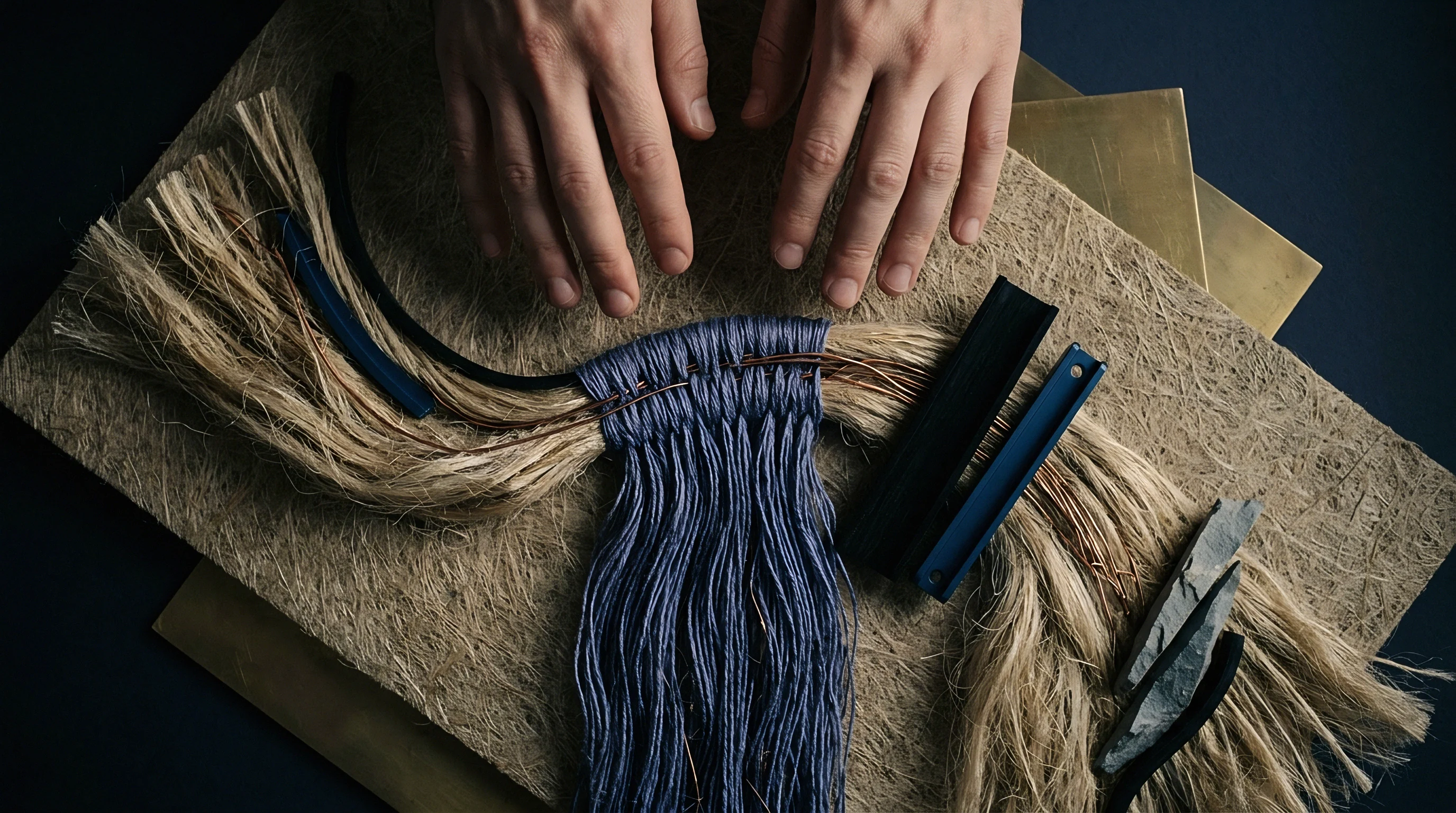

Sheaf
Inspection begins at the sheaf, where stem structure shows how far processing has gone. The flax stalk comprises an outer cuticle, cortical tissue housing bast fibre bundles, a cambium layer, a thick woody xylem core, and a hollow central pith. Bast fibre bundles run lengthwise down the stem, bound together and attached to surrounding tissue by pectic polysaccharides, hemicellulose, and structural proteins.
Tariff classification depends on measuring these physical properties directly from sample sheaves or drawn fibre lots.
Retting status determines whether un-scutched stems belong in subheading 5301.10. Microscopic examination shows how much middle lamella has broken down. In unretted green straw, pectin forms a solid matrix around individual fibres.
In properly dew-retted straw, fungal enzymes ~ mainly Cladosporium herbarum and Epicoccum nigrum , degrade the polygalacturonan in the pectin, creating voids between fibre bundles and the xylem core. This breakdown allows beaters to release fibre without snapping filament walls. Over-retting, however, causes cellulolytic fungi to degrade the cellulose itself, weakening bundle tenacity and raising waste tow yields during scutching.

Where Does Decortication Shift Heading 5301 Classification?
Decortication marks a primary dividing line in customs classification. Green decortication takes unretted straw and passes fresh stems through mechanical breakers, drums, or ultrasonic disintegrators to strip the bast layer from the core. This produces fibre with high residual pectin and wax, often over eight percent by total dry weight.
Scutching works only on retted straw whose cellular matrix was softened biologically. Customs labs test pectin, hemicellulose, and shive weight to decide if a lot is green decorticated material, traditional scutched line flax under subheading 5301.21, or crude tow under 5301.30.
| Test Parameter | Raw Retted Straw (5301.10) | Scutched Line Flax (5301.21) | Hackled Line Flax (5301.29) | Flax Tow (5301.30) |
|---|---|---|---|---|
| Mean Fibre Length (mm) | 500 to 900 | 450 to 800 | 500 to 850 | 50 to 250 |
| Shive Content (% weight) | 70.0 to 85.0 | 1.5 to 4.5 | 0.05 to 0.40 | 3.0 to 12.0 |
| Residual Pectin (% weight) | 4.5 to 7.0 | 2.0 to 4.0 | 1.2 to 2.5 | 2.5 to 5.0 |
| Bundle Tenacity (cN/tex) | N/A (unseparated) | 35 to 55 | 45 to 65 | 20 to 35 |
| Non-cellulosic Content (%) | 15.0 to 25.0 | 8.0 to 12.0 | 4.0 to 7.0 | 10.0 to 18.0 |
Customs officers test bundle alignment to distinguish hackled line flax from unoriented tow. Hackling combs away short, unaligned fibres, leaving ribbons of long, parallel filaments. Using a comb sorter array, technicians measure length distribution across sample bundles.
For hackled line flax under subheading 5301.29, over 80 percent of the fibre mass exceeds 400 millimeters, with an upper quartile near 800 millimeters. Scutched tow shows a broad length distribution: over 60 percent of fibres measure under 200 millimeters, mixed with heavy entanglements and random spatial orientation.
Parallel fibre alignment distinguishes hackled line flax from unoriented tow fractions.
Customs technicians evaluate laboratory fiber length arrays to confirm line flax separation from tow. Testing residual shive content follows ISO 2370, separating non-fibrous woody material from bast fibres. A weighed sample is agitated manually or mechanically over standard sieves to isolate woody fragments from flexible fibre bundles.
The shive portion is dried to constant weight at 105 degrees Celsius and measured as a mass percentage of the original dry sample. If a declared lot of scutched flax under subheading 5301.21 has a shive content above 5.5 percent by weight, customs reclassifies it as flax tow under subheading 5301.30 ~ or under 5301.10 if intact straw stalks make up most of the bale.
When physical appearance is ambiguous, chemical analysis confirms the degree of processing through sequential solvent extraction. First, hot water extraction removes soluble carbohydrates. Next, Soxhlet extraction with toluene-ethanol isolates fats, waxes, and resins.
Hot ammonium oxalate then dissolves insoluble pectate salts from the middle lamella. Pure cellulose content sits at 60 to 65 percent in raw straw, 70 through 80 percent in scutched flax, and over 85 percent in fully hackled, bleached sliver. Higher cellulose levels point to advanced chemical or mechanical refining that excludes the material from raw subheadings.
At receiving terminals, structural inspection uses distinct physical parameters to confirm processing classifications.
- Stalk architectural integrity confirms unretted or retted status under subheading 5301.10 when cortical tissue still encloses the central xylem cylinder.
- Mechanical impact fracture patterns on residual shives confirm turbine scutching under subheading 5301.21 through visible longitudinal splitting of woody fragments.
- Comb pin track marks along the main body of the fibre bundle verify pin drafting and hackling operations required under subheading 5301.29.
- Entanglement index measurements determined by air-flow resistance tests separate low-grade scutched line fibre from dense flax tow under subheading 5301.30.
- Moisture regain values determined by oven-drying at 105 degrees Celsius adjust gross consignment weights back to standard commercial moisture allowances.
Fibre bundles with attached epidermal tissue indicate incomplete scutching beat cycles.
Provenance
Establishing customs provenance for raw linen fibres means tracking physical transformation against legal rules of origin in international frameworks. These rules split into non-preferential origin rules, applied to baseline tariffs, anti-dumping actions, statistics, and origin labeling, and preferential origin rules, which dictate eligibility for reduced duties under trade agreements. Under either framework, raw agricultural products like flax straw originate where they were wholly obtained ~ meaning harvested from the soil.
Determining origin becomes complex when straw harvested in one customs territory is shipped to a second territory for retting, scutching, or hackling before final export.
Non-preferential rules under the Union Customs Code of the European Union and section 102 of the United States Code of Federal Regulations rely on substantial transformation. This occurs when processing creates a new commercial article with a distinct name, character, and use, typically reflected by a tariff classification shift at the four-digit heading or six-digit subheading level. Harvesting raw flax straw establishes origin under heading 5301 in Country A. Shipping raw straw to Country B for retting and primary scutching raises the critical question: does scutching constitute a substantial transformation that shifts non-preferential origin to Country B?
| Jurisdiction | Declared Processing Step | Tariff Classification Shift | Origin Conferred? | Primary Traceability Record |
|---|---|---|---|---|
| EU UCC | Dew-retting only | No shift (remains 5301.10) | No (retains field origin) | Farmer crop declaration |
| EU UCC | Mechanical scutching | Shift from 5301.10 to 5301.21 | Yes (scutching country) | Scutcher weighbridge log |
| US CBP | Scutching raw straw | Shift from 5301.10 to 5301.21 | Yes (substantial transformation) | Mill decortication docket |
| US CBP | Hackling scutched fibre | Shift from 5301.21 to 5301.29 | No (simple refining) | Comb pin maintenance record |
| China Customs | Hackling imported tow | Shift from 5301.30 to 5301.29 | Yes (value-add threshold) | Spinning preparatory log |
United States Customs and Border Protection rulings consider scutching raw straw (5301.10) into scutched line flax (5301.21) a substantial transformation. The process strips away 80 percent of plant mass, converts unspinable agricultural stalks into commercial textile fibre, and shifts the tariff subheading. Origin thus belongs where the scutching turbine operated.
Hackling previously scutched flax (moving from 5301.21 to 5301.29), however, is viewed by United States authorities as secondary refining or cleaning that does not alter the fundamental character of the fibre. Hackling alone does not confer non-preferential origin under United States customs law, leaving origin with the country where scutching occurred.
European Union customs authorities apply specific list rules under Annex 22-01 of the Union Customs Code Delegated Regulation. For heading 5301, transforming raw agricultural material into processed fibre confers origin only if operations go beyond simple cleaning, sorting, or drying. Scutching confers European Union non-preferential origin because mechanical breaking and high-speed rotary beating alter the physical form of the material.
Dew-retting alone, carried out in a field adjacent to the farm where the straw was harvested, does not shift origin away from the country of cultivation if un-scutched straw crosses a border prior to mechanical decortication.
Contract clauses specifying non-preferential origin criteria bind the seller to produce scutcher weighbridge records upon customs audit.
Preferential trade agreements apply stricter criteria, setting specific local processing rules or regional value content targets. Under free trade agreements like the United States-Mexico-Canada Agreement or the Pan-Euro-Mediterranean origin rules, vegetable textile fibres under Chapter 53 must satisfy specific working or processing thresholds for preferential zero-duty rates. Processing trials show raw dew-retted straw yields vary significantly across facilities.
Under Pan-Euro-Med rules, preferential origin for scutched flax under subheading 5301.21 requires that all raw flax straw used must be wholly obtained within participating partner countries, preventing importers from processing third-country straw inside an agreement zone to claim preferential treatment upon export.
Documenting provenance across complex international supply networks requires a transparent chain-of-custody file that connects individual field harvest lots to exported bale numbers.
- Agricultural cultivation dockets establish field location, harvest dates, and farm-gate gross tonnage for unretted or dew-retted straw.
- Scutching mill weighbridge tickets record incoming straw bale weights, processing lot numbers, output line fibre yields, and generated tow mass.
- Bale identification tag registers link individual 200-kilogram line flax bales to specific scutching turbine shifts and farm supply pools.
- Chain of custody movement certificates track transit between agricultural field stores, primary scutchers, secondary hackling mills, and export loading docks.
- Phytosanitary inspection certificates verify agricultural origin and confirm heat or chemical treatments applied prior to cross-border shipping.
Gaps in transaction certificates between harvest and mill entry destroy preferential origin claims, as origin rules require continuous documentation. When a supplier ships European-grown raw flax straw to an Asian facility for hackling before export to North America, the importer must verify whether the destination customs authority recognizes hackling as an origin-conferring transformation under domestic statutes.
Sellers warranting European origin for processed line flax commit to inserting specific operational verification language into supply contracts: “Seller shall provide mill-level batch weight reconciliation dockets from European scutching facilities certifying that all delivered flax fibres under subheading 5301.21 were mechanically extracted from straw grown and harvested within European Union member states.”

Valuation
Determining customs value and duty liabilities for raw linen fibre requires adjusting raw commercial transaction prices for freight, moisture variance, impurities, and processing fees. Ad valorem duty rates applied to Chapter 53 subheadings vary significantly between raw agricultural straw under 5301.10, scutched fibre under 5301.21, hackled sliver under 5301.29, and waste tow under 5301.30. Valuation errors happen when commercial invoice line items are not reconciled against dry fibre content or when price adjustments for non-conforming shive percentages are omitted from the entry declaration.
Moisture alters invoice weights. Raw and processed flax fibres absorb atmospheric water vapor up to 12 percent of their oven-dry weight under standard climate conditions (20 degrees Celsius and 65 percent relative humidity). Natural fibre trade standards and the International Bureau for the Standardization of Man-Made Fibres establish an official commercial regain allowance of 12 percent for raw, scutched, and hackled flax fibre.
If a consignment is invoiced on gross scale weight at a wet loading dock, actual dry fibre mass delivered may fall below bill-of-lading tonnage, inflating declared customs values unless a moisture adjustment calculation is included in entry documentation.
| Cost Component | Raw Retted Straw (5301.10) | Scutched Line Flax (5301.21) | Hackled Line Flax (5301.29) | Flax Tow (5301.30) |
|---|---|---|---|---|
| Free on Board Price ($/kg) | 0.45 | 3.80 | 5.20 | 1.60 |
| Freight and Insurance ($/kg) | 0.22 | 0.15 | 0.12 | 0.18 |
| Ad Valorem Duty Rate (%) | 0.0% to 1.5% | 2.0% to 4.5% | 3.0% to 5.8% | 0.0% to 2.0% |
| Customs Duty Amount ($/kg) | 0.01 | 0.14 | 0.26 | 0.03 |
| Landed Duty-Paid Cost ($/kg) | 0.68 | 4.09 | 5.58 | 1.81 |
Adjusting gross weight to official conditioned weight relies on standard commercial regain formulas. The equation calculates Conditioned Mass (Mc) from the dry mass (Md) measured after oven-drying sample lots at 105 degrees Celsius:
Mc = Md × (1 + fracR100)
where R represents the official 12 percent trade regain allowance. For example, if port sampling shows a 20,000-kilogram gross weight lot has a measured moisture content of 16 percent, actual dry mass equals 16,800 kilograms. Applying the 12 percent regain allowance yields a conditioned mass of 18,816 kilograms.
Declaring the full 20,000 kilograms gross scale weight results in paying customs duty and import taxes on 1,184 kilograms of excess water weight, inflating total landed cost per net kilogram of usable fibre.
Tariff line misclassification between raw flax and flax tow triggers retroactive duty adjustments upon port audit.
Raw flax supply contracts frequently include price adjustments tied to quality testing ~ such as scutching yield, bundle strength, color grading, and residual shive content. Under Article 70 of the Union Customs Code and United States 19 USC 1401a valuation rules, post-entry price adjustments agreed between buyer and seller affect the transaction value used for entry. If an importer receives a credit note from an overseas scutching mill because a lot declared under subheading 5301.21 contained 6.0 percent shives instead of the contract limit of 3.0 percent, the importer must file a post-summary correction or amendment to adjust declared customs value and reclaim overpaid duties.
Valuation scrutiny increases when trading between related-party suppliers. Customs authorities inspect transfer pricing mechanisms between overseas scutching mills and domestic spinning plants to ensure transaction values reflect arm’s-length commercial conditions. Article 15 of the WTO Customs Valuation Agreement establishes that corporate relationships alone do not invalidate transaction values, provided the importer demonstrates that prices closely align with test values established between unrelated parties under identical trade conditions.
Importers calculate total landed cost liabilities by systematically tracking each cost element attached to raw fibre movements.
- Base contract price per metric ton reflects negotiated invoice values for specified grade and moisture allowances.
- Ocean freight and port handling fees added to the transaction value under cost, insurance, and freight valuation systems.
- Moisture deviation adjustments applied to scale weighbridge receipts to align billed mass with conditioned commercial weight.
- Quality penalty deductions calculated for excessive shive content or reduced bundle tenacity as verified by lab testing.
- Targeted customs duty calculations determined by applying specific national tariff schedule percentages to net declared values.
Laboratory tests settle valuation disputes. Importers challenging customs duty calculations submit official test reports showing conditioned mass calculations alongside original bill-of-lading scale tickets. When customs auditors question declared unit prices on high-grade hackled sliver, billing sorting and hand-hackling costs separately as processing labor rather than integrating them into baseline commodity prices collapses under audit when processing fees are paid directly to affiliates.
Dossier
Defending tariff classification declarations for raw linen fibres before national customs authorities requires assembling a verification dossier prior to shipping. Agencies like United States Customs and Border Protection, European Union member state customs authorities, and China Customs deploy automated risk algorithms that flag high-risk agricultural and textile imports for physical examination, laboratory testing, and post-clearance audits. A complete verification dossier contains technical, commercial, and operational records that prove physical state, degree of processing, origin, and valuation for every imported lot.
Lab test reports form the foundation of technical verification. Customs entry documentation must be accompanied by independent certified laboratory test results executed according to internationally recognized standard methods. ASTM D1444 governs determination of cross-sectional properties and maturity of flax fibres, while ISO 2370 covers fineness and tenacity testing for scutched long line flax.
TAPPI test methods or modified chemical extraction protocols verify residual non-cellulosic impurities, lignin content, and shive percentages. A certified report from an ISO 17025 accredited laboratory detailing staple length distribution, gravimetric shive percentage, and moisture content provides authoritative evidence that counters arbitrary customs reclassification attempts at the port of entry.
Commercial records in the dossier must align with physical test results and customs declarations. Bills of lading, commercial invoices, packing lists, and mill weight certificates must share matching batch identification codes, shipping mark numbers, and precise HS subheading designations. Discrepancies between generic commercial invoice terms, such as “raw flax fibre,” and specific customs declarations under subheading 5301.21 create instant audit triggers.
Invoice line items should state explicit technical descriptors, for example: “Dew-retted scutched long flax fibre, conforming to HS 5301.21.00, average staple length 650mm, shive content 2.2%, moisture regain 12.0%.”
Customs compliance dossiers for raw flax imports must include ISO 17025 laboratory test results establishing residual shive mass percentages.
Chain-of-custody documentation links physical lots to claimed countries of origin. This requires farm-level crop registration records, agricultural harvest declarations, scutching mill weighbridge logs, and transit movement certificates. When preferential origin is claimed under a regional trade agreement, the dossier must contain a valid Certificate of Origin signed by the exporter or an approved exporter statement under authorized economic operator frameworks.
Importers maintaining automated entry files store digital copies of mill processing dockets recording exact input straw tonnage versus output line fibre and tow yields, proving mechanical transformation occurred at the designated facility.
When customs authorities issue a formal Request for Information, such as a Customs Form 28 in the United States or a formal audit notice under the Union Customs Code, the importer faces a strict statutory timeline, often 30 calendar days, to submit supporting proof. A pre-assembled verification dossier enables rapid response, preventing automatic liquidation of entries at higher duty rates, seizure of goods, or administrative fines. The dossier serves as the primary evidence file if the importer files a formal administrative protest, applies for a Binding Tariff Information ruling in the European Union, or requests an official Customs Ruling from United States Customs and Border Protection headquarters.
Structuring customs compliance files around verifiable batch records protects entry declarations. Establishing a robust entry defense system requires continuous updating of technical files as new crop years arrive, because field conditions, retting weather patterns, and scutching turbine performance vary annually, altering physical impurity profiles and yield metrics of harvested flax straw. Importers who maintain audited, lab-verified compliance dossiers protect their supply chains against unexpected trade barriers, port detentions, and retroactive customs tax assessments across all cross-border movements.
Whether customs authorities will eventually adopt automated optical sorting and real-time DNA traceability markers to verify raw flax origins and processing states directly at border terminals remains an open question for global trade compliance teams.