Fundamental Linen Lea Conversions and Metric Yarn Calculations
Linen Lea converts to Metric count via NeL multiplied by 0.604772, while direct Tex equals 1653.52 divided by NeL, adjusted for 12% moisture regain.


Index
Flax spinning still relies on historic length-per-unit-mass counts that sit uneasily alongside modern metric textile calculations. Mills traditionally grade flax fineness in Lea (NeL), where one Lea equals the number of 300-yard hanks weighing one avoirdupois pound. Because it is an indirect system, a higher Lea indicates a lighter, finer strand.
Modern high-speed looms and international contracts, however, run on metric counts: either Metric Count (Nm), which measures metres per single gram, or direct Tex (tex), which registers mass in grams per one thousand metres of continuous strand.
Converting between these systems requires reconciling Imperial units with metric standards. With one pound equal to 453.592 grams and 300 yards measuring 274.32 metres, dividing 274.32 metres by 453.592 grams establishes the constant conversion factor of 0.604772. Multiplying Lea by 0.604772 yields the Metric count; a 14 Lea yarn, for instance, calculates out to 8.47 Nm. Because Tex tracks mass per unit length, the conversion instead requires dividing the constant 1653.52 by the Lea count, giving 118.11 tex for that same 14 Lea strand.
Technical draughtsmen confirm these baseline densities before setting up loom construction sheets.

Conversion Mechanics between Imperial and Metric Systems
Working across international supply chains requires clean conversions between trade designations and physical yarn weights. Calculating direct linear mass from indirect trade numbers avoids discrepancies when buying raw yarn by mass to deliver specific fabric yardages.
The mathematical relationships governing linen conversions sit on fixed physical values:
Nm = NeL × 0.604772
tex = frac1653.52NeL
Denier = frac14881.68NeL
tex = frac1000Nm

Direct Linear Density Equivalent Values
Commercial flax yarns range from coarse strands for heavy canvas down to fine counts intended for lightweight apparel. Modern looms require direct tex figures to calibrate tension sensors and electronic accumulators accurately.
| Nominal Linen Lea (NeL) | Metric Count (Nm) | Direct Linear Density (tex) | Filament Equivalent (Denier) | Primary Industrial Application |
|---|---|---|---|---|
| 10 Lea | 6.05 Nm | 165.35 tex | 1488 Denier | Heavy upholstery, duck canvas, structural webbing |
| 14 Lea | 8.47 Nm | 118.11 tex | 1063 Denier | Furnishing fabrics, heavy drapery, workwear twills |
| 25 Lea | 15.12 Nm | 66.14 tex | 595 Denier | Medium suiting, table linens, heavy shirting |
| 40 Lea | 24.19 Nm | 41.34 tex | 372 Denier | Standard apparel shirting, bed linens |
| 60 Lea | 36.29 Nm | 27.56 tex | 248 Denier | Fine dress shirtings, handkerchief goods |
| 80 Lea | 48.38 Nm | 20.67 tex | 186 Denier | Ultra-fine sheer cambrics, technical filtration |
Even slight count deviations translate directly into off-spec finished cloth weights. A shift of just two Lea in fine apparel counts can push the finished piece outside contractual weight tolerances. Dialing in true yarn mass keeps shedding clean and ensures finished yardage lands within specification.
Whether regional markets will eventually adopt direct tex notation across trade contracts remains open, as legacy growing regions continue to trade primarily on Lea.

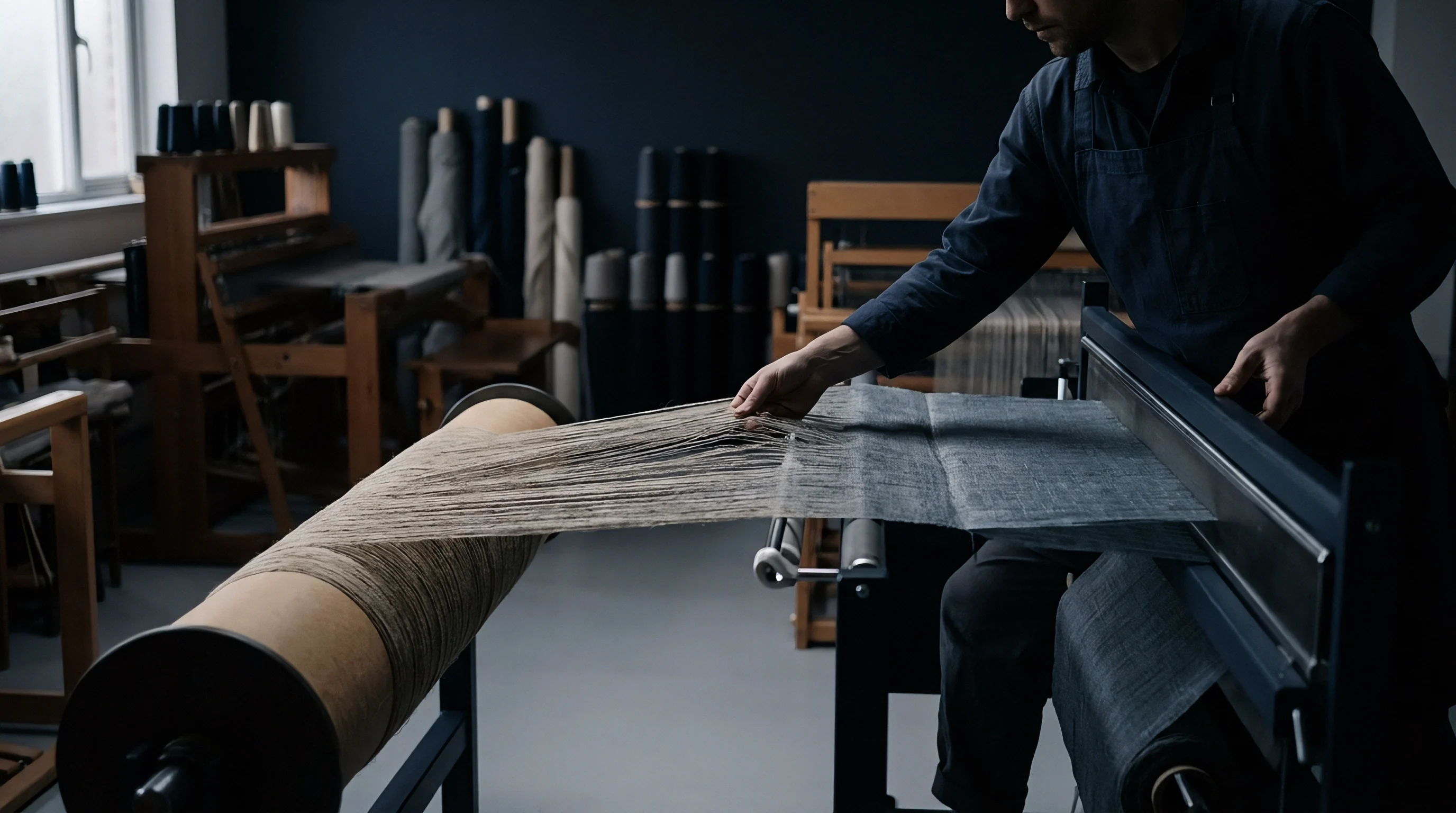
Spool
Flax fibres absorb atmospheric water up to twelve percent of their dry weight without feeling moist. This hygroscopic behavior creates substantial swings during physical yarn testing. ISO 2060 specifies testing conditions of twenty-one degrees Celsius and sixty-five percent relative humidity to provide a reliable baseline; testing unconditioned yarn in a dry spinning room yields an artificially high Lea count, skewing subsequent warp set calculations.
Commercial regain agreements establish uniform invoicing weights regardless of shipping conditions, fixing the official commercial moisture regain for linen at 12.0 percent. Target shipment weight is calculated by adjusting oven-dry fiber mass by this factor. Because dry flax yarn snaps readily under mechanical tension, spinning preparation directly alters physical strand structure.
Wet-spun yarns pass through a heated water bath that softens natural pectins, allowing bundles to slide into dense, smooth, tightly packed strands. Dry-spun linen bypasses this softening, producing a rougher, bulkier yarn with pronounced surface hairiness and lower density.

Moisture Regain Adjustments in Density Calculations
Establishing true linear density requires applying standard regain calculations before matching delivery dockets against landed weight certificates. Weighing packages under dry ambient mill conditions understates real tex, which later shows up as warp starvation on the beams.
Higher package winding tension compresses long linen slubs and distorts the apparent yardage during unspooling.
The standard commercial weight formula applies the official regain rate directly to oven-dry laboratory measurements:
Commercial Mass = Dry Mass × left(1 + frac12.0100right)
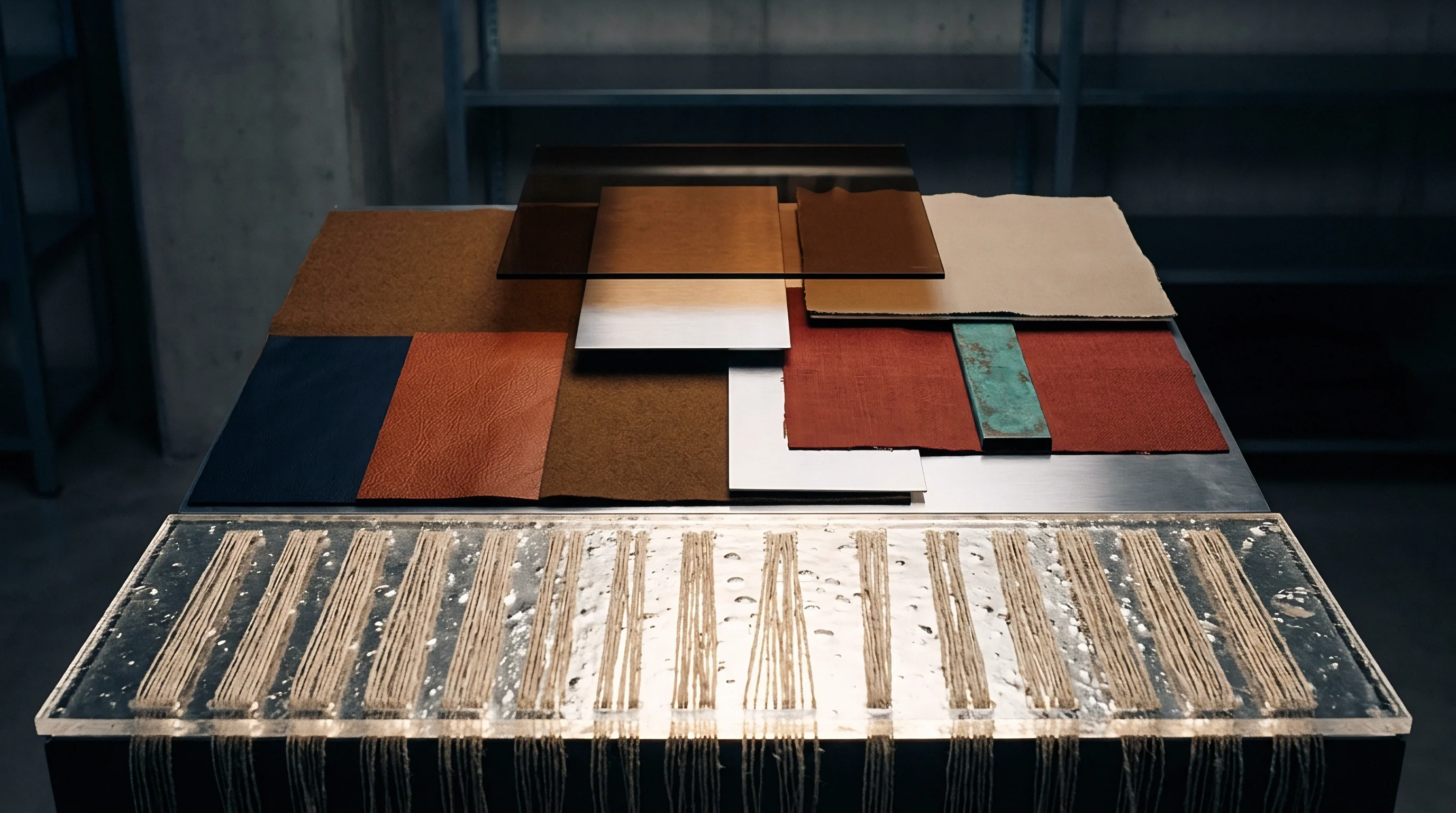
Structural Differences in Wet and Dry Spinning
Wet spinning yields a compact strand profile that allows higher reed densities and tighter beam packing without generating excessive shedding abrasion. Dry-spun yarns, with their lower tensile strength and irregular cross-section, need wider reed dents to keep loose surface fibres from tangling into mechanical stops.
- Slub bunching creates local gauge spikes that jam reed dents during high-speed insertion.
- Moisture unevenness across inner package layers causes unpredictable linear mass shifts during warping operations.
- Twist liveliness in low-lea wet-spun packages causes snarling before tension discs during creel unwinding.
- Fibre migration under low processing humidity generates loose surface fly that clogs yarn accumulators.
Count variations exceeding three percent typically stem from humidity fluctuations inside shipping containers rather than draft changes on the spinning frame.


Equation
Fabric weight per square metre depends on thread sett in both directions paired with structural crimp contraction. Arriving at target greige weights requires ends per centimetre, picks per centimetre, warp tex, weft tex, and expected crimp loss. Because interlacing yarns follow a serpentine path around each other, weaving uses more yarn length than the flat cut of the cloth indicates, a difference accounted for by the crimp percentage.
The tight structure of a plain weave increases interlacing resistance, driving crimp values higher than twill or satin constructions woven from identical yarns. Fabric cover factor measures visual opacity by calculating the proportion of fabric surface covered by intersecting threads. Combining warp and weft cover factors allows weavers to hit the necessary opacity and barrier properties without putting excess weight into the cloth.

Determining Greige Mass per Square Metre
Greige fabric mass modeling calculates warp and weft yarn consumption separately. Factoring crimp directly into these yarn count formulas prevents raw material shortfalls when ordering production quantities.
The total dry greige mass in grams per square metre utilizes the direct tex calculation formula:
Masswarp = fracEnds/cm × 100 × texwarp1000 × left(1 + fracCrimpwarp%100right)
Massweft = fracΠcks/cm × 100 × texweft1000 × left(1 + fracCrimpweft%100right)
Masstotal = Masswarp + Massweft

Crimp Contraction and Warp Take-Up Percentages
Weavers pull crimp figures from actual sample swatches before signing off on full production runs.
Standard trade specifications permitting a five percent weight variation allow mills to reduce pick counts without breaching delivery contracts.
- Extract ten warp ends and ten weft picks across a full fabric width.
- Measure straightened yarn lengths under a standard tension of half a centinewton per tex.
- Calculate average crimp contraction percentages for warp and weft directions separately.
- Weigh dry yarn samples on an analytical balance to determine actual linear density in tex.
- Multiply ends per centimetre by warp tex and crimp factor to establish nominal warp mass per square metre.
| Fabric Weave Construction | Sett (Ends x Picks / cm) | Yarn Count Warp x Weft | Warp x Weft Crimp % | Calculated Greige Mass | Total Fabric Cover Factor |
|---|---|---|---|---|---|
| Plain Tabby Weave | 18.0 x 16.0 ends/cm | 25 Lea x 25 Lea | 7.5% x 5.0% | 237.2 GSM | 19.8 (High Opacity) |
| 2/1 Ground Twill | 24.0 x 20.0 ends/cm | 40 Lea x 40 Lea | 9.0% x 4.5% | 198.8 GSM | 18.4 (Medium Opacity) |
| 5-End Satin Weave | 32.0 x 22.0 ends/cm | 60 Lea x 60 Lea | 11.0% x 3.5% | 168.1 GSM | 17.9 (Drape Preferred) |
Underestimating crimp can skew yarn procurement by hundreds of kilograms, exhausting warp beams before a planned cut length is finished and forcing costly loom stoppages.

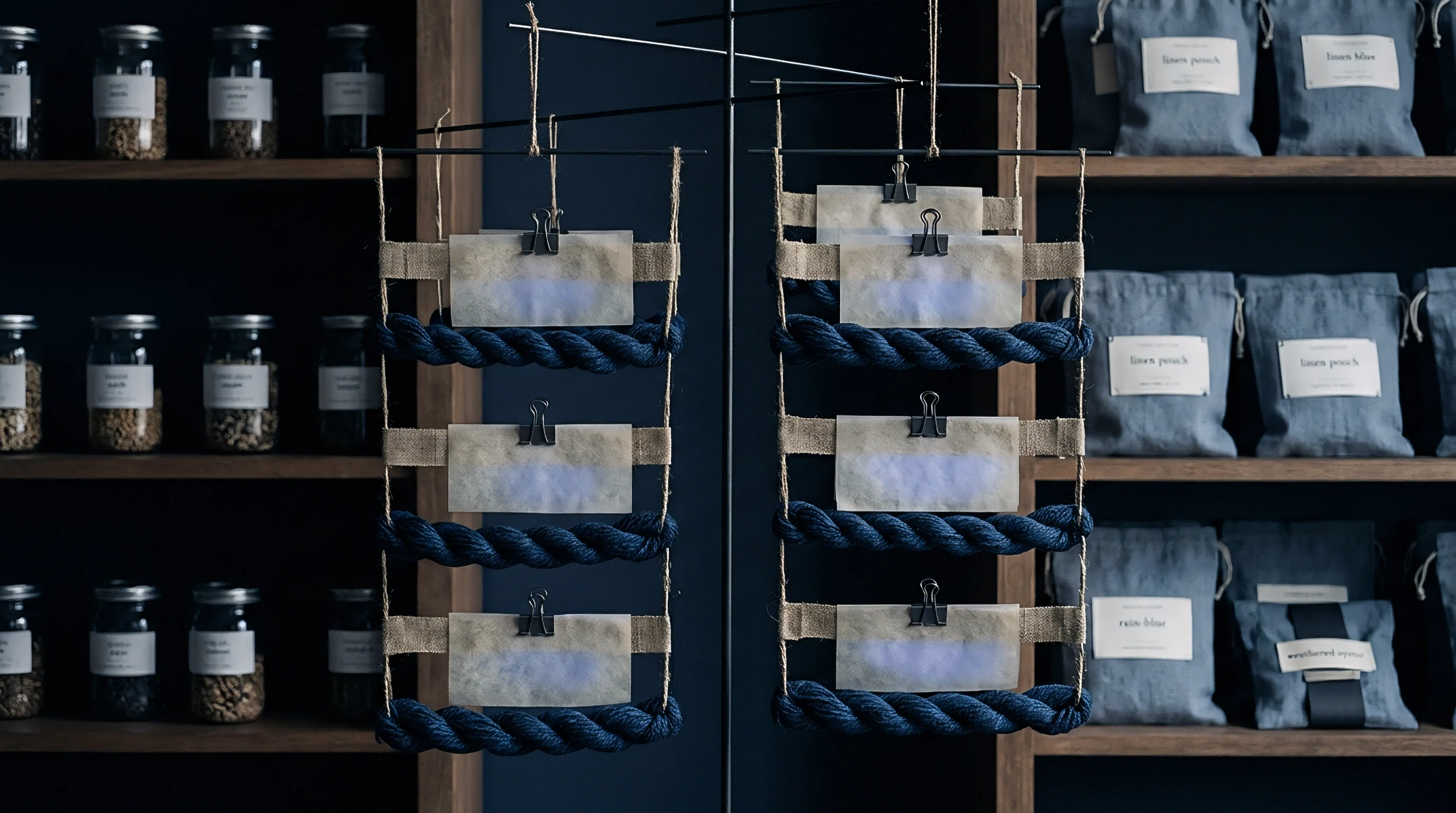
Frame
Loom motions subject warp strands to severe cyclic tension and friction as the harness separates the shed. Natural flax fibres offer low elongation at break, typically running between 1.5 and 2.5 percent, leaving little margin for tension spikes. Because modern rapier insertion demands sustained yarn tenacity, leaning on bundle-strength tests like the Lea Strength Index often hides defects that manifest as warp breaks during high-speed runs.
Single-end tensile evaluation under ISO 2062 exposes how individual strands behave under rapid loading. Lea tests measure aggregate bundle resistance, masking thin spots that snap immediately when the shed opens. A wide spread in single-end tenacity readings points to impending warp failures.
Rapier machines running beyond four hundred picks per minute require wet-spun warps with uniform tensile profiles and low surface hairiness to run without regular stops.
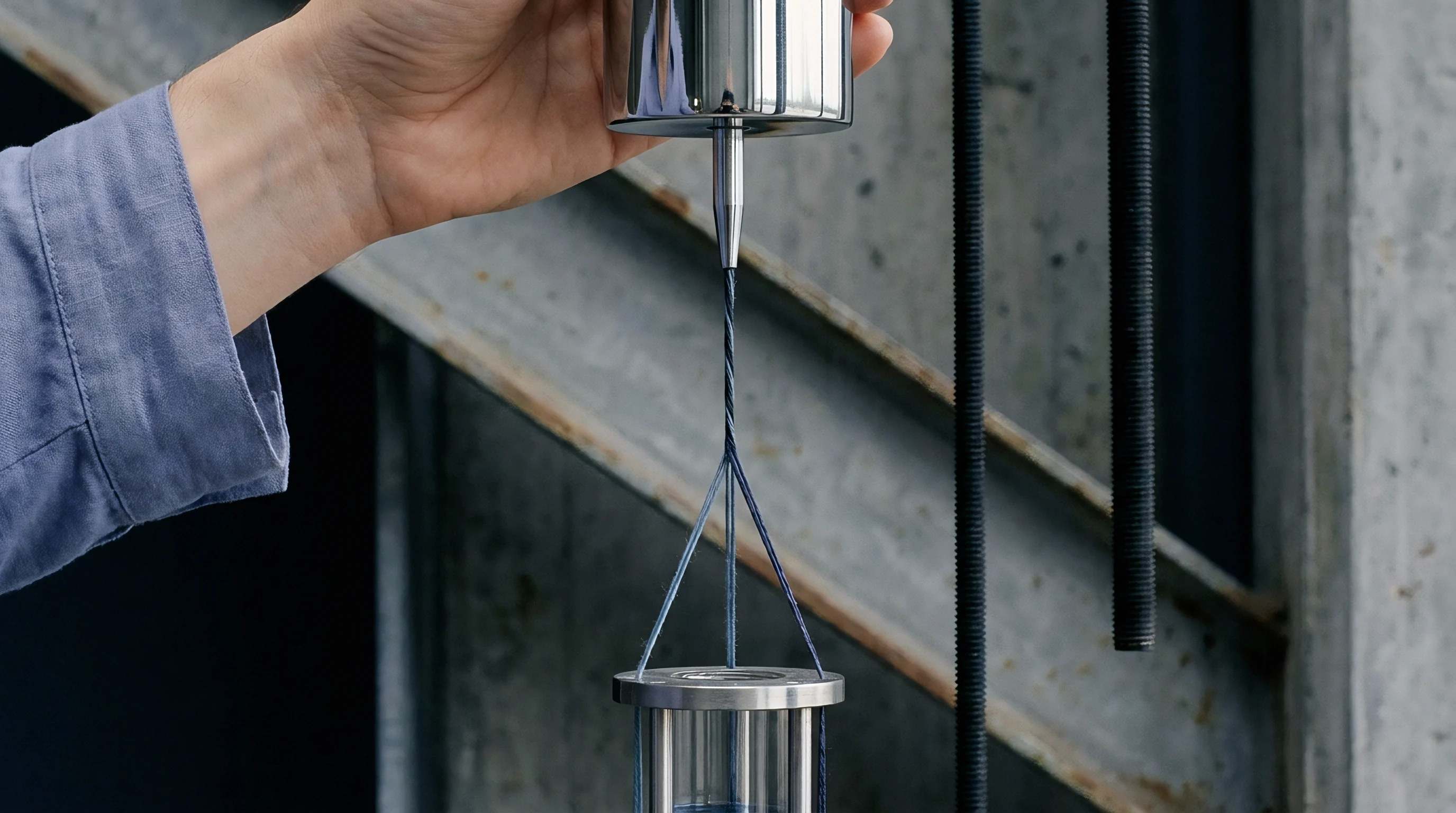
Which Mechanical Test Bench Best Predicts Warp Breaks?
Automated single-end testers deliver detailed failure distribution curves. Testing individual strands isolates the localized weak points and thin sections that aggregate bundle tests smooth over, identifying problem lots before creels are warped.
A minimum breaking tenacity of fourteen centinewtons per tex at twenty-one degrees Celsius and sixty-five percent relative humidity prevents excessive shedding stops on rapier machines.
Bundle Lea Strength Index (LSI) values correlate poorly with high-speed loom stops:
LSI = fracBreaking Load (lbs) × NeL80

Shedding Dynamics and Insertion Speed Limits
Because high insertion speeds put heavy strain on coarse linen, heavier yarns require lower shaft speeds and smaller shed clearances to prevent peak tension from snapping ends during harness lifts. Finer wet-spun yarns tolerate higher running speeds due to better fiber parallelization and superior strength per unit mass.
- Tensile threshold validation ensures single-end breaking tenacity meets machine insertion specs rather than relying on bundle Lea tests.
- Coeffient of variation caps limit mass unevenness per thousand metres to prevent localized break clusters.
- Sizing additive compatibility protects against excessive fiber shedding and dusting in the loom drop wires.
- Elongation floor targets mandate minimum dynamic strain allowance to absorb shed opening impact loads.
Writing ISO 2062 single-yarn strength minimums directly into purchase agreements places the financial cost of avoidable loom downtime on the spinning mill.

Ledger
Linen weaving margins depend on converting incoming yarn mass into realistic loom-hour yields, where unscheduled machine downtime quickly eats into project profitability. Material planning must account for physical yarn loss across every preparatory and weaving stage. Warping creels, sizing troughs, drawing-in frames, and shed trimming all chip away at gross yarn mass before finished yardage is realized.
Processing scrap directly shifts the real fabric cost: warping waste consumes three to five percent of yarn through spool bottoms, creel headers, and sizing tie-ins, while weaving sheds lose an additional two to three percent to selvedge fringes, caught picks, and beam ends. A practical landed fabric cost incorporates these cumulative waste rates alongside machine hourly rates, chemical sizing costs, and wet-finishing shrinkage.

Warping and Weaving Waste Allocation Rates
Production budgets assign scrap percentages based on yarn grade, spinning method, and sizing complexity. Severe count irregularities trigger frequent warp breaks, pushing up idle machine time and generating extra yarn scrap per finished bolt.
Gross raw yarn requirement calculations integrate structural fabric mass with stage scrap factors:
Yarngross = Fabricnet × left(1 + fracWastewarp% + Wasteweave%100right)

Loom Hour Costing per Finished Metre
Machine time cost corresponds directly to pick density. Lower pick counts move more linear metres through the loom per hour, lowering the fixed machine burden per yard produced. Coarse yarns, running at lower insertion speeds, absorb significantly more machine overhead per metre.
Coarse yarns consume beam capacity rapidly and force frequent warp changes that inflate fixed setup costs.
| Nominal Count (NeL) | Machine Insertion Speed | Average Shed Efficiency | Total Process Waste Factor | Loom Hours per 100 Metres | Relative Production Cost |
|---|---|---|---|---|---|
| 10 Lea (Coarse) | 320 picks/min | 78.5% | 7.5% gross loss | 14.2 Loom Hours | High Material / Low Time |
| 25 Lea (Medium) | 420 picks/min | 85.0% | 5.5% gross loss | 11.8 Loom Hours | Balanced Operating Ratio |
| 40 Lea (Fine) | 480 picks/min | 88.0% | 4.5% gross loss | 9.5 Loom Hours | Low Material / High Setup |
| 60 Lea (Extra Fine) | 450 picks/min | 81.0% | 6.0% gross loss | 12.4 Loom Hours | High Processing Premium |
Verifying exact linear density on incoming yarn lots ensures raw fiber allocations match actual loom consumption, protecting margins across long manufacturing runs.