Determining Flax Staple Profile Using Manual Comb Sorting
Manual comb sorting by ISO 2370 isolates technical flax bundle length profiles to prevent drafting waves, control short fibre content, and enforce purchase contracts.


Tuft
Flax fibres require precise manual sorting. Laboratory evaluation of bast fibre length profiles starts by pulling a representative sample from bulk agricultural shipments. Raw or hackled flax fibres do not exist as solitary biological units; they form complex technical fibre bundles bonded by intercellular pectins, hemicelluloses, and lignin.
Getting a proper sub-sample from a hundred-kilogram bale takes a systematic multi-stage quartering procedure to avoid sampling bias toward longer, stiffer stricks. An operator draws small hand-sized portions from twenty distinct physical locations throughout the open bale, selecting material from the core, corners, and exterior surfaces. Interleaving these portions gently by hand blends them without applying pulling forces that could fracture brittle technical fibres or disrupt natural bundle orientation.
The resulting composite sample is conditioned at twenty degrees Celsius and sixty-five percent relative humidity for at least twenty-four hours. Bast fibre dimensions fluctuate sharply with ambient moisture. Absorbed water swells the transverse cell wall boundaries, raising interfibre friction and altering bundle stiffness.
Aligning comb pins under standard ambient conditioning keeps mechanical transfer forces repeatable across test cycles. Preparing the test tuft from the conditioned sample takes hand-hackling over a graduated series of stationary bench pins. The operator draws the composite strick through coarse steel pins spaced five millimeters apart to untangle loose web structures and dislodge residual shive fragments without breaking sound technical fibres.
Compliance with ISO 2370 evaluation mandates pre-conditioning samples at sixty-five percent relative humidity, without which measured bundle linear density skews downward by up to twelve percent.
Progressively finer bench pins, down to one millimeter spacing, refine the parallel alignment of the strick. This hand-hackling removes unattached short fibres ~ the tow fractions ~ while isolating the continuous long-line bundle structure. The operator grips the strick firmly at its midpoint and draws the free ends through the pin bed until individual bundle strands lay parallel without crossing or crimping.
The strick is then reversed and the opposite end gets identical pin passes. This mechanical preparation yields a squared-off tuft weighing precisely two grams, with individual fibre bundles aligned cleanly along their longitudinal axes.
Failing to standardize tuft preparation introduces severe error into downstream comb sorting analyses. Mechanical damage from overly aggressive hand hackling generates false short-fibre populations that can flatter under-retted stock or penalize well-retted flax. The list details primary failure modes encountered during initial sample preparation and tuft conditioning.
- Improper oiling ~ Excess lubricating oil on pin beds causes fine ultimate flax fibres to cling to comb teeth, distorting the short-fibre fraction.
- Inadequate pre-conditioning ~ Testing raw flax bundles below sixty percent relative humidity induces static charge, preventing clean transfers between comb beds.
- Violent hand drawing ~ Rapid extraction of bundles during manual comb transfers snaps long technical fibres, artificially inflating the measured short staple percentage.
- Overloaded pin teeth ~ Packing excess fibre mass onto comb pins forces bundles over the top of the teeth, destroying parallel alignment during the draw.
Cohesion depends on bundle length. Fine technical fibres have low bending rigidity, which allows tight packing inside the comb array. When operators skip preliminary shive removal, coarse woody bark particles caught between pin rows push adjacent bundles out of alignment.
This shifts the effective origin point of the bundle base during initial sorting passes. A single misaligned bundle can shift length readings by ten to fifteen millimeters, distorting the downstream cumulative mass curve.

Sample Extraction and Strick Conditioning
Representative sampling of scutched or hackled flax demands strict adherence to geometric sub-sampling protocols. A bulk sample drawn from a commercial lot has to capture the natural variance from agricultural growing conditions, retting uniformity, and mechanical scutching intensity. Operators extract ten primary stricks across the depth profile of selected bales.
These stricks are laid flat on an analytical bench in a head-to-tail orientation and split longitudinally using a fine steel needle. One-half of each split strick forms the secondary composite lot, while the remainder goes back into the commercial bale.
Conditioning the secondary composite lot stabilizes moisture regain across all bundle diameters. Flax cell walls absorb water vapor through hydroscopic cellulose regions, expanding their cross-sectional area and softening the pectin matrix that binds ultimate fibres into technical complexes. Test specimens kept in low-humidity environments show elevated brittle fracture during pin combing, which creates an artificial surplus of fragments shorter than twenty millimeters.
Standard conditioning rooms under climate control allow internal moisture content to reach equilibrium at roughly twelve percent regain by weight.
Evaluating long-line hackled flax against scutched tow using dual-bed comb arrays verifies structural integrity before processing. Hand preparation of the strick requires measured manual tension. The operator applies an even, continuous pulling force along the longitudinal axis of the bundle group.
Abrupt twisting or snapping motions break delicate elementary fibre tips, shortening the upper quartile length parameter. Clean, steady hand passes across coarse pin beds strip away non-cellulosic impurities while preserving the full length spectrum of the original plant stems.

Manual Pin Preparation and Alignment Mechanics
Transitioning from raw stricks to a sorted tuft relies on precise mechanical interaction between steel pin beds and bast fibre bundles. Bench pins made from tempered tool steel feature polished conical tips that slide between parallel fibres without catching or severing cell walls. Pin density increases across successive preparation stages: the primary coarse bed has thirty pins per decimeter to clear coarse shive debris and major entanglements, while the secondary fine bed carries eighty pins per decimeter to split thick technical bundles into finer sub-units.
Hand hackling across these pin beds strips loose fibre fragments while orienting remaining bundles along a single axis. The operator holds the specimen with a wide grip clamp set five centimeters from the working end. Dropping the free end into the pin bed, the operator pulls the clamp backward along a horizontal plane parallel to the pin block base.
Straying from this horizontal line forces bundles against the pin bases, generating friction shear that strips healthy cortical tissue off the fibre spine.
The final tuft mass must reach two hundred milligrams within a five milligram tolerance for standard Baer sorter integration. Weighing takes place on an analytical balance precise to zero point one milligram immediately after final pin alignment. If the tuft mass exceeds two hundred and five milligrams, bundles are peeled carefully from the longitudinal edge of the tuft until it falls within limits.
Trimming the ends with shears is strictly forbidden, since cutting invalidates the natural staple length distribution profile.
Flax fibres require precise manual sorting because incorrect preparation distorts every downstream parameter. Skewing the initial tuft profile leads directly to wrong roller draft settings on spinning frames, causing excessive end breaks, severe yarn count variation, and unrecoverable financial losses on raw material.


Sorting
Comb sorter mechanisms isolate individual length fractions through systematic mechanical transfer between dual pin beds. The classic Johannsen or Baer comb sorter consists of two identical parallel banks of narrow, finely spaced steel combs mounted on a rigid cast base. Each bank contains a series of hinged or removable comb drops spaced at fixed five-millimeter or ten-millimeter intervals along the instrument’s axis.
High-grade instrument pins, ground sharp and set at up to two hundred pins per decimeter, hold the technical fibre tuft in flat horizontal alignment during sorting.
Manual comb sorting relies heavily on operator dexterity with specialized comb forceps. These forceps feature wide, flat, smooth-ground jaws that clamp bundle tips across their full width without crushing or slipping. The operator places the prepared two-hundred-milligram tuft into the left comb bank, pressing fibres into the pin rows with a padded velvet depressor.
The root ends extend slightly beyond the first comb row, presenting an even edge for forceps extraction.
With a smooth, continuous movement, the operator grips the protruding fibre tips with forceps and draws them horizontally out of the left comb bed. This pulls the longest individual technical bundles clear of the stationary tuft mass while shorter fibres remain behind the pin barriers. The extracted bundle fraction is carried directly across to the right comb bank and laid down so its front edge sits exactly on the zero line of the right bed.
The operator then lowers the upper comb set of the right bank to trap the deposited bundles in place.
This transfer sequence repeats across the entire tuft length. As the longest fibres leave the left comb bank, lower comb drops are released individually, exposing the tips of the next length fraction. The operator draws each successive group and places it onto the right comb bank in descending order of length, aligned along a common baseline.
What remains on the secondary bed is a physically sorted array of technical flax fibres organized from longest to shortest.
- Mount the conditioned two-hundred-milligram tuft into the primary comb bed, depressing bundles evenly into the pin matrix with a velvet tool.
- Lower all upper comb frames to secure the fibre mass, exposing only the extreme root tips beyond the zero-point pin line.
- Grip protruding fibre tips with flat-jaw forceps, applying steady horizontal traction to extract the longest bundle group without disturbing shorter adjacent stock.
- Transfer extracted bundle groups to the secondary comb bed, placing tip boundaries precisely along the baseline mark.
- Drop successive comb rows on the primary bed as long fibres clear, exposing intermediate and short length groups for sequential transfer.
- Depress each newly transferred group into the secondary comb bed using the velvet paddle to prevent draught-induced fibre loss.
- Collect individual length fractions from the secondary bed using forceps, grouping bundles into five-millimeter length increments.
- Transfer each isolated length increment directly to sealed weighing containers to prevent ambient moisture fluctuation during mass determination.
Single ultimate fibres rarely exist alone inside the sorter bed. Technical flax fibres consist of overlapping elementary ultimate cells, three to four centimeters long, linked together by strong pectic compounds. Mechanical comb sorting measures the length of these composite bundles rather than individual cell units.
Precise sorting requires careful drop-pin control to avoid disturbing adjacent short fibres during long-bundle extraction.
Manual comb sorting remains the definitive reference method for calibrating high-volume optical staple analyzers in bast fibre laboratories.
Fibre transfer dynamics depend heavily on forceps grip pressure and draw speed. Excessive clamping force crushes thin-walled technical fibres, snapping tips and shifting the measured profile toward shorter length intervals. Conversely, insufficient pressure allows slippage, resulting in partial extraction and tangled pin beds.
Operators maintain steady manual velocity during extraction, matching the natural resistance of the pin matrix.

Comb Sorter Mechanics and Pin Spacing
Internal geometry inside the Baer comb sorter determines the spatial resolution of the final staple profile. Steel pins set into brass comb bars have a wire diameter of zero point two five millimeters, tapering down to a tip radius of zero point zero two millimeters. Pin spacing within a single bar measures precisely zero point five millimeters center-to-center.
This dense pin arrangement stops technical flax bundles from wandering sideways during forceps extraction, forcing each bundle along a straight longitudinal path.
Vertical clearance between upper and lower comb banks dictates maximum sample mass capacity. Standard instruments provide a three-millimeter gap between opposing pin beds when closed. Packing excess material into this gap bends pin tips out of alignment, creating wider spaces where fine bundles escape sorting control.
Significant drafting force fluctuations occur when staple variance exceeds twenty percent, underscoring the necessity of pin maintenance and regular alignment checks.
Comb drop mechanisms operate via precision thumb levers along the lateral frame. Releasing a lever drops the corresponding comb bar twelve millimeters vertically, clearing workspace and exposing the embedded fibre tuft for the next forceps draw. Mechanical tolerance on drop-bar movement must remain within zero point zero five millimeters.
Sluggish or sticky drop-bar motion disrupts the operator’s rhythm, leading to inconsistent extraction tension and corrupted length increments.
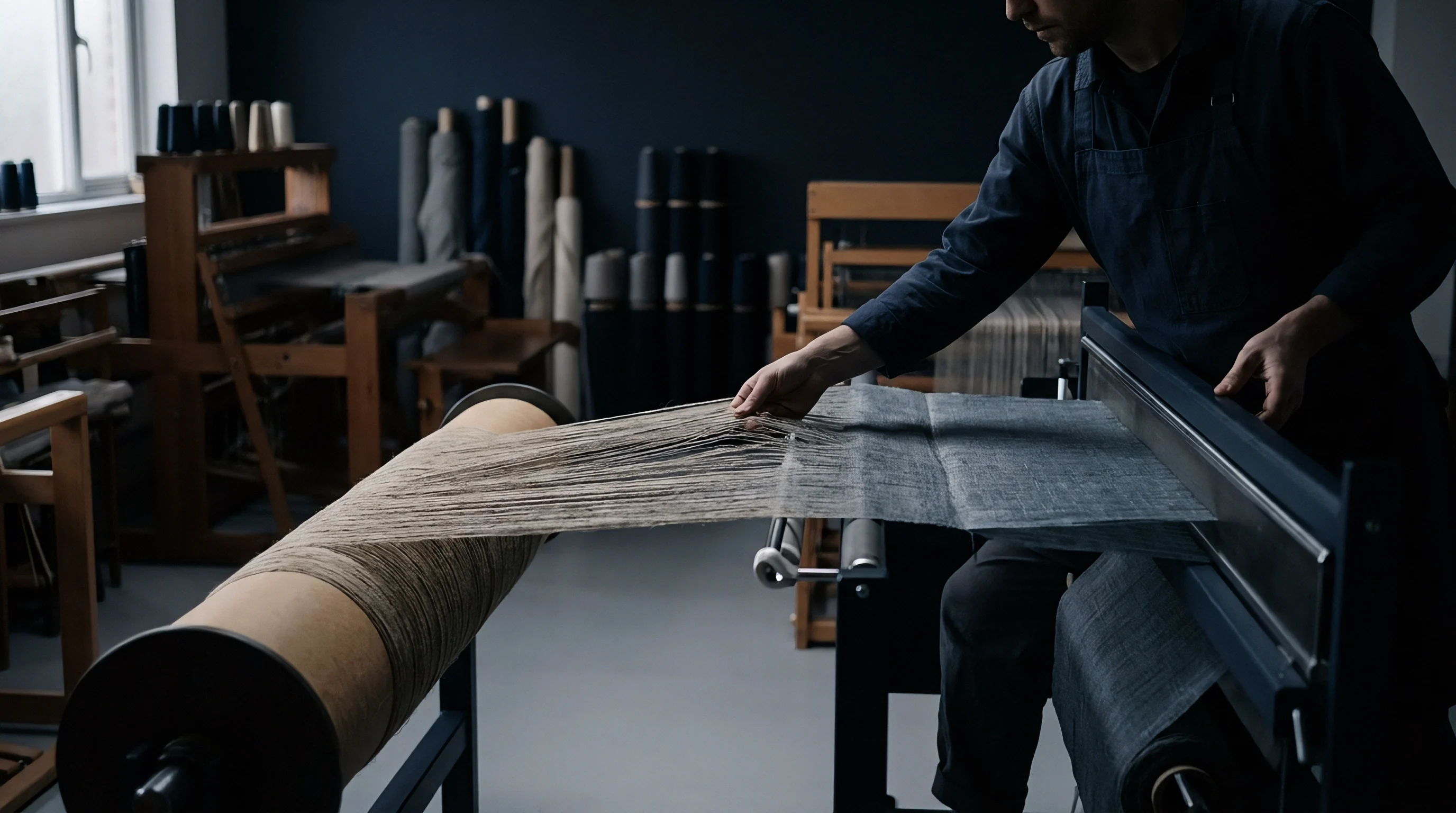
Dual-Bed Deposition and Fibre Transfer Sequence
Transferring fibres between primary and secondary comb beds converts a random length mixture into an organized spatial array. The secondary bed mirrors the primary bed in dimensions, pin density, and drop-bar spacing. Before deposition, the operator brushes the secondary pin rows clean to ensure zero contamination from prior runs.
The baseline mark on the secondary bed is an engraved tungsten line running perpendicular to the pin rows.
Extracted fibre groups are deposited onto the secondary bed with their root ends sitting directly on the engraved baseline. The operator uses forceps to pull the group flat, lowering it into the pins under light axial tension. A velvet-covered wooden depressor then presses the fibers deep into the pin gaps to protect them against drafts or accidental movement.
Subsequent transfers drop right next to previous fractions, working left to right across the bed width.
Sorting accuracy drops rapidly if extracted bundles are allowed to bow or crimp during transfer. Curved or diagonal placement understates the true length of individual technical bundles, skewing the sorter diagram. The operator has to maintain light, continuous longitudinal tension on the forceps right until the velvet depressor seats the fibres into the secondary pin matrix.
High short-fibre percentages are often attributed to pin transfer fracturing delicate flax bundles during manual comb sorting. In practice, this argument frequently masks severe mechanical scutching damage or improper retting.


Array
Constructing the sorter staple length diagram translates physical fibre fractions into visual and numerical models. Once sorting is complete, the operator removes each length fraction from the secondary comb bed in descending order. Each fraction represents fibres falling within a specific five-millimeter increment ~ ninety to ninety-five millimeters, eighty-five to ninety millimeters, down to zero to five millimeters.
The mass of each isolated fraction is measured on an analytical microbalance precise to zero point zero one milligrams.
Data obtained from fraction weighing yields both absolute and cumulative frequency distributions. The operator records the mass of each length class and calculates its percentage contribution to the total recovered sample mass. Summing these percentages sequentially from longest to shortest creates the cumulative mass distribution curve, commonly called the Baer staple diagram.
This plots cumulative mass percentage along the horizontal axis against technical fibre length in millimeters on the vertical axis.
Analyzing the resulting curve yields the core parameters of staple quality. Maximum staple length corresponds to the upper tip of the diagram where the curve intercepts the vertical axis. Mean staple length represents the height of a rectangle with an area equal to the space under the cumulative curve over the same baseline length.
The modal length interval indicates the category holding the largest individual mass fraction, identifying the dominant bundle length in the shipment.
Short fibre content calculation focuses on fractions below a specific technical threshold. In flax processing, technical fibres shorter than fifteen millimeters cannot be controlled effectively by drafting rollers during wet or dry spinning. The mass of all fractions measuring under fifteen millimeters is summed and expressed as a percentage of total recovered mass.
High short fibre percentages point to aggressive mechanical scutching and hackling, or poor biological retting control.
A comb sorter array with a steep drop in the middle length zone signals premature fibre breakage during preliminary scutching.
The shape of the staple profile reflects processing potential directly. A rectangular, box-shaped diagram demonstrates exceptional length uniformity, where most technical bundles share near-identical length dimensions. A sloped, triangular diagram indicates high length dispersion, with wide spreads between maximum line length and short tow fractions.
Fine yarn counts require box-shaped profiles to maintain evenness and prevent drafting waves.
| Staple Length Interval (mm) | Line Flax Mass (%) | Scutched Tow Mass (%) | Cumulated Line Mass (%) | Cumulated Tow Mass (%) |
|---|---|---|---|---|
| Above 100 | 12.4 | 0.0 | 12.4 | 0.0 |
| 80 to 100 | 38.6 | 2.1 | 51.0 | 2.1 |
| 60 to 80 | 28.2 | 11.4 | 79.2 | 13.5 |
| 40 to 60 | 11.5 | 26.8 | 90.7 | 40.3 |
| 20 to 40 | 6.1 | 38.2 | 96.8 | 78.5 |
| Below 20 | 3.2 | 21.5 | 100.0 | 100.0 |
| Test Method: ISO 2370 manual comb sorting at 20°C, 65% RH. Sample size: 200 mg per run across 5 replicates. Total recovered mass retained within 98.5% to 100.2% range. | ||||
Interpreting staple parameters requires evaluating both linear density and length distribution. The list outlines core metrics required for standard laboratory dossier inclusion.
- Mean staple length ~ The arithmetic average length of sorted fibre groups calculated from cumulative weight distribution curves.
- Modal length interval ~ The length category containing the highest cumulative mass percentage within the sorted array.
- Short fibre content ~ The percentage of total sample mass comprising technical fibres shorter than fifteen millimeters.
- Length CV percentage ~ The coefficient of variation expressing staple length dispersion across the combed profile.
Short fibres cause thin spots in yarn. When short fractions cluster together inside the drafting zone, local linear density drops instantly. This structural defect reduces local yarn strength, triggering thread breaks on winding frames or weaving looms.

Constructing the Sorter Staple Length Diagram
Plotting the physical sorter diagram involves mounting sorted fibre fractions onto a black velvet board with water-soluble adhesive or alignment pins. The board has a pre-printed grid with millimeter increments along the ordinate and percentage increments along the abscissa. The operator places the longest fraction against the left vertical axis, resting its root end on the bottom baseline.
Subsequent fractions sit right next to one another, moving rightward in order of decreasing length. The width allocated to each fraction along the horizontal axis correlates directly to its mass percentage of total recovered sample. For example, if the eighty-to-eighty-five millimeter fraction accounts for eight percent of total sample mass, it occupies eight percent of the total baseline width on the board.
Once all fractions are secured, the operator draws a smooth envelope curve connecting the upper boundary points of adjacent bundle groups. This line forms the classic Baer curve. The area under the curve represents total fibre mass, while horizontal slices reveal the proportion of fibres exceeding any given target length.

Is Sorter Diagram Mass Distribution Superior to Tuft Count?
Debate persists between gravimetric mass distribution methods and numerical tuft count methods for characterizing bast fibre profiles. Gravimetric sorter diagrams measure the mass of length classes, weighting coarse, heavy bundles far more heavily than fine, light ones. Numerical counting methods tally individual fibres per length category regardless of bundle linear density, producing a numerical frequency distribution.
In flax spinning, gravimetric sorter profiles give a better prediction of yarn linear density variations. Drafting rollers control fibre mass flow through the draft field rather than individual strand counts. A single thick technical bundle carries the same mass as five fine ultimate bundles, so its draft resistance and impact on yarn count variation correlate directly to its mass fraction.
Solvent extraction removes residual gum content before weighing comb fractions to eliminate non-cellulosic mass skew.
Numerical counting skews staple profiles toward the short-fibre end, since fine broken fragments exist in high numbers while contributing negligible mass. Gravimetric sorting isolates the load-bearing long-line bundles that form the structural spine of high-tenacity wet-spun yarns. Mass-based sorter diagrams reflect true commercial yield potential across hackling and carding operations.
Whether modern optical array scanners can fully replace manual comb sorting for heavy, irregular bast fibre bundles without losing fine length resolution remains an unresolved question across standard textile testing laboratories.

Draft
How staple profile parameters impact drafting mechanics governs maximum spinnable yarn count and yarn evenness. Drafting attenuates a thick sliver or roving into a fine strand by passing it through successive pairs of rollers rotating at increasing surface speeds. The draft ratio ~ the speed ratio of delivery roller to back roller ~ determines the degree of strand thinning.
Flax fibres inside the drafting field rely on interfibre friction and roller nip pressure to maintain controlled movement without slipping or bundling.
The physical distance between back and front drafting nips must be set slightly longer than the maximum staple length shown on the sorter diagram. Setting nip spacing closer than maximum staple length causes long fibres to be gripped simultaneously by both front and back rollers. Because the front roller rotates faster, trapped fibres snap violently or pull back rollers out of alignment, introducing severe thick spots and machine strain.
Setting nip spacing excessively wide leaves a large ungoverned drafting zone where short fibres float freely without control from either roller pair.
Floating fibres move unpredictably inside wide drafting zones. Fibres shorter than half the nip distance lack contact with either roller pair for substantial periods. These unguided short fibres accelerate prematurely, pulled along by adjacent long fibres through friction.
This uncontrolled movement generates periodic thick spots followed immediately by thin depleted zones ~ the so-called drafting waves. Fine counts demand low length variance to eliminate drafting waves and maintain high yarn strength.
| Flax Grade Profile | Mean Length (mm) | Short Content (<15mm %) | Draft Nip Distance (mm) | Target Yarn Count (Nm) | Yarn Unevenness (CV %) | End Break Rate (per 1000 spindle hours) |
|---|---|---|---|---|---|---|
| Prime Long-Line | 85.4 | 2.1 | 95.0 | Nm 60 (Wet) | 10.8 | 12.5 |
| Standard Hackled | 68.2 | 4.8 | 78.0 | Nm 39 (Wet) | 13.2 | 24.0 |
| Coarse Scutched | 45.0 | 12.4 | 55.0 | Nm 20 (Dry) | 17.5 | 58.0 |
| High-Tow Blend | 28.5 | 22.8 | 38.0 | Nm 10 (Dry) | 22.4 | 115.0 |
| Spinning Conditions: Wet-spinning trough temperature 60°C; reach set to 1.1x maximum sorter length. Dry-spinning drafting zone equipped with double-apron control. Spindle speed: 6000 RPM. | ||||||
High short-fibre fractions destabilize the drafting wedge. As short fibres collect behind the front roller nip, they form temporary clumps that pass through the nip as large slubs. The list outlines specific mechanical drafting failure modes directly attributable to defective staple profiles.
- Roving undulation ~ Floating short fibres aggregate between drafting rollers, producing periodic thick and thin places in spun yarn.
- Nip slipping ~ Unaligned long bundles bridge across drafting zones, causing localized drafting stalls and heavy slubs.
- Lap licking ~ High short-fibre fractions cause lint accumulation on drafting aprons, leading to catastrophic end breaks during wet spinning.
Hackling yield governs spinning margins. Material entering the mill with high staple variation requires wider nip spacing, forcing the spinner to reduce overall draft ratios. Lower draft ratios demand thicker input rovings or additional drawing passages, directly inflating production costs per kilogram of finished yarn.
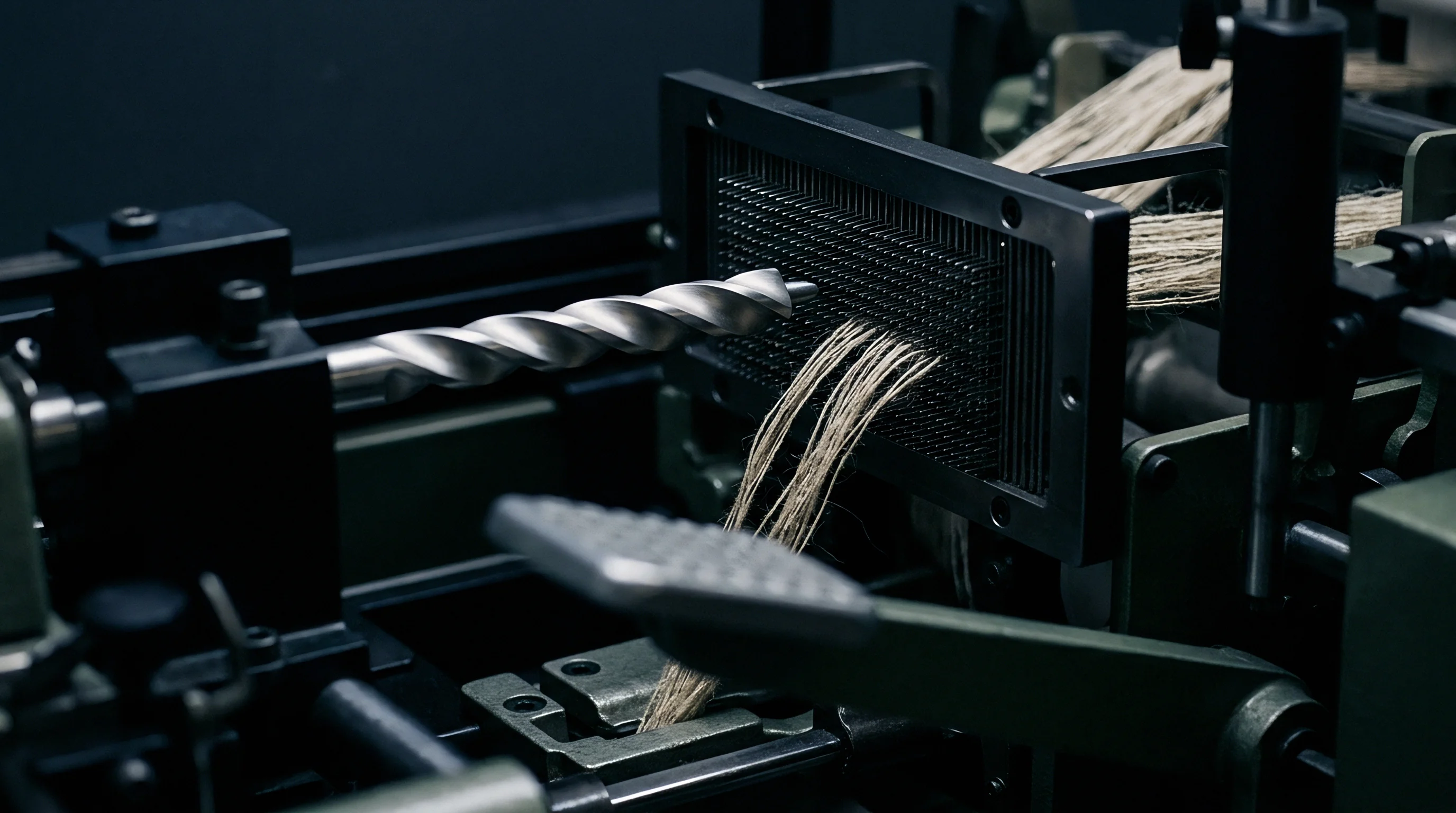
Roller Nip Spacing and Floating Fibre Control
Optimizing nip distance demands exact alignment with sorter diagram percentiles. Spinners calculate effective gauge length using the formula where nip distance equals upper quartile staple length plus a safety margin of three to five millimeters. For a long-line flax profile presenting an upper quartile length of eighty millimeters, technicians fix roller nip spacing at eighty-four millimeters.
Controlling floating short fibres inside wider gauge settings requires supplementary mechanical guiding elements. Wet-spinning frames utilize press rollers and guiding pins submerged in warm water baths. Warm water softens non-cellulosic pectins within roving strands, allowing smooth bundle slippage while cohesive fluid forces hold short fibres against the main drafting spine.
Dry-spinning frames use double-apron drafting arrangements or tumbler rollers to apply top pressing forces directly inside the middle drafting zone. These aprons pinch short fibres lightly enough to prevent uncontrolled acceleration while letting long fibres pull through without snapping. Proper apron tension reduces yarn count coefficient of variation by up to four percentage points on short-staple tow blends.

Staple Spread and End Breakage Dynamics
Staple length dispersion, measured by the coefficient of variation of the sorter diagram, directly dictates end break frequencies during spinning. High dispersion means long and short fibres coexist in extreme proportions. During drafting, sudden transitions between long bundle support and short fibre accumulation cause rapid tension spikes in the emerging strand.
When strand tension exceeds immediate bundle cohesion, the thread snaps instantly between the delivery roller nip and the spinning spindle traveller. End breaks force machine stoppages, create yarn splices, and increase operator workload. A lot exhibiting a staple length coefficient of variation above thirty-five percent causes end break rates to double, making fine count wet-spinning commercially unviable.
Structural cohesion in wet-spun flax yarn relies on twisted long fibres forming a continuous helical jacket around shorter central cores. When the staple profile lacks sufficient long-line carrier fibres, that protective outer helix breaks down, causing severe yarn hairiness and catastrophic strength loss.
In flax drafting mechanics, setting roller gauge wide to accommodate rare long bundles costs far more in short-fibre control than trimming the long tail pre-drafting.

Contract
Establishing staple tolerances in sourcing agreements protects yarn manufacturers from sub-standard raw material shipments. Commercial contracts for hackled flax or scutched tow must mandate explicit comb sorter profile parameters rather than relying on ambiguous visual grading terms. A robust technical specification incorporates minimum mean staple length, maximum short fibre content, and allowable staple length dispersion limits measured according to ISO 2370 reference standards.
Procurement dossiers set strict numerical thresholds for lot acceptance. A standard long-line flax purchase contract specifies a minimum mean staple length of seventy millimeters, a maximum short fibre content below fifteen millimeters of no more than five percent, and a length coefficient of variation capped at twenty-two percent. Receiving laboratories draw representative samples from five percent of delivered bales immediately upon dock arrival, running five replicate manual comb sorter tests per bale to verify compliance prior to invoice clearance.
Rejection protocols apply automatically when comb sorter metrics fall outside contract boundaries. If tested samples reveal a short fibre content exceeding specified limits by more than two percentage points, the buyer reserves the right to reject the entire shipment or apply compulsory price penalty deductions. Commercial penalty structures scale dynamically with the measured deviation, offsetting the buyer’s internal costs associated with increased hackling waste or reduced spinning counts.
Waste allowance arithmetic translates staple profile deficiencies directly into landed cost adjustments per finished metre of yarn. Raw flax possessing high length dispersion generates elevated waste percentages during mill hackling and carding operations. Short fibres are stripped out as low-value comb tow, reducing the net yield of high-value line sliver.
A lot yielding three percent more hackling tow than contracted baseline targets increases raw material cost per kilogram of line sliver by approximately four point five percent.
Calculating the landed cost impact requires applying yield formula adjustments to base raw material purchase prices. If a spinner pays six Euros per kilogram for raw line flax expecting a sixty-five percent hackling yield, the nominal fibre cost per kilogram of line sliver equals nine Euros and twenty-three Cents. If manual comb sorting identifies a hidden short-fibre surplus that drops actual hackling yield to sixty-two percent, the true fibre cost per kilogram of sliver rises to nine Euros and sixty-eight Cents, destroying spinning profit margins unless corrected by contract price adjustments.
Commercial contracts protect spinners through precise technical wording that connects physical test results directly to financial settlement. Standard clauses require suppliers to guarantee staple profiles using certified comb sorter testing methods.
Standard purchase terms stipulate that if manual comb sorter testing under ISO 2370 reveals a short-fibre mass fraction exceeding six percent, the baseline contract price drops automatically by zero point eight percent for every full percentage point of excess short fibre recorded across certified shipment sub-samples.