Hackling Yield Calculations for Imported Dew Retted Line Flax
Hackling yield calculations convert scutched line flax mass into spinnable sliver through precise moisture regain corrections and mechanical tow loss balancing.


Comb
Converting scutched long flax into continuous hackled sliver depends on steel pins progressively engaging with parallel bast bundles. Imported dew-retted line flax enters the hackling machine as raw stricks of varying length, containing cortical cell walls, residual shives, and intercellular pectin binders. The primary function of the hackling unit is separating these technical fibre bundles into finer strands without causing excessive axial rupture of the long line fibre.
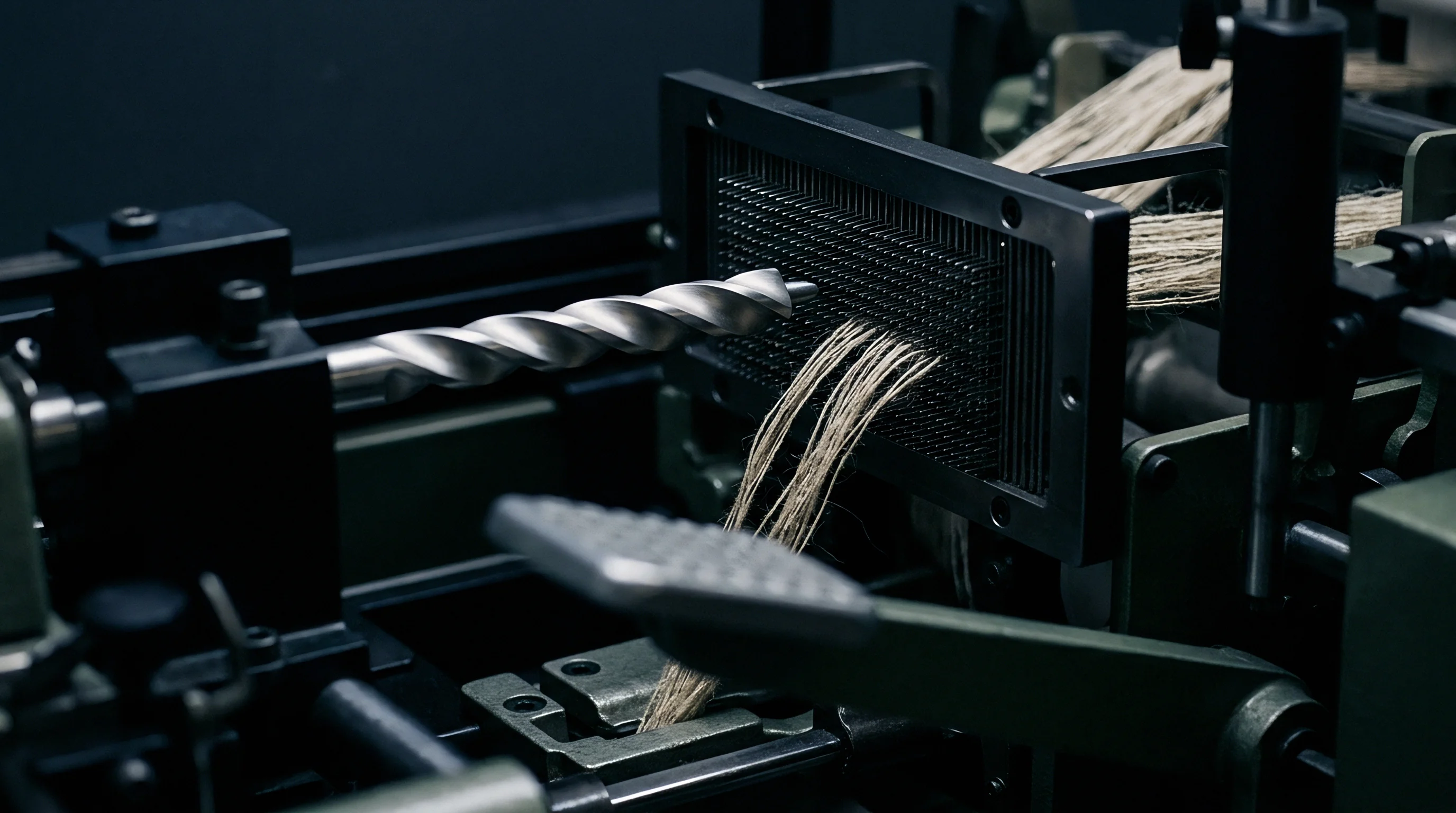
Flax stricks are clamped in heavy aluminum holders travelling along an overhead track, exposing the head and tail ends sequentially to pairs of revolving pinned aprons. These aprons carry horizontal bars fitted with steel needles, with pin spacing shifting from coarse settings on early vertical stands to dense needle configurations on the final dressing passes.
Pin density starts as low as 1.5 needles per centimetre on the initial break-open bars and reaches 28 needles per centimetre on fine finishing beds. As these needles penetrate, they split the compound bast bundles along weakened pectin middle lamellae. High pin density generates intense shear forces across the fibre surface.
If the pin entrance angle is too steep or bar linear velocity exceeds the natural drafting speed of the strick, structural fibre fracture occurs, converting spinnable long line fibre into short hackling tow. This balance between bundle splitting and axial fibre breakage defines the mechanical yield potential of any imported flax shipment.

Mechanical Action of Pinned Bars
Dressing bast fibres requires precise geometric interaction between pin projection, penetration depth, and strick tension. As holder clamps lower a strick between opposing pinned aprons, needles penetrate the body of the flax bundle. Initial contact strips unattached short fibers, residual straw fragments, and loose shives.
Because downward apron speed exceeds the vertical feed rate of the clamp holder, continuous axial tension pulls individual technical fibres into alignment along the length of the strick.
Progressive needle spacing forces finer separation. Early coarse pin passes remove large inclusions and heavy shive fragments. Intermediate passes, operating between 6 and 14 needles per centimetre, divide major bundle structures longitudinally.
Fine finishing bars with up to 28 needles per centimetre perform final fiber separation, stripping sub-millimetre plant residues and bark particles. Misaligned pinned bars or worn pin tips create uneven resistance across the strick; worn tips crush bast cell walls rather than sliding between bundle structures, producing localized micro-cracks that reduce yarn tenacity in later wet spinning drafting cycles.
Standard hackling operations on dew-retted line flax require pin densities escalating from 1.5 to 28 needles per centimetre to achieve optimal bundle splitting without mechanical fiber rupture.

Retting Chemistry and Fibre Cohesion
How fibre bundles behave under pin dressing depends on field retting conditions and the biological degradation of middle lamellae. Dew retting relies on soil-borne fungi, primarily Cladosporium herbarum and Epicoccum nigrum, to digest pectins, hemicelluloses, and aromatics binding cortical fibres to the woody core. Complete pectin removal never occurs in the field; residual pectin content ranges between 3.5 percent and 5.5 percent by mass in well-conditioned dew-retted line flax.
This residual pectin acts as a natural adhesive, preserving bundle continuity while allowing longitudinal cleavage under mechanical tension.
Under-retted line flax retains elevated pectin levels, often exceeding 6.5 percent by dry mass. These thick pectin layers bind elementary fibres into coarse bundles that resist pin penetration. When forced through dense needle beds, under-retted stricks meet high mechanical resistance; needles fail to cleave the thick pectin bridge, causing large technical bundles to snap at stress concentration points.
Over-retted flax exhibits the opposite defect: fungal enzymes degrade both middle lamella pectins and cellulosic primary cell walls. Over-retted bundles lack cohesion, causing technical fibres to disintegrate into short tow under minimal pin impact. Evaluating line flax lots on the mill floor by monitoring residual pectin concentration isolates whether low yield stems from mechanical aggressiveness or field degradation.
The wax coating on dew-retted flax further modulates friction during pin engagement. Lipidic content ranges from 1.2 percent to 2.1 percent in imported Western European line flax stocks. This wax film acts as an internal lubricant, allowing pinned bars to slide along individual technical filaments without generating destructive frictional heat.
Low-temperature retting conditions alter wax composition, leaving stiff, brittle fibre surfaces that increase dust formation and reduce long line recovery.
Incorrect machine setup on improperly characterized dew-retted line flax converts high-value long stricks into low-value tow waste, permanently reducing total financial recovery in spinning operations.

Fineness
Bast fibre bundle linear density determines the finest wet-spun yarn count attainable from a given scutched flax shipment. Evaluation of imported dew-retted line flax relies on standardization methods defined in ISO 2370 for linear density and ISO 2062 for bundle tensile behavior. Metric fibre number represents the length in metres of one gram of processed fibre bundle sliver.
Typical values for scutched dew-retted line flax range from 250 Nm to 450 Nm before hackling. Pin dressing cleans and divides these raw bundles, increasing the metric fibre number of the hackled line sliver to between 600 Nm and 1100 Nm depending on raw material capability and pin density sequences.
Individual elementary flax fibres measure between 12 and 22 micrometres in diameter and 20 to 45 millimetres in length. The technical fibre bundle, composed of dozens of elementary fibres glued end-to-end and side-by-side, forms the functional unit manipulated by hackling machinery. Measuring bundle fineness requires conditioned sampling in atmospheric environments controlled to 20 degrees Celsius and 65 percent relative humidity.
Metric fibre number shifts during dressing because pinned aprons strip non-cellulosic matter and shear thick technical bundles into slender sub-units. Fineness distribution across a hackled sliver dictates drafting force requirements in roving frames and wet-spinning troughs.

Standardized Metrology for Bast Bundles
Assessing raw and hackled bast bundles requires strict adherence to standardized test procedures to eliminate environmental variation. Testing linear density under ISO 2370 involves preparing cut bundle lengths, typically 100 millimetres, weighing sample mass on calibrated analytical balances, and counting individual bundle fragments under magnification. Tensile testing under ISO 2062 measures maximum breaking load and elongation at break using constant-rate-of-extension equipment.
Bundle strength for high-grade dew-retted line flax ranges between 35 cN/tex and 52 cN/tex, whereas over-retted or moisture-damaged lots drop below 26 cN/tex.
Nep potential and shive content directly affect hackling mass balance. Shives are fragments of woody core tissue adhering to bast bundles after scutching. During dressing passes, shives strike hackling pins, causing needle deflection or local strand breakage.
Heavy shive loads increase the ratio of short tow to line sliver, as pin impacts knock woody debris into collector hoppers along with attached spinnable fibres. Neps form when fine, low-tenacity fibres curl and entangle around pin tips, forming tight knots that pass into the sliver and cause end breaks during high-speed wet spinning.

Defect Propagation across Dressing Passes
Fibre damage occurring during hackling propagates through drawing, roving, and spinning operations. Severe mechanical stress applied to raw flax stricks creates transverse structural faults, known as knee joints or micro-compressions, along the cell walls of elementary fibres. These micro-compressions lower tensile strength and increase chemical vulnerability during bleaching and dyeing.
High needle penetration rates applied to dry flax stricks increase the micro-compression density per millimetre of fibre length.
Optimizing hackling yield requires matching pinned apron setups to incoming fibre fineness. Scutched flax with coarse, stiff bundles requires extended dressing sequences on wide-pitch needle bars to separate bundles gradually. Attempting to accelerate separation by placing coarse stricks directly onto high-density needle stands causes immediate bundle snapping, shifting mass distribution heavily toward short tow and rendering the run commercially unviable.
The structural defects that degrade line flax yield are listed below.
- Transverse Cell Wall Rupture occurs when high needle impact forces exceed the ultimate tensile strain limit of elementary flax cells, resulting in localized fiber breakage and elevated short tow generation.
- Cortical Cleavage Failure arises when under-retted pectin middle lamellae resist longitudinal needle shearing, causing coarse intact bundles to be stripped entirely into waste collectors rather than divided into spinnable sliver.
- Shive Entanglement Fracture occurs when rigid residual woody core particles lock between adjacent hackling pins, snapping high-tenacity technical fibres as the clamp holder pulls the strick through the needle bed.
- Nep Agglomeration develops when fine over-retted or low-tenacity fibre tips wrap around worn pin points, generating dense mechanical entanglements that pass into the final hackled line sliver.
Table 1 details the relationship between pinned bar sequences, pin density parameters, and progressive bundle fineness realization across a modern multi-head hackling machine line.
| Dressing Stage | Pin Density (Pins/cm) | Pin Diameter (mm) | Target Bundle Fineness (Nm) | Stage Fiber Loss Range (%) |
|---|---|---|---|---|
| Initial Break-Open | 1.5 – 3.0 | 1.20 | 280 – 340 | 1.8 – 2.5 |
| Coarse Separation | 4.0 – 8.0 | 0.90 | 380 – 460 | 3.0 – 4.2 |
| Intermediate Dressing | 10.0 – 16.0 | 0.65 | 520 – 680 | 4.5 – 6.0 |
| Fine Finishing | 18.0 – 24.0 | 0.45 | 720 – 900 | 5.2 – 7.5 |
| Ultra-Fine Dressing | 25.0 – 28.0 | 0.35 | 950 – 1150 | 6.0 – 8.8 |
Fibre bundles tested before dressing always yield higher strength values than the hackled slivers produced from them, as mechanical carding and dressing strip away high-tenacity outer cortical structural webs.

Arithmetic
Calculating long fibre conversion efficiency relies on a mass balance across inputs and outputs. Scutched line flax mass loaded into clamp holders yields three distinct material outputs: dressed long line sliver, hackling tow, and unrecoverable dust or shive waste. The total incoming raw scutched mass must equal the combined mass of these three outputs when adjusted to identical moisture content levels.
Commercial yield expressions state hackled line sliver mass as a direct percentage of incoming scutched line flax mass. In industrial linen spinning, hackling yield values for dew-retted European line flax range between 42 percent and 68 percent depending on raw crop quality, retting consistency, and target yarn fineness.
The financial viability of a flax processing facility depends on accurate tracking of these mass fractions. Dressed long line sliver commands the highest market value per kilogram, serving as the raw material for fine wet-spun yarns. Hackling tow, consisting of shorter entangled fibres pulled out by the needle aprons, has lower commercial value and goes into dry spinning, coarse wet spinning, or non-woven industrial applications.
Unrecoverable waste represents complete material loss and includes inorganic dirt, micro-shives, and airborne cellulose dust removed by vacuum extraction systems operating above the needle beds.

Mass Balance Formulation for Hackled Stocks
Expressing hackling yield mathematically requires defining mass variables and moisture correction factors. Let Minput represent the raw mass of scutched line flax loaded into the machine holders. Let Mline represent the mass of hackled long line sliver recovered at the exit end.
Let Mtow represent the mass of long and short hackling tow collected in side hoppers. Let Mwaste represent the total dust, shive, and short fibre loss evacuated by dust extraction units.
The total yield of hackled line fibre, designated as Yline, is calculated using the primary yield equation:
Yline = left( fracMlineMinput right) × 100
Similarly, the tow yield fraction, designated as Ytow, is defined as:
Ytow = left( fracMtowMinput right) × 100
The unrecoverable waste percentage, designated as Wloss, completes the mass balance equation:
Wloss = left( fracMwasteMinput right) × 100 = 100 – (Yline + Ytow)
All mass measurements must be adjusted to standard commercial moisture regain values defined under ISO 6741. Flax has a standard commercial moisture regain of 12.0 percent. When raw scutched flax enters a hackling room at an actual moisture content MCactual differing from the standard regain MCstd, the conditioned mass Mcond must be calculated before final yield computation:
Mcond = Mraw × left( frac100 + MCstd100 + MCactual right)
Failure to correct for moisture regain variations across incoming bales creates artificial yield fluctuations. A two percent elevation in raw bale moisture content inflates raw input weight, causing an apparent drop of over one point five percentage points in calculated long line yield if uncorrected.

Laboratory Yield Determination Routine
Standardized testing of line flax yield requires rigorous laboratory procedures to ensure reproducibility across imported shipments.
- Sample selection requires drawing representative stricks from ten randomly selected bales across an imported lot, securing a total sample mass of at least 25 kilograms.
- Conditioning the sample mass occurs in an atmospheric room maintained at 20 degrees Celsius and 65 percent relative humidity for a minimum of 24 hours until constant mass is achieved under ISO 139.
- Initial mass recording determines the clean baseline weight of the conditioned scutched stricks using a calibrated electronic scale accurate to plus or minus 0.1 grams.
- Strick mounting into laboratory hackling holders requires precise manual dressing to align root ends and secure clamp tightness, preventing strick slippage during pin engagement.
- Machine dressing passes run under a standardized pin density progression, processing head ends and tail ends through sequential coarse, intermediate, and fine pinned apron beds.
- Dressed long line collection involves removing hackled slivers from holders, laying them flat on conditioning tables, and recording net long line mass.
- Tow accumulation requires clearing side collection hoppers, extracting coarse and fine tow fractions, removing large shive fragments, and weighing total recovered tow mass.
- Mass balance verification checks total output mass against initial input mass, ensuring total accounted material falls within plus or minus 0.5 percent of initial conditioned mass.

Comparative Yield Distribution across Grade Qualities
Imported dew-retted flax shipments display wide variations in hackling yield performance depending on geographic origin, crop season weather, and retting control. Dew-retted flax from Western European growing regions, including France, Belgium, and the Netherlands, typically yields higher long line percentages than Baltic or Eastern European stocks due to uniform field retting practices and advanced mechanical scutching infrastructure.
Grade classification directly correlates with hackling performance. High-grade French dew-retted line flax exhibits superior bundle tenacity and uniform cell wall development, achieving hackled line yields exceeding 62 percent with waste losses under 4.5 percent. Lower grade stocks, marked by non-uniform retting, elevated shive loads, or severe fungal degradation, produce yields below 48 percent and tow fractions exceeding 42 percent.
Table 2 provides a detailed comparative mass balance for three representative imported dew-retted flax lots processed under identical mechanical hackling parameters.
| Parameter | Lot A (French Normandy Dew-Retted Grade 4) | Lot B (Belgian Flanders Dew-Retted Grade 3) | Lot C (Baltic Dew-Retted Grade 2) |
|---|---|---|---|
| Scutched Input Mass (Minput, kg) | 1000.0 | 1000.0 | 1000.0 |
| Conditioned Input Moisture (%) | 11.8 | 12.2 | 13.5 |
| Corrected Input Mass (Mcond, kg) | 1001.8 | 998.2 | 986.8 |
| Hackled Line Mass (Mline, kg) | 635.0 | 542.0 | 445.0 |
| Long Tow Mass (Mtow1, kg) | 210.0 | 265.0 | 290.0 |
| Short Tow Mass (Mtow2, kg) | 112.0 | 138.0 | 178.0 |
| Extraction Dust / Waste (Mwaste, kg) | 44.8 | 53.2 | 73.8 |
| Calculated Line Yield (Yline, %) | 63.39 | 54.30 | 45.10 |
| Combined Tow Yield (Ytow, %) | 32.14 | 40.37 | 47.43 |
| Waste Loss Fraction (Wloss, %) | 4.47 | 5.33 | 7.48 |
| All mass values conditioned to ISO 6741 standard commercial regain of 12.0 percent water content. Hackling parameters set to standard 24-bar apron progression with final pin density of 22 pins per centimetre. Total lot size tested: 1000 kg per trial run. | |||
Standard trade contracts under international flax organization rules specify that if certified hackling yield falls more than 2.0 percentage points below guaranteed contractual offer sheets, the seller must grant a direct price credit equal to the landed cost difference between lost long line sliver and recovered tow value.


Moisture
Water content inside raw bast bundles alters net bale weight and directly affects mechanical fiber breakage on hackling pins. Bast fibers are highly hygroscopic capillary structures, absorbing moisture into the amorphous cellulose and pectin matrices of the cell wall. Standard moisture regain for commercial flax trading is established at 12.0 percent under ISO 6741.
Actual incoming shipment moisture values vary dramatically, ranging from 9.5 percent in dry container shipments to over 16.0 percent in improperly stored or humidified bale lots.
Processing line flax at improper moisture levels degrades machine performance. Dry flax stricks, with moisture content below 10.0 percent, suffer from severe cell wall brittleness. Friction from pinned aprons generates high static charges, causing fine technical fibers to repel each other and wrap around needle bars.
Brittle fibers snap under low axial impact forces, producing excessive short tow and elevated airborne dust. Moist stricks, above 14.5 percent moisture content, show high structural flexibility but suffer from inter-fiber tackiness. Pectins soften under high moisture, causing fibers to cling tightly to pinned aprons, clog fine needle teeth, and create uneven, slubby hackled sliver.

Thermodynamic Regain and Commercial Mass Adjustments
Commercial mass determination prevents buyers from paying for excess water content in imported raw flax shipments. In cross-border flax trading, invoices are calculated on the basis of invoice mass, which represents oven-dry fiber mass plus standard commercial moisture regain. Determining oven-dry mass requires extracting representative core samples from sealed bales, drying them in forced-air ovens at 105 degrees Celsius plus or minus 2 degrees Celsius until constant weight is reached, and recording dry sample mass.
The mathematical formulation for standard commercial mass calculation follows:
Mcommercial = Mdry × left( 1 + fracRstandard100 right)
Where Mdry represents the bone-dry mass of the flax shipment and Rstandard represents the standard moisture regain percentage of 12.0 percent. Analyzing landed cost variances for international shipments by reconciling oven-dry test certificates against gross bill of lading weights isolates commercial mass shortfalls prior to hackling room deployment.
Under ISO 6741 standards, imported line flax commercial mass calculations establish an official moisture regain allowance of 12.0 percent over oven-dry fibre weight.
Verification Protocol for Non-Fibrous Residues
Evaluating raw dew-retted line flax purity requires determining non-fibrous residue content alongside moisture regain parameters. Non-fibrous residues include water-extractable organic matter, residual surface waxes, soil dirt, and un-retted bark fragments. High dirt and sand loads accelerate mechanical wear on pinned hackling aprons, blunting needle points and scoring guide plates.
Solvent extraction using petroleum ether or dichloromethane quantifies total wax and fat content on bast cell surfaces. Standard wax content for well-conditioned dew-retted line flax ranges between 1.2 percent and 1.8 percent. Pectins and water-soluble carbohydrates are measured by boiling fiber samples in distilled water for two hours and recording mass loss of the dried residue.
High water-extractable fractions, exceeding 4.5 percent, indicate incomplete field retting or excess residual plant sap that will leave sticky residues inside hackling beds.
The decision checklist below outlines criteria for accepting incoming dew-retted line flax lots based on moisture and purity testing.
- Moisture Regain Compliance requires that tested bale moisture falls strictly within the optimal processing window of 11.5 percent to 13.0 percent under standard atmospheric conditioning.
- Commercial Mass Verification confirms that oven-dry mass testing matches invoiced weight standards within a 0.5 percent tolerance threshold.
- Shive Mass Fraction Limit ensures that total woody bark and core residue content remains below 1.8 percent of total incoming scutched mass.
- Water Extractable Matter Cap confirms that hot-water extractable pectins and residual sugars do not exceed 3.5 percent by dry weight, preventing pin tackiness during high-speed dressing.
Seasonal atmospheric variations in field retting regions can permanently alter fiber friction coefficients beyond processing control, affecting certified hackling yields.

Parity
Commercial equivalency between raw fibre purchase price and finished fabric mill cost rests on total yield realization. Calculating the financial impact of hackling performance requires mapping fiber mass loss to downstream yarn production costs. Dressed long line sliver serves as the high-value input for wet spinning operations, producing fine, lustrous yarns ranging from Nm 26 to Nm 100 count.
Hackling tow, while carrying lower value by mass, contributes to total mill profitability when converted into dry-spun yarns or blended rotor-spun products.
A drop in hackling yield increases the effective cost of the remaining long line sliver. Financial loss from generating extra tow cannot be offset by tow sales because long line sliver trades at prices three to five times higher per kilogram than raw hackling tow. Spinning economists must incorporate hackling mass balance figures directly into finished yarn price equations to maintain target gross margins on fabric weaving and knitting contracts.
Where Does Hackling Tow Separation Shift Processing Cost?
Tow separation alters cost structures right at the boundary between the hackling room exit and the drawing frame creel. When hackling yield drops from 60 percent to 50 percent, a spinning mill processing 1,000 metric tons of raw scutched flax loses 100 metric tons of spinnable long line sliver while gaining 100 metric tons of lower-value hackling tow. The financial deficit created by this shift is calculated using the price differential formula:
Δ Closs = Minput × Δ Yline × (Pline – Ptow)
Where Δ Closs represents net financial loss, Minput represents total processed scutched mass, Δ Yline represents the percentage point drop in long line yield, Pline represents market value per kilogram of dressed long line sliver, and Ptow represents realized market value per kilogram of hackling tow.
Assuming a raw landed long line sliver value of 8.50 Euros per kilogram and a hackling tow value of 2.10 Euros per kilogram, a ten percentage point drop in line yield across a 1,000 ton processing volume generates a net raw material value loss of 640,000 Euros. This financial loss must be absorbed by the remaining 500 tons of long line sliver, elevating effective fiber raw material cost per kilogram of hackled line sliver from 14.16 Euros to 17.00 Euros before accounting for drawing and spinning conversion costs.

Downstream Yarn Realization and Metre Pricing
Translating fiber yield parameters into finished fabric costs requires accounting for spinning waste allowances and weaving efficiency losses. Wet spinning long line sliver involves drawing, roving frame twist insertion, roving boiling to remove residual pectins, and wet drafting through hot water troughs operating at 60 to 70 degrees Celsius. Total spinning line waste from hackled sliver to packaged yarn cone typically ranges from 8.0 percent to 12.0 percent.
Fabric cost per linear metre relies on yarn linear density, warp and weft thread density per centimetre, and net fiber cost per yarn kilogram. High hackling yield preserves fine technical bundle structures, enabling spinners to draft slivers down to high metric counts, such as Nm 60 or Nm 80, without elevated end-break rates. Low hackling yield correlates with bundle damage, restricting spinning potential to coarse counts like Nm 26 or Nm 39, which consume higher fiber mass per square metre of woven cloth.
Table 3 demonstrates the economic chain connecting raw scutched flax landed cost, certified hackling yield, achievable wet-spun count, and net grey fabric cost per square metre.
| Raw Scutched Price (€/kg) | Certified Hackling Yield (%) | Effective Sliver Cost (€/kg) | Achievable Wet-Spun Count (Nm) | Yarn Cost per kg (€/kg) | Fabric Weight (g/m²) | Grey Fabric Cost (€/m²) |
|---|---|---|---|---|---|---|
| 5.20 | 64.0 | 8.125 | Nm 60 | 14.80 | 135 | 2.00 |
| 5.20 | 58.0 | 8.965 | Nm 50 | 16.20 | 150 | 2.43 |
| 5.20 | 52.0 | 10.000 | Nm 39 | 18.10 | 175 | 3.17 |
| 5.20 | 46.0 | 11.304 | Nm 26 | 20.50 | 220 | 4.51 |
The contract parameters required for guaranteed line flax yield orders are detailed below.
- Certified Yield Floor Guarantee establishes a contractually binding minimum hackling yield threshold, measured under standardized laboratory conditions prior to shipment departure.
- Moisture Regain Settlement Scale defines sliding scale financial price adjustments for moisture deviations exceeding the 12.0 percent standard baseline.
- Tow Credit Indexing Formula fixes the commercial buy-back or credit valuation of recovered hackling tow relative to prevailing European spot market indexes.
- Spinning Count Suitability Clause guarantees that dressing line sliver metric fibre number will sustain drafting down to specified target yarn counts at end-break rates below 35 breaks per 1000 spindle hours.
Whether regional climatic warming during field retting months will permanently compress the yield gap between premium Western European line flax and secondary global growing origins remains an active question across the linen trade.

Invoice
Financial reconciliation for imported dew-retted flax shipments occurs through precise contractual adjustments based on certified hackling yield tests. International trade in scutched line flax relies on standardized contracts governed by C.I.C.C. (Confédération Internationale du Chanvre et du Lin) rules. These commercial frameworks establish strict tolerance bands for mass, moisture, impurities, and mechanical yield performance.
When an imported lot arrives at a spinning mill, joint sampling protocols allow buyers to verify certified yield metrics against actual mill floor production performance.
Dispute resolution mechanisms rely on independent laboratory testing conducted on sealed referee samples drawn at the port of entry or receiving mill dock. If referee laboratory tests confirm a yield deficit exceeding contractual tolerance bands, direct debit adjustments are applied to the final invoice value. These adjustments penalize sellers not only for lost raw material mass but also for elevated processing costs incurred when running inferior fiber lots through hackling lines.
Landed Cost Reconciliation and Tolerance Bands
Landed cost calculations incorporate freight fees, import tariffs, customs clearance expenses, marine insurance, and internal transport costs onto raw FOB port prices. For line flax imported under DAP (Delivered at Place) spinning mill terms, landed cost represents the total baseline expenditure against which yield losses are calculated. Contractual tolerance bands typically permit a minus 1.5 percentage point deviation from certified offer sheet yield figures before financial debit penalties apply.
When yield deficits fall within the allowable tolerance band ~ say between 0.1 and 1.5 percentage points below guaranteed figures ~ invoice adjustments are calculated purely on a pro-rata fiber mass replacement basis. When yield deficits exceed 1.5 percentage points, penalty escalation clauses take effect, increasing the debit rate to compensate the spinner for machine downtime, lower line throughput, and elevated tow inventory holding costs.

Contractual Financial Adjustment Formulas
Calculating final financial debit notes for yield non-compliance involves applying standardized adjustment equations. Let Pinvoiced represent the base invoice price per kilogram of scutched line flax. Let Yguaranteed represent the contractual yield percentage stated on the seller offer sheet.
Let Yactual represent the certified yield determined by independent testing. Let Drate represent the penalty multiplier factor defined in the purchase contract.
For yield deficits exceeding allowable tolerance limits Tallowable, the net price adjustment per kilogram, designated as Δ P, is calculated as follows:
Δ P = Pinvoiced × left( fracYguaranteed – YactualYguaranteed right) × Drate
Where the penalty multiplier Drate is typically set at 1.0 for deficits within tolerance and escalates to 1.25 or 1.50 for severe yield deficits exceeding 3.0 percentage points. Applying this financial debit reduces the net payable invoice amount, restoring commercial parity between raw material expenditure and downstream mill revenue potential.
The buyer executes net payment adjustments by withholding calculated yield debit amounts from final letter of credit settlements or issuing direct commercial debit notes against outstanding supplier balances upon completion of referee laboratory mass balance verifications.