Hackling Yield Arithmetic between a Bale and a Finished Metre
Landed linen metre cost depends primarily on hackling line yield, where each percentage loss in combed sliver inflates yarn preparation costs down the loom.

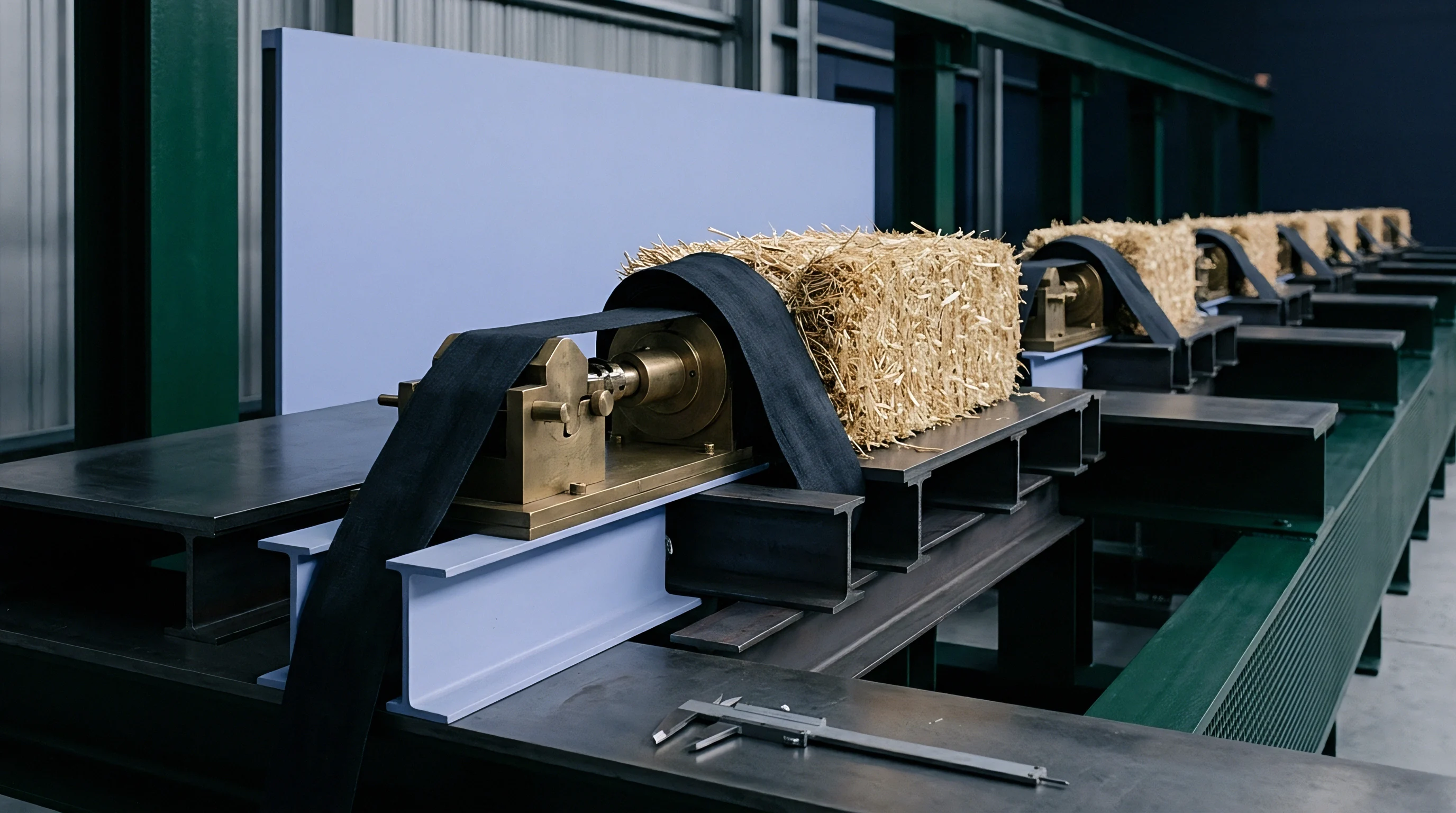
Bale
A standard 200-kilogram lot of scutched flax enters the opening bay with moisture, woody shive, and cortical debris bound to the bast bundles. Commercial settlement rests on gross weighbridge mass, yet the spinning value exists solely in the extractable long line stricks. Testing under ISO 6741 establishes an official commercial moisture regain of 12.0 percent for scutched flax, yet arriving container moisture frequently swings between 9.5 percent in dry winter transfers and 15.5 percent under monsoon port storage.
When moisture exceeds the contractual allowance, water weight masquerades as spinnable bast substance. A five-ton parcel purchased at fifteen percent moisture transfers 175 kilograms of pure water above the legal standard into the warehouse ledger. That water vanishes during conditioning, reducing initial mass before mechanical opening commences.
Fibre quality within the compressed block governs every subsequent stage of line yield. Raw scutched flax arrives graded under regional naming conventions: French dew-retted parcels classify across numbers 3 through 7, Belgian assortments carry Courtrai marks, and Heilongjiang domestic bales arrive under national grading categories. The metric fibre fineness, measured under ISO 2370 via airflow resistance or cut-and-weigh gravimetric methods, dictates the drafting limit of the eventual yarn.
Coarse scutched fibre presenting an airflow value below Nm 180 yields stiff, brittle stricks that shatter over the pinned worker rollers. High-grade long-staple flax delivers an airflow fineness exceeding Nm 320, offering pliable cellular bundles that slip past hackling pins without transverse fracture.
Commercial invoices balance against gross bale weight, while spinnable yield contracts with every point of excess moisture and unretted shive found on the opening floor.
Sampling across ten percent of delivered containers requires coring to extract core stricks from the dense interior. Flax Classers evaluate five primary physical attributes at the bench:
- Bundle length uniformity establishes whether the mechanical scutching turbine maintained the full parallel alignment of the primary stems without creating knotted centres.
- Retting degree measures the enzymatic breakdown of the inter-cellular pectin matrices, determined by sensory tactile drag and calcium pectate dissolution tests.
- Residual shive content quantifies the mass percentage of unseparated woody core particles retained inside the stricks after turbine scutching.
- Tensile bundle tenacity verifies the ultimate breaking force in centinewtons per tex using flat bundle clamps spaced at zero gauge.
Under-retted fibre clings tenaciously to its woody epidermis. The bast bundles remain broad ribbons glued with insoluble calcium polygalacturonate. When such stock hits the hackling combs, the rigid pins fail to divide the ribbons into fine filaments, dragging whole bundle segments down into the tow collectors.
Over-retted flax presents the inverted problem: cellulose-degrading fungi have penetrated the secondary cell walls, lowering single-fibre tenacity below 35 centinewtons per tex. The mechanical combing action snaps these weakened filaments indiscriminately, transforming long line potential into short comb waste. Laboratory testing measures the retting envelope by gravimetric chemical extraction of residual pectins; an optimal parcel holds between 2.8 and 3.6 percent water-soluble pectin substances by dry weight.
| Fibre Origin And Grade | Mean Length (mm) | Airflow Fineness (Nm) | Bundle Tenacity (cN/tex) | Shive Content (%) |
|---|---|---|---|---|
| French Dew-Retted Grade 5 | 820 | 290 | 48.5 | 2.1 |
| Belgian Dew-Retted Grade 6 | 880 | 340 | 53.2 | 1.4 |
| Heilongjiang Dew-Retted Type II | 710 | 220 | 39.0 | 3.8 |
| Egyptian Water-Retted Type A | 790 | 260 | 44.0 | 2.9 |
Gross batch calculations start at the scale. Unstrapping the steel bands releases mechanical pressure, expanding the compressed bale. Dense stratification within the pack forces mill technicians to condition the fibre room at 65 percent relative humidity and 20 degrees Celsius for forty-eight hours.
Dry flax shatters under comb impact. Moist flax wraps around rotating drums. Mill managers who accelerate this resting cycle load brittle, unrelaxed bundles directly onto the feed conveyors, forfeiting up to four percentage points of potential line sliver to the tow exhaust channels.
Unseasonal autumn rains during the field retting window harden the cellular gums, cutting clean yield on the mill floor.


Comb
Mechanical hackling performs the definitive commercial division of the flax plant. The raw strick, weighing roughly one hundred grams, is secured in steel clamps lined with vulcanized rubber. These clamps travel down a double-sided machine bed where matching pairs of pinned aprons cycle continuously.
Hackling operates as a progressive combing operation. Early sheets present coarse, widely spaced steel pins that straighten the tangled ends, strip out remaining shive, and extract tangled short fibres. Later sheets present needle-dense brass fields, rising to twenty pins per centimetre, that split the cylindrical bast bundles longitudinally into fine technical fibres.
Combing splits the incoming mass into three distinct physical categories: dressed line sliver, hackling tow, and unrecoverable fly waste. Dressed line represents the intact, long-staple stricks retained within the clamps throughout the traversal. Hackling tow comprises the short, broken, and lateral fibres pulled away by the pinned bars, collected on oscillating comb plates beneath the machine.
Fly waste consists of powdered shive dust, short cellular debris, and fine fibrils drawn out through the pneumatic exhaust ducting. In commercial ledger accounting, line fibre carries the highest market valuation, hackling tow commands between twenty and thirty-five percent of line value, and dust waste represents total loss of material.
Hackling Mass Balance Equation
The operational balance of the hackling frame resolves across a simple gravimetric relationship. Let total raw scutched flax fed to the line equal Mraw. The outputs distribute according to the expression:
Mraw = Mline + Mtow + Mdust + ΔMmoisture
Here, Mline represents the mass of finished hackled line sliver delivered to the spreader table, Mtow denotes the total weight of coarse and fine hackling tow baled beneath the aprons, Mdust is the particulate matter collected in the central filtration room, and ΔMmoisture quantifies the evaporative or absorptive mass shift occurring during mechanical processing under conditioned room air. Yield percentages are calculated strictly against conditioned input mass:
Yieldline (%) = (Mline / Mraw) × 100
Yieldtow (%) = (Mtow / Mraw) × 100
Industrial performance on modern automated hackling frames yields between 45 and 55 percent line fibre from high-grade Western European scutched flax. Lower-tier domestic scutched straw routinely drops to 32 percent line yield, diverting 60 percent or more of the bale mass into tow collections. This shift distorts the commercial viability of fine-count yarn orders.
The price gap between line sliver and hackled tow dictates that a three percent drop in line yield increases the effective raw material cost of the resulting sliver by over seven percent.
A three percent loss in line yield shifts valuable cellulose into low-value tow bins, inflating the raw material cost base of the combed sliver.
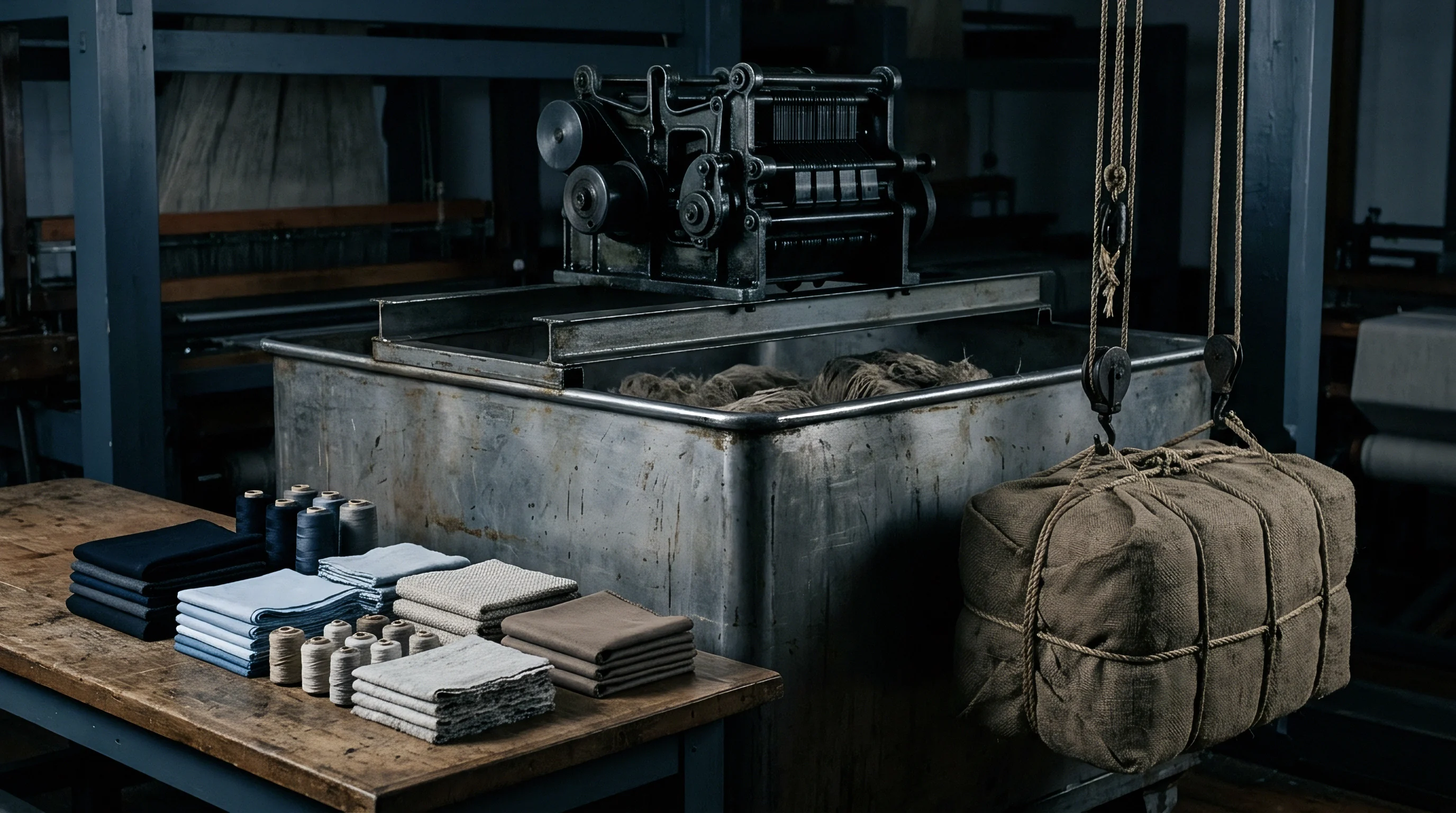
Pin Density Transitions
The progression of pin density down the hackling bed governs the degree of bundle splitting. A standard machine configuration traverses eighteen distinct pin fields across two operational sides. Side A combs the root ends of the suspended stricks; the mechanical clamps then open, shift their gripping location to the hackled root section, and present the uncombed top ends to Side B.
| Combing Field Stage | Pins Per Linear CM | Pin Length (mm) | Cumulative Tow Extracted (%) | Mean Fibre Fineness (Nm) |
|---|---|---|---|---|
| Coarse Breaker (Stages 1 ~ 4) | 0.8 ~ 2.5 | 28 | 42.0 | 110 |
| Intermediate Splitter (Stages 5 ~ 10) | 3.5 ~ 8.0 | 22 | 36.0 | 185 |
| Fine Finisher (Stages 11 ~ 15) | 10.0 ~ 16.0 | 16 | 16.5 | 290 |
| Ultra-Dense Dressing (Stages 16 ~ 18) | 18.0 ~ 22.0 | 12 | 5.5 | 380 |
When the pins strike the hanging flax, mechanical impact forces exceed the transverse cohesive strength of the middle lamella. Pectins and hemicelluloses fracture. The pin speed relative to clamp translation velocity, termed the combing ratio, ranges between 1.8:1 and 2.6:1.
Excessive comb velocity fractures healthy cellulose filaments, accelerating tow creation without increasing the fineness of the surviving line sliver.
How Do Shifted Combing Grids Move Landed Metre Costs?
Modifying the pin progression to increase bundle fineness alters the commercial yield profile. Consider a commercial production run processing a 10,000-kilogram lot of Western European dew-retted scutched flax purchased at 4.20 USD per kilogram. The baseline configuration targets a standard Nm 36 wet-spun yarn.
The aggressive configuration attempts to dress the same raw material to spin an Nm 50 warp yarn by inserting high-density finishing bars in stages 9 through 18.
Under the baseline setup, line yield settles at 52.0 percent (5,200 kg of line sliver), tow yield reaches 41.0 percent (4,100 kg of hackling tow valued at 1.10 USD/kg), and fly waste consumes 7.0 percent (700 kg). Gross fibre expenditure totals 42,000 USD. Crediting the tow value of 4,510 USD against the raw material expense leaves a net line sliver material cost of 37,490 USD.
Dividing this by the 5,200 kg of harvested sliver yields a baseline sliver cost of 7.21 USD per kilogram.
Under the aggressive setup, higher mechanical pin shear forces break a substantial fraction of the stricks. Line yield falls to 41.5 percent (4,150 kg of finer line sliver), while tow yield expands to 50.5 percent (5,050 kg). The tow realization increases slightly to 5,555 USD.
The net material cost for the surviving sliver becomes 36,445 USD. Allocating this across the smaller sliver output of 4,150 kg drives the line sliver cost up to 8.78 USD per kilogram. The raw material cost of the spinnable sliver rises by 21.8 percent.
This sliver cost increase flows directly into the finished greige cloth. Assuming a pure plain-weave linen fabric with a target weight of 160 grams per square metre and a finished width of 145 centimetres, each linear metre contains approximately 232 grams of yarn. Accounting for weaving and spinning waste, one linear metre consumes 0.310 kilograms of hackled line sliver.
Under the baseline combing setup, the sliver component contributes 2.24 USD per linear metre of fabric. Under the aggressive setup, the sliver component contributes 2.72 USD per linear metre. The choice of hackling pins adds 0.48 USD to every single running metre before yarn spinning or weaving labour enters the ledger.
Dressing flax past the natural biological limit of the bast bundle converts expensive line stricks into cheap tow, burdening the remaining sliver with intolerable raw material overhead that ruins downstream weaving margins.
Rove
Line sliver leaving the automated hackling table drops onto the spreading machine. Here, operators overlap the tail of one strick with the head of the next across a continuous chain gill bed. The mechanical gill pins maintain parallel arrangement while draft rollers draw the overlapping stricks into a continuous, cohesive sliver ribbon.
The primary technical objective across the spread board, drawing frames, and roving frame centers on attenuation without breakage. Successive drawing passes blend slivers from multiple hackling runs, suppressing lot-to-lot density variation and drafting irregularities.
Flax drafting relies on interfibre friction regulated by bast gums. Because single flax fibres vary from 20 to 60 millimetres in length while technical line bundles extend to 800 millimetres, the drafting zones must accommodate wide length distributions. Modern gill boxes utilize faller bars carrying hardened steel pins that enter and leave the moving sliver ribbon vertically.
Faller speed controls fibre velocity between the slow back rollers and the rapid front drafting rollers. Draft ratios typically scale from 8 to 14 across three successive drawing passages. Sliver linear density steps down progressively from 25 kilotex at the spreader delivery to roughly 1.8 kilotex at the input to the roving frame.
The roving frame imparts a delicate protective twist to the attenuated sliver ribbon, winding the resulting rove onto wooden or plastic bobbins. Unlike dry cotton roving, flax line roving must withstand chemical pre-treatment before wet spinning. The bobbins are cross-wound with permeable open packages, allowing boiling alkaline liquor to penetrate the tightly wound rove structure during roving boiling.
- Spreader processing transforms disconnected hackled stricks into a continuous 25 kilotex sliver with a doubling factor of sixteen overlapping tails.
- First and second drawing passes double and draft the sliver assemblies across pinned faller beds, eliminating mass variances and evening out short-wave thickness errors.
- Third drawing pass refines the sliver down to 1.8 kilotex while monitoring online drafting force to detect undissolved pectin clumps.
- Roving frame insertion delivers 15 to 30 turns per metre of protective false twist, packaging the material onto perforated roving tubes at controlled winding tension.
- Alkaline roving boiling submerges the rove packages in a hot sodium carbonate bath at 95 degrees Celsius to soften the middle lamella pectins before the package reaches the spinning creel.
The roving boiling stage constitutes the second major mass loss zone between bale and cloth. The mild alkali scouring bath dissolves water-soluble pectins, hemicelluloses, residual waxes, and mineral salts. Weight loss during roving boiling ranges strictly between 8.5 percent and 13.0 percent of dry rove mass.
Insufficient boiling leaves the pectins stiff, causing intense end breakages in the wet-spinning trough as the fibres fail to slip past each other in the drafting zone. Excessive boiling removes too much inter-cellular glue, causing the rove to disintegrate prematurely under the drafting rollers.
| Processing Stage | Typical Doublings | Applied Draft Ratio | Stage Waste Loss (%) | Cumulative Loss From Scutched Flax (%) |
|---|---|---|---|---|
| Spreading And Gilling | 12 ~ 16 | 6.0 ~ 9.0 | 1.8 | 49.0 |
| First Drawing Head | 8 ~ 12 | 8.0 ~ 11.0 | 0.9 | 49.5 |
| Second Drawing Head | 6 ~ 8 | 9.0 ~ 12.0 | 0.6 | 49.8 |
| Roving Frame | 1 | 7.0 ~ 10.0 | 1.5 | 50.6 |
| Roving Caustic Scour | 1 | 1.0 | 11.2 | 56.1 |
Wet spinning takes place on ring frames equipped with heated water troughs maintained between 55 and 70 degrees Celsius. The boiled rove bobbin unwinds into the hot water, re-hydrating and softening the residual pectin matrix immediately before drafting. The front and back drafting rollers sit submerged or positioned directly above the water exit.
With the pectins thoroughly softened, the drafting rollers separate the technical bundles into elementary fibres, drawing them down to the target yarn count. As the drafted strand exits the front roller nip, the rotating ring traveller inserts high mechanical twist, binding the parallel elementary fibres into a smooth, lustrous, high-tenacity yarn structure.
Spinning line efficiency hinges directly on draft consistency. Fibre breakage in the trough, known as drafting slip, deposits sludge in the bath and creates thin points in the yarn strand. The wet yarn winds onto spinning bobbins with moisture content reaching 120 percent of dry weight, demanding careful low-temperature hot-air drying to prevent thermal degradation of the moist cellulose before winding and clearing.
Standard master purchase agreements stipulate that wet-spun line yarns maintain an unevenness CVm value below 14.5 percent under standard capacitive testing methods, shifting liability for drafting defects back to the roving preparation floor.
Greige
Winding and electronic yarn clearing transfer the wet-spun yarn from small spinning bobbins onto cone packages. Clearers set with optical sensors detect thick places, thin places, and foreign fibres, slicing out defective segments and splicing the ends with pneumatic hot-water splicers. Every knot or mechanical splice represents a potential failure point during warp preparation.
High-speed rapier or air-jet looms subject linen warp yarns to violent cyclic tension spikes, demanding robust yarn sizing and uniform structural elasticity.
Warp preparation consumes material across winding, warping, and sizing. Sectional warping frames draw hundreds of ends from the creel onto the warp beam. Breakages during beaming introduce loose ends and tension variances that trigger loom stops.
In standard linen mill operations, yarn-to-warp conversion waste accounts for 1.5 to 2.5 percent of total yarn mass. Sizing applies potato or modified maize starch to the warp sheet, coating the hairy exterior of the wet-spun linen yarn to resist reed friction. Sizing adds between 4.0 and 7.0 percent dry weight to the warp, but this mass is non-permanent and washes away completely during wet finishing.
Loom construction parameters dictate the exact mass consumption per linear metre of raw greige fabric. Crimp, the waviness imparted to warp and weft yarns as they interlace over and under each other, consumes additional yarn length beyond the finished linear dimensions of the cut cloth.
Yarn Mass Calculation per Metre
To establish the exact weight of yarn required to weave one linear metre of greige cloth on the loom, the warp and weft components are isolated using structural parameters:
Mwarp (g/m) = (Endstotal × 1000) / (Nmwarp × (1 – Cwarp))
Mweft (g/m) = (Picks/cm × Widthreed (cm) × 100) / (Nmweft × (1 – Cweft))
Here, Endstotal represents the total number of warp threads across the full reed width including selvedges, Nmwarp and Nmweft designate the metric yarn counts, Cwarp and Cweft express the fractional yarn crimp percentages, Picks/cm defines the weft density on the loom, and Widthreed denotes the operational drawing width inside the loom reed.
Consider a concrete worked example: a plain-weave upholstery linen woven on a 160-centimetre reed space. The structural construction targets 20 warp ends per centimetre and 18 weft picks per centimetre. Both warp and weft utilize an identical Nm 26 wet-spun line yarn.
Total warp ends across the reed equal 3,200. Measured warp crimp Cwarp resolves at 0.08 (8.0 percent), and weft crimp Cweft settles at 0.05 (5.0 percent). Applying the structural equations:
Mwarp = (3200 × 1000) / (26 × 0.92) = 3,200,000 / 23.92 = 133.78 g/m
Mweft = (18 × 160 × 100) / (26 × 0.95) = 288,000 / 24.70 = 116.60 g/m
Summing both components yields a theoretical greige loom mass of 250.38 grams of pure yarn per linear metre of woven cloth. Weaving operations inevitably generate waste: selvedge fringe trimmings on rapier looms, leftover yarn remnants on exhausted cone bases, and warp tie-in losses. Accounting for a standard industrial weaving waste factor of 3.5 percent on the warp and 2.5 percent on the weft, the gross yarn required to weave that single metre increases to 258.07 grams.
| Processing Stage | Stage Input Mass (kg) | Stage Output Mass (kg) | Output Physical Form | Cumulative Loss (%) |
|---|---|---|---|---|
| Bale Opening And Hackling | 1,000.0 | 510.0 | Hackled Line Sliver | 49.0 |
| Drawing And Roving | 510.0 | 492.0 | Raw Line Roving | 50.8 |
| Roving Boiling Scour | 492.0 | 438.0 | Boiled Line Roving | 56.2 |
| Wet Ring Spinning | 438.0 | 416.0 | Wet-Spun Cops | 58.4 |
| Winding, Clearing, Splicing | 416.0 | 403.5 | Cleared Yarn Cones | 59.6 |
| Warping, Sizing, Weaving | 403.5 | 391.4 | Greige Woven Cloth | 60.9 |
The cumulative mass yield demonstrates that 1,000 kilograms of raw scutched flax delivered to the mill produces precisely 391.4 kilograms of unsized greige linen cloth. Across the entire conversion sequence, 60.86 percent of the original bale mass disappears into tow collections, boiling effluent, yarn clearings, and loom selvedge scrap. Dividing the greige cloth yield by the linear weight requirement of 0.258 kilograms per metre demonstrates that a one-ton scutched bale delivers roughly 1,517 linear metres of off-loom greige cloth.
How much unseen tension variation across individual cone packages survives sizing to emerge as warp stripe defects in the off-loom greige?

Bolt
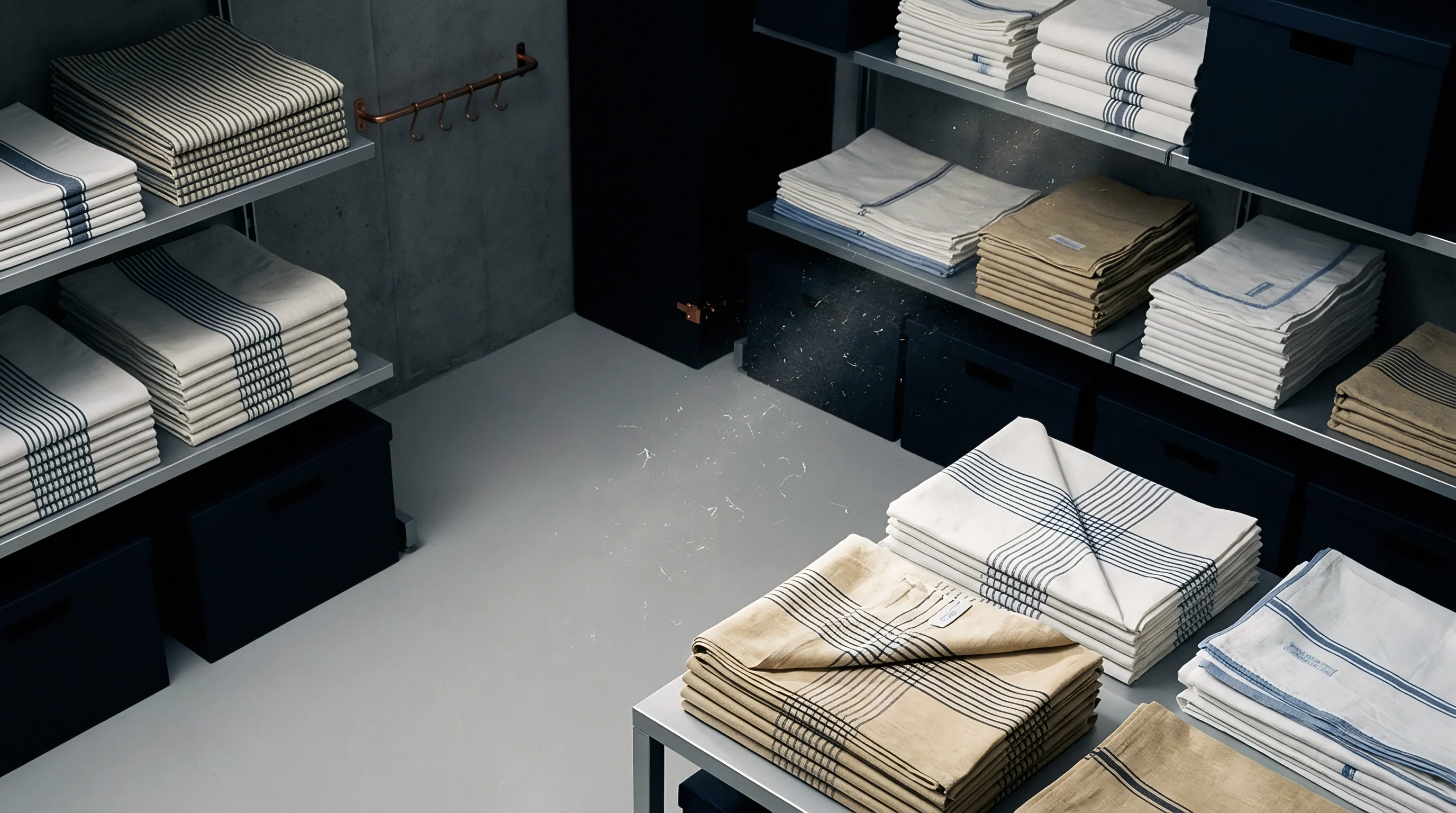
Greige cloth departing the weave room contains size starches, natural plant waxes, retting residues, and weaving dirt. Finishing transforms the harsh, brown greige roll into a stabilized, soft, bleached or dyed bolt of commercial fabric. Every finishing step extracts mass and shrinks linear dimensions.
A failure to calculate finishing area shrinkage alongside dry mass extraction results in inaccurate yarn estimates, leaving fabric mills short on contracted finished metres.
Desizing and scouring remove applied starches and remaining natural pectins. A continuous open-width scouring range uses hot sodium hydroxide (30 g/L at 95 degrees Celsius) combined with non-ionic wetting agents to saponify fats and break down lignified shive flecks. Hydrogen peroxide bleaching oxidizes the natural grey-brown pigments of the bast fibre, whitening the fabric.
Weight loss during full chemical desizing, scouring, and bleaching averages between 6.0 and 10.5 percent of raw greige mass.
Dimensional relaxation and shrinkage act inversely on fabric mass per square metre. While chemical scouring removes mass, warp and weft shrinkage compacts the structure, packing more yarn ends and picks into every square centimetre. Linen exhibits substantial wet relaxation shrinkage.
Unrestrained wet processing induces warp shrinkage between 6.0 and 10.0 percent, and weft width contraction between 4.0 and 7.0 percent. Sanforizing or controlled compressive shrinking stenter ranges stabilize the piece against subsequent domestic laundering, locking the finished width to the target specification.
Chemical scouring strips away residual waxes and sizes while compressive shrinkage increases finished fabric density per square metre.

The Landed Metre Cost Derivation
To price finished linen cloth with precision, the technologist connects the entire sequence from raw bale price to finished bolt length. The model below outlines the calculation for one linear metre of finished linen fabric.
- Target Fabric Specification ~ Plain weave, 140 cm finished width, 185 g/m² finished weight, plain bleached white.
- Raw Fibre Basis ~ Western European dew-retted flax purchased at 4.50 USD/kg landed at mill dock.
- Combing Performance ~ Line yield settles at 50.0 percent; hackled tow yield is 42.0 percent (tow credit realization of 1.15 USD/kg).
- Preparation and Boiling ~ Line sliver to boiled rove yield is 86.0 percent.
- Spinning and Winding ~ Boiled rove to cleared Nm 30 yarn yield is 92.0 percent.
- Weaving Conversion ~ Warp and weft yarn to off-loom greige yield is 96.5 percent.
- Finishing Conversion ~ Chemical mass loss is 8.0 percent; linear warp shrinkage is 7.5 percent; width shrinkage is 6.0 percent.
The calculation traces backward from the finished bolt to find the required bale mass:
1. One linear metre of finished fabric at 1.40 m width and 185 g/m² contains 259.0 grams of finished material (0.259 kg).
2. Due to 8.0 percent chemical finishing loss, this finished metre demands 0.259 / (1 – 0.08) = 0.2815 kg of unsized greige yarn mass.
3. Due to 7.5 percent warp linear shrinkage during finishing, one finished metre requires 1 / (1 – 0.075) = 1.081 linear metres of greige fabric. Therefore, total greige yarn required per finished metre equals 0.3043 kg of greige yarn.
4. Factoring in weaving waste (3.5 percent), gross cleared yarn needed equals 0.3153 kg of Nm 30 yarn.
5. Factoring in spinning and winding losses (8.0 percent total), boiled rove required equals 0.3153 / 0.92 = 0.3427 kg.
6. Factoring in roving boiling loss and drawing waste (14.0 percent total), hackled line sliver required equals 0.3427 / 0.86 = 0.3985 kg.
7. Factoring in the 50.0 percent hackling line yield, gross scutched flax bale mass required per finished metre equals 0.3985 / 0.50 = 0.7970 kg of raw flax.
The cumulative financial buildup per linear metre across every operational transformation stage breaks down as follows:
| Processing Level | Input Fibre Mass (kg) | Transformation Cost ($/kg) | Byproduct Credit ($) | Net Stage Cost ($) | Cumulative Cost ($/m) |
|---|---|---|---|---|---|
| Raw Scutched Flax Input | 0.7970 | 4.50 (Material Price) | 0.000 | 3.587 | 3.587 |
| Hackling And Combing | 0.7970 | 0.45 (Machine Opex) | -0.385 (Tow Credit) | -0.026 | 3.561 |
| Drawing And Roving Preparation | 0.3985 | 0.85 (Drawing Opex) | 0.000 | 0.339 | 3.900 |
| Roving Boiling And Scour | 0.3427 | 0.60 (Chemical Opex) | 0.000 | 0.206 | 4.106 |
| Wet Ring Spinning (Nm 30) | 0.3427 | 2.10 (Spinning Opex) | 0.000 | 0.720 | 4.826 |
| Winding, Clearing, Beaming | 0.3153 | 0.55 (Winding Opex) | 0.000 | 0.173 | 4.999 |
| Weaving Preparation And Looms | 0.3043 | 2.40 (Weaving Opex) | 0.000 | 0.730 | 5.729 |
| Wet Finishing And Sanforizing | 0.2815 | 1.60 (Finishing Opex) | 0.000 | 0.450 | 6.179 |
| Quality Inspection And Rolling | 0.2590 | 0.30 (Packaging Opex) | 0.000 | 0.078 | 6.257 |
The net landed industrial manufacturing cost of the finished fabric settles at exactly 6.26 USD per linear metre. The raw flax material purchase accounts for 57.3 percent of the final manufacturing cost, proving that yield losses at the hackling comb drive fabric cost far more aggressively than loom speeds or finishing chemistry selections. A mill that miscalculates its line yield by five percent or underestimates finishing shrinkage by three percent erodes its entire operational margin on the weaving floor.
Grade the raw fibre accurately at the opening bay, calibrate comb pin density to preserve long line integrity, and yarn counts hold true through every finished bolt.