Dew-Retted Heilongjiang Line Fiber Processing Parameters for Ring Frames
Optimize wet ring frame trough temperatures to 72°C and hold draft ratios below 17 for Heilongjiang dew-retted line flax to limit end breaks.
Stem
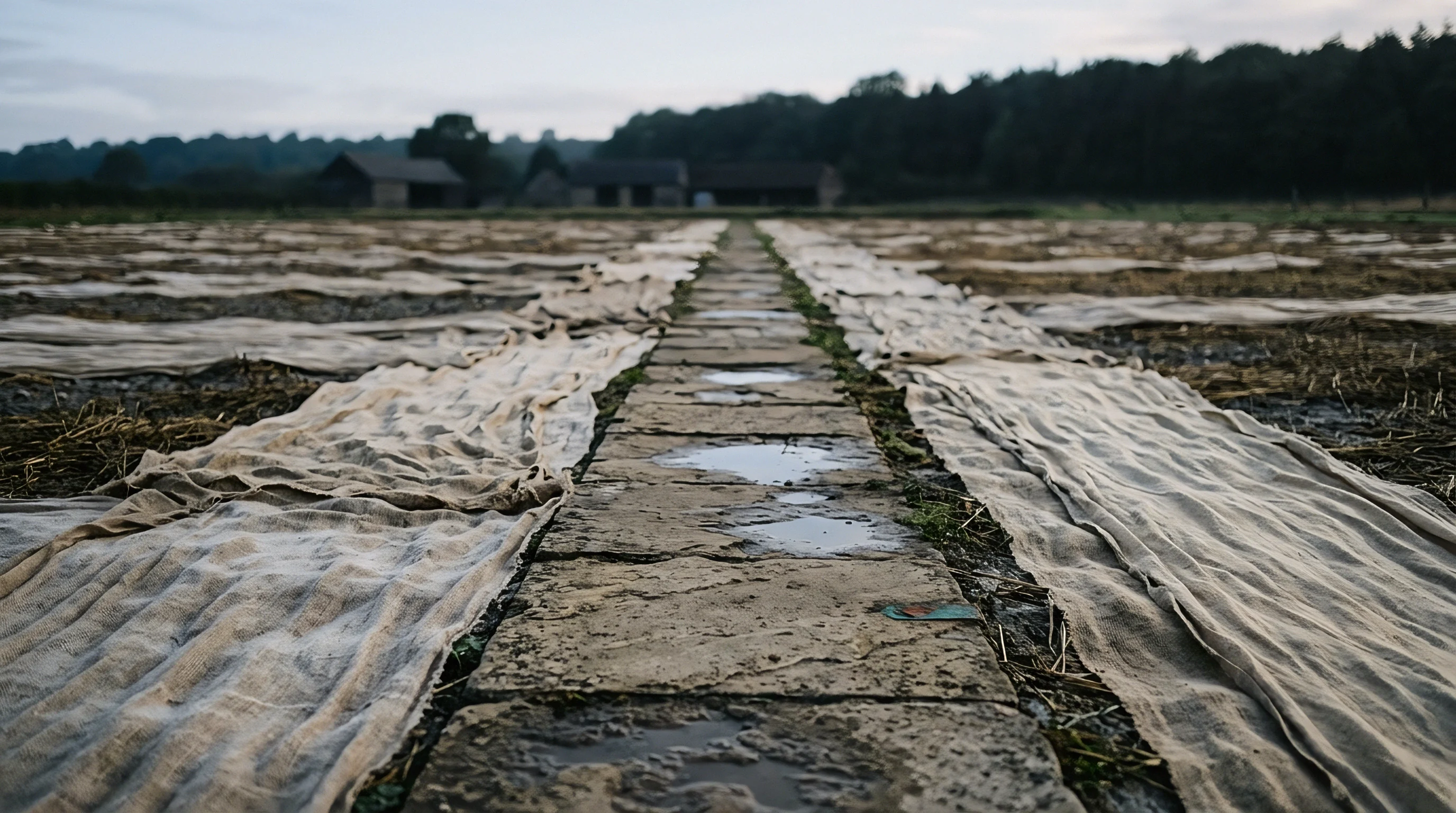
Heilongjiang dew-retted line flax presents specific mechanical attributes defined by the regional climate of northeastern China. Late summer atmospheric moisture, combined with soil temperature shifts during field retting in Harbin and Suihua farming sectors, generates a fiber bundle bound by partially decomposed pectins. The resulting scutched line exhibits a characteristic light grey to silver-brown hue, carrying a moisture regain standard between 12 percent and 14 percent under standard laboratory testing.
Industrial ring spinning operations demand exact bundle strength metrics from this raw material to maintain drafting stability on high-speed frames.
Fineness measurement performed via air-permeability apparatus according to ISO 2370 yields a metric fiber number ranging between 260 Nm and 320 Nm for standard Grade I and Grade II Heilongjiang scutched line. Higher bundle cohesive forces emerge from incomplete pectolytic degradation compared to West European water-retted or dew-retted origins. This structural tenacity demands targeted hackling pin density sequences to avoid fiber damage during initial division.
Bundle breaking tenacity determined by flat bundle test methods under standard atmospheric conditions of 20 degrees Celsius and 65 percent relative humidity demonstrates strength profiles between 28 and 34 centinewtons per tex. The coefficient of variation for length distribution across raw scutched stricks frequently exceeds 22 percent, necessitating systematic sorting and grading protocols prior to the hackling passage.
Dew-retted Heilongjiang scutched line exhibits an average bundle tenacity of 31 centinewtons per tex with an air-permeability fineness reading of 280 Nm under standard testing conditions.
Cellulose integrity remains tied to the retting duration on the soil surface. Retting progress monitored via chemical extraction reveals residual pectin content averaging 4.2 percent to 5.8 percent by weight. Higher pectin content increases fiber rigidity, shifting the drafting force profile during wet roving preparation.
Mill reception checks verify bundle length distributions using comb sorting apparatus, ensuring mean long-staple fraction stays above 650 millimetres prior to hackling system entry.
Fiber Metric Variations by Growing Region
Soil composition across the Songnen Plain introduces distinct mineral loads into the bast tissue. High potassium levels in local soils yield thicker cortical cell walls, altering the flexural rigidity of the technical fibers. Spinners adjust initial breaker card settings when tow fractions from hackling yield exceed expected baseline levels.
Moisture distribution within delivered bales requires systematic 24-hour conditioning in humidity-controlled stores held at 70 percent relative humidity. Direct processing of dry bales leads to severe strick breakdown on the hackling pins, generating excess tow and reducing line yield below acceptable economic thresholds.
Hackling
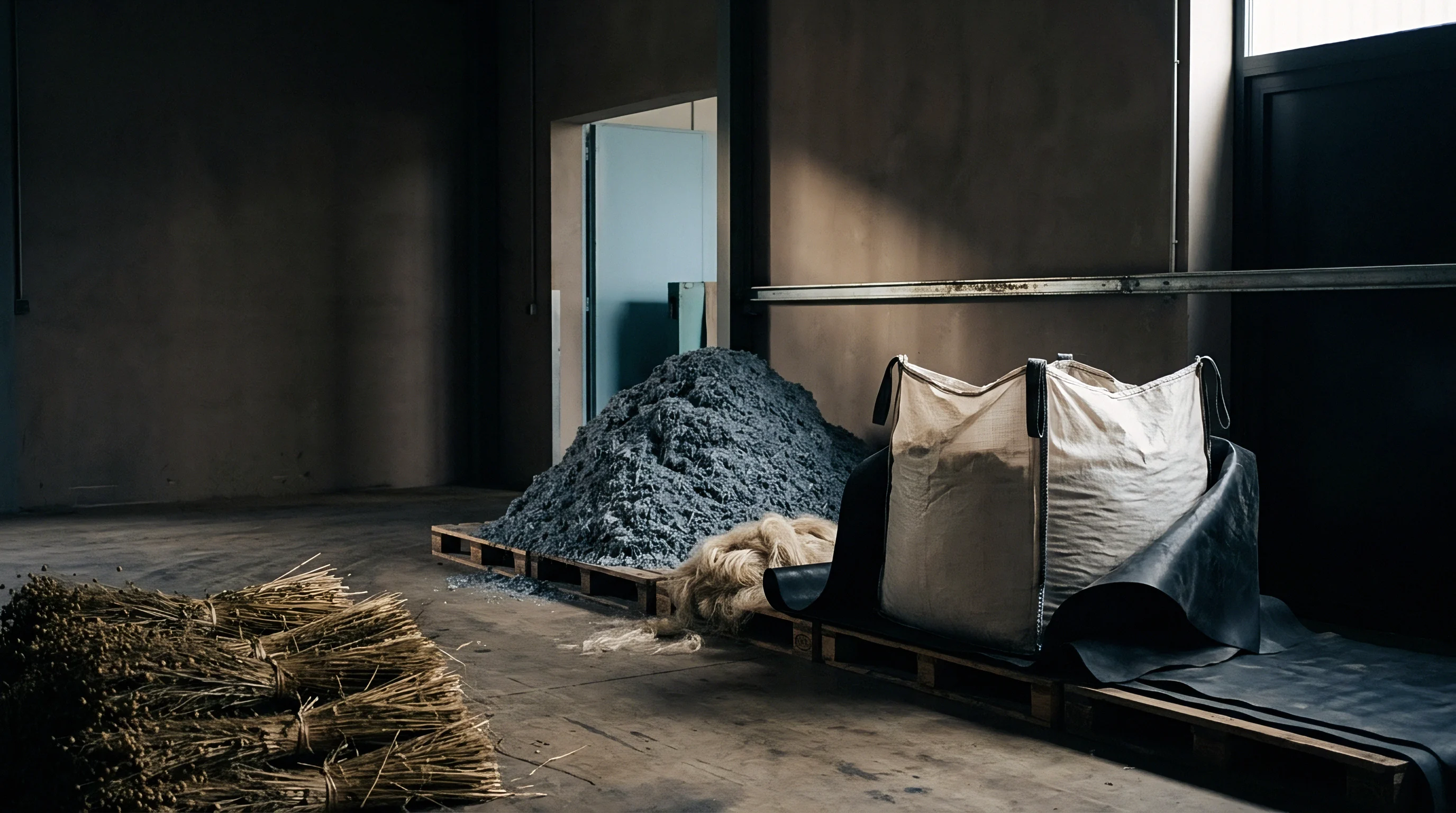
Hackling operations transform raw scutched stricks into continuous, parallelized line slivers while removing short fibers and residual shive. On modern automatic hackling lines, Heilongjiang dew-retted flax requires a progressive pin density gradient across 12 to 16 tool pairs. Standard pin density begins at 1.2 pins per centimetre on the initial combing heads, advancing systematically to 14 pins per centimetre at the finishing stations.
Pin insertion geometry directly impacts line yield and total fiber fragmentation. Maintaining a pin penetration angle of 82 degrees relative to the strick path preserves bundle continuity while stripping unretted bark fragments. Excessive pin density in early heads fractures high-tenacity, low-elongation bundles, shifting overall yield toward low-value hackling tow.
| Hackling Station | Pin Density (pins/cm) | Pin Diameter (mm) | Sliver Yield Target (%) | Mean Fiber Length (mm) |
|---|---|---|---|---|
| Station 1-3 (Combing) | 1.2 to 2.5 | 1.80 | 92.5 | 720 |
| Station 4-7 (Coarse) | 3.0 to 5.5 | 1.20 | 84.0 | 680 |
| Station 8-11 (Medium) | 6.0 to 9.5 | 0.80 | 71.5 | 610 |
| Station 12-16 (Fine) | 10.0 to 14.0 | 0.50 | 62.0 | 540 |
| Data recorded at 65 percent relative humidity, processing Grade II Heilongjiang dew-retted line stock. | ||||
Linear density of the resulting hackled line sliver is regulated between 15 tex and 22 tex equivalent weight per unit length. Yield calculations track total line output against incoming raw scutched weight, establishing the commercial viability of the lot. Processing Heilongjiang line stock through optimized pin profiles maintains long-staple line yield between 58 percent and 64 percent of raw fiber mass.
Gills and drawing frames process the hackled bundles into uniform slivers through multiple passages. Intersecting gill boxes utilize fallers pinned at 6 to 8 pins per centimetre on the first passage, increasing to 12 pins per centimetre on the third passage. Draft ratios across drawing stages are constrained between 6.0 and 8.5 to prevent draft waves caused by irregular inter-fiber friction.
Sliver Formation and Doubling Ratios
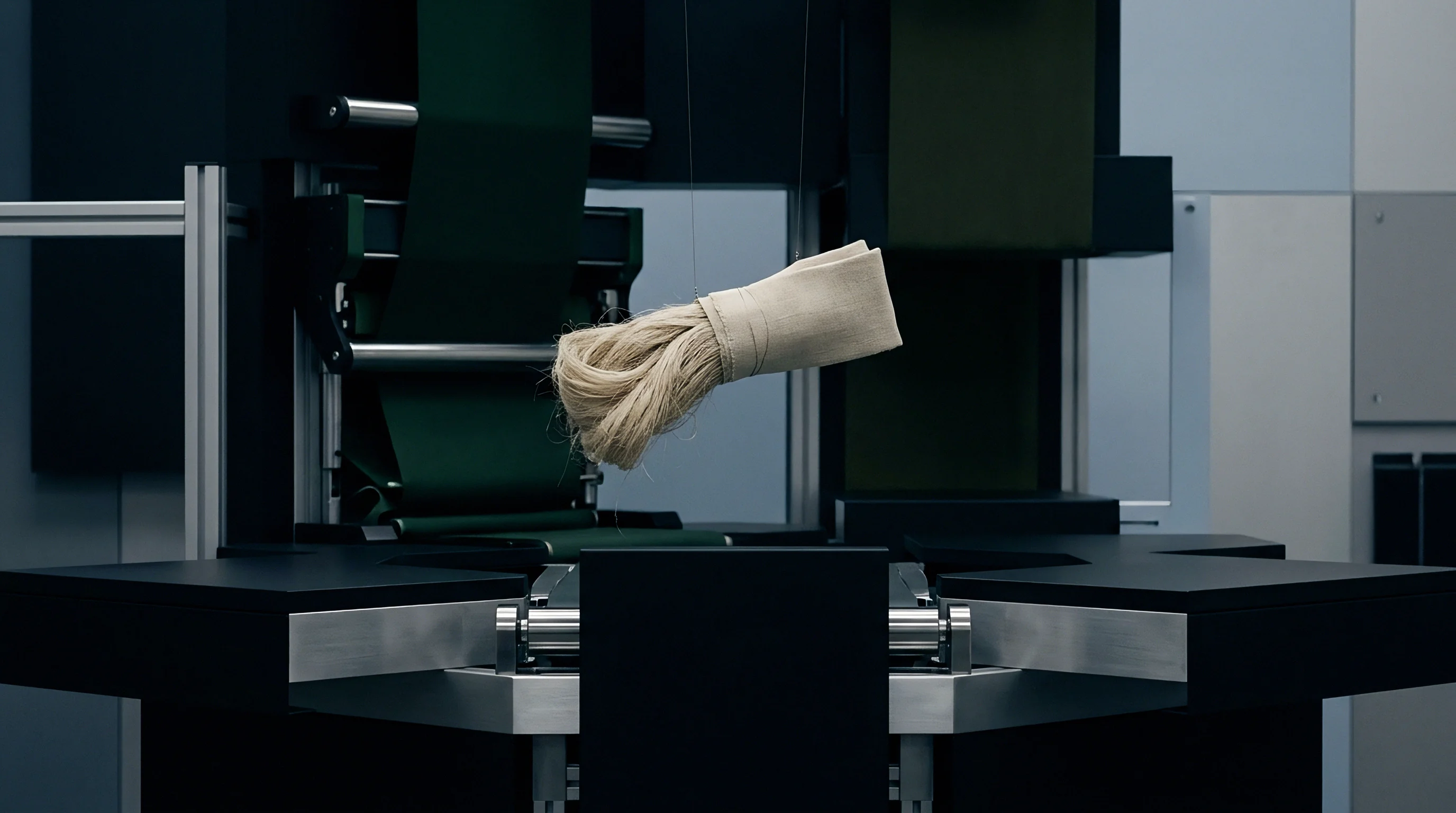
Doubling numbers on drawing frames compensate for regional fiber irregularity. A standard three-passage drawing system employs a 6x6x4 doubling scheme, achieving a total doubling factor of 144. This combination suppresses periodic sliver mass variations induced by natural retting fluctuations across field lots.
Linear density variation across delivered slivers is verified via Uster testing methods designed for bast fibers. A target mass coefficient of variation below 4.5 percent on 1-metre cut lengths guarantees smooth roving formation on flyer frames.
Contractual rejection thresholds trigger when hackled line yield drops below 55 percent on standard Grade II Heilongjiang delivery batches.
Over-hackling generates excessive fiber dust and splits technical bundles into fragile ultimate fibers below 20 millimetres in length. Controlling hackling speed to 18 cycles per minute balances output capacity with gentle fiber treatment.
Cohesion
Roving production converts drawn sliver into a consolidated, slightly twisted strand suitable for wet ring spinning. Flyer frames insert a light protective twist ranging from 15 to 25 turns per metre, calculated via twist factor formulas adapted for long-staple bast fibers. The insertion of mechanical twist counteracts inter-fiber slip during subsequent immersion in the wet-spinning trough.
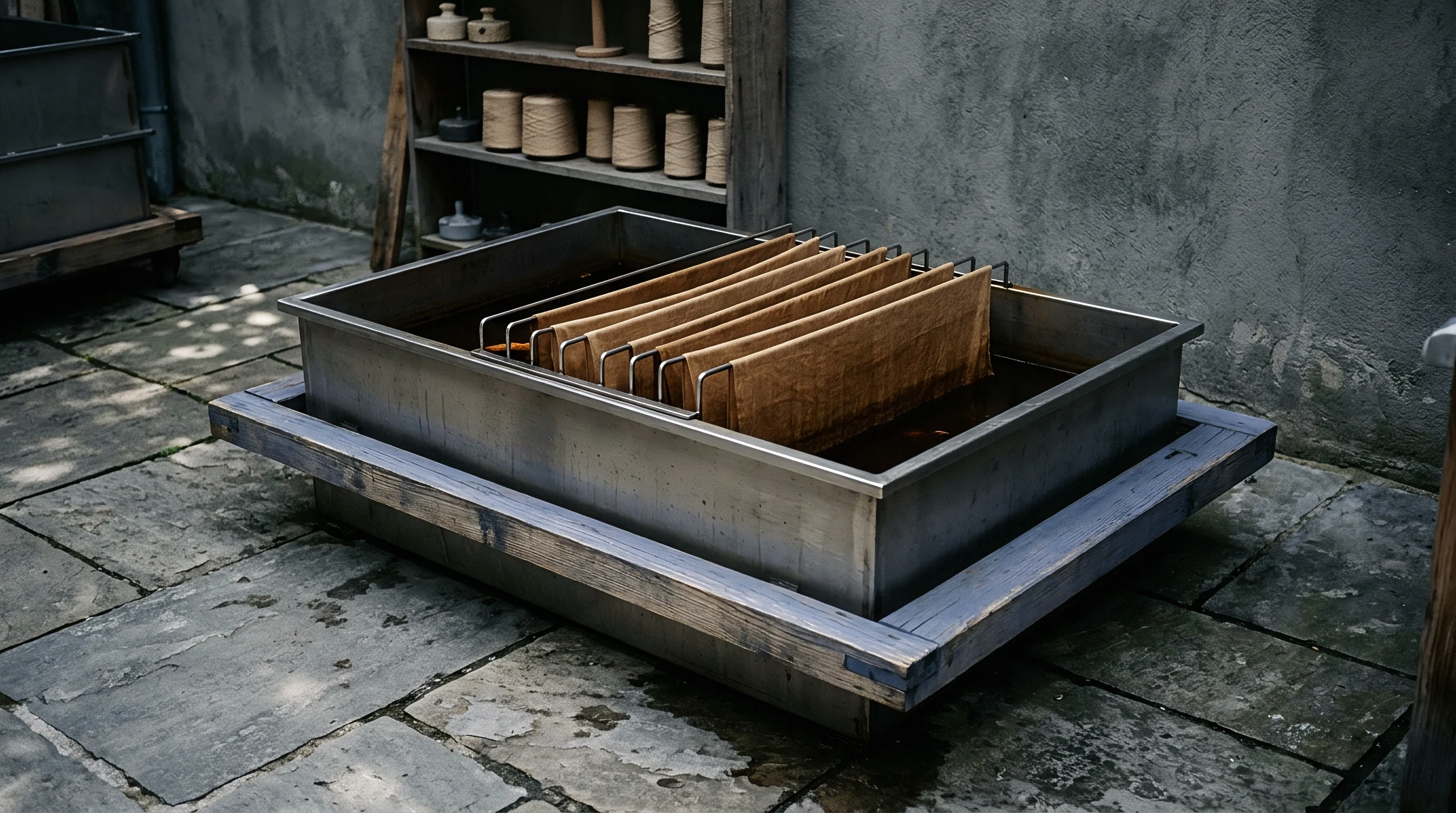
Boiling processes applied to roving bobbins alter the inter-fiber cohesive binder. Thermal chemical treatment in light soda ash solutions removes residual surface pectins and natural waxes, softening the fiber bundles. Roving bobbins undergo pressurized treatment at 95 degrees Celsius for 45 to 60 minutes, shifting fiber friction coefficients from static dominance to uniform dynamic sliding during frame drafting.
- Roving Density Control regulates package package hardness on flyer bobbins to achieve 0.42 grams per cubic centimetre density, preventing inner layer collapse during fluid circulation in the boiling kiers.
- Chemical Bath Composition establishes a solution containing 3.5 grams per litre sodium carbonate and 1.0 gram per litre non-ionic wetting agent, stabilizing bath pH at 10.2 to strip excess surface waxes without degrading core bundle strength.
- Thermal Profile Ramping applies a continuous 2 degrees Celsius per minute temperature increase to eliminate thermal shock, avoiding localized fiber contraction that generates uneven roving density across the bobbin core.
- Rinsing and Neutralization introduces dilute acetic acid baths at 0.5 grams per litre to achieve a final fiber pH between 6.5 and 7.0, preventing chemical residue buildup on ring frame drafting rollers.
Unboiled roving options require higher mechanical draft pressures and elevated trough water temperatures on the ring frame. Slippage characteristics of unboiled Heilongjiang line stock demand strict control over the nip-to-nip distance in the drafting field to avoid uncontrolled drafting surges.
Roving Twist Factor Calculations
Determining optimum roving twist relies on the alpha twist factor relationship where turns per metre equals alpha multiplied by the square root of metric count. For Heilongjiang line stock intended for wet spinning to Nm 36 yarn, alpha values are held between 18 and 22. Lower alpha values lead to roving breakage during trough passage, while higher values restrict draft action between the front and back roller pairs.
Roving packages are transferred directly to ring frame creels within 12 hours of chemical treatment and gentle drying. Prolonged storage of wet-boiled bobbins causes non-uniform moisture migration, producing periodic thick and thin places in the final spun yarn.
Optimized roving boiling reduces dynamic inter-fiber friction by 35 percent, allowing uniform attenuation on high-draft ring frames.
Moisture content of roving reaching the ring frame creel must measure exactly 25 percent to 30 percent if wet-wound, or achieve equilibrium at 12 percent regain if fully dried prior to creeling. Deviations introduce unpredictable tension spikes during unwinding.

Drafting
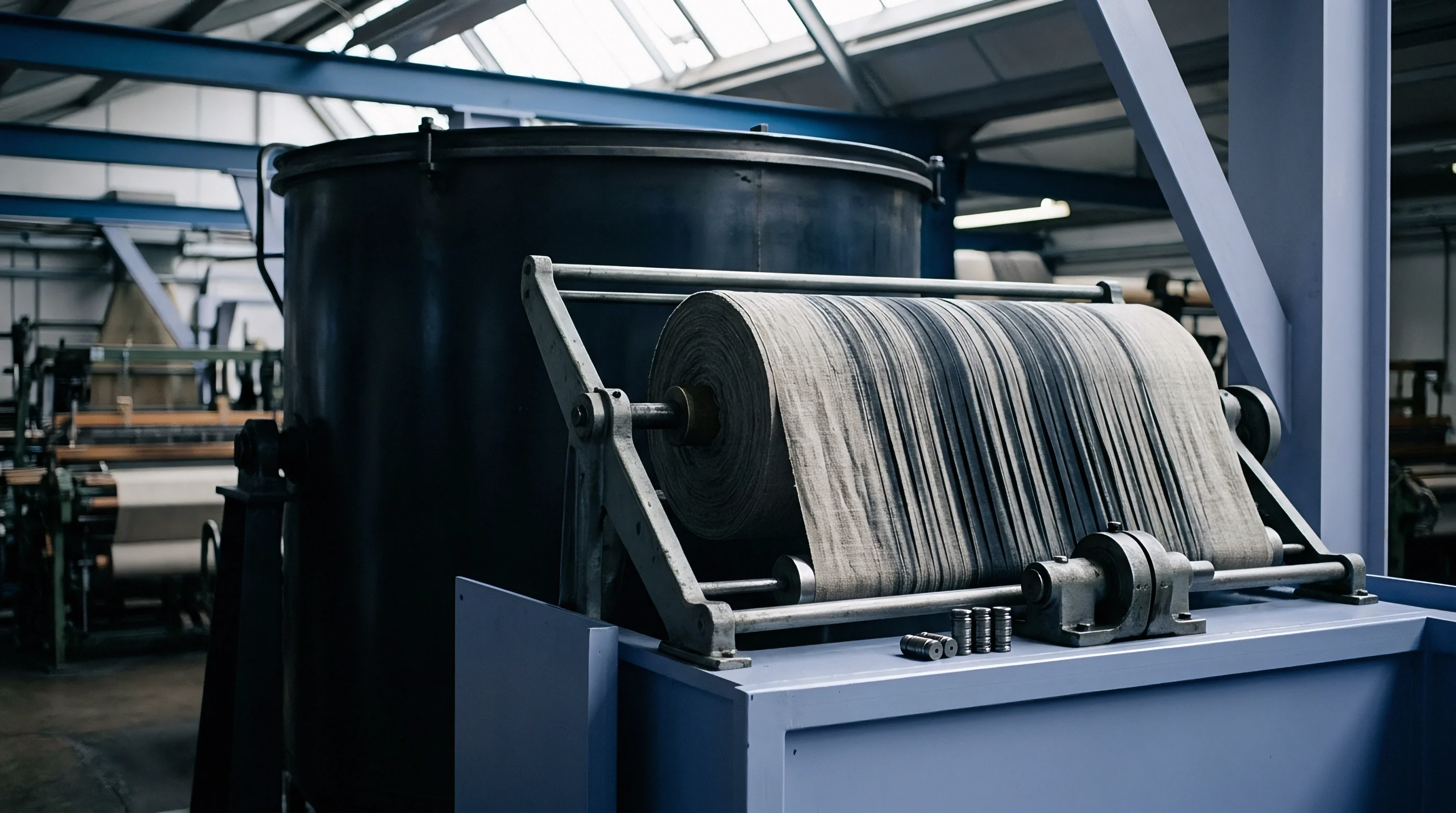
Wet ring frames for line flax process roving through hot water troughs positioned directly above the drafting zone. The water bath softens residual intercellular pectins, allowing ultimate fibers within the technical bundles to slide past one another under applied drafting force. Trough water temperature for Heilongjiang dew-retted line must be maintained between 68 degrees Celsius and 74 degrees Celsius.
Temperatures below 65 degrees Celsius fail to plasticize the pectin matrix, resulting in high drafting force, fiber breakage, and severe yarn hairiness. Temperatures exceeding 80 degrees Celsius dissolve excess structural pectin, weakening the fiber strand and causing high end-breakage rates at the thread guide.
| Target Yarn Count (Nm) | Draft Ratio | Trough Temp (°C) | Spindle Speed (RPM) | Twist Multiplier (alpha) | Breakage Rate (/1000 sp-hr) |
|---|---|---|---|---|---|
| Nm 24 | 12.5 | 68 | 6200 | 115 | 18 |
| Nm 36 | 16.8 | 72 | 5800 | 125 | 24 |
| Nm 48 | 21.2 | 74 | 5400 | 135 | 32 |
| Nm 60 | 26.5 | 76 | 4900 | 145 | 45 |
Drafting zones on flax ring frames employ a double-roller arrangement with synthetic rubber top rollers resting against fluted steel bottom rollers. Top roller hardness for processing dew-retted line stock is specified at 85 to 90 Shore A durometer. Softer rubber compounds suffer rapid grooving from high roller clamping loads, which range from 250 to 350 Newtons per weighting point.
Reach settings, defined as the distance between the nip of the back rollers and the nip of the front rollers, must match the effective staple length of the softened fiber strand. For Heilongjiang line roving, reach distances are fixed between 68 millimetres and 78 millimetres. Setting the reach too narrow breaks individual ultimate fibers, while an excessively wide reach causes uncontrolled floating fibers and draft waves.
Roller Pressure and Surface Speed Control
Front roller surface speeds directly govern frame production rates. On modern wet ring frames spinning Nm 36 line yarn, front roller delivery speeds run between 18 and 24 metres per minute. Maintaining precision in roller speed synchronization prevents tension transients that degrade yarn mass evenness.
Grooved bottom rollers require weekly cleaning to remove accumulated flax wax and pectin deposits. Contaminated flutes cause micro-slippage during drafting, raising yarn mass Uster CV values above acceptable commercial tolerances.
How does trough water pH impact yarn tensile strength during high-speed drafting?
Water chemistry inside the wet-spinning trough directly modulates pectin hydrolysis rates. Maintaining trough water pH between 6.0 and 6.8 prevents premature binder stripping. Acidic conditions below pH 5.5 cause rapid machine corrosion, while alkaline conditions above pH 7.8 soften the fiber structure excessively, lowering yarn tenacity by up to 15 percent.
Trough
Immersion time within the wet-spinning trough dictates the depth of fiber bundle softening. Standard trough length ranges from 1.2 to 1.8 metres, yielding a fiber exposure duration between 3.0 and 5.0 seconds at typical delivery speeds. Continuous water circulation systems replenish trough volume twice per hour to prevent the concentration of dissolved organic extractives.
Dissolved solids accumulating in stagnant trough water deposit onto machine guides and traveler rings, drastically increasing thread line friction. Auto-dosing filtration units maintain total dissolved solids below 400 parts per million, preserving consistent fluid viscosity across long spinning shifts.
- Water Hardness Range maintains calcium carbonate concentrations between 40 and 70 parts per million, preventing mineral scale buildup on heating elements and yarn delivery guides.
- Surfactant Addition Protocols meter non-ionic wetting agents at 0.2 grams per litre into incoming bath liquor, lowering surface tension to accelerate fluid penetration into dry-cored roving strands.
- Overflow Rate Control enforces a continuous 5 percent fresh water bleed rate based on total tank volume, purging suspended pectin particulate before redeposition occurs on drafting aprons.
- Temperature Zone Isolation divides long troughs into dual heating zones, holding the entry zone at 65 degrees Celsius and the exit zone at 74 degrees Celsius to establish a smooth thermal gradient.
Yarn consolidation occurs immediately as the attenuated strand leaves the front roller nip. Real-time monitoring of strand tension between the front roller and the thread guide prevents excessive ballooning on the ring frame, minimizing mechanical stress on weakened wet fibers.
Yarn Twist Insertion and Ring-Traveler Dynamics
Twist insertion converts the flat, drafted wet ribbon into a cohesive cylindrical yarn. Wet flax spinning requires specialized traveler profiles designed to clear excess water dragged along by the yarn strand. Stainless steel or nickel-plated travelers with high-clearance bows prevent slurry accumulation that leads to traveler flutter and yarn breakage.
Traveler mass selection scales directly with target yarn count and spindle speed. Spinning Nm 36 yarn at 5800 RPM utilizes ISO shape 120 through 140 travelers. Light travelers cause excessive balloon width and bobbin soft-winding, while heavy travelers induce tension breaks at the front roller nip.
Ring diameter choice balances package weight with traveler speed limitations. Standard ring diameters for wet line spinning range from 45 to 55 millimetres. Traveler linear speeds must not exceed 22 metres per second to prevent thermal degradation of traveler lubricants and premature ring wear.
Calculations for metric twist employ high alpha factors due to the low natural elasticity of flax fibers. Metric twist turns per metre equal alpha metric multiplied by the square root of the metric count. Wet line yarns require alpha metric values between 110 and 145 depending on end-use strength requirements.
Traveler clearance checks conducted every 24 operating hours prevent water slurry buildup and reduce ballooning tension spikes.
Balloon control rings are positioned midpoint between the thread guide and the spinning ring on frame lifts exceeding 200 millimetres. The control ring restricts outer balloon diameter, stabilizing yarn tension profiles during bobbin buildup.
Spindle
Spindle allocation and speed profiling control the mechanical efficiency of wet ring spinning rooms. Heilongjiang dew-retted line yarn exhibits specific end-breakage curves across the bobbin build cycle. Speed profiling systems reduce spindle speeds by 8 percent during doff start-up and package completion to manage peak tension loads on high-stress zones.
End breakage rates on wet ring frames processing Grade II Heilongjiang line stock should not exceed 30 breaks per 1000 spindle-hours at standard commercial speeds. Higher breakage rates signal incorrect trough temperature, degraded top roller covers, or unbalanced traveler weights. Systematic audit procedures trace persistent breaks to specific drafting positions.
Calculated yarn production rates follow the formula where output in kilograms per spindle-hour equals spindle speed in RPM divided by the product of yarn twist in turns per metre, metric yarn count, and 1000, multiplied by operational efficiency factors averaging 0.92.
Cost calculations integrate fiber yield, energy consumption, traveler replacement cycles, and frame efficiency. Landed yarn costs reflect raw material conversion losses, where 1.0 kilogram of raw scutched line yields approximately 0.52 kilograms of finished wet-spun line yarn after accounting for hackling waste, carding tow drops, and roving waste.
Quality Verification and Yarn Test Standards
Finished wet-spun line yarn undergoes systematic laboratory testing after conditioned drying. Skein testing per ISO 2060 determines linear density, confirming count compliance within a +/- 2.5 percent tolerance band around nominal target specifications.
Tensile testing via single-strand automatic tester per ISO 2062 evaluates breaking force and elongation at break. Standard wet-spun Nm 36 line yarn produced from Heilongjiang dew-retted stock must achieve a minimum single-thread tenacity of 26.5 centinewtons per tex with an elongation at break between 2.2 percent and 2.8 percent.
Mass evenness and defect counts recorded on capacitive yarn testing equipment establish Uster percent values. Target Uster CV metrics for Nm 36 line yarn are held below 13.5 percent, with thin places (-50%) below 15 per 1000 metres, thick places (+50%) below 25 per 1000 metres, and neps (+200%) below 45 per 1000 metres.
Twist stability testing verifies turn counts per metre according to ISO 2061 via direct untwist-retwist procedures. Standard deviation across 50 test samples must remain below 3.5 percent to ensure uniform appearance in woven fabrics.
Drying wet-spun packages requires controlled ambient airflow at temperatures below 60 degrees Celsius. Rapid thermal drying at elevated temperatures induces core-to-surface migration of residual soluble pectins, causing harsh fabric hand and uneven dye strike during subsequent finishing operations.
The operational success of processing Heilongjiang line stock on ring frames depends on balancing chemical pectin conditioning against mechanical drafting parameters across every stage of manufacture.