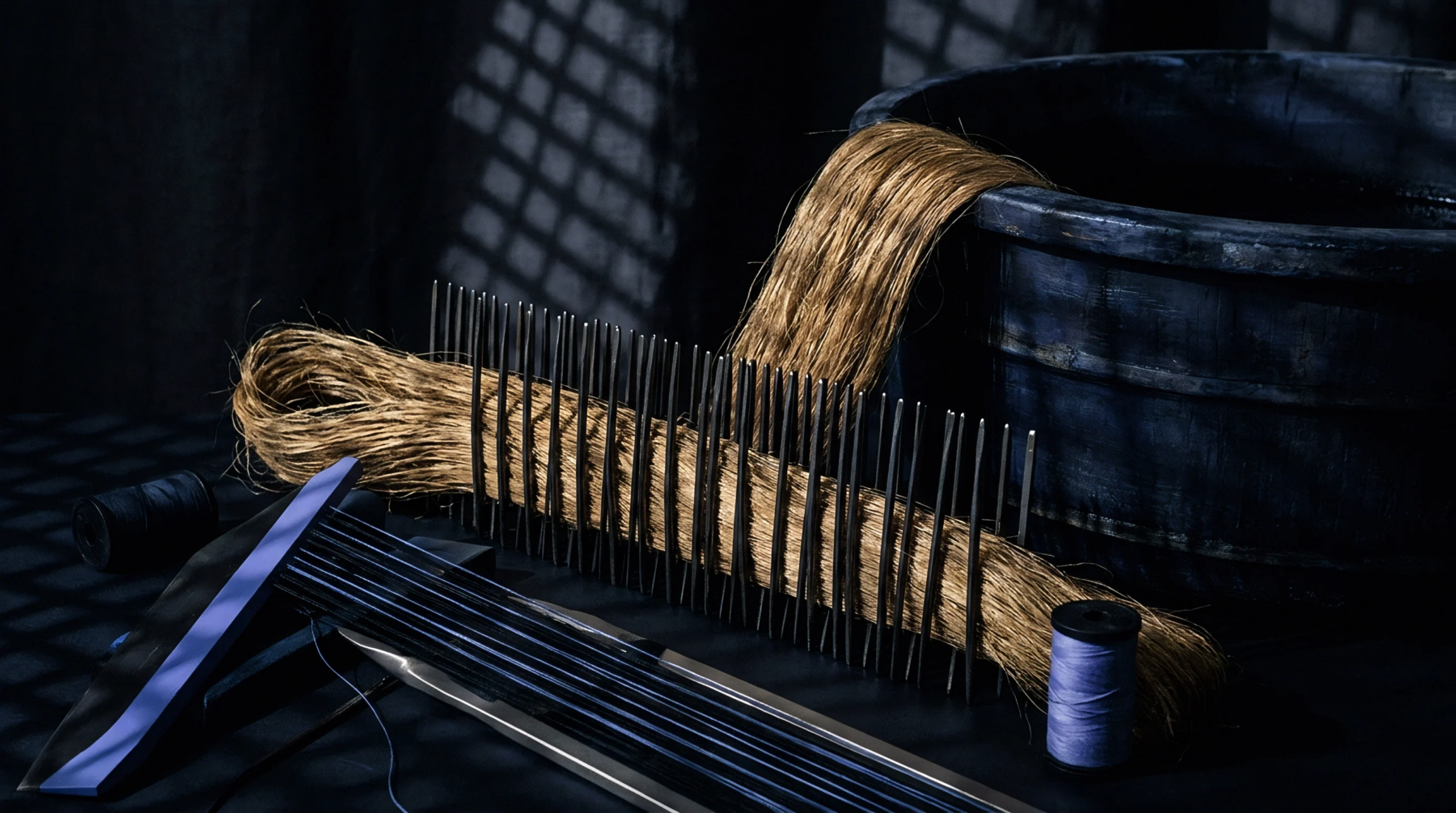
Fibrous Union
Sliver cohesion designates the internal tensile resistance exerted by parallelized flax strands during preparatory drawing operations inside Chinese spinning mills. Mechanical drawing frames pull continuous carded bands through successive roller pairs to align ultimate bast cells before twisting occurs on ring frames. The metric governs draft force limits and breakage rates on the production floor while ending abruptly at the wet spinning bath where moisture alters surface friction entirely.
Parallel fibers must hold together under high tension without premature parting or drafting irregularity. Carding machines align individual filaments into uniform ribbons before drawing frames attenuate the mass into roving weights. Friction between contacting surfaces creates enough holding power to sustain mechanical pull without adhesive additives.
Higher levels allow greater drafting speeds on industrial lines without snapping intermediate bands. When drafting rollers pull too fast, tension exceeds internal resistance and thin spots develop along the ribbon. Mill operators record these baseline measurements inside daily production ledgers to verify carding quality before material moves to roving frames.
Factory standards diverge sharply from external buyer specifications because internal quality control prioritizes machine throughput while commercial contracts penalize excessive lint shedding.
Drafting Mechanics
Drawing heads apply differential speed across adjacent roller pairs to elongate the carded ribbon continuously. Fiber length distributions dictate how much tension drawing mechanisms apply safely during attenuation. Short segments slip past neighbors too easily if roller pressure drops below specification limits.
Long filaments bridge drafting zones and create clumps that jam subsequent processing machinery. Workers adjust roller weighting arms manually to match changing natural characteristics of incoming flax harvests.
Commercial Verification
Laboratory tensile testers pull conditioned ribbon samples apart at constant velocities to generate formal acceptance records for export shipments. Buyers examine test certificates alongside raw material certificates to confirm mechanical stability before bales enter wet spinning lines. Contractual penalties apply whenever batch averages fall below agreed thresholds because weak material causes frequent machine stoppages on commercial spinning floors.
Export grade certificates distinguish between raw fiber preparation quality and finished yarn tensile strength to protect mill investments against substandard harvests.