Correlating Monomer Ratio Variances in Flax Middle Lamella Lignin to Drafting Force Instability
Low S/G monomer ratios in flax middle lamella increase lignin cross-linking, elevating wet drafting force variability and driving yarn count instability.

Monomer
Phenylpropanoid Monomer Ratios in Bast Intercellular Matrices
Technical flax fibre bundles depend on compound middle lamella structures composed of pectic polysaccharides, hemicellulose networks, and aromatic phenylpropanoid polymers. The structural integrity and thermal responsiveness of this intercellular matrix reflect the relative proportion of guaiacyl (G), syringyl (S), and p-hydroxyphenyl (H) monolignol units. Because guaiacyl units possess an open C5 position on the aromatic ring, carbon-carbon cross-linking during lignification forms condensed structures such as 5-5, beta-5, and 4-O-5 linkages.
Syringyl units, methoxylated at both C3 and C5, restrict polymer branching predominantly to linear beta-O-4 ether bonds.
The ratio of syringyl to guaiacyl monomer units (S/G ratio) dictates the thermodynamic plasticization threshold of the middle lamella during industrial wet processing. Dew-retted flax harvested under drought conditions displays S/G monomer ratios as low as 0.35, accompanied by elevated levels of condensed biphenyl bonds, whereas water-retted or controlled enzyme-retted long-staple flax exhibits S/G ratios between 0.70 and 0.95. When the S/G ratio drops below 0.50, the highly condensed aromatic network raises the glass transition temperature (Tg) of the middle lamella beyond the standard 60 °C wet-spinning trough environment, leaving the bundle structure rigid under applied mechanical shear.
Higher proportions of ether-linked syringyl units accelerate chemical plasticization during hot wet drawing.
Variations in retting severity alter the total lignin concentration and accessible monomer ratios within the intercellular space. Over-retting degrades pectic binders while concentrating recalcitrant, G-rich aromatic domains that resist chemical dispersion. Under-retting retains massive, heterogeneous middle lamella blocks, yielding erratic mechanical properties across adjacent bundle segments.
Precision long-staple flax grading requires mapping these monomeric variances before committing raw scutched line to high-count wet-spinning operations.
| Retting Profile | S/G Monomer Ratio | Condensation Index (%) | Glass Transition Temp (°C) | Ether Linkage Frequency (per 100 C9) |
|---|---|---|---|---|
| Under-retted Field Dew | 0.38 ± 0.04 | 68.2 | 74 to 78 | 42 |
| Standard Field Dew (Normandy) | 0.68 ± 0.05 | 51.4 | 60 to 63 | 58 |
| Enzyme-Assisted Retting | 0.88 ± 0.03 | 41.0 | 52 to 56 | 67 |
| Over-retted Field Dew | 0.45 ± 0.06 | 62.7 | 68 to 72 | 49 |
Why specific enzymatic retting formulations preferentially cleave S-rich ether domains over G-rich condensed nodes remains an active area of investigation among bast fibre polymer chemists.

Grip

Sliver Cohesion Mechanics and Attenuation Dynamics
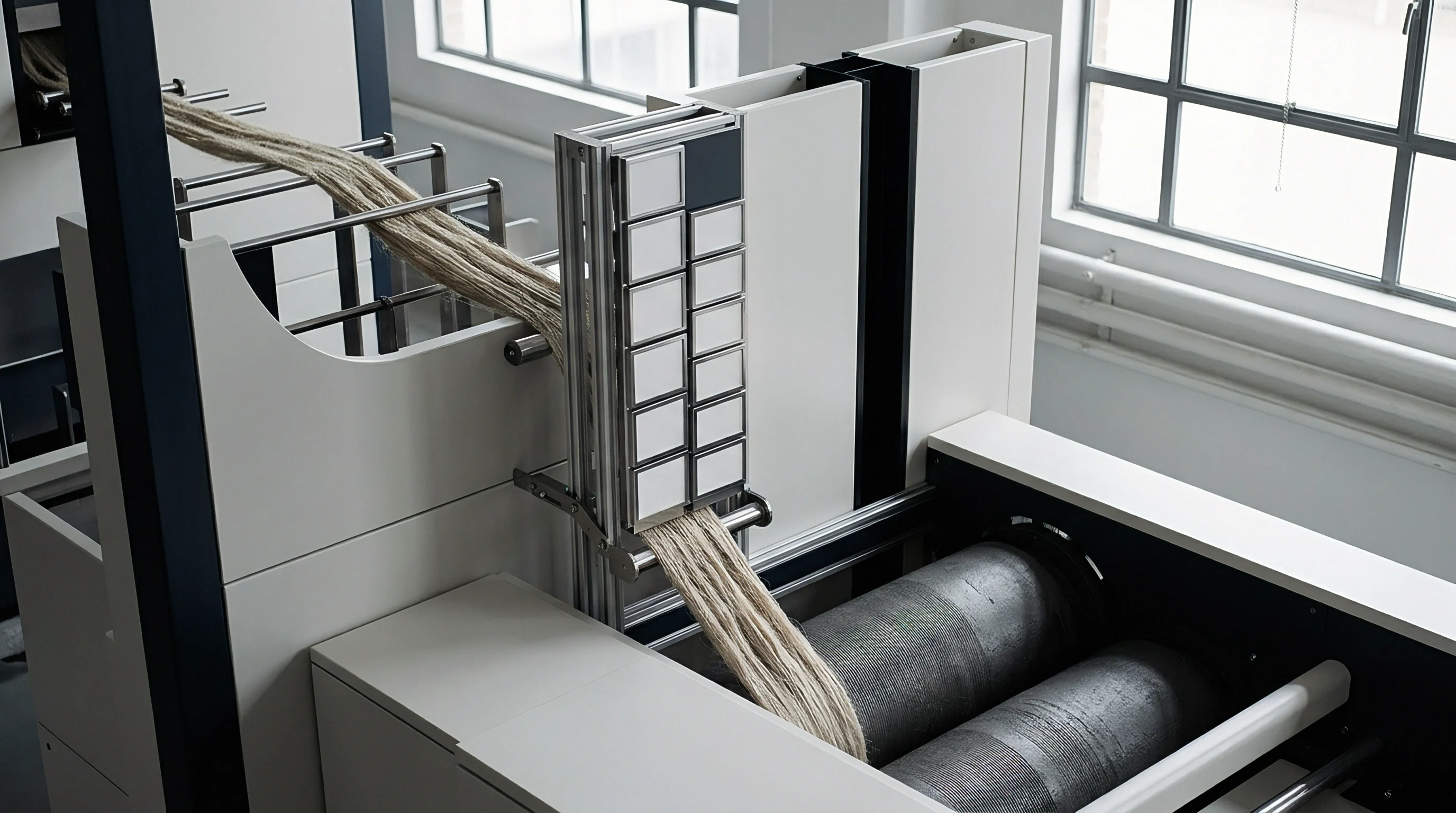
Inter-fibre friction within a drawn sliver dictates how bundle elements slip past one another during velocity transitions between drafting rolls. Drafting force (Fd) represents the dynamic resistance generated when fibre groups decouple under axial tension. In a wet-spinning drafting zone, heated water penetrates the middle lamella, plasticizing linear polymer fractions and lowering the inter-bundle shear threshold.
High-density guaiacyl cross-links prevent uniform polymer softening at standard 60 °C trough temperatures, maintaining elevated inter-fibre bond strength and promoting localized stick-slip oscillations.
Drafting force instability is quantified by tracking the standard deviation (σFd) and peak-to-mean force ratios across the drafting zone. When a sliver containing G-rich, unyielding middle lamella nodes enters the drafting nip, the mechanical force required to initiate slip rises sharply, producing dynamic drafting force spikes exceeding 18 newtons. Once the critical yield stress is surpassed, sudden bundle detachment occurs, resulting in catastrophic tension drop-offs and sliver necking.
This erratic stick-slip cycle causes uncontrolled fibre grouping, generating severe thick and thin places in the drafted ribbon.
A standard deviation exceeding 4.2 newtons in wet sliver drafting force triggers end-break rates above twelve breaks per spindle hour at 60 degrees Celsius.
When monomer ratios shift toward high syringyl content, the reduction in condensed aromatic linkages lowers the dynamic frictional force (Fd) to a stable baseline between 4.5 and 6.0 newtons. The drafting force standard deviation compresses below 1.2 newtons, allowing smooth, continuous attenuation of the technical bundles without uncontrolled slippage or localized bundle rupture.
| S/G Ratio Class | Trough Temp (°C) | Mean Drafting Force (N) | Force Standard Dev (N) | Stick-Slip Amplitude (N) |
|---|---|---|---|---|
| Low (0.35 – 0.48) | 50 | 19.4 | 5.8 | 11.2 |
| Low (0.35 – 0.48) | 70 | 14.1 | 3.9 | 7.6 |
| Medium (0.60 – 0.75) | 50 | 10.2 | 2.1 | 3.8 |
| Medium (0.60 – 0.75) | 70 | 6.4 | 0.9 | 1.5 |
| High (0.82 – 0.95) | 60 | 5.1 | 0.7 | 0.9 |
On the spinning floor, slivers demonstrating erratic drafting force spikes require increased faller pin density rather than elevated roller pressure.

Gauge

How Does Pyrolysis Gas Chromatography Quantify Lignin Ratios?
Analytical characterization of bast intercellular polymers relies on pyrolyzing isolated middle lamella fragments at 500 °C in an inert helium atmosphere followed by capillary gas chromatography and mass spectrometry. Thermal cleavage breaks ether linkages clean, releasing monomeric units into the vapor stream without destroying aromatic ring substituents. Guaiacyl derivatives elute primarily as 4-methylguaiacol and vanillin, whereas syringyl derivatives present as 4-methylsyringol and syringaldehyde.
Peak area integration across these specific fragment markers yields the precise S/G monomeric ratio of the raw fibre lot.
Complementary spectroscopic screening utilizes Fourier transform infrared spectroscopy (FTIR) on raw bundle cross-sections. Absorbance bands at 1270 cm-1 correspond to C-O vibration in guaiacyl rings, while the 1328 cm-1 band isolates C-O stretching in syringyl structures. Calculating the baseline-corrected ratio of absorbance (A1328 / A1270) provides a rapid optical method for screening incoming scutched flax bales prior to hackling.
- Sample Extraction Clean raw flax bundles via Soxhlet extraction using toluene-ethanol (2:1 v/v) for six hours to eliminate lipophilic waxes and surface resins.
- Monomer Cleavage Subject 2.0 mg of wax-free bundle material to analytical pyrolysis at 500 °C for 20 seconds under ultra-high-purity helium carrier gas.
- Chromatographic Separation Direct pyrolyzate through a 5% phenyl-methylpolysiloxane capillary column using a temperature program rising from 50 °C to 280 °C at 8 °C per minute.
- Mass Integration Quantify specific mass-to-charge ratios (m/z 138, 152, 168, and 182) to compute the absolute mass balance of S, G, and H fragments.
- Fineness Verification Cross-reference monomer ratios against air-permeability fineness values determined via ISO 2370 to separate structural bundle size from chemical stiffness.
Relying on wet chemical extraction without spectroscopic validation exposes spinning operations to unmapped monomer variance, leading to uncompensated drafting wave defects across entire yarn production runs.

Frame

Wet-Spinning Parameter Adjustments for High-Variance Lots
Translating polymer analysis onto the spinning floor requires matching drafting machine mechanical settings directly to the middle lamella softening profile. When processing low S/G ratio flax lots rich in rigid guaiacyl networks, standard wet-spinning configurations generate severe yarn count variation (CV% of Nm). High dynamic drafting resistance causes the sliver to bypass faller pin control, producing irregular bundle elongation and high end-break rates at the spinning spindle.
Adjusting the wet-spinning trough chemistry and temperature offers an operational lever to mitigate high guaiacyl stiffness. Elevating trough water temperature from 60 °C to 72 °C increases thermal kinetic energy, accelerating water penetration into the hydrophobic aromatic domains. Adding non-ionic surfactant agents at 1.5 grams per liter lowers surface tension, promoting chemical swelling of the intercellular pectin-lignin matrix.
A mill processing a 20-tonne delivery of long-staple dew-retted flax with a measured S/G ratio of 0.42 targets an Nm 39 yarn count. Under standard settings (60 °C trough, 2.2 draft ratio, 48 mm gauge), drafting force spikes reach 16.5 newtons, resulting in an Nm count CV of 14.8% and 18.5 end breaks per 100 spindle hours. By reconfiguring the draw frame to a 74 °C trough, introducing 1.8 g/L wetting agent, expanding nip gauge to 52 mm, and reducing spindle speed by 8%, the dynamic drafting force drops to 7.1 newtons.
The yarn count CV stabilizes at 11.2%, and end breakage drops to 4.2 per 100 spindle hours.
| Parameter | Low S/G Lot (Standard Setting) | Low S/G Lot (Optimized Setting) | High S/G Lot (Standard Setting) |
|---|---|---|---|
| Trough Temperature (°C) | 60 | 74 | 60 |
| Drafting Force Mean (N) | 14.8 | 7.1 | 5.2 |
| Drafting Force CV (%) | 38.5 | 16.2 | 11.4 |
| Yarn Count (Target Nm 39) | Nm 37.8 | Nm 39.1 | Nm 39.0 |
| Yarn Count CV (%) | 14.8 | 11.2 | 8.9 |
| End Breaks / 100 Spindle Hours | 18.5 | 4.2 | 1.8 |
| Yarn Tenacity (cN/tex) | 22.4 | 27.8 | 31.2 |
- Inspect incoming scutched line fibre bales for retting uniformness and test composite samples for Py-GC-MS monomer ratio.
- Set breaker drawing frame draft ratios according to the calculated S/G condensation index, adjusting faller bar pinning density to prevent bundle dragging.
- Fill wet-spinning conditioning troughs with softened water containing 1.5 g/L non-ionic wetting agent and heat to 70 °C for lots with S/G ratios below 0.50.
- Calibrate spinning frame nip roller pressure to 4.5 bar, verifying that rubber apron hardness measures between 75 and 80 Shore A.
- Monitor online drafting force sensors at the finisher draw head, stopping the frame if force standard deviation exceeds 2.0 newtons.
Failure to meet the maximum coefficient of variation threshold under ISO 2060 permits yarn buyers to cancel open delivery lots without penalty.
Wet-spinning drafting failures often stem as much from underlying monomeric polymer variances within the crop as from improper retting duration.
Invoice
Commercial Yield Arithmetic and Financial Exposure
Lignin monomer variability moves directly from the raw fibre laboratory onto the mill ledger, altering scutching yields, hackling short-fibre waste allowances, and finished yarn manufacturing costs. High guaiacyl content increases middle lamella brittle fracture during hackling, converting valuable long-staple line fibre into low-value tow. A three percent increase in hackling tow generation elevates raw material input costs per kilogram of spun line yarn by eight to eleven percent.
Metre pricing of woven linen fabric reflects the cumulative scrap rate generated by yarn count instability. Uncontrolled drafting force variation produces thin places that fail during high-speed rapier weaving, stopping looms and causing visible fabric structural defects.
Excessive middle lamella stiffness shifts spinning waste from manageable hackling short-fibre loss into irrecoverable yarn end breaks.
Consider a commercial contract for 50,000 metres of 150 g/m² pure linen fabric woven from Nm 39 wet-spun line yarn, priced at 8.50 EUR per finished metre. Processing a low S/G flax lot (0.40 S/G ratio) without drafting parameter adjustments yields a yarn end-breakage rate that reduces weaving loom efficiency from 92% to 78%. Second-quality fabric yield increases from a baseline of 1.5% up to 7.8% due to localized thick-thin filling bars.
The resulting financial loss totals 26,775 EUR on second-quality price downgrades, combined with an additional 11,400 EUR in lost spindle production capacity across the spinning floor.
- Scutched Line Fiber Cost High-grade Normandy dew-retted line flax commands 4.80 EUR/kg, requiring strict S/G ratio verification to protect downstream yield.
- Hackling Yield Loss Monomer-induced brittleness reduces long-staple hackling yield from 68% to 59%, adding 0.72 EUR/kg to the prepared sliver cost.
- Spinning Waste Penalty Spinning frame end breaks generate un-dropped roving waste, costing 0.45 EUR per kg of produced Nm 39 yarn.
- Weaving Efficiency Loss Uncontained yarn count CV% drops loom efficiency below 80%, adding 0.68 EUR per finished linear metre of fabric.
Commercial purchase contracts must incorporate standard chemical parameters stipulating that any long-staple flax lot demonstrating an S/G ratio below 0.50 under Py-GC-MS testing triggers an automatic 6% price discount to cover mandatory spinning line thermal conditioning and speed derating.