Hackled Flax Sliver Mass Determination in Textile Testing
Hackled flax sliver mass determination combines exact cut-length gravimetric sampling with oven-dry correction to verify linear density and commercial invoice mass.

Pan

Gravimetric Mechanics of Bast Bundles
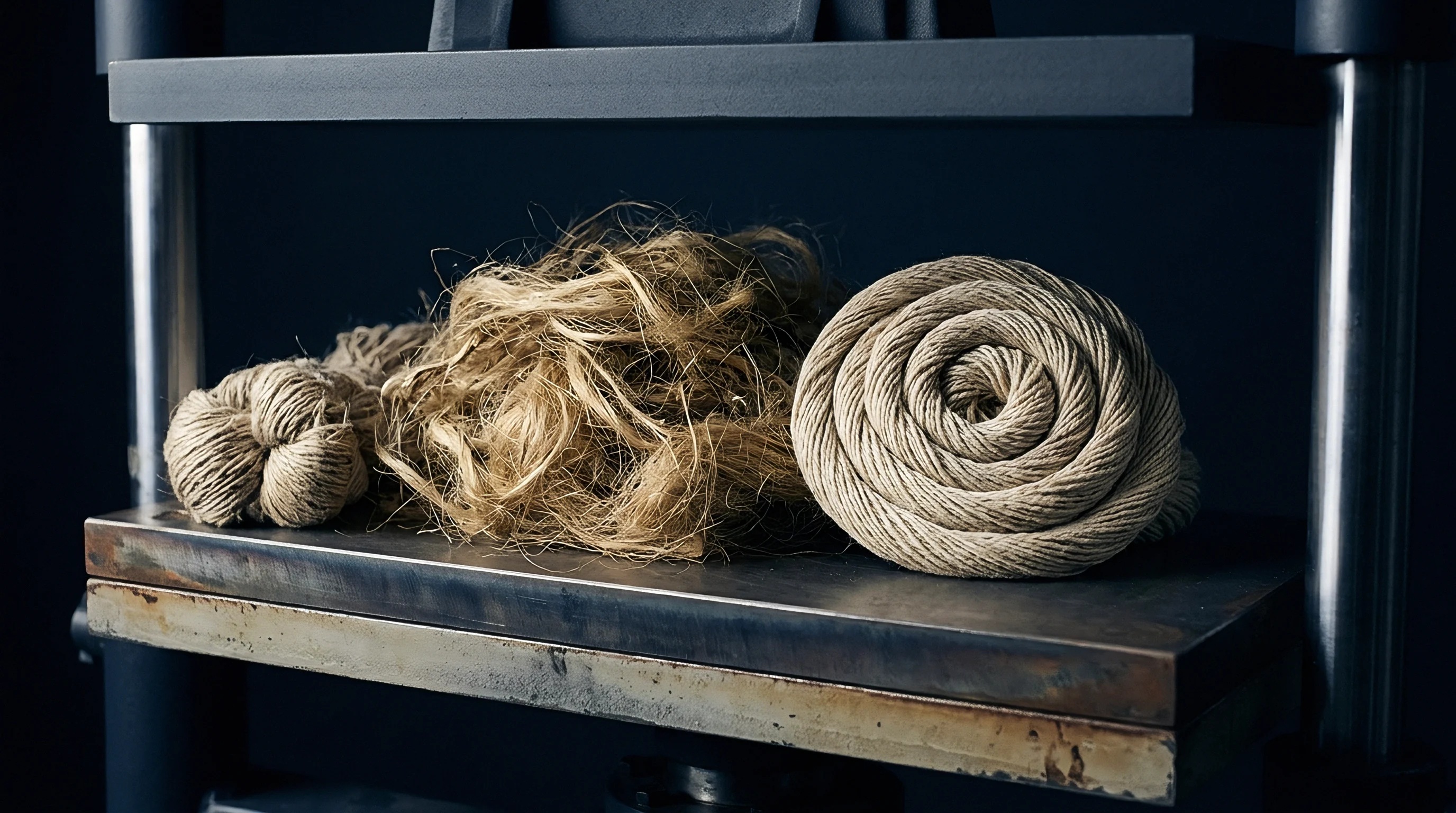
Technicians isolate hackled line flax strands by drawing bundles through calibrated cutting templates to establish linear density in kilotex. A sliver taken from a spreadboard or gill box delivery can holds variable groupings of technical fibres bonded by residual pectin. The balance registers mass down to one milligram across five-metre cut lengths.
To avoid adding false moisture mass, operators coil the specimen smoothly inside a tare container without stretching the strand, preserving bundle alignment before recording the wet weight.
Industrial testing standards specify conditioned test atmospheres at twenty degrees Celsius and sixty-five percent relative humidity. Bast fibres respond sluggishly to atmospheric shifts compared to cotton or regenerated cellulose. Ten specimen cuts drawn from different delivery cans provide the raw population for gravimetric calculation.
Technicians handle sliver lengths with clean forceps or cotton gloves so skin oils do not distort dry mass readings on fine hackled lots.
A five-metre hackled sliver cut weighing exactly one hundred grams yields a nominal linear density of twenty kilotex under standard atmosphere.
Direct gravimetric determination establishes whether the preparation line produces slivers aligned with the mechanical draft settings of subsequent gill boxes. When sliver mass strays outside designated tolerances, the drafting rollers exert irregular forces on the fibre bundles. Bundles then slip unpredictably between faller pins, producing severe mass wave patterns along the strand length.
Execution Steps for Cut Length Sampling
- Template Alignment positions the hackled sliver across the steel cutting bed with zero drafting tension to prevent false elongation before severing.
- Rotary Blade Bisection cleaves the bundle perpendicular to fibre orientation, preventing drawn ends from distorting length accuracy.
- Tare Enclosure seals the test length inside an airtight container within three seconds, preserving the exact ambient moisture profile.
- Balance Deposition records gross weight on an analytical unit calibrated to four decimal places.
Clamping pressure across the specimen cutting guide requires consistent manual handling across operator shifts. Uneven knife application drags peripheral fibres out of the bundle matrix, yielding a truncated sample with artificially low linear density. Careful transfer to the weighing vessel prevents fibre loss and preserves testing integrity.

Sorption

Thermodynamic Regain and Hemicellulose Affinity
Water vapour adheres rapidly to free hydroxyl groups within the amorphous regions of flax cellulose and the surrounding pectin matrix. Raw hackled line fibre exhibits an equilibrium moisture regain between ten and thirteen percent depending on ambient barometric state and prior thermal history, as pectin retains bound water tenaciously. Desorption curves diverge from absorption pathways, producing a distinct hysteresis loop that alters sliver weight between origin ports and destination mill storehouses.
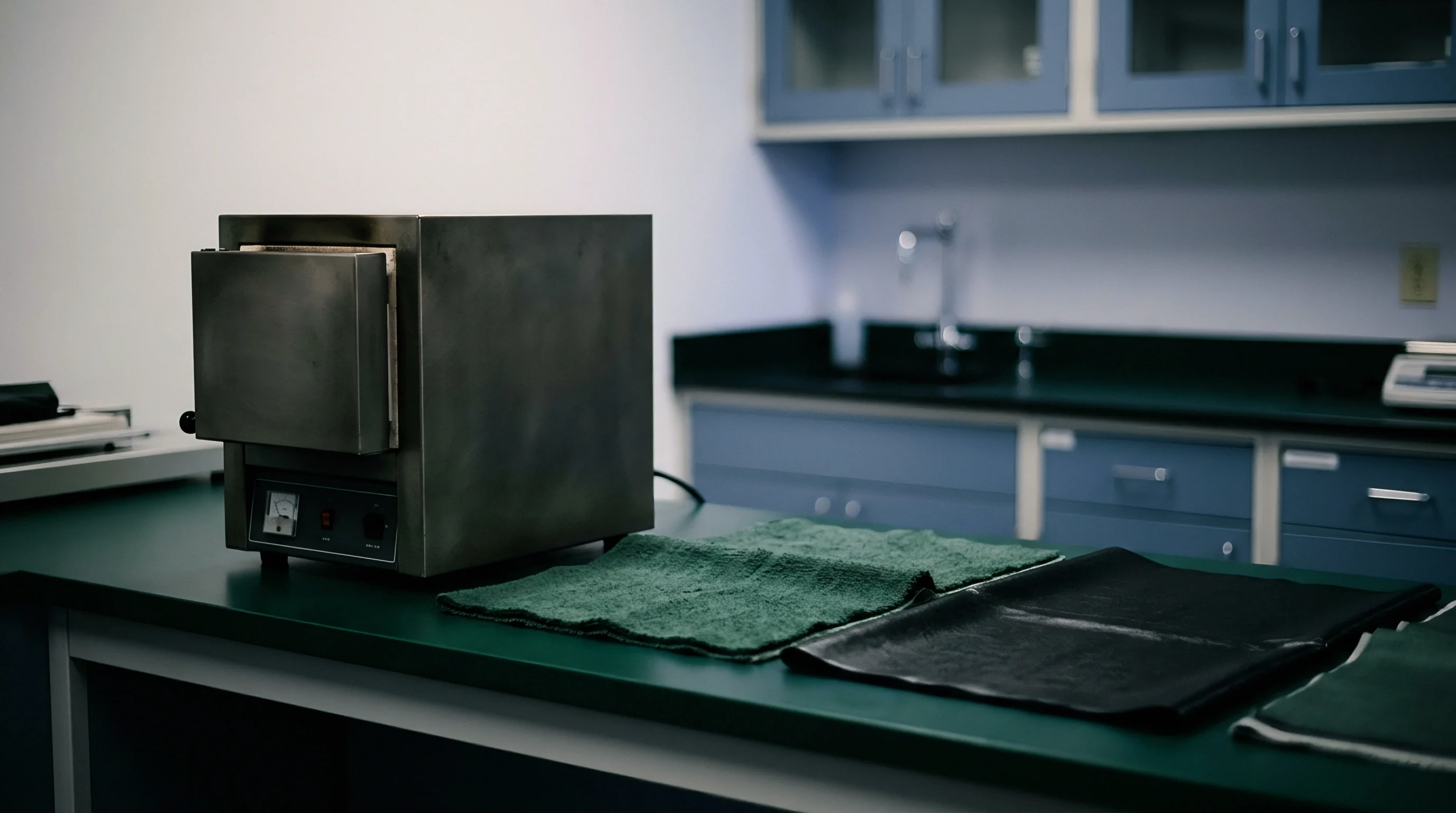
Drying sliver samples to constant mass in a ventilated conditioning oven takes place at one hundred and five degrees Celsius. The test chamber evacuates moisture continuously until successive weighings taken fifteen minutes apart vary by less than zero point zero five percent of total specimen mass. This establishes the absolute bone-dry mass of the flax specimen, removing all variable ambient water components from the evaluation.
ISO 6741-2 assigns a definitive commercial moisture regain allowance of twelve percent to boiled or hackled flax fibre deliveries.
Commercial transactions calculate invoiced weight by applying a standardized regain allowance to the measured bone-dry mass. Without this thermal correction, buyers routinely purchase atmospheric water masquerading as raw fibre mass. Beyond inflating costs, high moisture accelerates fungal rot and alters the inter-fibre friction coefficient within the sliver, shifting drafting resistance in gill boxes and drawing heads.
The table below details the interaction between measured regain states, chemical conditioning levels, and standardized mass calculations across typical trade grades.
| Fibre Processing State | Nominal Moisture Regain (%) | Standard Commercial Allowance (%) | Moisture Conversion Factor | Sorption Hysteresis Delta (%) |
|---|---|---|---|---|
| Dew-Retted Unboiled Line | 10.80 | 12.00 | 1.0108 | 1.45 |
| Water-Retted Unboiled Line | 11.40 | 12.00 | 1.0054 | 1.20 |
| Enzyme-Treated Sliver | 9.60 | 12.00 | 1.0219 | 1.85 |
| Boiled Hackled Sliver | 8.90 | 12.00 | 1.0285 | 0.95 |
| Bleached Preparation Sliver | 8.20 | 10.50 | 1.0212 | 0.80 |
Calculating true legal delivery mass requires multiplying dry sample weight by the standard allowance factor. Processors who skip oven-drying risk absorbing commercial losses up to four percent per shipping container during wet transit seasons. Standard commercial contract terms dictate that invoice mass equals oven-dry mass multiplied by one plus the agreed moisture regain fraction, legally overriding dockside scales.


Density

Linear Mass Allocation along the Drafting Path
Fibre mass concentration per unit length determines mechanical drafting limits across every drawing passage. Hackled flax entering the first drawing frame typically carries a linear density between fifteen and twenty-five kilotex, where coarse sliver strains drawing pins. Gill box fallers grip this thick ribbon, advancing it into drafting rollers operating at surface speeds four to eight times faster than back feed rollers, where aggressive drafting can break uneven bundles.
When sliver mass exceeds design limits, faller bars deflect under mechanical strain while thick spots resist the drafting rollers. Fibres choke the pins, causing entire bundles to ride over the faller field without proper drafting while short fibres drop out. The resulting sliver exhibits severe periodic mass fluctuations matching the faller pitch cycle.
Maintaining proper control requires a strict balance between sliver mass and pinned volume inside the gill bed.
Can Sliver Mass Predict Fine Yarn Uniformity?
Linear density consistency in early drawing cans directly dictates the level of unevenness in finished wet-spun yarns. Sliver mass variance propagates through subsequent passages rather than smoothing out. Autolevelling systems on modern drawing heads compensate for long-term mass drift by adjusting drafting roll velocity via mechanical sensor shoes, but high-amplitude short-term mass spikes pass undetected, leaving dense slugs in the resulting roving.
Thick sliver zones overload faller bar pins and create long-wave mass irregularities throughout subsequent drawing passages.
Downstream spinning frames cannot correct mass variation introduced by irregular hackled slivers. A sliver with erratic linear density can jam gill pins and produces wet-spun yarn with an elevated coefficient of variation, triggering yarn breakage during automatic winding and weaving shed halts that raise production costs per linear metre of cloth.

Variance

Non-Fibrous Inclusions and Structural Anomalies
Gravimetric sliver analysis often registers mass contributed by non-cellulosic impurities rather than spinnable flax bundles. Shive fragments and woody stem particles trapped between parallelized fibres add dead mass to the scale pan while contributing nothing to structural strand continuity. Incomplete retting leaves epidermal tissue bonded to fibres, artificially inflating the apparent kilotex rating of the delivery can.
Nep clusters formed during aggressive hackling introduce localized mass spikes along the sliver axis. These tight entanglements contain short, broken fibrils wrapped around core bundles. Technicians separate structural fibre mass from foreign contamination through visual sorting and gravimetric fractionation following standard trash separation techniques.
Clean line sliver contains less than zero point five percent shive by weight.

Is Shive Entrainment Skewing the Gravimetric Count?
Laboratory assessments must differentiate between genuine linear density and weight anomalies caused by debris clusters. Unhackled tow fragments carried over into line sliver can add five to ten grams of unaligned fibre per ten-metre length. Beyond degrading yarn quality, this contamination distorts mass determinations and destabilizes drafting force curves during processing.
| Quality Classification | Target Linear Density (ktex) | Linear Density CV (%) | Shive Content (% w/w) | Drafting Force Peak (cN) |
|---|---|---|---|---|
| Prime French Line Hackled | 18.5 | 3.8 | 0.25 | 420 |
| Standard Belgian Line | 20.0 | 4.5 | 0.40 | 485 |
| Eastern European Dew-Retted | 22.5 | 6.2 | 0.85 | 610 |
| Blended Tow and Line Sliver | 26.0 | 8.9 | 1.60 | 780 |
| Data measured under standard conditions of twenty degrees Celsius and sixty-five percent relative humidity across ten representative cans per lot. | ||||
Bale contamination patterns reflect poor scutching control and uneven hackling pin maintenance. Seasonal retting differences and natural agronomic growth variances explain wide drafting force fluctuations across delivered sliver cans when mass varies.

Ledger

Commercial Mass Auditing and Yield Economics
The financial valuation of hackled flax sliver depends directly on verified conditioned mass rather than gross container tare. Discrepancies between billed weight and verified dry-plus-regain mass shift raw material expenses significantly ~ since every excess gram is effectively billed twice ~ prompting sourcing managers to reconcile bills of lading against certified moisture oven tests to prevent financial loss on wet deliveries.
In a commercial delivery of forty metric tonnes of imported hackled line flax sliver priced at seven euros and twenty cents per kilogram, the shipping invoice declares forty thousand kilograms gross at twelve percent nominal moisture. Destination testing establishes an average moisture regain of fifteen point five percent across the lot. Calculating the oven-dry mass yields thirty-four thousand six hundred and thirty-two kilograms.
Applying the standard contract regain of twelve percent establishes an allowable commercial mass of thirty-eight thousand seven hundred and eighty-eight kilograms. Adjusting for one thousand two hundred and twelve kilograms of billed water recovers eight thousand seven hundred and twenty-six euros on the lot ledger.
Uncorrected moisture mass overcharges translate directly into elevated yarn spinning costs per metre of woven fabric.
Operational cost implications extend past the raw material balance sheet into the spinning mill. Excessive sliver mass variation forces spinning lines to reduce wet-spinning spindle speeds to prevent ends down, inflating conversion costs per spindle hour. Mill profitability depends heavily on precise control of initial sliver linear density.
- Gross Weight Receipt logs physical container weight at the factory receiving dock before atmospheric exposure alters sliver moisture content.
- Oven Dry Sampling measures moisture loss from ten representative cans per shipment lot to calculate actual bone-dry fibre content.
- Standard Allowance Adjustment applies the contractually agreed commercial regain factor to determine true commercial billing mass.
- Drafting Yield Tracking verifies delivered sliver linear density against target spinning yields to confirm yarn output per raw material unit.
Whether regional retting facilities can achieve narrower sliver mass tolerances under increasingly volatile harvest weather patterns remains an unresolved technical dilemma for bast fibre sourcing.