Determining Hackled Flax Linear Density through Manual Bundle Sectioning
Manual bundle sectioning isolates true flax fibre linear density by cutting mid-strick segments for gravimetric tex determination prior to spinning.
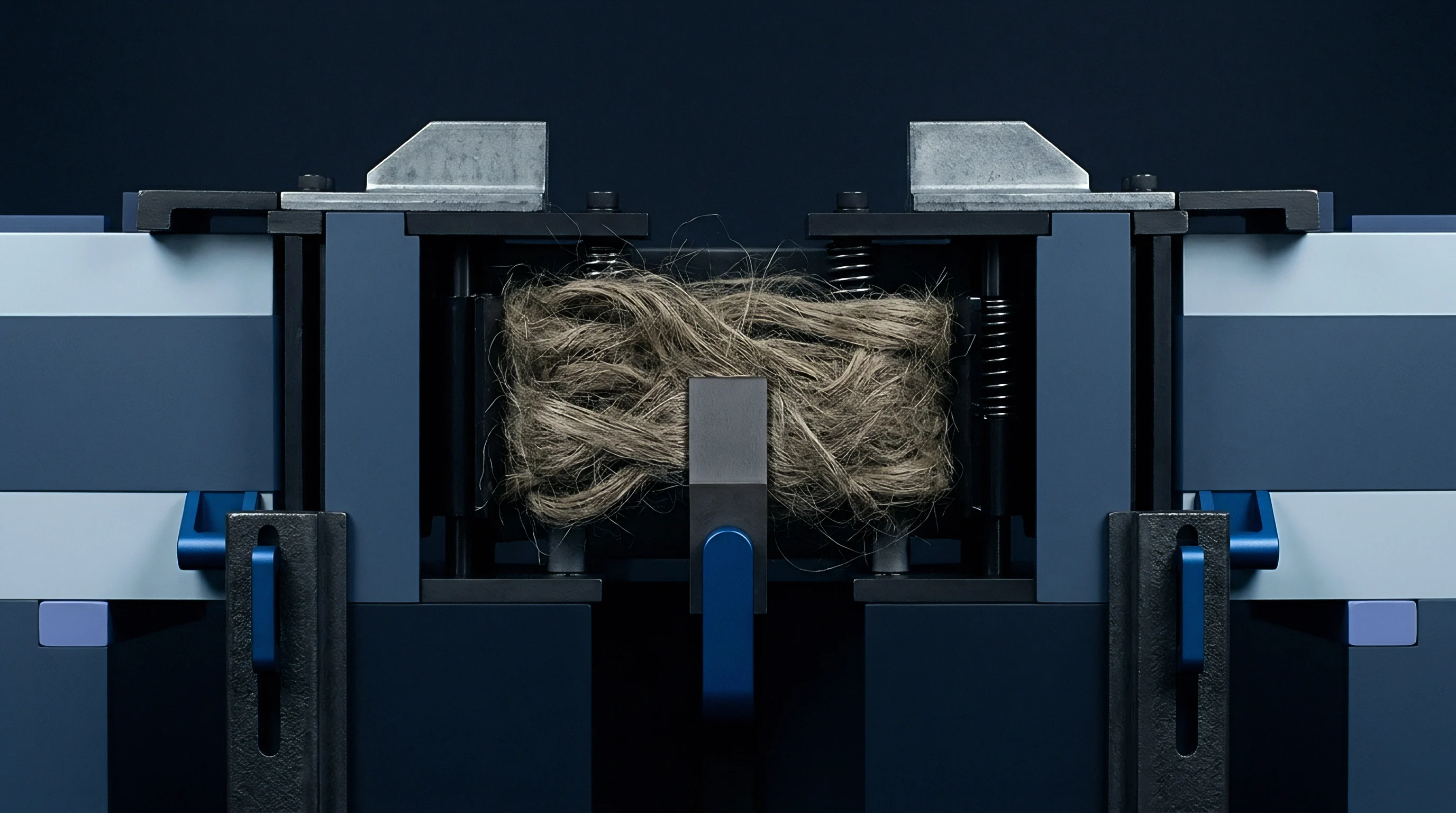

Blade
Technical flax stricks require mechanical stabilization inside a specialized clamp before manual cutting. Long flax line fibres consist of technical bundles bound together by middle lamella pectins. Manual sectioning isolates a uniform central length from the strick, eliminating edge irregularities and staple end tapering so technicians can calculate linear density in tex or decitex by direct gravimetric measurement.
Precision sectioning relies on dual razor assemblies held at fixed distances. Spacers constructed from hardened tool steel set the gauge length ~ typically 10 mm, 20 mm, or 50 mm, depending on sample availability and balance sensitivity. Aligning technical bundles parallel to the cutting axis prevents oblique cuts that would artificially inflate bundle segment mass.
Straightening tension removes bundle crimp prior to sectioning without inducing unwanted drafting.

Bundle Preparation and Clamp Geometry
Pre-conditioning the hackled strick at 20°C and 65 percent relative humidity stabilizes moisture content before clamping. Technicians select representative stricks from raw bale samples and comb them gently by hand with a fine needle comb to remove loose tow, neps, and unhackled shive remnants. The comb teeth pass through the fibre fringe without splitting technical bundles, preserving the natural structure.
The strick then enters a spring-loaded clamp fitted with polyurethane gripping faces that compress around bundle contours, holding outer and inner fibres with equal force so the centre does not slip during the pass of the cutting blade.
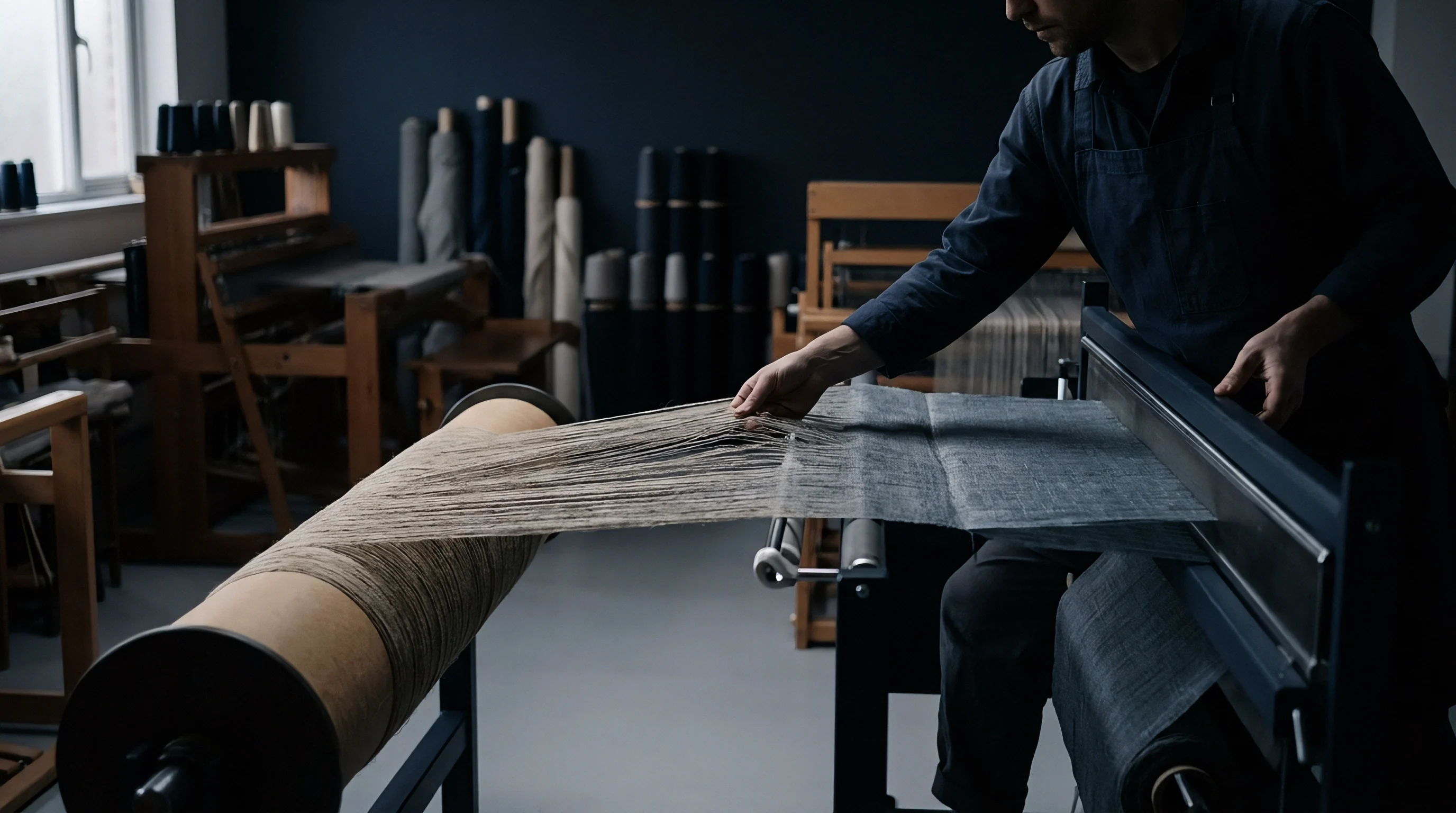
Cutting Fixtures and Gauge Length Selection
Mounting the clamped specimen in a heavy anvil fixture provides rigid support during sectioning. Two razor blades, bolted against a central spacer block, descend simultaneously through the clamped fibre bundle to eliminate timing and position errors between individual cuts. Shorter gauge lengths cut down sample preparation time but require micro-balance sensitivity to 0.001 mg, whereas longer section lengths yield greater mass and reduce relative weighing error on standard laboratory balances.
| Gauge Length Designation | Spacer Width Tolerance | Cutting Edge Thickness | Min Recommended Bundle Mass | Alignment Error Limit |
|---|---|---|---|---|
| 10 mm | ±0.02 mm | 0.10 mm | 2.50 mg | 1.0 degree |
| 20 mm | ±0.02 mm | 0.10 mm | 5.00 mg | 1.5 degrees |
| 50 mm | ±0.05 mm | 0.15 mm | 12.50 mg | 2.0 degrees |
Slipping clamps or dull cutting surfaces crush fibre ends and skew measured linear density by fifteen percent, leading to unearned price penalties on incoming bale lots.


Mass
Analytical balances with 0.01 mg resolution record the precise weight of cut bundle segments after environmental conditioning. Measuring the total mass of a known number of sectioned fibres, or weighing a dense cut bundle of measured total length, forms the foundation of bast fibre fineness testing under modified ISO 2370 frameworks, which assume a standard regain of twelve percent.
Oven-drying sectioned specimens establishes dry mass, eliminating ambient humidity variations from storage. Bast fibres retain hygroscopic moisture within their crystalline cell walls and amorphous pectin matrices, so converting oven-dry mass back to commercial mass requires multiplying by the standard regain factor. Skipping this correction skews linear density calculations by up to eight percent in humid environments.

Micro-Balance Precision and Regain Correction
Weighing procedures require zero-draft enclosures so ambient air currents do not disturb the balance pan. The operator transfers cut bundle sections with anti-static ceramic tweezers, as stainless steel can pass micro-static charges that attract dust or make fibres stick to chamber walls. The specimen rests on the pan for thirty seconds to let static dissipate and the reading stabilize before recording the final mass.

Calculating Mean Tex and Tex Spread
Calculating bundle linear density relies on total specimen mass, cut gauge length, and fibre strand count. When counting individual strands under a stereomicroscope is practical, linear density in tex equals the conditioned mass in milligrams divided by cumulative length in metres. Where high bundle density makes counting impractical, test methods correlate total cross-sectional area or mass per unit length directly to spinnable yarn count.
Consider a practical laboratory example: a technician extracts a 50 mm section containing 120 counted technical fibre bundles from a prepared strick. The oven-dry weight of the cut section measures 6.15 mg. Applying the standard commercial moisture regain allowance of 12.0 percent brings the commercial mass to 6.888 mg.
With a total cumulative length of 6.0 metres (120 bundles at 0.05 metres), dividing 6.888 mg by 6.0 metres yields 1.148 tex per technical bundle. Assuming a sample standard deviation of 0.22 tex across ten replicates, the coefficient of variation is 19.16 percent ~ a spread that reflects high splitting uniformity, suitable for wet-spinning fine line yarns.

Is Manual Sectioning Precise Enough for Raw Stock Acceptance?
Manual bundle sectioning provides direct gravimetric verification without relying on optical calibration curves or airflow assumptions. Airflow meters calibrated for cotton introduce systematic errors on technical flax because of non-circular cross sections and variable middle lamellae. By isolating absolute mass over an exact cut length, manual sectioning serves as the referee test method in commercial grade arbitrations.
- Conditioning Equilibrium brings specimen moisture to twelve percent commercial regain prior to precision weighing.
- Section Counting involves manual separation under a magnifying lens to record exact individual technical bundle counts.
- Tared Weighing uses a closed-chamber analytical balance to isolate 0.01 mg mass differentials without draft interference.
- Linear Calculation divides total conditioned mass by summed fibre length to establish absolute tex values.
ISO 6741 defines twelve percent as the standard commercial moisture regain allowance when converting dry bundle section weights to invoice linear density.
When contract clauses specify ISO 2370 compliance without defining sample bundle counts, buyers face legally binding delivery rejections based on statistically invalid sample sizes.


Taper
Hackled flax stricks display a pronounced thickness gradient from root to tip. Biological growth deposits thick cell walls and dense lignin-pectin binder complexes near the soil line, making root sections heavy in pectin. Middle sections reflect true average fineness, whereas upper plant sections feature finer ultimates with thinner cell walls that split during drafting.
Where section cuts are taken directly alters measured tex values. Cuts taken exclusively from the root end artificially inflate linear density and misrepresent overall spinning quality, while tip samples record low values that cannot be sustained through drawing. Standard protocols target the middle third of the hackled strick to capture median technical bundle diameter.

Root Middle and Tip Fineness Gradient
Analyzing the longitudinal profile of long flax shows how much structure varies along a single strick. The root region contains coarse technical bundles where individual ultimate fibres remain glued in clusters; the middle region features partially split bundles that respond predictably in wet-spinning draft zones; and the tip region contains fine, highly divided bundles with little residual pectin. Testing across all three zones reveals the internal heterogeneity of incoming fibre lots.
| Strick Section Location | Mean Linear Density | Residual Pectin Content | Mean Ultimate Cell Diameter | Drafting Cohesion Index |
|---|---|---|---|---|
| Root (Lower 20%) | 3.45 tex | 6.8 % | 24.5 µm | 0.82 |
| Middle (Central 40%) | 1.85 tex | 4.2 % | 18.2 µm | 0.45 |
| Tip (Upper 20%) | 1.12 tex | 2.5 % | 14.1 µm | 0.28 |

Staple Length Segmentation and Sampling Bias
Sampling bias occurs when technicians pull only straight, long strands from the outer layers of a hackled head. Inner strick fibres often carry higher curvature and variable bundle fineness from comb action during hackling. Random composite sampling across five distinct depth layers prevents selection bias, producing a bell-curve distribution that reflects true mill processing potential.
Middle strick sectioning yields a linear density figure 15 percent lower than root sectioning on dew-retted long flax.
How far commercial enzyme retting alters the structural pectin ratio between root and tip sections without degrading ultimate tensile strength remains open for multi-lot trials.


Spinning
Sliver drafting behaviour in the wet-spinning trough depends directly on the linear density of individual technical bundles. Warm water softens residual middle lamella pectins, allowing technical bundles to slide and split into finer ultimate assemblies under draft roller tension, whereas coarse bundles increase sliver breakages.
Fine bundle section tex values translate directly into higher spin limits, measured in metric count (Nm) or English lea. Bundles measuring under 1.5 tex in mid-section tests yield thin, even roving slivers capable of drafting down to fine yarns without draft-wave periodicities, whereas coarse sections above 2.8 tex resist splitting and cause thick places and end breaks at high spindle speeds.
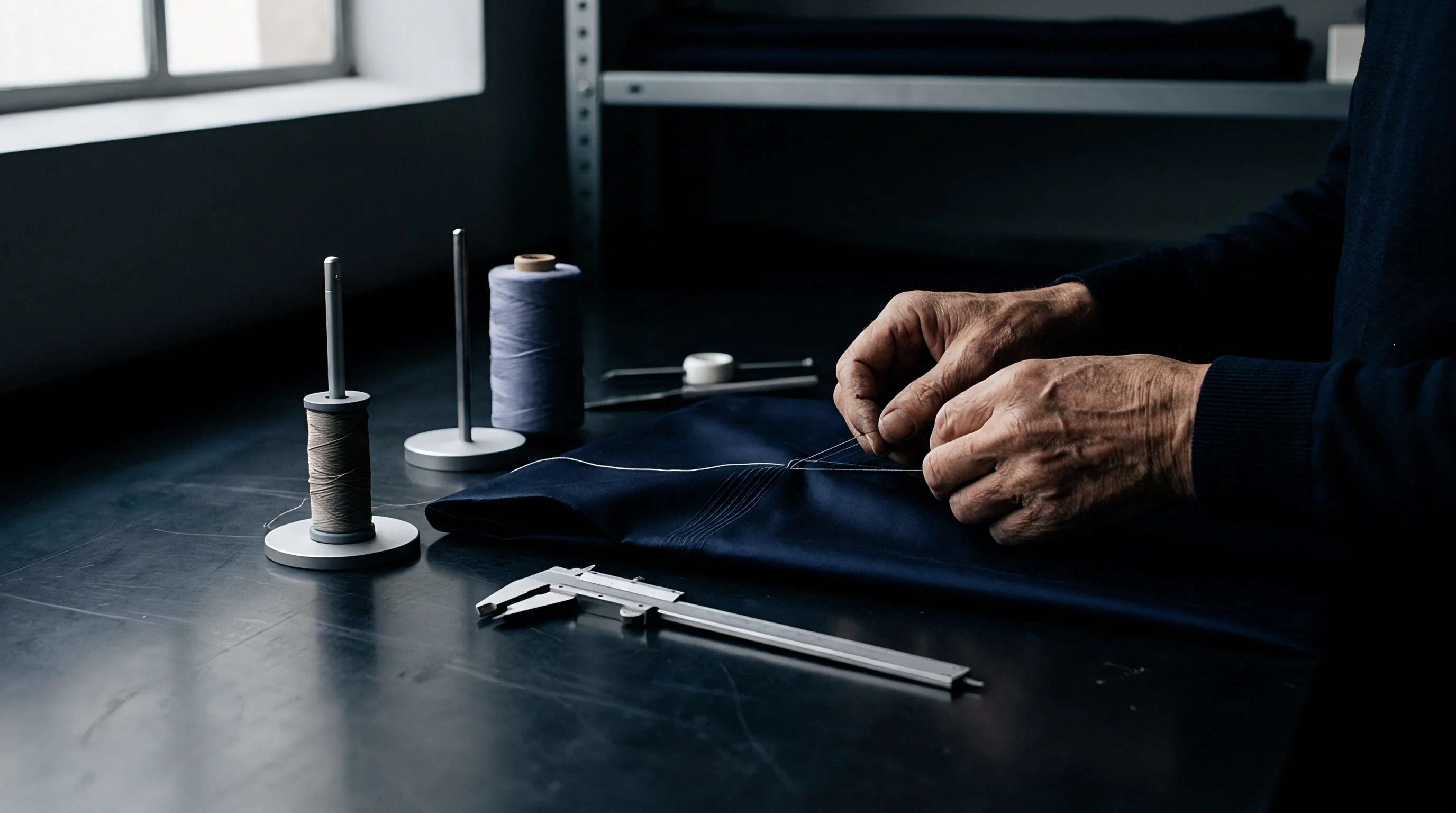
Correlation between Section Tex and Sliver Cohesion
Cohesion within drawn slivers relies on inter-fibre friction and bundle surface area. Fine technical bundles provide more surface area per unit mass than coarse, unretted clusters, generating uniform friction under drafting clamps and suppressing thin-place slip. Measuring linear density before lot allocation lets mill managers adjust draft zone roller settings to match incoming fibre fineness.
- Fine Bundle Selection specifies section linear density below 1.6 tex for high-count wet frames running fine linen yarns.
- Trough Temperature Calibration adjusts pectin softening rates according to residual middle lamella density recorded during manual section testing.
- Draft Zone Spacing aligns roller nip distances to the mean staple length of sectioned stricks to eliminate floating fibre nep creation.

Predicting Wet Spun Count Limits
Predicting maximum spinnable yarn count requires matching bundle tex to the number of fibres in the yarn cross-section. Quality linen yarns need at least 25 to 30 technical fibres in cross-section to maintain tensile strength and keep breakages under 15 breaks per 100 spindle hours. A lot with a sectioned linear density of 1.4 tex easily spins to Nm 60 (16.6 tex yarn linear density), whereas a lot averaging 2.6 tex reaches its structural limit at Nm 30, where finer counts would hold too few fibres to withstand winding tension.
Coarse technical bundle sections collapse draft zone stability long before high twist multipliers can compensate.
Elevated end-breakage rates on fine yarn frames stem either from operator drafting errors or from unmonitored bundle section coarseness in the raw bale.


Yield
Economic performance on the spinning floor links hackling mass recovery to delivered thread linear density. Raw scutched flax entering the mill undergoes repetitive combing to separate short tow fibres from long line stricks. Fine, well-retted flax yields higher proportions of line fibre during hackling because flexible technical bundles yield to comb pins without snapping.
Manual bundle sectioning acts as a gatekeeper for fibre valuation. Buying coarse flax mislabeled as fine long-staple line stock incurs losses on two fronts: reduced hackling yield in the mill and lower market prices per kilogram of finished yarn. Quantifying bundle linear density at intake protects spinning margins by establishing true spinnable count limits before processing begins.

Hackling Room Fibre Loss and Waste Coefficients
Hackling machine settings must match incoming strick fineness. Processing coarse, stiff flax through tight comb setups causes aggressive breakage, turning valuable line fibre into low-value tow. Measuring section tex guides pin density selection, as finer initial values allow aggressive combing with minimal mass loss, maximizing long line output.
| Fineness Class | Section Linear Density | Hackling Line Yield | Max Spinnable Count | Landed Metre Cost Index |
|---|---|---|---|---|
| Extra Fine Line | 1.10 to 1.40 tex | 68 % | Nm 80 (12.5 tex) | 1.00 |
| Standard Line | 1.41 to 1.90 tex | 62 % | Nm 50 (20.0 tex) | 1.18 |
| Coarse Line | 1.91 to 2.60 tex | 54 % | Nm 26 (38.4 tex) | 1.45 |
| Tow Grade Line | > 2.60 tex | 42 % | Nm 14 (71.4 tex) | 1.92 |

Cost per Metre Arithmetic for Target Yarn Counts
Evaluating landed fibre economics requires tracing raw material costs through hackling yield losses down to the finished yarn metre. Consider a raw scutched flax lot purchased at 4.50 USD per kilogram. Standard line flax yielding 62 percent long line fibre increases the effective raw material cost of hackled stricks to 7.26 USD per kilogram, with residual hackling tow credited back at 1.20 USD per kilogram.
Spinning this hackled line stock to an Nm 40 yarn (25 tex) consumes 25 grams of fibre per 1,000 metres of thread, contributing 0.181 USD in raw material per 1,000 metres of single yarn.
If unmonitored raw material variance increases bundle section linear density from 1.6 tex to 2.4 tex, the frame cannot spin Nm 40 without excessive end breaks. The mill must drop the target count to Nm 26 (38.4 tex) to keep operating. An Nm 26 yarn consumes 38.4 grams of fibre per 1,000 metres, pushing fibre cost per 1,000 metres up to 0.278 USD ~ a 53.5 percent increase in raw material cost per delivered yarn metre caused entirely by unmanaged bundle coarseness.
- Density Threshold Specification anchors contract price adjustments to certified section tex median values across incoming lots.
- Waste Allowance Indexing ties hackling room tow generation limits to raw strick bundle fineness measurements.
- Rejection Limit Setting establishes automatic batch disqualification when bundle tex standard deviation exceeds zero point four.
Fine bundle section values predict high yarn yields only when hackling machine comb density matches incoming strick stiffness.