Predicting Sliver Breakage Rates through Positional Tex Variance in Dew Retted Hackled Line Flax
Short-wavelength sliver tex variance above eleven percent triggers drafting separation and spikes wet-spinning breaks, adding over one dollar per finished metre.
Profile
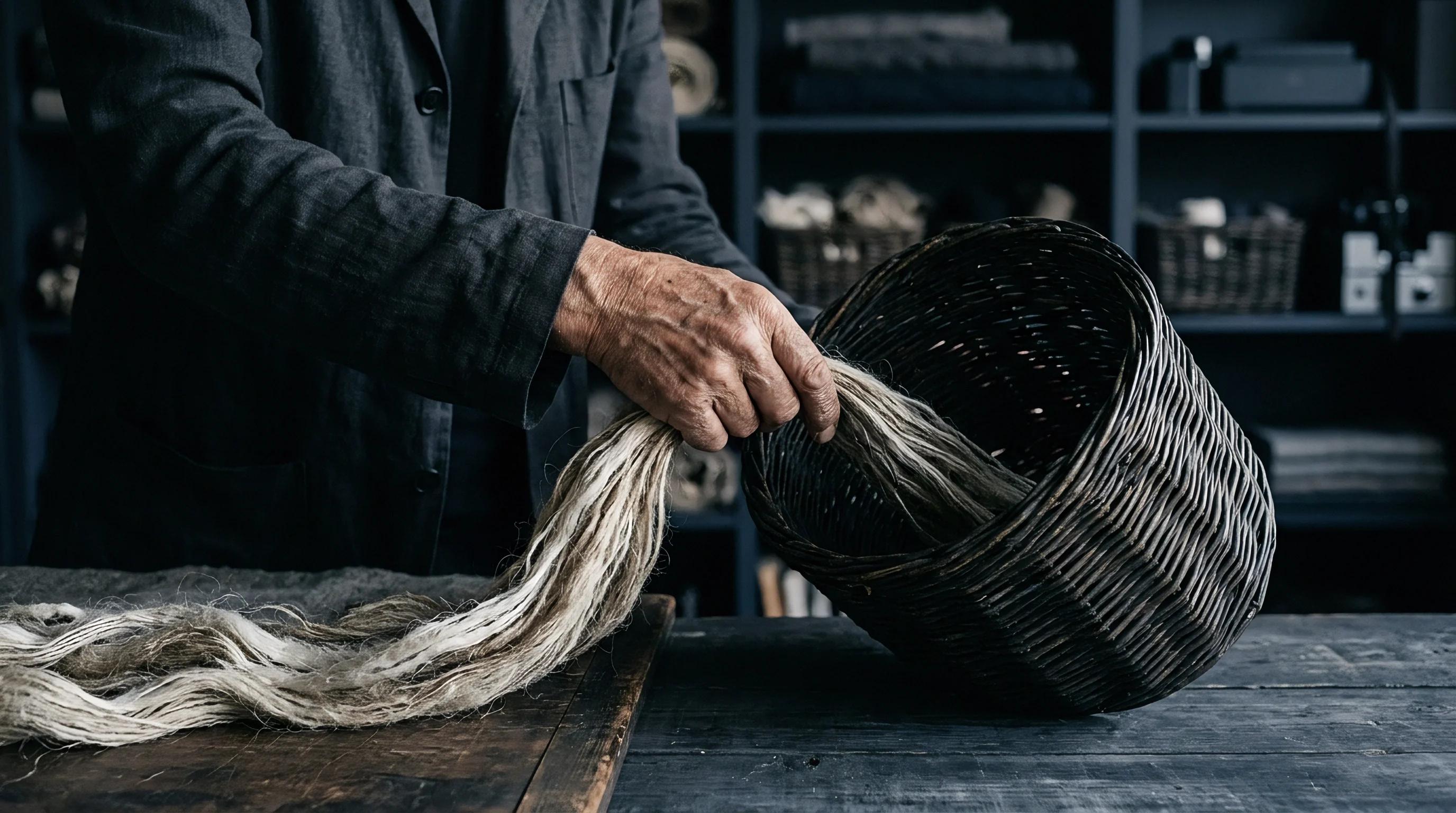
Dew-retted hackled line flax reaches the first drawing frame as an assembly of overlapping bast strands averaging between 20 and 30 kilotex. Cutting a ten-meter sliver into one-hundred-millimeter lengths reveals severe mass fluctuations, with individual test cuts swinging from 14 kilotex to 38 kilotex. Because flax fibers have no natural crimp, strand cohesion depends entirely on residual pectin, lateral friction among parallel fibrils, and the mechanical entanglement left behind by hackling pins.
If bundle density drops below a critical threshold, that friction fails under standard drafting pull.
Linear Density Variations along Bast Fiber Bundles
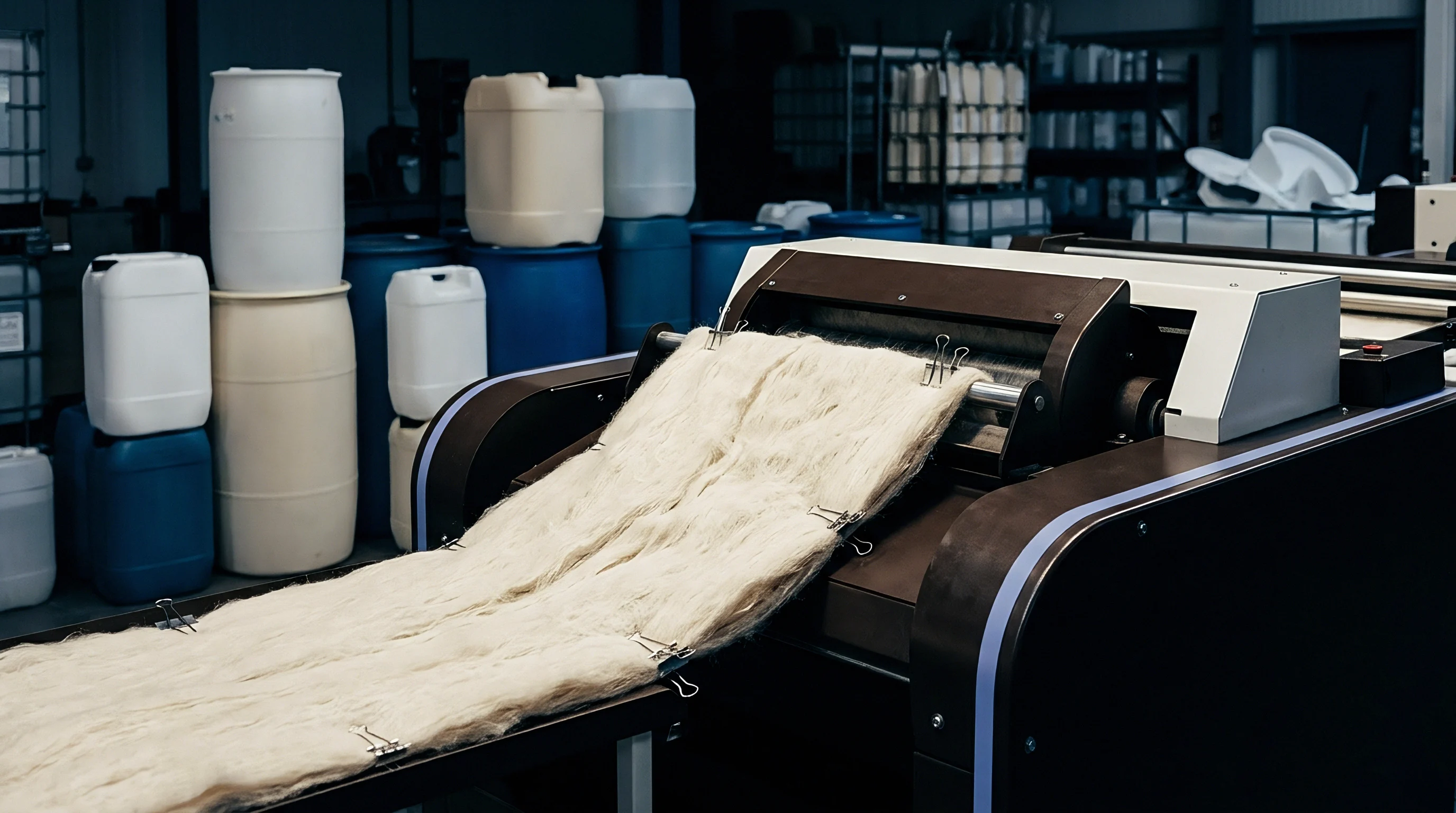
Flax stems taper naturally from the root toward the apical branches. Scutching and hackling preserve that taper in line flax ribbons, which keep a heavy root end and a finer tip. Feeding scutched stricks onto the spreadboard without precise overlapping produces recurring mass waves along the sliver.
An experienced classer detects these thick and thin cycles by hand, but manual sorting misses short-wavelength variations running under two hundred millimeters.
Mass dips in the sliver mean an immediate shortage of load-bearing fibers. When twenty kilotex sliver enters a gill box drafted at an attenuation factor of ten, a fifty-millimeter dip down to twelve kilotex enters the pin field as an active defect. The front rollers pull with a force set for the nominal cross-section.
Drafting resistance depends on total contact area under the faller pins, so any localized drop in bundle count slips prematurely and breaks the strand.
A sliver drawn from unevenly retted flax pulls apart at the boundary where stiff, gummy bundles meet supple fibers.
Dew Retting Nonuniformity and Pectin Dissolution
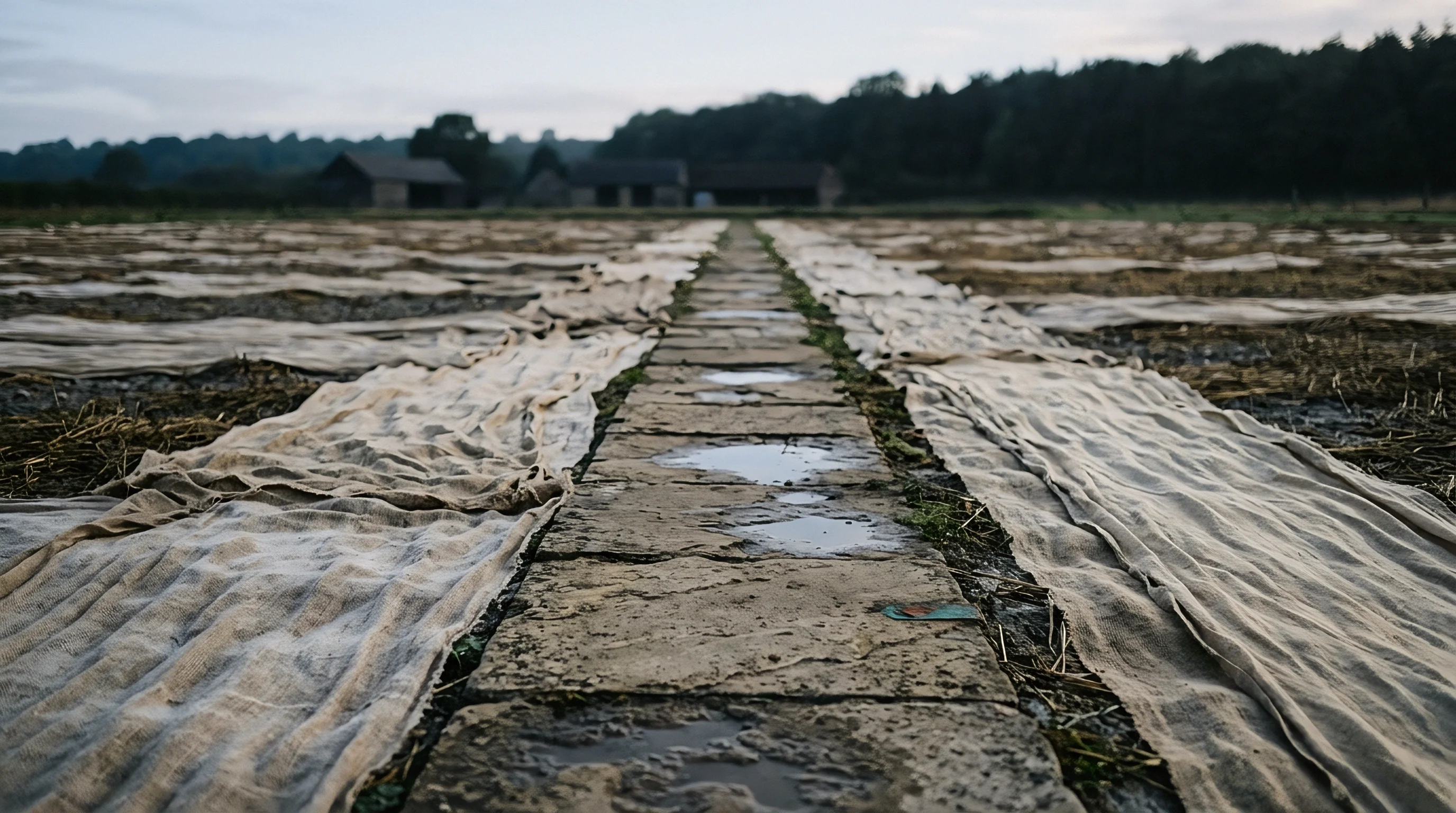
Swath retting in the field creates sharp biochemical differences through the straw layer. Stems pressed against damp soil are colonized quickly by saprophytic fungi like Cladosporium herbarum, while stems on top dry out under direct sun and remain under-retted. This uneven exposure leaves varying amounts of calcium pectate and hemicellulose across the fiber bundles.
Fully degraded sections split down into fine technical fibers of 1.5 to 2.5 tex; the under-retted portions stay bound in coarse bundles over 8 tex.
Uneven pectin removal causes faults during hackling. Well-retted bundles divide cleanly, but under-retted straw resists the combs, breaking off short or passing through as stiff, woody laths. Blending these disparate fractions into a single sliver sets up friction differentials that pull apart under draw-frame nip pressure.
- Inter-fiber slip accelerates along boundaries where over-retted fibrils lose contact friction against stiff, under-retted bundles.
- Cohesive voiding develops when an isolated under-retted shive prevents adjacent flexible fibers from engaging the nip rollers.
- Short-wavelength drafting waves generate periodic thin spots spaced at intervals matching the distance between the front and back drawing nips. This periodicity worsens downstream count variance.
Thick sections drag neighboring fibers forward, whereas thin sections forfeit contact friction and slip apart under the draw roll.

Sensor
Capacitive sensors and multi-axis optical arrays generate continuous linear density profiles on moving flax sliver. Sliver testers monitor dielectric shifts as the strand runs between parallel plates, outputting a voltage proportional to fiber mass. Because flax regains eight to twelve percent moisture depending on ambient warehouse conditions, dielectric readings drift with relative humidity.
Multi-axis optical arrays measure shadow profiles instead, giving a direct physical cross-section unaffected by moisture shifts.

Capacitive Mass Measurement versus Optical Scanning
Dielectric sensors read the full mass volume between their plates, including the core and compacted fibers. However, damp patches across a bale register as phantom mass, misleading linear density audits on dry fiber. Optical diameter testing ignores moisture entirely by projecting the strand across orthogonal axes.
The drawback is surface hairiness: loose bundle ends and stray whiskers cast wide shadows, showing a false thick reading on loose or hollow sliver.
Mounting both sensors on a test line resolves ambiguities. If an optical sensor shows normal sliver width while the capacitive channel registers a thirty percent mass drop, the strand has an internal hollow where fibers are missing. Conversely, a high capacitive signal through a narrowed optical profile flags a hard, gummy bundle packed into the core.
Combining both streams separates real voids from surface irregularities.
Testing under ISO 1973 reveals fivefold surges in local mass variance when cut lengths drop below the mean fiber span.

How Does Gauge Length Alter Measured Variance?
Test interval determines the measured coefficient of variation. When sliver linear density is checked with five-meter cut-and-weigh samples under ISO 2060, the results show an artificially smooth CV of 3.5 to 5.0 percent. Re-testing the same lot in one-hundred-millimeter steps on a capacitive tester uncovers true short-span variance, with CV values climbing to twelve or sixteen percent.
Short gauge lengths expose the local valleys that tear during drafting.
The cut-and-weigh procedure establishes baseline truth for instrument calibration:
- Condition fifty meters of hackled line flax sliver at twenty degrees Celsius and sixty-five percent relative humidity for twenty-four hours inside an environmental chamber.
- Feed the conditioned sliver into a motor-driven rotary shear calibrated to sever exactly one-hundred-millimeter increments without stretching the untwisted strand.
- Transfer each severed segment directly to an analytical balance sensitive to 0.1 milligrams using anti-static forceps to avoid bundle loss.
- Record one thousand consecutive segment masses to map spatial linear density across a continuous one-hundred-meter run.
- Calculate the positional tex profile, standard deviation, and localized mass coefficient of variation to isolate critical attenuation valleys.
Spinning mills in northern Europe frequently work from the rule that a five-meter sliver mass CV below 4.5 percent guarantees clean drafting. That guideline comes out of standard five-meter cut-and-weigh testing on fifty-kilogram lots of Courtrai hackled line flax. The benchmark fails when localized retting defects create ten-centimeter valleys forty percent below nominal, hidden by the five-meter average.
The drawing frame parts the strand at the valley regardless of the lot certificate.
The retting yard experienced uneven late-autumn rains, which the combing line could only partially equalize across the lot.


Hazard
Drafting models treat sliver as a continuous strand carrying axial tension through the faller pin field. The sliver breaks when drawing force exceeds the local cohesive strength of the bundle inside the drafting zone. Because untwisted line flax carries no true twist, tensile cohesion relies strictly on faller bar pressure and inter-fiber friction.
When a low-density dip enters the pins, the smaller bundle loses contact area, deforms plastically, and parts.

Weibull Modeling of Cross Sectional Minimums
Weak spots along untwisted sliver follow weakest-link mechanics. Strand survival over a set drafting distance matches a two-parameter Weibull distribution: the scale parameter tracks nominal linear density, while the shape parameter reflects mass consistency along the length. Lots with a high shape parameter draft reliably under steady roller tension.
A low shape parameter flags irregular sliver full of random, deep cross-sectional valleys that tear under ordinary drafting drafts.
Breakage rises sharply once local linear density falls below a critical fraction of mean sliver weight. In bast fiber drafting, separation occurs when local mass drops below fifty-five percent of nominal tex. Below this line, remaining fibers cannot generate enough frictional resistance against neighboring strands to pull through the faller bed.
A localized linear density drop exceeding forty-two percent over ten centimeters induces instantaneous drafting separation under a draft ratio of twelve.
How Do Density Deviations Initiate Sliver Rupture?
Drafting stress concentrates directly on the thinnest section of the strand. As the front rollers accelerate leading fibers, tension pulls back through the fiber beard toward the fallers. In uniform sliver, this pull distributes across thousands of overlapping filaments.
In a necked sliver, the few remaining fibers carry the entire load and slide past each other without drawing down.
Degradation patterns in rotting flax straw resemble tensile decay in aging polymeric geotextiles buried in damp soil, where localized fungal digestion strips structural strength well before total mass falls. In the mill, over-retted fiber produces the same mechanical failure inside the draft field.
| Lot Designation | Nominal Tex (ktex) | CV% (100 mm) | Valley Minimum (ktex) | Peak Drafting Force (N) | Breakage Rate (per km) |
|---|---|---|---|---|---|
| Grade A Dew-Retted | 24.2 | 6.8 | 18.1 | 42.5 | 0.08 |
| Grade B Dew-Retted | 25.1 | 10.4 | 14.2 | 48.2 | 0.45 |
| Grade C Inhomogeneous | 23.8 | 15.2 | 9.8 | 61.0 | 2.80 |
| Grade D Mixed Origin | 26.4 | 19.8 | 7.5 | 74.6 | 7.15 |
Drafting loads jump as uniformity deteriorates: lots with a 100-millimeter coefficient of variation near twenty percent produce an eighty percent rise in peak drafting force alongside a ninety-fold increase in breaks. Rigid, under-retted bundles deflect the faller pins, opening the pin field and releasing clamping pressure on adjacent thin zones. The unsupported weak spot necks down and separates.
Whether microscopic moisture gradients within the sliver core suppress or accelerate localized bundle slippage during drafting under variable ambient humidity remains unresolved.

Pin
Fiber control through the drafting zone depends on steel faller pins penetrating the sliver as it travels from back to front rollers. The pins restrain trailing fibers while the front nip grips and accelerates fiber tips forward. Hackled flax fibers run between two hundred and eight hundred millimeters long, demanding wide drafting reaches and clean pin spacing.
If faller bars run loose, low-density dips float through without attenuation, producing cloudy, uneven web.
Faller Field Control in Gill Drawing
Pin density and penetration depth determine fiber restraint. A line flax gill box uses faller bars pinned at two to four pins per centimeter on the breaker passage, stepping up to eight to twelve pins per centimeter on the finisher head. If a heavy mass surge hits a tight pin field, bundle volume overflows the pin gaps, lifting the sliver off the bar bed and dropping draft control entirely.
When an attenuated valley passes through the same zone, the thin strand fails to fill the gaps between pins. Contact friction against the pin flanks collapses, throwing the entire tractive force of the front nip onto the few remaining fibers. The strand snaps and trips the head.
Draft Ratios and Doubling Attenuation Limits
Doubling several slivers into one gill head levels out mass irregularities by statistical averaging. Feeding eight slivers together cuts positional variance by the square root of eight, provided thin spots are distributed randomly across the cans. If incoming slivers carry matching periodic variations from the spreadboard, doubling compounds the mass waves instead of smoothing them.
- Doubling factor selection balances mass leveling against total draft capacity to prevent faller choking.
- Pin density adjustments prevent fibers from riding over faller tips during periodic mass surges.
- Nip distance settings prevent premature release of fiber ends before the front roller firmly grips them.
Excessive faller speed on slivers with high mass variance breaks the pins, tears the web, and produces hundreds of meters of untwisted waste on the drawing room floor.


Penalty
Drawing frame stoppages compound through subsequent processing stages, adding directly to finished fabric costs. Every stop requires manual piecing, and hand-twisted splices carried onto the roving bobbin cannot clear wet-spinning troughs or spinning rings cleanly. At spindle speeds above six thousand revolutions per minute, these joints blow out.

Downstream Wet Spinning End Breakage Frequencies
Wet-spinning frames run into repeated breaks in the water trough when drafting roving made from uneven hackled flax. Water at sixty degrees Celsius dissolves residual pectin to let individual fibers draw down to fine linen counts like Nm 39 or Nm 68. If the roving contains a necked defect from the drawing frame, hot water removes what little cohesion remains; the strand washes out and laps around the bottom fluted roller.
Each break wastes prepared roving, consumes operator hours, and leaves spindles standing empty while broken ends are pieced by hand, because roving frames cannot repair upstream voids.
| Sliver CV% (100 mm) | Spindle Breaks (/1000 hr) | Frame Efficiency (%) | Roving Waste (%) | Yarn Cost ($/kg) | Landed Cost ($/m²) |
|---|---|---|---|---|---|
| 6.5 – 8.0 | 18 | 96.2 | 1.2 | 14.80 | 3.85 |
| 8.1 – 11.0 | 34 | 92.8 | 2.6 | 16.10 | 4.19 |
| 11.1 – 14.0 | 68 | 85.4 | 5.4 | 18.45 | 4.80 |
| 14.1 – 18.0 | 142 | 71.0 | 9.8 | 22.90 | 5.95 |

Landed Yarn Cost per Finished Square Metre
In a standard run converting forty tonnes of dew-retted hackled line flax into 180 grams per square meter plain weave linen fabric at 150 centimeters width, buying lower-grade fiber with an unmonitored short-span CV of 16 percent trims raw material expenditure by $1.20 per kilogram. That margin is lost in processing: drawing waste climbs by 4.2 percent, and wet-spinning breaks rise to 115 per thousand spindle hours, pushing frame efficiency down to 76 percent.
The standard commercial expectation that roving waste stays below three percent on sliver CVs over twelve percent conflicts with floor data. Above ten percent CV, waste climbs into a three-to-eight percent range governed by trough water temperatures and piecing response times. Plant estimators without short-wavelength mass profiles for incoming fiber lots routinely carry a six percent waste factor to offset this spread.
The finished textile calculation proves the loss. Extra roving waste, piecing labor, and frame downtime elevate yarn production costs by $5.10 per kilogram. Translating this yarn deficit into grey cloth elevates the manufacturing cost by $1.33 per finished square metre.
The purchase savings of $1.20 on the raw fiber bale converted into a net loss of $2.10 per kilogram by the time cloth reached the inspection perch.
Spinning mills absorb the cost of irregular slivers long after the drawing frames have delivered their roving bobbins.
Incorporating an absolute cap of eleven percent for sliver linear density coefficient of variation at twenty-centimeter cut lengths into the purchase specification forces the scutching mill to re-comb substandard bundles before shipment.