Wet Spun Flax Yarn Tensile Behavior under High Warp Tension
High warp tension on wet spun flax accelerates crystalline bundle micro-cracking, requiring controlled sizing regain and reduced shedding angles to maintain shed capacity.

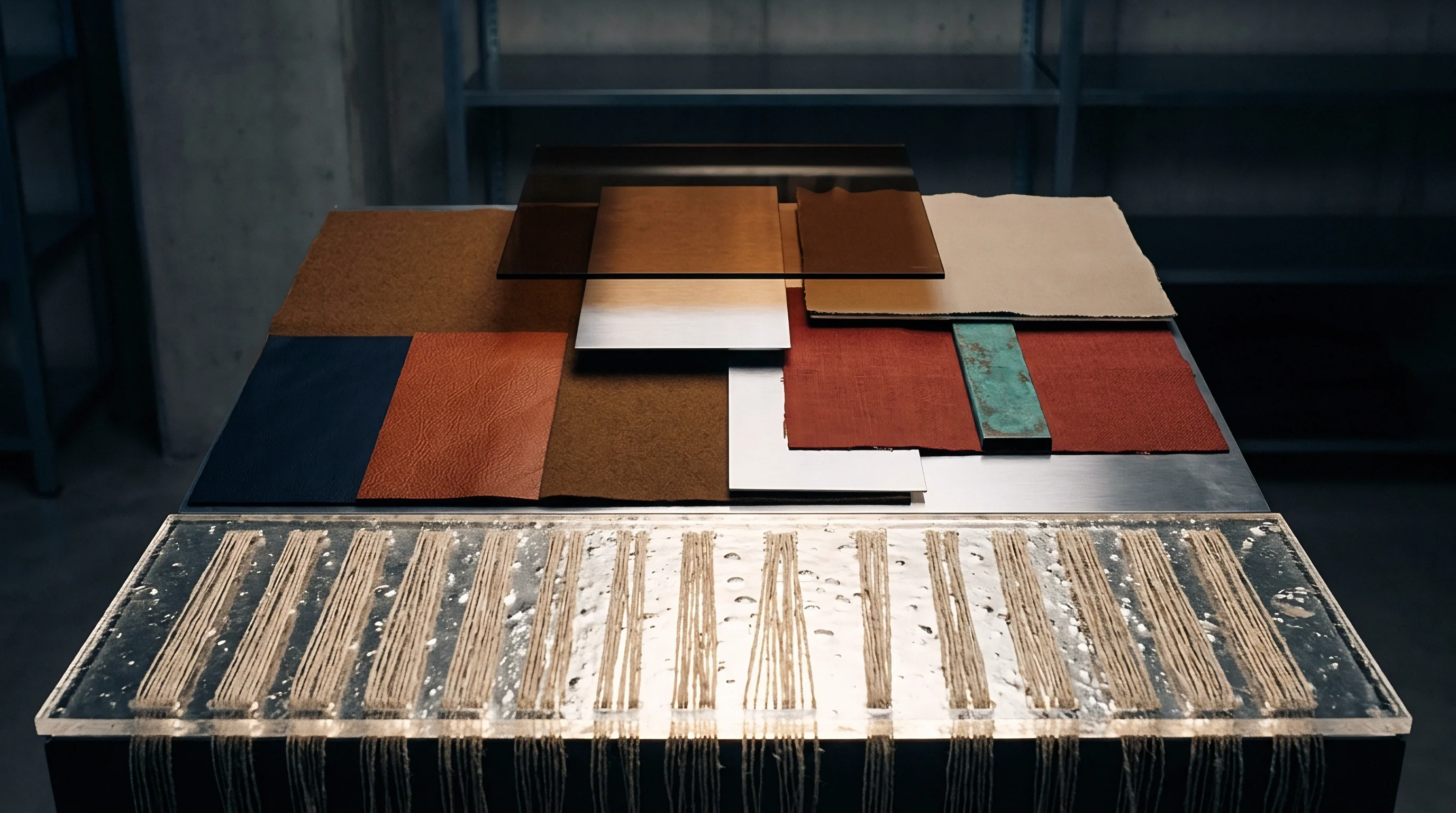
Draft
Wet spinning long-staple flax aligns the fibers parallel to one another, producing a yarn with high initial stiffness. Hot water baths held at 60 to 70 degrees Celsius soften the pectin middle lamella during spinning, letting technical fiber bundles slide past each other before twist is inserted. As the strand dries, the pectin matrix recrystallizes, binding the elementary fibers into a dense, smooth cross-section with a high initial modulus.
The resulting tensile response is quite rigid: initial Young’s modulus ranges from 18 to 35 GPa, while elongation at break rarely exceeds 2.5 percent.
Under high warp tension on the loom, this structure behaves very differently from ring-spun cotton or synthetics. Cotton relies on convolution friction and high twist to resist tensile loads, yielding under strain through slip and uncoiling. Wet-spun flax carries load almost entirely along the longitudinal axis of its alpha-cellulose microfibrils, which align within 10 degrees of the fiber axis.
Tensile stress from the let-off mechanism and back-rest roller transfers straight into these cell walls, and because long-staple flax has little viscoelastic damping capacity, it absorbs energy with minimal plastic elongation.
Static strain highlights the structural difference between wet-spun and dry-spun linen yarns. Dry-spun yarns retain unaligned fiber clusters and higher intra-yarn void volume, extending under load as the fiber network settles. Wet-spun yarns start with high baseline alignment that prevents this settling.
Applied tensile stress instead concentrates at pre-existing flaws, node intersections, and weak spots along the flax stem walls, so high baseline tension creates localized stress peaks rather than uniform strain across the yarn cross-section.
Flax fibers align directly along the load axis.
The draft applied during roving attenuation sets baseline diameter uniformity and dictates where thin places accumulate. A wet-spun yarn of 40 Lea (approximately 14.7 Tex) produced at a draft ratio of 12 shows higher tensile variation than the same count spun at a draft ratio of 18 from combed, double-hackled line stock. Under static loads above 15 cN/tex, thin places undergo localized necking; because the ultimate fibers cannot stretch to redistribute tension, local stress quickly exceeds the shear strength of the pectin bonds.
| Yarn Type and Count | Static Warp Tension (cN/tex) | Tenacity at Break (cN/tex) | Elongation at Break (%) | Initial Modulus (GPa) |
|---|---|---|---|---|
| Wet Spun Long Flax 26 Lea (22.7 Tex) | 8.5 | 32.4 | 1.85 | 24.2 |
| Wet Spun Long Flax 26 Lea (22.7 Tex) | 14.0 | 30.1 | 1.52 | 28.6 |
| Wet Spun Long Flax 40 Lea (14.7 Tex) | 8.5 | 34.8 | 1.65 | 27.1 |
| Wet Spun Long Flax 40 Lea (14.7 Tex) | 14.0 | 31.2 | 1.38 | 31.4 |
| Dry Spun Flax Tow 26 Lea (22.7 Tex) | 8.5 | 18.2 | 2.80 | 12.5 |
| Dry Spun Flax Tow 26 Lea (22.7 Tex) | 14.0 | 15.6 | 2.10 | 14.8 |
| Data recorded under standard atmosphere conditions (20 degrees Celsius, 65 percent relative humidity) following ISO 13934 gauge length guidelines. | ||||
Higher static warp tension shifts the stress-strain curve toward abrupt failure. At lower tension, wet-spun flax absorbs temporary load surges through slight elastic bending within the fiber bundles. Once baseline warp tension rises past 12 cN/tex on the loom beam, however, that baseline load consumes over 40 percent of total breaking strength before the shed even opens, leaving little safety margin for dynamic shedding and beat-up spikes.
The elementary flax cells, or ultimates, measure 10 to 40 millimeters long and 15 to 30 micrometers across. They are bound together end-to-end and side-by-side by a non-cellulosic middle lamella of hemicellulose, lignin, and calcium pectate complexes. High warp tension induces shear stress along these lamella boundaries.
If applied stress exceeds the shear strength of the intercellular pectin layer, individual ultimate fibers slip past one another at a microscopic scale, degrading yarn cohesion without immediate surface breaks and causing unexplained strength loss downstream.
Dynamic tension testing shows a sharp drop in work-to-break values once baseline tension crosses critical operational thresholds. Work-to-break ~ the area under the force-elongation curve ~ falls off rapidly because extension capacity drops faster than tenacity increases under strain hardening. The yarn stiffens, transferring shock loads from loom components directly into the crystalline core of the fiber bundle.
Whether the non-cellulosic pectin matrix undergoes irreversible micro-cracking prior to macro-yield under static tensions above 16 cN/tex remains an open question in technical flax processing.
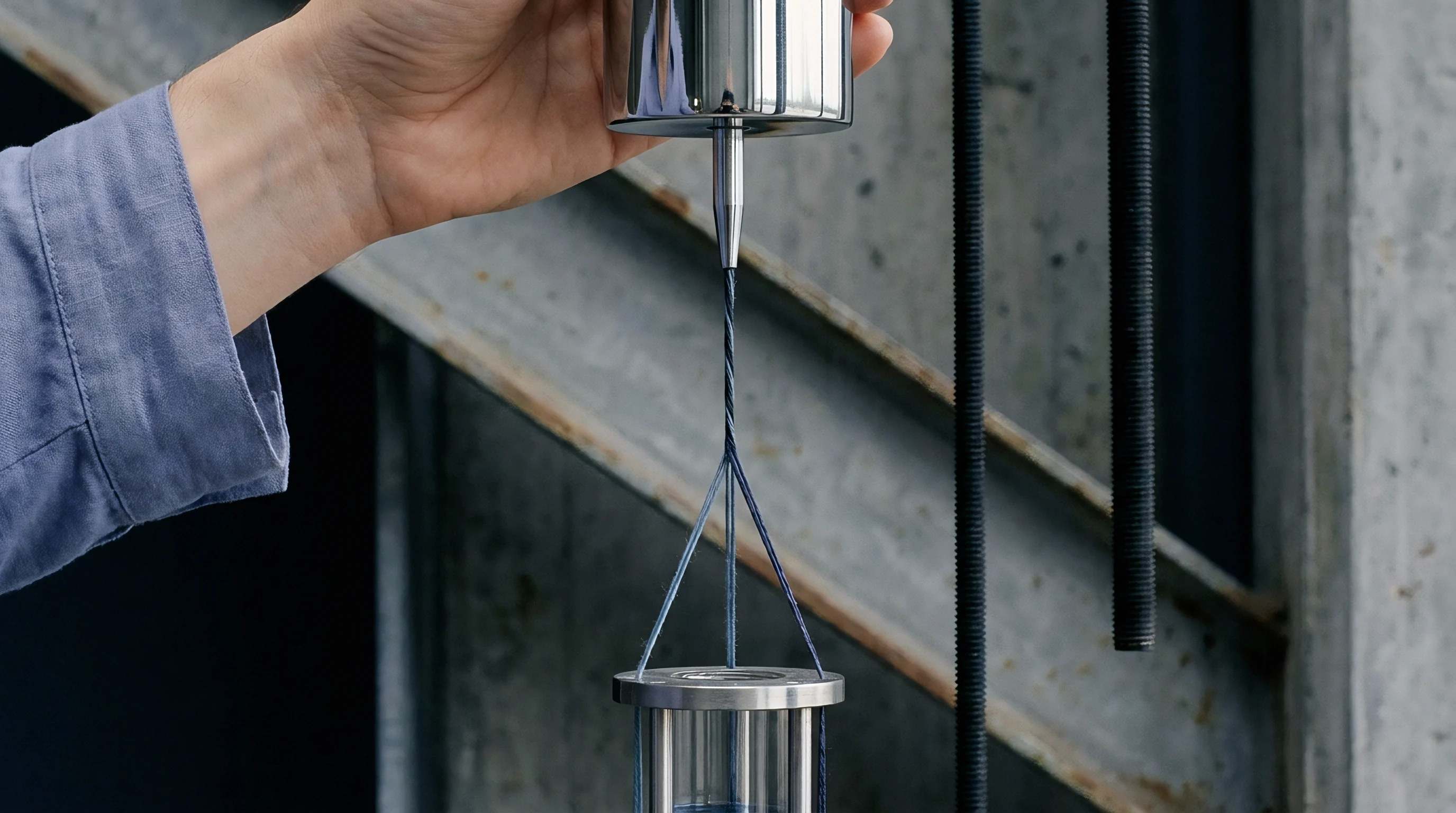
Fatigue
Loom operation subjects every warp end to cyclic strain as the heald frames form the shed. At speeds of 350 to 500 picks per minute on modern rapier looms, a single warp end undergoes up to eight extension peaks per second. Each shed opening adds dynamic stretch onto existing static tension.
For wet-spun flax, with total extensibility under 2 percent, a shed opening requiring even 0.8 percent extension takes up a huge fraction of the material’s total deformation capacity.
Cyclic strain gradually degrades linen warps through sub-critical structural damage. Flax fibers do not exhibit classic plastic yielding; instead, repeated loading cycles induce micro-fissures in the crystalline cellulose and micro-cleavage at middle lamella pectin interfaces. Successive shed movements widen these internal defects, steadily reducing the load-bearing cross-section.
Tenacity degrades over thousands of cycles even when peak dynamic tension stays well below single-end static breaking force.
High stiffness limits total extension.
Ambient moisture strongly influences cyclic strain survival. Cellulose microfibrils absorb water, which acts as an internal plasticizer within amorphous regions and inter-fiber pectin boundaries. Running a loom shed at 65 percent relative humidity leaves the yarn dry and brittle, accelerating fatigue under high tension.
Raising shed humidity to 75 or 78 percent brings fiber moisture regain to roughly 8 to 10 percent, restoring pectin flexibility. This internal lubrication allows minor micro-slippage without immediate fracture, extending dynamic fatigue life by up to 300 percent.
Relative humidity levels maintained between 75 and 78 percent increase the dynamic fatigue life of wet spun long flax warp yarns by 300 percent compared to performance at 65 percent relative humidity under identical 14 cN/tex baseline warp tension.
Peak tensile stress rises sharply.
Dynamic strain frequency interacts directly with the fiber bundle’s viscoelastic response. At high weaving speeds, peak tension during shed opening lasts less than 50 milliseconds. Long-staple flax relaxes stress slowly compared to synthetics, so rapid tension spikes cannot dissipate before the next peak arrives.
Baseline tension within the warp end steps up incrementally ~ a phenomenon called tension buildup ~ leaving the yarn under an effective static load well above the nominal let-off setting.
Mechanical fatigue under cyclic shedding creates specific vulnerabilities in wet spun flax that trigger shed stoppages:
- Inter-bundle Pectin Shear ~ Degradation of the intercellular calcium pectate layer under high frequency tension cycles, causing micro-fiber separation without complete yarn rupture.
- Flexural Stress Concentration ~ Bending stresses generated where the yarn passes through the dropper and heald eye, combining with axial tension to cause localized transverse micro-cracking.
- Abrasive Surface Splitting ~ Friction against neighbouring warp ends during shed crossover stripping surface fibers and forming small slub-like fiber balls that jam the reed.
- Fibrillar Creep Rupture ~ Time-dependent extension of alpha-cellulose chains under persistent high baseline tension leading to sudden low-load failure during beat-up.
Accumulated dynamic strain also distorts yarn geometry. As cyclic loads pull the bundle tight, the natural twist angle flattens, reducing internal friction that binds short fibers. Thin zones in wet-spun yarn lose structural stability quickly under high-frequency loading; once twist stability fails in a thin spot, tension shifts entirely to the parallel core fibers, causing immediate rupture during shed opening.
Back-rest roller setup alters the shape of the dynamic tension pulse. A spring-loaded compensating back-rest roller dampens peak tensile forces during shed opening by moving forward as the heald frames lift, absorbing part of the required geometric warp extension. Lowering tension peak amplitude preserves pectin bond integrity, delaying micro-cracking and extending warp fatigue life.
Excessive static tension accelerates dynamic strain damage, rendering any flax warp run above critical yield thresholds vulnerable to structural degradation regardless of machine dampening mechanisms.
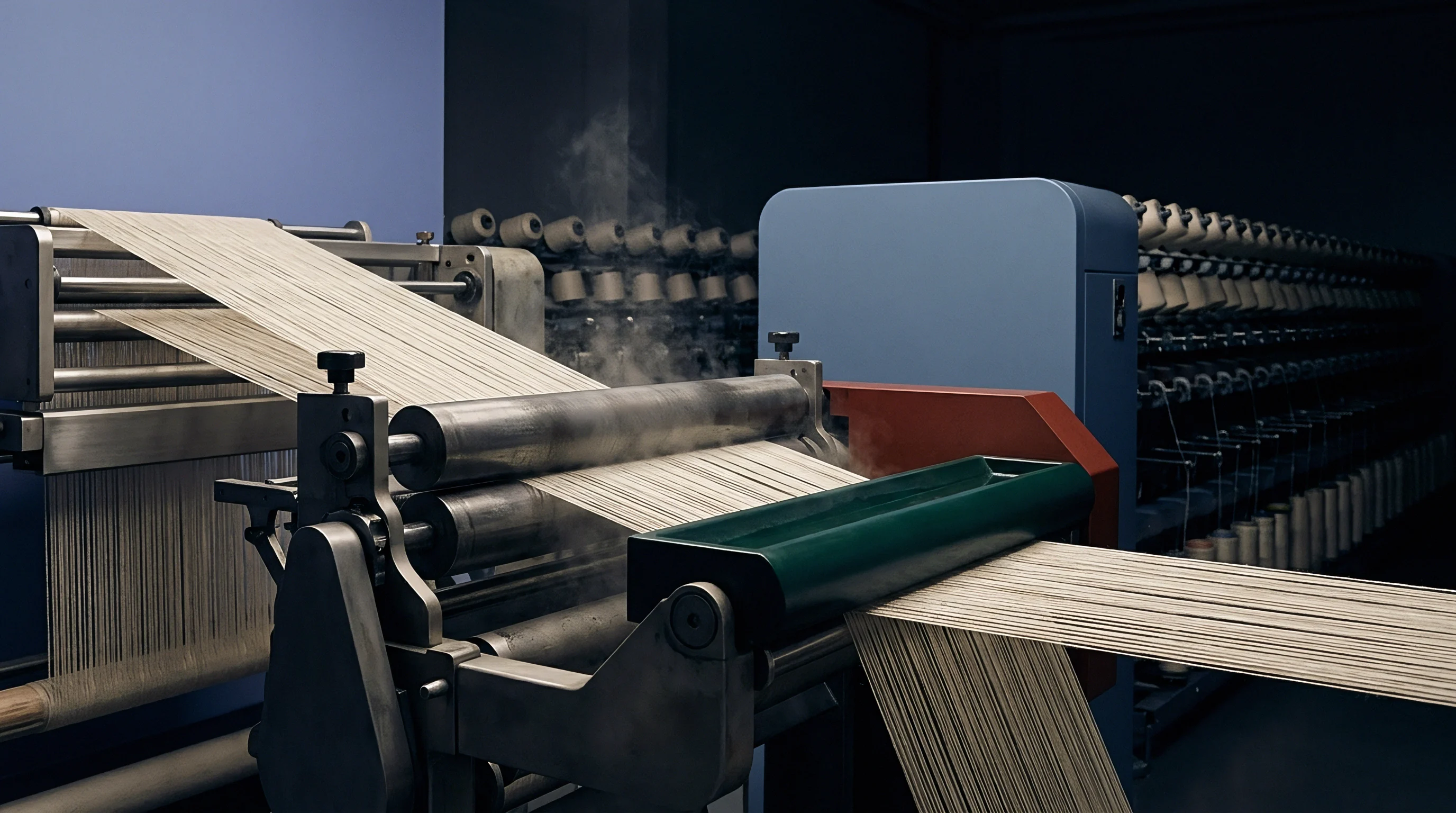
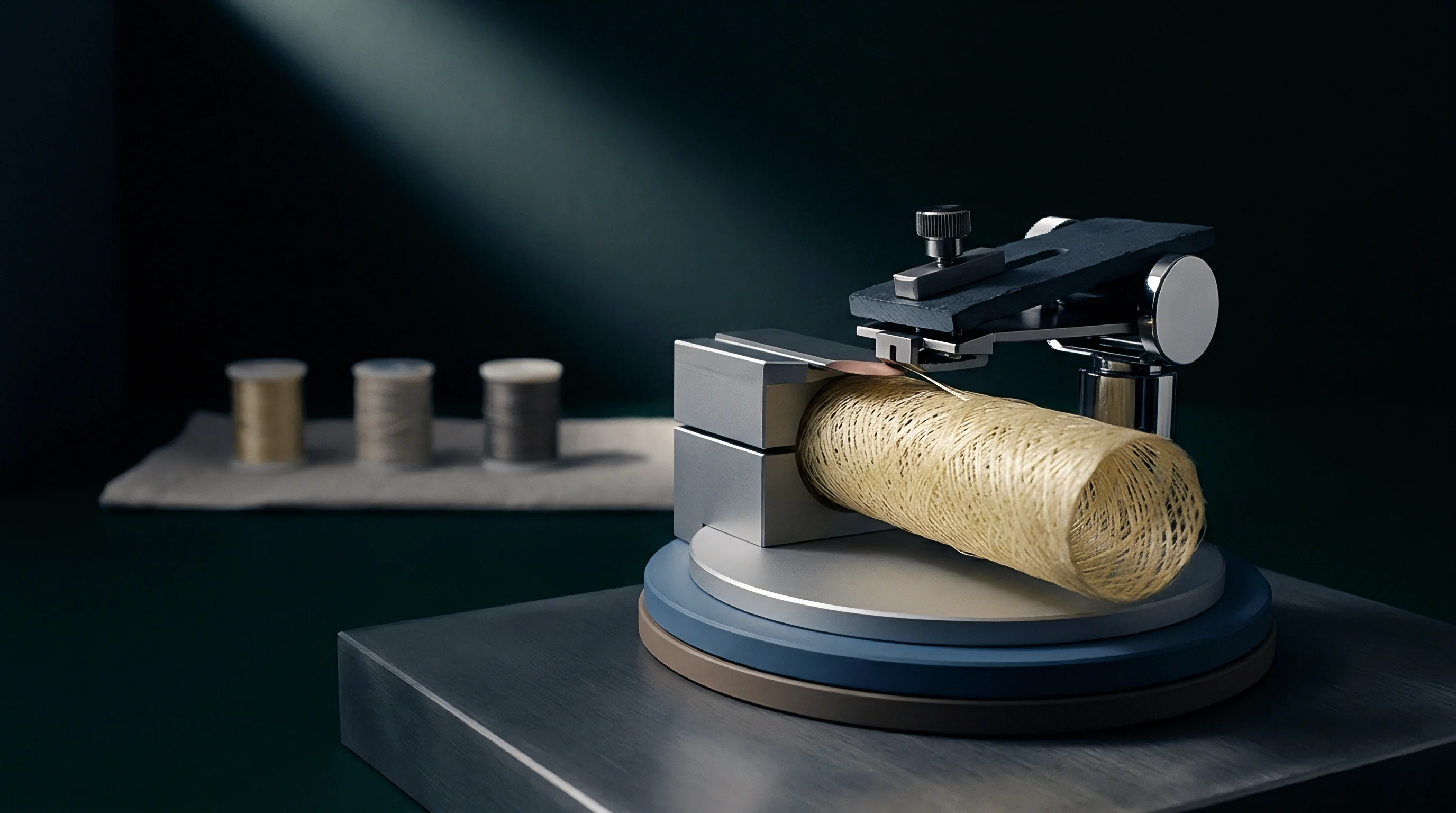
Sizing
Protective chemical coatings applied during warp preparation alter the surface mechanics of wet-spun flax to withstand loom tension. The yarn presents a smooth, dense surface with low porosity, absorbing liquid less readily than soft cotton yarns. Sizing agents cannot deeply penetrate the dense core of long-staple flax; instead, they coat the exterior perimeter.
Forming a uniform, cohesive surface film is the main defense against abrasive dynamic stress during weaving.
Formulations for sizing wet-spun flax prioritize film elasticity, surface adhesion, and moisture retention. Straight starch coatings form stiff, brittle films that crack under the cyclic bending of high-tension shedding. Adding carboxymethyl cellulose, hydrolyzed polyvinyl alcohol, or acrylic co-polymers turns the brittle outer shell into a flexible membrane that extends with the flax strand without flaking off.
A fractured sizing film exposes raw flax fibers directly to metallic friction from droppers and heald eyes.
Unprotected fiber friction causes loom stops.
Sizing pick-up requires tight control. Applying more than 12 percent dry pick-up by weight makes the yarn overly rigid and stiffens bending. Rigid warp ends resist flexing around the back-rest roller and through heald eyes, generating transverse shear forces that break the yarn core under high tension.
Conversely, size pick-up below 6 percent leaves surface fibers exposed, allowing shedding friction to raise hairiness, split technical fiber bundles, and cause warp tangles.
Contractual sizing clauses must mandate a minimum film elongation at break of 4.5 percent under standard atmospheric conditions to prevent shell-cracking on wet spun flax warps subject to shedding tensions above 12 cN/tex.
Residual moisture heavily influences yarn flexibility.
Controlling moisture inside the sized warp beam is critical for loom performance. Drying warp sheets too aggressively calcifies the starch-pectin matrix, permanently impairing the natural elastic recovery of wet-spun flax. Keeping residual moisture between 8 and 10 percent maintains structural flexibility and ensures optimal film adhesion.

Why Does Warp Tension Peak during Shed Opening?
Separating the heald frames increases the physical path length of the warp sheet between the back-rest roller and cloth fell. As upper and lower shed lines reach maximum lift, the yarn path elongates by a precise distance set by shed height and frame depth. Wet-spun flax has minimal elastic stretch, so this geometric lengthening instantly translates into a sharp rise in internal tensile load, forcing strain directly into loom spring mechanisms or into the yarn matrix itself.
Preparing wet spun flax warps for high-tension weaving requires execution of a multi-stage sizing protocol to balance coat strength and elastic compliance:
- Pre-wetting the warp sheet in a hot water bath at 85 degrees Celsius to swell the natural flax pectin structures and improve chemical penetration.
- Passing the yarn through a low-viscosity polymer size liquor held at 90 degrees Celsius with squeeze roller pressure calibrated to achieve an 8 percent dry size pick-up.
- Drying the warp sheet across multi-cylinder drying cans using a graded temperature profile starting at 110 degrees Celsius and dropping to 70 degrees Celsius to prevent film vitrification.
- Applying a post-sizing moisture re-conditioning mist to restore internal fiber moisture regain to 9.5 percent before beam winding.
- Winding the warp beam under constant, load-cell-controlled winding tension to ensure uniform beam density and prevent embedded warp ends.
Sizing performance is evaluated by measuring abrasion resistance under simulated loom tension. Standard tests place sized yarn ends under static tension of 15 cN/tex while subjecting them to cyclic friction from reciprocating steel pins. Unsized wet-spun flax yarn usually breaks within 150 cycles under these conditions; a properly sized yarn withstands over 1,500 cycles before film breakdown and rupture.
Improper squeeze roller calibration during a high-count linen warp preparation run caused size film vitrification, resulting in widespread micro-shelling and a total batch scrap charge on 4,000 metres of greige linen.

Crimp
Interlacing geometry between warp and weft establishes structural equilibrium in woven cloth under tension. In high-density linen constructions like plain weave hotel bedding or heavy duck, warp tension during beat-up determines how much crimp transfers into weft yarn relative to warp. High warp tension flattens the path of warp ends, forcing the weft to bend entirely around taut warp strands.
This shift alters fabric mechanical performance, dimensional stability, and cover factor.
High tension on wet-spun flax warps reduces warp crimp below 2 percent while weft crimp rises past 8 to 10 percent. Lacking structural elasticity, a low-crimp warp thread carries external tensile loads applied along the fabric length almost immediately. This creates high initial tensile strength along the warp direction of the finished cloth but impairs tear strength: taut warp threads cannot gather together under tearing forces, causing individual ends to snap sequentially under low shear stress.
Weave structure directly dictates tension limits a warp sheet can endure. Plain weave 1/1 has the maximum number of interlacing points per square centimeter, generating intense warp-to-weft friction during beat-up. Every pick insertion requires warp threads to cross over, creating high cyclic friction and peak beat-up resistance.
Twill 2/2 and satin 5/1 weaves reduce interlacing points, allowing warp ends to slide more freely during shedding and beat-up, which lowers peak dynamic tension forces on individual ends.
| Weave Structure | Ends x Picks per cm | Warp Tension Setting (cN/tex) | Resulting Warp Crimp (%) | Resulting Weft Crimp (%) | Peak Beat-up Load (N/m width) |
|---|---|---|---|---|---|
| Plain Weave 1/1 | 24 x 20 | 10.0 | 3.2 | 6.8 | 2,400 |
| Plain Weave 1/1 | 24 x 20 | 16.0 | 1.4 | 9.2 | 3,800 |
| Twill 2/2 | 32 x 26 | 10.0 | 4.1 | 5.5 | 1,850 |
| Twill 2/2 | 32 x 26 | 16.0 | 1.9 | 7.8 | 2,900 |
| Satin 5/1 (Warp Face) | 40 x 28 | 10.0 | 5.8 | 3.9 | 1,400 |
| Satin 5/1 (Warp Face) | 40 x 28 | 16.0 | 2.4 | 6.1 | 2,100 |
Cover factor calculations must account for yarn flattening caused by high warp tension. As tension pulls wet-spun flax ends tight against the weft, circular yarn cross-sections deform into ellipses. This flattening increases the projected width of the warp end, slightly boosting warp cover factor while reducing fabric thickness.
The mathematical Pierce cover factor equation, assuming rigid circular yarns, under-predicts actual cloth cover when warp tension exceeds 14 cN/tex.
Beat-up impact forces increase at higher tensions.
Managing the crimp differential between warp and weft is essential to avoid defects like reed marks and weft-way bowing. When warp tension is set too high to achieve dense pick packing, rigid wet-spun warp ends resist lateral movement of the weft pick. The beat-up force needed to push the pick into the fell increases exponentially, driving mechanical shock loads back into the reed, sley drive, and main loom bearings, accelerating machine wear and causing vibration-induced weaving faults.
Intercellular pectin locks the yarn structure together.
Off-loom relaxation alters fabric geometry as warp tension dissipates upon cloth take-up and doffing. Freed from loom tension, wet-spun flax warps undergo immediate elastic recovery followed by delayed viscoelastic relaxation. Warp crimp increases slightly as internal stresses redistribute into the weft.
If the fabric was woven under extreme warp tension, this elastic recovery causes high longitudinal contraction, severe greige width loss, and high residual wash shrinkage.
Warp crimp suppression under elevated loom tension permanently locks structural strain into wet-spun flax fabrics, decreasing tear resistance while elevating longitudinal wash shrinkage.
Excessive tension suppresses warp crimp permanently.
Balancing warp and weft crimp requires adjusting back-rest roller height relative to the shed line. Setting an asymmetric shed, where the upper warp sheet carries lower tension than the bottom sheet during shedding, lets warp ends shift slightly during beat-up. This asymmetric tension distribution lets the weft pick interlace cleanly without requiring extreme baseline warp tension, preserving yarn structural integrity and lowering beat-up forces.
High end-break rates on the 50-count linen damask run were attributed to inconsistent yarn twist rather than the 40 percent increase in static warp tension applied to prevent weft-way bowing.
Rupture
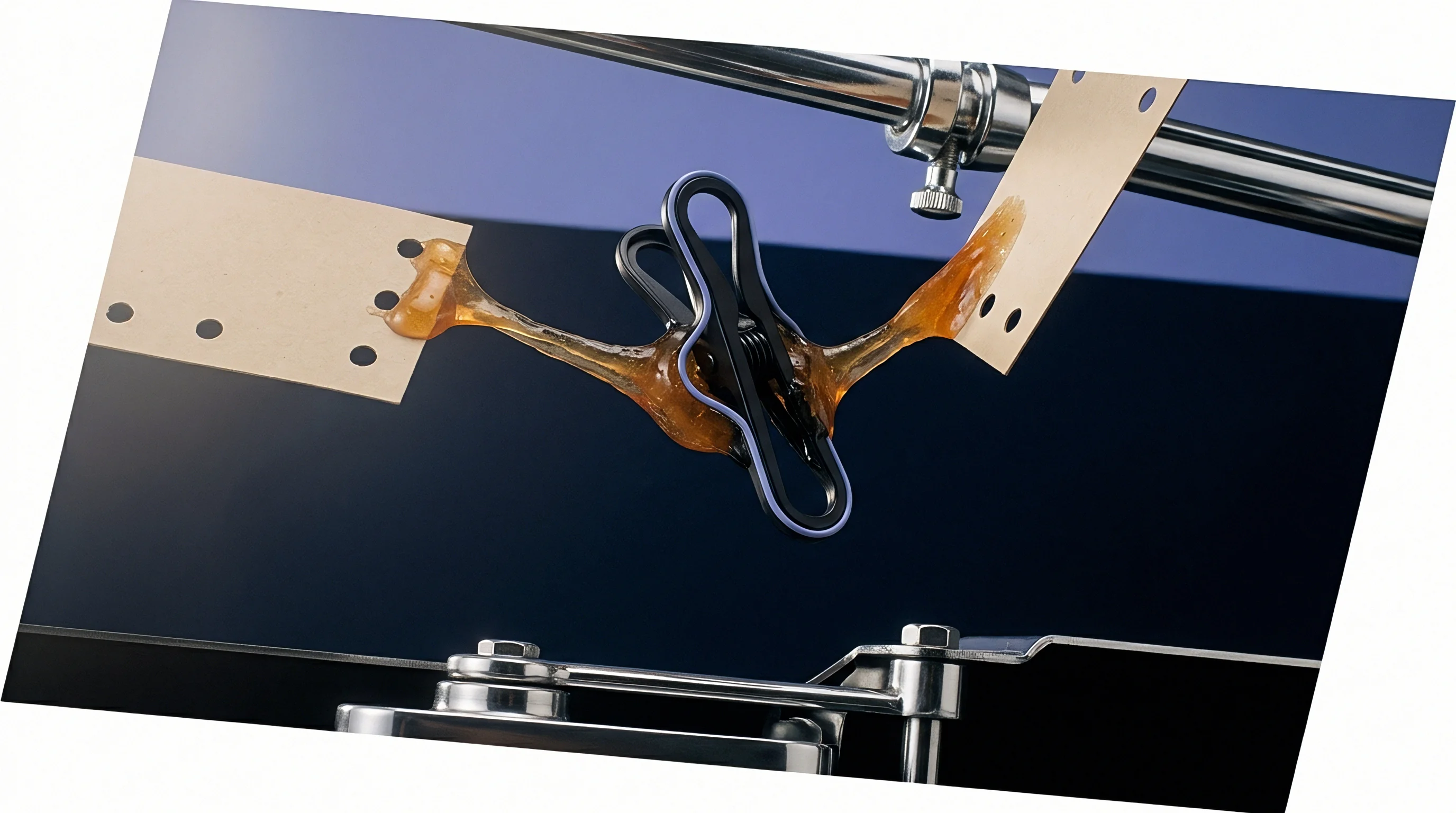
Catastrophic failure of wet-spun flax yarn under high warp tension occurs when localized stresses exceed the mechanical strength of the weakest technical fiber bundle within the strand. Unlike synthetic filaments that exhibit necking and plastic drawing before failure, wet-spun flax exhibits brittle fracture. The yarn snaps instantly with minimal necking, leaving fibrous break ends that can tangle adjacent warp ends and cause secondary breaks across the warp sheet.
Weibull distribution parameters describe the statistical probability of yarn breakage under high warp tension regimes. Because flax is a natural bast fiber with inherent length, fineness, and wall-thickness variations, its strength distribution displays a wide scatter band. The Weibull modulus for wet-spun flax typically falls between 4.5 and 6.5; a lower modulus indicates a higher frequency of localized weak points along the yarn.
Increasing static warp tension shifts working stress higher up the Weibull curve, sharply raising the likelihood of end breaks in low-strength segments.
Evaluating warp end tension capacity requires auditing critical physical criteria prior to loom beam loading:
- Single-End Tenacity Variance ~ Verifying that the coefficient of variation for yarn breaking force remains below 9.0 percent across thirty test breaks per bobbin.
- Imperfection Index Thresholds ~ Quantifying thin places below minus 50 percent to ensure low-mass segments do not collapse under baseline tension loads.
- Sizing Penetration Uniformity ~ Confirming complete outer rim polymer encapsulation without core saturation via microscopic cross-sectional staining.
- Residual Moisture Content ~ Measuring yarn beam moisture regain to verify levels remain within the 8.5 to 10.0 percent optimal plasticization window.
- Dynamic Fatigue Limit Verification ~ Testing yarn samples on a cyclic extension rig at 12 cN/tex to guarantee survival past 100,000 tension cycles without structural unravelling.
Microfibrils slip under high shear stress.
Frictional contact points along the yarn path act as stress multipliers, transforming average warp tension into extreme localized peak loads. Droppers, heald eyes, and reed dents apply transverse compression and abrasive shear forces directly to the taut flax strand. A steel heald eye with surface roughness exceeding 0.4 micrometers creates high frictional drag.
Under baseline warp tensions of 14 cN/tex, localized friction at the heald eye can elevate instantaneous dynamic tension between the heald frame and reed by an additional 30 to 50 percent, triggering immediate breakage.
Viscoelastic creep develops during machine idle time.
Stop-marks and density variations stem directly from lost yarn elasticity when high-tension warps sit idle during loom stoppages. When a loom stops for a weft break or warp failure, taut wet-spun flax ends remain under static tension. Over extended stoppages, viscoelastic creep causes permanent micro-elongation in the static yarn sheet.
When the loom restarts, this stretched segment shows altered crimp capacity and dye affinity, leaving a visible horizontal band across the cloth known as a starting mark.
Precise warp path alignment prevents physical degradation.
Minimizing mechanical end breakage under high tension demands precise alignment of the loom warp path. Misaligned reed cap channels, uneven dropper rails, or worn heald frame guides force individual warp ends to rub against metallic components. Eliminating sharp deviation angles between let-off beam and cloth fell reduces transverse shear forces, preserving maximum tensile resistance in the flax bundle for shedding movements.
Standard purchasing contracts for technical linen greige mandate that warp end break frequencies shall not exceed 1.2 breaks per 100,000 picks, with supplier financial penalties applying to all loom stops exceeding this threshold.
Yield
Commercial viability in weaving wet-spun flax cloth depends on maximizing loom shed efficiency while minimizing total yarn breakage rates. Weaving machines represent capital-intensive investments where capacity is measured in billable loom hours per square metre of fabric. Operating at elevated warp tensions allows mills to produce high-density constructions, but running tension levels too close to the yarn failure limit causes end breaks to escalate.
Frequent machine stoppages destroy shed operating efficiency, raising unit production costs and negating the commercial benefit of high-density cloth specs.
Loom efficiency calculations must account for the direct labor and opportunity costs of repairing broken warp ends. A skilled weaver requires 45 to 90 seconds to locate, piecen, and re-thread a snapped wet-spun flax warp end through dropper, heald eye, and reed dent. During this downtime, the loom sits idle, losing billable pick insertions.
If high warp tension causes warp break rates to climb from 0.5 to 3.5 breaks per 100,000 picks, actual shed efficiency drops from 88 percent to less than 68 percent.
| Baseline Warp Tension (cN/tex) | Loom Speed (PPM) | End Break Rate (per 100,000 picks) | Shed Efficiency (%) | Daily Output per Loom (Metres) | Landed Metre Manufacturing Cost (USD) |
|---|---|---|---|---|---|
| 8.0 | 450 | 0.3 | 92.4 | 248.5 | 3.12 |
| 11.0 | 450 | 0.6 | 89.1 | 239.6 | 3.24 |
| 13.5 | 450 | 1.2 | 84.2 | 226.4 | 3.42 |
| 15.0 | 450 | 2.8 | 72.5 | 194.9 | 3.98 |
| 17.0 | 450 | 5.4 | 54.0 | 145.2 | 5.34 |
The economic balance point shifts based on yarn quality, size application, and machine speed. Operating high-count wet-spun linen warps at baseline tension settings above 14 cN/tex increases manufacturing cost per metre by over 25 percent due to downtime losses. Mill managers often attempt to compensate for tension-induced end breaks by lowering loom speed from 450 to 350 picks per minute.
While reducing speed lowers dynamic impact forces during shedding and beat-up, it reduces daily linear metre output, increasing the fixed overhead loom-hour cost allocated to each finished bolt.
Quantifying landed cloth cost requires evaluating yarn scrap rates generated during high-tension warp setup and weaving runs. High end-break rates generate localized fabric defects, pick-finding marks, and short-length bolts that sell at steep commercial discounts. Overall loom shed efficiency dropped by 4.2 percent during a 40-count wet-spun linen trial when static warp tension was increased to achieve a dense 28 picks per centimetre specification.
Calculating the optimal warp tension regime involves balancing structural density requirements against machine hourly run rates. Procurement contracts that specify dense linen constructions must recognize the shed capacity constraints involved in processing low-elasticity bast fibers under high mechanical strain. Establishing realistic warp tension limits protects yarn structural integrity, preserves loom shed productivity, and delivers consistent fabric performance across production lots.