Structural Mechanics of Coarse Linen Weaves and Yarn Crimp
Coarse linen structural performance depends on controlling asymmetric yarn crimp interchange caused by high flax flexural rigidity under beat-up tension.
Dock
Raw Flax Bales and Heavy Yarn Linear Density
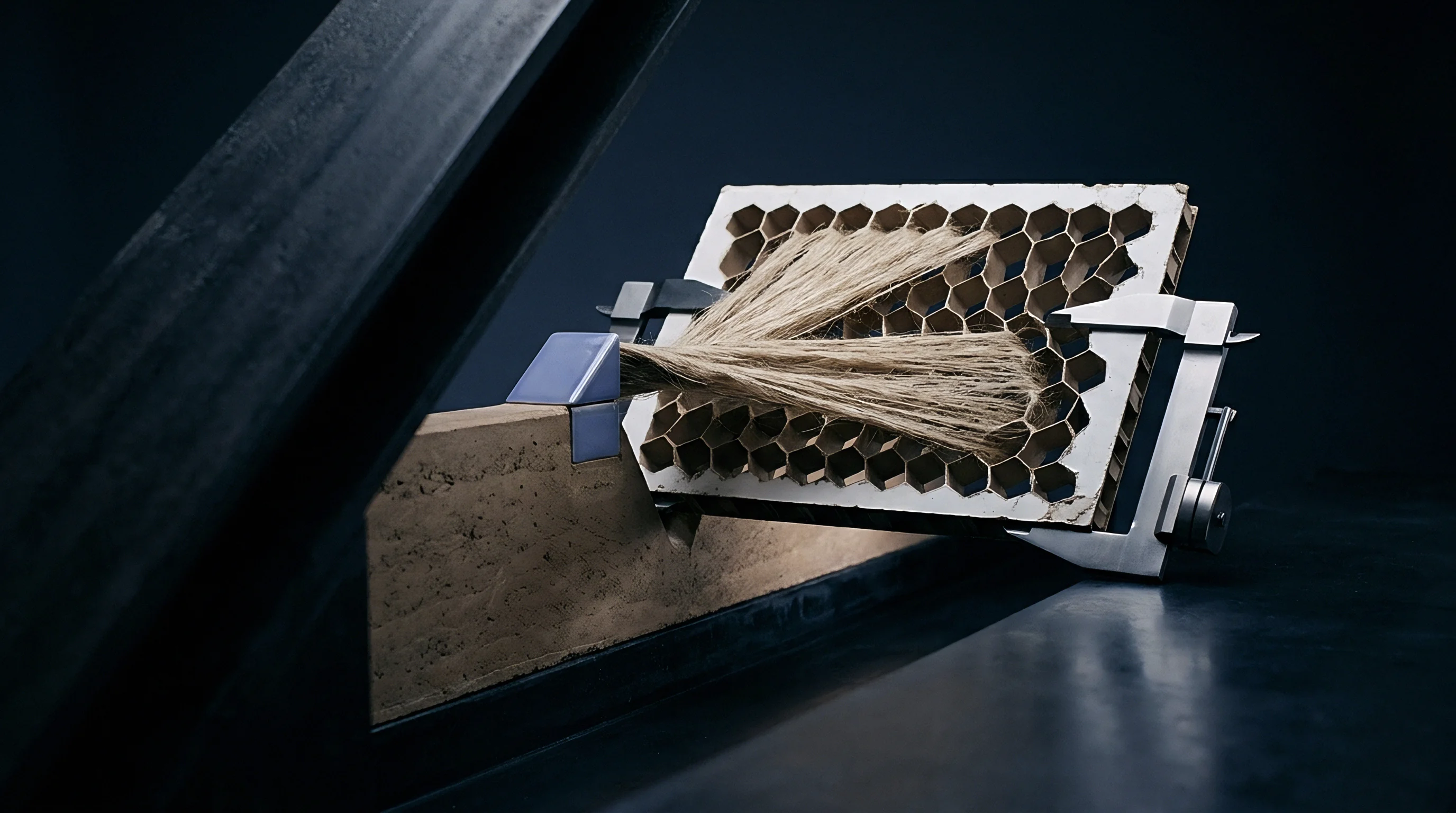
Coarse linen yarn arriving at the mill gate behaves quite differently from fine cotton or continuous filament synthetics. Spun from long bast fibers of Linum usitatissimum, coarse yarns spanning linear densities from Nm 2.5 (400 tex) to Nm 10 (100 tex) combine high flexural rigidity with pronounced cross-sectional asymmetry. Wet-spun bundles hold fiber alignment through pectinate cohesion, whereas dry-spun coarse yarns show wide spatial variance in mass per unit length.
Tensile behavior is characterized by high initial modulus, low elongation at break (typically between 1.5% and 2.8%), and negligible elasticity. Feeding these stiff strands into weaving preparation under standard cotton warp tensions invariably causes issues, as conventional calculations ignore the mechanical resistance coarse bast fibers exert during interlacing.
Linear mass irregularity in coarse flax originates during scutching and hackling. Thick places and slubs in an Nm 4 yarn introduce localized bending stiffness spikes that disrupt how warp and weft nest during shed formation. These structural variations produce uneven crimp across the loom width long before the cloth reaches finishing.
Fiber Rigidities and Crimp Generation Mechanisms
Yarn crimp refers to the waviness warp and weft threads take on as they interlace in a woven matrix. Under ISO 7211-3, crimp percentage c measures the percentage difference between the straightened length of yarn L extracted from a fabric sample and the distance l between its ends in the intact cloth:
c = fracL – ll × 100
In fine cotton weaves, flexible threads yield readily under beat-up pressure, distributing crimp evenly between warp and weft. Coarse linen does not behave this way; high flexural rigidity prevents easy cross-sectional deformation. The yarn acts more like a semi-rigid rod than a pliable thread.
Because warp threads run under substantial loom tension, they force the stiffer, unconstrained weft picks to do most of the bending, skewing crimp distribution heavily toward the weft.
Heavy flax yarns resist spatial displacement during interlacing, concentrating crimp into the active thread system experiencing the lowest longitudinal strain.
Balancing this crimp interchange requires careful positioning of the warp line geometry and backrest roller height. If the warp line sits dead level, beat-up forces compress the pick without deflecting the warp, yielding a flat fabric prone to low cover factor and severe seam slippage. Raising the backrest roller introduces differential tension between upper and lower shed lines during beat-up, forcing the warp threads to bend around the heavy weft and restoring balance to the structural crimp.
Inbound Quality Thresholds for Coarse Bast Yarns
Spinning defects directly compromise loom efficiency and the finished structural integrity of the cloth. Incoming yarn lots therefore warrant thorough inspection before beams are wound.
- Mass Variance Coefficients ~ Yarn mass variation exceeding an 18% CV over 100-metre test lengths creates structural streaks and variable crimp levels across the fabric width.
- Flexural Modulus Spikes ~ Unretted bast fiber bundles elevate yarn stiffness, preventing proper crimp interchange and inducing reed wire wear during beat-up.
- Slub Frequency Limits ~ Thick places exceeding 250% of nominal yarn diameter cause shed clearance failures and warp end breakages in heavy reed setts.
- Moisture Content Equilibrium ~ Flax yarns packed below 8% regain suffer severe fiber brittleness, yielding unpredictable crimp values compared to standard 12% moisture regain processing conditions.
When yarn lots fail to meet these physical parameters, the resulting defects stem from spinning control rather than the baseline agricultural tolerances inherent to unrefined flax strands.

Interlock
Peirce Geometric Models Applied to Coarse Linen Architecture
Structural mechanics for coarse woven linen adapt the classical Peirce geometric model to account for non-circular yarn cross-sections. In heavy linen, the assumption of circular geometry fails completely. Under beat-up impact and relaxation during wet finishing, stiff bast yarns flatten into elliptical or race-track profiles.
The flattening factor e changes the weave geometry by reducing the centerline displacement d between intersecting thread axes, which alters thread spacing and recalculates cover factor.
In a plain weave 1/1 architecture, theoretical packing density depends on thread spacing p, yarn diameter d, and thread bending angle thη. As the yarn count coarsens from Nm 10 down to Nm 3, thread diameter increases from 0.31 mm to 0.58 mm. Bending an Nm 3 flax yarn to an angle of 30 degrees demands four times the beat-up force required for an Nm 10 yarn at the same thread density.
This flexural resistance strictly limits the maximum ends and picks per centimetre achievable before structural jamming occurs.

Weave Structural Variations and Interlacing Dynamics
Weave selection determines how internal stresses, float lengths, and crimp capacity distribute through the cloth. Mechanical response shifts substantially when moving from tight plain weaves to loose float structures.
| Weave Structure | Yarn Count (Nm) | Sett (Ends/cm x Picks/cm) | Warp Crimp (%) | Weft Crimp (%) | Fabric Mass (g/m²) |
|---|---|---|---|---|---|
| Plain Weave 1/1 | Nm 4.0 / Nm 4.0 | 10.0 x 9.5 | 8.5 | 4.2 | 495 |
| Matt/Basket 2/2 | Nm 4.0 / Nm 4.0 | 14.0 x 13.0 | 5.2 | 3.1 | 670 |
| Twill 2/2 | Nm 4.0 / Nm 4.0 | 12.5 x 11.5 | 6.8 | 4.8 | 590 |
| Crowfoot / Drill 3/1 | Nm 4.0 / Nm 4.0 | 15.0 x 12.0 | 7.4 | 2.9 | 665 |
Plain weave 1/1 maximizes structural interlock per unit area. Each warp end alternates over and under the weft at every cross, producing high crimp interchange, firm hand, and considerable beat-up resistance. Basket weaves (2/2 matt) pair adjacent yarns, doubling float length and halving the interlacing points.
This relieved geometry allows higher reed density without inducing premature yarn jamming at beat-up.

Float Length Mechanics and Fabric Geometry
Longer floats in twills and satins allow yarn cross-sections to retain their ellipticity without severe axial distortion. In a 2/2 twill woven from coarse Nm 4 linen, warp ends float over two picks before interlacing under the third. With fewer bends per unit length, internal shear stresses remain lower.
Warp crimp drops below plain-weave levels at identical thread counts, though resistance to seam slippage falls along with it.
Increasing float length lowers internal yarn bending resistance, shifting structural performance from crimp-dominated tension resistance to friction-dominated slip resistance.
Under longitudinal tension, coarse twill floats pull flat before the interlock points pack tightly against neighbouring threads. This initial extension occurs under modest loads; once structural crimp pulls out, the modulus steepens sharply as axial loading of the flax fibers takes over. Float lengths must be matched to intended tensile exposures to avoid permanent fabric deformation.
Specifying an overly tight plain weave with heavy linen yarns generates severe reed marks, yarn fibrillation, and warp end breaks whenever beat-up force surpasses the structural deflection limit of crossing yarns.


Warp

Loom Shed Mechanics and Tension Management
Weaving heavy linen calls for dedicated loom settings capable of handling sustained warp tension and high beat-up resistance. Operating tension runs between 120 grams and 220 grams per end on coarse counts like Nm 3 to Nm 6. This level of pull is necessary to clear the shed when hairy bast fibers interlock in the reed.
Insufficient tension lets ends cling during shedding, provoking rapier tape entry collisions or double picks.
High warp tension leaves little compliance during shed closure. When the reed drives the inserted pick home to the fell, the warp experiences an acute dynamic tension spike. These peaks can exceed static baseline values by 80%, bringing ends close to their tensile limit.
Absorbing these shocks requires fine coordination between shed closure timing, backrest travel, and let-off motion response.

Shed Timing and Beat-Up Dynamics
The timing of shed closure relative to beat-up governs final crimp distribution. Early shed timing crosses the warp before the reed reaches front dead center, trapping the inserted pick at the fell and holding it under mechanical pressure during beat-up. This clamping forces crimp into the warp ends and flattens the weft into an elliptical cross-section.
- Mechanical let-off monitors warp beam diameter and adjusts brake torque continuously to maintain set tension values within plus or minus 2%.
- Heald frames split the warp sheet into upper and lower lines, creating an asymmetric clearance gap of at least 85 millimetres for rapier insertion.
- Rapier heads carry the heavy weft pick through the open shed, maintaining controlled yarn tension to prevent loop formation at the selvage.
- Early shed timing crosses warp ends 15 millimetres before the reed reaches front dead center, locking the weft pick at the cloth fell.
- The heavy reed strikes the locked pick, executing beat-up and forcing crimp interchange between warp and weft systems.
- Take-up rolls draw finished greige cloth away at a synchronized speed, fixing picks per centimetre and structural crimp ratios.
Late shed timing holds the shed open until the reed beats up and starts its return stroke. Without the fell clamping down on the pick, the stiff flax springs back. That elastic recovery cuts into finished picks per centimetre, lowers weft crimp, and leads to greater width shrinkage during wet finishing.
Beat-Up Force Deflection and Structural Jamming
Jamming occurs when thread density approaches the point where warp bending angles cannot increase without exceeding the crushing strain of the yarn. At this limit, beat-up resistance spikes without packing additional picks into the cloth. The reed strikes the fell without advancing the weave, generating fell bounce where the entire fabric sheet oscillates back and forth across the loom bed.
The crimp differential between warp and weft directly dictates how far the cloth narrows once off the loom.
In heavy linen constructions, high warp tension during weaving flattens the ends, holding warp crimp down near 3% while forcing the weft to bend around them at 10% or higher. When greige fabric releases from loom tension at the take-up roll, stored elastic strain relaxes over the following 24 hours.
This high weft crimp draws the selvages inward, causing substantial fabric width contraction. A cloth woven at 160 centimetres reed width with a 12% weft crimp shrinks down to 140.8 centimetres off-loom greige width. Wet processing relaxes internal stresses further, driving additional width loss as warp ends shrink and force weft crimp higher.
Calculating total crimp take-up beforehand is essential for establishing correct reed widths before warping.
Variable yarn lubricity across flax dye lots introduces persistent crimp imbalances that standard adjustments on rapier shedding frames cannot fully offset.
Density

Predictive Fabric Weight and Crimp Calculations
Engineering coarse linen fabrics requires mathematical modeling to hit specified finished weight targets (g/m²). Standard textile equations must incorporate both warp crimp cw and weft crimp cf alongside yarn linear counts and thread densities. The theoretical mass per square metre M of greige linen cloth is calculated as:
M = left( fracE × (1 + fraccw100)Nw × 100 right) + left( fracP × (1 + fraccf100)Nf × 100 right)
Where E equals warp ends per centimetre, P equals weft picks per centimetre, Nw is warp yarn count in metric (Nm), and Nf is weft yarn count in metric (Nm). Ignoring yarn crimp underestimates final fabric mass by 8% to 15%, leading to underspecified fabric weight and non-compliant delivery lots.
Worked Construction Matrix and Shrinkage Analysis
Three worked construction specifications illustrate structural crimp behavior for coarse flax yarns under typical loom settings.
| Parameter / Metric | Option A (Plain Heavy) | Option B (Twill Medium) | Option C (Hopsack Heavy) |
|---|---|---|---|
| Yarn Count Warp (Nm) | Nm 3.0 (333 tex) | Nm 6.0 (166 tex) | Nm 2.5 (400 tex) |
| Yarn Count Weft (Nm) | Nm 3.0 (333 tex) | Nm 6.0 (166 tex) | Nm 2.5 (400 tex) |
| Reed Width (cm) | 172.0 | 168.0 | 175.0 |
| Target Off-Loom Width (cm) | 152.0 | 155.0 | 150.0 |
| Warp Sett (Ends/cm) | 8.5 | 13.0 | 7.0 |
| Weft Sett (Picks/cm) | 8.0 | 12.0 | 6.5 |
| Assumed Warp Crimp (cw) % | 9.2 | 6.5 | 5.8 |
| Assumed Weft Crimp (cf) % | 11.6 | 7.7 | 14.2 |
| Calculated Greige Mass (g/m²) | 573 | 418 | 592 |
| Total Width Shrinkage % | 11.62 | 7.74 | 14.28 |
In Option C (Hopsack Heavy), the heavy Nm 2.5 yarn introduces severe flexural stiffness. Because heavy warp ends are held under taut tension, weft crimp climbs to 14.28%. This draws the fabric in from 175 centimetres in the reed down to 150 centimetres off the loom.
Managing that magnitude of width shrinkage requires precise beam allowance planning to avoid yield shortfalls.

Specifications for Structural Crimp Tolerances
Setting engineering limits for crimp parameters protects buyers against off-spec weight and unstable fabric performance.
- Yarn Count Verification Method ~ ISO 2060 specifies yarn count determination from packages, requiring moisture correction factors for bast fibers before entering mass balance equations.
- Crimp Extraction Testing ISO 7211-3 ~ Straightening tension applied during crimp testing must be standardized to 0.5 cN/tex for coarse linen strands to avoid artificial fiber elongation during measurement.
- Off-Loom Contraction Tolerances ~ Finished cloth width tolerances must sit within plus or minus 1.5% of specified bill of materials targets to ensure downstream cutting table efficiency.
- Mass Per Unit Area Standard ISO 3801 ~ Test specimen cutouts must undergo 24-hour conditioning at 20 degrees Celsius and 65% relative humidity prior to gravimetric weighing.
A contract clause specifying ISO 7211-3 crimp extraction under a fixed 0.5 cN/tex tension prevents mills from artificially stretching unraveled yarns to inflate measured crimp figures.
When greige inspection reveals weight deviations exceeding 5% of calculated values, the buyer retains rights under standard purchase conditions to re-test yarn counts and crimp fractions at the supplier’s expense.


Audit
Off-Loom Vs Finished Crimp Relaxation Mechanics
Greige linen straight off the loom is far from mechanical equilibrium. Warp ends remain extended from tension, and crossing points stay locked under strain. Once the fabric enters scouring at 90 degrees Celsius, those stress concentrations dissipate.
Hydrogen bonds within the cellulosic bast matrix hydrolyze and reform, allowing bent yarns to relax into lower-energy configurations.
This thermal-aqueous relaxation drives significant dimensional movement. Warp crimp expands while cloth density increases. A greige fabric showing 8% warp crimp off the loom commonly advances to 13% after washing and tumble drying.
This shift draws the fabric in lengthwise and swells yarn diameters, noticeably raising final cover factor.

ISO Tensile Drop and ASTM D5430 Fault Grading
Higher yarn crimp lowers initial tensile modulus. In ISO 13934-1 strip tensile tests, high-crimp linen exhibits prolonged low-load extension while yarn undulations pull straight. Initial resistance comes from inter-yarn friction rather than direct fiber tensile loading; only after structural crimp is exhausted does the curve steepen toward ultimate fiber failure.
Coarse linen weaves are prone to localized defects caused by flax slubs and beat-up irregularities. Mills grade these under the ASTM D5430 four-point system per 100 square metres.
- Heavy Slubs and Thick Places ~ Defect lengths under 75 millimetres incur 1 point; slubs spanning 75 to 150 millimetres incur 2 points; slubs over 300 millimetres incur 4 points.
- Reed Marks and Warp Lines ~ Continuous warpwise streaks caused by damaged reed wires incur 4 points per metre of affected fabric length.
- Double Picks and Shedding Faults ~ Two weft picks trapped in a single shed incur 2 points when localized, or 4 points if spanning across the entire woven width.
- Loose Crimp and Floats ~ Uninterlaced thread loops exceeding 10 millimetres incur 3 points due to severe snagging risk during garment assembly.
Uneven crimp across the roll also disturbs liquor pickup during continuous padding. Flatter sections absorb less dye than high-crimp zones, creating shaded bands that compromise cutting yields.
A simple rule of thumb holds that every one percent rise in finished warp crimp increases total fabric washing shrinkage by an equal one percent in the warp direction.

Invoice
Loom-Hour Cost Economics and Yield Calculations
Producing heavy linen weaves means balancing yarn mass, machine speed, and warp run length against capacity costs. Modern rapier looms running fine cotton easily maintain 600 picks per minute (PPM). Coarse linen, by contrast, caps operating speeds at 180 to 280 PPM to prevent end breaks under heavy beat-up loads, effectively doubling machine time per linear metre.
Shed efficiency also drops with coarser counts. Stops to clear slubs or untangle hairy ends bring operational efficiency down from a normal 92% to between 78% and 82%. That lost runtime increases the fixed loom-hour overhead charged against every finished metre.
Commercial Capacity Impact of Heavy Weave Beat-Up
Capacity allocation depends heavily on weave construction and target crimp levels. The table below outlines operational parameters across varying pick densities for coarse bast yarns.
| Yarn Count (Nm) | Pick Density (Picks/cm) | Loom Speed (PPM) | Shed Efficiency (%) | Output (Metres/Loom-Hour) | Estimated Shed Cost (USD/m) |
|---|---|---|---|---|---|
| Nm 3.0 | 9.5 | 200 | 78.5 | 7.95 | 4.40 |
| Nm 4.0 | 11.0 | 230 | 82.0 | 8.23 | 4.25 |
| Nm 6.0 | 13.5 | 260 | 86.5 | 10.00 | 3.50 |
| Nm 8.0 | 16.0 | 300 | 89.0 | 10.01 | 3.50 |
As pick density increases from 9.5 picks/cm to 16.0 picks/cm, output drops while machine time per metre expands. Weaving heavy Nm 3.0 linen consumes substantial shed capacity per metre produced. High warp crimp requires additional raw yarn length per linear metre of woven cloth.
A construction with 10% warp crimp requires 1.10 metres of warp yarn per metre of greige fabric. When raw flax yarn prices sit high, this crimp take-up adds significant direct raw material cost per square metre.
Arriving at an accurate landed cost per metre requires folding warp take-up losses, off-loom width shrinkage, and shed capacity charges directly into the yarn baseline. Bidders who neglect weft crimp contraction underestimate both the required reed width and the raw yarn weight, eroding operating margin to cover raw material deficits.