Quantifying Structural Shear Resistance and Tear Strength Losses under Industrial Cross-Linking Routes
Industrial cross-linking locks flax yarn mobility, driving tear strength losses up to forty percent while restricting structural shear resistance.
Resin
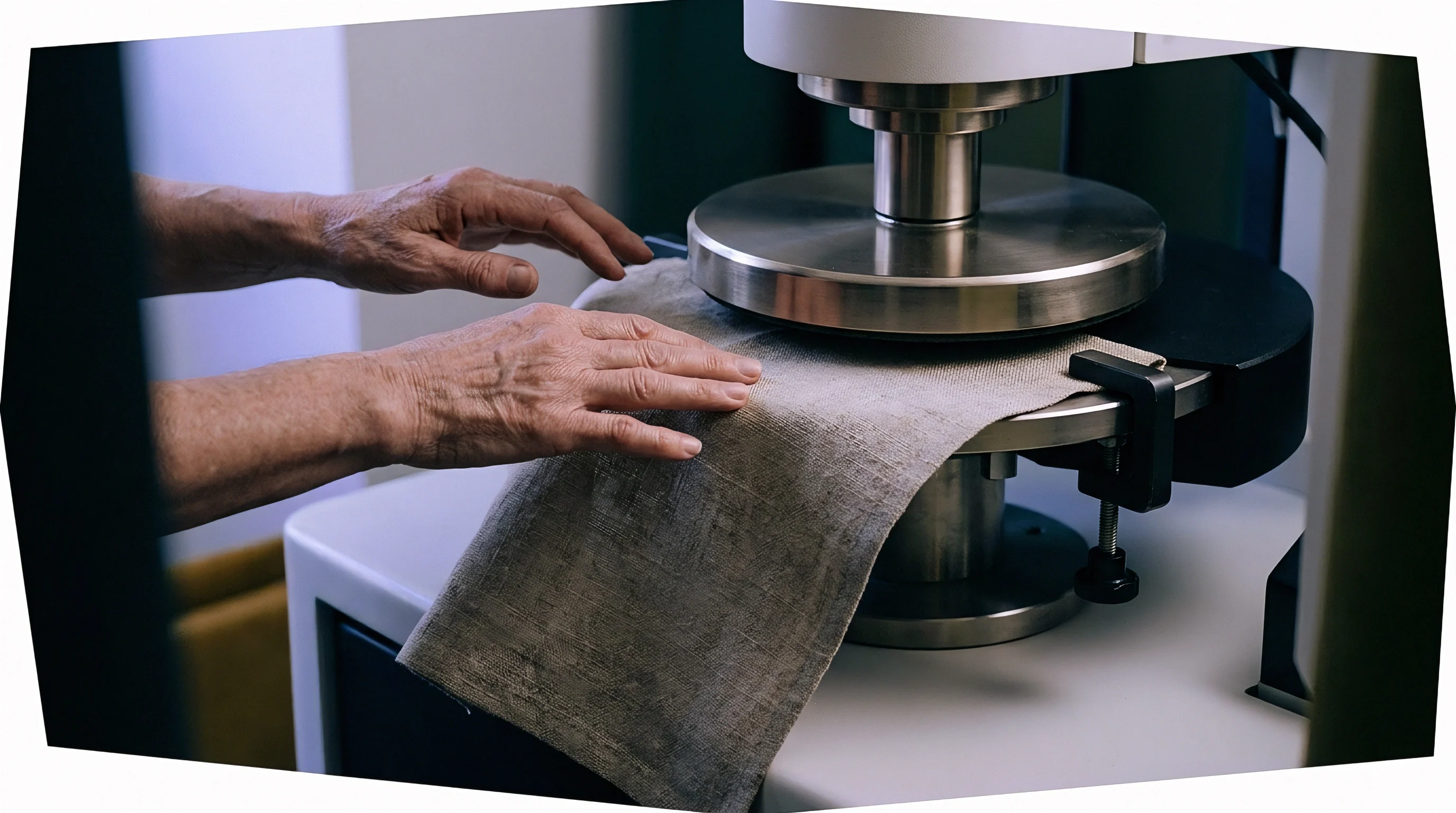
Cellulosic fibers absorb liquid chemistry rapidly during pad-dry-cure operations. Cross-linking targets the amorphous regions of the cellulose polymer chain, swapping loose hydrogen bonds for covalent bridges between adjacent chains. Dimethyloldihydroxyethyleneurea, modified low-formaldehyde reactants, and polycarboxylic acids like 1,2,3,4-butanetetracarboxylic acid lock this supramolecular network in place to prevent wet wrinkling.
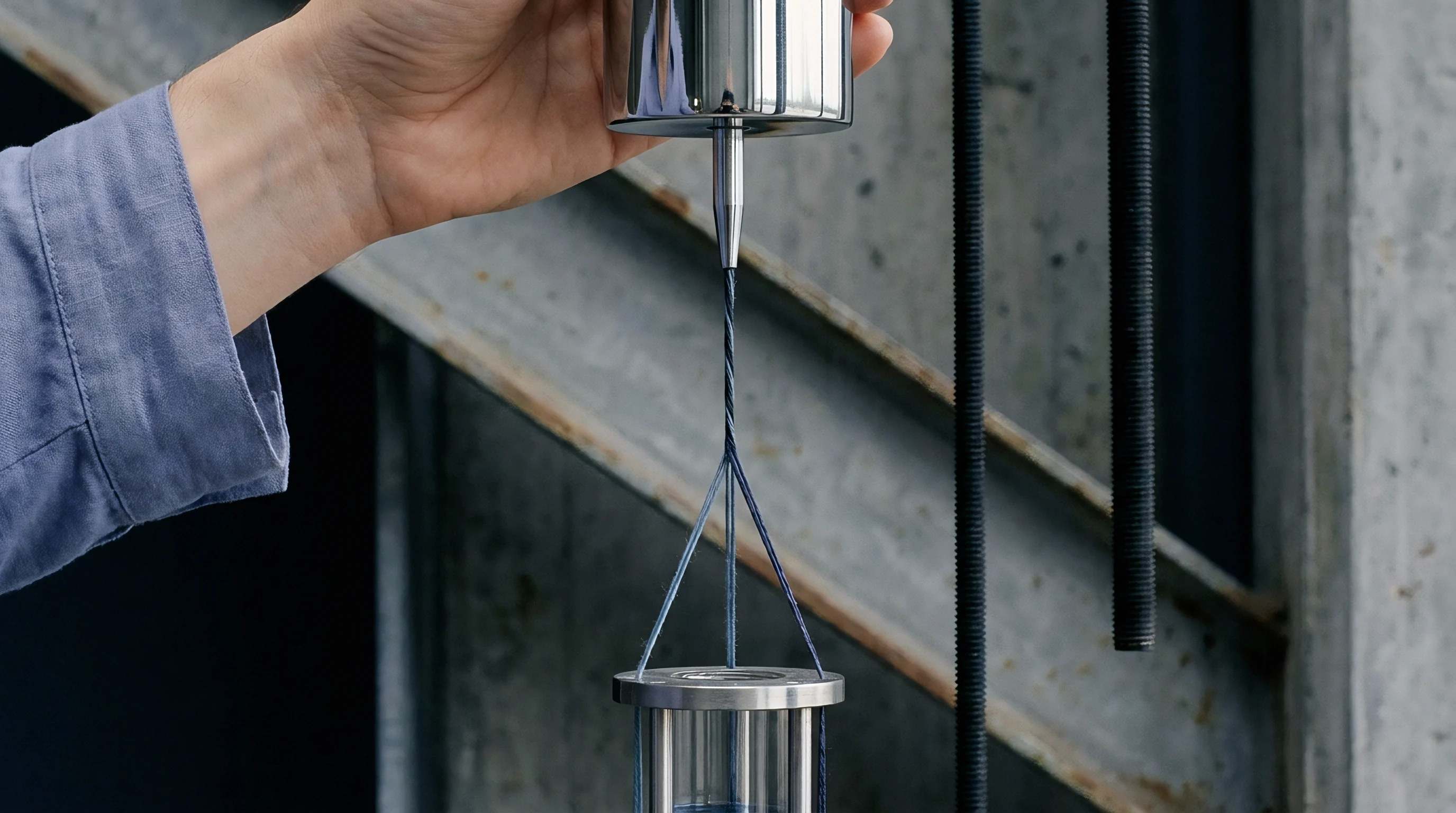
That molecular stability exacts a physical penalty inside the yarn. By restricting how individual elementary flax fibers slide past one another under load, covalent cross-linking alters intra-yarn friction and whole-fabric deformation.
Cellulosic hydroxyl accessibility dictates the reaction profile during resin application. Acid-catalyzed condensation of thermosetting compounds forms ether linkages with hydroxyl groups at the C-2, C-3, and C-6 positions of the anhydroglucose units. These rigid chemical bridges decrease intrinsic elongation across the bast fiber bundle.
Untreated flax relies on hydrogen bond rearrangement to absorb strain, work-hardening under tension. Post-treatment cross-linking suppresses that strain accommodation, turning a flexible fiber assembly brittle. Reduced polymer chain mobility propagates up into yarn dynamics, shifting how loads distribute under stress.
Padding pickup rates govern the reagent gradient across the yarn cross-section. High pickup combined with rapid initial drying drives chemical migration toward the fabric surface, forming a dense shell of cross-links. This concentrates mechanical stress at the outer yarn perimeter during bending and shear.
Low pickup application paired with controlled infrared pre-drying yields a more uniform cross-link distribution from core to mantle. That uniformity helps avoid localized stress points, though total loss of fiber extensibility is still set by aggregate chemical add-on.
Industrial cross-linking pathways degrade the woven structure through distinct chemical and physical mechanisms:
- DMDHEU Etherification locks adjacent cellulose chains via short monomeric bridges, reducing elongation at break while building high dry and wet wrinkle recovery angles.
- Polycarboxylic Acid Esterification uses multi-carboxyl reactants to form ester links under sodium hypophosphite catalysis; this preserves tensile strength in cotton but triggers severe acid hydrolysis in bast fibers if bath temperatures run too high.
- Glyoxal Condensation Routes build direct dialdehyde cross-links without formaldehyde emissions, though aggressive acid reaction kinetics cause localized embrittlement in the crystalline cell walls.
- Polyurethane Elastomeric Top-Coating deposits a flexible surface film that partially restores tear propagation resistance by spreading point forces across adjacent warp ends, without forming chemical bonds inside the crystalline fiber core.
Acid catalysts in thermosetting resin baths create a second path for strength loss. Magnesium chloride and zinc nitrate release hydrogen ions during high-temperature curing, triggering cellulose depolymerization through acid hydrolysis. Flax is especially sensitive to acid degradation because of the non-cellulosic hemicelluloses and pectins in its middle lamella.
These pectic substances break down rapidly under prolonged exposure to low pH at curing temperatures above 150 degrees Celsius. This chain scission cuts intrinsic fiber tenacity before any mechanical force ever touches the cloth.
Chemical cross-linking reduces the ultimate elongation of individual flax fibers while increasing internal bundle friction.
Cross-linking alters how the fabric matrix dissipates energy. In untreated linen, applied stress makes fibers slip within the yarn bundle, converting work into frictional heat. Covalent locking stops this slippage.
Loads applied to treated fabric can no longer spread across hundreds of micro-lumens, concentrating instead along rigid crystalline planes. Ultimate tensile strength drops in direct proportion to cross-link density, forcing a hard trade-off between crease resistance and structural integrity.
Attributing tear and shear degradation entirely to acid hydrolysis during curing implies that buffered catalysts or non-acidic routes will eliminate strength loss, though physical locking remains the primary driver.
Shear
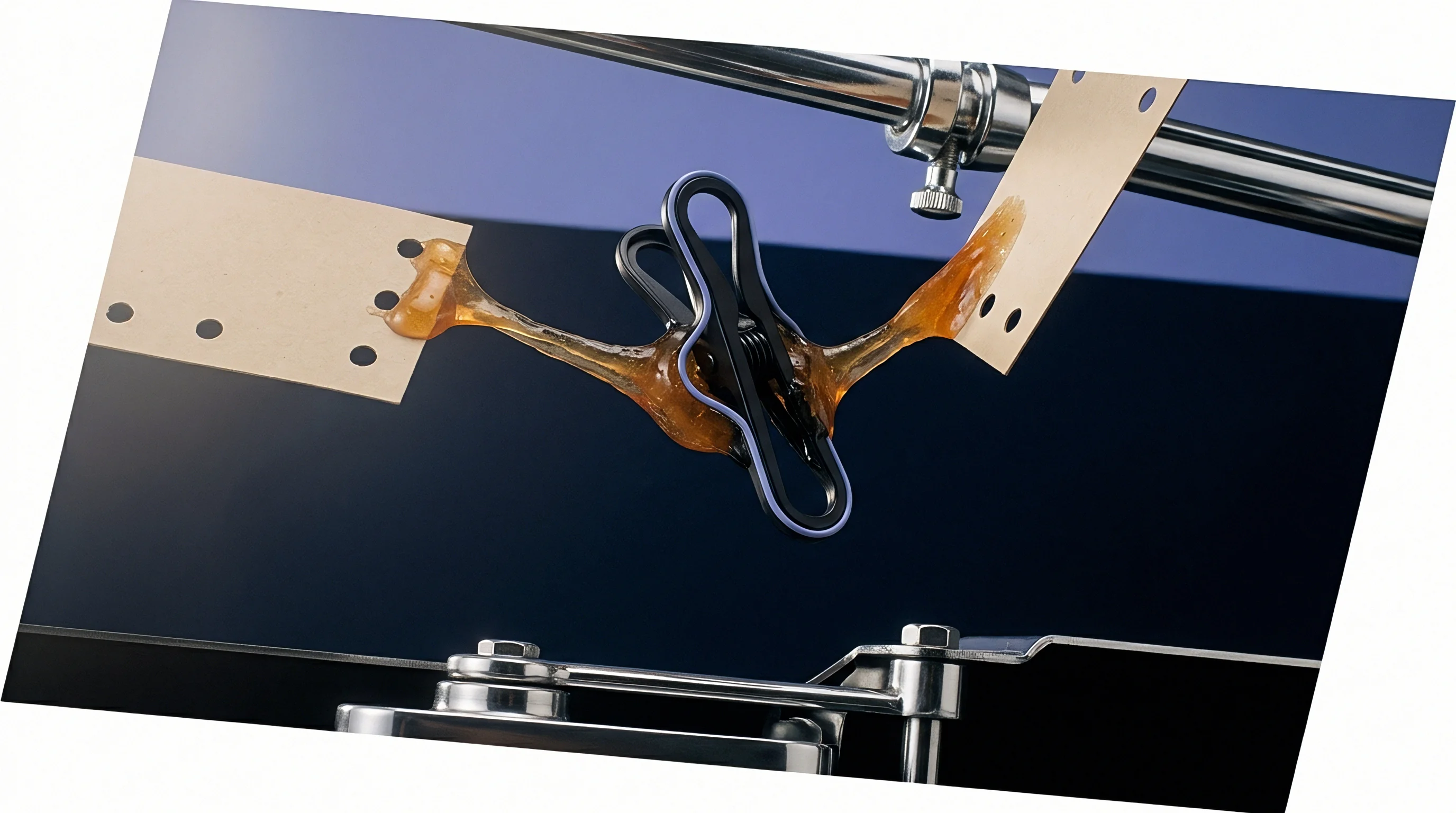
Structural shear resistance reflects how well a woven fabric deforms angularly without buckling out of plane or jamming locally. Under bias strain, intersecting warp and weft threads pivot at their crossovers. In greige or washed linen, that rotation meets little resistance until yarns hit their mechanical packing limit ~ the locking angle.
Resin finishing changes this kinematic behavior by depositing polymer residue directly into thread intersections and stiffening yarn surfaces with cross-links.
Rotational friction at crossover points controls initial shear rigidity. Untreated linen has a low initial shear modulus, letting it conform easily to 3D contours. As the finish cures, resin bridges form across warp-weft contact zones to create a micro-bonded lattice.
Moving the fabric angularly then requires rupturing or distorting these inter-yarn resin bridges. Post-treatment shear rigidity measured on a Kawabata Evaluation System climbs sharply; the fabric loses its fluid drape and feels stiff and boardy under light handling.
The table below details structural metrics and shear resistance values for untreated and cross-linked linen constructions tested at standard laboratory conditions (20 degrees Celsius, 65 percent relative humidity):
| Weave Structure | Yarn Count (Nm) Warp/Weft | Sett (Ends x Picks / cm) | Untreated Shear Rigidity G (N/m·rad) | Treated Shear Rigidity G (N/m·rad) | Untreated Hysteresis 2HG5 (N/m) | Treated Hysteresis 2HG5 (N/m) |
|---|---|---|---|---|---|---|
| 1/1 Tabby Plain | 26 / 26 | 18.5 x 18.5 | 1.45 | 4.12 | 2.10 | 6.85 |
| 2/1 Warp Twill | 26 / 26 | 22.0 x 18.5 | 1.10 | 2.95 | 1.65 | 4.70 |
| 2/2 Basket Weave | 26 / 26 | 20.0 x 20.0 | 0.85 | 2.25 | 1.20 | 3.40 |
| 4-End Satin | 39 / 39 | 28.0 x 22.0 | 0.65 | 1.75 | 0.95 | 2.80 |
Crimp amplitude strongly influences inter-yarn contact stress in shear. In balanced plain weaves, warp yarns carry heavy crimp while weft yarns lie comparatively flat, creating asymmetrical contact patches at crossings. When resin solution is pressed in by pad mangles, liquor pools in these high-crimp pockets.
Once dried and cured, those pools turn into rigid spots that raise the torque needed to rotate weft against warp. Shear hysteresis at five degrees of angular displacement jumps by three hundred percent in tight plain weaves, showing that the deformed fabric retains heavy internal tension rather than recovering its flat state.
Industrial cross-linking restricts how bias stress redistributes. Untreated fabric absorbs diagonal tension first by rotating threads, then by letting yarns slide. Cross-linked fabrics lose that sliding ability.
Under bias tension, load transfers straight into micro-tears at thread intersections. This structural lock-in shifts the failure mode from progressive yarn rotation to prompt surface rupture, destroying the shear compliance required for demanding industrial uses.
Float length modulates how severely shear resistance increases. Twills and satins feature long floats that limit inter-yarn contact points per square centimeter. A 4-end satin treated with DMDHEU shows a smaller absolute increase in shear rigidity than a 1/1 plain weave of the same weight.
Fewer crossover points leave longer sections of yarn free to flex, preserving some structural compliance. Choosing looser weave geometries thus provides a mechanical cushion against resin stiffening.
Tighter setts magnify the friction penalty. As ends and picks per centimeter approach maximum cover factor, inter-yarn gaps vanish. Resin application then locks the congested thread network into a stiff grid.
The force needed to start shear deformation scales steeply with density, turning tight plain weaves into semi-rigid sheets unsuited for applications needing fluid shear flexibility.
Structural shear compliance is preserved when yarn mobility at crossovers remains uninhibited by surface bonding resin.

Tear
Loss of tear strength is the single most critical failure mode in resin-finished linen. Standard lab assessments ~ such as ASTM D2261 tongue tear and ASTM D1424 Elmendorf falling pendulum tests ~ measure the energy needed to drive a cut through a sample. In untreated linen, tearing forces individual threads to slide together at the rip apex, forming a bundle of parallel yarns.
This gathered group resists the tear together, spreading stress over a larger zone and yielding high tear values.
Cross-linking destroys this collective bundling mechanism. By cross-linking polymers inside the fibers and gluing thread crossings with surface resin film, processing suppresses yarn mobility. When a tearing force hits the rip apex, yarns cannot slide or group.
The load strikes threads one by one. Instead of five ends resisting together, each warp end or weft pick takes the full force alone, snapping in rapid succession at much lower thresholds.
In 220 GSM linen twill, tongue tear strength drops by 38 percent once cross-link density surpasses 0.45 moles per mole of anhydroglucose units.
Analyzing tear failure modes on treated greige linen follows a standard diagnostic path:
- Extract ten warp and weft test specimens measuring 75 millimeters by 200 millimeters from the processed bolt according to standard sampling practice ISO 13937-2.
- Mount the specimen legs into the pneumatic clamps of an automated universal testing machine, setting a gauge length of 75 millimeters.
- Start jaw separation at a constant traverse rate of 50 millimeters per minute to generate the force-displacement tearing curve.
- Record peak force values across the five highest load peaks on the electronic load cell chart during active tearing.
- Inspect the torn edge boundary under optical magnification at twenty-times zoom to examine individual fiber fracture morphology.
- Count pulled-out yarns versus cleanly sheared yarns along the tear apex to calculate the structural lock-in coefficient.
Single-rip tear tests highlight stark differences in force profiles. Raw linen generates a jagged saw-tooth trace with wide oscillations and high peaks, capturing energy absorption as yarns group before breaking. A cross-linked sample yields a flat, high-frequency, low-amplitude trace.
Peak forces collapse, showing that the fabric offers little dynamic resistance to tear propagation. This loss of yarn mobility correlates directly with dry crease recovery gains ~ a permanent trade-off between wrinkle resistance and tear durability.
The table below summarizes mechanical property losses across four cross-linking routes on a standardized 100 percent linen plain weave fabric:
| Chemical Route | Catalyst & Temp (°C) | Tensile Strength Loss (%) | Tongue Tear Loss (%) | Bias Shear Modulus (kPa) | Dry Crease Recovery Angle (°) |
|---|---|---|---|---|---|
| DMDHEU Standard | MgCl2 / 160 | 28.5 | 42.1 | 12.4 | 275 |
| DHDMHEU Low-Formaldehyde | Zn(NO3)2 / 150 | 22.1 | 34.8 | 9.8 | 258 |
| BTCA Polycarboxylic Acid | NaH2PO2 / 175 | 18.4 | 29.2 | 8.2 | 262 |
| Glyoxal Non-Formaldehyde | Mixed Acid / 140 | 31.0 | 45.6 | 14.1 | 245 |
Fiber brittleness from internal cross-linking compounds tear losses. Bast fibers contain micro-fibrils oriented along small helix angles to the main fiber axis. Cross-linking agents penetrate inter-crystalline regions, binding these micro-fibrils into rigid columns.
Under bending moments at the tear apex, treated fibers cannot deform through inter-fibrillar shear. Micro-cracks form quickly on the tensioned outer surfaces, causing early brittle fracture. Electron microscopy reveals clean, planar fractures in treated specimens, contrasting with the fibrillated, frayed ends seen on ruptured untreated controls.
A thirty percent drop in single-rip tear strength occurs when inter-yarn sliding drops below the critical displacement threshold of 0.8 millimeters under load.
Yarn structure modulates tear loss. Ring-spun yarns with high twist multipliers drop sharply in tear strength post-treatment because the tight fiber spiral already limits movement before finishing. Low-twist open-end yarns or wet-spun flax yarns with moderate twist permit chemical penetration while leaving internal space for fibers to shift.
Yet if resin concentrations in the pad bath run too high, even low-twist yarns saturate fully, wiping out their structural advantage and causing severe tear loss.
Converters absorb the cost of an entire five-thousand-metre production run when chemical tear strength drops cause bulk goods to fail minimum specification limits post-garment washing.

Shed
Translating cross-linking tolerances into viable loom operations requires precise tuning of warp tension, reed selection, and weave design. In high-speed sheds running air-jet or rapier machinery, greige construction must anticipate the degradation occurring downstream in wet finishing. If a target product requires a minimum finished tear strength of twenty Newtons post-resin, weaving a dense, high-pick plain cloth will fail.
The tight thread count restricts yarn movement, guaranteeing that resin curing will pull tear strength well below threshold limits.
Re-engineering the weave is the most reliable way to mitigate strength loss without dropping fabric mass. Swapping a 1/1 plain weave for a 2/2 hopsack or 2/1 warp-face twill alters crimp distribution and lengthens yarn floats. Longer floats give yarns room to slide under tearing loads, offsetting mobility lost to resin cross-linking.
The loom scheduler can preserve target weight by bumping up pick density on a twill, using the open structure to balance strength retention against crease resistance.
Mill managers rely on specific adjustments when modifying greige parameters for chemical post-processing:
- Reed Count Reduction lowers ends per centimeter in the denting plan, leaving space between yarns to preserve post-treatment tear mobility.
- Picks Per Centimeter Elevation compensates for lower reed counts, keeping finished fabric weight within contract targets.
- Warp Tension Attenuation reduces grey yarn strain during shed opening, preserving residual elongation for post-finish stress absorption.
- Asymmetric Shed Timing delays shed closure relative to reed beat-up, balancing crimp between warp and weft systems to equalize directional tear resistance.
Loom speed must be weighed against tension profiles when running modified weaves. High insertion rates on air-jet looms demand elevated warp sheet tension to ensure clean shed opening with hairy flax yarns. That tension pulls warp ends straight during weaving, throwing structural crimp mostly into the weft.
When this unbalanced cloth enters the pad bath, wet swelling and curing lock in the asymmetry, leaving acceptable tear strength along the weft but severe tear losses along the warp.
Contracts defining finished mechanical thresholds must specify greige weave structural adjustments to offset chemical cross-linking degradation.
Shed capacity takes a hit when converting tight plain weaves to multi-shaft dobby structures to save physical properties. Dobby looms running 2/2 twills insert picks slower than plain weave looms on simple cam motions. A rapier loom running 160 GSM plain linen will run smoothly at 550 picks per minute at 88 percent efficiency.
Shifted to a 2/2 basket weave on dobby to retain tear strength, machine speed drops to 450 picks per minute to control frame acceleration and wear. That lost loom output must be factored directly into the landed meter price.
Reed denting directly affects resin pickup and shear behavior. Packing three or four warp ends into a single dent creates paired groupings ~ reed marks. During padding, liquor pools in the wide gaps between groups while under-wetting compressed ends inside them.
Once cured, those wide gaps turn into rigid resin tracks that act as stress risers under shear and tear forces. Finer reed counts with no more than two ends per dent spread warp ends evenly, preventing liquor pooling and maintaining uniform shear resistance across the bolt.
A standard contract clause allowing weavers to alter greige constructions to hit target tear strength shifts all financial responsibility for lost loom efficiency straight onto the mill desk.

Gauge
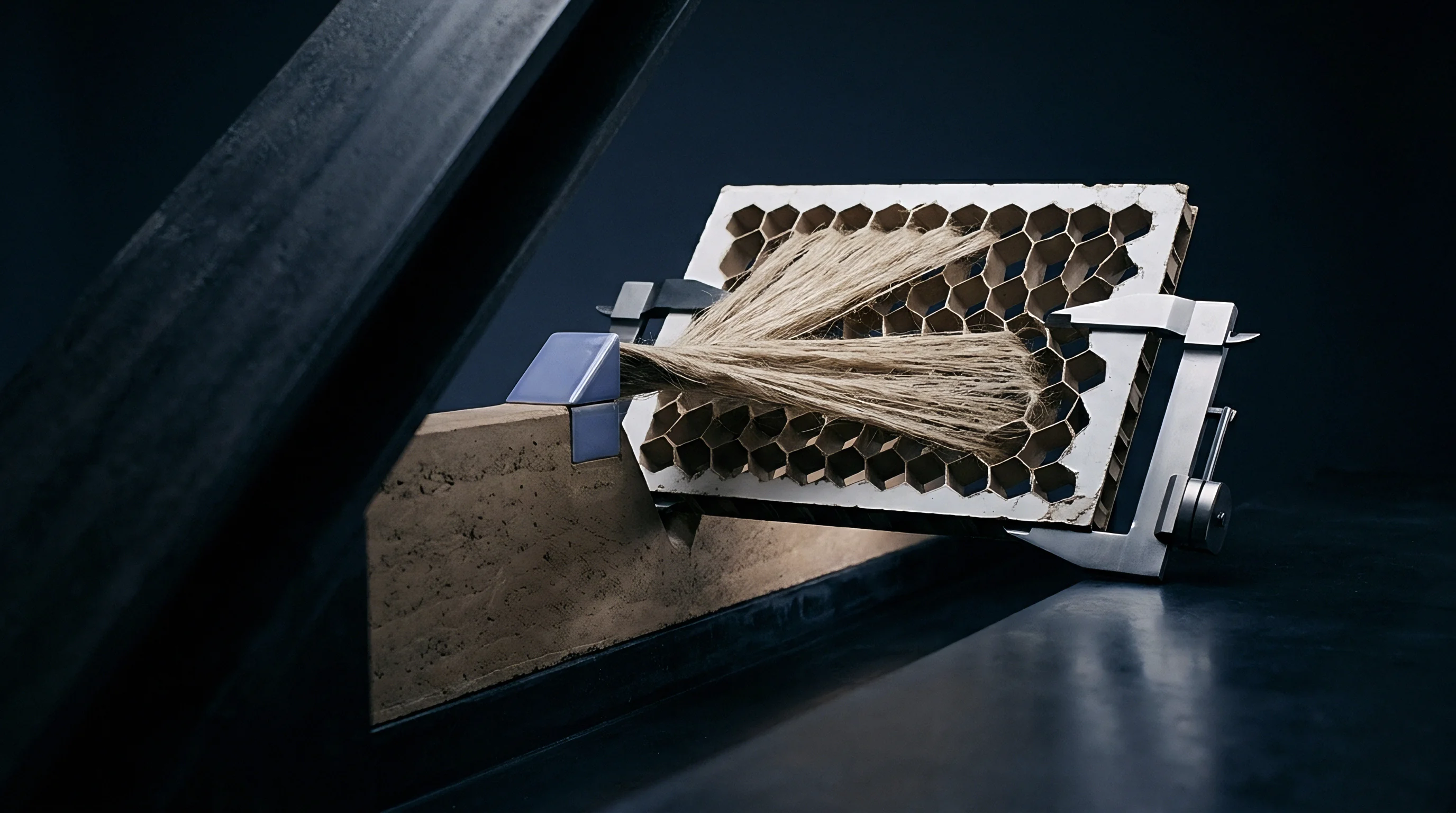
Accurately quantifying shear and tear losses requires appropriate test protocols and strict environmental control. Standard lab testing calls for conditioning specimens at 20 plus or minus 2 degrees Celsius and 65 plus or minus 4 percent relative humidity for at least twenty-four hours before testing. Flax contains hydrophilic hemicellulose matrices; minor shifts in moisture content alter baseline tensile strength, yarn friction, and cross-link stability under strain.
Why Do Laboratory Tear Metrics Mislead Field Sourcing?
Standard laboratory tear assessments use slow tensile testers or single-impact falling pendulums, neither of which replicates dynamic, multi-directional field stresses. A standard trapezoid tear test under ISO 13937-4 clamps specimens along non-parallel lines, forcing stress down a set path. But cross-linking shifts how the material fails internally.
Under complex dynamic loads during laundering or use, treated linen fails along bias shear planes rather than down the clean rip lines shown on lab gauges.
Measuring shear parameters precisely requires dedicated instrumentation. The Kawabata Evaluation System KES-FB4 measures shear stiffness by applying cyclic pure shear stress up to an eight-degree displacement. The resulting curve yields two main parameters: shear rigidity (the slope of the force-angle response) and hysteresis at five degrees (the energy lost during deformation).
Chemically treated linen shows steep shear slopes and wide hysteresis loops, reflecting high stiffness alongside heavy permanent deformation under bias loads.
A complete qualification dossier for cross-linked linen requires documenting key physical and chemical metrics:
- Unreacted Chemistry Kinetics tracking residual un-crosslinked resin monomer concentrations via high-performance liquid chromatography to verify cure completion.
- Standardized Tear Peak Tracing documenting full force-displacement plots across ten replicate samples to capture average low-peak energy absorption.
- Multiaxial Bias Deformation Profiles recording angular shear resistance up to structural locking points on pure shear testing frames.
- Dimensional Change Verification measuring wash-induced relaxation shrinkage alongside crease recovery angle stability across five standardized laundry cycles.
Testing labs frequently see discrepancies between warp and weft tear losses after processing. On standard industrial pad-dry-cure ranges, warp tension is held high to keep fabric flat through the chemical bath. That tension holds warp yarns taut while forcing weft yarns to take up almost all the crimp.
Straight warp yarns take on heavy chemical coating due to their exposed profile, and their lack of crimp prevents them from shifting under tearing loads. As a result, warp-direction tear loss often exceeds weft-direction loss by fifteen to twenty-five percent.
A fabric displaying balanced greige tear strength will develop severe directional mechanical imbalance if processing tension is unmanaged.
Separating chemical fiber damage from mechanical yarn locking requires tensile testing individual yarns extracted from the weave. By unraveling warp and weft ends from both greige and finished fabric, technicians can test thread strength on a single-yarn tester. If individual yarn strength drops by only ten percent while total fabric tear strength drops forty percent, the loss comes from yarn lock-in rather than cellulose depolymerization.
That distinction tells the mill to alter weave geometry instead of reformulating the resin bath.
Questions remain over whether non-formaldehyde cross-linking agents can ever match the dimensional stability of traditional cyclic ureas without causing equivalent yarn locking and tear loss.

Invoice
Margins mirror structural choices on the loom. Specifying cross-linked linen requires calculating full landed costs ~ factoring in weight adjustments, loom-hour penalties, chemical bath charges, and prospective quality claims. Finishing mills quote cross-linking on a per-linear-meter or per-kilogram basis, but a realistic commercial calculation must account for greige weave adjustments made to offset finishing losses.
The table below compares commercial landed costs across three structural mitigation strategies designed to achieve identical target weight and tear performance under DMDHEU cross-linking:
| Construction Specification | Reed Width (cm) & Loom Type | Loom Speed (PPM) & Shed Efficiency (%) | Chemical Finishing Cost ($/m) | Landed Price ($/m) at 5,000m Order |
|---|---|---|---|---|
| 1/1 Tabby Baseline (Standard Sett: 18.5 x 18.5) | 190 cm / Air-Jet | 580 PPM / 91% | 0.85 | 4.45 |
| 2/2 Hopsack Modified (Coarse Sett: 16.0 x 21.0) | 190 cm / Rapier | 480 PPM / 85% | 0.85 | 4.92 |
| 2/1 Twill Modified (High-Picks: 22.0 x 18.5) | 190 cm / Rapier | 460 PPM / 84% | 1.15 | 5.28 |
Switching to a coarse-sett 2/2 hopsack to maintain yarn mobility means moving production from high-speed air-jets to rapier looms, dropping shed output from 32 linear meters per loom-hour to 23. With loom-hour rates fixed at approximately 18.50 USD, greige weaving costs climb. That extra weaving cost of 0.47 USD per meter easily exceeds the chemical finish cost, shifting the program’s underlying economics.
Commercial buyers structure contract terms around finished mechanical retention rather than liquor pickup ratios. When sourcing cross-linked linen, purchase orders must explicitly state minimum acceptable tear strength alongside target wrinkle recovery angles. Specifying chemical treatment parameters without setting physical performance floors leaves the buyer exposed to brittle, unmarketable cloth.
Standard practice requires a debit-back clause: if bulk finishing cuts tongue tear strength by more than thirty-five percent relative to approved greige standards, the finishing mill absorbs the cost of re-weaving and re-processing the lot.
Yield loss during chemical processing is another hidden cost. Padding, stenter drying, and curing cause thermal shrinkage along both warp and weft axes. Linen shrinks substantially under the high curing temperatures needed for polycarboxylic acid cross-linking.
A grey fabric measuring 1000 meters on the batcher may yield only 920 meters of finished cloth once thermal relaxation and stenter edge trimming are done. That eight percent yield loss must be amortized directly into the unit meter price on the final invoice.
Quality claims from post-finish degradation represent the single largest financial risk in linen sourcing. When garments fail at retail due to seam tears or bias shear distortion, warranty claims wipe out margins across the supply chain. Integrating complete testing protocols, structural weave modifications, and realistic shed-efficiency accounting into initial purchasing negotiations provides the only reliable defense against shear and tear losses under industrial cross-linking routes.