Rapier against Air-Jet Sheds for Wet-Spun Linen Warps
Positive rapier insertion handles low-elongation wet-spun linen warps reliably, while air-jets trigger high stop rates, pneumatic costs, and greige faults.

Beam
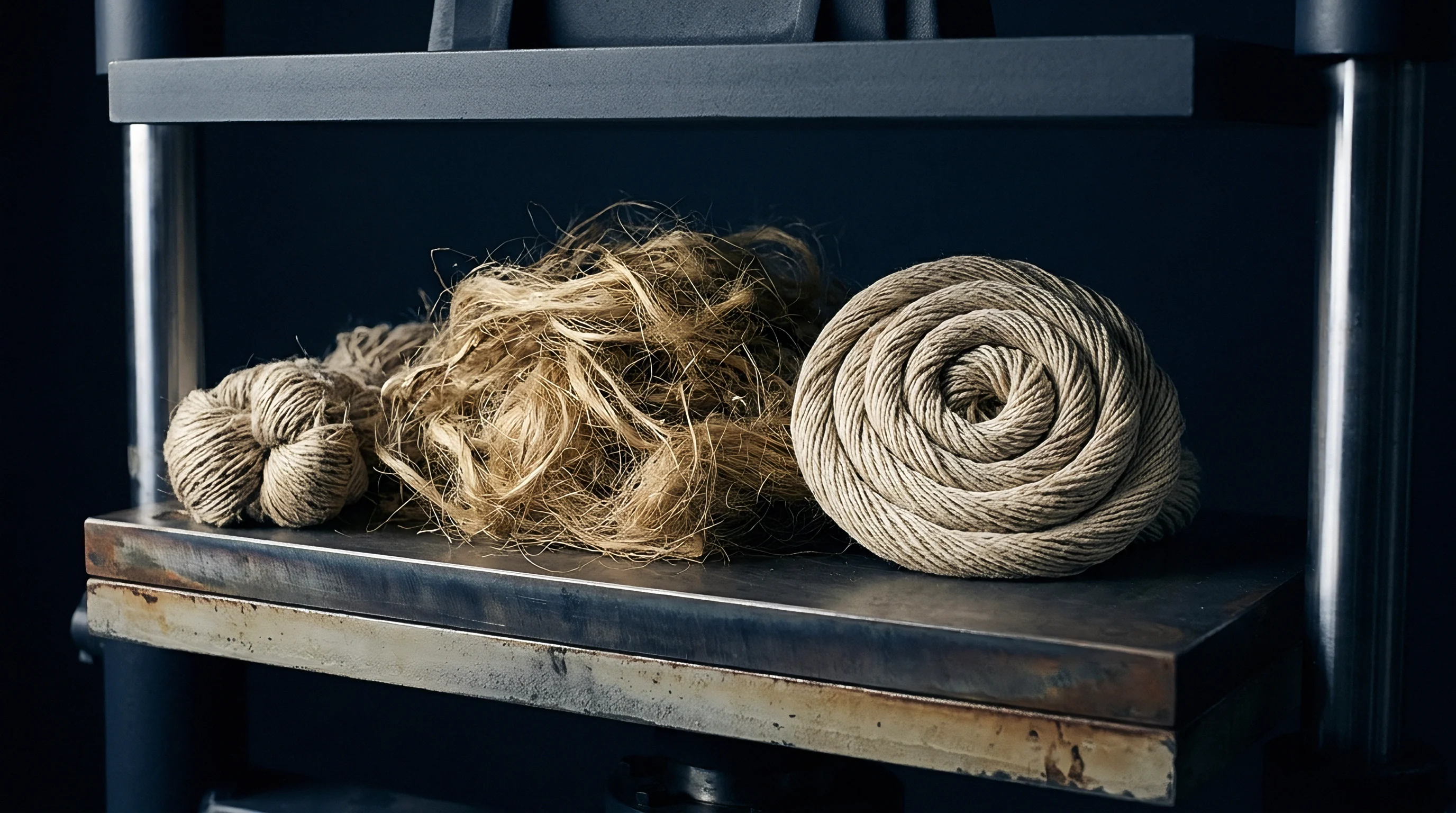
Wet-spun flax yarns combine high tensile strength with minimal elasticity and pronounced surface hairiness. Drawing long flax line fibers through a hot water bath before twisting softens natural pectin and lignin binders, letting individual ultimate fibers slide past each other and align tightly along the yarn axis. That structure limits elongation at break to between 1.8% and 2.4% ~ roughly one-third the stretch allowance of spun cotton yarns of equivalent linear density.
Under continuous weaving tension, wet-spun linen cannot absorb peak shedding loads through stretch. Warp preparation must produce a beam where every end maintains exact length and structural uniformity; any path variance creates local tension spikes that immediately snap the yarn.
Sizing wet-spun linen warps requires chemical formulations that bind loose surface fibers to the yarn core without leaving a brittle film. Raw starch fails on wet-spun linen because the smooth surface of the fiber bundle offers no deep anchor points for raw granules. High-performance sizing recipes for 100% wet-spun linen mix modified potato starches with low-viscosity polyvinyl alcohol and synthetic acrylic binders, targeting a total size add-on of 8% to 12% by dry yarn weight.
Setting squeeze roller pressures between 18 kN and 24 kN forces the liquor into the core while leaving a thin, pliable outer shell. Oversizing hardens the yarn until brittle flax fibers break under flex fatigue inside drop wires and heddle eyes. Undersizing leaves fine fibrils exposed to rub into obstructive fuzz balls as ends slide past each other during shed movement.
Moisture control during warp preparation dictates whether wet-spun flax survives on the loom. As a hygroscopic bast fiber, flax shifts its mechanical behavior radically with internal water content. While standard dry-spun linen warps break under rapid tension cycles, wet-spun linen maintains optimal tenacity and flexibility when internal moisture regain holds between 8.5% and 10.5%.
Winding yarn onto the beam in dry air causes micro-fractures in the cellulosic structure, so modern linen warping plants run high-output atomizing humidifiers over the creel zone to maintain 70% to 75% relative humidity. Checking beam density across the full working width with a Shore A hardness tester should yield 75 to 82 Shore A degrees. Soft spots allow adjacent ends to bite into lower layers during let-off, causing sudden pull-backs and yarn breakage as the shed opens.
| Yarn Type | Nominal Count (Nm / Lea) | Tensile Tenacity (cN/tex) | Elongation at Break (%) | Sizing Add-on Target (%) | Target Beam Hardness (Shore A) |
|---|---|---|---|---|---|
| Wet-Spun Pure Linen | Nm 26 / 43.5 Lea | 28.5 to 34.0 | 1.9 to 2.3 | 9.0 to 11.5 | 78 to 82 |
| Dry-Spun Pure Linen | Nm 14 / 23.4 Lea | 16.0 to 21.0 | 1.5 to 1.8 | 11.0 to 14.0 | 70 to 75 |
| Ring-Spun Combed Cotton | Nm 50 / 30.0 Ne | 18.0 to 22.0 | 6.0 to 7.5 | 6.0 to 8.5 | 65 to 70 |
| Viscose Continuous Filament | Nm 60 / 150 dtex | 20.0 to 25.0 | 12.0 to 15.0 | 3.0 to 5.0 | 55 to 60 |
Wet Spun Linen Physical Properties
Wet linen barely stretches. High crystallinity of native cellulose I gives wet-spun yarn an extremely high initial modulus, resisting extension right up to its breaking threshold and leaving no margin for shedding errors. Unlike cotton, where spiral fibril angles permit mechanical unwind under load, ultimate flax fibers lie almost parallel to the yarn axis at a low spiral angle of roughly 6 degrees.
That alignment builds high dry and wet strength, but leaves the warp vulnerable to severe dynamic loads as heddles move. Opening a shed on a 220 cm wide warp at 24 ends per centimetre creates peak tension pulses above 45 cN per end if shed geometry is unbalanced.
Surface hairiness in wet-spun linen differs structurally from short-staple cotton hairiness. Flax fibers have irregular polygonal cross-sections with thick cell walls and small central lumens. During wet spinning, short fiber tails snap away from the draft band to project from the yarn body, carrying residual pectin bands that harden as they dry.
When adjacent warp threads rub together in the harness zone, these rigid hairs interlock into micro-bridges across the shed space. If a shedding mechanism relies on passive air streams to separate ends, these bridges hold warp threads together, distorting the shed line and trapping insertion elements.
Twist distribution along wet-spun linen yarn is inherently irregular. Thin places absorb higher twist per unit length during spinning to form rigid, dense sections, while thick places or slubs receive less twist. These low-twist slubs have poor abrasion resistance.
Passing through drop wires and heddle eyes, friction strips their protective sizing film and exposes raw flax filaments. This slub degradation causes yarn splitting, where individual bast fiber bundles peel away from the core and wrap catastrophically around the back rest roller or drop wire banks.

Sizing Formulations for Low Elongation Warps
Formulating size for wet-spun flax requires balancing film flexibility against surface adhesion. Raw starch forms a rigid film that cracks under the heavy flexural fatigue of heddle movement. To prevent this, size kitchens blend enzyme-modified starches with cold-water-soluble carboxymethyl cellulose and flexible acrylic co-polymers.
The acrylic polymer lowers the dry film’s glass transition temperature so yarn bends around small-radius drop-wire eyes without cracking its coating. Lubricants like hydrogenated vegetable fats or emulsified tallow are added at 1.5% to 2.5% of total dry solids to reduce friction against steel loom components.
Cooking linen size takes strict temperature control to keep viscosity stable. Holding sizing liquor at 95 degrees Celsius for 45 minutes fully gelatinizes modified starches. Target box viscosity must stay between 25 mPa·s and 35 mPa·s at an application temperature of 85 degrees Celsius.
Above 40 mPa·s, size coats only the exterior of the bundle, forming a skin that peels during weaving. Below 20 mPa·s, liquor sinks completely into the core, leaving surface hairs unsized to shed fly lint when the shed opens.
Drying sized warps takes multi-cylinder temperature zoning so flax fibers avoid thermal shock. High-density linen ranges run wet warp sheets across six to eight steam-heated cylinders. Initial cylinders run at a reduced 60 to 70 degrees Celsius to avoid boiling water inside the wet film, which would form microscopic voids and destroy continuity.
Later cylinders ramp up to 110 degrees Celsius to drive off moisture before a final cooling cylinder brings the sheet back to ambient temperature for winding. Polished split rods at the headstock must be set to separate sized ends cleanly without tearing size bridges, keeping thread structure intact before loom mounting.
The size film on wet-spun linen must yield under flexure without flaking, or shed friction will reduce the yarn to raw fiber within five thousand loom revolutions.
Warp Beam Density and Tension Uniformity
Weaving wet-spun linen warps requires uniform beam density across the full loom width. During direct or sectional warping, closed-loop electronic tensioners must continuously adjust thread tension; a variance of just 2 grams between ends across a 2,000-end warp leaves soft zones on the barrel. Under let-off tension during weaving, ends in soft zones sink into lower layers.
This changes their effective unwinding radius, creating slack threads that float out of alignment in the shed and catch on moving grippers.
Sectional warping carries distinct risks for low-elongation flax. Each section on the drum must match the exact circumferential length of the others. If section build-up varies from subtle count shifts or moisture swelling, adjacent sections end up with different outer diameters.
Once beam transfer occurs, ends from the shorter section face high tension while ends from the larger section run slack. On high-speed looms, tight ends quickly exceed their 2% elongation limit, snapping repeatedly along section boundary lines.
Direct warping paired with a sizing re-beamer offers superior tension uniformity for fine linen warps. Combining multiple beams at the size box and winding them onto a single weave beam under load-cell control keeps cross-beam tension variation below 1.5%. Presser rollers on the re-beamer compress the sheet at up to 500 kg across the barrel, forcing warp threads into a compact, parallel matrix free of air pockets.
This dense build ensures every end releases at identical linear speed as the beam unwinds, maintaining a flat warp line over the full beam life.
A soft beam produces loose warp ends, while an over-tensioned beam snaps wet-spun flax well before the shed fully opens.

Grip
Positive rapier systems control weft insertion through every millimetre across the shed. Rigid or flexible rapiers use mechanical grippers with spring-loaded or cam-actuated clamps to grip the weft tip before it enters the warp sheet. In a bilateral setup, the bringing rapier carries weft to the shed midpoint and hands the yarn end directly to the receiving rapier under positive mechanical lock.
Because this transfer operates independently of surface hairiness or cross-sectional mass, wet-spun linen wefts ~ despite coarse slubs, variable twist, and high stiffness ~ pull smoothly through the open warp without depending on aerodynamic drag.
Air-jet insertion swaps mechanical clamps for high-velocity compressed air streams, propelling weft yarn through a channel formed by profile reed dent blades. The main nozzle accelerates the yarn tip into the channel while relay nozzles down the reed fire timed bursts to sustain velocity. This fluid-dynamic method relies entirely on the yarn surface’s aerodynamic drag coefficient.
Wet-spun linen presents serious obstacles here: coarse flax’s high mass per unit length demands heavy pneumatic force to overcome inertia, while low elasticity and high bending stiffness cause the yarn tail to whip violently inside the narrow profile channel, buckling or collapsing in transit.
Rapier sheds can be optimized for stiff wet-spun linen warps by running smaller shed openings, typically 24 to 28 degrees, since slim rapier heads need minimal vertical clearance. Smaller openings reduce peak strain on warp threads during heddle movement, keeping tension well within the elastic limits of the sized bundle. Air-jet sheds require wider angles ~ often 30 to 34 degrees ~ to keep the pneumatic tunnel clear across the reed width, subjecting brittle warp ends to higher cyclic stress.
| Loom Type | Insertion System | Max Weft Speed (m/min) | Peak Warp Tension (cN/end) | Weft Insertion Stops (per 10^5 picks) | Shed Opening Angle (degrees) |
|---|---|---|---|---|---|
| Flexible Rapier | Positive Mechanical Transfer | 1,100 | 22 to 26 | 1.2 to 2.1 | 24 to 26 |
| Rigid Rapier | Direct Mechanical Drive | 850 | 20 to 24 | 0.8 to 1.5 | 25 to 27 |
| Air-Jet (Profile Reed) | Multi-Nozzle Pneumatic Drive | 1,600 | 34 to 42 | 8.5 to 14.2 | 30 to 33 |
| Air-Jet (Single Nozzle) | Confined Jet Tunnel | 1,200 | 38 to 46 | 12.0 to 19.5 | 32 to 35 |
Rapier Insertion Mechanics and Weft Control
Rapier heads built for spun linen use hardened carbide or diamond-like carbon clamp surfaces to resist abrasion from flax fibers. Outside the selvedge, the bringing rapier clamp opens at an exact mechanical position, grabs the cut weft end, and closes with 4.5 N to 6.0 N of force. Too little clamping force lets stiff wet-spun yarn slip during initial acceleration; too much crushes brittle flax fibers, snapping the weft at the gripper head during mid-shed transfer.
Midpoint yarn transfer is the most sensitive phase of rapier insertion. At 500 RPM, bringing and receiving rapiers meet within less than 3 milliseconds. The receiving clamp opens, grips the weft tail held by the bringing rapier, and snaps shut as the bringing rapier lets go.
Because transfer relies on mechanical contact rather than air friction, it runs reliably through thick slubs, thin spots, or heavy hairiness, maintaining uniform insertion tension across the fabric.
Programmable electronic weft brakes manage tension spikes at the end of the rapier stroke. As the receiving rapier reaches the far selvedge and releases the weft, package momentum can cause over-travel, leaving loose loops or double picks at the selvedge. The brake applies a friction pulse just before insertion finishes, decelerating the yarn smoothly and removing slack without snapping stiff wet-spun tips.

Air Jet Propulsion Dynamics and Profile Reeds
Air-jet insertion transfers kinetic energy from high-velocity compressed air to the outer surface of the weft. Air velocity inside the profile reed channel must stay well above target yarn velocity to generate forward drag. For Nm 26 wet-spun linen running at 1,200 metres per minute, main nozzle pressures must rise to 0.45 ~ 0.55 MPa.
High mass and stiffness resist acceleration, demanding longer main-nozzle blows that drive up air consumption per pick.
Relay nozzles spaced down the profile reed fire in staggered groups to push air across the loom. Their jet profiles must clear the channel without disturbing adjacent warp threads, but wet-spun linen warps impair air stability. Surface hairs on upper and lower warp sheets project into the reed tunnel, creating turbulent boundary layers that disrupt the air jet’s velocity profile.
As turbulence dissipates the air stream, forward propulsion drops and the yarn tip falls before reaching the receiving selvedge.
Air-jet looms weaving linen require larger profile reed cross-sections to clear yarn stiffness and protruding slubs. Standard reeds designed for filament or combed cotton choke on thick flax slubs; striking the inner wall of a narrow dent blade creates enough friction to stop a pick mid-shed. Specialized linen reeds enlarge tunnel clearance by 15% to 20%, but the bigger channel demands higher air volume from relay nozzles to maintain velocity, raising operating costs.

Shed Geometry and Clearance Angles
Shed geometry sets the mechanical clearances for insertion elements and stress profiles across the warp. On rapier looms, back rest roller, drop-wire box, heddle frames, and reed can form an asymmetrical shed line. Raising the back rest position for heavy wet-spun linen increases top-sheet tension during opening, pulling fuzz down and away from the shed midpoint so rapier heads pass through cleanly without dragging threads.
Air-jet shedding requires exceptionally clean separation across the entire width. With no mechanical gripper clearing a path, any floating or sagging warp thread breaks air stream continuity and blocks the weft tip. Achieving a clear shed on wet-spun linen requires warp line tension often exceeding 35 cN per end.
Because wet-spun flax elongation stays below 2.4%, such high tension drastically increases end breaks at the heddle eye line.
Heddle frame stroke dynamics depend on the insertion mechanism. Rapier looms allow a dwell period of 120 to 140 degrees of loom rotation, holding the shed fully open while rapiers pass through; this long dwell reduces harness acceleration and smooths tension shifts. Air-jet looms must open and close rapidly to contain the air column in the profile reed, limiting dwell to 80 to 100 degrees.
That rapid harness acceleration subjects stiff linen warps to sharp mechanical shocks, accelerating fatigue failure at the reed entry line.
Weft tension during rapier insertion stays flat across the shed width at 24 grams, while air-jet propulsion forces peak at 42 grams at the arrival selvedge.
Increasing relay nozzle pressure by half a bar offers immediate relief from clearing failures, but accelerates the accumulation of linen lint inside the profile channel.
Lint
Loom vibration and shedding friction continuously strip pectin residues, dry cortical fragments, and short fiber ends from wet-spun linen warps, dropping coarse lint and fine cellulosic dust into the loom. Unlike soft cotton fly that floats away on air currents, linen fly contains stiff, needle-like fiber shreds coated in abrasive pectin resins. It settles rapidly on horizontal machine surfaces, drop-wire banks, heddle eyes, and reed channels, packing into dense, greasy masses inside moving parts that resist air blasts and accelerate component wear.
Drop-wire banks are a prime source of lint and mechanical failure on wet-spun linen warps. Reciprocating friction through the narrow steel eyelet of each drop wire strips surface fibers from the core, packing lint inside the guide channels and dragging on the wire. When an end snaps, the drop wire must fall by its own weight onto the contact bar to stop the loom; packed lint inside the tracks stops it from falling freely, leaving broken ends to float into the shed for hundreds of picks and cause extensive float faults or entanglements.
Shed clearing failures happen when adjacent warp ends interlock through surface hairiness and fail to separate as heddles move. On rapier looms, the rapier head physically pushes un-cleared ends aside to forge an insertion path. On air-jet looms, trapped ends block the profile channel.
High-velocity air cannot push tangled ends aside; the jet deflects off caught threads, sending the weft tip crashing into the warp sheet to cause a short pick or total blockage stop.
- Profile Reed Contamination develops when airborne flax fly lodges inside the fine channels of profile reed dent blades, restricting airflow and distorting jet geometry.
- Relay Solenoid Clogging occurs as fine pectin dust penetrates pneumatic control valves, causing valve sluggishness, mis-timed air bursts, and compressed air leaks.
- Drop-Wire Hanging happens when sticky fiber fly packs into stop-motion slide tracks, preventing drop wires from falling during end breaks.
- Heddle Eye Abrasion results when abrasive flax dust mixes with machine oil into a lapping compound that cuts grooves into steel heddle eyes.
- Optical Sensor Blindness occurs as fine linen dust settles over optical weft arrival detectors, triggering false stops and lowering output.
How Do Profile Reeds Handle Linen Slubs?
Profile reeds use a precision-milled tunnel along their front edge to channel compressed air across the loom. When weaving wet-spun linen, rigid slubs and fiber bridges frequently pass through reed dents during beat-up. Traveling through the profile channel during shed changes, these dense slubs repeatedly strike the delicate edges of profile dent blades, eventually bending the tips, narrowing the air channel, and creating turbulence that ruins insertion consistency.
Flax lint carrying residual plant wax and pectin sticks tightly to stainless steel reed surfaces, altering the tunnel’s aerodynamic properties as it accumulates. As lint narrows the cross-sectional area of the profile channel, air velocity profiles shift. Operators compensate by raising relay nozzle pressure to maintain arrival times, which consumes more compressed air and speeds up fly deposition inside the channel ~ a cycle that forces frequent manual cleaning.
Cleaning profile reeds on linen air-jet looms takes specialized solvent washes and ultrasonic tanks to dissolve hardened pectin. Standard shop air cannot dislodge bound fly and often forces dust deeper into relay nozzle orifices. Mills weaving wet-spun linen on air-jets must pull reeds every 15,000 to 20,000 metres for off-loom ultrasonic cleaning.
Rapier looms use flat reeds without profile channels, which clean easily with an air blast while the warp stays mounted.
Drop Wire Dynamics and False Warp Stops
Choosing drop wires for wet-spun linen warps requires balancing wire mass against yarn tension dynamics. Standard cotton warps use wires weighing 0.7 to 1.2 grams, but wet-spun linen runs under much higher dynamic tension, needing 2.1 to 3.5 gram wires to ensure a clean drop when an end breaks. However, heavier wires exert continuous downward pressure on low-elongation flax yarn, raising friction and stripping size from the surface as the yarn bounces during shedding.
False warp stops happen when tension fluctuations make heavy drop wires bounce on the active warp line, touching the electrode bar without a broken end. Wet-spun linen’s lack of elasticity makes it prone to sharp tension pulses: when harness frames open, the warp sheet pulls tight and snaps wires upward; as harnesses close, tension drops and heavy wires free-fall onto the contact bar. These false stops disrupt efficiency and force operators to restart looms with no broken ends, leaving start marks on the fabric.
Eliminating false warp stops requires electronic stop-motion systems with variable dampening and timed detection windows. Adjusting the contact response delay between 15 and 45 milliseconds ignores brief contact bounces while catching real breaks. Installing anti-ballooning separator bars between drop-wire banks also dampens vertical yarn vibration, stabilizing stiff flax ends so heavy wires ride smoothly without false tripping.
- Mount drop-wire pin bar assemblies with exact axial alignment across the full warp sheet width.
- Select stainless steel drop wires weighed specifically for the yarn count, targeting 2.8 grams for Nm 26 wet-spun linen.
- Thread individual warp ends through drop-wire eyes using automated drawing-in machinery to prevent crossed ends.
- Adjust vertical drop-wire box height to maintain a neutral 3-degree break angle over the back rest roller.
- Set the electronic stop-motion delay circuit to 30 milliseconds to damp out wire bounce during shed opening.
- Inspect electrode bar insulation strips daily with a megohmmeter to confirm fiber dust has not created a short circuit.
Relay Nozzle Contamination and Air Channel Clogging
Relay nozzles on air-jet looms use tiny discharge orifices (0.4 mm to 0.8 mm in diameter) to direct the air stream. In wet-spun linen sheds, blowing creates a high-velocity venturi effect that draws airborne plant dust and microscopic pectin into these orifices. Mixing with trace oil and moisture from air lines, this dust forms an insoluble crust inside the nozzle tip that distorts discharge angles.
A clogged or misaligned relay nozzle fires its air blast outside the profile reed channel and straight into the warp sheet. This blows fine wet-spun linen ends out of alignment and into the path of the incoming weft pick. The resulting collision causes severe pick entanglements, splitting weft through the warp sheet to form bird nests or blow-outs.
Because distortion is invisible during high-speed running, detecting misaligned nozzles requires electronic airflow verification meters.
Preventing nozzle failures requires two-stage air filtration at the compressor plant and sub-micron coalescing filters at every loom inlet, achieving 0.01-micron particulate separation and oil vapor below 0.003 mg/m³. Even with pristine air, ambient linen fly coats nozzle tips. Mills running air-jets on linen must manually wipe nozzle tips with alcohol solvents at every beam change, adding labor costs to keep insertion stable.
Standard ISO 13934 testing demonstrates that wet-spun linen retains 92% of its tensile strength when wet, but loses up to 40% of its abrasion resistance when size coatings are stripped by drop-wire friction.
Lint-triggered false stops created prominent horizontal start marks across three thousand metres of plain-weave sheetings, adding six thousand dollars in re-sorting fees.
Output
Manufacturer loom speed metrics reflect ideal conditions with synthetic filaments or combed cotton warps, where builders quote air-jet speeds over 1,200 RPM and rapiers up to 600 RPM. Weaving 100% wet-spun linen warps forces operational speeds down to protect low-elongation yarn from heavy breakage. On a 220 cm loom weaving standard Nm 26 wet-spun linen plain weave, rapiers run reliably at 380 to 440 RPM.
Air-jets on the same construction are capped at 550 to 650 RPM by shed clearing failures and yarn tip collapse.
Overall equipment effectiveness (OEE) in a linen weave room comes down to stop frequency per 100,000 picks. Wet-spun linen warps on rapier looms typically average 1.5 to 2.5 warp stops and 0.5 to 1.2 weft stops per 100,000 picks, maintaining shed efficiencies of 86% to 91%. Running the same warps on air-jets produces 6.0 to 12.0 warp stops and 4.0 to 8.0 weft stops per 100,000 picks from un-cleared fiber bridges and channel obstructions, dropping efficiency to 68% ~ 74% and eroding the pneumatic speed advantage.
Energy analysis highlights a clear financial divergence between rapier and air-jet insertion. A 220 cm flexible rapier loom uses 3.5 kW to 5.0 kW of direct electrical power for its main motor, shedding motion, and let-off. An equivalent air-jet loom draws about 3.0 kW directly, but needs an extra 18.0 kW to 24.0 kW of compressed air power from rotary screw compressors to keep nozzle pressures up on stiff linen.
When yarn stops lower air-jet efficiency, compressor power draw continues unchanged, driving up energy costs per woven metre.
| Performance Metric | Flexible Rapier Loom | Air-Jet Loom (Profile Reed) | Variance / Impact |
|---|---|---|---|
| Operational Loom Speed (RPM) | 420 | 580 | Air-Jet +38% gross speed |
| Realized Shed Efficiency (%) | 88.5% | 71.0% | Rapier +17.5% net efficiency |
| Net Output per Loom Hour (m/hr) | 14.8 | 16.4 | Air-Jet net gain only +10.8% |
| Direct Electrical Load (kW) | 4.2 | 3.2 | Air-Jet direct electrical lower |
| Compressed Air Power Load (kW) | 0.5 (selvedge tuckers) | 21.5 (main + relay blowing) | Air-Jet requires massive air plant |
| Total Energy Cost per Metre ($) | $0.12 | $0.48 | Rapier saves $0.36 per metre |
| Maintenance & Spare Parts ($/m) | $0.08 | $0.22 | Air-jet reed/nozzle wear high |
| Total Landed Weaving Cost ($/m) | $1.45 | $1.92 | Rapier delivers $0.47/m advantage |
Loom Speed against Realized Efficiency
Judging shed productivity by mechanical speed alone skews financial planning. An air-jet running at 650 RPM at 70% efficiency yields a net production equivalent to 455 picks per minute. A flexible rapier running at 420 RPM at 90% efficiency yields 378 picks per minute.
The net difference shrinks to 20%, even though the air-jet runs 55% faster mechanically. That modest gain in output comes at the cost of higher capital risk and fabric quality losses.
Every stop on a wet-spun linen warp carries a quality penalty beyond downtime. When the loom pauses for a fault, static tension on the open warp sheet relaxes because wet-spun linen exhibits high stress relaxation under load. When the loom restarts, the initial beat-up stroke strikes a warp sheet with altered tension, leaving a visible line across the fabric called a start mark.
Higher stop rates on air-jet looms generate multiple start marks per roll, preventing the cloth from selling as first-quality greige.
Weaver workloads shift dramatically between rapier and air-jet sheds running linen. In a rapier room with wet-spun linen warps, low stop frequencies allow one weaver to handle 16 to 24 looms. In an air-jet room on the same yarn, high stop rates force mills to assign only 6 to 8 looms per weaver to manage downtime.
The added labor cost per loom hour wipes out any marginal output gain from the air-jet’s higher mechanical speed.

Energy Balance and Compressed Air Utility Costs
Compressed air is one of industrial manufacturing’s least efficient energy transfers. A rotary screw compressor converts only 10% to 15% of electrical input into pneumatic energy, shedding the remaining 85% as heat. Supplying continuous high-pressure air to dozens of air-jets weaving heavy bast fibers demands massive infrastructure; generating 2.2 Nm³/min of dry, filtered air at 0.6 MPa for one loom takes roughly 20 kW of compressor power.
Compressed air operating costs surge when operators turn up relay nozzles to force stiff, hairy linen yarns through the shed. To stop tip buckling on Nm 26 wet-spun linen, nozzle pressure is often raised from 0.35 MPa to 0.50 MPa. Power draw on variable-speed compressors scales exponentially with pressure, so raising main line pressure by just 0.1 MPa increases compressor electricity use by 7% to 10%, adding thousands to monthly utility bills.
Heat rejection and climate control in air-jet weave rooms create hidden electrical costs. Air discharged from hundreds of relay nozzles expands into the room, releasing heat and disrupting local relative humidity. Because wet-spun linen requires ambient humidity between 70% and 75% to prevent yarn brittleness, HVAC systems must constantly humidify and recondition this continuous air throughput, adding substantial load to plant utilities.

Loom Hour Calculations for Pure Linen Greige
Calculating landed weaving costs per metre means dividing total hourly loom operating cost by net linear fabric output. Hourly costs cover capital amortization, direct electricity, auxiliary utilities, floor space, weaver labor, and spare parts. For a flexible rapier weaving Nm 26 wet-spun linen at 420 RPM and 88% efficiency, the fully loaded loom-hour rate averages $21.46, yielding 14.8 metres per hour for a weaving cost of $1.45 per metre.
Air-jet loom-hour calculations show the real economic burden of pneumatic insertion on stiff yarns. High compressed air demands and lower shed efficiency push the fully loaded loom-hour rate on wet-spun linen to $31.48. Even with a slightly higher output of 16.4 metres per hour, weaving cost reaches $1.92 per metre ~ a 32% premium over rapier weaving while producing higher defect rates.
Capital depreciation schedules favor rapiers for specialized linen weaving. Air-jet looms demand higher upfront capital for profile reeds, multi-nozzle manifolds, fast solenoids, and heavy compressor infrastructure. Amortizing an air-jet shed over a 7-year machinery cycle creates a high fixed-cost base, made worse by rapid reed wear from abrasive flax.
Rapier looms rely on simpler mechanical insertion elements that offer long service lives, keeping annual depreciation costs per yard lower.
- Evaluate Warp Elongation limits, selecting rapier technology whenever wet-spun yarn breaking elongation falls below 2.5%.
- Calculate Compressed Air Capacity to ensure compressors handle high relay nozzle pressures without drops across the shed line.
- Audit Ambient Humidity Systems to confirm the weave room maintains 72% relative humidity under high air discharge volumes.
- Assess Weaver Allocation Ratios, adjusting assignment densities to avoid extended downtime from yarn stops.
- Compute Landed Metre Costs using net realized efficiency figures rather than theoretical maximum loom speeds.
Whether future air-jet nozzle designs can bypass the frictional drag of un-cleared flax fibers without consuming excessive compressor power remains an open question for high-speed linen weaving.

Contract
Sourcing specifications for 100% wet-spun linen must explicitly state permissible weaving technology to protect buyers from low-grade greige. Unusually cheap mill quotes often rely on running wet-spun linen warps over high-speed air-jets. To meet targets on air-jets, mills modify sizing recipes with extra synthetic lubricants or hard binders to force yarn clearing, or lower ambient humidity to stop nozzle clogging.
These compromises ruin chemical absorption, handfeel, and tensile retention during downstream dyeing and bleaching.
Linen greige quality verification relies on the standardized four-point system under ASTM D5430, which assigns penalty points per 100 square yards based on defect length. Wet-spun linen woven on air-jets regularly exceeds point thresholds due to start marks, double picks, short picks, and warp float repairs. First-quality greige must stay below 28 points per 100 square yards.
Buyers who omit insertion methodology from purchase contracts often receive lots scoring between 45 and 70 points, forcing expensive re-sorting or outright rejection.
Landed cost calculations have to account for sizing choices and finishing yields. When wet-spun warps are over-sized with inferior PVA blends to survive air-jet shedding, finishing plants must use aggressive enzymatic scouring and alkali boiling to desize. That heavy chemical treatment degrades native flax cellulose, causing tensile strength losses up to 25% and unpredictable shrinkage.
Specifying rapier-woven greige ensures a balanced, water-soluble size formulation that washes out under mild conditions, preserving strength and dimensional stability.
| Defect Type | Visual Aspect / Mechanism | 4-Point Penalty (per occurrence) | Air-Jet Frequency (per 100m) | Rapier Frequency (per 100m) |
|---|---|---|---|---|
| Start Mark / Stop Mark | Horizontal line of altered pick density from loom pause | 3 to 4 points (length dependent) | 8.2 to 14.0 | 0.5 to 1.2 |
| Short Pick / Mis-pick | Weft yarn collapses mid-shed, failing to reach selvedge | 2 to 4 points (length dependent) | 5.0 to 9.5 | 0.2 to 0.8 |
| Warp Float / Stitch | Un-cleared warp ends catch weft, leaving un-woven float | 2 to 3 points | 4.1 to 7.8 | 0.4 to 1.1 |
| Broken Warp End | Single thread missing along warp direction, forming line | 1 to 4 points (length dependent) | 3.5 to 6.2 | 1.0 to 1.8 |
| Reed Mark / Warp Streak | Vertical line from bent profile reed dent blade impact | 4 points (continuous fault) | 2.8 to 5.0 | 0.1 to 0.3 |
Sourcing Specifications and Machinery Mandates
Purchase orders with spinning and weaving mills need clear machinery allocation clauses. A proper contract specifies the exact equipment line, detailing loom manufacturer, shed motion type, insertion system, and maximum operational speeds. For high-density wet-spun linen, contracts should explicitly ban pneumatic air-jet insertion for warp counts finer than Nm 20 unless written proof confirms the mill uses automated shed-clearing sensors and dedicated micro-climate sizing.
The contract’s technical dossier must set precise physical tolerances for raw yarn and prepared beams. Buyers should mandate minimum breaking tenacity (at least 28.0 cN/tex), minimum breaking elongation (at least 2.0%), maximum hairiness index (S3 below 150), and target moisture regain (9.0% ± 0.5%). Setting these thresholds prevents mills from substituting lower-grade dry-spun or tow flax yarns that shed excessive lint on rapiers, keeping greige quality consistent across batches.
Contracts should secure audit rights allowing independent technical inspections of the weave shed. Auditors verify beam hardness against specified Shore A ratings, check size box temperatures and squeeze pressures against approved recipes, and confirm looms run within agreed speed windows. Catching a mill shifting production from rapiers to air-jets to clear a capacity bottleneck lets buyers halt production before sub-standard greige is woven.
Four Point Inspection Tolerances for Wet Spun Fabrics
Acceptance criteria under ASTM D5430 require distinguishing between natural yarn anomalies and machine-generated weave faults. Native flax contains natural slubs, shives, and thickness variations that give linen its texture; these are not penalized under four-point grading unless they exceed specific dimensions. Machine faults ~ like start marks from false drop-wire stops or short picks from air-jet tip collapse ~ carry heavy penalty points and must be strictly capped in the contract.
Contracts must establish maximum penalty point thresholds for individual rolls and shipment averages. Premium apparel and home textile grades require individual rolls to stay under 28 points per 100 square yards, with the lot average below 20 points. Any roll showing more than 4 points per 100 square yards from start marks or weft stops should automatically downgrade to second-quality status, with a price penalty deducted from the mill’s invoice.
Lab testing of incoming greige samples should accompany fabric inspection before approving shipments. Key metrics include mass per unit area (ISO 3801), ends and picks per centimetre (ISO 7211), warp and weft tensile strength (ISO 13934-1), and residual size content via hot-water extraction. Residual size above 12% indicates oversizing, signaling desizing problems, strength loss, and stiff handfeel during wet processing.
Landed Metre Economics and Mill Sizing Risk
Landed cost calculations for wet-spun linen must factor in greige yield, finishing loss allowances, and defect penalty deductions. An initial quote of $4.20 per metre for air-jet greige looks cheaper than $4.65 per metre for rapier greige. But if the air-jet cloth yields only 82% first-quality fabric after finishing due to start marks and size abrasions, effective landed cost jumps to $5.12 per metre, reversing the price advantage.
Finishing loss allowances for over-sized air-jet greige cover higher chemical use and lost yardage. Over-sized warps require prolonged enzyme scouring to break down heavy acrylic films, losing up to 6% in fabric weight and shrinking up to 8% in warp length. Rapier-woven greige, sized with lighter starch-acrylic blends, desizes under mild conditions with minimal weight loss and warp shrinkage under 3%, delivering higher finished yields from the same raw yardage.
Procurement contracts need automatic settlement mechanisms for non-conforming goods. If an inspection lot averages between 29 and 40 points per 100 square yards under the four-point system, the contract should trigger an automatic 15% price deduction. Above 40 points per 100 square yards, the buyer retains the right to reject the entire shipment at the mill’s expense, including full reimbursement of import duties, freight, and port handling fees.
- Include an explicit loom allocation clause in the purchase order mandating positive rapier insertion for wet-spun linen warps.
- Attach raw yarn parameters specifying a minimum breaking tenacity of 28.0 cN/tex and a maximum S3 hairiness index under 150.
- Establish first-quality greige acceptance limits at a maximum of 28 points per 100 square yards under ASTM D5430 four-point inspection.
- Define automatic invoice penalty deductions for fabric rolls exceeding agreed start mark frequencies.
- Specify a maximum residual size content limit of 10% dry weight to protect fabric tensile strength during finishing desize cycles.
Mandating rapier insertion for all wet-spun linen warps finer than Nm 26 shifts the financial risk of shed-clearing stops back to the weave room.