Determination of Bast Fiber Fineness via Standardized Low-Pressure Air Permeability
Low-pressure air permeability tests determine bast fiber fineness by measuring specific surface area across standardized compressed fiber plugs under ISO 2370.

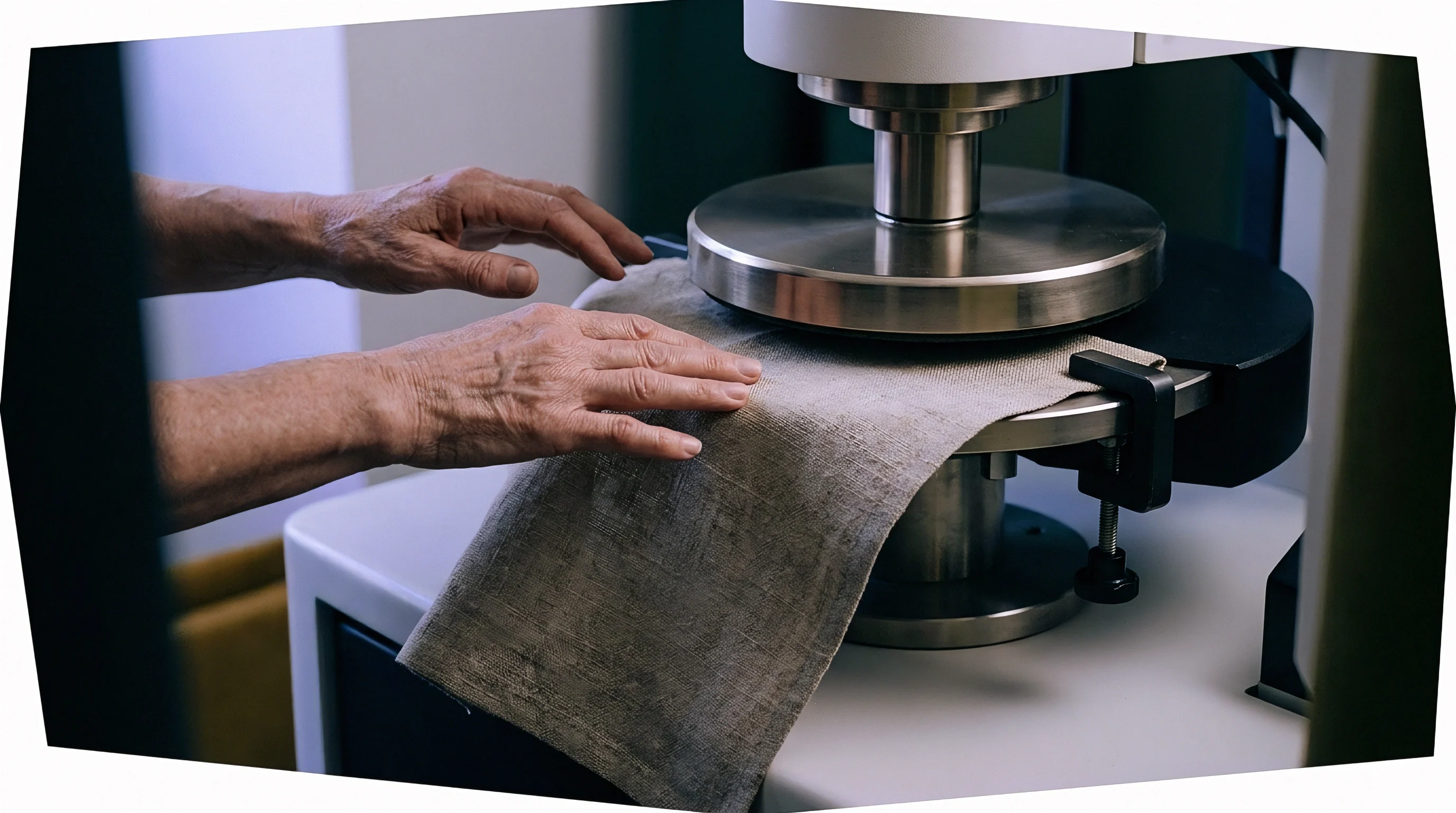
Chamber
A compressed bed of flax fiber resists steady airflow in proportion to its total exterior surface area. In practice, air permeability testing forces clean, dry air through a uniaxially packed fiber plug inside a rigid cylindrical cell, where the resistance to the gas stream creates a measurable pressure drop across the sample. Fine technical fibers offer a large surface area per unit mass, generating enough drag to restrict volumetric flow, whereas coarse technical bundles present less surface area for the same mass, allowing higher flow velocities at the same pressure drop.
Unlike synthetic filaments or individual cotton seed hairs, raw and hackled flax occurs as compound technical bundles held together by middle lamella pectins. Standard low-pressure test apparatuses compress a known specimen mass into a fixed chamber volume to form a defined porous bed. Measuring fluid conductance through this bed gives a direct value for specific surface area, avoiding tedious microscopic cross-sectional profiling.

Kozeny-Carman Dynamics in Bast Fiber Plugs
Low-pressure permeability instruments pass dry gas through a weighed sample held at a constant volume. Fluid movement through these randomly oriented fiber beds follows viscous flow principles described by the Kozeny-Carman relation, where the permeability coefficient K depends on bed porosity e, specific surface area per unit volume S0, and a Kozeny shape factor k that accounts for pore tortuosity and cross-sectional geometry.
Packing density governs this flow. In a uniform cell, volumetric porosity e equals one minus the ratio of bulk packing density to solid fiber density ~ which averages 1.54 grams per cubic centimeter for flax. When dry air flows laminarly under low differential pressure, the measured volumetric flow rate Q is inversely proportional to the square of the specific surface area S0.
As a result, even minor shifts in average bundle diameter cause noticeable changes in manometer readings.
At 20 degrees Celsius and 65 percent relative humidity, a 5.00 gram flax sample packed to a height of 25.0 millimeters produces a differential pressure drop directly proportional to fiber specific surface area.
Uneven packing within the cylinder creates localized channeling. If fiber bundles are loaded irregularly, air bypasses denser regions and slips through looser zones, artificially inflating the flow rate and making coarse fibers look finer than they are. Proper sample preparation requires light carding or manual parallelization to eliminate micro-voids and ensure uniform resistance across the entire cross-section.
Specific Surface Area and Porosity Matrix
Fineness in technical flax bundles reflects the external boundary area per unit mass. The equations for flow through compressed fiber beds incorporate specific surface area per unit mass Sw alongside volumetric specific surface area S0, and converting volumetric flow rate into specific surface area requires tight control over sample mass, cell diameter, and column height.
Keeping differential pressure low preserves laminar flow through the interstitial pores. Operating below 50 millimeters of water column prevents turbulent eddies from forming along bundle walls, maintaining a linear relationship between air velocity and pressure gradient. Any roughness on the cell walls or misalignments in the plunger alter fluid resistance and introduce systematic errors into the calculated surface area.
Channel distortion happens when sample compression forces bundles into tight surface contact. High packing densities shrink interstitial pore space while increasing dead-end voids that contribute nothing to fluid transport. Standard practice balances sample mass against chamber volume to keep porosity between 0.65 and 0.80, a range where the Kozeny shape factor remains stable at roughly 5.0 for parallel bast fibers.
- Chamber Wall Friction creates density gradients along the compressed fiber column as the plunger is inserted.
- Edge Channeling Effects allow excess air to leak along smooth metal walls if sample alignment is skewed.
- Compression Non-Uniformity produces localized pockets of low permeability that distort total flow resistance.
- Finer Particle Trapment clogs internal pores when dust or loose fiber fragments migrate during testing.
Ignoring wall effects distorts specific surface area calculations and can lead to misgrading high-value line flax as coarse tow material.


Calibration
Standardized air permeability measurements require accurate bench verification against primary reference standards. Test protocol ISO 2370 sets out specific guidelines for assessing flax fiber fineness with low-pressure airflow equipment. Instruments like the WIRA Fiber Fineness Meter or adapted Sheffield Micronaire units either measure airflow through a sample plug held at a constant pressure differential or record the pressure drop across it at a fixed flow rate.
| Test Parameter | Standard Specification | Acceptable Tolerance | Operational Impact |
|---|---|---|---|
| Specimen Mass | 5.000 g | +/- 0.005 g | Mass variations distort bed porosity calculations. |
| Pressure Differential | 490.3 Pa (50 mm H2O) | +/- 2.5 Pa | Pressure fluctuations disrupt laminar flow regimes. |
| Chamber Diameter | 25.40 mm | +/- 0.02 mm | Diameter drift changes cross-sectional flow area. |
| Chamber Compressed Height | 25.00 mm | +/- 0.10 mm | Height errors alter volumetric porosity directly. |
| Relative Humidity | 65.0 % RH | +/- 2.0 % RH | Humidity shifts affect moisture regain and fiber diameter. |
| Laboratory Temperature | 20.0 deg C | +/- 1.0 deg C | Temperature alters dynamic air viscosity values. |
Calibration links raw scale readings to absolute physical values using non-hygroscopic secondary reference plugs or certified reference cotton and flax lots of known specific surface area. Routine calibration prevents instrument drift, orifice fouling, or room temperature shifts from distorting linear density calculations.

ISO 2370 Standardization Protocol Parameters
International testing standards for flax fineness specify a constant pressure drop of 50 millimeters water column across the cylinder. ISO 2370 compliance requires operators to calibrate the flowmeter using standard restrictor plates or certified fiber samples. Because dynamic air viscosity increases with temperature ~ reducing flow through the same pore structure ~ laboratories maintain 20 degrees Celsius and 65 percent relative humidity to eliminate temperature-driven drift.
Calibration checks verify manometer zero points and float movement in the flowmeter. Dust accumulating inside rotameter tubes increases float friction and leads to false flow readings, so glass tubes are routinely cleaned with dry solvent to preserve factory calibration.

Moisture Equilibrium and Mass Regain Tolerances
Relative humidity directly alters fiber bundle volume and pneumatic conductance. Bast fibers show high moisture regain because of their amorphous cellulose and hydrophilic pectin networks. As dry flax takes up moisture to reach equilibrium, individual bundles swell transversely; cross-sectional swelling from absorbed moisture shrinks the interstitial void space inside the plug, raising resistance to air movement.
Moisture also affects sample mass. Weighing flax before full conditioning leads to inaccurate sample weights: an over-dry sample with 5 percent moisture contains more solid fiber mass than a fully conditioned sample at 12 percent regain. That extra mass packs into a lower-porosity plug, artificially restricting airflow and making fine fibers look hyper-fine.
Under ISO 2370 section 6.2, calibration against secondary cotton standards without flax density adjustment shifts reported specific surface area by up to 12 percent.
- Condition raw bast fiber samples in standard atmosphere at 20 degrees Celsius and 65 percent relative humidity for a minimum of 24 hours prior to testing.
- Weigh exactly 5.000 grams of conditioned flax fiber on an analytical balance with a precision of 0.001 grams.
- Open the fiber sample manually, removing large shive fragments and untangling dense fiber bundles without causing mechanical breakage.
- Insert the weighed specimen into the test cylinder in small, evenly distributed increments to prevent density stratification.
- Lower the compression plunger slowly to the designated stop height of 25.00 millimeters, locking the chamber mechanism in place.
- Apply compressed air at a regulated pressure differential of 490.3 Pascals across the specimen cell.
- Record the steady-state flowmeter reading from the rotameter float level after airflow stabilization.
- Convert observed volumetric flow values into specific surface area or metric fineness using calibrated conversion charts.
Including ISO 2370 clause 8.3 in purchase contracts requires suppliers to recalibrate permeability gauges against verified flax standards before issuing shipping documents.
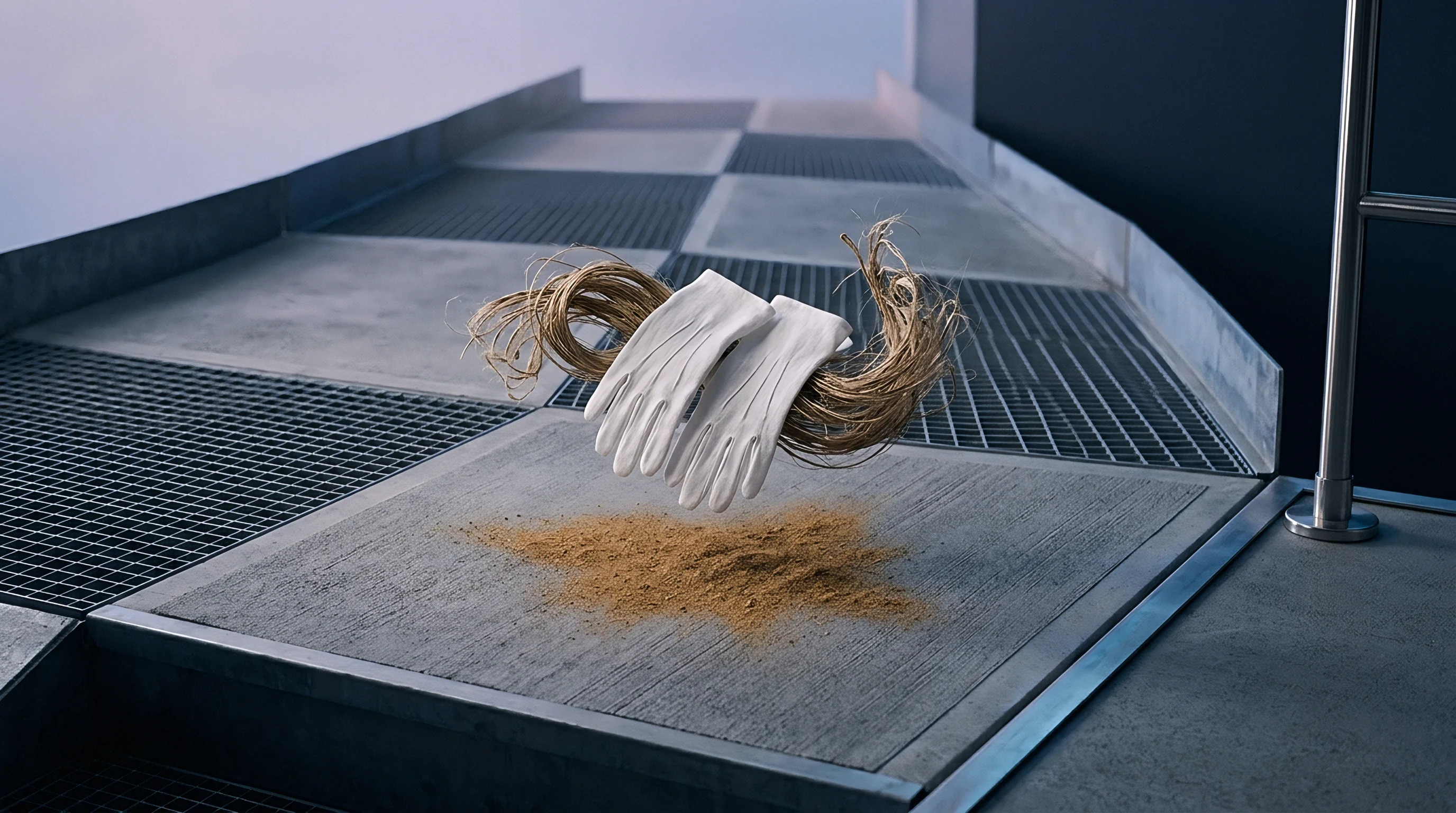

Shive
Unretted woody core fragments alter airflow resistance by disrupting fiber packing in the test holder. Shive consists of non-fibrous xylem tissue that survives scutching and hackling; these rigid, cellular remnants have large internal cavities and irregular shapes that do not align with the longitudinal bast fibers.
When raw flax with high shive content is loaded into the chamber, rigid woody particles bridge against the plunger and prevent uniform consolidation. Surrounding fibers pack loosely around these inclusions, creating high-permeability bypass channels that allow air through quickly, inflating total measured flow and masking true fiber fineness.
| Impurity / Retting Defect | Physical Mechanism | Airflow Measurement Variance | Fineness Assessment Error |
|---|---|---|---|
| Woody Core Shive | Creates high-permeability void channels along rigid particle boundaries. | Flow increases by 8% to 15% | Fineness underestimated (appears coarser). |
| Unretted Epidermis | Binds fibers into thick, stiff technical ribbons. | Flow increases by 12% to 22% | Fineness underestimated (appears coarser). |
| Over-Retted Pectin Loss | Causes excessive bundle division into fine ultimate elements. | Flow decreases by 10% to 18% | Fineness overestimated (appears finer). |
| Residual Cortical Dust | Clogs fine interstitial pores within the fiber bed. | Flow decreases by 5% to 9% | Fineness overestimated (appears finer). |

Retting Homogeneity and Epidermal Residuals
Incomplete pectin degradation leaves thick, coherent ribbons that enlarge hydraulic channel diameters. Retting relies on fungal or bacterial enzymes to break down the middle lamellae; dew retting produces variable degradation along the stem, while controlled enzyme or water retting yields uniform bundle separation. Under-retted flax retains strong pectin bonds, presenting less surface area per unit mass to the gas stream.
Over-retting degrades cell wall polymers and splits ultimate fibers apart completely. Single elementary fibers average 10 to 30 micrometers in diameter, compared to 40 to 150 micrometers for intact technical bundles. In over-retted flax, the abundance of separated ultimate fibers forms a dense pore network with tiny hydraulic radii; this produces very low flow readings that suggest extreme fineness, even though the damaged fibers suffer high end-breakage during spinning.
Coarse retting bundles and shive fragments reduce pneumatic airflow resistance by creating wide hydraulic channels along the specimen tube wall.
Cleaning raw samples prior to testing remains controversial between buyers and processors. Mechanical carding removes shive but breaks technical bundles, artificially increasing measured surface area. Manual cleaning preserves bundle structure but leaves variable amounts of shive behind.
Standard test methods specify gentle manual opening without heavy carding, balancing impurity removal against bundle preservation.
Elevated airflow readings may stem from seasonal retting variations rather than unretted bast fragments.

Count
Predicting yarn spinning limits from specific surface area requires converting air permeability values into metric fineness equivalents. Metric fiber count Nm expresses linear density as meters per gram; higher numbers designate finer fibers suitable for thin, high-count yarns. Airflow measurements yield specific surface area directly, which links to linear density through fiber density and cross-sectional shape factors.
Spinning fine line flax yarn (Nm 60 to Nm 100) requires raw material with high metric fineness, typically exceeding Nm 2000 at the bundle level. Coarse tow fibers below Nm 1000 are restricted to heavy industrial fabrics or dry-spun yarns (Nm 10 to Nm 26). Air permeability testing provides a rapid, objective classification of incoming lots so spinners can allocate stock across production lines.

What Airflow Differential Signals Excessive Fiber Coarseness?
A sharp drop in pressure differential across the test cell indicates coarse technical bundles exceeding 2.5 tex. In low-pressure meters operating at fixed inlet pressure, high flow rates correspond to coarse fibers, signalling under-retted ribbons or thick basal stem material when rotameter readings cross upper threshold limits. Conversely, fine long-staple line flax restricts airflow, giving low flowmeter readings that correspond to linear densities below 1.5 tex per technical unit.
| Air Permeability Flow Rate (L/min) | Specific Surface Area (m2/g) | Technical Bundle Linear Density (tex) | Metric Fiber Fineness (Nm) | Maximum Wet-Spun Yarn Count (Nm) |
|---|---|---|---|---|
| 1.5 to 2.5 | 0.85 to 1.10 | 1.0 to 1.4 | 2200 to 3000 | Nm 80 to Nm 120 |
| 2.6 to 4.0 | 0.65 to 0.84 | 1.5 to 2.1 | 1500 to 2190 | Nm 50 to Nm 79 |
| 4.1 to 6.0 | 0.48 to 0.64 | 2.2 to 3.0 | 1000 to 1490 | Nm 26 to Nm 49 |
| 6.1 to 9.0 | 0.32 to 0.47 | 3.1 to 5.0 | 600 to 990 | Nm 10 to Nm 25 (Dry Spun) |
Fineness governs draft limits directly. During drafting on wet-spinning frames, high specific surface area increases inter-fiber friction and prevents premature strand slippage. Fine fibers offer more contact points within the roving cross-section, distributing drafting forces evenly; insufficient fineness for a target count leads to thin spots, slubs, and frequent yarn breaks.
Linear Density Conversion Equations
Airflow values correlate directly with specific surface area, which converts to mean fiber diameter using solid material density constants. Calculating linear density Tt in tex from volumetric specific surface area S0 relies on empirical conversions established through gravimetric cut-and-weigh calibration. The formula includes a fiber shape factor f, where circular cross-sections equal 1.0 and ribbon-like bast structures range between 1.2 and 1.5.
These calculations assume uniform cross-sections along the fiber length, though bast fibers naturally taper and vary in lumen dimension along the stem. Basal portions have thick cell walls and wide lumens, while apical sections have thin walls and narrow lumens. Low-pressure air permeability measures average surface drag across all segments in the chamber, yielding a weighted mean fineness that accounts for this longitudinal variation.
- Verify that the air permeability instrument holds current calibration against standard reference flax samples.
- Obtain a representative 50 gram sample from five randomly selected bales across the delivered shipment lot.
- Condition the test specimens at 20 degrees Celsius and 65 percent relative humidity for 24 hours.
- Execute triplicate permeability measurements on 5.00 gram test specimens drawn from each bale sample.
- Calculate mean volumetric flow rate Q and determine specific surface area Sw from instrument conversion charts.
- Apply shape factor corrections based on known fiber retting state to convert Sw into metric fineness Nm.
- Compare calculated Nm values against contractual purchase specifications to authorize spinning room release.
Whether low-pressure airflow instruments can reliably differentiate individual ultimate fibers from tightly bound technical bundles remains an open question.


Settlement
Commercial valuation of long-staple flax shipments hinges on verified air permeability reports attached to shipping documents. Buyers pay premium rates for high metric fineness because finer raw material yields higher spin counts and better yarn prices per meter. Contracts stipulate strict target ranges for specific surface area or flow rates, and delivering lots below threshold results in price penalties or rejection.
Integrating objective airflow test reports into trade agreements eliminates disputes over subjective hand-classing. Mill buyers specify minimum air permeability performance to protect spinning yields and ensure hackling line waste stays within predicted allowance models.

Dossier Preparation and Technical Specification Clauses
Purchase orders for hackled flax sliver specify an air permeability tolerance band aligned with a target metric fineness. Complete technical dossiers include certified lab reports detailing mean airflow values, test temperature, relative humidity, and sample moisture content.
Dispute resolution relies on re-testing by independent arbitral laboratories. When a buyer challenges lot fineness, standard arbitration protocols require testing retained fiber samples using ISO 2370 reference methods. If arbitration confirms elevated airflow (coarser fiber), the supplier pays testing costs and accepts a price adjustment according to contractual penalty scales.
Price adjustments follow linear or stepped penalty schedules based on fineness deviations. A shipment contracted at Nm 2000 that tests at an average of Nm 1750 incurs a discount reflecting its reduced spinning capacity. Deviations exceeding 20 percent of target fineness give the buyer the right to reject the shipment and return it at the supplier’s expense.
Yarn spinners accept raw flax lots only when airflow permeability testing proves linear density variance stays within specified contract limits.
Settling commercial invoices against certified air permeability readings removes subjectivity from raw bast fiber grading and establishes predictable spinning economics.