Dynamic Psychrometric Microclimate Control and Viscoelastic Warp Film Stress in High-Speed Bast Weaving
Dynamic localized psychrometric control sustains viscoelastic sizing compliance on bast warps, preventing film fracture and lifting loom speeds past 500 PPM.

Enclosure
Running 100 percent wet-spun flax warp yarns on positive rapier looms at 550 picks per minute produces localized thermal dissipation that strips bound moisture from sizing films in fractions of a second. Standard shed controls set to 65 percent relative humidity and 21 degrees Celsius cannot keep native bast polymers plasticized across the open shed line. As the warp sheet travels from the back rest roller through the drop wires, heald frames, and reed, convective drafts pulled into the shedding zone evaporate surface water, raising the glass transition temperature of the polyvinyl alcohol and modified starch size.
Maintaining a localized psychrometric microclimate directly in the weaving zone isolates the active yarn path from plant drafts, preserving target moisture regain in the cellulosic fiber bundles.
Direct atomization nozzles mounted along the harness frames and above the warp stop motion discharge 5 to 10 micrometre droplets, which evaporate before hitting the yarn and sustain 78 percent relative humidity at 24 degrees Celsius within the immediate envelope. This stability suppresses the moisture gradient between the yarn core and the exterior size sheath. Without targeted containment, air movement generated by the heald frames accelerates boundary layer evaporation, leaving brittle sizing films that crack under cyclic flexure.
A dry warp sheet sheds its protective coat long before the reed completes the beat-up cycle.
Baffles around the harness motion restrict air turnover to below 0.15 cubic metres per second per metre of reed width. That containment keeps the equilibrium moisture content of the flax yarns between 8.5 percent and 9.2 percent dry basis during continuous weaving. When microclimate control lapses, surface drying triggers immediate size desquamation, piling up shedding debris, abrading heald eyes, and snapping warp ends until entire shift schedules stall.


Plasticization
Flax fibers consist of crystalline cellulose fibrils held in an amorphous matrix of hemicellulose, pectin, and lignin. Water acts as an endogenous plasticizer in this amorphous phase, weakening inter-chain hydrogen bonds so elementary fibrils can slide under axial load. When warp sizing compounds like modified carboxymethyl starches, acrylic co-polymers, or hydrolyzed polyvinyl alcohols are applied, their mechanical compliance hinges on retained moisture.
At standard room conditions of 50 percent to 60 percent relative humidity, dried size films develop an elastic modulus above 2.8 gigapascals, making them too stiff to follow the dynamic elongation imposed during shed formation.
Hygrothermal Transitions in Bast Film Sheaths
Elevating vapor pressure inside the weaving enclosure drops the sizing polymer’s glass transition temperature below shed operating temperature. At 80 percent relative humidity, polyvinyl alcohol films shift from a glassy solid into a viscoelastic state, with an elastic modulus between 450 and 650 megapascals. This structural softening lets the size dissipate cyclic tensile energy through molecular relaxation rather than micro-cracking.
Under 80 percent relative humidity at 24 degrees Celsius, plasticized polyvinyl alcohol films maintain an elongation at break of 18 percent without structural rupture.
Sizing layer equilibrium moisture responds non-linearly to ambient relative humidity, tracking a type II sorption isotherm. Size additives like polyol humectants and sulfonated lipids shift this sorption curve upward, aiding water retention against rapid air movement.
| Formulation Chemistry | Target Zone Relative Humidity (%) | Film Moisture Content (%) | Elastic Modulus (MPa) | Film Tensile Strain at Break (%) | Specific Abrasion Resistance (Cycles) |
|---|---|---|---|---|---|
| Modified Potato Starch (8% add-on) | 60 | 7.8 | 2150 | 3.2 | 420 |
| Modified Potato Starch (8% add-on) | 78 | 12.4 | 820 | 8.5 | 1180 |
| PVA / Acrylic Copolymer Blend (6% add-on) | 60 | 6.5 | 1890 | 5.4 | 760 |
| PVA / Acrylic Copolymer Blend (6% add-on) | 78 | 11.1 | 510 | 19.8 | 2840 |
| Enzyme-Modified Bast Blend (7% add-on) | 65 | 8.1 | 1640 | 4.6 | 610 |
| Enzyme-Modified Bast Blend (7% add-on) | 82 | 13.8 | 460 | 14.2 | 2250 |
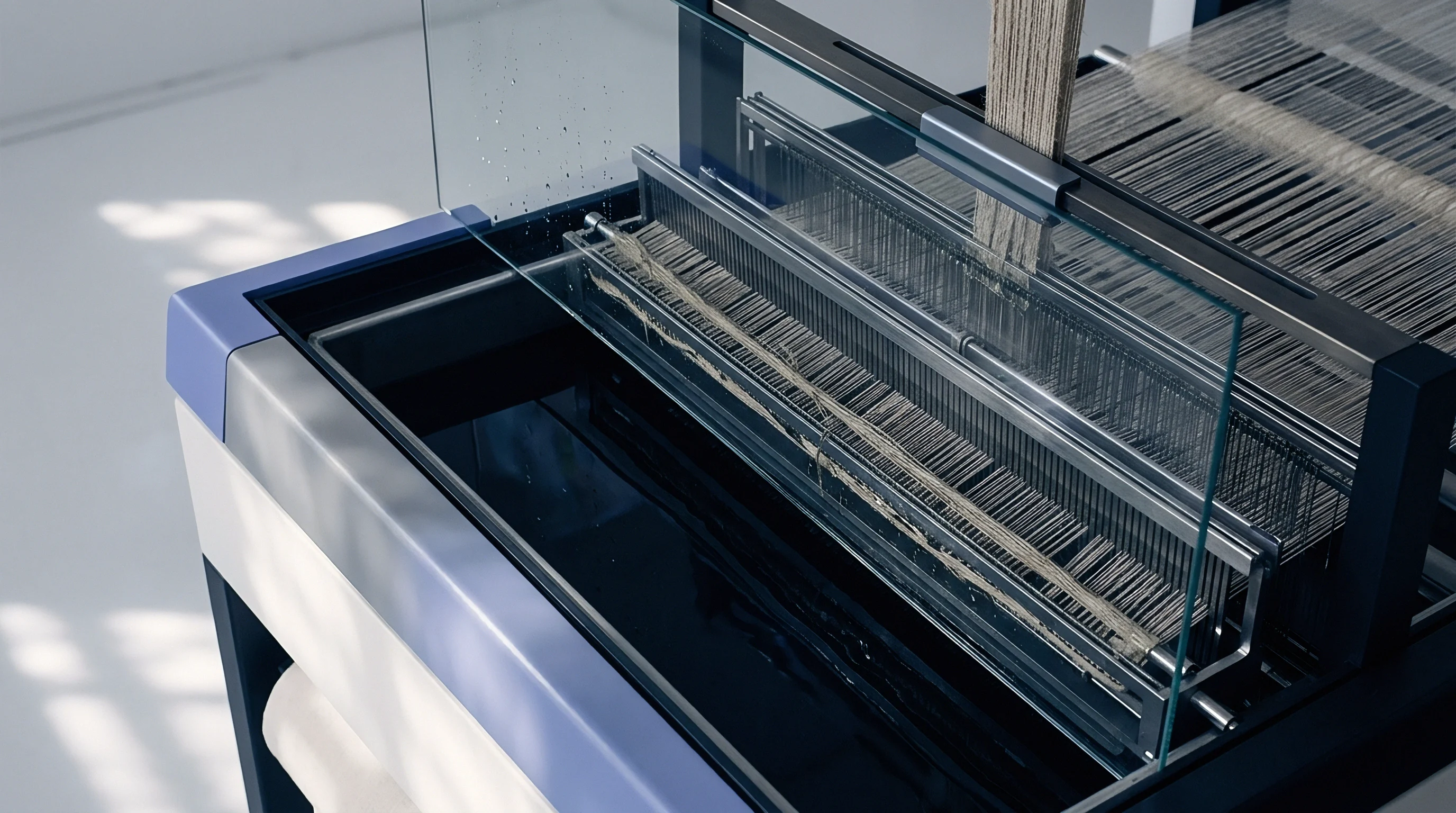
Viscoelastic Recovery under Dynamic Frequency
Cyclic shedding exposes the warp line to stress frequencies of 6 to 10 hertz on modern rapiers. Viscoelastic materials exhibit time-dependent deformation where strain lags applied stress by a phase angle. If the sizing compound lacks sufficient loss modulus, deformation energy converts into permanent lattice strain or brittle fracture planes along the fiber-matrix boundary.
- Interfacial Shear Delamination occurs when dried size sheaths detach from the outer bast fiber walls under rapid axial elongation gradients.
- Transverse Micro-Fissuring forms across the sizing surface when the dynamic storage modulus exceeds the tensile compliance threshold of the composite yarn structure.
- Fibrillar Splitting develops within unplasticized flax bundles as elementary fibers lose cohesive pectin coupling during shed opening cycles.
- Adhesion Degradation takes place at high relative humidity levels exceeding 88 percent, where excess moisture softens the size matrix into a tacky paste that adheres to adjacent ends.
The thermodynamic distribution of moisture between core cellulose fibrils and the external polymer film remains an open question, as real-time hygrometric measurement across a moving yarn at production speed exceeds current instrumentation limits.
Tension
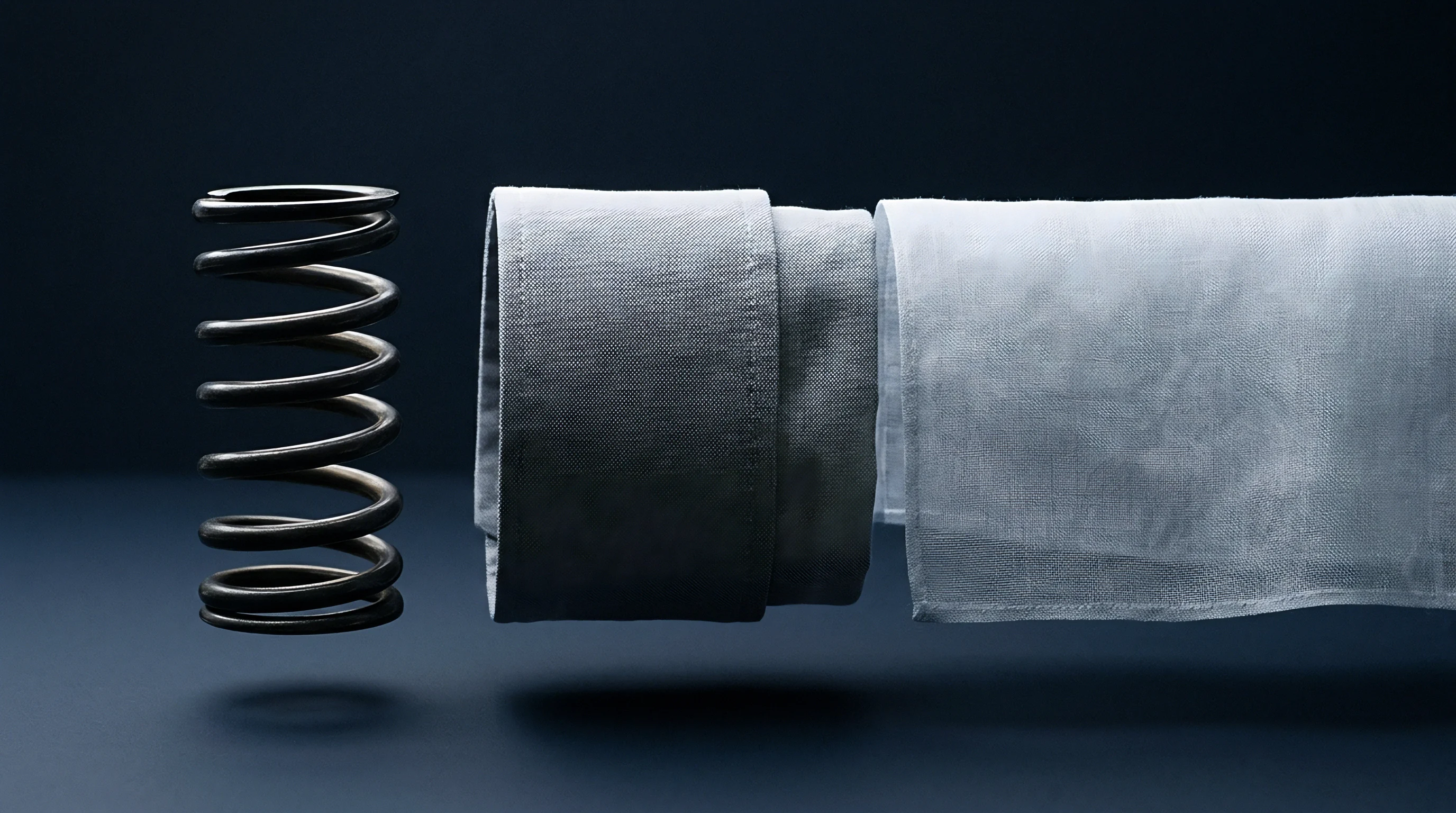
Warp tension profiles in high-speed bast weaving differ sharply from continuous filament or cotton patterns because flax elongates only 1.5 percent to 2.5 percent before breaking. Dynamic shedding creates sharp tension peaks at full open shed and beat-up. On negative cam or electronic dobby motions, geometric extension on individual ends reaches 1.2 percent to 1.8 percent strain.
Combined with a static baseline pretension of 0.45 centinewtons per tex, instantaneous load approaches 75 percent of yarn breaking force.
Why Rapid Shed Cycling Alters Film Compliance?
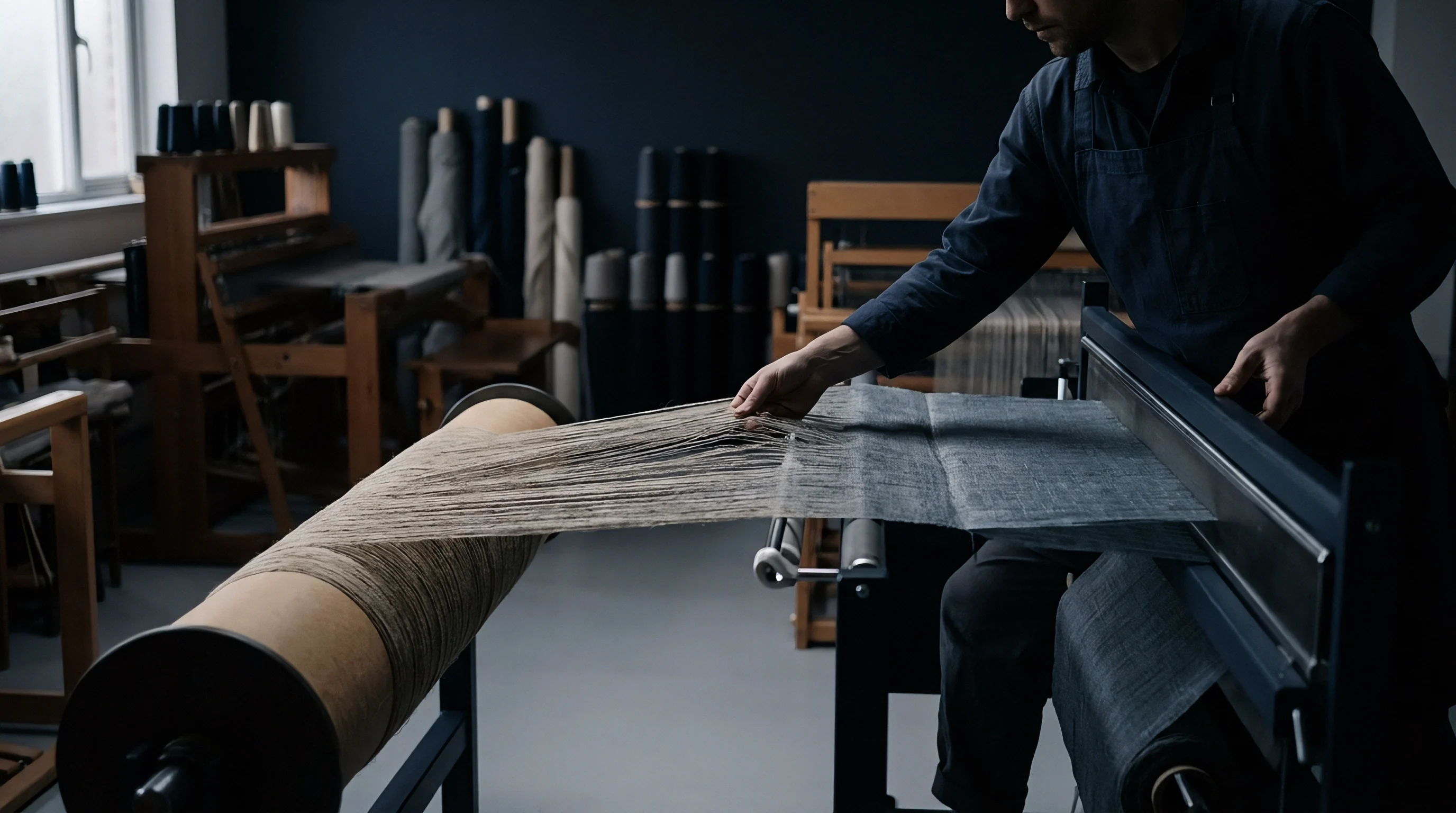
High picking speeds compress the warp cycle’s loading phase into less than 45 milliseconds. Bast fibers exhibit severe stress hardening at these strain rates, so the size film must adjust its relaxation spectrum to absorb the peak without yielding. An under-plasticized sheath ruptures within the first 15 milliseconds of shed rise, throwing the full tensile burst onto individual, unaligned elementary bast fibers.
Peak warp line extension during shed opening must never outpace the molecular relaxation rate of the protective size layer.
Tension control depends on low-inertia, electronically driven back rest rollers with load cell feedback to dampen cyclic amplitude spikes. The following sequence stabilizes dynamic film stress on 190-centimetre rapier installations weaving fine bast yarns:
- Calibrate warp stop motion drop wire banks to an angle of 18 degrees relative to the warp line to minimize friction entry points.
- Set the static baseline warp tension on the electronic let-off controller to exactly 0.38 centinewtons per tex for wet-spun bast counts finer than Nm 36.
- Adjust the back rest roller spring pre-charge to provide 6 millimetres of dynamic deflection under peak shed opening.
- Advance the electronic shedding harness timing to close 15 degrees early, reducing peak yarn-to-yarn crossing interference before reed beat-up.
- Engage the localized psychrometric atomizers to ramp output proportionally whenever machine speed exceeds 400 picks per minute.
Proper mechanical alignment prevents strain from concentrating at the outer selvage ends, where draw-in creates the steepest lateral angles. In practice, warp elasticity dictates shed geometry, while sizing compliance sets the limit on shed speed.


Defects
Mechanical breakdown of warp sizing films during weaving produces recognizable fabric defects and loom stops. Fiber fuzzing from lost size adhesion causes ends to cling together in the shedding zone as loose fibrils entangle. When sheds fail to clear cleanly, rapier heads miss or foul their entry, generating false weft stops, broken picks, warp floats, and stitching blemishes.

Structural Classification of Greige Imperfections
Stoppage marks appear whenever a loom halts to repair an end break. During the standstill, the warp section held under tension between the back rest and fell relaxes while drying out if local psychrometric control drops. When the loom restarts, the altered compliance of that dried section leaves a visible pick density stripe across the fabric width, hurting commercial grades under standard four-point scoring.
Qualifying greige flax fabrics requires verifying yarn integrity before wet processing. Inspection sheets target specific defects tied directly to microclimatic breakdown:
- Warp Stripiness resulting from localized moisture variation across the beam width during sizing or weaving passes.
- Skinning and Size Accumulation observed at the drop wires and heald eyes where delaminated sizing polymer packs into abrasive rings.
- Reed Abrasion Fibrillation visible as hairy yarn segments located systematically along high-density dent zones.
- Starting Marks characterized by localized pick spacing deviations exceeding 10 percent of the nominal set after a loom stop.
Under ASTM D5430, apparel-grade classification requires demerit points to stay below 20 points per 100 square metres, and any warp breakage cluster longer than 300 millimetres triggers an immediate whole-roll penalty.
Capacity
Running high-speed bast weaving calls for close balance among loom speed, target efficiency, and environmental energy demand. Flax weaving historically stayed below 300 picks per minute on projectile or rapier looms to prevent warp cleavage. Modern installations with localized psychrometric microclimate cells run stably at 520 to 600 picks per minute on plain weave and 2/2 twill apparel constructions, boosting machine output by more than 70 percent per loom hour.
Economic Mechanics of Shed Efficiency
Loom-hour costing accounts for both capital depreciation and operating throughput. Total weaving cost per linear metre depends directly on operating efficiency ~ the ratio of actual picks inserted to theoretical maximum capacity. Localized microclimate systems cut warp break frequency from 4.2 stops per 100,000 picks to 0.8 stops per 100,000 picks, raising room efficiency from 74 percent to 91 percent.
A two-stop reduction per hundred thousand picks increases net loom output by twelve finished metres per shift on wide-width flax runs.
Operating at this efficiency reduces fixed overhead allocations per metre, offsetting the capital required for local air delivery piping and reverse-osmosis water systems on the atomizers.
| Control Configuration | Weaving Speed (PPM) | Warp Stops / 10^5 Picks | Shed Efficiency (%) | Output (Metres/Loom Hour) | Landed Weaving Cost ($/Metre) |
|---|---|---|---|---|---|
| Ambient Shed Control Only (60% RH) | 340 | 4.8 | 71.5 | 9.14 | 2.48 |
| Ambient Shed Control Only (70% RH) | 420 | 2.9 | 79.0 | 12.44 | 1.86 |
| Localized Microclimate Enclosure (78% RH) | 540 | 0.8 | 91.2 | 18.47 | 1.32 |
| Localized Microclimate Enclosure (82% RH) | 580 | 0.9 | 89.5 | 19.47 | 1.27 |
High ambient plant humidity alone does not provide sufficient yarn lubrication for fast weaving; blanket shed humidification compromises worker comfort, corrodes structural loom parts, and still fails to prevent rapid yarn drying inside convective machine drafts.