Modelling Warp Take up Ratios in Grey Plain Weaves
Warp take up ratio in grey plain weave determines true yarn length from cloth length, calculated via thread density, diameter, and crimp geometry.

Contraction
Yarn path shortening in woven structures stems directly from the geometric displacement of threads weaving over and under orthogonal yarn sets. As warp yarn feeds off the beam into the loom, interlacing with weft picks forces the straight yarn into three-dimensional crimp curves. The ratio of initial unwoven length to off-loom greige fabric length defines the warp take-up ratio.
Modeling this figure accurately dictates yarn procurement volumes, sizing formulations, and beam planning target metrics in grey fabric manufacturing.
In greige plain weaves, warp take-up ratio differs fundamentally from weft crimp percentage, even though both stem from the same interlacing points. Take-up measures yarn consumption against the initial length drawn off the beam, while crimp percentage measures it against finished fabric dimensions. Converting between the two requires exact mathematical handling during planning, as substituting raw crimp values directly leads to systematic underestimates of total yarn mass.

Thread Trajectory and Dimensional Shortening
Linear yarn segments shift vertically as orthogonal threads cross above and below the cloth plane. The amplitude of this wave depends on yarn diameter, thread spacing, and structural packing density. As weft density rises, warp yarns undergo greater flexural deflection per unit length, driving up warp take-up while reducing weft contraction.
| Yarn Linear Density (Tex) | Ends per Centimetre | Picks per Centimetre | Greige Mass (g/m²) | Warp Take-Up (%) | Weft Crimp (%) |
|---|---|---|---|---|---|
| 20 | 24 | 24 | 103.2 | 6.8 | 6.9 |
| 20 | 28 | 24 | 112.5 | 8.4 | 5.2 |
| 30 | 20 | 20 | 130.1 | 7.5 | 7.6 |
| 30 | 24 | 20 | 141.8 | 9.2 | 5.8 |
The spatial arrangement between warp and weft in the unsized grey state shifts the moment tension is released during doffing. Once off the loom, stored viscoelastic strain relaxes, causing secondary dimensional contraction in both warp and weft directions.
Grey plain weaves with balanced yarn counts display near-equal warp and weft crimp when off-loom tension completely relaxes.

Distinguishing Unsized Grey State from Beam Feed
Machine feed rates rarely match finished fabric length because off-loom relaxation releases stored mechanical strain. Sizing adds temporary binder mass while stretching warp threads prior to loom mounting, introducing stretch allowances that mask underlying structural take-up. Isolating the pure geometric take-up of grey plain weave requires accounting for slasher stretch and loom tension extensions to isolate displacement caused purely by yarn path geometry.
Whether ultra-high flexural rigidity in bast yarns prevents theoretical crimp equalization under asymmetric loom tensions remains an open operational question.


Reed
Loom width selection directly controls the transverse tension profile during fabric formation. Physical contact between warp threads and reed wires imposes lateral constraint, guiding thread alignment at the fell of the cloth. Denting plans determine how threads are distributed across the width, influencing vertical displacement during shedding cycles.
Tension gradients distort weave balance. Near the selvedges, higher reed friction and temple draw shift the crimp distribution, making warp take-up at the edges distinctly different from the cloth center. Shedding mechanics exert higher cyclic strain on edge ends, requiring structural adjustments on high-speed rapier and air-jet looms.

Dynamic Warp Tension across the Loom Width
Transverse load distribution shifts during shed movement, altering yarn path geometry between central ends and edge threads. Central warp yarns experience uniform vertical deflection, while selvedge threads endure compound angular strain from temple pins and harness spread. These variations induce localized crimp differences across the fabric, setting up contraction gradients during grey relaxation.
- Off-center reed alignment creates localized tension spikes across the warp beam, forcing outer ends to absorb higher crimp rates than central threads.
- Inconsistent let-off tension lets the warp beam over-feed during shed opening, causing unpredictable variations in greige cloth length.
- Excessive beat-up resistance causes weft threads to bow near the selvedges, altering the structural equilibrium of the plain weave matrix.
- Incorrect reed count selection bunches warp ends in the dent, elevating localized thread packing and preventing natural crimp balance.
Beat up Force Influence on Thread Packing
Beat-up forces weft picks into position, compressing intersections and driving axial thread movement. Higher beat-up intensity flattens weft cross-sections into elliptical geometries, reducing warp wave amplitude and lowering total warp take-up. Conversely, lighter beat-up settings leave weft yarns round, forcing warp threads to follow a longer path around each pick.
Higher weft tension forces warp threads to travel a longer path around an essentially straight weft line.


Equation
Mathematical modeling of yarn deformation relies on geometric relationships built around idealized flexible cylinders. Standard calculation models expand on classical Peirce equations, defining unit cell dimensions through thread diameter, spacing, and weave angle. In a 1/1 plain weave, thread spacing is the reciprocal of ends or picks per unit length, while thread diameter correlates with linear density and fiber packing.
The geometric relationships governing plain weave crimp balance rely on interdependent spatial parameters. Let p1 represent weft spacing, p2 warp spacing, d1 warp diameter, d2 weft diameter, theta1 warp weave angle, and theta2 weft weave angle. The modular length l1 of warp yarn per unit cell connects to thread spacing and curvature through standard geometric forms.
Peirce Geometry Mechanics for Plain Weaves
Classical circular arc geometry defines unit cell length through two structural states: open cover and jammed thread configurations. In non-jammed grey plain weaves, warp length per repeat cell l1 is modeled as: l1 = (p1 – D sin(theta1)) + D theta1, where D represents the sum of warp and weft diameters (d1 + d2), and theta1 is expressed in radians. Warp crimp percentage C1 follows directly from: C1 = (l1 / p1) – 1.
- Define target fabric specifications including yarn counts in tex, ends per centimetre, picks per centimetre, and fiber bulk density.
- Calculate theoretical yarn diameters using fiber density constants and yarn packing factors under standard mechanical packing assumptions.
- Determine unit cell spacing parameters p1 and p2 by taking the reciprocal of pick density and end density respectively.
- Solve the transcendental equation system for warp weave angle theta1 under assumed non-jammed geometric conditions.
- Compute modular yarn length l1 and derive the grey warp take-up ratio T1 using the relationship T1 = 1 – (p1 / l1).
Practical yarn modeling requires adjusting for cross-sectional flattening. Mechanical beat-up loads compress circular yarn profiles into racetrack or elliptical shapes, altering the effective displacement height D. Modified models substitute major and minor axis dimensions for nominal diameter to maintain accuracy in tight greige constructions.
A grey plain weave running 24 ends per centimetre with 20 tex cotton yarn exhibits a baseline warp take up ratio of seven point two percent under standard loom tension.

How Do Yarn Flexural Rigidity Values Alter Crimp Balance?
Yarn bending resistance dictates how axial forces distribute between warp and weft during fabric formation. High-rigidity yarns, such as coarse grey linen or high-tenacity filament synthetics, resist crimp formation. When stiff warp yarns meet flexible weft yarns, the weft absorbs most of the curvature, causing warp take-up to drop sharply while weft crimp rises.
Inaccurate crimp predictions cause severe warp shortfalls, resulting in premature beam exhaustion, broken production schedules, and lost mill capacity.

Assay
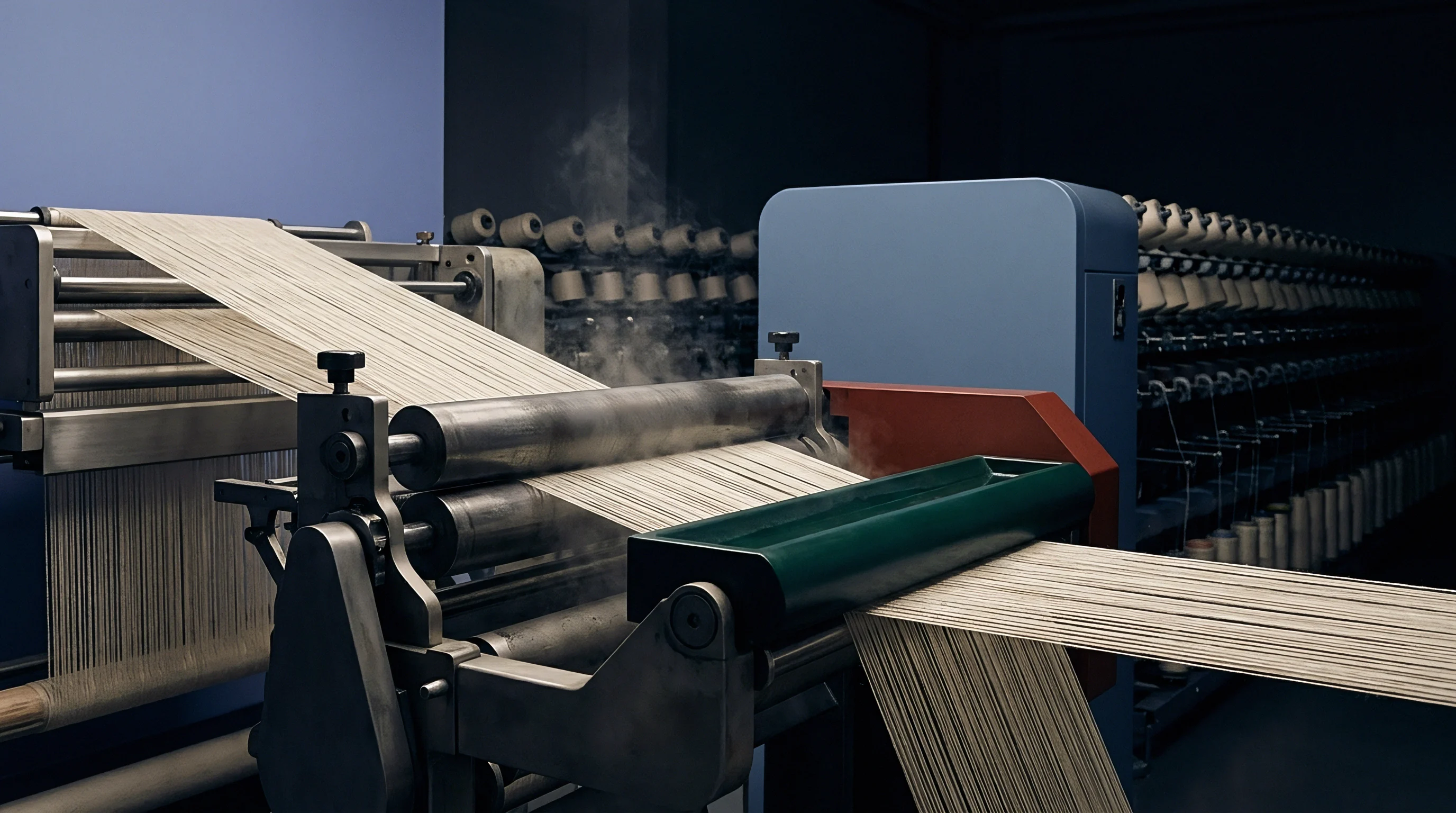
Laboratory verification of yarn path length requires precise mechanical tensioning during unravelling from fabric samples. ISO 7211-3 specifies standard parameters for measuring warp and weft crimp in woven textiles. Testing isolated grey fabric samples provides empirical baseline figures to validate theoretical geometry models and verify mill delivery compliance.
The evaluation process demands careful sample preparation to prevent unraveling tension from permanently stretching individual yarns. Standard atmospheric conditioning under ISO 139 ensures moisture content stabilizes before mechanical loads are applied.

ISO Standard Measurement Protocols
Unraveling grey cloth without introducing manual draft requires mounting specimens on specialized crimp testers equipped with sensitive load cells. Calibrated pretension forces prevent under- or over-stretching the relaxed yarn path. ISO 7211-3 establishes pretension values based on yarn linear density, typically set at zero point five centinewtons per tex for spun staple yarns.
| Yarn Type | Linear Density (Tex) | Standard Pretension (cN) | Tension Tolerance (cN) | Acceptable Deviation Range (mm/m) |
|---|---|---|---|---|
| Ring Spun Cotton | 15 | 7.5 | 0.25 | 2.0 |
| Ring Spun Cotton | 30 | 15.0 | 0.50 | 2.5 |
| Wet Spun Linen | 40 | 20.0 | 1.00 | 4.0 |
| Textured Filament | 20 | 10.0 | 0.30 | 1.5 |
Testing personnel remove individual warp yarns from a sample of at least 500 millimetres, place them under calibrated pretension load, and measure extended length directly. Comparing extended straight length to initial specimen length yields the measured warp take-up.
Laboratory Moisture and Temperature Controls
Fiber swelling alters cross-sectional yarn dimensions, shifting measured crimp values. Cotton and bast fibers absorb ambient humidity, swelling radially and increasing thread diameter D. Larger diameters increase vertical wave height, artificially elevating measured warp take-up if testing occurs outside regulated climate conditions.
- Unconditioned sample testing yields erratic length values due to uncontrolled fiber regain and thermal contraction.
- Incorrect pretension selection causes incomplete crimp removal or permanent yarn elongation, distorting model calibration data.
- Improper specimen extraction damages spun yarn cohesion, untwisting single ends and shifting measured yarn lengths.
- Specimen size truncation below 500 millimetres increases edge sampling error percentages beyond acceptable confidence limits.
Discrepancies between calculated beam lengths and delivered fabric yields often stem from unrecorded yarn tension fluctuations during humidity spikes.


Yield
Commercial efficiency in cloth production hinges on exact calculations of raw yarn mass committed to the warp beam. Warp take-up directly increases the length of yarn required to deliver a target meterage of finished grey cloth. Failing to account for take-up leads to yarn shortages, unfulfilled purchase orders, and financial penalties on high-volume production contracts.
| Target Take-Up (%) | Actual Take-Up (%) | Warp Mass Overhead (%) | Shed Efficiency Variance (%) | Cost Impact per Metre (USD) |
|---|---|---|---|---|
| 6.5 | 6.5 | 0.0 | 0.0 | 0.000 |
| 6.5 | 7.2 | 0.7 | -0.3 | +0.014 |
| 6.5 | 8.0 | 1.6 | -0.8 | +0.032 |
| 6.5 | 5.8 | -0.7 | +0.2 | -0.012 |
The financial weight of warp take-up compounds on large production runs. A miscalculation of just one percent on a one-hundred-thousand-metre grey cloth order alters yarn requirements by over a thousand metres of warp, directly affecting landed metre costs and raw material working capital allocation.

Beam Length Planning and Mass Calculations
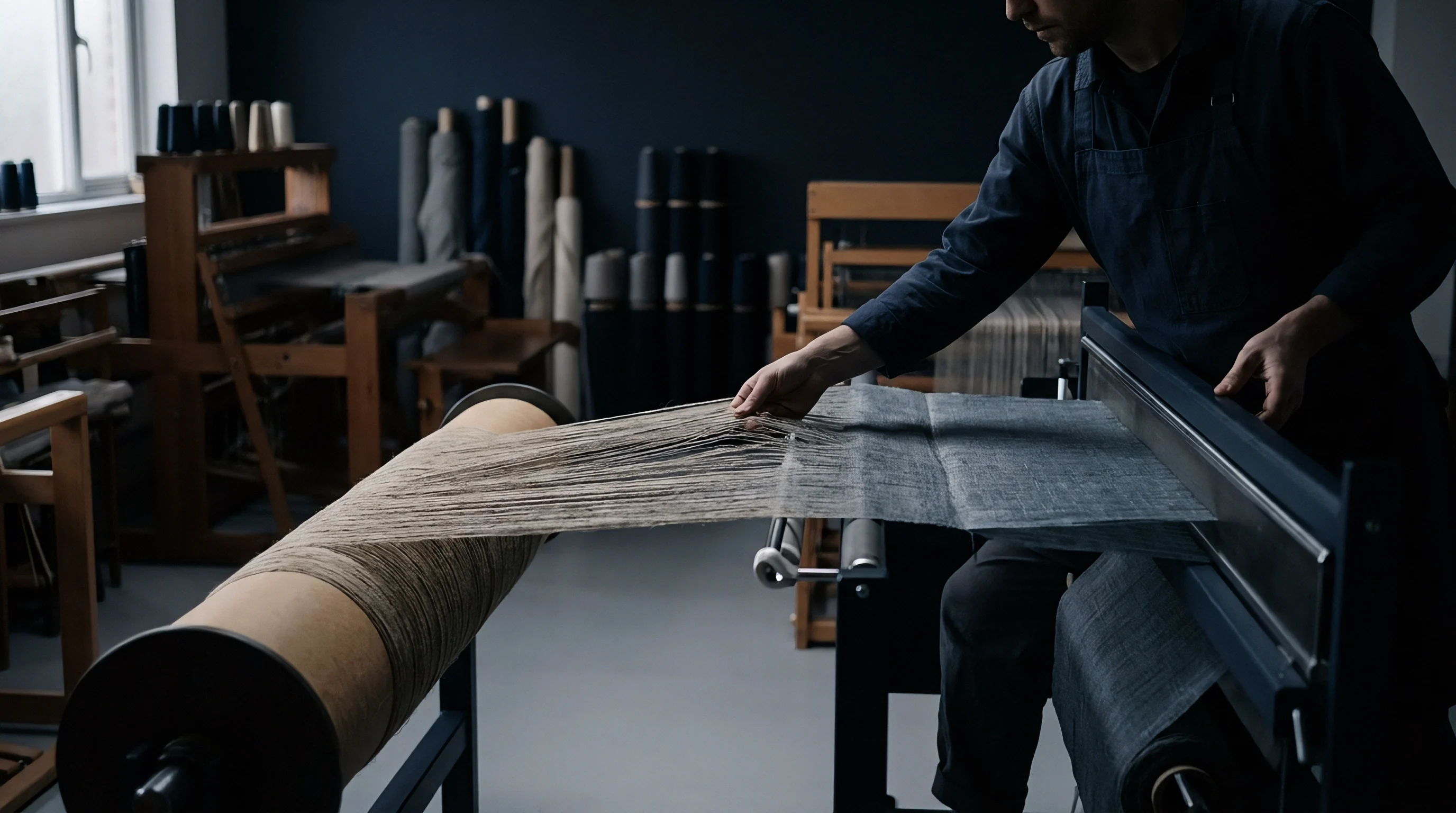
Calculating total warp length requires combining target greige fabric length, predicted take-up ratio, sizing stretch allowance, and waste margins. The operational model for total warp yarn length L_total takes the form: L_total = L_cloth / (1 – T) (1 + W), where L_cloth represents target greige length, T represents warp take-up ratio, and W represents operational waste factor. Converting length to yarn mass involves multiplying by total end count and yarn linear density in tex.
Standard commercial weave contracts specify a maximum allowable warp length variance of plus or minus zero point five percent from calculated beam models.
Contractual Tolerances and Commercial Adjustments
Fabric purchase agreements establish strict financial benchmarks for allowable deviation between design specifications and delivered cloth metrics. When delivered greige cloth exhibits excessive warp take-up, cloth mass per square metre rises while total bolt length shrinks, triggering customer rejections under standard inspection codes. Exact mathematical modeling provides the technical foundation needed to guarantee compliance across commercial supply chains.
Incorporating ISO 7211-3 section four tolerances directly into grey cloth purchase specifications binds the weaver to financial compensation when delivered warp crimp exceeds planned limits by more than zero point three percent.