Separating Viscoelastic Crimp Interchange from Biochemical Mass Loss in Scouring
Scouring linen increases GSM despite mass loss because wet viscoelastic crimp interchange condenses thread count faster than non-cellulosic extraction lightens yarn.

Swell
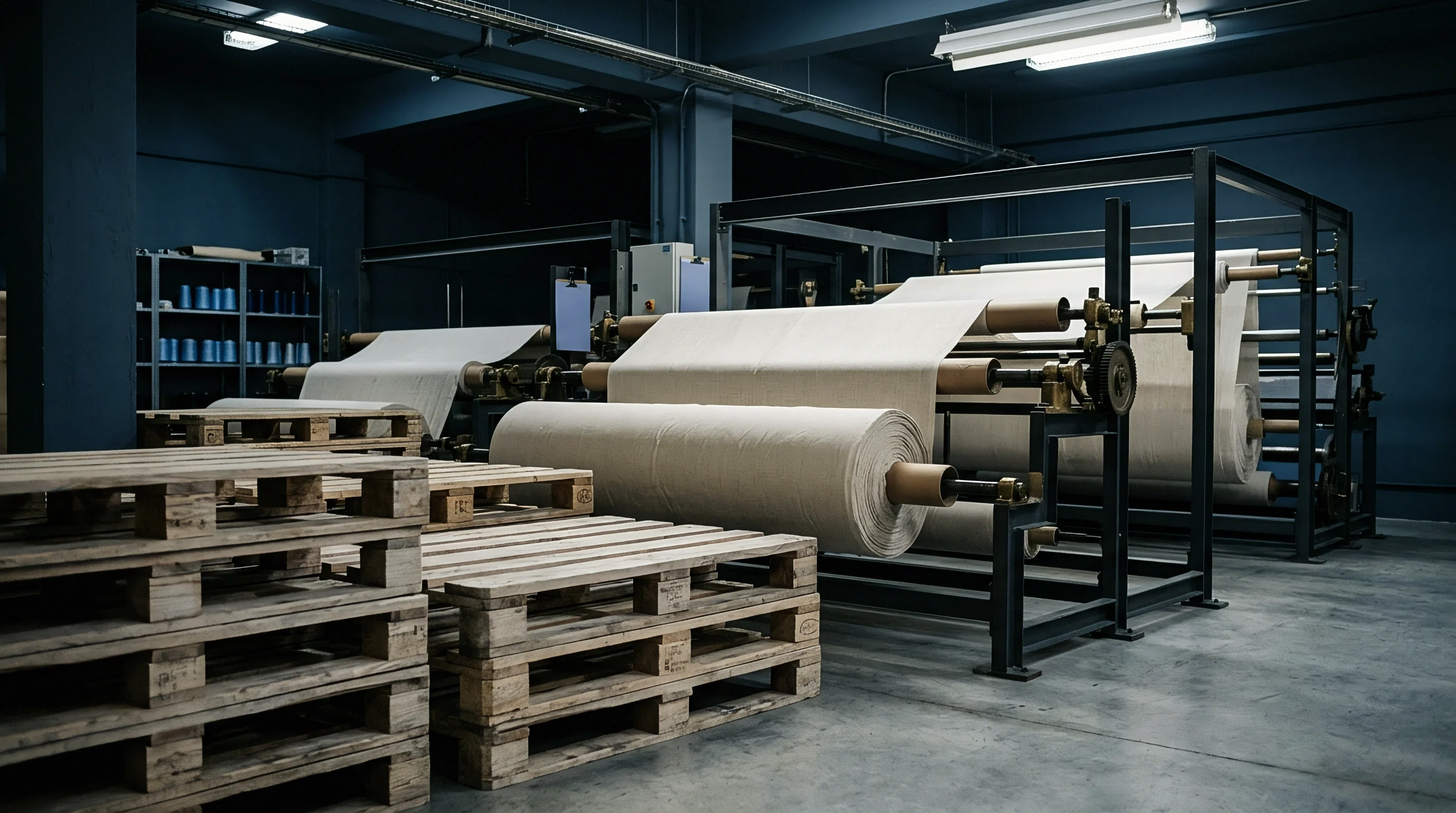
Greige linen cloth leaving the loom exists in a state of high structural tension. Warp yarns, subjected to continuous mechanical strain from the shedding motion and beat-up, remain elongated while weft yarns sit in a relatively relaxed, planar configuration. Wet finishing disrupts this mechanical equilibrium.
Flax fibers swell sideways in water. Radial moisture uptake forces individual ultimate fibers within the technical yarn bundle to expand transversely by 15 to 25 percent, driving an immediate axial contraction of 2 to 5 percent along the yarn length. This anisotropic dimensional shift forces the interlacing points to renegotiate their spatial balance.
Warp yarns release held strain, transferring bending wave amplitude into the weft direction. Crimp shifts under zero tension.
The resulting geometric reorganization is pure crimp interchange. Crimp defined as the percentage excess length of yarn removed from a fabric woven structure relative to the straight length of that fabric increases significantly in the warp while fluctuating in the weft. As warp crimp rises from a loom-state baseline of 3.5 percent up to 8.5 percent in continuous open-width wet processing, the cloth suffers significant longitudinal contraction.
This dimensional collapse alters the physical density of the cloth independently of mass changes. Sett increases passively. An initial warp sett of 18 ends per centimetre at the reed can condense to 19.5 ends per centimetre on the batching roller solely through mechanical wet relaxation.
Unchecked water absorption drives axial fiber contraction that alters thread counts before any chemical reaction takes place in the liquor.
The physical transformation occurs rapidly within the first stages of aqueous exposure. When greige flax enters an ambient pre-wetting tank, transverse hydration relaxes hydrogen bonds within the amorphous regions of the crystalline cellulose matrix. Mechanical strain imparted during warping and weaving dissipates instantly.
Tension masks true fiber contraction. If the finishing line runs under minimal machine tension, the fabric contracts in length while expanding in thickness as yarn crowns rise above the weave plane.
| Processing Stage | Fiber Diameter Change (%) | Axial Yarn Contraction (%) | Average Warp Crimp (%) | Average Weft Crimp (%) |
|---|---|---|---|---|
| Loom State (Greige) | Base (0.0) | 0.0 | 3.2 to 4.0 | 1.8 to 2.4 |
| Aqueous Hydration (20°C) | +16.5 | -3.2 | 6.5 to 7.8 | 2.8 to 3.5 |
| Hot Alkaline Scour (95°C) | +22.0 | -4.8 | 8.2 to 9.6 | 3.1 to 4.2 |
| Relaxed Tumble Drying | +4.5 | -6.1 | 9.8 to 11.2 | 4.0 to 5.0 |
Treating this structural compaction as volumetric shrinkage alone introduces profound errors in yield estimation. The loom setting determines the maximum potential for crimp interchange, but the wet finishing route governs how much of that potential converts into permanent dimensional change. Miscalculating the boundary between mechanical stress relaxation and fiber swelling causes re-runs, ruined finished widths, and costly disputes over off-spec mass per unit area.

Dissolution
Biochemical mass loss during scouring operates via an entirely distinct chemical mechanism. Greige flax fiber is not pure cellulose. The technical fiber bundle contains 70 to 80 percent alpha-cellulose, with the remainder composed of non-cellulosic constituents: 12 to 15 percent hemicellulose, 4 to 6 percent pectins, 1.5 to 3 percent waxes and fats, 1 to 3 percent lignin, and trace water-soluble inorganic salts.
Scouring aims to strip non-cellulosic impurities from the primary cell wall and middle lamella to increase absorbency, improve dye affinity, and soften the textile hand. Pectins dissolve in warm alkali. Sodium hydroxide solutions applied at 80 to 95 degrees Celsius saponify natural waxes into water-soluble soaps and hydrolyze insoluble pectins into soluble sodium pectates.
Mass leaves the yarn matrix. This extraction removes 6 to 12 percent of the fabric greige mass directly into the scouring effluent. Cellulose remains largely untouched here.
Unlike synthetic fibers or clean cotton, the weight change in scoured linen represents a massive net reduction in solid polymer mass within each individual yarn core. The removal of intercellular pectins loosens the technical fiber bundles, allowing sub-fibrils to slide more freely over one another under applied stress. This structural loosening changes the internal bending modulus of the yarn.
A softer yarn deforms more easily at weave interlacing crowns, which directly alters how crimp distributes between warp and weft during drying.
Can Laboratory Solvent Extraction Distinguish Structural Contraction from Non-Cellulosic Mass Loss?
Disentangling gravimetric extraction from geometric contraction requires strict analytical protocol control. When a lab receives a customer complaint regarding lightweight fabric post-scouring, standard practice often defaults to measuring grams per square metre directly from a cut swatch. This measurement conflates two opposing vectors: mass loss reduces fabric weight while dimensional contraction increases thread density per unit area, inflating the measured mass per square metre.
Relying solely on fabric weight without extracting non-cellulosic fractions masks the true extent of chemical material loss.
Enzymatic or alkaline removal of middle lamella pectins lowers yarn flexural rigidity, accelerating crimp accommodation under lighter mechanical loads.
Executing an inaccurate scouring procedure generates specific structural and physical defects in the finished cloth:
- Excessive Pectin Depletion removes structural binding material between ultimate fibers, causing yarn disintegration, severe strength loss, and elevated fiber shedding during tumble drying.
- Incomplete Wax Saponification leaves non-uniform hydrophobic barriers along the yarn length, resulting in streaky dye absorption and erratic dimensional movement in subsequent wash cycles.
- Uncontrolled Fiber Fibrillation occurs when high alkali concentrations combined with intense mechanical agitation break down technical fibers into individual ultimates, producing surface pilling and fuzzy face appearance.
- Asymmetrical Extraction Creasing develops when continuous rope scouring applies localized mechanical pressure to non-uniformly softened fiber bundles, setting permanent sharp creases into the fabric structure.
Mill technicians routinely assert that fabric mass loss during scouring is compensated entirely by warp contraction during open-width drying. This claims that the increase in ends and picks per centimetre exactly cancels the gravimetric loss of pectins and waxes, maintaining nominal cloth weight per running metre.
Metrics
Standardized laboratory testing isolations provide the only objective path for separating physical crimp interchange from chemical mass loss. To establish absolute material balance, the analytical procedure must combine ISO 7211-3 for crimp determination, ISO 3801 for fabric mass per unit area, and ISO 1833 chemical extraction protocols on identical sample swatches. Measuring fabric weight before and after scouring without accounting for area change produces useless operational data.
The correct method requires tracking an exact, marked boundary area on the greige cloth throughout the wet process.
Yarn linear density changes radically. Greige linen yarn is specified by its nominal metric count, expressed as Tex or Lea. During scouring, two opposing forces act upon yarn linear density.
The chemical removal of 8 percent non-cellulosic mass makes the yarn inherently finer, increasing the Tex value numerical equivalent toward a lighter count. Simultaneously, axial yarn contraction packs more fiber mass into each unit length, making the yarn coarser. Calculating the true scoured yarn count requires isolating yarn crimp from straightened yarn length using precision unravelling equipment under standard tension loads of 0.5 centinewtons per Tex.
| Property Measured | Applicable Standard | Test Specimen State | Isolation Formula or Key Variable |
|---|---|---|---|
| Yarn Crimp Percentage | ISO 7211-3 | Conditioned (20°C, 65% RH) | Crimp = 100 (Straightened Length – Distance) / Distance |
| Mass Per Unit Area | ISO 3801 | Oven-dry & Conditioned | GSM = Mass in grams / Fabric Area in square metres |
| Non-Cellulosic Content | ISO 1833-1 / Soxhlet | Defatted / Scoured Core | Mass Loss % = 100 (Dry Greige Mass – Dry Extracted Mass) / Dry Greige Mass |
| Thread Density (Sett) | ISO 7211-2 | Flat Plate Glass Magnifier | Ends or Picks counted per 100 mm span |
Precision testing requires marking a 500 millimetre by 500 millimetre square on the loom-state fabric using indelible, high-temperature resistant ink prior to wet processing. Following scouring, neutralization, and relaxed flat drying, the marked square is re-measured to determine dimensional area change. The ratio of scoured area to greige area provides the true surface contraction factor.
Multiplying the measured scoured GSM by this area contraction factor isolates the residual fabric mass. Subtracting this value from the original greige GSM yields the absolute biochemical mass loss, completely unconfounded by warp and weft crimp adjustments.
Compliance with ISO 3801 testing yields actionable data only when area contraction factors are measured simultaneously on the same physical swatch.
Greige metrics deceive unseasoned buyers. Standard laboratory analysis that fails to measure straightened yarn length alongside cloth area shrinkage yields distorted material yield reports that fail to withstand audit.

Arithmetic
A rigorous worked example illustrates how crimp interchange and chemical mass loss alter the balance sheet of a commercial linen order. Consider a standard plain weave linen sheeting construction committed to a rapier loom shed. The specification calls for a loom-state greige cloth produced with the following verified construction parameters:
Reed width sits at 185 centimetres. Warp count is 39.6 Tex (25 Lea) dry-spun flax yarn. Weft count matches the warp at 39.6 Tex.
Loom warp sett is set at 18.0 ends per centimetre. Loom weft sett is set at 16.0 picks per centimetre. Warp crimp off the loom measures 3.8 percent.
Weft crimp off the loom measures 2.2 percent. The calculated greige fabric weight at standard moisture regain yields 140.8 grams per square metre.
This greige specification enters a continuous scouring and bleaching line. The process parameters result in a verified biochemical mass loss of 8.5 percent due to pectin dissolution and wax saponification. Concurrently, wet stress relaxation under low-tension open-width drying induces a warp crimp increase from 3.8 percent to 9.2 percent, driving longitudinal cloth contraction.
Weft crimp increases from 2.2 percent to 4.5 percent, driving width contraction. The cloth narrows from a loom width of 185 centimetres down to a finished scoured width of 172 centimetres.
Scouring changes both thread counts. The new warp sett rises due to width contraction: 18.0 ends per centimetre multiplied by (185 / 172), yielding 19.36 ends per centimetre in the finished state. The new weft sett rises due to length contraction: 16.0 picks per centimetre multiplied by the warp crimp adjustment factor ratio (109.2 / 103.8), yielding 16.83 picks per centimetre.
Yarn count increases after scouring in terms of coarseness due to axial compaction, but decreases due to mass loss.
Calculating the finished yarn Tex requires applying both vectors simultaneously. The net yarn linear density becomes: initial Tex multiplied by (1 minus mass loss fraction) divided by (1 minus axial shrinkage fraction). For this lot, the effective yarn Tex shifts to 39.6 (1 – 0.085) / (1 – 0.052), resulting in 38.22 Tex.
The scoured yarn is lighter because chemical extraction outweighed axial contraction.
Now calculate the final scoured cloth mass per square metre using the updated parameters:
Warp mass contribution equals warp ends per cm 100 yarn Tex / (1000 (1 – warp crimp fraction)). This gives 19.36 100 38.22 / (1000 (1 – 0.092)), which equals 81.44 grams per square metre.
Weft mass contribution equals weft picks per cm 100 yarn Tex / (1000 (1 – weft crimp fraction)). This gives 16.83 100 38.22 / (1000 (1 – 0.045)), which equals 67.36 grams per square metre.
Total finished scoured cloth weight equals 81.44 + 67.36, giving 148.80 grams per square metre. Notice the counter-intuitive result: despite losing 8.5 percent of its solid polymer mass to chemical dissolution, the fabric weight per square metre increased from 140.8 GSM to 148.8 GSM. Dimensional compaction through viscoelastic crimp interchange completely overshadowed the chemical mass loss on a unit-area basis.
To establish the true material yield and avoid paying for phantom fabric volume, a mill technologist executes the following diagnostic routine on every production batch:
- Measure exact greige fabric width and total length of the warp beam loaded onto the loom frame.
- Extract twenty warp yarn samples and twenty weft yarn samples from the greige roll, record their unspun length under standard tension, and calculate baseline greige crimp.
- Weigh a one-square-metre cut sample on an analytical balance to record greige dry mass.
- Mark a five-hundred-millimetre square matrix directly on the running cloth using water-insoluble technical ink prior to entering the scouring range.
- Process the marked cloth through the chemical scouring bath, neutralizer, and drying tension frames.
- Re-measure the marked square dimensions after full moisture equilibrium equilibration to determine exact longitudinal and lateral area contraction ratios.
- Unravel yarn samples from within the marked square to calculate final scoured crimp percentages and true scoured yarn linear density.
- Desize and extract the non-cellulosic components in a Soxhlet apparatus according to ISO 1833-1 to verify the net gravimetric loss fraction independently of fabric geometry.
Width losses alter loom efficiency. If a mill books loom capacity based on a final Target GSM without accounting for the exact split between crimp interchange and chemical extraction, how many extra warp meters must be scheduled on the beam to deliver ten thousand finished linear meters at specification?

Clause
Commercial sourcing contracts for woven linen frequently fail to define the acceptable limits for dimensional contraction versus chemical yield loss. When buying greige cloth intended for third-party commission scouring, or when contracting a integrated mill to deliver finished scoured goods, the purchasing dossier must protect against double-dipping allowances. Mills often claim a 10 percent total processing allowance composed of a 5 percent length shrinkage credit and a 5 percent mass loss allowance.
Unclear contracts allow mills to blend these factors, hiding excessive yarn degradation or high loom off-quality under the guise of natural wet relaxation.
Shed performance dictates true landed cost. Warp allocation costs money. If a weaver uses low-quality flax yarn that requires harsh, high-concentration alkaline scouring to clean, the chemical mass loss may reach 12 percent.
To restore the required finished GSM, the finisher is forced to run the fabric under zero warp tension on an overfeed stenter, artificially inflating warp crimp to 12 percent. The buyer receives a heavy fabric that meets the GSM target on paper, but suffers severe longitudinal shrinkage in consumer washing because the exaggerated crimp interchange was never thermally or mechanically set.
Contract limits govern yield disputes. A robust commercial specification isolates these parameters cleanly. The purchasing dossier must include specific contractual clauses that treat physical dimensional change and biochemical extraction as separate quality audit items with independent tolerance bands.
Contractual specifications that isolate non-cellulosic mass loss limits from maximum permitted warp relaxation eliminate yield disputes before warp beams are warped.
A standard purchasing dossier must embed explicit protective parameters:
- Maximum Permissible Chemical Mass Loss Clause limits gravimetric extraction during scouring to a fixed band, typically 7.0 to 9.0 percent for half-bleached linen, audited via standardized oven-dry extraction testing.
- Dimensional Contraction Allowance Ceiling restricts allowable length loss due to crimp interchange to a maximum threshold, preventing finishers from over-compacting cloth to meet weight targets.
- Finished Sett Tolerance Band mandates that post-scour ends and picks per centimetre must land within plus or minus 2.5 percent of the negotiated master specification, regardless of fabric weight adjustments.
- Minimum Clean Alpha-Cellulose Content Rule stipulates that the finished fabric core must maintain a minimum cellulose purity level, ensuring chemical treatments do not degrade the load-bearing fiber matrix.
The contract line that fixes commercial liability across wet processing explicitly governs dimensional allowance claims. Standard trade terms incorporate ISO 13934 break strength tests alongside mass loss balance sheets: Mass loss exceeding 9.0 percent by weight, or warp crimp adjustments exceeding 10.5 percent without written buyer authorization, shall entitle the buyer to reject the entire batch or invoice a linear meter price reduction proportional to the net structural yield deficit.