Jacquard Repeat Length Priced as Card Time and Loom Hours
Pricing Jacquard repeat length requires balancing flat card preparation fees against loom hour rate increases caused by harness mass speed penalties.

Hook
Pattern dimensions in Jacquard weaving come down to the mechanical connection between individual warp ends and the selector mechanism overhead. When evaluating a fabric proposal, the count of controlling wires inside the Jacquard head sets the maximum horizontal repeat width before any design repeats across the reed. A standard electronic head configured with 2,688 hooks or 5,376 hooks allocates threads per unit of measure based on warp end density.
If a construction calls for 40 ends per centimetre on a 160-centimetre reed width, the total warp count equals 6,400 threads. Running a full-width non-repeating horizontal pattern across those 6,400 threads requires a Jacquard head capacity of at least that number. Where head capacity falls short, the draughtsman divides the harness into repeated sections, casting out unused hooks or doubling harness cords across identical harness paths.
The vertical length of the repeat works under a different physical constraint. Vertical repeat height depends on how many unique pick selections are stored in memory before the sequence loops back to pick one. Legacy mechanical systems used an endless chain of individual punched cards for each pick.
Modern electronic heads store the selection matrix in computer memory, but physical limits on loom speed and shed geometry stay tied to repeat height. Longer repeats mean more picks per cycle, demanding extended card preparation cycles and altering how the shed opens during high-speed insertion.
Harness ties form the mechanical foundation of any pattern structure. Designers choose between a straight tie, where each hook controls warp ends spaced across the reed width, and a point tie, which mirrors the pattern across a central axis. A straight tie on a 2,400-hook head with 40 ends per centimetre gives a maximum single horizontal repeat width of 60 centimetres.
Creating a 120-centimetre horizontal repeat requires coupling two heads electronically or mechanically over the same loom frame, doubling the load on the loom arch. Alternatively, dropping warp density to 20 ends per centimetre widens the repeat to 120 centimetres, though it softens the structure and weight of the finished cloth.
Allocating loom capacity means balancing this hook distribution against target cloth weight. Higher end densities produce tight, durable linen and cotton constructions, but limit horizontal repeat dimensions unless a larger Jacquard head takes over the frame. When specifying complex damasks or large architectural textiles, decisions made at the draughting board directly dictate which loom shed can mount the beam.
Audits across three regional mills traced how harness configuration alters machine allocation. The data confirmed that shed flexibility drops sharply once harness ties exceed 10,000 active ends, restricting production to specialized high-frame lines.

Harness Architecture and Repeat Boundaries
The layout of the comber board determines how harness cords drop from the Jacquard head to the heald eyes holding individual warp threads. The board maintains exact lateral alignment so adjacent cords do not rub during rapid shedding. When a design calls for a repeat width smaller than the head’s full capacity, technicians run a harness cast-out.
Casting out leaves specific hooks unthreaded while distributing active ends across the remaining capacity. A 5,376-hook head running a 4,800-end pattern leaves 576 hooks idle. Mills still charge for full frame capacity regardless of cast-out percentages, because those idle hooks continue moving on every pick cycle, drawing power and adding to frame wear.
| Hook Count | Ends/cm | Reed Width (cm) | Horizontal Repeats Across Width | Single Repeat Width (cm) | Harness Utilization (%) |
|---|---|---|---|---|---|
| 1,440 | 32 | 160 | 3.55 | 45.00 | 100.0 |
| 2,688 | 32 | 160 | 1.90 | 84.00 | 100.0 |
| 5,376 | 32 | 160 | 0.95 | 160.00 (Full Width) | 95.2 |
| 5,376 | 48 | 160 | 1.42 | 112.00 | 100.0 |
| 10,240 | 48 | 160 | 0.75 | 160.00 (Full Width) | 75.0 |
Harness cord length and lingo weight set physical limits on shedding speed. Lingos are small metal weights attached below the heald eye on each harness cord, pulling the cord down when the Jacquard knife releases the hook. For heavy linen warps, lingos need to weigh between 15 and 25 grams per cord to overcome warp tension and shed friction.
A 10,000-hook harness loaded with 20-gram lingos hangs 200 kilograms of deadweight from the machine frame. Raising thousands of these weights at 600 picks per minute creates heavy mechanical vibration and heat, which degrades shed clarity, makes warp ends cling, and triggers automatic stops.
According to ISO 7211 guidelines for cloth structural analysis, repeat dimensions must be calculated directly from active end counts rather than target finished dimensions to account for off-loom relaxation.
Vertical repeat limits interact with weft density to define total card selection requirements. A pattern measuring 100 centimetres vertically woven at 30 picks per centimetre requires 3,000 unique pick commands. Extending that repeat to 200 centimetres at the same pick density expands the card matrix to 6,000 picks.
Large file sizes present little challenge in digital environments, but physical loom dynamics change completely. Longer repeats increase the risk of structural float variations, where long un-interlaced yarn segments destabilize fabric geometry during washing and finishing.

Card Capacity Mechanics across Width and Length
Loom frames can only accommodate so much physical weight and overhead space. Mounting two 5,376-hook heads side by side requires an elevated gantry that can support over two metric tons of dynamic load. When mill engineers review an incoming specification with a wide horizontal repeat, they calculate whether existing gantry infrastructure can handle that head density.
If the gantry cannot support the load, the mill will insist on reducing end density or switching to a point-tie arrangement, which mirrors the motif across the center line to preserve warp density within capacity.
Changes in end density alter repeat dimensions non-linearly. Increasing warp sett from 30 ends per centimetre to 45 ends per centimetre compresses a 2,400-hook pattern repeat from 80 centimetres down to 53.3 centimetres. Maintaining that 80-centimetre repeat size at the higher density requires stepping up to 3,600 hooks.
Buyers who alter yarn specifications late in sampling are often surprised when mills charge for a full harness re-tie. Threading thousands of harness cords through comber board holes and re-leveling heald eyes takes up to four days of manual bench work.
Floating warp ends create another physical hurdle tied directly to repeat scale. Plain or twill weaves interlace threads predictably every few picks, keeping tension stable across the loom width. Large Jacquard motifs, by contrast, often place areas of dense interlacing right beside long warp or weft floats.
That uneven float distribution drops tension locally. Loose warp ends sag in the shed, colliding with incoming insertion elements like rapiers or air-jet streams. To balance the tension, mills must install specialized slack-energisers or split warp beams, adding setup surcharges to the quote.
End Density Interactions with Harness Lift
Thread tension dictates how high the Jacquard knife grid must lift hooks during shed opening. Fine linen yarns require high warp tension for clean shed separation, creating a sharp angle so the insertion element passes without snagging filaments. As repeat length grows, uneven lift frequencies among individual ends build complex strain patterns along the warp beam.
Frequently lifted ends face continuous friction and stretch, while ends lying idle in the bottom shed stay slack. That difference produces wavy selvages and uneven tension bands along the woven roll.
Loom sheds manage these tension differences using dual-scale lifting movements or electronic shed modulation. Double-lift Jacquard mechanisms move warp ends on alternating picks, cutting hook movement speeds in half relative to loom RPM. That setup reduces mechanical wear, though it demands precise synchronization between upper and lower knife boxes.
A misaligned box causes cloudy shed separation, leading to broken ends and high stop rates that eat into loom efficiency and drive up total production hours.
Managing float limits is critical when designing large repeats. Floats longer than seven ends in upholstery or four ends in apparel linen easily catch during finishing or daily use. Pattern scale forces changes in backing structures: designers insert tie-down weaves, such as small satin or twill interlacements inside large ground motifs, to pin down long floats.
Tie-downs keep the cloth stable, but they subtly alter visual depth, requiring coordination between the draughtsman and buyer before committing to card punching.
As one shed manager noted, keeping to tight delivery schedules is impossible when single-repeat harness modifications take three full shifts of unbilled setup time.

Punch
Converting artwork into an operational Jacquard control matrix requires rasterizing the motif down to individual thread movements. Traditionally, this step involved manual point-paper draughting and mechanical card punching using perforated cardboard. Modern production relies on CAD software to export binary control files straight to electronic Jacquard controllers.
Even though digital files have replaced physical cards, mills still list card fees on commercial invoices to cover artwork cleaning, weave assignment, pick-by-pick simulation, and programming time.
Card preparation costs scale directly with the pick count inside the repeat unit. A 4,000-pick design requires twice the processing and verification time of a 2,000-pick design, even if both cover identical physical dimensions on cloth. The draughtsman has to assign specific binding structures across every section of the motif, balancing visual appearance against fabric stability.
Multi-ground designs combining damask satin, figure twill, and extra-weft figuring require pick-by-pick verification to prevent un-bound floats or structural breakdown at weave boundaries.
Cleaning up artwork takes up most of the card preparation hours. Source graphics or high-resolution images must be mapped to the exact grid formed by the warp sett and pick sett. Curved lines in digital files create pixel aliasing, which translates into stepped edges on cloth.
The draughtsman manually adjusts individual pixels on digital point paper to smooth diagonal lines and sharp corners. Skipping manual pixel adjustments leaves jagged pattern outlines on the finished fabric that show up clearly after piece-dyeing or calender finishing.
Digital Rasterization and Physical Card Manufacturing Costs
Modern electronic heads use file formats like EJC, JC5, or DAT to drive solenoid actuators. Generating these files requires translating point-paper data into control signals tailored to a machine’s specific wiring layout. Different Jacquard heads, even from the same manufacturer, use distinct hook routing schemas based on how harness cords were pulled through the comber board.
A digital pattern file compiled for a straight-tie harness setup produces garbled imagery if loaded onto a loom wired for a center-point tie. Technical offices maintain precise wiring maps for every loom in the shed, recompiling control files whenever an order switches frames.
- Point-Paper Resolution Alignment matching digital pixels to physical ends per centimetre and picks per centimetre ensures correct pattern proportions without spatial distortion.
- Weave Allocation and Binding Assignment applying functional interlacing structures to visual design zones prevents weak, un-bound floats across large motif areas.
- Boundary Pixel Smoothing correcting stepped edges along diagonal design elements eliminates jagged outlines on the woven cloth surface.
- Harness Map Compilation translating general raster data into machine-specific hook addressing files aligned with the target comber board layout.
- Simulation and Defect Scanning running software checks to detect un-bound threads, excessive float lengths, and shed collision zones before sending files to the loom floor.
Physical punched cards remain in service for specialized narrow-fabric looms and heritage velvet production. Paper card punching is billed per hundred or per thousand cards. Operating a mechanical punch machine involves costs for heavy pressboard cards, lacing twine, and upkeep.
A 6,000-card chain for a complex tapestried fabric represents several hundred kilograms of storage volume. Storage space, humidity control, and repairing torn lacings add ongoing overhead expenses that mills roll into their flat card preparation rates.

What Mechanics Elevate Cards per Pick?
Multiple shuttle movements per pick push total card volume up quickly within a repeat. When a design incorporates extra weft figuring, such as adding silver metallic threads or contrasting colored yarns to a base fabric, every visual line of weft requires multiple insertion passes. A pattern running at 30 picks per centimetre of finished cloth using three distinct shuttles per line requires 90 control commands per centimetre of pattern length.
A 100-centimetre repeat length under this construction demands 9,000 control cards or digital frames instead of 3,000.
Pick insertion sequencing alters control file size and loom efficiency at the same time. System configurations running shuttle-changing or selector-changing mechanisms must code extra control channels for color selection, weft tensioner settings, and pick-finding safety pauses. Table 2 breaks down card generation metrics across standard Jacquard weave structures running on high-speed rapier frames.
| Weave Structure | Ends/cm | Picks/cm | Repeat Height (cm) | Shuttles per Pick | Total Card Frames | Prep Time (Hours) |
|---|---|---|---|---|---|---|
| Single-Cloth Damask | 36 | 30 | 50 | 1 | 1,500 | 4.5 |
| Double-Cloth Brocade | 48 | 40 | 50 | 2 | 4,000 | 11.0 |
| Extra-Weft Figuring | 32 | 28 | 100 | 3 | 8,400 | 22.5 |
| Multi-Layer Matelassé | 60 | 52 | 80 | 2 | 8,320 | 26.0 |
| Tapestry Construction | 40 | 60 | 120 | 4 | 28,800 | 65.0 |
High pick counts per repeat unit elevate pre-production checks. Before starting full production, mills weave a short blanket sample or strike-off to check visual scale and physical properties. If the sample reveals structural flaws, such as seam slippage along pattern edges or uneven shrinkage during washing, the draughtsman must modify the point paper and recompile the file.
Re-compiling and re-sampling consumes loom time, stretching lead times and adding secondary programming fees to the customer ledger.
Flat Card Fees versus Amortized Metre Costs
Pricing structures for Jacquard prep work generally follow two models: flat-fee card charges or amortized metre surcharges. A flat card fee isolates technical labor, billing design setup as a single line item ranging from five hundred to several thousand dollars depending on complexity. Small production runs get hit hard by flat fees, as setup costs spread over short total yardage.
An order for 300 metres carrying a 1,500-dollar card fee incurs a 5-dollar per metre penalty before yarn, loom time, or finishing costs enter the equation.
Standard commercial procurement terms specify that flat card setup fees grant the buyer exclusive rights to the digital punch file for three calendar years.
Amortizing card fees into the linear metre price hides setup overhead, but it creates financial risk for the mill. If a buyer commits to a minimum order of 3,000 metres, the mill amortizes a 1,500-dollar card charge at 50 cents per metre. If the buyer cancels the contract after taking delivery of only 500 metres, the mill fails to recover 1,250 dollars of expended CAD setup labor.
Sourcing agreements must state explicitly whether card fees are non-refundable upon order placement, protecting both parties against volume discrepancies.
Technical modifications requested midway through production trigger complete file re-punching. Changing weft yarn count alters pick spacing, shifting the aspect ratio of the visual motif. Switching from a 30-count linen weft to a 20-count weft without adjusting point-paper scale stretches the design vertically on cloth.
Fixing this distortion requires re-rasterizing the design, re-assigning weave bindings, and re-issuing control files to the loom floor. An unapproved yarn substitution on a custom hotel upholstery program forced two rounds of full pattern re-drafting and loom re-sampling, resulting in a 3,400-dollar loss.

Pace
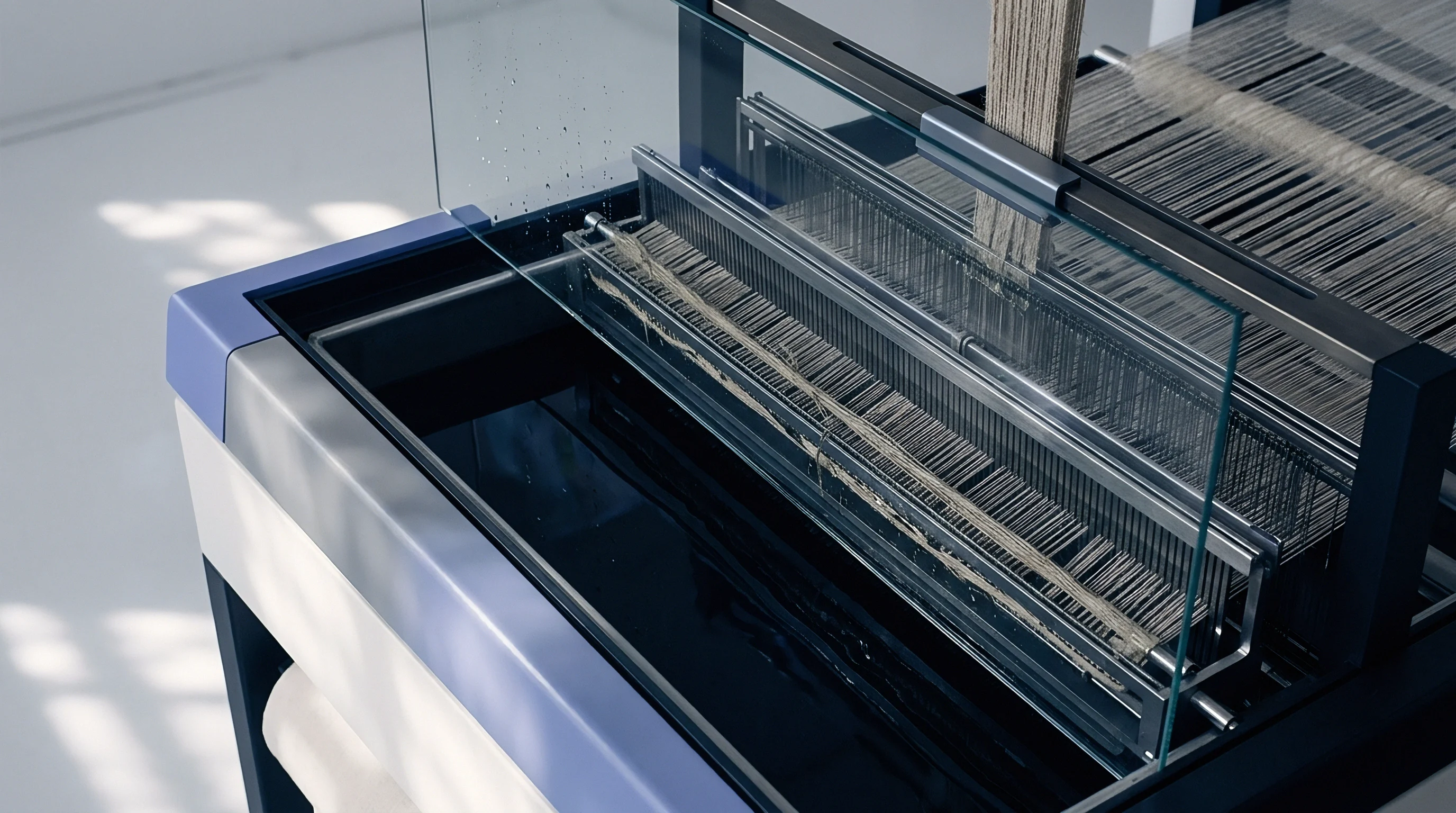
Loom operating speed, measured in picks per minute, depends directly on dynamic forces acting on the shedding mechanism. Plain air-jet looms running simple dobby structures reach speeds over 1,000 picks per minute because harness movement is small, symmetrical, and tightly controlled. Mounting a Jacquard head overhead changes physical mechanics completely.
A harness lifting thousands of individual cords, lingos, and warp threads introduces heavy inertia and aerodynamic drag. To keep harness cords from snapping and lingos from bouncing wildly on lower-shed return, managers cut operating RPM.
Repeat length influences operating pace by altering shed height requirements. As pattern scale expands, warp threads undergo varying strain across longer non-interlacing runs. Deep shed openings ensure clean separation between top and bottom sheets, allowing rapiers or shuttles to pass without clipping slack ends.
But deep sheds require longer harness lifting strokes, accelerating wear on Jacquard hooks and knife boxes. Operating a 10,000-hook head at maximum stroke length forces loom speed down from 650 picks per minute to 420 picks per minute to keep yarn tension within safe stress limits.
Speed drops hit daily output non-linearly. A loom running at 600 picks per minute produces 36,000 picks per hour. At a pick density of 30 picks per centimetre, that machine yields 12 linear metres of greige cloth per hour at 100 percent efficiency.
Dropping speed to 400 picks per minute under heavy Jacquard harness loads cuts output to 8 linear metres per hour. Fixed mill overhead ~ floor space, electric power, depreciation, labor ~ remains constant per hour, so reductions in running speed translate directly into higher hourly machine rates per linear metre produced.

Harness Mass and Shedding Height Restrictions
Mass dynamics escalate rapidly with larger head installations. Double-capacity setups, like tandem 5,376-hook units running over a wide 340-centimetre carpet or upholstery loom, push components to structural limits. The moving mass of hooks, neck cords, harness cords, and lingos can exceed 400 kilograms.
Accelerating and decelerating this load hundreds of times per minute creates severe mechanical stress. Shed managers install heavy-duty cooling systems and automatic lubrication units on top-mounted Jacquard boxes to manage frictional heat from rapid knife movement.
High dynamic loads shorten the operational lifespan of harness components. Harness cords rub against comber board holes during every stroke, generating friction heat that breaks down low-friction coatings. Synthetic cords like Kevlar or high-density polyethylene last longer, but stretch slightly over millions of continuous flex cycles.
Harness stretch shifts heald eye positioning and mistimes shed openings. When a shed opens off-tempo, weft insertion elements hit warp ends, causing severe breakages, machine stops, and visible line marks across the fabric width.
Reducing stroke height cuts dynamic stress, but demands precise warp preparation. Dropping shed opening height from 100 millimetres to 70 millimetres permits higher loom speeds, but narrow sheds offer minimal clearance for insertion elements. Warp yarn must be smooth, perfectly sized, and free of slubs or fuzz balls.
Fine flax yarns with natural thick-and-thin surface variation catch easily in shallow sheds. When running irregular natural fibers, shed managers accept lower loom speeds to maintain wider shed openings and prevent constant warp break stop-downs.
Speed Penalties across Shuttleless Insertion Types
Insertion technology dictates how efficiently a loom copes with Jacquard-induced speed penalties. Rapier looms, which utilize mechanical grippers to transfer weft threads across the shed, tolerate wide shed variations and heavy harness loads reasonably well. Air-jet looms pass weft yarn using high-pressure air streams emitted from main and relay nozzles.
These air systems demand exceptionally clean shed separation, as stray warp fibers block air pulses and cause insertion failures. Jacquard air-jet weaving achieves high speeds on light, short-repeat designs, but encounters severe efficiency losses on dense, long-repeat constructions.
Projectile looms handle extra-wide Jacquard applications efficiently thanks to robust mechanical insertion elements. Metallic projectiles pull weft yarn through physical guide teeth inserted directly into the open shed. These guide teeth require dedicated clearance, setting a lower limit on shed height.
Table 3 compares loom insertion types, maximum achievable speeds, and realistic efficiency figures when running heavy Jacquard linen constructions.
| Insertion System | Max Speed (PPM) | Jacquard Speed (PPM) | Target End Density (ends/cm) | Shed Efficiency (%) | Greige Output (m/hr) |
|---|---|---|---|---|---|
| Flexible Rapier | 700 | 480 | 36 | 84 | 8.06 |
| Rigid Rapier | 550 | 380 | 42 | 88 | 6.68 |
| Air-Jet Insertion | 1,200 | 650 | 28 | 76 | 9.88 |
| Metallic Projectile | 450 | 340 | 48 | 89 | 6.05 |
| Water-Jet Insertion | 1,000 | 580 | 30 | 81 | 9.39 |
Air-jet weaving of Jacquard patterns carries high compressed air energy costs. Relay nozzles pulse air across the width of the reed to guide the weft thread. When Jacquard shedding creates turbulent air pockets between floating warp threads, operators must boost air pressure to push the weft through safely.
Higher air pressure draws substantial power at the compressor house. Running high-pressure air-jet operations on dense Jacquard fabrics can increase utility costs by up to 40 percent compared to rapier weaving, offsetting speed advantages.

Stop Motion Frequencies on High Float Length Repeats
Stop motion systems automatically halt loom operation whenever a warp thread snaps or a pick insertion fails. On plain weave fabrics, stop frequencies remain low due to uniform thread distribution and consistent tensioning. Jacquard fabrics with long pattern repeats display varied stop rates depending on motif distribution.
Areas featuring dense interlacing experience higher warp thread friction, while open float zones suffer from localized slackness. Slack warp threads drop low enough to trigger mechanical dropper wires, causing false warp stops.
Restarting a Jacquard loom after a warp stop takes precise operator intervention to prevent starting marks. When a loom stops, warp threads stay under static tension while heat from the machine dissipates into the stationary cloth. Upon restarting, the first few picks compress differently than those woven during continuous motion, leaving a distinct horizontal line across the fabric.
High-speed Jacquard frames feature automatic pick-finding algorithms that back-track the loom by one or two picks before restarting. Despite automated systems, frequent stops reduce overall cloth quality and force operators to run machines below maximum rated capacity.
Efficiency percentages dictate total available loom hours on a shed floor schedule. A shed running at 85 percent efficiency loses 9 kinetic minutes out of every operational hour to thread breakages, beam changes, and pick adjustments. If a complex 120-centimetre repeat Jacquard fabric drops shed efficiency down to 68 percent due to yarn friction and float instability, total production time per order expands by 25 percent.
Sourcing contracts that price cloth based on projected linear metre output will fail commercially unless efficiency loss penalties are built directly into the loom-hour calculation model.
What structural modifications can a draughtsman apply to balance uneven warp tension across long repeat zones without visibly altering the visual character of the motif?


Ledger
Pricing Jacquard textiles accurately demands translating physical yarn requirements, design setup labor, and mechanical loom capacity into a clear landed cost per linear metre. Buying plain fabric relies primarily on raw material weights and baseline machine rates. Buying Jacquard cloth requires accounting for card preparation fees and loom efficiency slowdowns driven by repeat dimensions.
A supplier quote that lists a low price per metre while hiding heavy setup surcharges or imposing unrealistic minimum warp lengths will quickly distort landed cost projections once production commences.
The primary commercial variable on the shed floor is the loom-hour cost. Standard mill accounting assigns a fixed monetary rate to every hour a weaving frame remains allocated to an order, regardless of whether that frame runs continuously or sits idle during card loading and beam knotting. Loom-hour rates encompass factory overhead, capital depreciation, direct labor, utility consumption, and maintenance reserves.
If a specialized 360-centimetre rapier frame equipped with dual 5,376-hook electronic heads carries an operating cost of 45 dollars per loom hour, any construction choice that reduces output speed increases the per-metre cost directly.
Formulaic cost modeling combines card fees, running speed, pick density, and shed efficiency into a single unit equation. Calculating the loom-hour cost contribution per linear metre requires dividing the hourly loom rate by the net linear output per hour. Net linear output equals machine picks per minute multiplied by 60 minutes, multiplied by efficiency percentage, divided by picks per centimetre multiplied by 100.
Adding yarn costs, finishing surcharges, and amortized card fees yields the baseline cost prior to commercial gross margin allocation.

Comprehensive Cost Modeling for Jacquard Production
Building a robust pricing model begins with identifying fixed versus variable setup components. Fixed setup components include artwork digitalization, point-paper rasterization, and initial digital file compilation. These costs remain identical whether the buyer orders 500 metres or 5,000 metres.
Variable setup components involve harness re-tying, comber board adjustment, and warp beam knotting, which recur on every new warp loading. The buyer must verify how these setup costs are distributed across the total volume committed on the purchase order.
- Artwork Transformation and Digital CAD Setup cover initial point-paper rasterization, weave binding assignment, and electronic file formatting for specific Jacquard head maps.
- Loom Allocation and Harness Mounting Charges capture mechanical bench labor spent re-tying harness cords, adjusting comber board drop heights, and leveling lingos.
- Warp Beam Preparation and Knotting include sizing, warping, drawing-in, or automatic knotting of new warp yarns to existing harness tails.
- Run-Speed Efficiency Adjustments account for loom output reductions driven by wide shed lifts, heavy lingo weights, and complex float distributions.
- Strike-Off Sampling and Quality Verification record loom downtime, sample inspection, and technical corrections before full-scale production authorization.
Warp yarn waste during machine setup represents a significant hidden cost. Mounting a new Jacquard pattern requires pulling warp ends through heald eyes and tying them off to the take-up roller under uniform tension. Setup waste typically consumes between 15 and 30 metres of warp length before the loom achieves stable shed separation and accurate pattern registration.
On short order runs of 300 metres, a 30-metre setup waste loss consumes 10 percent of the total warp beam, escalating yarn overhead per finished metre.
Three Repeat Length Scenarios under Shed Audit
Evaluating real-world price variations across different repeat lengths demonstrates the financial impact of Jacquard complexity. Consider a standard 100 percent linen upholstery construction: 160 centimetre finished width, warp sett of 32 ends per centimetre, running a 24-count linen warp and a 16-count linen weft at 28 picks per centimetre. The loom carrying this setup is a flexible rapier frame with an operating cost of 38 dollars per loom hour.
Below is a comparative cost breakdown across three repeat length variations run on the same base loom setup.
| Cost Component / Parameter | Scenario A (Small Repeat) | Scenario B (Medium Repeat) | Scenario C (Large Repeat) |
|---|---|---|---|
| Vertical Repeat Length (cm) | 15.0 | 60.0 | 180.0 |
| Total Picks per Repeat Cycle | 420 | 1,680 | 5,040 |
| Jacquard Head Hook Count | 1,440 | 2,688 | 5,376 (Tandem) |
| Card Setup / CAD Processing Fee ($) | 450.00 | 1,200.00 | 3,500.00 |
| Operating Speed (PPM) | 520 | 440 | 360 |
| Shed Operating Efficiency (%) | 86.0 | 81.0 | 72.0 |
| Net Output Speed (m/hr) | 9.58 | 7.64 | 5.56 |
| Loom Cost per Metre ($) | 3.97 | 4.97 | 6.83 |
| Amortized Card Cost on 1,000m ($/m) | 0.45 | 1.20 | 3.50 |
| Base Landed Cost per Metre ($) | 11.42 | 13.17 | 17.33 |
Analyzing Scenario C highlights how large vertical repeats double processing charges and reduce running output simultaneously. Moving from a 15-centimetre repeat to a 180-centimetre repeat decreases output speed from 9.58 metres per hour to 5.56 metres per hour due to harness mass limits and tension instability. Concurrently, card fees rise from 450 dollars to 3,500 dollars due to extensive point-paper clearing.
On a 1,000-metre production order, the landed cost per metre increases by 5.91 dollars, representing a 51.7 percent price premium over the small-repeat baseline construction.

Contractual Allocation of Setup Losses
Commercial sourcing contracts must define explicit terms regarding setup loss allocations and lead time definitions. When mills quote lead times, they frequently estimate delivery dates based on standard loom running speeds at 90 percent efficiency. If complex pattern dynamics cause shed efficiency to drop to 70 percent, delivery schedules slip accordingly.
Contractual clauses must tie delivery deadlines to firm loom-hour bookings with specified efficiency floors, penalizing mills for delays caused by poorly maintained equipment while protecting mills from unapproved design changes.
Minimum order quantities represent a critical buffer against setup costs. If a buyer insists on ordering less than the mill’s standard warp length minimum, the mill must either charge an extra small-run surcharge or pass the full un-amortized card and setup costs to the buyer. Technical specification sheets should clearly present the trade-off between order volume and unit price, allowing procurement teams to adjust their order sizes based on clear economic thresholds.
Unanticipated yarn price fluctuations during long development cycles present another risk. If card preparation and sampling consume four months before full-scale production authorization, raw material costs may move outside original quote allowances. Procurement contracts must include raw material indexing clauses that lock yarn pricing upon strike-off approval while fixing loom-hour rates for the duration of the agreed purchase order window.
Standard procurement contract clause 14.2 explicitly stipulates that any variation in repeat dimensions exceeding 2.5 percent from approved strike-off specifications grants the buyer full right of rejection without absorbing card preparation or loom allocation costs.

Dock
Receiving inspection represents the final commercial gate where physical fabric deliveries are validated against technical specifications and approved strike-off standards. While basic parameters like overall fabric width, total roll length, and mass per unit area are straightforward to measure, Jacquard fabrics require rigorous verification of repeat dimensions and visual motif symmetry. Off-loom relaxation, wet finishing processing, and roll winding tension can alter pattern dimensions significantly, causing delivered fabrics to drift outside contractual tolerances.
Checking repeat dimensions requires measuring vertical and horizontal motif lengths at multiple points along every inspected roll. Fabric inspected on a motorized inspection table remains under longitudinal tension, which stretches the cloth vertically and compresses it horizontally. If an inspector records repeat dimensions directly on the inspection table without relieving tension, measurements will reflect temporary mechanical strain rather than relaxed dimensions.
Validating repeat accuracy requires conditioning cut fabric samples on a flat table under standard atmosphere conditions according to ISO 139 testing protocols.
Pattern repeat creep describes a progressive change in repeat length along the longitudinal axis of a woven roll. Creep occurs when weft insertion density varies slightly during weaving or when finishing stenters apply inconsistent tension from bolt to bolt. A repeat specification calling for exactly 100.0 centimetres may gradually expand to 103.5 centimetres over a 50-metre roll run.
In architectural upholstery or wall-covering applications where pattern matching across adjacent fabric panels is required, a 3.5 percent repeat creep renders the material unusable, leading to total lot rejections at the receiving dock.
Dimensional Stability and Pattern Drift Measurement
Verifying pattern alignment involves checking both spatial skew and bow. Bow occurs when the center of the pattern leads or lags behind the selvages across the fabric width. Skew occurs when the pattern lies at an angle relative to a line perpendicular to the selvages.
Excessive bow or skew in Jacquard textiles usually stems from improper stenter chain feeding during wet finishing or heat setting. Standard four-point inspection protocols under ASTM D5430 assign penalty points to bow and skew defects that exceed stated percentage thresholds relative to overall fabric width.
Measuring dimensional stability under washing and dry cleaning remains essential for linen and cotton Jacquard goods. Natural cellulosic fibers swell when exposed to moisture, causing warp crimp to increase and vertical repeat length to contract. A Jacquard drapery linen that shrinks 6 percent in vertical repeat length after dry cleaning will pull hem lines up, causing severe installation failure.
Technical specs must establish maximum allowable dimensional change limits under ISO 5077 test methods, forcing finishing houses to apply mechanical pre-shrinkage processes like sanforizing before shipping goods.
Below is an operational inspection protocol detailing failure thresholds, standard test methods, and commercial consequences for Jacquard repeat variations at receiving inspection.
| Quality Parameter | Test Standard | Acceptable Tolerance | Defect Threshold | Commercial Consequence |
|---|---|---|---|---|
| Vertical Repeat Length | ISO 7211-2 | ±1.5% from spec | > ±2.5% variation | Price debit or roll rejection |
| Horizontal Repeat Width | ISO 7211-2 | ±1.0% from spec | > ±2.0% variation | Full lot rejection |
| Pattern Repeat Creep | Internal Audit | < 0.5% drift per 10m | > 1.5% total drift | Supplier absorbs re-cutting loss |
| Weft Pattern Bow | ASTM D5430 | < 1.5% fabric width | > 2.5% fabric width | Four-point penalty escalation |
| Warp Pattern Skew | ASTM D5430 | < 1.0% fabric width | > 2.0% fabric width | Re-finishing at mill expense |
Recording defect points under the four-point system isolates structural Jacquard faults from simple yarn flaws. Structural faults include dropped warp ends caused by broken harness cords, double picks resulting from incorrect pick-finding sequences, and pattern mis-punches caused by corrupted digital control files. A single pattern mis-punch that recurs once every repeat length creates a continuous defect line down the entire roll, accumulating hundreds of penalty points within a few metres and instantly downgrading the roll to second-quality status.

Off-Loom Crimp Recovery and Finish Shrinkage
Understanding crimp recovery dynamics helps technicians differentiate between loom-shed errors and finishing house mistakes. When cloth is cut under tension from the loom take-up roll, warp yarns relax and snap back, increasing warp crimp and pulling picks closer together. If the mill runs warp tension too high during weaving, off-loom relaxation causes severe vertical repeat contraction.
A loom manager who attempts to increase output speed by pulling warp beams excessively tight will produce fabric that shrinks far beyond standard tolerances once released from frame tension.
Finishing treatments like desizing, bleaching, mercerizing, and resin application alter repeat geometry dramatically. Liquid processing swells fibers, relaxing stress locked into yarns during spinning and weaving. Mercerization under high tension can stretch horizontal repeats while compressing vertical dimensions.
Finishing plant managers must adjust stenter frame width and feed overfeed percentages precisely to return processed fabric to target repeat dimensions. If the finishing house lacks accurate specification sheets, uncoordinated processing will ruin expensive Jacquard goods.
Documenting finished fabric physical parameters requires establishing clear baseline reference files during initial sampling. Retaining a physical sample from the approved strike-off run permits direct comparison against incoming bulk production rolls. When inspecting bulk lots, technicians lay the approved strike-off directly over incoming material on a lightbox.
Any visual discrepancy in motif scale, float length, or color registration immediately alerts inspectors to process drift, allowing the sourcing team to halt further shipments before cutting operations begin.

Resolving Commercial Claims for Pattern Variance
Settling financial disputes over out-of-spec Jacquard goods requires clear documentation linking measured physical variances back to specific production stages. If receiving inspection reveals pattern repeat creep, the sourcing team must isolate whether the fault occurred due to inconsistent pick density on the loom or improper tension during finishing. Taking thread count measurements across multiple points along the roll proves whether pick density varies.
If pick density remains perfectly uniform while repeat length fluctuates, the fault lies with finishing stenter tension rather than loom shedding control.
Commercial remedies for non-compliant deliveries vary based on severity. Minor variations within acceptable tolerance bands are resolved through negotiated price debits, where the mill provides a percentage discount on the affected yardage. Severe variations exceeding failure thresholds trigger formal rejection, requiring the mill to re-weave the order at their sole expense.
Sourcing agreements should require suppliers to hold safety buffer stock for custom Jacquard programs, ensuring replacement rolls can ship without causing production line shut-downs at the buyer’s cut-and-sew facilities.
Maintaining long-term supplier performance metrics prevents recurring quality failures. Sourcing desks compile quarterly vendor rating scorecards tracking repeat compliance, four-point defect averages, and delivery schedule precision. Mills that consistently deliver precise repeat geometry and clear invoicing win larger allocations of high-margin Jacquard production, while suppliers exhibiting frequent process drift face commercial volume reductions and loss of approved vendor status.
Pattern repeat stability relies on maintaining identical warp tension settings across every production beam committed to a single order matrix.