Identifying Warp Yarn Quality Parameters for High Speed Weaving
High-speed weaving requires warp yarn tenacity above 16.5 cN/tex, S3 hairiness under 25, and splice efficiency over 85% to prevent shed stoppages.

Stress
When high-speed insertion mechanisms run above 1000 picks per minute, they exert severe, concentrated mechanical forces on the warp sheet. Modern air-jet and rapier shedding systems demand exceptional structural integrity from the yarn, as warp ends undergo rapid displacement, tensioning, and relaxation within milliseconds during every loom cycle, leaving un-sized fibers vulnerable to breaking under sudden tension spikes.

Mechanical Load Profiles in Shed Shifting
Tension builds within very narrow windows as the heddle frames move. Peak strain coincides with maximum shed opening, when yarn geometry must stretch enough to clear the path for the insertion element. On an air-jet loom operating at 1200 picks per minute, this cyclic opening repeats twenty times every second, creating a force profile that combines static warp tension with dynamic inertial peak loads.
Static tension set on the let-off motion maintains basic alignment of the warp sheet across the back rest roller, but dynamic additions build quickly from harness frame lift, drop wire friction, and back-rest roller oscillation. When acceleration in the shedding motion peaks, total yarn strain regularly doubles nominal static settings ~ a repetitive spike that causes immediate failure in standard staple yarns with irregular cross-sections.
Peak dynamic tension reaches 3.5 cN per tex at an air-jet weaving speed of 1200 picks per minute on a 190-centimeter reed width.

Cyclic Extension and Yarn Fatigue Dynamics
Repeated strain cycles degrade spun yarn structures long before beat-up occurs at the cloth fell. A single warp end experiences between 2,000 and 5,000 tension cycles traveling from the back beam to the fell line, inducing structural fatigue that breaks down internal fiber-to-fiber friction and snaps weak splices under peak loads.
Under continuous cyclic extension, fibers inside un-combed yarns progressively slip past one another. This micro-slippage narrows the yarn cross-section and reduces local breaking strength. Without sufficient elastic recovery, progressive elongation causes permanent deformation, causing the warp sheet to slacken unevenly and leading to shed mis-picks and improper filling insertion.
Miscalculating back-rest roller spring rates allows unmitigated dynamic force spikes across the warp sheet, resulting in systematic end breaks along the selvedges, sharp drops in loom efficiency, and irreversible stop marks across the greige fabric roll.
Splice
Joint integrity across the warp beam determines whether yarn ends pass through heddle eyes and reed dents without mechanical obstruction. Traditional knotting leaves bulky projections that catch in high-density reed wires, whereas modern warping and clearing frames use pneumatic splicing to join broken threads without altering overall cross-sectional diameter or linear density.
Retained Tensile Properties of Pneumatic Joints
Air-splicing chambers entangle staple fibers into a continuous thread line without knot geometry. The mechanical strength of the spliced region depends on fiber length, air pressure duration, and chamber geometry, requiring splice parameters to be matched carefully to yarn count and fiber origin.
A spliced joint needs a breaking force close to that of the parent yarn. Retained splice strength below 85 percent causes immediate end breaks when the joint enters the shedding zone, and the elongation of the splice must mirror the parent yarn to withstand cyclic strain spikes during weaving.
- Splice tail slippage occurs when air chamber pressure drops below 0.5 MPa during the splicing cycle, leaving un-entangled fiber ends that unravel under shed tension.
- Excessive joint thickness exceeding 130 percent of nominal yarn diameter causes physical snags within the drop wire slot and reed dent.
- Twist differential distortion disrupts size penetration, leaving the joined zone un-encapsulated and prone to abrasive fraying.
- Fiber migration loss within synthetic blends creates localized low-density zones that yield prematurely under beat-up impact.
Geometrical Profile and Shed Clearance
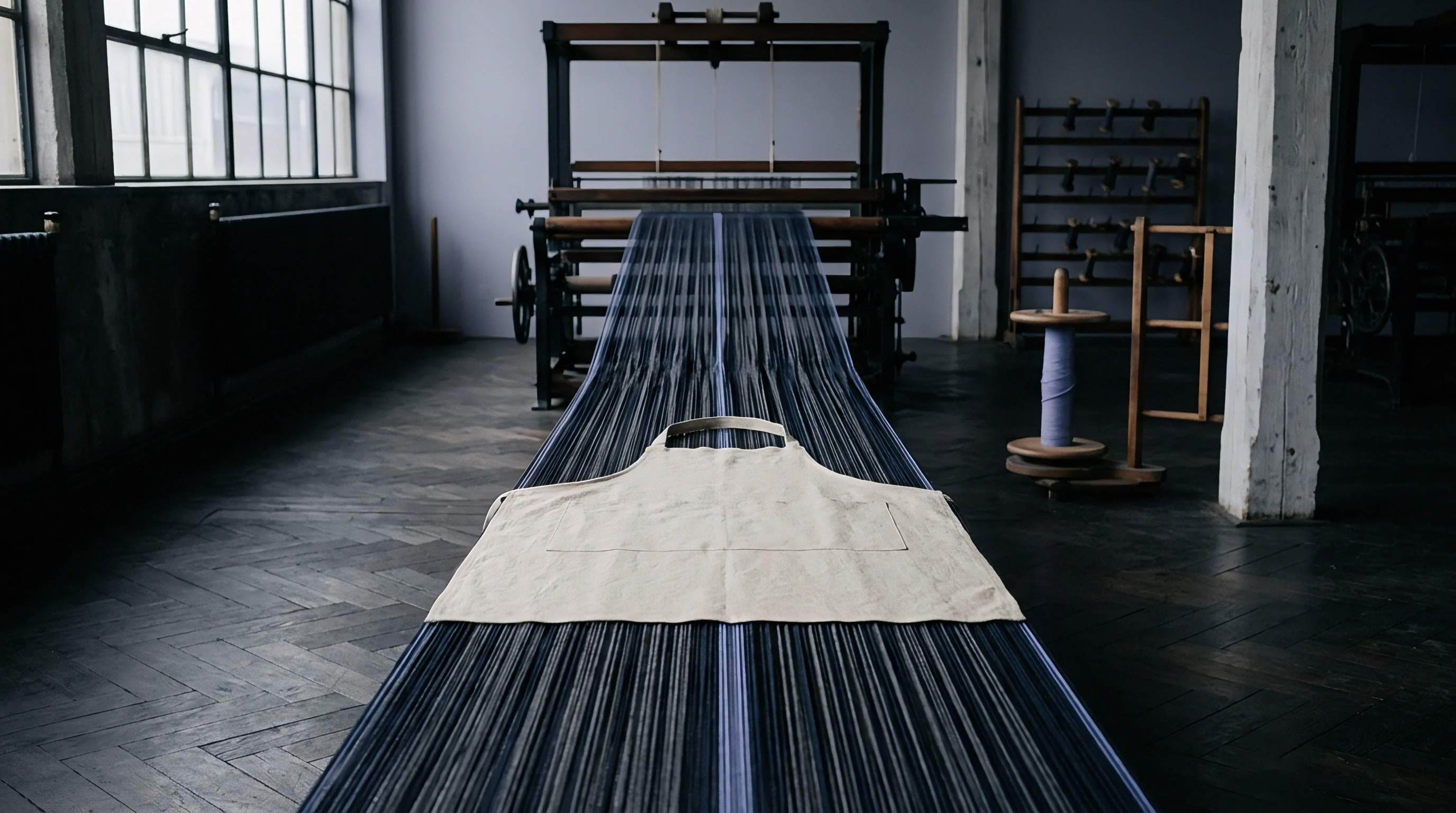
Excessive mass at connection points causes immediate abrasion against adjacent ends. The optical diameter profile of a pneumatic splice governs how cleanly it passes through heddle eyes, as projecting tail ends catch neighboring fibers and form fuzz balls that block the shed opening.
Automatic winding machines track joint geometry with high-resolution clearers, keeping splice length targets set tightly between 20 and 35 millimeters for short-staple ring yarns. Splices longer than this create stiff segments that resist bending around loom guide rollers, inviting bending fatigue failures.
| Joint Parameter | Target Specification | Rejection Threshold | Impact on Weaving |
|---|---|---|---|
| Retained Tensile Strength | 88% to 95% of parent | Below 82% of parent | Frequent warp ruptures at beat-up |
| Splice Diameter Increase | +15% to +25% nominal | Above +35% nominal | Heddle eye obstruction and fuzz formation |
| Splice Length | 22 mm to 28 mm | Above 35 mm | Localized stiffness and bending fatigue |
| Tail Length Projection | Under 1.5 mm | Above 3.0 mm | Inter-yarn entanglement in open shed |
Pneumatic splicing can eliminate warp-stop variation across beam changes, though subsequent loom stoppages often stem from splice strength loss rather than improper sizing chemical viscosity.


Tenacity
Breaking force alone is a poor predictor of warp yarn performance on high-speed weaving frames. Tensile behavior under rapid loading requires high absolute tenacity combined with uniform elongation, so even a yarn with high mean strength will fail repeatedly if its coefficient of variation is un-checked.

Breaking Force and Elongation Balance
High-speed looms demand a minimum single-yarn breaking strength paired with sufficient extension reserve. Measured in centinewtons per tex, tenacity provides a normalized baseline across yarn counts; ring-spun cotton warps for high-speed air-jet looms require breaking tenacity above 16.5 cN/tex.
Elongation at break reflects how much energy the yarn absorbs before structural failure. A minimum breaking elongation of 6.0 percent gives the yarn enough elasticity to absorb peak shedding strains, whereas yarns with high tenacity but inadequate elongation snap cleanly when transient load spikes hit.
Tenacity variability impacts loom efficiency more severely than average breaking strength.

Coefficient of Variation in Tensile Testing
Weak points along the thread line dictate warp break frequency during weaving, making the statistical distribution of yarn strength far more important than the mathematical mean. Tensile testing protocols must therefore evaluate minimum breaking force values across thousands of test meters.
The coefficient of variation for breaking tenacity needs to stay below 8.5 percent for high-speed warp preparation. When tenacity CV exceeds 10 percent, low-strength points below the critical shedding load occur far more frequently, producing isolated, unpredictable warp ruptures.
- Tenacity CV percentage establishes the frequency of extreme low-strength points along the yarn package length.
- Work-to-break energy capacity calculates total area under the force-elongation curve, defining total energy absorption before rupture.
- Elastic recovery ratio measures the proportion of strain recovered immediately following peak shed opening.
- Minimum breaking force floor isolates the absolute lowest tensile resistance observed within a 50-test sample set.
Uniform elongation reserve protects yarn structure far more effectively than peak ultimate strength.

Hairiness
Surface fibers extending beyond the core structure control inter-yarn friction in both open and closed sheds. Long protruding fibers cling to adjacent warp ends as the harness frame moves, delaying shed separation and entangling warp ends.

S3 Fiber Counts and Shed Entanglement
Fibers longer than three millimeters wrap around neighboring ends during heddle movement and prevent the warp shed from opening cleanly. The S3 value ~ the count of protruding fibers 3 mm or longer per 100 meters of yarn ~ is the single most critical hairiness metric in high-speed weaving, where high counts cause false loom stops on air-jet machines due to dropped picks.
Short surface hair under 1 mm adds to fabric hand without affecting shedding mechanics. Protruding fibers over 3 mm form interlocking networks between adjacent warp sheets, causing filling insertion channels to collapse and creating weft stops, warp floats, and reed tooth damage.
Standard delivery contracts for air-jet warp packages stipulate a maximum threshold of 25 S3 fibers per 100 meters, triggering batch rejection when exceeded.

Classimat Fault Categorization for Warp Preparation
Yarn thick places and slubs create harsh friction points when colliding with reed wires. Capacitive and optical clearers group these short-term mass variations into standardized Classimat categories by length and cross-sectional increase.
Objectionable faults include short thick places exceeding a +100 percent diameter increase and long thin places dropping below -30 percent nominal mass. Thin places lack the fiber volume to survive tension spikes, while thick places wedge into drop wire eyelets; both extremes cause immediate warp stops.
- Category A4 slubs represent short thick places that physically block passage through drop wires and heddle eyes.
- Category B4 thick places induce severe reed abrasion and cause adjacent warp ends to break through friction.
- Category H2 thin places lack sufficient fiber alignment to withstand beat-up impacts, snapping instantly at the cloth fell line.
- Category I2 long thin spots produce extended structural weaknesses that un-ravel under continuous let-off tension.
| Fault Classification | Fault Dimension Limits | Air-Jet Maximum (per 100 km) | Rapier Maximum (per 100 km) |
|---|---|---|---|
| Short Thick Places (A4, B4) | +100% mass, 0.1 to 1.0 cm | 5 | 12 |
| Long Thick Places (E, F, G) | +45% mass, over 8.0 cm | 1 | 4 |
| Long Thin Places (H2, I2) | -30% mass, over 8.0 cm | 2 | 6 |
| Total Objectionable Faults | Combined threshold | 8 | 22 |
Master supply agreements specify that yarn lots containing more than 25 S3 fibers per 100 meters or exceeding 8 total objectionable Classimat faults per 100 kilometers trigger full landed-cost credit obligations and immediate supplier reimbursement for wasted beam preparation loom hours.


Abrasion
Friction between yarn surfaces and loom components wears down sizing films during continuous high-speed weaving. Sizing coats the yarn with protective polymers to bind loose surface fibers into the main body, without which drop wire vibration quickly rubs fibers free.

Film Penetration and Surface Encapsulation
Starch and synthetic polymers coat outer fiber bundles to lock protruding ends into the core. Effective sizing balances outer film encapsulation against internal core penetration.
A penetration depth between 20 and 30 percent of the yarn radius anchors the polymer coat securely to the fiber matrix. Insufficient penetration allows the film to peel under drop wire friction, while excessive penetration leaves the surface unprotected, causing fuzzing and shed friction.
| Size Formulation | Tensile Strength (MPa) | Film Elongation (%) | Abrasion Resistance Index |
|---|---|---|---|
| Native Corn Starch | 18 to 22 | 2.5 to 3.5 | Low (Flakes easily) |
| Modified Thin-Boiling Starch | 24 to 30 | 3.8 to 4.5 | Moderate (Standard rapier) |
| PVA / Modified Starch (50/50) | 35 to 45 | 6.0 to 8.0 | High (Air-jet compliant) |
| Acrylic Co-polymer Blend | 28 to 36 | 10.0 to 14.0 | Very High (Fine filament/combed) |
Testing Procedures for Sized Warp Resistance
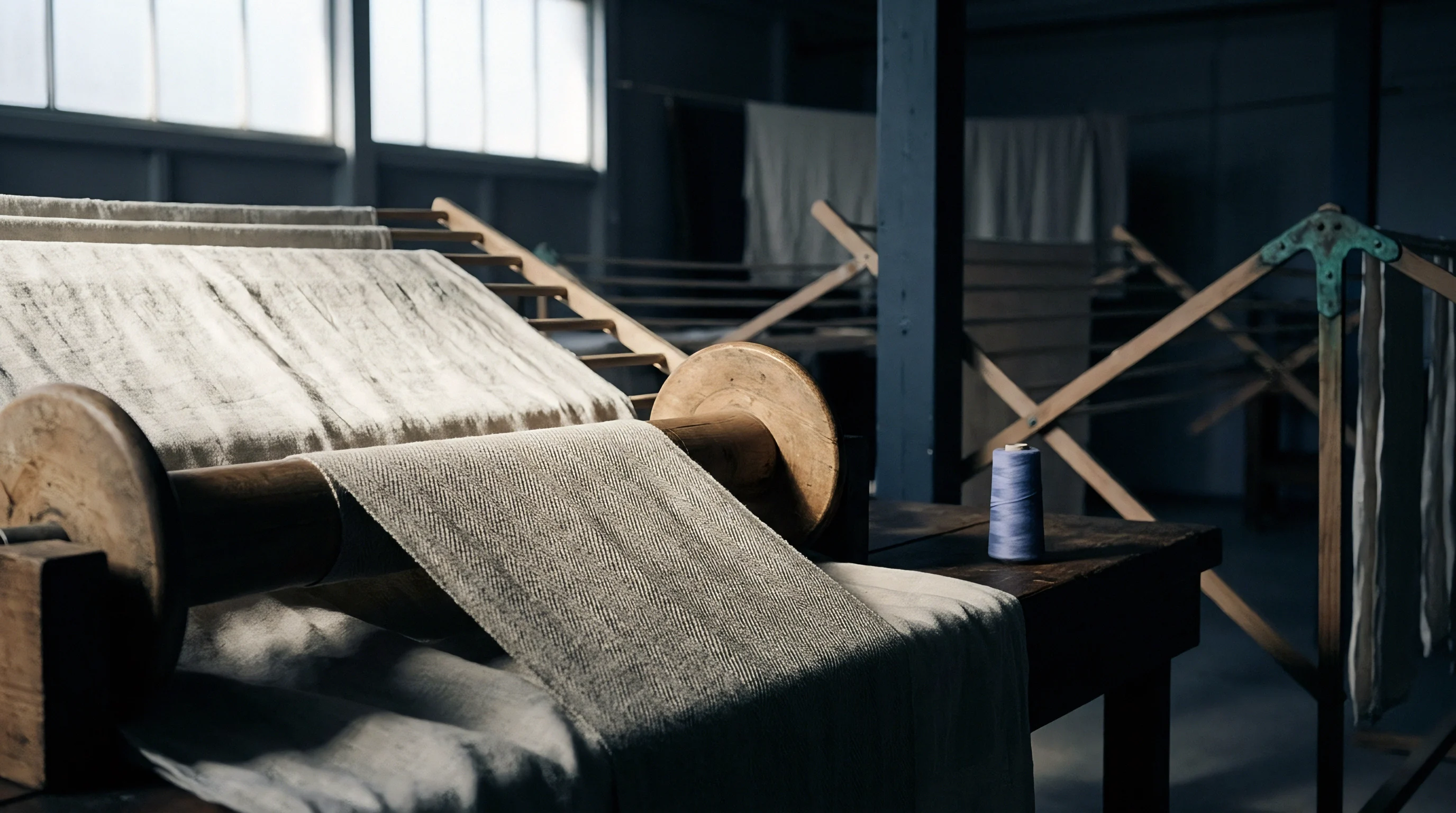
Laboratory bench instruments simulate loom shedding mechanics to evaluate yarn durability before beams are loaded. Multi-end abrasion testers apply reciprocating frictional force to sized yarn sheets under regulated mechanical tension.
- Mount twenty parallel sized yarn samples across the oscillating bar fixture under a uniform pre-tension of 0.5 cN per tex.
- Reciprocate the steel abrasion pins across the yarn sheet at a constant frequency of 300 cycles per minute while maintaining relative ambient humidity at 65 percent.
- Measure the number of cycles required to cause five warp end ruptures across the test array.
- Record the mass loss of size coating flaked off during the rubbing process as a percentage of total dry size add-on.
How do environmental humidity variations within modern weave sheds alter the micro-abrasion kinetics of hybrid starch-PVA size films operating under peak beat-up dynamic loads?

Stoppage
Machine downtime from thread breaks directly inflates landed cost per woven meter. High-speed weaving machines cost upwards of 60,000 USD per unit, requiring continuous operation to amortize capital investment.
Warp End Break Frequency and Loom Efficiency
Maintaining target efficiency above ninety percent requires warp break rates below one break per 100,000 picks. A single warp break on an air-jet loom at 1200 picks per minute incurs a one-to-three-minute downtime penalty while the weaver locates the broken end, repairs the joint, and re-threads drop wires, heddle eyes, and reed dents.
High stoppage rates cause compound losses beyond lost machine time. Stopping the loom relaxes warp tension, creating greige fabric defects known as start or stop marks that degrade finished cloth value and force mills to sell at seconds pricing or take buyer rejections.
Air-jet weaving sheds calculate capacity loss based on a standard intervention time of one minute per manual warp repair.

Loom-Hour Cost Arithmetic and Quality Allocation
Financial evaluation balances the higher price of combed, low-hairiness yarn against productivity gains on the loom. Purchasing higher-grade warp yarn increases raw material expenditure, but that cost is offset by operational savings in the shed.
Consider an operational weave shed running 100 air-jet looms at 1100 picks per minute, producing a high-density plain weave (28 picks/cm). Standard shed operating overhead equals 18.50 USD per loom hour. Evaluating two yarn supply options illustrates the financial impact of warp yarn quality parameters:
- Carded yarn option exhibits a warp stop rate of 2.8 breaks per 100,000 picks, resulting in 81.5 percent loom efficiency and 19.8 meters per hour output.
- Combed low-hairiness yarn option limits warp stop rate to 0.6 breaks per 100,000 picks, achieving 93.2 percent loom efficiency and 22.6 meters per hour output.
- Direct labor overhead reallocation reduces weaver allocation counts from 1 weaver per 12 looms down to 1 weaver per 24 looms under high-quality warp parameters.
- Landed meter cost differential yields a net production cost reduction of 0.14 USD per finished meter when accounting for shed capacity gains.
| Performance Metric | Baseline Carded Warp | Optimized Combed Warp | Operational Variance |
|---|---|---|---|
| Warp Stop Rate (per 100,000 picks) | 2.80 | 0.60 | -78.5% |
| Average Stoppage Duration | 1.50 minutes | 1.00 minutes | -33.3% |
| Actual Shed Efficiency | 81.5% | 93.2% | +11.7% absolute |
| Loom Output (meters/hour @ 28 picks/cm) | 19.8 m | 22.6 m | +14.1% output |
| Loom-Hour Cost Allocation | 18.50 USD | 18.50 USD | Fixed shed overhead |
| Woven Fabric Conversion Cost | 0.934 USD/m | 0.818 USD/m | -0.116 USD/meter saving |
| Assumptions: 1100 PPM air-jet speed, 190 cm reed width, 100 loom shed capacity, fixed shed operating rate of 18.50 USD/loom hour. | |||
Allocating expenditure toward premium warp yarn parameters lowers overall fabric manufacturing costs. The financial return stems from increased meter output per loom hour, reduced weaver labor requirements, and the complete elimination of fabric downgrade penalties caused by loom stop marks.