Calculating Warp Crimp and Reed Width in Linen Weaving
Calculating reed width requires multiplying target greige width by weft crimp and finish shrinkage allowances tailored to flax yarn modulus.
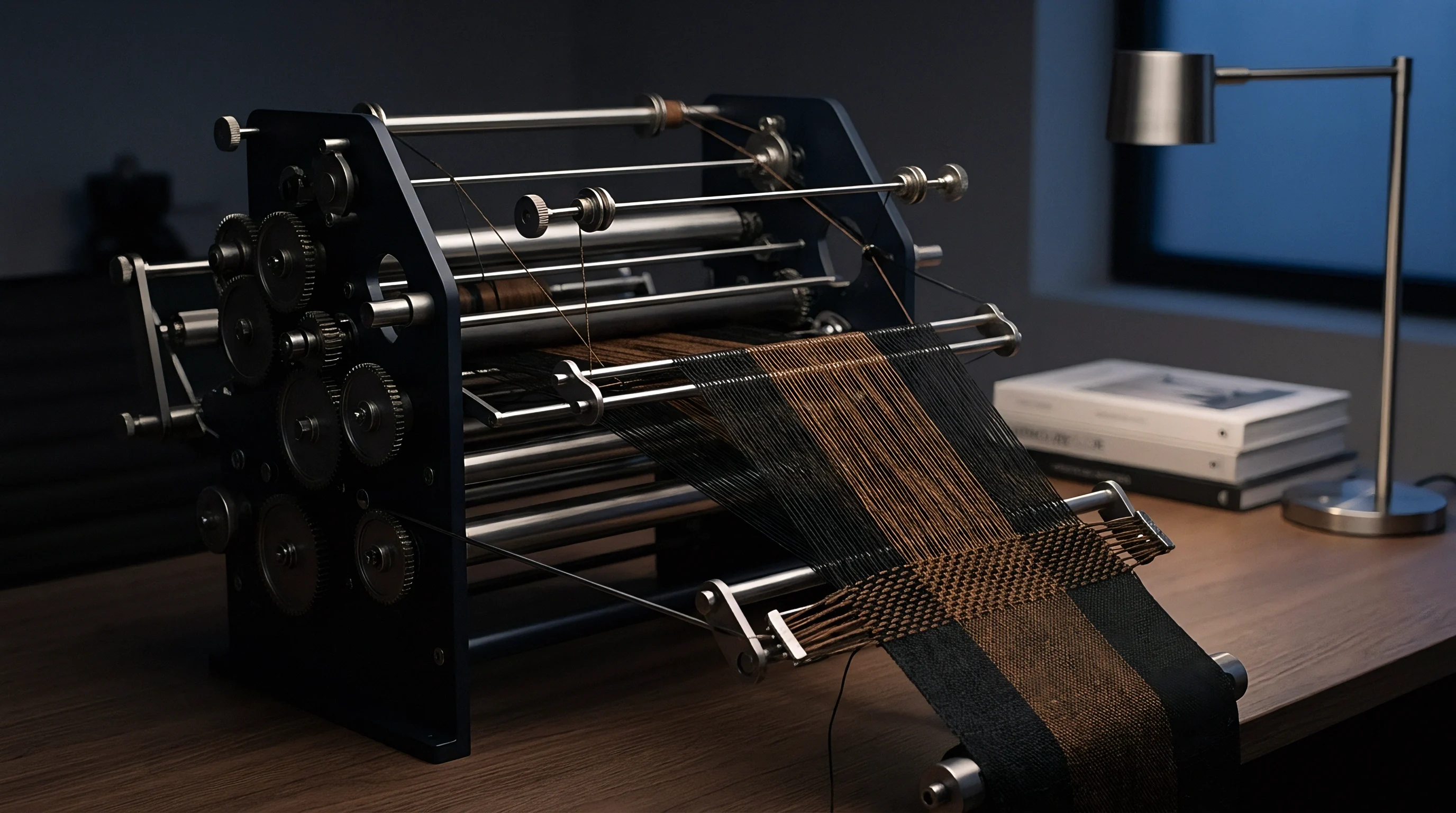

Draft
Setting up a linen loom requires matching finished cloth dimensions directly to on-loom settings. Flax fiber lacks elastic extension. While cotton or synthetic filaments stretch in the shed and recover post-doffing, bast fibers have a rigid crystalline molecular structure with ultimate elongation capped between 1.5 percent and 2.5 percent.
Because of this, geometric displacement around interlocking picks accounts for nearly all warp contraction during weaving. Getting crimp and reed width calculations right prevents off-target fabric weights, excessive loom stops, and reed mark defects.
Calculating total warp crimp percentage relies on Pierce’s geometry model adapted for inelastic yarns. The crimp percentage defines the extra warp yarn length needed for a given length of woven cloth, governed by yarn diameter, pick spacing, and thread bending wave amplitude. Equation 1 expresses warp crimp percentage by comparing yarn length before weaving against grey cloth length:
Crimp Percentage = ((Unraveled Warp Length – Fabric Length) / Fabric Length) 100
Calculating reed width requires accounting for weft crimp and structural widthwise contraction. As weft yarn interlaces with warp ends, weft crimp draws the warp sheet inward toward the fabric center. The reed width calculation uses target greige fabric width, weft crimp percentage, and processing allowance to set the minimum denting width required on the loom beam:
Reed Width = Greige Width (1 + (Weft Crimp Percentage / 100)) (1 + (Finishing Contraction Percentage / 100))
Table 1 details standard calculation parameters across common linen constructions woven on high-speed rapier machinery at a target greige width of 150 centimeters using wet-spun flax yarns.
| Fabric Structure | Warp Count (NeL / Tex) | Weft Count (NeL / Tex) | Sett (Ends x Picks / cm) | Estimated Warp Crimp (%) | Estimated Weft Crimp (%) | Target Greige Width (cm) | Calculated Reed Width (cm) |
|---|---|---|---|---|---|---|---|
| Plain Weave (1/1) | 25 Lea / 66 Tex | 25 Lea / 66 Tex | 18 x 16 | 7.8 | 6.2 | 150.0 | 161.4 |
| Plain Weave (1/1) | 14 Lea / 118 Tex | 14 Lea / 118 Tex | 12 x 12 | 9.5 | 8.1 | 150.0 | 164.7 |
| Twill Weave (2/2) | 25 Lea / 66 Tex | 25 Lea / 66 Tex | 22 x 20 | 5.4 | 4.8 | 150.0 | 158.7 |
| Satin Weave (4-end) | 40 Lea / 41 Tex | 40 Lea / 41 Tex | 28 x 26 | 4.1 | 3.6 | 150.0 | 156.8 |
Miscalculating these parameters triggers predictable mechanical failure points during loom operation and subsequent wet processing.
- Greige Target Deficit yields narrow cloth that fails finished customer dimensional specifications, forcing mill re-grading or full batch rejections.
- Excessive Reed Space over-stretches selvage ends, causing high warp end breakage rates near the temples and degrading loom efficiency below 75 percent.
- Underestimated Warp Crimp leads to premature warp beam exhaustion, short bolt lengths, and incorrect raw material cost allocations on production sheets.
- Improper Dent Density Selection forces coarse denting patterns that generate prominent reed marks unable to scour out during bleaching or dyeing.
Underestimating weft contraction forces weavers to increase warp sheet tension past the yield strength of wet-spun flax, snapping edge ends and producing uneven selvage lines.

Swell
Flax fiber is highly hydrophilic due to its amorphous cellulosic structure and non-cellulosic constituents like pectin and hemicellulose. Commercial standard moisture regain for linen sits at 12 percent, but shifts in relative humidity inside the loom shed alter yarn diameter dramatically. Water absorption causes flax fibers to swell laterally by up to 25 percent while axial length increases by less than 1 percent.
This asymmetrical expansion alters thread spacing and crimp geometry during weaving.
When high ambient relative humidity or wet-sizing moisture increases flax yarn thickness, packing density inside the dent gap shifts. Thicker yarns increase the deflection angle of opposing threads at every crossover point, forcing warp yarns to travel a longer sinuous path around weft picks and elevating warp crimp percentage without any change in pick count setting. Keeping ambient conditions within strict limits of 65 percent to 70 percent relative humidity maintains stable thread geometry across multi-shift production runs.
Flax fibers absorb moisture rapidly, expanding laterally up to 25 percent and altering thread crossover geometry during active shed opening.
Sizing applied to flax warps further alters crimp development. Modified starches and polyvinyl alcohol formulations form a protective film around stiff bast fibers, suppressing yarn bending during beat-up. Sized warp yarns resist deformation, forcing weft picks to take on more of the total crimp under weaving tension.
Once the grey fabric is scoured and desized during wet finishing, these stiff films dissolve, allowing warp ends to relax into their true structural crimp and causing noticeable fabric length contraction.
Mills frequently attribute widthwise contraction discrepancies to uncontrolled humidity fluctuations in grey cloth storage rooms rather than structural calculation errors on warp preparation sheets.
Harness
Loom harness geometry and backrest position determine how mechanical forces distribute warp crimp across the fabric width. Symmetrical shed settings split tension equally between top and bottom shed lines, producing equal crimp distribution. Asymmetrical setups ~ where the backrest roller sits elevated above level ~ create unequal tension between upper and lower warp sheets during heddle separation.
An elevated backrest flattens the lower warp sheet at beat-up, forcing weft picks to bend higher around upper warp threads and shifting structural crimp directly into the warp.
High warp sheet tension prevents weft picks from crimping easily, forcing the fabric to pull inward across the reed width. Edge control depends heavily on temple selection and harness draft setup to counteract this inward drag.
- Heddle Draft Distribution places extra selvage ends on dedicated harness frames to spread tension load during wide shed openings.
- Backrest Roller Elevation raised 15 to 25 millimeters above center line increases cover factor while transferring crimp amplitude into upper warp ends.
- Shed Crossing Timing advanced prior to front-center beat-up locks weft picks firmly into place, preventing crimp recovery slipping during cloth take-up.
- Temple Ring Selection matching fabric density grips selvages firmly to hold calculated reed width until take-up rollers clamp the fell.
Correct balancing between warp let-off rate and cloth take-up speed maintains uniform pick spacing across long weaving runs.
A 150 centimeter greige linen plain weave requires a minimum 161.4 centimeter reed space to prevent temple shear and selvage end breakage.
When warp tension drops below optimum levels, thread crossover angles collapse unpredictably, leaving weft crimp loose and generating unstable off-loom cloth widths.

Bench
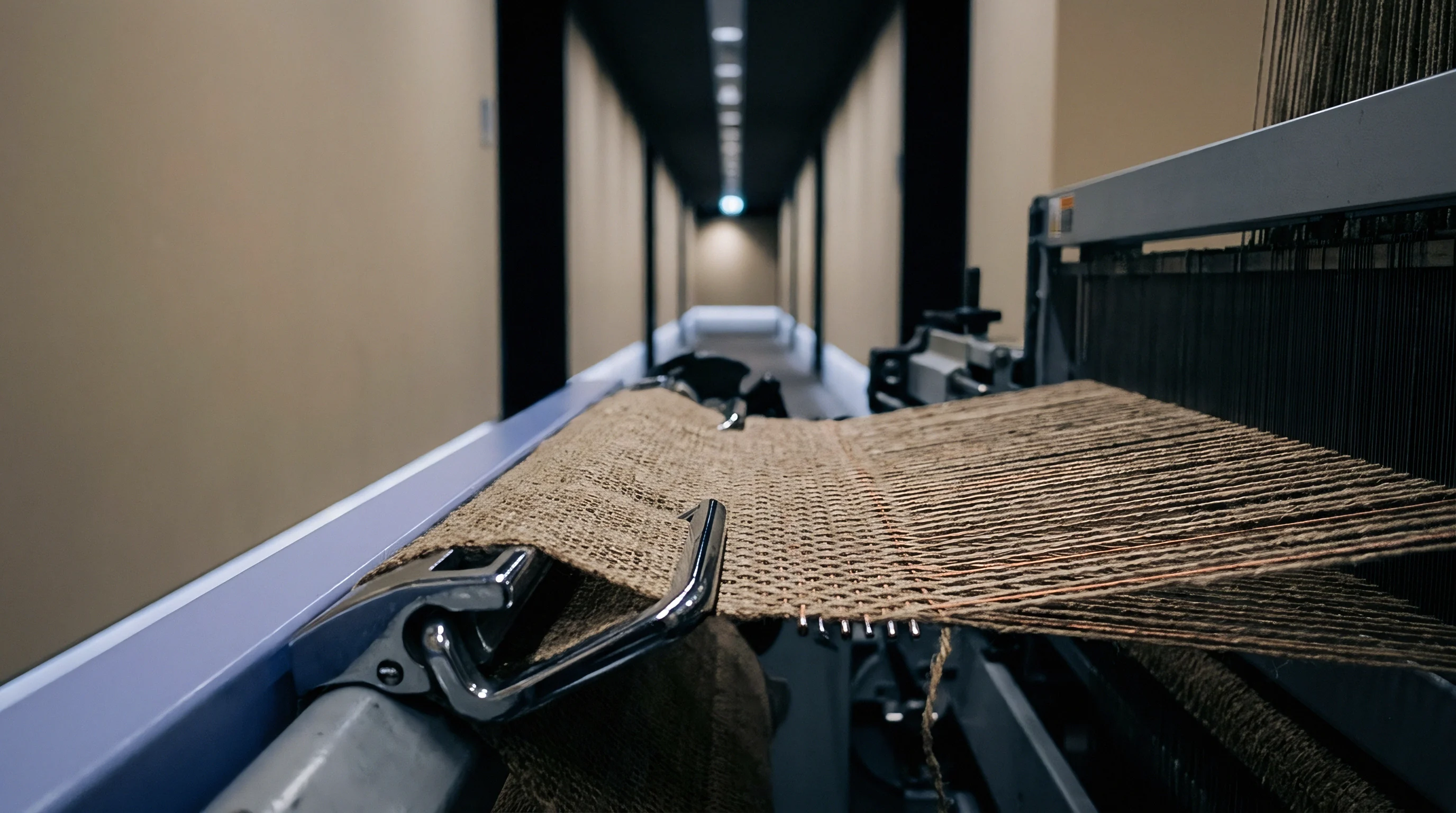
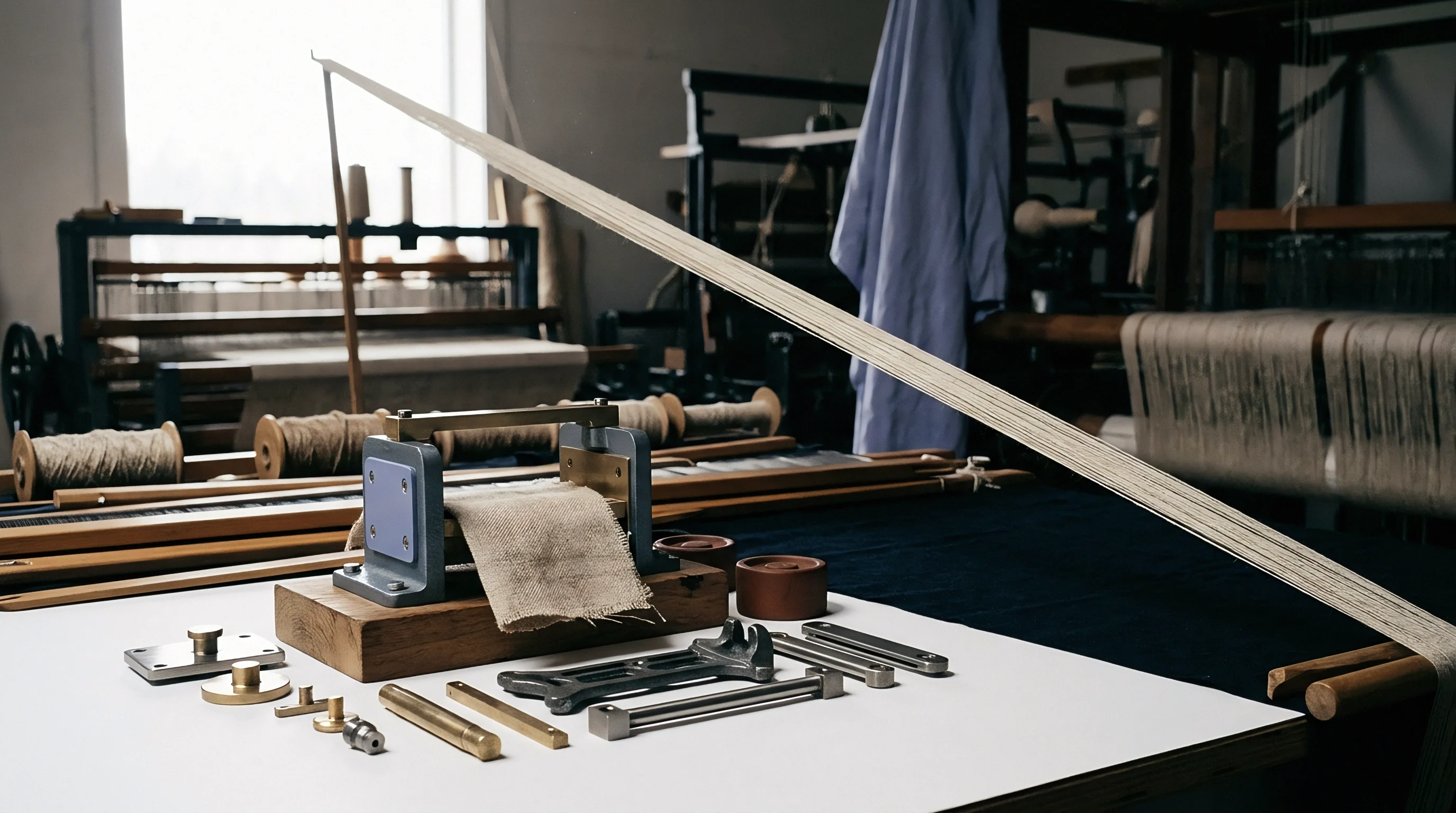
Verifying actual warp crimp and reed width contraction requires laboratory testing protocols performed on untensioned grey and finished swatches. ISO 7211-3 specifies procedures for determining thread crimp in woven fabrics by extracting yarns under precise pretension calculated from yarn tex count. Measuring unraveled thread length against fabric sample length isolates mechanical crimp from elastic yarn extension.
Does Finishing Shift the Crimp Distribution Pattern?
Wet processing shifts crimp values significantly from the greige state to the finished bolt. Scouring, bleaching, and tumbling remove natural pectins and release mechanical stress locked into flax fibers during loom beat-up. Unconstrained wet relaxation allows flax threads to swell and recoil, increasing warp crimp while reducing fabric length.
Weft crimp also reorganizes depending on stenter frame width settings during final drying, making greige calculations dependent on known mill finishing routes.
- Cut a fabric specimen measuring exactly 500 millimeters in warp direction by 100 millimeters in weft direction using a precision sample cutter.
- Extract ten individual warp threads carefully from central zone of specimen, avoiding fraying or changing natural thread crimp structure.
- Apply a mounting pretension to each thread calculated using formula: Pretension in centinewtons = 0.5 Yarn Count in Tex.
- Measure extended straight length of each thread on an ISO-compliant crimp tester to nearest 0.5 millimeter.
- Calculate mean crimp percentage across ten test strands using unraveled length equation.
Comparing laboratory crimp measurements against loom calculation sheets identifies whether width errors stem from loom mechanical setup or yarn count variations.
Standard ISO 7211-3 mandates applying a pretension equal to half the numerical yarn tex value during crimp extended length measurements.
Under ISO 3801 quality standard contracts, a width variation exceeding plus or minus 1.5 percent from agreed finished specifications allows buyers to issue formal quality deficiency claims and demand price adjustments.

Matrix
Evaluating relationships across yarn Lea counts, reed denting setups, and crimp variations clarifies landed fabric yields and machine productivity. Heavyweight constructions using coarse Lea counts exhibit high bending stiffness, creating wide crimp angles that demand substantial reed width expansion. Fine Lea counts run with lower crimp amplitudes, requiring less reed allowance per unit of finished width.
Table 2 models parametric variations across four standard commercial flax yarn counts, illustrating how yarn count, denting rate, and weft crimp dictate required reed width, loom capacity demands, and finished square-meter fabric weights.
| Yarn Count (Lea / Tex) | Weave Structure | Reed Dent Count (Dents / cm) | Ends Per Dent | Target Greige Width (cm) | Weft Crimp Allowance (%) | Calculated Reed Space (cm) | Greige Weight (g / m²) |
|---|---|---|---|---|---|---|---|
| 14 Lea / 118 Tex | Plain 1/1 | 6.0 | 2 | 160.0 | 8.5 | 173.6 | 310 |
| 25 Lea / 66 Tex | Plain 1/1 | 9.0 | 2 | 160.0 | 6.5 | 170.4 | 225 |
| 36 Lea / 46 Tex | Twill 2/2 | 12.0 | 2 | 160.0 | 5.2 | 168.3 | 185 |
| 40 Lea / 41 Tex | Satin 4-end | 14.0 | 2 | 160.0 | 3.8 | 166.1 | 160 |
Consider a practical manufacturing scenario. A mill receives an order for 5,000 meters of finished 100 percent linen plain weave fabric at 150 centimeters finished width, with target fabric weight set at 220 grams per square meter using 25 Lea (66 Tex) yarns in both warp and weft. Laboratory trials establish that finishing shrinkage accounts for 4.0 percent widthwise and 6.0 percent lengthwise contraction.
Target greige fabric width must equal 150 (1 + 0.04) = 156 centimeters. Weft crimp for this 18 ends/cm by 16 picks/cm grey construction measures 6.5 percent under standard shed tension.
Calculating required reed width yields 156 (1 + 0.065) = 166.14 centimeters. Total warp ends equal 156 centimeters 18 ends/cm = 2,808 ends, plus 48 selvage ends, totaling 2,856 ends. Threading through a 9 dents/cm reed at 2 ends per dent yields a reed denting width of 2,856 / (9 2) = 158.6 centimeters, showing that a coarser 8.5 dent/cm reed threaded at 2 ends per dent across 168 centimeters reed space is necessary to accommodate structural weft draw-in without crowding dents.
Warp crimp measures 7.5 percent in grey state. Adding 6.0 percent finishing shrinkage yields total warp take-up of 13.5 percent. To produce 5,000 meters of finished cloth, required raw warp yarn length equals 5,000 / (1 – 0.135) = 5,780 meters per end.
Total warp yarn mass consumed equals (2,856 ends 5,780 meters 66 Tex) / 1,000,000 = 1,089.5 kilograms of flax yarn before beam handling waste allowances.
Balancing reed space against warp yield per loom hour remains an operational trade-off that direct production trial data must validate.
Calculating warp length without adding wet finishing contraction results in short warp beams that exhaust before fulfilling complete fabric order yardage.
Whether modern air-jet insertion can maintain uniform weft crimp distribution on extra-wide linen constructions above 220 centimeters reed width without causing edge pick buckle remains an open question across high-speed weaving sheds.
Transit
Moving woven grey linen rolls from the loom shed to the wet finishing plant introduces external variables that alter off-loom fabric relaxation. Tension stored inside bast fiber bundles during shedding releases over time in ambient storage. Unconstrained grey cloth rolls undergo structural relaxation, causing width to drop by 1.0 percent to 2.5 percent within 72 hours post-doffing.
Factoring post-loom relaxation into initial reed width calculations guarantees that greige cloth arrives at the finishing plant stenter entry rails within mechanical clamping tolerances.
Processing specifications must state explicitly whether target width metrics apply immediately at loom doffing, following 72-hour ambient relaxation, or after final sanforizing. Standard commercial purchase agreements incorporate a 1.5 percent width tolerance band to account for natural variations in flax fiber diameter and batch-to-batch crop retting differences. Specifying reed width based on precise crimp equations and validated finishing shrinkages protects manufacturing margins across high-volume production orders.