Interfacial Pectic Shear Failure Calibration under Variable Atmospheric Moisture Regain in Long Staple Flax
Moisture regain plasticizes pectic middle lamella bonds, dropping interfacial shear strength from 38 to 10 MPa and dictating drafting stability.
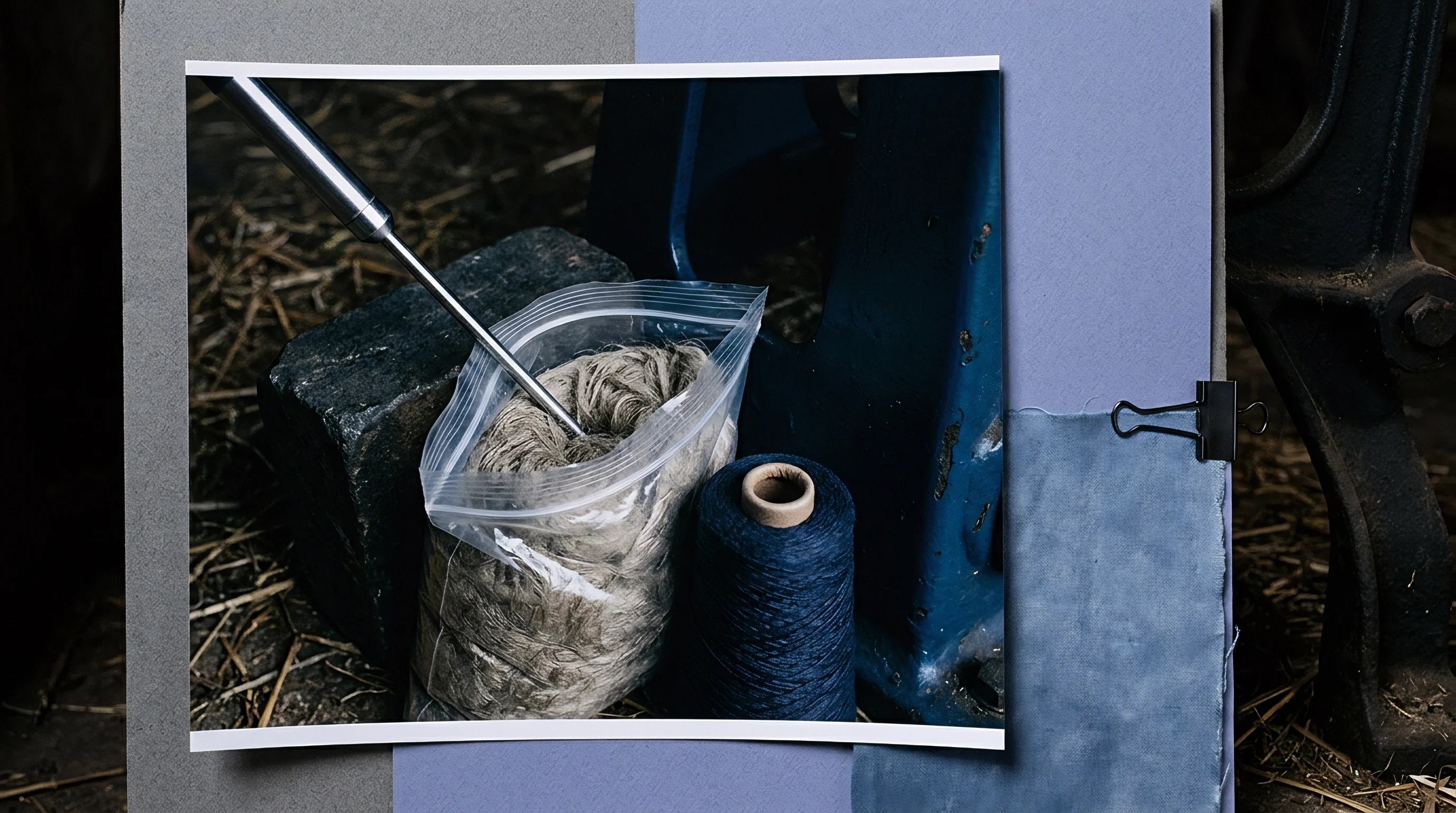

Swell
Water uptake inside technical flax line bundles alters how the middle lamella responds viscoelastically. This inter-fiber adhesive boundary consists mostly of rhamnogalacturonan-I, unbranched homogalacturonans, and complex neutral hemicelluloses. As long staple flax encounters changing ambient humidity, moisture sorption breaks down the dense hydrogen bonding across these polysaccharides.
Volumetric expansion follows, widening intermolecular spacing. Interfacial pectic shear capacity drops sharply as moisture content climbs from five to fifteen percent dry-basis regain. In shifting maritime climates, processors deal with fluctuating drafting forces because ambient sorption determines whether bundles split smoothly into elementary fibrils or snap catastrophically during drawing.
The middle lamella serves as a compliant stress-transfer medium between rigid, highly crystalline elementary fibers. Long staple flax bundles rely on this pectin-rich zone to distribute axial tensile loads across discontinuous single cells. Below six percent moisture regain, the polysaccharide matrix sits below its glass transition temperature, acting as a glassy solid with a high shear modulus that transfers stress efficiently across short overlapping fiber regions.
Water directly plasticizes the matrix. At moisture levels above ten percent, the glass transition temperature drops below typical room operating conditions. As pectin softens, polymer chains slide past one another under low shear stress, hydrogen linkages break, and tensile pull curves drop.
A long staple scutched line flax bundle conditioned at sixty-five percent relative humidity exhibits a mean interfacial shear strength of twenty-four megapascals at twenty degrees Celsius.

Plasticization of Rhamnogalacturonan Networks
Softening in the interfacial pectin stems from the dissociation of secondary valence bonds. Neutral side chains of arabinans and galactans entangle with surrounding cellulose microfibrils in the cell wall. Incoming water dipoles screen polar hydroxyl groups along galacturonan backbones, lowering cohesive energy density.
Consequently, the storage shear modulus of isolated flax middle lamella drops from 1.8 gigapascals when bone-dry to 0.3 gigapascals at sixteen percent regain. This physical shift changes how fibers fail during yarn drafting: dry atmospheres demand high axial pull forces that cause jagged transverse fractures across elementary cell walls, whereas humid conditions favor adhesive slip, allowing smooth longitudinal bundle division.
Chemical composition dictates how sensitive the interface is to hydration. Homogalacturonan segments with free carboxyl groups bind divalent calcium ions into stiff junction zones known as egg-box structures. Conversely, methylesterified carboxyl groups cannot coordinate calcium and interact only weakly with moisture, so flax harvested with high pectic methylation shows greater sensitivity to atmospheric water vapor.
Sorption isotherms confirm that long staple flax follows distinct Type II sigmoidal behavior ~ rapid monolayer formation occurs below twenty percent relative humidity, followed by multilayer condensation within mesoporous interstitial voids between twenty and seventy percent relative humidity.
- Capillary condensation occurs within inter-fiber voids exceeding two nanometers in width, filling voids with liquid water at relative humidities above seventy-five percent.
- Hydroxyl screening weakens direct bonding between elementary cell outer primary walls and amorphous middle lamella polymers.
- Pectic matrix swelling exerts transverse dilational strains that lower the critical shear stress required to initiate cohesive interface debonding.
- Viscoelastic relaxation accelerates the dissipation of axial strain energy, shifting deformation from brittle fracture to steady-state viscous slippage.
Equilibrium Moisture Sorption in Technical Bundles
Equilibrium regain values show marked hysteresis during desorption cycles. A long staple flax lot transferred from humid ocean transit to an air-conditioned spinning floor holds more bound water than one moved out of dry winter storage. At sixty-five percent relative humidity, desorption equilibrium settles near 10.8 percent moisture regain, whereas adsorption levels off around 9.2 percent at the same temperature.
This 1.6 percent disparity shifts the critical shear stress of the middle lamella by roughly 4.5 megapascals, meaning testing laboratories that skip standardized pre-conditioning produce erratic shear failure calibrations.
| Relative Humidity (%) | Moisture Regain (%) | Matrix Shear Strength (MPa) | Matrix Tg (°C) | Dominant Failure Mode |
|---|---|---|---|---|
| 35 | 6.2 | 38.4 | 52 | Elementary cell fracture |
| 50 | 8.4 | 31.1 | 36 | Mixed cell rupture and interfacial tear |
| 65 | 10.5 | 23.8 | 18 | Cohesive middle lamella shear |
| 75 | 12.8 | 16.2 | 8 | Adhesive interface slippage |
| 85 | 15.6 | 9.7 | -6 | Viscous pectic flow and fibrillation |
Accurate calibration demands conditioning technical bundles inside airtight climatic chambers for forty-eight hours prior to mechanical testing. Standard textile methods rely on ISO 139 tolerances of twenty degrees Celsius and sixty-five percent relative humidity, though industrial processing floors rarely hit these narrow targets. In coastal spinning hubs across Zhejiang and Jiangsu, summer humidity routinely pushes ambient regain above fourteen percent inside storage sheds.
Whether progressive cyclic sorption permanently alters the debonding threshold of cross-linked rhamnogalacturonan chains over prolonged sea transit remains unsettled in standard laboratory trials.

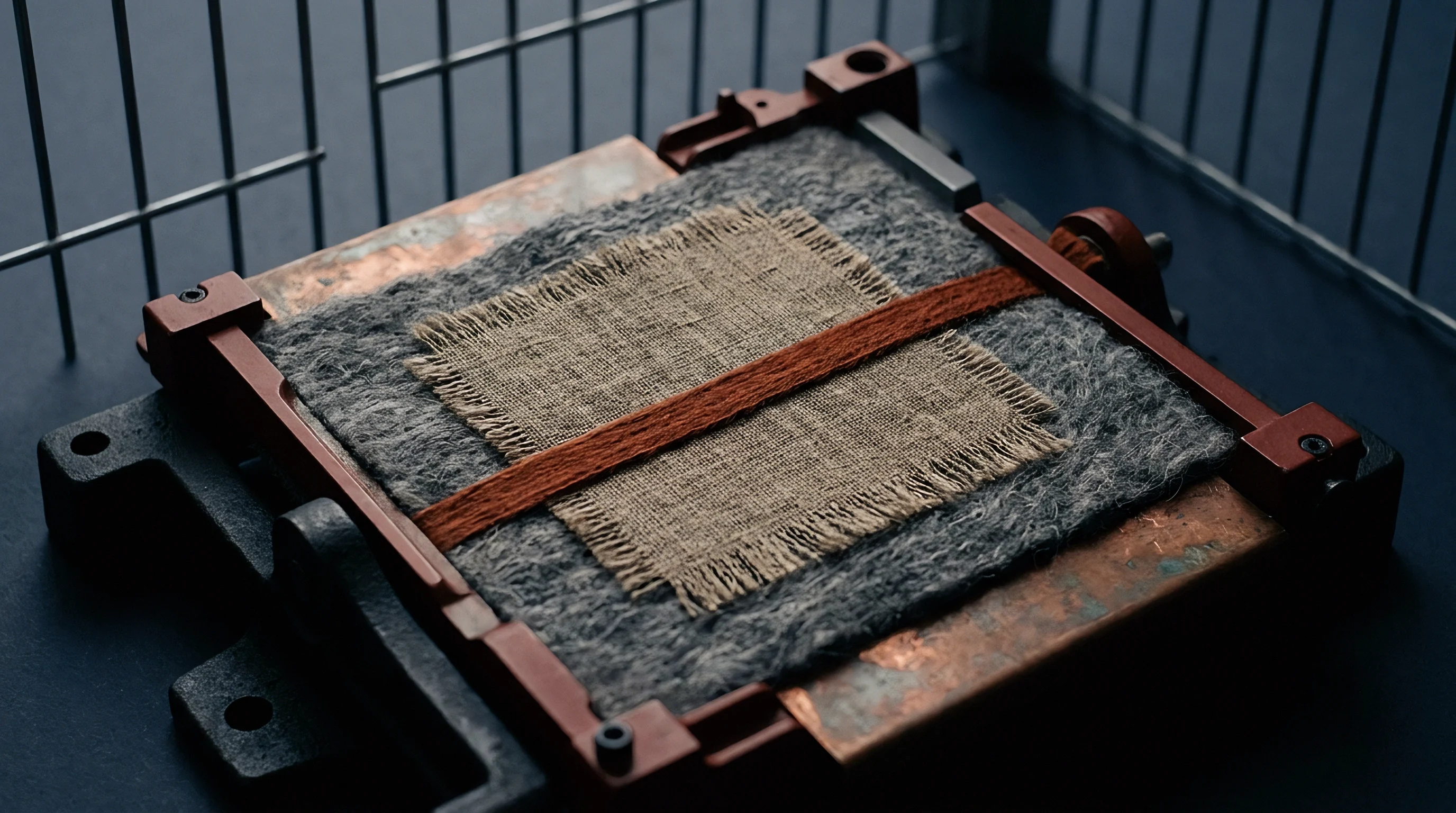
Slip
Shear calibration across long staple line flax requires precise micromechanical clamping arrangements. Individual technical fibers comprise ten to forty elementary fibers fused alongside each other. Measuring the shear failure of this joint involves isolating two overlapping elementary fibers or pulling an elementary fiber out from an intact technical bundle embedded within a calibrated resin matrix.
Dynamic microdroplet debonding and single-fiber pull-out apparatuses quantify the critical shear debond force. When ambient humidity shifts during testing, recorded peak shear force varies by more than forty percent across identical seed varieties.
Fiber pull-out mechanics demonstrate three distinct deformation phases: linear elastic loading, stable interfacial crack propagation, and dynamic frictional slide. As moisture regain increases, the initial linear slope flattens as the pectic interphase softens. Peak force, which marks the start of catastrophic debonding, moves toward higher axial displacements.
In dry specimens, debonding occurs abruptly with high acoustic emission and negligible pull-out resistance afterward. In plasticized wet specimens, debonding transitions into an extended plateau where viscous pectic residues exert persistent hydrodynamic drag along separating surfaces.
Under ISO 139 standard atmospheric conditioning, test specimens failing moisture equilibrium within four hours produce voided slip-force calibration certificates.

Does Equilibrium Moisture Regain Shift Interfacial Shear?
Atmospheric moisture modifies both apparent interfacial shear strength and frictional shear traction. The apparent strength represents peak axial pull-out force divided by embedded contact area. Testing relies on twenty-millimeter gauge lengths on custom micro-tensile units with laser extensometers, with data from thirty test specimens per moisture stage establishing the curve.
Apparent interfacial shear strength drops by 1.4 megapascals for every one percent increase in fiber moisture regain between seven and twelve percent dry-basis regain. This value stems from a ninety-specimen testing trial across Western European scutched line flax harvested in 2022; shifting gauge length from twenty millimeters down to ten millimeters alters this slope by concentrating shear stress unevenly along fiber ends.
Post-debonding frictional traction represents a second variable. During drafting on gill boxes and draw frames, fibers rarely separate completely before engaging adjacent pins and rollers. Frictional resistance between debonded surfaces governs slippage uniformity.
As pectic gels absorb water, dynamic friction follows a non-linear path: falling initially as unbound water forms a thin lubricating film over smooth cell walls, then rising beyond twelve percent regain as swelling amorphous pectin exposes rough fibrillar debris that increases mechanical interlocking.

Microdroplet and Pull-Out Calibration Metrics
Calibration protocols demand strict standardization of droplet geometry, embedment length, and loading velocity. Droplet testing places tiny spherical beads of pectic-mimetic epoxy or cross-linked calcium pectate directly onto cleaned elementary flax fibers. The droplet cures under controlled relative humidity before micro-vise blades engage its edge at displacement rates of one millimeter per minute.
Whether isolated synthetic resin droplets accurately mirror the native middle lamella during high-speed mechanical drawing remains uncertain; buyers facing this ambiguity establish acceptance limits using full technical bundle pull-out tests rather than single-fiber microdroplets.
- Mount twenty-millimeter technical flax fiber bundles onto laser-cut cardstock carrier frames using fast-curing cyanoacrylate adhesive at opposing clamp tabs.
- Place mounted specimens within a variable environmental chamber maintaining target relative humidity within one percent tolerance for twenty-four hours.
- Insert the carrier frame into micro-tensile grips equipped with a five-newton load cell having 0.05 percent measurement resolution.
- Sever the supporting side rails of the cardstock frame with micro-shears without imparting torsional or bending strains to the axial fiber bundle.
- Apply monotonic displacement at 0.5 millimeters per minute until complete interfacial debonding occurs, recording force and crosshead displacement at one kilohertz.
- Extract peak debond force, debond energy, and frictional sliding tail resistance using automated curve-integration software.
| Gauge Length (mm) | Test Humidity (%) | Peak Debond Force (cN) | Standard Deviation (cN) | Peak Slip Displacement (mm) |
|---|---|---|---|---|
| 10 | 50 | 42.6 | 3.8 | 0.12 |
| 10 | 65 | 33.1 | 3.1 | 0.18 |
| 10 | 80 | 19.4 | 2.4 | 0.29 |
| 20 | 50 | 68.9 | 5.7 | 0.21 |
| 20 | 65 | 51.2 | 4.6 | 0.32 |
| 20 | 80 | 31.5 | 3.9 | 0.48 |
Variations in fiber cross-sectional geometry distort raw load data unless normalized against actual perimeter values. Flax elementary fibers possess irregular polygonal cross-sections with lumens of variable diameter. Optical micromeasurement systems scan each test specimen at five angular positions to construct a true peripheral perimeter before calculating shear stress.


Draft
Drawing frames translate interfacial shear failure from single-fiber mechanics into bulk processing behavior. Scutched line flax enters spinning preparation as parallelized slivers. Gilled drafting stages attenuate these slivers by accelerating front rollers relative to back feeding rollers.
As technical bundles pass adjacent fibers under tight mechanical confinement, excess shear resistance in the middle lamella causes roller slip, fluted roller wear, and bundle ruptures. If the lamella softens too much under ambient humidity, fibers slide prematurely, producing thin spots, uneven roving mass profiles, and yarn thick-and-thin defects.
Modern flax mills track drafting force dynamically using piezoresistive load sensors under the faller bars of intersecting gill boxes. This force reflects total interfacial shear failure within the drafting zone. As factory relative humidity shifts with seasonal weather, drafting resistance fluctuates accordingly.
Processing flax in unconditioned draw sheds leads to severe mass unevenness across finished slivers, making environmental control inside drafting zones essential for high-count long staple yarns used in fine shirting.
Higher moisture content accelerates pectic softening across fiber bundles during flyer frame drafting.

Sliver Attenuation and Creep under Dynamic Tension
Tension profiles inside drafting fields generate localized viscoelastic creep along inter-fiber boundaries. As sliver density drops from twenty-five kilotex down to two kilotex across progressive drawing passages, inter-fiber contact points diminish. Elementary fibers absorb high normal forces from faller pins while moisture plasticizes the interphase.
The combination of pressure and pin friction causes localized heating, driving moisture away from contact points into neighboring pectic domains. Drafting rollers crush the softened bundles, creating transient shear resistance gradients across the sliver cross-section.
In high-draft roving frames, long staple flax undergoes simultaneous twisting and attenuation. At this stage, atmospheric moisture regain must balance two physical needs: low interfacial shear resistance to permit bundle subdivision without fiber breakage, and sufficient cohesion to prevent draft waves. Drafting charts show that roving CV percentage climbs steeply when moisture regain moves outside the nine to eleven percent corridor.
Below nine percent, drafting force peaks intermittently, snapping fibers and depositing short waste fragments in faller beds. Above eleven percent, fibers slide in uncontrolled clumps, creating periodic slubs in finished yarns.
- Incoming bale desiccation causes excessive drafting resistance exceeding seventy centinewtons per tex, destroying pin alignments on intersecting gill boxes.
- Roller slippage occurs when over-moisturized pectic residues deposit onto fluted bottom steel rollers, reducing mechanical gripping traction.
- Flyer frame draft waves emerge when sudden humidity spikes drop interfacial shear values below the threshold required for steady-state fiber attenuation.
- Pneumatic waste surges multiply at the ring spinning frame as broken elementary fibers fail to incorporate into the twisted yarn core.
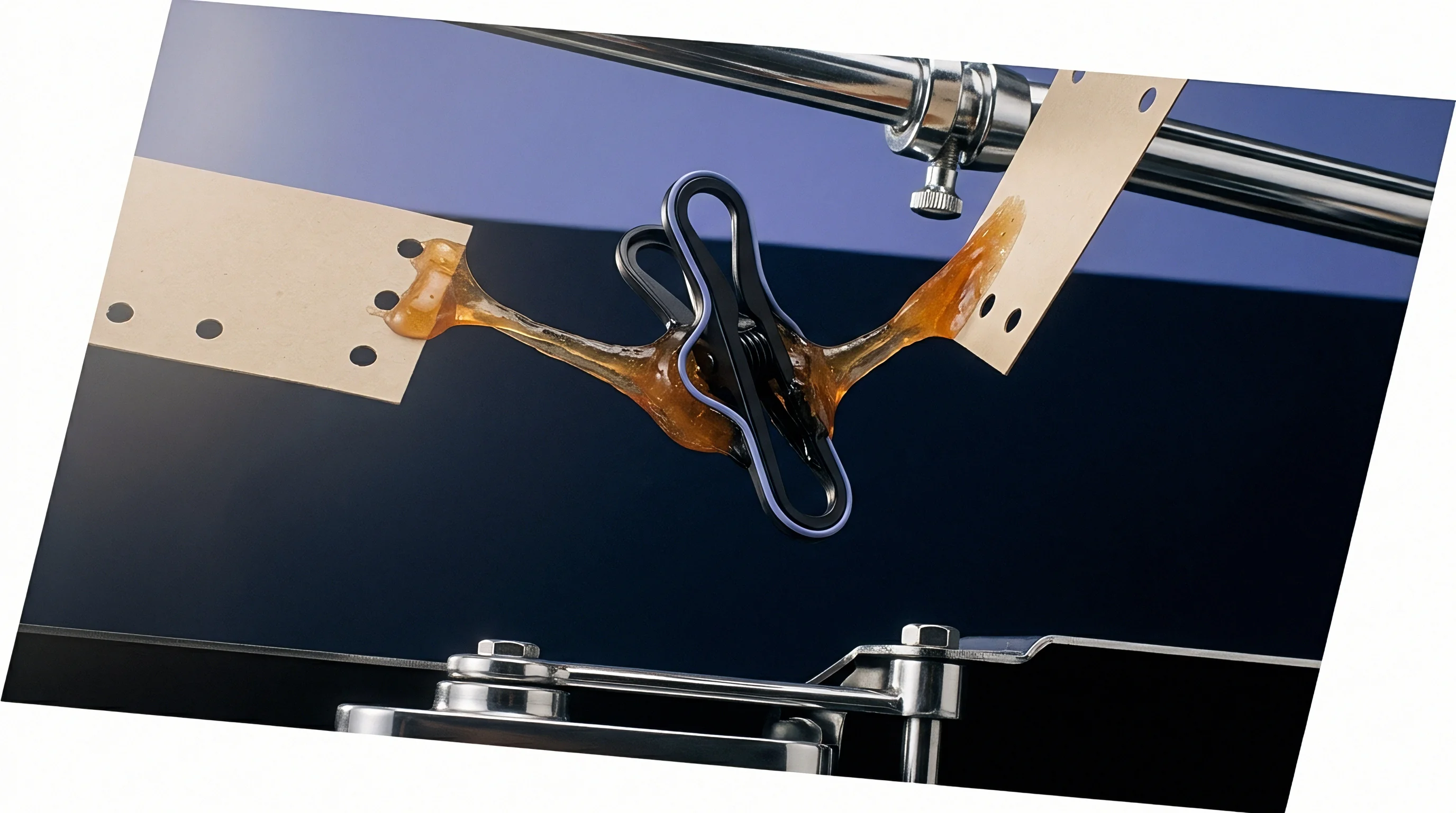
Worked Calculation of Drafting Resistance
Predicting mechanical loads on high-speed draw frames requires calculating total shear dissipation across the drafting zone. Take an industrial preparation line processing a 40-tonne lot of Western European long staple line flax at a production delivery speed of two hundred meters per minute. Assume an incoming sliver linear density of twenty kilotex (grams per meter), a draft ratio of ten, and an active drafting zone length of two hundred millimeters.
The total drafting force F_d equals the sum of the mechanical pin friction F_pin and the aggregate interfacial pectic shear resistance F_shear:
F_shear = A_int tau_c (1 – S_rel)
Here, A_int represents the active inter-fiber contact area within the drafting field, tau_c denotes the moisture-dependent interfacial pectic shear strength, and S_rel represents the fractional slippage index. In a standard conditioned mill atmosphere at sixty-five percent relative humidity, the moisture regain settles at 10.5 percent, yielding an interfacial shear strength tau_c of 23.8 megapascals. For a sliver carrying forty thousand parallel elementary fibers with an effective contact area A_int of 0.0035 square meters inside the nip zone and an empirical slippage index of 0.85, the pectic shear force calculates as follows:
F_shear = 0.0035 m² 23.8 10⁶ N/m² (1 – 0.85) = 12.495 kilonewtons
When factory air conditioning fails and ambient relative humidity rises to eighty-five percent, moisture regain reaches 15.6 percent. The interfacial shear strength tau_c collapses to 9.7 megapascals. Inserting this degraded shear value into the equation yields:
F_shear = 0.0035 m² 9.7 10⁶ N/m² (1 – 0.85) = 5.092 kilonewtons
This 59.2 percent collapse in drafting force invalidates the mechanical weighting settings on drafting rollers. The nip rollers lose mechanical grip over the rapidly sliding fibers. Uncontrolled mass acceleration ensues, causing cyclic drafting waves that increase sliver mass variation from an acceptable 2.8 percent CV up to an unusable 7.4 percent CV.
| Zone Relative Humidity (%) | Drafting Force (cN/tex) | Sliver Mass CV (%) | Roving Tenacity (cN/tex) | End-Breakage (per 1000 Spindle Hours) |
|---|---|---|---|---|
| 45 | 64.2 | 5.8 | 14.8 | 42 |
| 55 | 48.1 | 3.6 | 18.2 | 21 |
| 65 | 32.5 | 2.4 | 21.5 | 12 |
| 75 | 21.8 | 4.1 | 16.1 | 28 |
| 85 | 12.4 | 7.9 | 9.4 | 68 |
| Values recorded across twenty tex wet-spun roving lots at thirty-five meters per minute delivery speed. | ||||
Failure to synchronize drawing zone humidity with incoming bale moisture produces persistent yarn count variation, surging end-breakage rates, and massive consignment rejections at weaving mills.


Calcium
Divalent cations govern the structural stability of the middle lamella across agronomic environments. Pectic polysaccharides in flax derive their shear resistance from coordination complexes formed between unesterified galacturonic acid residues and divalent calcium ions. In the classic egg-box conformation, antiparallel chains of polygalacturonate chelate calcium ions within cavities created by folded helical backbones.
These ionic cross-links resist mechanical displacement far more effectively than neutral hydrogen bonds. The density of these calcium cross-links depends upon field retting duration, soil mineral availability, and rainfall during the vegetative growth cycle.
Dew retting relies on indigenous saprophytic fungi, including Cladosporium herbarum and Epicoccum nigrum, to produce polygalacturonases and pectin lyases. These enzymes degrade the middle lamella while straw lies in swaths across Western European fields. Fungal colonizers cleave unesterified pectin chains, releasing bound calcium ions that wash into the soil.
Under-retted flax retains dense calcium bridges that resist mechanical bundle separation during scutching and hackling. Over-retted flax suffers widespread enzymatic destruction of both pectic and hemicellulosic matrices, leaving fibers vulnerable to moisture penetration and premature breakage.
Water molecules weaken the divalent salt linkages binding rhamnogalacturonan chains inside the middle lamella.
Pectic Methylation and Enzymatic Retting Variations
Enzymatic breakdown targets specific esterification patterns along the galacturonan backbone. Industrial line flax exhibits degrees of methylation ranging from thirty to sixty-five percent. Highly esterified pectins repel calcium ions, forming flexible, water-receptive gels that hydrate rapidly under ambient humidity shifts.
Unesterified pectins cross-link readily with calcium, creating rigid, moisture-resistant interfacial regions. Long staple flax lots sourced from northern France and Flanders feature controlled dew retting, preserving an optimal balance of thirty-five to forty percent methylation. This specific chemical window delivers predictable interfacial shear performance across standard spinning humidities.
Water retting, historically executed in slow-moving rivers or heated anaerobic tanks, produces a distinct pectic architecture compared to modern field dew retting. Industrial anaerobic fermentation by Clostridium species eliminates nearly all unesterified pectin, leaving elementary fibers held together predominantly by high-methoxyl fractions and neutral hemicelluloses. This processing route creates fiber bundles with hypersensitivity to moisture regain.
When atmospheric humidity climbs, water-retted flax loses interfacial shear resistance twice as fast as dew-retted flax. The modern linen trade relies almost exclusively on dew retting, accepting seasonal variations in exchange for environmental compliance and eliminated wastewater effluent.

Do Divalent Cations Preserve Middle Lamella Cohesion?
Chemical analysis confirms that calcium concentrations directly dictate the shear failure envelope under elevated moisture regain. Technical flax bundles containing more than 0.8 percent calcium by dry weight maintain fifty percent higher interfacial shear strength at twelve percent regain than bundles containing less than 0.4 percent calcium. Divalent magnesium ions also participate in cross-linking, but magnesium complexes display significantly higher hydration energies, allowing ambient water molecules to displace ionic bridges under lower mechanical shear strains.
Cold water halts retting kinetics. When rain leaches calcium from dew-retting swaths, the resulting fiber line yields erratic drafting resistance on spinning frames.
Blends of diverse origin lots destabilize drafting consistency across the spinning floor. Flax scutchers in Europe classify long line scutched flax into homogeneous farmer lots based on color, scutching cleanliness, and manual break assessments. When Chinese spinning mills import containerized scutched line flax, blending operators combine multiple scutched lots to optimize raw material purchase costs.
Combining lots with divergent calcium contents and disparate pectic esterification levels creates severe interfacial shear mismatch. Inside the drafting zone, bundles from high-calcium lots remain rigid while low-calcium bundles slide prematurely. The resulting sliver exhibits periodic mass instability that defies corrective draw frame adjustments.
- Scutching delivery receipts must specify field retting classification and average calcium concentration metrics for each delivered farm parcel.
- Chemical esterification assays tracking the degree of methylation should accompany long line flax lots destined for high-count yarn spinning.
- Conductometric titration records reveal residual ionic cross-linking density across incoming scutched bale selections.
- Trace element soil profiles from certified growing regions document regional calcium availability during vegetative stalk development.
Excessive field dew exposure softens the crop naturally, which lowers drafting tenacity.

Ledger
Documenting fiber provenance provides the foundation for commercial valuation in the linen market. Long staple line flax grown in the coastal corridor spanning France, Belgium, and the Netherlands commands an eighty to one hundred twenty cent per kilo pricing premium over lower-tier Egyptian, Russian, or domestic Chinese scutched line fibers. This premium reflects both superior agronomic traits and consistent middle lamella drafting behavior.
The European Flax certification, managed by the Alliance for European Flax-Linen & Hemp, validates geographic origin from scutched line flax up to finished fabric. Masters of Linen imposes a far stricter chain of custody, demanding that all processing stages from scutching through wet spinning and weaving occur entirely within European territory.
Importers purchasing European-grown line flax for spinning in Jiangsu or Zhejiang cannot claim Masters of Linen certification, because the spinning stage crosses outside European territorial borders. They can, however, maintain European Flax certification provided every intermediary entity holds a valid chain-of-custody scope certificate. Fiber buyers pay an estimated twelve to fifteen percent raw material cost premium for European Flax certified long line bales.
Preserving this commercial asset demands rigorous audit reconciliations that match raw fiber purchase tonnages against exported yarn and cloth shipments.

Provenance Auditing across Scutched Line Consignments
Traceability auditing relies on mass balance reconciliations calculated through each production stage. Long staple scutched line flax converts into spun yarn through a series of yield-reducing mechanical processes. A typical wet spinning line yields sixty-two to sixty-eight percent finished yarn from raw scutched line, with thirty-two to thirty-eight percent descending into hackling tow, carding waste, and pneumatic dust.
Mass balance confirms genuine origin. Auditors inspect spinning office production books, weighbridge tickets, and warehouse packing lists to ensure certified yarn shipments do not exceed the theoretical conversion ceiling derived from incoming certified scutched line bale volumes.
A mill processing non-certified local flax alongside certified European flax introduces severe commercial exposure. Without physical segregation of bale laydowns, blending hoppers, and draw frame tracks, lower-tier fibers infiltrate certified spinning runs. Lower-tier fibers frequently exhibit divergent pectic characteristics, including erratic methylation and inconsistent calcium cross-linking.
When these uncontrolled fiber lots blend into European lines, drafting zones suffer erratic interfacial pectic shear failure. Yarn buyers detect this physical failure through soaring yarn unevenness, irregular dye pick-up, and localized pilling on woven goods.

Transaction Certificate Scopes and Conversion Proof
Transaction certificates issued by accredited certification bodies confirm that a specific lot of yarn or fabric derives directly from certified precursor materials. Each transaction certificate specifies the certified volume, fiber content, dispatch date, and the seller and buyer scope certificate numbers. When purchasing long staple linen yarns from Asian wet spinners, buyers review the transaction certificate scope details to prevent uncertified substitutions.
The document must carry the issuing certifier stamp, list the exact spinning lot numbers, and correlate precisely with commercial customs declarations and commercial invoices.
Customs authorities enforcing trade compliance inspect Harmonized System tariff classifications alongside origin documentation. Raw and scutched long staple flax enters destination ports under HS heading 5301.21 for scutched flax or 5301.29 for line flax. Single yarn wound on cops or bobbins clears under HS heading 5306.10, while multiple or cabled yarns clear under HS 5306.20.
Misdeclaring yarn origin to bypass trade remedies or to capture preferential duty rates exposes importers to substantial regulatory fines, cargo forfeiture, and retroactive tariff assessments. Origin claims remain valid only when accompanied by unbroken chain-of-custody documentation linking finished yarn lots back to specific European farm delivery dockets.
Insertion of the standard Federation of European Flax and Hemp contract clause eleven shifts full financial liability for uncertified fiber substitution directly onto the export seller.