Correlating Crystallite Orientation Dispersions with Wet Spinning Yields in Long Staple Flax
Narrow crystallite orientation dispersion below 14 degrees FWHM maximizes wet spinning yields and fine count limit up to Nm 60 in long staple flax.

Lattice
Cellulose I-beta crystallite chains within long staple flax elementary cell walls assemble into tightly packed parallel microfibrils. Their narrow spiral angle relative to the longitudinal fibre axis establishes the axial tensile stiffness of the plant cell wall. In high-grade scutched line flax, this microfibril angle ranges between six and eleven degrees.
Wide-Angle X-ray Scattering provides direct physical measurement of that geometry. When a monochromatic X-ray beam passes through a parallel bundle of elementary fibres, diffractometers produce a characteristic two-dimensional diffraction pattern where equatorial reflections ~ specifically the 200 lattice plane at a scattering angle two-theta near 22.6 degrees ~ register as sharp azimuthal arcs.
Quantifying the angular spread of these diffraction arcs reveals crystallite orientation dispersion. When the azimuthal intensity distribution across the 200 reflection peak maintains a full width at half maximum below fourteen degrees, the crystalline domains are oriented cleanly along the fibre axis, translating to Hermans orientation factor values above 0.92. Tensile load applied to an elementary fibre with this crystalline structure distributes evenly across the glucan chains.
Crystalline domain alignment along the cellulose I-beta microfibril axis determines the tensile load capacity of elementary flax cell walls under longitudinal draft forces.
Structural misorientation broadens the azimuthal intensity peak beyond eighteen degrees, driving the Hermans orientation factor down toward 0.82. This broadening reflects physical disruptions in the secondary cell wall: wavy microfibrillar tracks, dislocation kink bands produced by aggressive mechanical scutching, or incomplete removal of the amorphous hemicellulose and lignin matrix during field retting. When elementary fibres with broad orientation dispersion face axial tension, stress accumulates at localized tilt boundaries instead of distributing across the crystalline lattice.
Elementary fibre tensile modulus drops from eighty gigapascals in highly oriented stock down to forty-five gigapascals in disordered lots, while breaking tenacity falls from sixty-five centinewtons per tex to thirty-eight centinewtons per tex. Purchasing line flax based purely on hand-hackled visual appearance without verifying azimuthal dispersion metrics guarantees elevated yarn linear density variance and high break counts at the spinning frame.


Bath
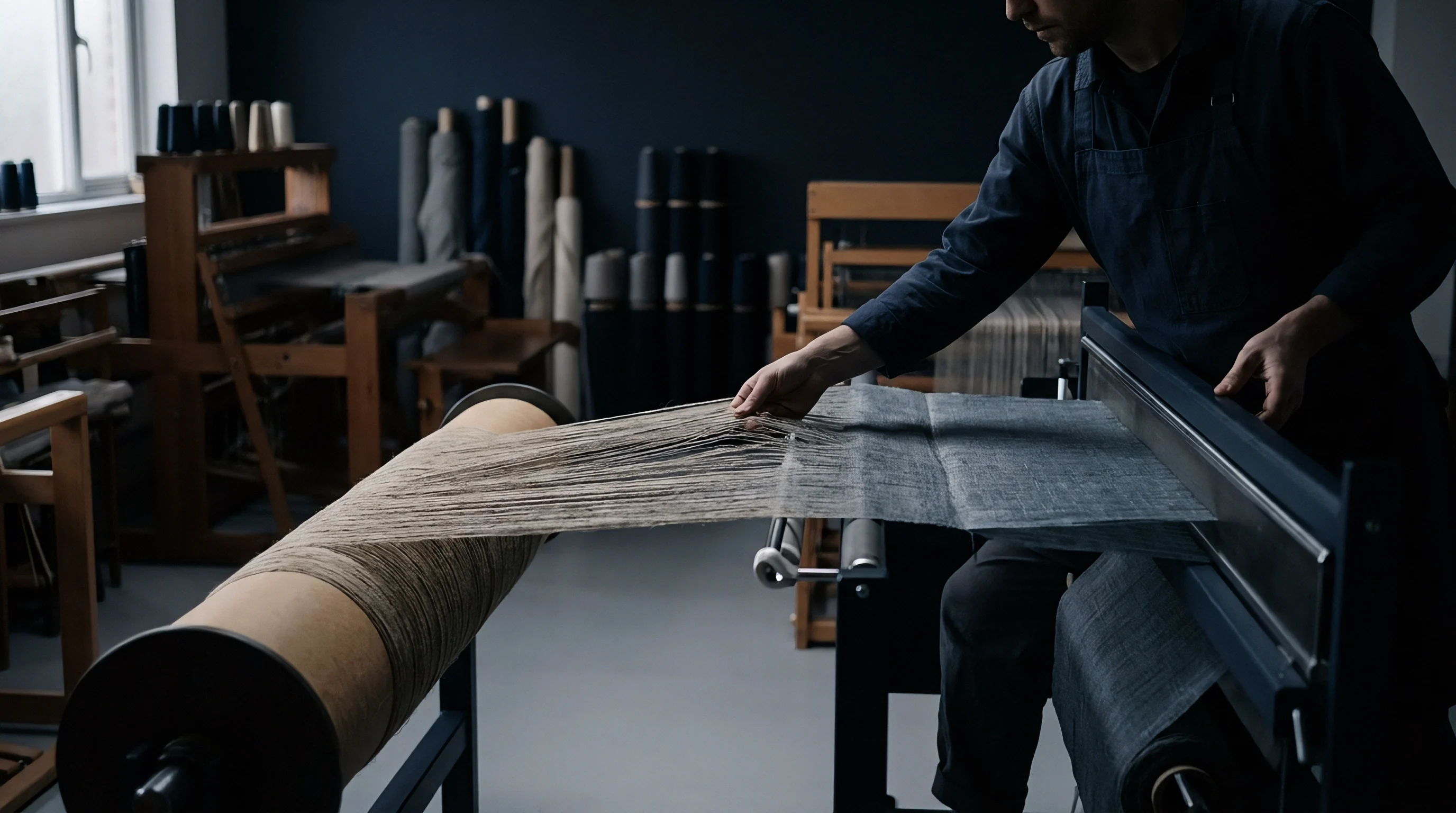
Hot water troughs maintained between 60 and 70 degrees Celsius hydrate the pectic inter-cellular matrix surrounding technical flax bundles. The aqueous thermal exposure solubilizes calcium pectinate complexes within the middle lamellae that bind individual elementary fibres into technical strands. As roving passes through the trough at residence times between four and eight seconds, bundle cohesion relaxes, converting the rigid material into a compliant array of sub-bundles ready for drafting.
Hydrodynamic Softening in Pectic Middle Lamellae
Aqueous thermal treatment softens inter-fibre binder networks while preserving cell wall integrity. Pectins swell and dissolve, allowing elementary fibres to slide past one another under applied tension. If crystallite orientation within the elementary walls is uniform, adjacent cells offer consistent surface shear resistance.
Controlled bundle division then splits line flax sliver into fine, continuous sub-bundles down to single elementary units without fracturing individual cell walls.

Tensile Distribution during Attenuation
Drafting rollers impose continuous axial shear forces across incoming roving bundles. The total draft ratio, typically set between ten and eighteen in wet spinning frames, accelerates the forward fibre array relative to the back retaining rollers. Under these hydrodynamic shear conditions, crystallite orientation dispersion dictates strand integrity.
- Thermal Immersion Roving enters the aqueous trough at 65 degrees Celsius, initiating rapid hydration of middle lamella pectin gels.
- Matrix Dissolution Pectic binders soften under thermal shear, permitting controlled slippage between adjacent technical fibre strands.
- Roller Engagement Retaining and drafting rollers apply differential speed vectors, generating tensile stress along individual elementary walls.
- Fibre Attenuation Highly aligned crystallite structures bear uniform draft loads, whereas misaligned microfibrils suffer localized shear fracture.
When microfibrillar angles vary widely within the same technical bundle, elementary fibres react unevenly to drafting forces. Fibres with lower microfibril angles absorb draft tension first due to their higher axial modulus. Misaligned neighbour fibres offer lower initial resistance, sliding prematurely or snapping at kink bands.
Mills often attribute excessive draft waves to inconsistent retting duration rather than addressing structural crystallite misorientation within incoming raw sliver.


Breakage
Dislocation zones and kink bands inside elementary cell walls create structural stress concentrations that rupture during frame attenuation. In high-speed wet spinning, these defects turn into yarn end breaks, forcing frame stoppages and generating excessive flyer waste. When crystallite orientation dispersion broadens across a fibre lot, weak points multiply along the sliver length.
Where Does Microfibrillar Disorder Originate during Retting?
Uncontrolled fungal colonization in field-retted straw breaks down structural cell wall layers unevenly. Over-retting degrades the outer primary wall and attacks the outer secondary cell wall layers, allowing microfibril spirals to uncoil and misalign under mechanical handling. Aggressive scutching turbines compound this damage, inducing transverse kink bands that shift local crystallite angles by up to twenty-five degrees from the fibre main axis.
End Stoppage Rates across Density Classes
High-speed ring frames running fine count yarns above Nm 60 register immediate performance drops when orientation dispersion broadens. Standard operating targets maintain end breakages below twenty stoppages per one thousand spindle hours. When processing scutched line flax with a Hermans orientation factor below 0.85, break rates routinely exceed fifty stoppages per one thousand spindle hours, overwhelming operator attendance capacity and forcing frame speed reductions of up to twenty-five percent.
An increase in crystallite orientation dispersion angle beyond sixteen degrees raises wet spinning end breakage from eighteen to fifty-two stoppages per one thousand spindle hours on fine count frames.
Microfibrillar disorientation destabilizes the drafting zone, producing mass variations that appear as periodic yarn thin and thick places. As drafting rollers pull the softened bundle, misaligned fibre segments slip abruptly rather than attenuating smoothly. Twist inserted by the ring flyer fails to trap these loose fibre ends, leading to weak yarn segments that break under winding tension.
| Crystallite FWHM (Degrees) | Hermans Factor f | Tenacity (cN/tex) | Spinnable Limit (Nm) | End Breaks per 1000 Spindle Hours |
|---|---|---|---|---|
| 11.5 | 0.94 | 68.2 | 100 | 12 |
| 13.8 | 0.91 | 59.5 | 60 | 18 |
| 16.2 | 0.86 | 48.0 | 39 | 34 |
| 19.5 | 0.81 | 36.5 | 26 | 58 |
- Localized Necking Sub-bundles containing broad orientation dispersions elongate unevenly, producing thin spots that snap prior to twist insertion.
- Sliver Draft Waves Microfibrillar sliding resistance fluctuates across the drafting zone, causing periodic mass variations and frame stoppages.
- Flyer Waste Spikes Short fractured elementary fragments detaching from misaligned bundles accumulate in flyer arms and wet troughs.
Whether targeted chemical pretreatment before roving insertion can selectively realign disordered amorphous matrix domains without degrading crystallite core tenacity remains unproven across commercial production speeds.


Yield
Raw fibre conversion efficiency from hackled line sliver into saleable yarn packages directly governs mill gross margin. High crystallite orientation alignment preserves structural bundle integrity through hackling, drawing, and wet spinning, maximizing net yarn output per kilogram of input fibre.
Spinnable Count Boundaries and Conversion Economics
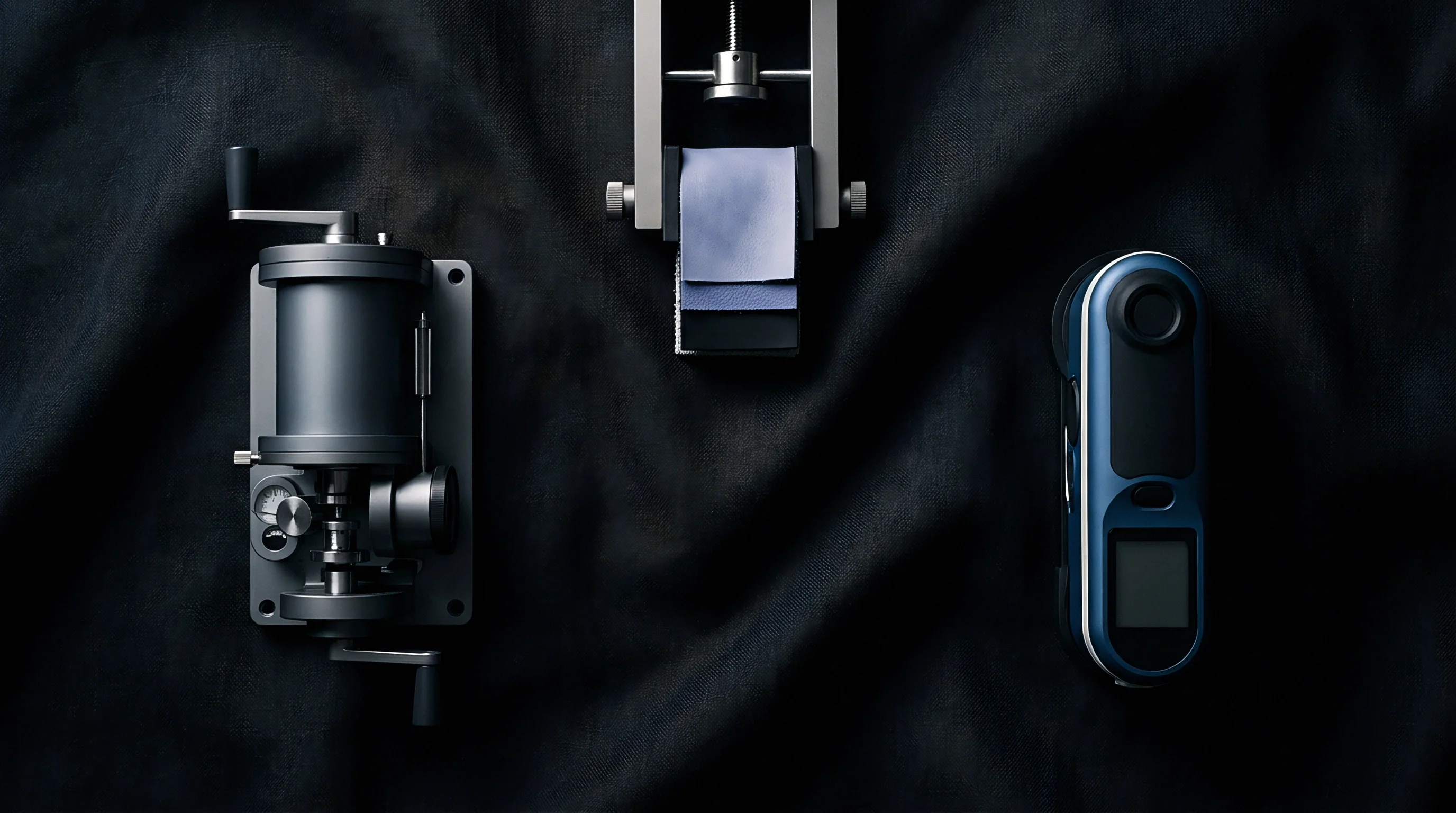
Fine yarn spinning demands structural unit uniformity that broad orientation profiles cannot sustain. To establish the monetary impact of crystallite orientation dispersion, evaluate a commercial mill processing a 10,000 kilogram lot of scutched long staple flax line fibre under two distinct orientational quality profiles.
Assume Lot A represents high-orientational line flax exhibiting an azimuthal full width at half maximum of 12.5 degrees and a Hermans factor of 0.93. The raw fibre purchasing cost sits at $4.80 per kilogram. This lot supports fine yarn production up to Nm 60 (36 lea).
During wet spinning, Lot A operates with a flyer waste rate of 2.8 percent and a break waste rate of 1.2 percent. Total material conversion efficiency from hackled sliver to final wound yarn cone reaches 88.5 percent, yielding 8,850 kilograms of Nm 60 yarn. At a market price of $32.00 per kilogram for Nm 60 yarn, gross lot revenue equals $283,200.
Total processing cost, including hackling, drawing, roving, wet spinning, and winding, equals $12.50 per kilogram of finished yarn, totaling $110,625. Net revenue after fibre cost ($48,000) and processing cost equals $124,575, corresponding to a margin of $14.07 per kilogram of yarn, or approximately $0.235 per finished metre at a standard fabric weaving weight of 150 grams per square metre.
Assume Lot B represents disordered line flax with an azimuthal full width at half maximum of 18.2 degrees and a Hermans factor of 0.83, purchased at the same raw price of $4.80 per kilogram. When forced into an identical Nm 60 spinning specification, broad orientation dispersion causes extensive strand rupture in the hot water trough. Flyer waste increases to 8.5 percent, while break waste rises to 6.2 percent.
Total conversion yield drops to 74.1 percent, yielding only 7,410 kilograms of saleable yarn. Frame stoppages and downtime increase processing costs to $15.80 per kilogram of finished yarn, totaling $117,078. Gross revenue drops to $237,120.
Net profit after fibre cost ($48,000) and elevated processing cost collapses to $72,042, representing a margin loss of $52,533 compared to Lot A.
If the mill re-routes Lot B to a coarser, spinnable yarn count boundary of Nm 26 (15 lea) to avoid excessive breakages, conversion yield recovers to 84.0 percent, producing 8,400 kilograms of yarn. However, Nm 26 coarse linen yarn commands a market price of only $18.50 per kilogram, generating gross revenue of $155,400. With processing costs for coarse yarn at $7.20 per kilogram ($60,480 total), net profit after raw fibre costs equals $46,920, demonstrating how crystallite misorientation caps maximum realizable value per kilogram of raw material.
A narrow orientation dispersion allows maximum yarn attenuation without sacrificing strand cohesion during wet drafting.
Selecting long staple lots with tighter crystallite alignment permits higher drafting ratios while keeping frame waste within planned operational thresholds.

Index
Standardized laboratory verification of cellulose orientation relies on wide-angle diffraction patterns and polarized spectroscopic screening. Receiving inspection protocols must capture crystallite orientation dispersion metrics before fibre lots enter the drawing room. Fast optical methods provide non-destructive screening, while X-ray diffractometry provides definitive bench validation.
Diffractometric and Spectroscopic Verification Methods
Transmission geometry X-ray equipment measures crystal reflection peaks across prepared parallel fiber bundles. Polarized Raman spectroscopy offers a rapid alternative, calculating orientation parameters by comparing the intensity ratios of the 1095 cm-1 cellulose backbone stretching band under parallel and perpendicular laser polarization states.
| Test Method | Sample Size | Target Parameter | Measurement Precision | Primary Standard |
|---|---|---|---|---|
| Wide-Angle X-Ray Scattering (WAXS) | 15 mg bundle | 200 Peak Azimuthal FWHM | +/- 0.2 Degrees | ISO 2370 / ASTM E1426 |
| Polarized Raman Spectroscopy | 5 single fibres | 1095 cm-1 Intensity Ratio | +/- 0.03 Hermans Index | ISO 18452 |
| Birefringence Interference Microscopy | 20 elementary cells | Refractive Index Anisotropy | +/- 0.002 Birefringence Delta | ISO 11461 |
| Sample conditioning performed at 20 degrees Celsius and 65 percent relative humidity for 24 hours prior to diffractometric scan. | ||||
- Azimuthal Scan Verification Confirm that full width at half maximum across the cellulose 200 reflection plane stays below fourteen degrees across ten random sliver bundles.
- Birefringence Screening Verify that polarized light optical retardation indicates a mean refractive index ratio corresponding to Hermans factor above zero point nine zero.
- Linear Density Calibration Ensure metric fibre count measured per ISO 2370 aligns with microfibrillar alignment metrics before routing sliver to fine roving frames.
Inserting ISO 2370 compliance mandates alongside an absolute full width at half maximum threshold of fourteen degrees into supply contracts binds traders to deliver high-orientational line flax suitable for fine counts.


Settlement
Commercial invoices for long staple flax line reflect structural spinnability rather than basic bundle length and color alone. Grade designations that rely solely on subjective visual classing fail to protect yarn spinners from high frame waste and low yield when processing fine count specifications. Integrating physical crystallite orientation thresholds into international procurement contracts establishes objective quality boundaries that dictate invoice pricing adjustments.

Contractual Quality Penalties and Rebate Scales
Fibre procurement agreements establish direct monetary deductions when delivered lots deviate from specified microfibrillar alignment parameters. Contract terms specify base pricing against a baseline Hermans orientation factor of 0.90 or an azimuthal FWHM of 14.0 degrees.
A contract clause mandating a two percent price reduction per degree of orientation dispersion above fifteen degrees protects spinning buyers against unforeseen mill efficiency losses.
When diffractometric testing on incoming lot samples reveals an azimuthal FWHM between 14.1 and 16.0 degrees, the purchasing framework applies a three percent price deduction per degree of broadening to compensate for necessary spinning frame speed reductions. Lots displaying an azimuthal FWHM exceeding 18.0 degrees, or a Hermans factor below 0.83, trigger automatic lot rejection clauses, granting the buyer immediate right of return at the supplier expense. Adjusting raw fibre purchase prices against azimuthal dispersion test results ensures that yarn spinners offset higher frame waste costs through immediate material discount allowances.