Long Staple Flax Fibre Tensile Metrics and Scutcher Loss
Long staple flax tenacity and scutcher loss dictate yarn spinning limits and processing economics, requiring standardized ISO gauge length testing and mill-level mass balance verification.


Tenacity
Tensile strength in scutched long staple flax dictates spinning limits, yarn breakage rates, and the structural integrity of fine linen. Lab measurements of bundle tenacity (in cN/tex) often diverge from actual yarn yield when test parameters fail to separate micro-structural defects from true elementary fibre strength. These technical bundles consist of single elementary fibres held together by a pectin and lignin matrix.
Testing them requires strict control over gauge length, clamp pressure, and atmospheric conditioning to avoid early slippage or localized strain at defect sites.
Standard testing under ISO 3060 (Pressley tester for bundles) or ISO 5079 (automated Favimat single-fibre equipment) sets the mechanical baseline. At a 3.2 millimeter gauge length, high-grade European long staple flax measures between 45 cN/tex and 68 cN/tex. Open that span to 10 or 20 millimeters, and recorded tenacity drops by 25 to 40 percent.
Longer spans cross more cell wall dislocations and weak points in the middle lamella left by field decortication. Any tensile report omitting gauge length gives little indication of how fibre will perform during spinning.
Relative humidity during testing shifts tensile values because cellulose microfibrils are strongly hydrophilic. As flax cellulose absorbs water into its amorphous zones, internal strain relaxes and breaking force increases. At 65 percent relative humidity and 20 degrees Celsius, standard moisture regain sits near 12 percent.
Drop ambient humidity to 45 percent, and measured tenacity falls 12 to 18 percent ~ understating the batch’s true strength. Samples must condition for 24 hours in a climate-controlled room to get repeatable results.
Gauge length alters the measured mean, moisture controls breaking force, and tenacity ultimately dictates achievable yarn count.
| Fibre Batch Code | Gauge Length (mm) | Relative Humidity (%) | Mean Tenacity (cN/tex) | Elongation at Break (%) | Young Modulus (GPa) |
|---|---|---|---|---|---|
| FR-NOR-2023-A1 | 0.0 (Pressley) | 65 | 62.4 | 2.1 | 48.5 |
| FR-NOR-2023-A1 | 3.2 | 65 | 54.1 | 2.8 | 42.0 |
| FR-NOR-2023-A1 | 10.0 | 65 | 41.3 | 3.4 | 35.2 |
| FR-NOR-2023-A1 | 3.2 | 45 | 46.2 | 2.2 | 38.9 |
| BE-FLA-2023-C4 | 3.2 | 65 | 58.7 | 2.9 | 44.1 |
| BE-FLA-2023-C4 | 10.0 | 65 | 43.8 | 3.6 | 37.5 |
| Data gathered across 50 individual test breaks per batch using automated Favimat single-bundle tensile test bench at constant rate of extension (20 mm/min). | |||||
Single-fibre testing on automated equipment separates elementary fibre properties from inter-fibre friction. Individual elementary fibres measure 10 to 25 micrometers across, showing tenacities up to 80 cN/tex when undamaged. The gap between single-fibre tenacity and total bundle strength comes down to uneven load sharing across the pectin matrix: under tension, outer fibres take the load first, breaking progressively before the bundle ever hits its true peak strength.
Measuring the linear density of technical bundles relies on direct weighing or acoustic airflow methods, both of which skew if shives remain stuck to the strand. An unremoved shive adds weight without adding strength, artificially inflating the tex value and understating true tenacity. Modern acoustic testing bypasses this by measuring airflow resistance against surface area instead of total mass, yielding accurate tenacity values for commercial grading.
Single-bundle tensile testing executed at a zero gauge length yields mean tenacity values up to 30 percent higher than tests run at a 3.2 millimeter span on identical long staple flax lots.
Tensile profiles vary widely by region, reflecting differences in retting control and harvest weather. Over-retting degrades the middle lamella; this makes fibre separation easier during decortication but ruins bundle cohesion under tension. Under-retting leaves inter-fibre bonds too rigid, requiring heavy mechanical force during scutching that fractures cell walls.
Hitting target tensile specs means carefully balancing field retting time against turbine speeds.
Mill intake protocols screen incoming long staple bales by testing five samples per 200-kilogram lot. Standard deviation in tenacity across a lot must stay under 8 percent to prevent uneven draft during ring spinning. Higher variability forces operators to add twist, sacrificing fabric hand feel to keep the line running without breaks.
- Jaw Cushion Deformation produces inflated elongation readings once polyurethane clamp linings wear below 1.5 millimeters during high-frequency testing.
- Specimen Slippage occurs when smooth bundles slip through flat grips, yielding low tenacity spikes paired with artificially high strain curves.
- Shive Mass Contamination inflates linear density tex values, lowering calculated tenacity by up to 15 percent below true fibre potential.
- Sub-Optimal Atmospheric Conditioning allows flax bundles to dry out quickly during testing, dropping measured tensile strength within minutes of removal from climate chambers.
Sudden tenacity drops in high-grade shipments often trace back to late harvest rains that truncated the retting window before pulling could finish.

Turbine
Decortication turns retted flax straw into separated long fibres and woody core fragments (shives). This relies primarily on the turbine scutcher ~ a continuous line of fluted breaker rolls followed by counter-rotating drums fitted with steel beating blades. Mechanical forces inside the turbine set the balance between long fibre yield and scutching loss.
Overly aggressive beating strips long fibres from the strand, turning valuable long flax into low-grade tow.
Fluted breaker rolls handle the initial breakdown, bending straw back and forth at sharp angles. This flexural stress breaks the rigid woody core into short shive fragments while preserving outer bast fibre bundles. Gap clearance must match stem diameter: anything under 0.6 millimeters crushes the bast fibres and destroys microfibrillar structure before the straw enters the drums, while gaps over 1.4 millimeters leave the core unbroken, forcing heavier beating downstream.
The scutching drum uses double-rotor pairs with synchronized, intermeshing blades. Clamped in a rubber belt, flax straw hangs into the chamber while blades sweep past at 12 to 18 meters per second. The blades strike the hanging straw, scraping off shives and beating away unretted outer tissue.
The energy transfer needs to break the adhesive bond between core and fibre without snapping the fibre bundles themselves.
Blade speed dictates impact energy, grid clearance governs fibre loss, and excessive mechanical stress fractures bundles before cleaning finishes.
Blade-to-grid clearance directly controls cleaning efficiency and fibre breakage. Gaps under 2.0 millimeters generate strong shear forces that strip shives quickly, but cause severe end-breakage on technical bundles. Gaps wider than 4.5 millimeters soften the impact but leave up to 3.5 percent residual shive on the fibre, causing trouble later during hackling.
Efficient scutching means finding the exact gap that removes shive without destroying yield.
Increasing turbine drum tip speeds past sixteen meters per second increases shive removal rates while exponentially accelerating technical fibre breakage into short tow.
Turbine length and drum counts vary across European plants. Standard lines run two to four drum sets in series to refine the strand from root to tip. The first pair runs slower to strip the heavy core; downstream pairs run faster to polish the strands and split coarse bundles into finer fractions.
Operators adjust blade attack angles and suction velocity along the line to manage dwell time inside the chamber.
Airflow inside the turbine chamber plays a double role. Rotating blades generate centrifugal currents that pull long fibres outward against grid bars, aiding cleaning. Too much turbulence, however, wraps fibres around shafts or tangles adjacent bundles into knots that snap off as waste.
Modern lines install vacuum exhaust hoods along the lower grid perimeter to keep strands aligned and draw detached shives out of the beating zone immediately.
Friction between blades, straw, and internal grid frames heats up the turbine housing. Above 40 degrees Celsius, surface moisture evaporates rapidly from the bast bundles, turning ductile fibres brittle. To maintain moisture, decortication plants use humidification systems that spray atomized water directly into intake chutes, keeping fibres pliable under impact.
Blade edges require routine maintenance to avoid uneven shearing. Overly sharp edges slice clean bundles into short segments, driving up scutcher loss. Worn edges fail to strip shives cleanly, forcing extra passes that compound friction damage.
Best practice calls for inspecting blades every 80 operating hours with radius gauges to maintain a consistent 0.8 millimeter edge profile.
Scutcher loss increases whenever mechanical drum speed climbs while straw moisture falls below ten percent.

Fissure
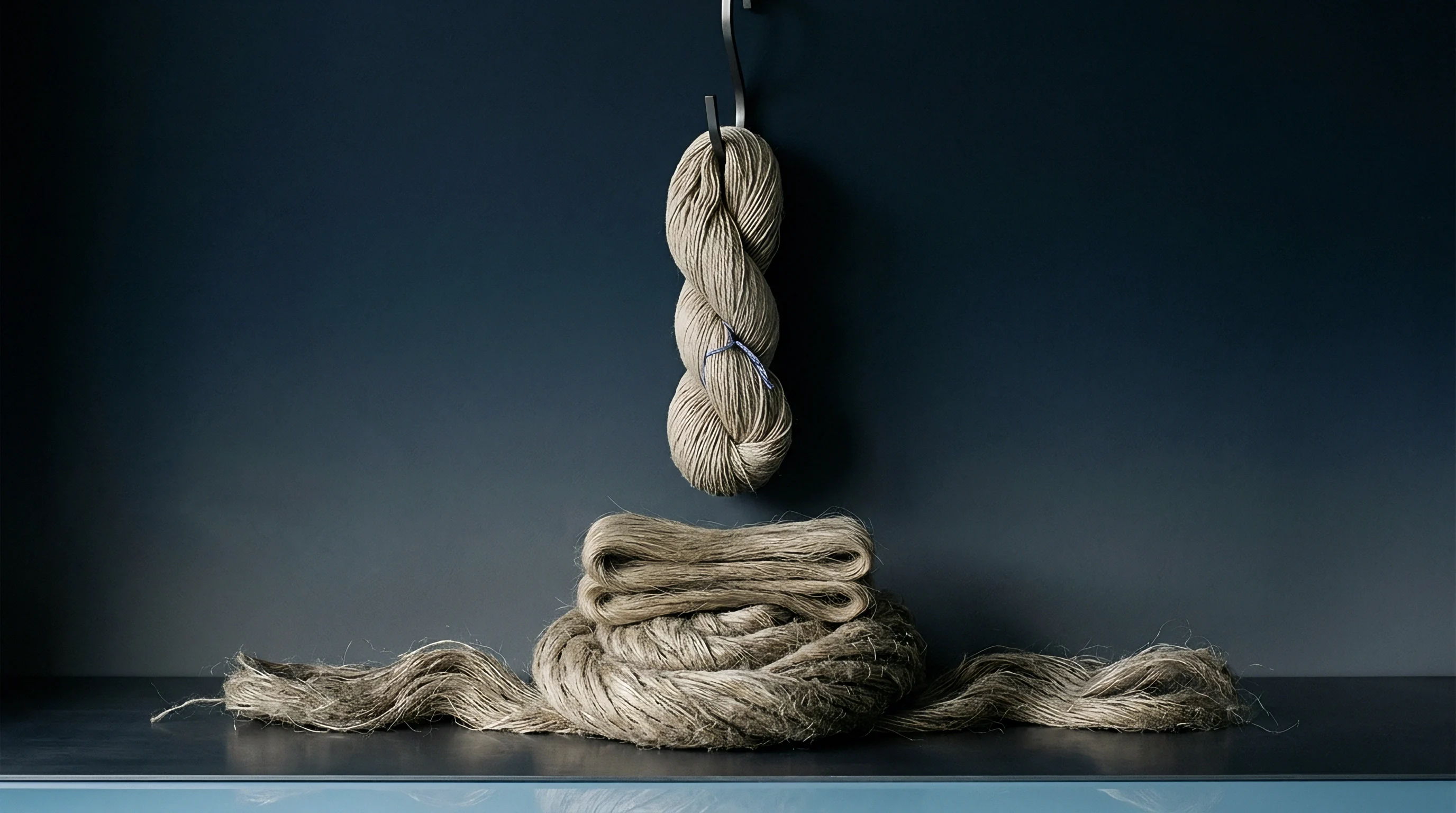
Decortication and turbine scutching inevitably cause micro-structural damage inside long staple flax fibres. Under microscopic inspection, these defects ~ cell wall dislocations, kink bands, and longitudinal slip planes ~ reduce ultimate bundle tenacity. Macro evaluations focus on percentage yield loss, but microscopic analysis shows how turbine impact creates permanent damage zones that drag down yarn strength during spinning.
Cell wall dislocations form when transverse impacts bend elementary fibres past their elastic limit. Under polarized light, they show up as bright bands across the crystalline cellulose. Microfibrils flex and separate at these points, leaving voids in the secondary cell wall matrix.
Under spinning tension, stress concentrates at these kink bands, causing bundles to break well below their expected strength.
Heavy beating causes longitudinal splitting along the middle lamella, breaking bundles into coarse, irregular fragments with jagged ends. Unlike the controlled bundle division achieved in wet hackling, scutching fissures break bonds unevenly, exposing raw cellulose to oxidation and moisture shifts. Fibres with heavy longitudinal splitting lose flexural stiffness and wear down faster during processing.

Which Structural Defects Originate during Mechanical Beating?
Distinguishing field growth damage from machinery-induced defects requires detailed microscopic classification. Growth defects ~ like kink bands caused by wind bending live plants ~ show smooth cell wall transitions. Machine fissures show sharp, jagged dislocation edges, broken crystalline cellulose structures, and cracked primary membranes under an electron microscope.
Fissure frequency tracks directly with straw moisture during processing. Below 8 percent moisture, cell wall polymers harden, preventing microfibrils from sliding smoothly as the stem bends. Striking dry straw at 15 meters per second creates up to three times more kink bands per millimeter than decorticating straw conditioned to 12 percent moisture.
Keeping moisture within tight limits before beating is critical.
Micro-cracks in the outer primary cell wall reduce resistance to chemical treatments during bleaching and dyeing. Chemicals soak rapidly into these voids, causing local swelling that degrades inter-elementary bonds. Uneven absorption at defect sites leads to patchy dye uptake, causing visible streaks in finished fabric.
Optimizing scutching mechanics preserves the uniform surface needed for even dyeing.
- Transverse Kink Bands form across cell walls when breaker rolls over-bend dry flax stems.
- Longitudinal Shear Splits fracture inter-elementary pectin layers under excessive turbine blade impact.
- Primary Membrane Cracks expose inner cellulose microfibrils to moisture swings and process chemicals.
- Compressive Microbuckling Zones develop along the inner curves of bent strands during high-velocity movement through transport chutes.
Quantifying structural damage takes micro-tensile testing paired with high-resolution optical imaging. Pulling individual elementary fibres from scutched bundles yields stepped stress-strain curves, where sudden strain jumps mark microfibrils failing at dislocation sites. Lots with high fissure counts show erratic elongation and lower work-to-break values, making them unfit for fine, high-tenacity yarns.
Tracking tenacity loss across hackling by counting dislocations per centimeter under cross-polarized light reveals a direct link between turbine drum speed and defect accumulation. Controlling contact geometry inside the scutcher preserves bundle structure, ensuring better strength transfer from raw fibre to finished yarn.
Whether steam conditioning prior to spinning can partially heal micro-structural kink bands remains an open question in processing research.

Tow
Scutcher loss is the mass fraction of flax straw turned into non-long-staple byproduct during decortication. It splits into two main streams: scutcher tow (short, tangled, or broken bast fibres) and shives (the fragmented woody core). Scutching profitability hinges on maximizing long fibre yield (teille) while keeping tow and dust to a minimum.
Yield calculations follow mass balance from raw, dew-retted straw through processing. A typical European crop yields 20 to 26 percent long staple fibre, 10 to 15 percent scutcher tow, 45 to 50 percent shives, and 10 to 12 percent moisture loss and fine dust. Shifts in retting uniformity, crop density, or stem thickness move these numbers significantly, impacting mill margins.
| Processing Output Stream | Mass Fraction (%) | Mean Fibre Length (mm) | Residual Shive Content (%) | Commercial Value relative to Long Flax (%) |
|---|---|---|---|---|
| Long Staple Flax (Teille) | 22.5 | 650 – 900 | 0.8 – 1.5 | 100.0 |
| First-Pass Scutcher Tow | 8.0 | 100 – 250 | 4.5 – 6.0 | 28.0 |
| Second-Pass Scutcher Tow | 5.5 | 50 – 150 | 8.0 – 12.0 | 18.0 |
| Coarse Shives (Anthonis) | 48.0 | 2 – 15 | 98.5 (Woody) | 4.5 |
| Dust & Fine Reject | 16.0 | < 2 | N/A | 0.0 |
Tow quality dictates its commercial destination. Clean first-pass tow undergoes shaking and carding to produce combed tow for coarse dry-spun yarns, paper, or non-woven textiles. Second-pass tow carries high shive levels and short fragments, selling at much lower prices.
Fine-tuning turbine settings keeps high-grade long flax from slipping into low-value tow.
Verifying mass balance requires matching input bale weights against output rolls and waste hoppers. Plants use automated weighbridges at intake linked to load cells under tow balers and shive silos. Gaps between input and output reveal unmeasured moisture loss, dust build-up, or short fibres bleeding into shive streams.
Auditing a decortication line requires a structured procedure to isolate mechanical loss sources across key machine zones.
- Weigh incoming dew-retted straw bales on the intake conveyor after checking moisture at five depth points with calibrated probes.
- Sample broken straw leaving the breaker rolls to check shive detachment before straw enters the turbine.
- Catch long flax output at the main belt for ten minutes, recording clean long fibre weight and shive content.
- Collect first- and second-pass tow from lower grids, weighing total yield during the test window.
- Divert shive chutes into test containers to calculate total shive weight and screen for fine fibre carryover.
- Reconcile output mass against initial bale weight to calculate net scutcher loss and moisture evaporation.
On Normandy scutcher lines running turbine drum speeds above 1500 RPM, a 4.2 percent rise in scutcher tow generation shifted 180 metric tons of potential long flax into short-fibre pricing tiers across a single processing season.
Excess storage moisture leads to mold growth, which weakens bast bundle bonds. Mold-damaged straw shatters on contact with breaker rolls, cutting long fibre yield by up to 6 percent while doubling dust reject volumes. Controlling storage climate protects yield before mechanical processing even starts.
Shive removal directly affects market value. Residual shive above 2.0 percent forces spinning mills to run extra cleaning passes during hackling, raising fibre waste and labor costs. Modern plants use multi-stage air shakers and optical sorters beneath grid bars to clean strands without adding mechanical stress.
Fibre breakage spikes when stem diameters vary widely in the same lot. Thicker stems require wider roll gaps, which leaves thinner stems under-broken and liable to snag inside turbine drums. Sorting straw by diameter before decortication reduces total loss by keeping mechanical resistance uniform across the breaker line.
Systematic monitoring of input straw moisture prevents mechanical fibre shattering inside turbine decortication chambers.
A 40-ton shipment of long staple flax was re-classified as coarse tow after independent lab audits discovered unrecorded mechanical fiber crushing throughout the lot, causing severe commercial loss.
Docket
Traceability in long staple flax depends on an unbroken chain of documentation connecting field, scutcher, and mill. Because physical testing alone cannot confirm geographic origin, certification schemes like European Flax and Masters of Linen require transaction records at every step. Scutchers mark the point where raw agricultural straw becomes traded commodity fibre, making batch dockets the primary proof of origin.
A certified docket must record key identifiers: crop year, plant facility code, field parcel numbers, net bale weight, baling moisture, and mean bundle tenacity. This paperwork travels with the physical shipment to the mill or warehouse. Any mismatch between docket numbers and bale tags breaks the chain of custody, stripping origin premiums from the lot.
European Flax certification guarantees origin within Western Europe ~ specifically France, Belgium, and the Netherlands. Maintaining it requires strict physical segregation. Plants must run certified European straw on separate schedules from non-certified material, doing full clean-downs of breaker rolls, turbine chambers, and baling presses between runs.
Auditors match incoming straw weights against certified output to confirm mass balance.
Masters of Linen sets a higher bar, requiring every step from harvest through scutching, spinning, and weaving to occur within Europe. Chinese spinning mills purchasing European long flax cannot claim Masters of Linen status on their yarn, even if the raw bales hold European Flax certificates. Passing off raw European Flax certification as Masters of Linen yarn status is a frequent compliance violation in trade.
Audits at Chinese processing plants require matching import dockets, bills of lading, customs papers, and physical bale tags. Mills buying certified European flax must run dedicated spinning lines and use isolated storage bays to avoid mixing certified stock with non-certified short fibres or domestic flax. Any breakdown in physical segregation during transport or storage voids origin certification.
Audit dockets must list essential technical and provenance variables to survive regulatory compliance cross-checks.
- Unique Scutcher Batch Serial Number linking physical bale tags to plant processing logs and harvest field records.
- Net Certified Bale Weight recorded post-baling alongside moisture meter calibration logs verified under ISO 17025.
- Certified Chain of Custody Scope Number confirming active certification status for the facility on the processing date.
- Independent Laboratory Tensile Certificate listing mean bundle tenacity, test gauge length, and relative humidity test conditions for the lot.
- Customs Harmonized System Declaration confirming non-preferential origin status under regional import frameworks.
Audit logs document mass shifts, balance checks highlight missing volumes, and certificate scopes define financial recovery limits.
Third-party transaction certificates validate ownership transfers between entities, listing buyer, seller, gross and net mass, certified mass fraction, and specific lot numbers. Buyers verifying origin should match certificate issue dates against bills of lading; certificates issued after shipment without prior audit approval suggest a breakdown in custody protocols.
Verifying origin docs requires cross-referencing weighbridge tickets, internal batch cards, and plant electricity records to confirm the scutching line actually ran during declared production windows. Mill management software logs run times for every lot, comparing machine metrics against output volumes to flag fake dockets.
Standard contracts for high-grade flax include strict origin and parameter clauses, specifying price adjustments whenever delivered lots fail audit checks.
Under Standard Trade Provision European Flax Protocol Clause 14.2, any lot missing valid transaction certificates that match physical bale serial numbers within 15 days of port discharge loses certification. This triggers an immediate 18 percent invoice discount and shifts all re-inspection costs to the seller.
Parity
Valuing long staple flax relies on a price parity framework balancing tensile tenacity, scutching yield, and expected hackling losses. Base pricing assumes medium-grade fibre at 50 cN/tex bundle tenacity with under 1.5 percent residual shive. Superior lots command steep premiums per kilogram, while sub-standard lots take heavy discounts based on projected waste during hackling.
Hackling loss measures the secondary conversion of long fibres to short tow at the spinning mill. As bundles pass through increasingly fine pin combs, they split, align, and drop short fibres. Higher intrinsic tenacity keeps bundles intact, raising long-fibre yield.
Buyers evaluate raw fibre by balancing estimated hackled yield against total landed cost.
| Tenacity Grade Category | Mean Tenacity Range (cN/tex) | Base Price Surcharge / Discount (%) | Anticipated Hackling Long Fibre Yield (%) | Spinning Mill Landed Cost (EUR/kg) | Fine Yarn Count Suitability (Nm) |
|---|---|---|---|---|---|
| Extra Premium Long Flax | > 60.0 | + 22.0 | 78.5 | 6.10 | Nm 60 – Nm 100 |
| Standard Premium Long Flax | 52.0 – 59.9 | + 8.5 | 72.0 | 5.425 | Nm 39 – Nm 59 |
| Baseline Grade Long Flax | 45.0 – 51.9 | 0.0 (Base) | 65.0 | 5.00 | Nm 26 – Nm 38 |
| Sub-Standard Long Flax | 38.0 – 44.9 | – 14.0 | 54.0 | 4.30 | Nm 14 – Nm 25 |
| Degraded / Over-Retted Flax | < 38.0 | – 32.0 | 41.0 | 3.40 | Coarse Tow Blends Only |
Landed cost formulas in commercial contracts account for ocean freight, tariffs, customs fees, and certification surcharges. Importing European flax into China adds shipping fees, port handling, and VAT adjustments. Certified European Flax commands a premium of 0.25 to 0.45 EUR per kilogram over non-certified fiber of identical mechanical grade, reflecting audit costs and demand for proven origin.
Chinese mills use yield models to determine whether high-tenacity European flax justifies its landed premium over cheaper regional options. High-tenacity fibre handles faster draft speeds and lower twist factors during ring spinning, boosting frame throughput by up to 15 percent. Higher output per spindle hour offsets initial raw material costs, making premium European flax economical for fine-count yarns.
Disputes over valuation usually stem from testing discrepancies between loading ports and receiving mills. If origin certificates report 55 cN/tex bundle tenacity at a 3.2 millimeter gauge, but mill re-testing yields 44 cN/tex because samples were tested dry, buyers issue formal debit notes. Contracts settle these claims through independent re-testing by accredited neutral labs operating under ISO 17025 climate controls.
Tow pricing alters scutching strategies. When global demand for coarse tow drops, operators adjust machine settings to preserve long flax length, accepting higher residual shive levels. Conversely, when strong demand for technical non-wovens drives tow prices up, plants increase drum speeds to boost throughput, taking the higher scutching loss because tow revenue offsets the yield drop in long fibre.
Evaluating batch tickets against moisture readings and weighbridge dockets shows why landed cost models must recalculate purchase price against dry weight content. Buying raw bales at 14 percent moisture under standard pricing means paying fibre rates for excess water. Commercial contracts require invoice adjustments for any moisture content deviating from the 12 percent commercial regain baseline.
Managing financial risk in linen procurement relies on tying payment releases to quality clearance at destination. Standard letters of credit require clean bills of lading, accredited lab tensile certificates, and European Flax transaction dockets before banks will release funds. Combining physical tensile testing with verified chain-of-custody docs protects capital across global supply chains.