European Union Customs Code Bast Fiber Classification Baseline Rules
EU Customs Code classifies bast fibers under Chapter 53 based on mechanical scutching, chemical degumming depth, fiber bundle separation, and staple length.


Decortication

Classification Parameters under Harmonized System Chapter 53
The Common Customs Tariff assigns raw and processed bast fibers to four-digit headings in Chapter 53 based on the mechanical and structural state of the plant material. Fibers that have only been field-, dew-, or water-retted are classified separately from those that have gone through scutching, hackling, or cottonization. Under Article 57 of Regulation (EU) No 952/2013 (the Union Customs Code), imports into EU entry points follow the Combined Nomenclature.
For flax under heading 5301, classification hinges on the mechanical division between unretted or retted straw and broken, scutched, hackled, or processed tow and waste.
The specific processing state dictates applicable duty rates for each consignment.
Heading 5301 covers flax, raw or processed but unspun, along with flax tow and waste. Heading 5302 covers true hemp, Cannabis sativa L., in raw or processed unspun form, including tow and waste, provided its provenance is established. Importers claiming tariff line 5301 10 00 for raw or retted flax straw must show that no mechanical scutching has separated the woody shives from the bast fiber bundles.
Once mechanical beaters strike the stems to strip off the epidermis and xylem, the fiber moves to heading 5301 21 00 for scutched flax or 5301 29 00 for hackled or processed flax fibers.
Scutched flax enters duty free under Autonomous Common Customs Tariff provisions when fiber bundles remain parallel and uncarded.
The line between scutched bast fiber and combed or hackled fiber depends on bundle orientation and parallelization. Scutched flax consists of long fiber bundles released after woody shives are knocked free during turbine scutching. Hackled flax undergoes continuous linear combing, which aligns long fibers while separating short knots, residual shive fragments, and broken filaments into flax tow under subheading 5301 30 00.
When decortication units process dry hemp stalks or unretted flax through mechanical impact breakers without prior retting, the resulting unretted technical fiber retains elevated pectin concentrations and shive content above five percent by mass, altering physical handling during downstream spinning.
| Commodity Code | Botanical Source | Processing State Standard | Duty Rate Standard |
|---|---|---|---|
| 5301 10 00 | Linum usitatissimum | Flax, raw or retted, un-scutched stem straw | 0.0% Third Country |
| 5301 21 00 | Linum usitatissimum | Scutched flax fibers, long fiber bundles | 0.0% Third Country |
| 5301 29 00 | Linum usitatissimum | Hackled, combed, or finely divided flax fibers | 0.0% Third Country |
| 5301 30 00 | Linum usitatissimum | Flax tow and waste including yarn waste | 0.0% Third Country |
| 5302 10 00 | Cannabis sativa L. | True hemp, raw or retted stem straw | 0.0% Third Country |
| 5302 90 00 | Cannabis sativa L. | True hemp, scutched, hackled, tow, or waste | 0.0% Third Country |
Mechanical Separation Limits and Non-Textile Contaminants
Customs officials evaluate bast fiber shipments by measuring the proportion of residual epidermis, woody core fragments, and unseparated fiber bundles. When inspecting raw bast materials, officials verify whether the shipment consists of unretted straw, retted stalks, or scutching waste. Misclassifying scutching tow as long scutched fiber results in reclassification under residual subheading 5301 30 00.
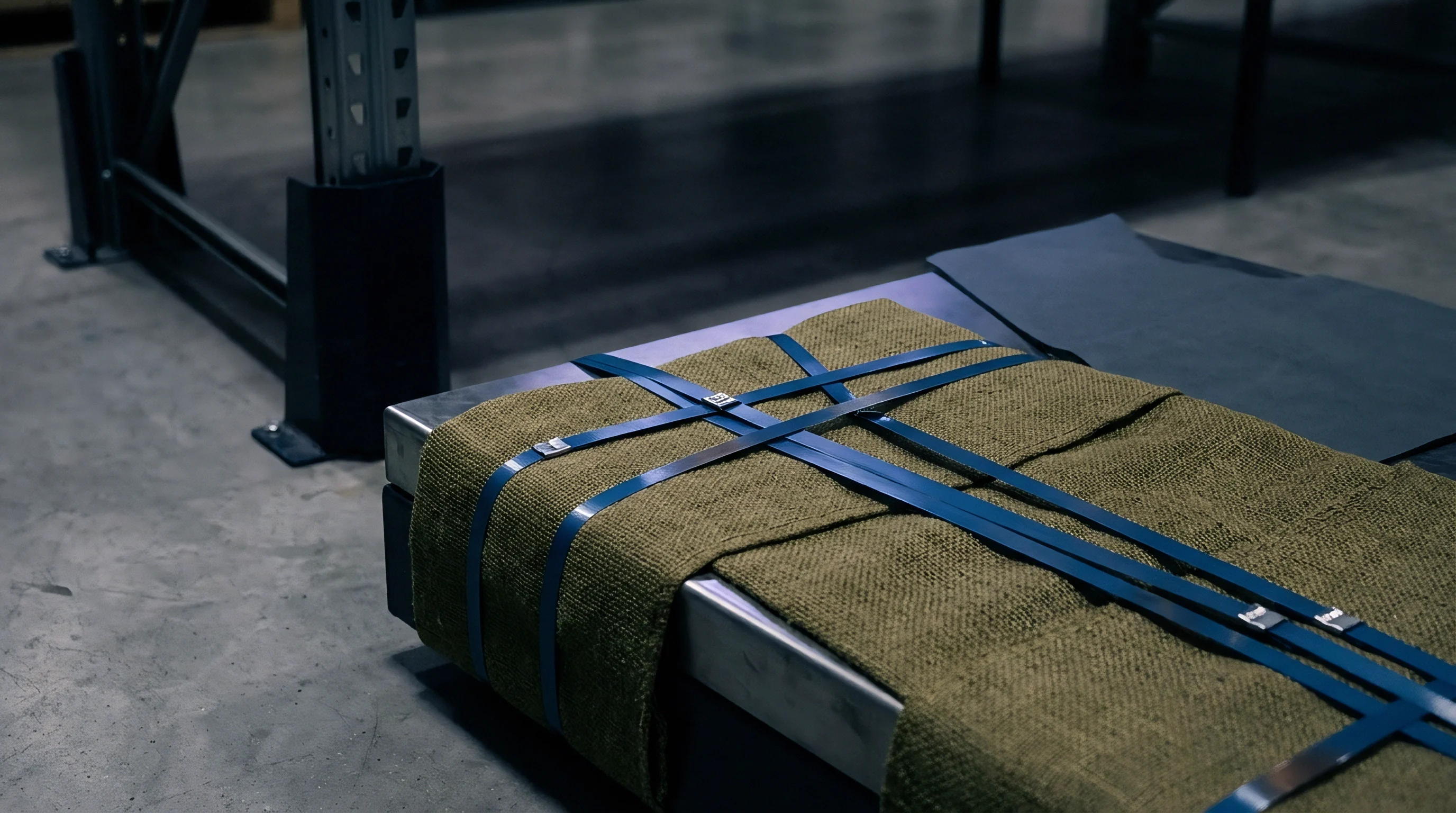
Non-vegetable binding cords, polypropylene bale straps, or synthetic wrap fragments alter physical sampling protocols without changing the baseline tariff position, though heavy synthetic debris requires mechanical cleaning before spinning.
Distinguishing between heading 5301 and heading 5302 comes down to botanical origin, verified through microscopic cross-sections and chemical testing. Note 1 to Chapter 53 specifies that bast fibers from plants other than flax, hemp, jute, or ramie fall under heading 5305. Mechanical processing state determines whether an entry stays in Chapter 53 or moves to processed textile waste under Chapter 63.
- Unretted Flax Straw consists of harvested stems containing intact woody cores, pectin matrix, and unseparated outer epidermal layers.
- Retted Stem Straw exhibits microbial degradation of the outer pectin binder, permitting initial separation of fiber bundles from internal wood.
- Scutched Fiber Bundles have had woody shives removed by mechanical scutching wheels, yielding parallel bundles exceeding 500 millimeters in length.
- Hackled Long Line consists of combed fiber ribbons freed from short elements, containing less than one percent residual shive content by mass.
Incorrect declaration of mechanical processing stages leads to border delays, administrative penalties, and sampling audits that freeze shipments at container terminals for laboratory testing.


Cottonization
Chemical and Enzymatic Degumming Transformations
Chemical degumming alters the structure of bast fiber bundles by stripping away non-cellulosic matrix components. Native flax and true hemp fibers naturally exist as multicellular bundles held together by middle lamellae of pectin, hemicellulose, and lignin. Standard scutching and hackling leave these bundles intact, keeping fiber lengths between 300 and 900 millimeters.
Cottonization subjects long bast bundles to alkaline boiling, enzymatic digestion, or steam explosion to dissolve the intercellular pectin matrix. This breaks the bundles down into individual elementary fibers measuring 15 to 45 millimeters in length, matching the staple length profile of cotton.
Under the Combined Nomenclature explanatory notes for Chapter 53, cottonized bast fibers remain under heading 5301 or 5302 provided they have not been carded or combed. Once cottonized flax or hemp undergoes carding or combing to align the shortened elementary fibers for short-staple ring or open-end spinning, classification shifts to subheading 5301 29 00 or 5302 90 00. If cottonized fiber is blended with synthetic staple fibers prior to carding, classification rules under General Rules for the Interpretation of the Harmonized System (GIR) Rule 3 determine whether Chapter 53 or Chapter 55 applies.
Cottonized bast fibers retain their origin classification under Chapter 53 until mechanical carding or combing aligns them for short-staple spinning machines.
Chemical degumming does not transform flax into synthetic or regenerated cellulosic fiber for customs purposes, as it merely removes non-cellulosic binders without altering the natural crystalline structure of Cellulose I present in bast plants. Regenerated fibers such as viscose or modal undergo chemical dissolution and re-extrusion, forming Cellulose II structures governed under heading 5504 or 5507.
Staple Length Distribution and Fiber Morphology Changes
Aggressive cottonization modifies the linear density and mean length distribution of the raw fiber mass. Scutched long flax fiber displays a linear density between 1.5 and 4.0 tex per bundle, whereas individual cottonized flax filaments measure between 1.2 and 2.5 decitex. This reduction in bundle thickness allows processing on conventional cotton spinning equipment, bypassing the need for specialized wet-spinning flax machinery.
To determine whether an imported lot has crossed the threshold from partially degummed tow to fully cottonized fiber, customs laboratories test average fiber length, residual pectin content, and bundle cleavage. A worked example demonstrates the structural transition:
Consider a 20-tonne consignment declared as scutched hemp under heading 5302 90 00. Physical testing yields an average fiber length of 28 millimeters with a standard deviation of 4.2 millimeters, residual pectin below 0.8 percent by dry mass, and full dissociation of fiber bundles into single elementary cells. Structurally, the material behaves like short-staple cotton.
Because it has undergone chemical degumming and elementary separation without mechanical carding, it remains under subheading 5302 90 00. However, if customs authorities find that the lot passed through a flat carding engine to create a carded sliver, the product is classified as carded hemp fiber under 5302 90 00, altering origin determinations under preferential trade agreements.
In one mill handling report, processing was recorded as simple physical washing even though chemical degumming agents had been added to the vat.

Dissect

Customs Laboratory Analytical Protocols
EU customs laboratories follow testing protocols established by the Customs Code Committee and European standards organizations to resolve classification disputes. ISO 2076 and ISO 6938 set the standards for microscopic identification and quantitative chemical analysis. When a shipment arrives at port, officers extract samples in line with EN 12751, sampling across multiple bales within the container to prevent moisture or processing variations from distorting results.
Initial identification relies on optical microscopy under cross-polarized light. Flax fibers show characteristic transverse nodes, cross-markings, and narrow lumens. True hemp exhibits broader lumens, thicker cell walls, and blunt, swollen ends with occasional branching.
Ramie under heading 5305 displays large diameters from 40 to 80 micrometers with prominent longitudinal striations. To confirm botanical origin beyond visual observation, laboratories use Herzog-test birefringence analysis. Under polarized light, flax fibers exhibit positive twist under extinction, rotating extinction colors in a pattern that distinguishes flax from raw hemp and jute filaments.

Quantitative Fiber Content and Lignin Determination
Quantitative analysis of fiber blends containing bast fibers alongside synthetic or seed fibers uses selective dissolution defined in Regulation (EU) No 1007/2011. When bast fibers are mixed with cotton, polyester, or acrylic, samples are dried to constant mass at 105 degrees Celsius to establish an oven-dry baseline. Reagents then extract pectins, hemicelluloses, and lignins to isolate the pure cellulose fraction.
Quantitative chemical dissolution per Regulation EU 1007/2011 establishes baseline fiber ratios by measuring dry mass loss after selective matrix extraction.
Determining whether a sample represents raw, retted, or chemically modified bast material requires measuring non-cellulosic residue. Analysts run acid-insoluble lignin tests using a 72 percent sulfuric acid solution. Raw hemp stalks contain between 8 and 13 percent lignin by mass, retted and scutched flax contains 1.5 to 3.5 percent, and fully cottonized or thoroughly bleached bast fibers show lignin levels below 0.5 percent.
- Optical Microscopy verifies cellular wall thickness, cross-sectional geometry, transverse nodes, and lumen proportions.
- Polarized Light Birefringence establishes microfibrillar orientation angles to separate flax from hemp fibers.
- Chemical Dissolution removes non-bast matrix components using sodium hydroxide, formic acid, or zinc chloride solutions.
- Gravimetric Lignin Testing quantifies residual lignin content to determine the depth of chemical processing.

How Do Customs Laboratories Differentiate Hackled Flax from Cottonized Fibers?
Customs laboratories use cross-sectional electron microscopy and staple length distribution measurements to distinguish hackled long-line flax from cottonized bast material. Hackled flax retains cohesive bundle structures over 200 millimeters in length with distinct pectin-bonded cell networks. Cottonized fibers display individualized elementary filaments with average lengths between 20 and 38 millimeters, lacking the intercellular pectin matrix under gravimetric extraction analysis.
Coarse bast fibers processed on long-staple machinery maintain bundle cohesion, whereas cottonized fibers show complete elementary dissociation under cross-sectional analysis.

Docket

Chain of Custody and Document Verification
EU customs authorities require complete documentary trails to substantiate origin and classification declarations under the Union Customs Code. An importer cannot rely on a commercial invoice alone to prove that bast fibers meet the physical criteria of heading 5301 or 5302; paperwork must trace the material back through processing nodes to the farm gate or primary scutching facility to preserve eligibility for preferential rates.
The primary verification document for raw or scutched bast fiber is the scutcher delivery note, cross-referenced against weight tickets and phytosanitary certificates from the exporting country. For imports from third countries like China, India, or Ukraine, preferential origin claims require specific documentation, such as EUR.1 movement certificates or Registered Exporter System (REX) statements on origin. These documents must contain precise descriptions matching the physical state of the fiber rather than generic terms like raw fiber or textile raw material.
| Document Type | Issuing Entity | Traceability Target | Risk Point |
|---|---|---|---|
| Scutcher Delivery Note | Primary Processing Facility | Bale numbers and raw stalk mass ratios | Mismatch between stalk input and fiber yield |
| Phytosanitary Certificate | National Plant Health Authority | Botanical species identification | Generic family names obscuring restricted species |
| REX Origin Statement | Certified Exporter Mill | Transformation step compliance | Non-originating tow added to originating lots |
| BTI Ruling Copy | EU National Customs Authority | Ten-digit TARIC code binding approval | Expired validity or modified mechanical state |
| Mill Weighbridge Ticket | Licensed Logistics Depot | Net bale mass per lot number | Weight discrepancies from unverified moisture loss |

Binding Tariff Information Procedures
To eliminate classification risk before shipping, importers can apply for Binding Tariff Information (BTI) under Article 33 of Regulation (EU) No 952/2013. BTI decisions bind customs authorities across all EU member states for three years from issue. A BTI dossier requires technical documentation, physical fiber samples, mill process flow diagrams, and details of any chemical or mechanical treatments applied to the lot.
Assembling a BTI filing follows a set procedural sequence:
- Compile detailed processing flowcharts from the spinning or scutching mill detailing every mechanical, chemical, and enzymatic operation.
- Extract representative physical samples totaling 500 grams from multiple production batches, sealed in airtight packaging with lot tags attached.
- Obtain certified laboratory test results confirming fiber linear density, mean staple length, moisture content, and residual lignin percentages.
- Draft the BTI application within the EU Customs Trader Portal, attaching technical datasheets, mill process disclosures, and proposed TARIC ten-digit codes.
- Submit physical samples to the designated national customs laboratory for testing against official Combined Nomenclature rules.
- Review issued BTI decision details, ensuring all process boundaries and fiber attributes match operational mill conditions exactly.
If the seller fails to provide mill transformation records tracing back to the primary scutching lot for each consignment, the buyer retains the right to withhold customs clearance authorization.

Remittance

Duties, Preferential Rules, and Tariff Discrepancies
Financial liabilities under the Union Customs Code depend directly on four-digit and eight-digit tariff classification. While most raw and simply processed bast fibers under headings 5301 and 5302 enter the EU at zero percent autonomous third-country duty, downstream processed items, yarn, and woven fabrics carry tariffs between 2.0 percent and 12.0 percent. Misclassifying carded or combed flax yarn as raw flax fiber triggers retroactive duty recovery, interest penalties under national customs codes, and administrative fines calculated on duty-paid landed cost.
Under non-preferential origin rules in Article 60 of the UCC, bast fiber originates in the country where it underwent its last substantial, economically justified processing. Simple cleaning, baling, or dust extraction does not confer origin; retting combined with scutching converts raw stem straw into originating fiber under standard processing criteria. When fiber moves through multiple non-EU processing steps before import, documented proof of value-added transformations determines whether preferential trade agreements apply.
| Target Tariff Code | Input Material Code | Mandated Processing Step | Non-Originating Content Cap |
|---|---|---|---|
| 5301 21 00 (Scutched Flax) | 5301 10 00 (Raw Straw) | Complete field retting and mechanical scutching | 0% non-originating straw allowed |
| 5306 10 10 (Flax Yarn) | 5301 21 00 / 5301 29 00 | Wet or dry spinning from long or short fiber | 10% maximum non-originating fiber blend |
| 5309 11 10 (Unbleached Linen) | 5306 10 00 (Flax Yarn) | Weaving from single or multiple plied yarns | Must be woven from originating yarn |
| 5302 90 00 (Hackled Hemp) | 5302 10 00 (Raw Hemp) | Decortication, degumming, and hackling | 0% non-originating raw hemp allowed |

Duty Calculations and Financial Consequences of Reclassification
Evaluating financial exposure on a large bast fiber import requires testing sensitivity against potential customs reclassification. Consider a 100-tonne shipment declared as raw scutched hemp under tariff line 5302 90 00 at zero percent third-country duty. With an invoice value of 3.20 Euros per kilogram, the customs valuation at the port of entry totals 320,000 Euros.
If a customs audit determines that the shipment actually consists of spun single hemp yarn under tariff heading 5307 10 00, the duty rate rises from zero percent to 4.0 percent, adding 12,800 Euros in duty. If authorities find gross negligence, administrative penalties between 100 percent and 300 percent of the evaded duty apply under national law, along with interest charges from the date of release. Reclassification also invalidates preferential claims under Pan-Euro-Mediterranean (PEM) cumulation rules if records fail to prove spinning took place inside a qualifying partner state, exposing the buyer to full third-country duty across downstream product lines.
Duties and administrative penalties compound rapidly when custom reclassification forces raw fiber entries into processed yarn or fabric tariff lines.
Customs authorities conduct post-clearance audits up to three years after container release, examining mill inventory books, yield ratios, and entry documents to verify that imported bast lots matched their declared physical form.