Calculating Hackled Flax Linear Density under Standard Moisture Regain Baseline
Standard hackled flax linear density multiplies bone-dry sliver mass by 1.12 to enforce the twelve percent statutory moisture regain baseline per meter.


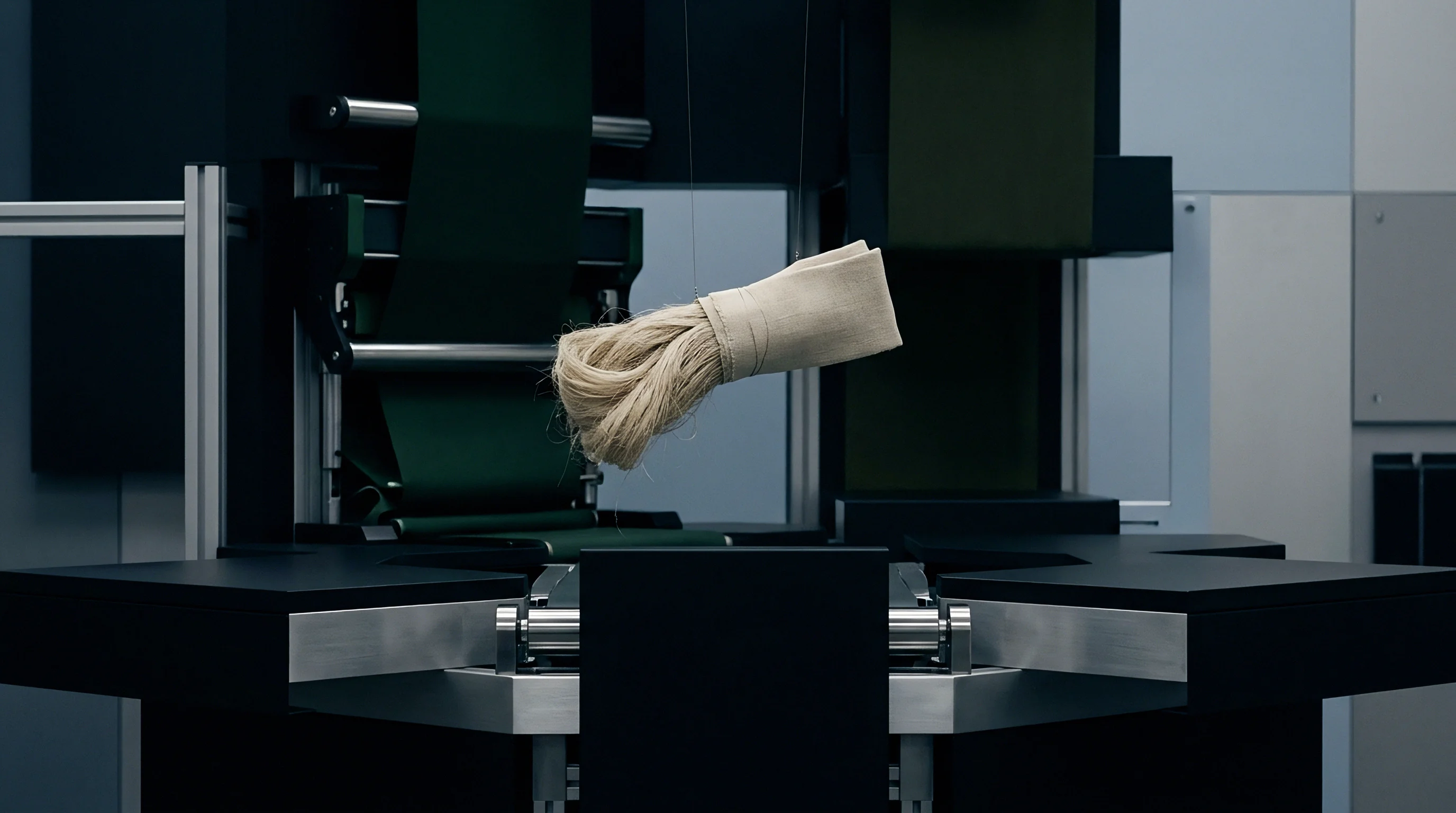
Skein
Sampling incoming hackled flax begins at the sliver drawhead or within the conditioned inspection room. Consignments of hackled line flax sliver arrive in coiled cans or compressed bumps with uneven moisture loads picked up during ocean transit or dock storage. Evaluating linear density directly from ambient baled fibre without correcting for this dampness means the measured tex reflects environmental moisture rather than actual cellulosic substance.
An auditor takes ten test lengths across five separate cans per delivery lot, discarding crushed edges where handling friction has fractured the parallel fiber alignment.

Rotary Drum Preparation and Cut Lengths
A precision reel extracts fifty meters of continuous sliver directly from production cans. The reel operates with a perimeter circumference of exactly one meter, governed by a mechanical revolution counter and a friction-brake creel maintaining uniform winding tension at five centinewtons per kilotex. Excessive winding drag attenuates hackled line slivers by pulling parallel bundles past one another, skewing the cut length.
Conversely, slack tension allows sagging loops that lead to underestimating length and falsely inflating linear density.
A conditioned fifty-meter sliver weighing five hundred grams at ten percent moisture regain contains exactly four hundred fifty-four point five grams of bone-dry flax.
Once fifty meters of hackled sliver leave the reel, an operator cuts the sample along the reel bar groove using a hardened razor blade. Dull blades pull staple ends unevenly, leaving ragged tufts that can forfeit up to two grams per cut. Operators transfer each specimen immediately into an airtight container to prevent moisture exchange with mill air prior to the initial weighing.

Sliver Cohesion across the Balance
Uncombed fibre stricks shed loose material during transfer between racks, so operators move specimens directly onto an analytical balance resolving to one milligram. This initial weight, designated as wet or original mass, forms the uncorrected baseline for subsequent calculations.
- Creel Drag Variance introduces false elongation into the measured length when tension brakes exceed calibrated thresholds.
- Edge Cleavage Loss drops unaligned fibre fragments during extraction from the reel, reducing measured linear density.
- Can Surface Condensation saturates outer sliver coils, generating anomalous moisture spikes in the initial five meters of drawn material.
- Static Dispersion forces ungrounded bast filaments apart, complicating transfer into weighing vessels and scattering bundle tips.
Handling delicate hackled bundles demands rapid, steady manipulation to prevent atmospheric exchange before weighing.

Oven
Thermal extraction removes free moisture from the cellulosic structure through forced convection at regulated temperatures. Bast fibers hold water both on peripheral capillary surfaces and within hydrophilic amorphous zones between crystalline cellulose microfibrils. Direct drying drives off this moisture while keeping structural cellulose and hemicellulose chains intact.

Thermal Desorption Parameters and Cycle Times
Drying chambers run at one hundred and five degrees Celsius under active air displacement, circulating heated air through open wire mesh baskets containing the test specimens. To weigh without exposing hot samples to room drafts, an analytical balance is mounted directly above the oven, connected to sealed tare canisters below via an insulated suspension wire.
Cellulosic bast fibres absorb water vapor into amorphous cell regions until vapor pressure matches ambient atmosphere.
- Preheat the drying chamber to one hundred and five degrees Celsius with active airflow stabilization.
- Weigh the empty perforated canister to establish container tare on the integrated top-pan balance.
- Deposit the hackled flax specimen into the basket, spreading bundled strands evenly to avoid dense thermal clumps.
- Dry the specimen for sixty minutes, initiating ventilation cycles to purge saturated air from the chamber.
- Record specimen mass at fifteen-minute intervals until the difference between successive weighings drops below zero point zero five percent.

Pectic Mass Loss during Sustained Exposure
Temperatures exceeding one hundred and ten degrees evaporate intercellular waxes and volatile fractions. Overheating initiates thermal degradation of middle lamella pectins, liberating carbonaceous gases and artificially inflating calculated moisture loss. Holding drying temperatures strictly at one hundred and five degrees ensures the recorded loss reflects only moisture desorption, isolating the true bone-dry mass of the hackled flax.
Clause 6.3 of ISO 6741-2 establishes the drying termination point at identical consecutive weights spaced fifteen minutes apart, removing subjective judgment from end-point determination.

Allowance
International trade agreements establish a fixed moisture regain percentage to standardize settlement weights across borders. Because flax changes mass continuously with ambient relative humidity, trading bast fibre on raw scale weight invites constant disputes. The commercial moisture regain baseline is twelve percent ~ a contractually codified allowance added back to bone-dry mass to establish invoicing weight.

Does Ambient Humidity Distort Commercial Mass Settlement?
Equilibrium moisture content inside conditioned testing rooms stabilizes between nine and ten percent under standard atmospheric conditions. ISO 139 defines this atmosphere as twenty degrees Celsius and sixty-five percent relative humidity. Raw hackled flax conditioned here naturally adsorbs around ten percent water ~ with desorption curves consistently exceeding adsorption values.
Because natural equilibrium sits two percentage points below the twelve percent commercial baseline, a consignment weighed in a standard testing atmosphere appears underweight unless adjusted mathematically.
ISO 6741-1 establishes the commercial moisture regain baseline for hackled flax at twelve percent, converting bone-dry weight into billable trade mass.
| Fibre Classification | Commercial Regain Baseline (%) | Standard Equilibrium Regain At 65% RH (%) | Commercial Correction Factor Multiplier |
|---|---|---|---|
| Hackled Line Flax (Combed Sliver) | 12.00 | 9.80 to 10.50 | 1.1200 |
| Scutched Flax Tow | 12.50 | 10.20 to 11.00 | 1.1250 |
| Wet-Spun Pure Linen Yarn | 12.00 | 10.00 to 10.80 | 1.1200 |
| Bleached Linen Yarn | 10.00 | 8.50 to 9.20 | 1.1000 |
| Raw Seed Cotton (Comparison) | 8.50 | 7.00 to 8.00 | 1.0850 |
Contract Baselines across Global Bast Conventions
Trade conventions distinguish raw scutched stricks from processed combed slivers through mandated moisture allowances. Under European contracts governed by CELC regulations, pure hackled flax line sliver carries a twelve point zero zero percent allowance. Tow is assigned twelve point five zero percent because residual shive and cortical bark fragments retain additional water.
For blended slivers combining flax with synthetic fibers, mills calculate a weighted composite regain factor proportional to clean dry fiber mass ratios.
Whether chemical degumming alters the hygroscopic capacity of hackled bast bundles sufficiently to demand a revision of the statutory twelve percent standard regain remains contested across European and Asian spinning rings.

Correction
Translating bone-dry laboratory mass into normalized linear density governs machine settings throughout the preparation floor. Linear density expresses specimen mass per unit length, designated as kilotex for slivers, tex for rovings, and metric count or lea for finished yarns. Calculating linear density without correcting for moisture regain skews drafting calculations across every subsequent passage.

Direct Conversion Formulae for Hackled Slivers
Calculating standard linear density links oven-dry mass directly to commercial regain factors. Let original laboratory mass equal m_a in grams, measured length equal L in meters, and bone-dry mass equal m_0 in grams. The actual moisture regain R_a of the tested sample appears through formula:
R_a = ((m_a – m_0) / m_0) 100
The standard commercial regain R_s for hackled line flax sliver is twelve point zero percent. The commercial corrected mass m_s reflects bone-dry mass expanded by the statutory twelve percent allowance:
m_s = m_0 (1 + (R_s / 100)) = m_0 1.1200
Linear density at standard commercial moisture regain, expressed in kilotex (grams per meter), resolves as:
Linear Density (ktex) = m_s / L = (m_0 1.1200) / L
When working from original conditioned mass without complete oven desiccation, operators determine linear density through the direct regain ratio factor:
Linear Density (ktex) = (m_a / L) ((100 + R_s) / (100 + R_a)) = (m_a / L) (112.00 / (100 + R_a))

Do Residual Pectins Suppress Apparent Metric Count?
Non-cellulosic incrustations alter the apparent density of hackled line bundles without contributing to tensile strength. In metric count calculations, where count equals length in meters divided by mass in grams, excess moisture suppresses the apparent metric count. The uncorrected sliver appears heavier and coarser than its true cellulosic substance warrants, which sets off draft miscalculations that cause end breaks during spinning.
| Measured Regain (%) | As-Tested Mass Per 50m (g) | Bone-Dry Mass Per 50m (g) | Standard Mass At 12% Regain (g) | Corrected Linear Density (ktex) | Apparent Uncorrected Linear Density (ktex) |
|---|---|---|---|---|---|
| 8.00 | 482.14 | 446.43 | 500.00 | 10.00 | 9.64 |
| 9.50 | 488.84 | 446.43 | 500.00 | 10.00 | 9.78 |
| 11.00 | 495.54 | 446.43 | 500.00 | 10.00 | 9.91 |
| 12.00 | 500.00 | 446.43 | 500.00 | 10.00 | 10.00 |
| 13.50 | 506.70 | 446.43 | 500.00 | 10.00 | 10.13 |
| 15.00 | 513.39 | 446.43 | 500.00 | 10.00 | 10.27 |

Worked Sliver Calculation and Draft Settings
Assume a forty-kilogram lot of hackled line sliver delivered to the drawing frame. A laboratory technician reels a fifty-meter sample from can number four. The initial balance reads five hundred and twenty-eight grams.
Following oven desiccation at one hundred and five degrees Celsius to constant weight, the bone-dry mass registers four hundred and sixty-three point one six grams.
The actual moisture regain calculates as:
R_a = ((528.00 – 463.16) / 463.16) 100 = (64.84 / 463.16) 100 = 14.00%
The tested sliver carried fourteen percent moisture, exceeding commercial baseline by two full percentage points. Standard mass at twelve percent commercial regain calculates as:
m_s = 463.16 1.1200 = 518.74 grams
Corrected linear density over fifty meters calculates as:
Corrected ktex = 518.74 / 50.00 = 10.375 ktex
If the technician relied on uncorrected scale mass, linear density would register as five hundred twenty-eight divided by fifty, yielding ten point five six kilotex. Setting drawing frame draft wheels to an uncorrected ten point five six value over-drafts the genuine cellulosic core, delivering starving slivers into subsequent passages.
- Verify Ambient Moisture Regain by sampling sliver cans before fixing draft wheels on the initial drawing passage.
- Calculate True Kilotex using certified oven-dry mass multiplied by one point one two zero zero.
- Adjust Draft Gear Ratios to match the corrected bone-dry linear density baseline rather than scale balance weight.
- Recalibrate Wet Ring Frames whenever incoming delivery moisture shifts beyond zero point five percent from previous consignments.
Miscalculating linear density by even three percent shifts spinning draft ratios enough to double yarn breakage rates and sharply inflate roving waste on downstream frames.

Penalty
Financial settlement between spinning mills and fibre merchants hinges on mass discrepancies established at intake. Billed shipments accepted on raw scale weight without regain correction hand unearned margin to suppliers while leaving spinners to absorb both phantom fiber costs and processing yield losses.
Fibre purchased wet extracts a double toll in water invoices and spinning waste.

Discrepancy Settlements in Baled Consignments
Receiving docks record significant variances when ambient weather shifts moisture content during ocean transit. If a container holds twenty metric tons of hackled flax sliver invoiced at nine euros per kilogram, total invoice value stands at one hundred and eighty thousand euros. When laboratory desiccation reveals an actual moisture regain of fourteen point five percent against the twelve point zero percent statutory limit, the shipment contains excess water above contract allowances.
| Delivery Intake Condition | Actual Moisture Regain (%) | Commercial Billed Mass (kg) | True Contract Mass At 12% Regain (kg) | Excess Billed Water (kg) | Direct Invoice Loss (EUR) |
|---|---|---|---|---|---|
| Severe Ocean Dampness | 15.00 | 20,000 | 19,478 | 522 | 4,698 |
| Moderate Excess Moisture | 14.00 | 20,000 | 19,649 | 351 | 3,159 |
| Contract Standard Match | 12.00 | 20,000 | 20,000 | 0 | 0 |
| Dry Season Deficit | 10.00 | 20,000 | 20,364 | -364 | -3,276 |
| Calculations establish true contract mass through m_contract = m_delivered (112 / (100 + R_actual)). Negative values denote vendor under-billing. | |||||

Finished Cloth Margin and Linear Variance
Weaving specifications establish strict target areal weights in grams per square meter. When a mill drafts uncorrected wet slivers, the resulting wet-spun yarn loses water during winding and bleaching, dropping below nominal count. A nominal lea fifty yarn spun from overweight sliver thins out to lea fifty-two once dried on cones.
This undersized yarn fails fabric cover requirements and forces the weaver to insert additional picks per centimeter; adding three picks per centimeter in a plain weave slows loom output and raises conversion costs by zero point eighteen euros per finished meter.