Determining Pure Flax Content for HS Code Classification
HS classification for pure flax relies on gravimetric mass determination on a clean dry basis adjusted for statutory moisture regain allowances under ISO 1833.


Boundary
Harmonized System classification for pure flax fabrics under Chapter 53 hinges upon exact weight thresholds. Tariff heading 5309 governs woven fabrics of flax, split cleanly into two distinct subheadings based on fiber composition by weight. Subheading 5309.11 and 5309.19 cover fabrics containing 85 percent or more by weight of flax.
Subheading 5309.21 and 5309.29 cover fabrics containing less than 85 percent by weight of flax, mixed mainly or solely with cotton, synthetic fibers, or regenerated cellulose. Crossing the 85 percent line changes non-preferential origin treatment, baseline customs duty rates, and anti-dumping exposure across multiple import jurisdictions.
Customs authorities reject estimated ratios. Determining whether a woven shipment qualifies for the 85 percent threshold demands gravimetric mass determination on a clean dry basis, adjusted for official moisture regain allowances. A fabric specified commercially as pure linen can fail the technical standard if foreign fibers, sizing agents, finish chemistries, or residual non-cellulosic impurities depress the true flax yield below the 85.0 percent threshold during laboratory extraction.
Commercial specifications stating pure linen fail customs verification when unextracted sizing materials and chemical finishes inflate non-flax mass above tariff thresholds.

Harmonized System Chapter 53 Mass Thresholds
Customs auditors classify woven linen according to strict mass breakdowns specified in the Legal Notes to Section XI of the Harmonized System. Legal Note 2(A) states that goods classifiable in Chapters 50 to 55 containing two or more textile materials are classified as if consisting wholly of that one textile material which answers to the largest proportion by weight. Note 2(B) mandates that non-flax fibers are aggregated to evaluate composition thresholds.
When a fabric contains 83 percent flax, 10 percent cotton, and 7 percent viscose, the combined non-flax content equals 17 percent, which drops the product into the sub-85 percent category under Heading 5309.29.
| HS Code Subheading | Declared Flax Threshold | Permitted Fiber Additions | Customs Regain Standard | Duty Impact Risk |
|---|---|---|---|---|
| 5309.11 | 85.0 percent or greater | Unbleached or bleached yarn only | 12.0 percent official regain | Baseline rate applicable to unmixed linen |
| 5309.19 | 85.0 percent or greater | Dyed, printed, or yarn-dyed flax | 12.0 percent official regain | Subject to non-preferential origin verification |
| 5309.21 | Less than 85.0 percent | Cotton, synthetic, or cellulosic blends | 12.0 percent flax / 8.5 percent cotton | Reclassification to higher tariff schedules |
| 5309.29 | Less than 85.0 percent | Dyed or finished mixed fiber structures | Variant based on blend constituents | Triggers mixed-fiber import declarations |
Yarn count consistency across warp and weft directions influences total composition calculations. In high-density fabrics, selvedge construction using polyester or reinforced cotton binding yarns alters total roll weight. Customs testing labs dissect full-width fabric specimens, including selvedges, unless specific regional customs directives instruct the analyst to strip edge yarns prior to chemical dissolution.
Including synthetic selvedge threads in a lightweight open-weave linen canvas reduces the declared pure flax fraction by up to 1.8 percent, pushing an 86 percent baseline fabric below the statutory threshold.
A false declaration of 85 percent pure flax content exposed on import entry leads to administrative penalties, retroactive duty assessments going back five calendar years, and immediate physical hold mandates on all arriving containers from the named supplier.

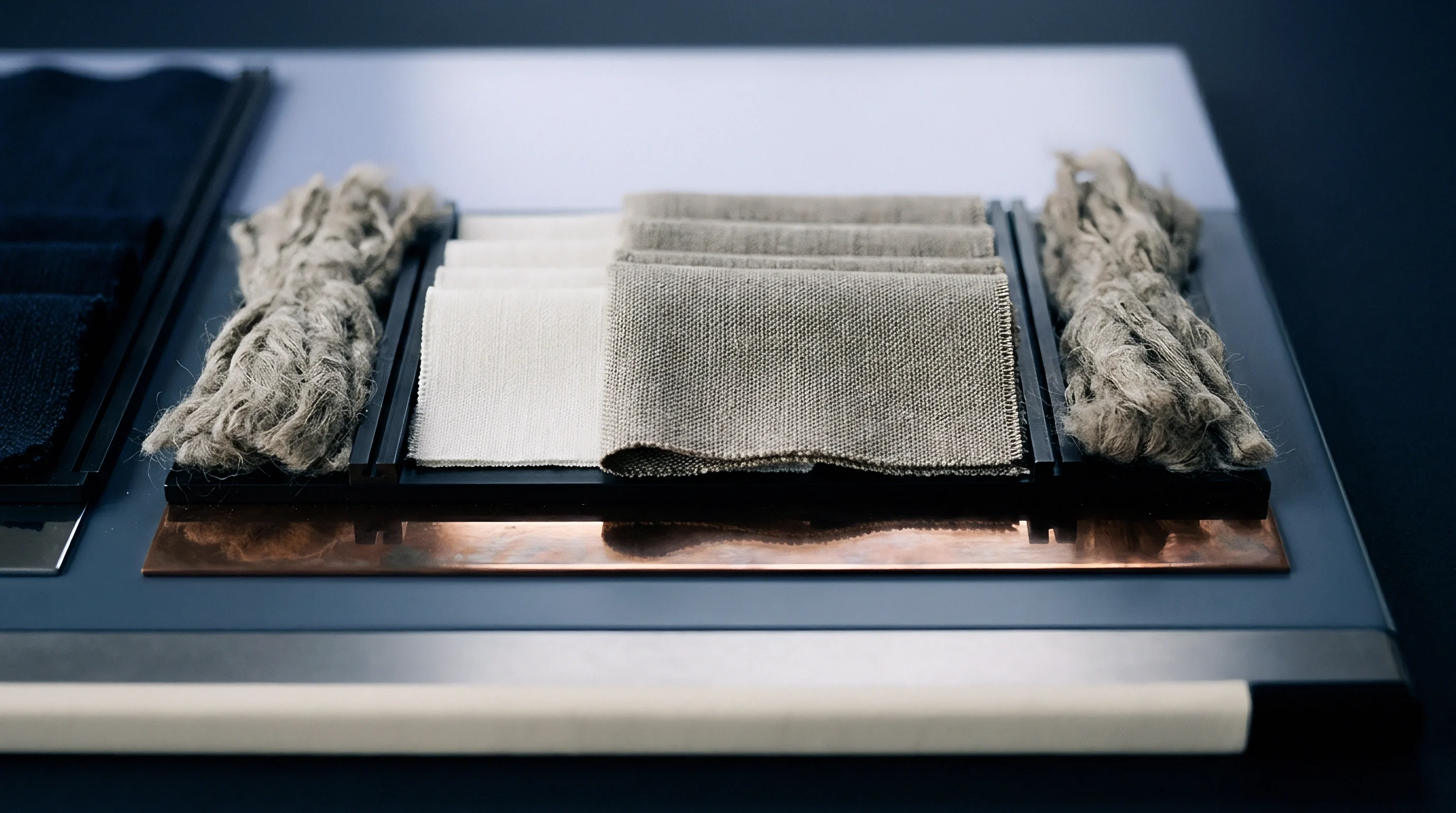
Fiber
Quantitative analysis of flax fiber content relies on international standard test methods, primarily ISO 1833 parts 1 and 11, alongside AATCC Test Method 20A. Flax consists predominantly of alpha-cellulose, ranging between 70 and 80 percent by mass, combined with hemicellulose, lignin, pectins, fats, and waxes. Identifying pure flax content inside a woven matrix requires separating organic non-cellulosic impurities from insoluble plant cellulose and isolating true bast fiber mass from other natural or synthetic polymers present in the yarn structure.
Purity claims demand laboratory proof. Solvent extraction begins with removing non-fibrous materials such as lubricants, starch sizes, water-soluble finishing resins, and surface coatings. Standard Soxhlet extraction using petroleum ether followed by hot water rinsing strips non-cellulosic additions.
Failing to conduct pre-treatment leads to false mass readings, as sizing agents and chemical softeners dissolve alongside target companion fibers or remain in the insoluble residue, artificial swelling the measured flax percentage.
Chemical Dissolution and Gravimetric Separation
ISO 1833-11 uses 75 percent sulfuric acid to separate binary mixtures of flax and certain synthetic or regenerated fibers. Viscose, cupro, and modal dissolve entirely in 75 percent sulfuric acid at room temperature, leaving pure flax cellulose as insoluble residue. When cotton mixes with flax, chemical dissolution becomes challenging due to their shared cellulosic chemistry.
Concentrated sulfuric acid, zinc chloride, and cupriethylenediamine dissolve both fibers simultaneously. Microscopic cross-section counting combined with chemical extraction becomes mandatory for precise quantification of cotton-flax blends.
- Petroleum Ether Pre-treatment removes surface waxes, spinning oils, and fatty substances through continuous reflux extraction over two hours, preventing hydrophobic residues from blocking solvent access during chemical dissolution.
- Enzymatic Starch Desizing uses alpha-amylase solutions at 60 degrees Celsius to hydrolyze starch-based warp sizes, which would otherwise report as insoluble organic matter during final gravimetric weighing.
- Sulfuric Acid Dissolution isolates cellulose bast fibers from polyester, acrylic, or polyolefin components by selectively dissolving non-target cellulosic polymers under temperature-controlled digestion bath parameters.
- Formic Acid Zinc Chloride Method separates polyamide fibers from pure flax by dissolving nylon variants while leaving the native flax bast bundle intact for filtering and drying.
Standard chemical dissolution testing without prior solvent extraction of finishing waxes causes up to 3.2 percent error in measured dry fiber mass.
Non-flax fibers alter chemical mass. When raw unscoured flax fibers enter testing, residual pectins and lignins resist mild acid dissolution, remaining in the dry crucible mass. This residual plant matter inflates the calculated flax percentage beyond the actual textile fiber portion.
Laboratories apply official correction factors (d-factors) to adjust for structural weight loss suffered by pure flax during chemical treatment. The standard d-factor for scoured and bleached flax in 75 percent sulfuric acid equals 1.02, accounting for a two percent mass reduction during solvent exposure.
Suppliers frequently claim that variations in laboratory test results stem entirely from natural agricultural growth differences across flax crops rather than inconsistent chemical processing or fiber blending errors on the spinning line.

Regain
Textile fibers absorb ambient moisture, changing their total measurable mass based on environmental relative humidity and ambient temperature. Customs determinations calculate flax content on an official commercial mass basis rather than actual landed weight. The clean dry mass of the extracted flax fiber is adjusted by adding the official moisture regain allowance established by international customs agreements and regional trade regulations.
EU Regulation 1007/2011 Annex IX and US Federal Trade Commission regulations set the official moisture regain allowance for flax yarn and fabric at 12.0 percent.
Moisture distorts gravimetric weights. Ambient relative humidity during laboratory weighing corrupts data unless samples undergo drying in a ventilated oven at 105 degrees Celsius until reaching constant mass. Constant mass is achieved when consecutive weighings taken fifteen minutes apart show less than 0.05 percent variation.
All composition calculations start from this oven-dry mass baseline before applying official regain factors.
Commercial Weight Calculations and Correction Formulas
Calculating pure flax content for tariff entry requires converting oven-dry extracted masses into commercial masses using statutory regain percentages. The formula for pure flax percentage (P1) in a two-component mixture containing flax and cotton evaluates as follows:
P1 = fracm1 · (1 + fracR1100)m1 · (1 + fracR1100) + m2 · (1 + fracR2100) × 100
In this expression, m1 represents the clean oven-dry mass of the flax component, m2 represents the clean oven-dry mass of the companion fiber, R1 represents the official moisture regain allowance for flax (12.0 percent), and R2 represents the official regain allowance for the companion fiber (8.5 percent for scoured cotton, 11.0 percent for viscose, and 1.5 percent for polyester).
| Fiber Type | Official Regain Percentage (R) | ISO 1833 Correction Factor (d) | Solvent Resistance Limits |
|---|---|---|---|
| Bleached Flax / Linen | 12.0 percent | 1.02 | Insoluble in 75 percent H2SO4 at 20°C |
| Raw / Unbleached Flax | 12.0 percent | 1.03 | Resistant to cold dilute acids |
| Scoured Cotton | 8.5 percent | 1.02 | Soluble in cold concentrated H2SO4 |
| Viscose / Rayon | 11.0 percent | 1.00 | Rapidly soluble in cold 75 percent H2SO4 |
| Polyester (PET) | 1.5 percent | 1.00 | Insoluble in concentrated H2SO4 at room temperature |
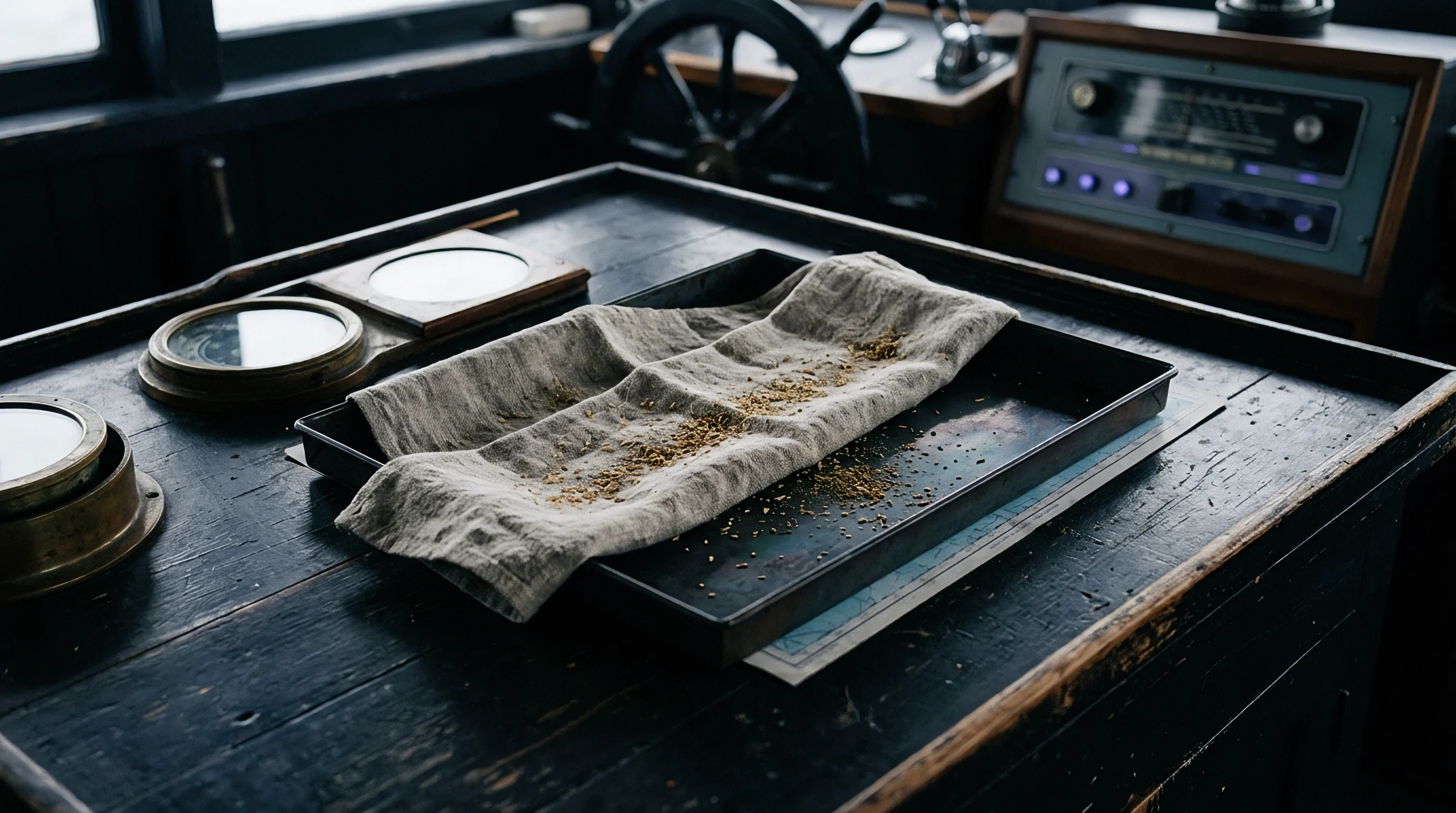
Clean dry mass governs classification. Assume a laboratory tests a 10.000 gram fabric specimen. After Soxhlet pre-treatment and desizing, the dry fabric mass equals 9.400 grams.
Chemical extraction dissolves the secondary fiber, leaving an oven-dry flax residue mass of 8.000 grams and a dry secondary fiber mass of 1.400 grams (cotton). Applying the official regain adjustments gives a flax commercial mass of 8.000 multiplied by 1.12, yielding 8.960 grams. The cotton commercial mass evaluates to 1.400 multiplied by 1.085, yielding 1.519 grams.
The calculated flax content on an official commercial mass basis equals 8.960 divided by 10.479 total grams, resulting in 85.50 percent flax. Without moisture regain adjustments, the unadjusted dry mass fraction would be 8.000 divided by 9.400, or 85.11 percent.
Standard purchase contracts incorporating ISO 1833 specify: “All fiber content declarations shall be calculated strictly on an oven-dry mass basis adjusted by official statutory moisture regain allowances as mandated in Section XI of the Harmonized System Tariff Guidelines.”

Specimen
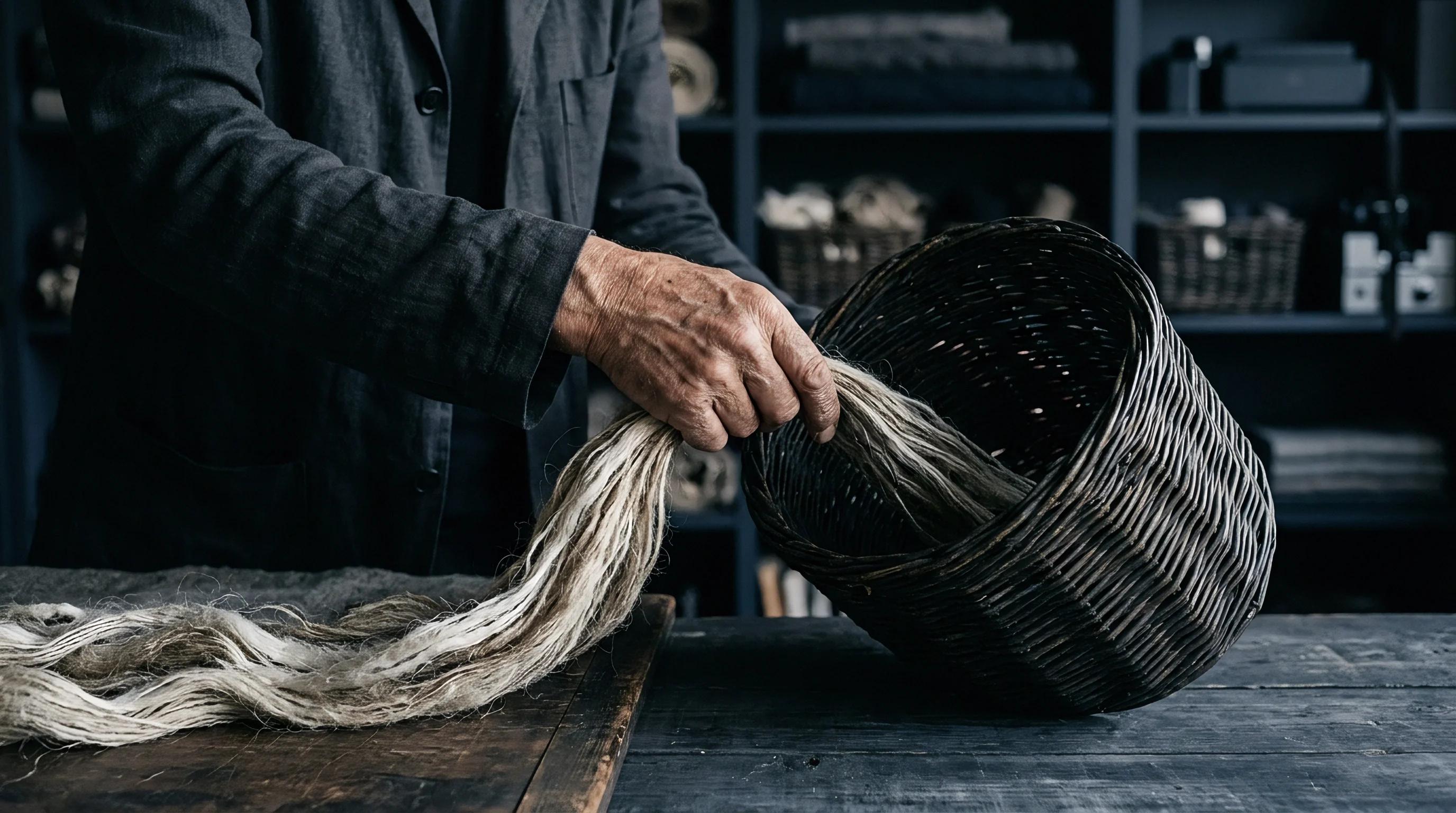
Sampling procedures dictate whether laboratory analysis reflects the true composition of an imported textile shipment. Testing an isolated sample taken from an outer fabric wrap leads to misclassification when roll-to-roll variation exists across a production lot. ISO 5089 specifies sampling rules for laboratory test specimens, requiring composite samples gathered across multiple independent rolls from distinct spinning and weaving batches.
Solvent residues skew dry mass. Specimen preparation demands cutting swatches across the full width of the fabric at least one meter from the cut roll end, avoiding distorted selvage tension zones. Samples undergo mechanical conditioning in a standard atmosphere of 20.0 degrees Celsius and 65.0 percent relative humidity for 24 hours before preliminary weighing when baseline raw mass determinations are required.
Sampling Protocols and Precision Boundaries
- Lot Sample Selection draws random full-width swatches from five percent of total imported rolls, taking a minimum of three rolls per shipment container to ensure batch representation.
- Composite Specimen Preparation cuts five 10-gram laboratory samples from distinct spatial zones across warp and weft coordinates, combining them to eliminate local thread density variance.
- Non-Fibrous Matter Extraction exposes specimens to continuous solvent reflux in a Soxhlet apparatus, stripping processing oils, paraffin waxes, and water-soluble finishes.
- Oven Drying and Desiccation bakes specimens at 105 degrees Celsius until reaching constant mass, followed by rapid transfer to a silica gel desiccator to prevent atmospheric re-absorption during weighing.
- Chemical Separation and Filtration digests companion fibers using selective chemical reagents, catching insoluble flax bundles on sintered glass filter crucibles under vacuum pressure.
Composite sampling across multiple production rolls eliminates localized thread density variations that cause boundary test failures during customs enforcement audits.
Laboratory tests determine final duty. Statistical variance in chemical testing requires applying confidence intervals to measured purity figures. A single test result showing 84.8 percent flax content cannot automatically prove non-compliance if the analytical method carries a expanded uncertainty of plus or minus 0.5 percent at the 95 percent confidence level.
Customs testing instructions specify whether mean values across five test replicates or absolute single-test threshold values govern legal non-compliance findings.

Which Solvent Method Validates Mixed Linen Blends?
Choosing between sulfuric acid dissolution, zinc chloride extraction, and microscopic longitudinal fiber count methods depends entirely on whether companion fibers share cellulosic structures with flax. Sulfuric acid parts flax from synthetics cleanly, but cotton-linen mixtures leave the analyst dependent on quantitative microscopic analysis per ISO 1833-1 or manual thread separation when warp and weft yarns are unmixed within the weave structure. Unresolved analytical limits persist when processing micro-blended ring-spun yarns where cotton and flax micro-fibers are intimately combined within the individual thread cross-section.


Loom
Structural yarn placement on the weaving machine creates systematic variation in flax distribution across the finished cloth. Fabrics designed with pure flax warp yarns and blended flax-cotton weft yarns present distinct quantitative challenges compared to fabrics woven from uniform intimate blend spun yarns. Customs inspectors analyze yarn-level fiber distributions to verify whether physical segregation or microscopic blending generated the declared mass balance.
Selvedge threads alter total mass. Weaving mills frequently utilize synthetic monofilament or high-tenacity polyester yarns in tuck-in selvedges to prevent yarn breakage under high-speed air-jet or rapier loom tension. Although these structural edge yarns account for a fraction of the total width, their inclusion in whole-fabric chemical analysis depresses the measured flax fraction.
Removing selvedges prior to customs testing yields the true composition of the body fabric, but failure to document this removal in laboratory reports opens grounds for import rejection.

Structural Yarn Dissection versus Whole-Fabric Extraction
When warp and weft yarns consist of different fiber combinations, manual thread dissection provides greater accuracy than whole-fabric chemical extraction. Dissection involves unpicking warp and weft threads from a weighed 100 mm by 100 mm fabric swatch, weighing warp and weft components separately, and applying quantitative solvent extraction to each yarn group independently.
| Fabric Construction | Dominant Analysis Technique | Preparation Complexity | Measurement Precision | Customs Rejection Risk |
|---|---|---|---|---|
| Intimate Blend Spun Yarns | ISO 1833-11 Chemical Dissolution | Moderate (Soxhlet required) | ±0.5 percent mass yield | Low when d-factor is correct |
| Flax Warp / Cotton Weft (Union Cloth) | Manual Yarn Thread Separation | High (Labor-intensive) | ±0.1 percent mass yield | High if selvedge yarns included |
| Jacquard Patterned Filaments | Dissection followed by Chemical Extraction | Very High (Intricate weave) | ±0.8 percent mass yield | Moderate due to localized pattern variations |
| Coated / Laminated Linen Canvas | Solvent Stripping prior to Dissolution | Extreme (Resin removal) | ±1.2 percent mass yield | High due to incomplete resin extraction |
Unprocessed fibers retain natural waxes. Scouring and bleaching operations carried out during wet finishing remove up to four percent of raw flax mass in pectin and hemicellulose. An unbleached loom-state greige fabric exhibits higher apparent resistance to chemical digestion than fully scoured and dyed cloth made from identical fiber lots.
When customs laboratories compare greige fabric tests against finished product certificates, failing to account for finishing mass loss creates apparent composition discrepancies.
A reliable practical guideline dictates that any fabric measuring within 0.8 percent of the statutory tariff threshold requires complete yarn-level dissection and pre-treatment verification before committing to a final customs tariff declaration.
Assessment
Customs enforcement audits evaluate historical import entries using retroactive laboratory testing and supply chain document tracing. When customs authorities reclassify a shipment from HS 5309.11 to HS 5309.29 due to a recorded flax content of 84.3 percent, the importer faces administrative duty adjustments based on the tariff differential. Preferential trade agreements requiring 100 percent regional origin or specific yarn-forward rules disallow duty-free status if non-originating synthetic fibers drive the flax composition below mandatory certification thresholds.
Commercial invoices carry financial risk. Audit investigations extend beyond chemical test reports to examine mill-floor records, including spinning lot numbers, scutcher output logs, and weighbridge delivery receipts. Mass-balance reconciliation conducted during an audit compares total raw flax fiber kilos purchased by the mill against total square meters of pure linen fabric exported.
Misalignments between fiber consumption and fabric output suggest the unrecorded inclusion of lower-cost companion fibers like cotton or regenerated rayon.
Incorrect declarations trigger tariff penalties. Importers defend classification claims by assembling a complete technical dossier containing ISO 17025 accredited laboratory test reports, mill-level fiber composition certificates, transaction certificates detailing field-to-spindle origin, and calculation datasheets showing moisture regain corrections. Securing supplier indemnification clauses in purchase contracts shifts direct financial liability for duty backpayments and administrative fines onto the mill when independent laboratory testing disproves certified pure flax declarations upon customs arrival.
Customs authorities issue final classification rulings based on the physical state of the goods as presented at the port of entry. Chemical evidence showing dry fiber yield adjusted by official regain allowances overrides commercial trade descriptions, brand labelling claims, and unverified mill certificates during formal administrative review proceedings.