Wet Spinning Frame Drafting Behavior under Cut Length Density Variance
Cut length density variance destabilizes wet drafting by altering dynamic friction in the trough, demanding precise ratch, saddle pressure, and thermal control.

Nip
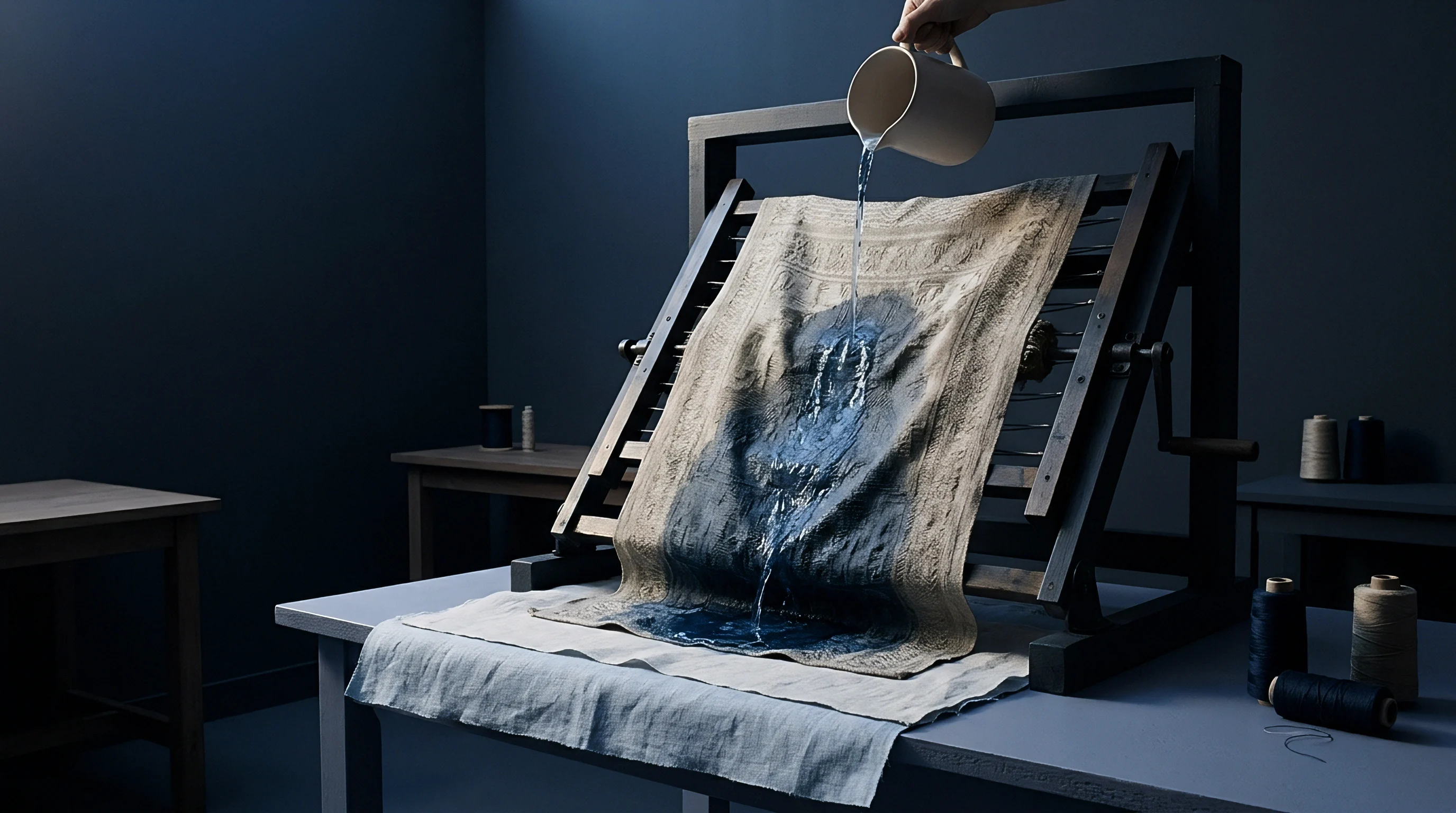
On an industrial wet-spinning frame, drafting zone stability collapses whenever cut length density shifts across the rove cross-section. Attenuation relies on the viscous drag of hot water to slide softened flax bundles past each other between fixed roller nips. In a standard fluted-roller setup running a 65 mm ratch at 60 degrees Celsius trough temperature, abrupt variations in linear mass density or cut length alter the effective gripping pressure.
Overlength technical bundles end up pinched simultaneously by back retaining and front drawing rollers. Meanwhile, short fibrils drift through the liquid wedge without restraint, producing acceleration spikes that show up as thick-and-thin faults in the spun yarn.
Diagnosing this instability starts with measuring the mass distribution curve of the pre-treated rove instead of adjusting front roller weighting. A linear density swing of just four percent across a five-meter rove sample shifts dynamic drawing force by eighteen to twenty-five percent ~ enough to surpass the yield point of the inter-fiber pectin matrix before bundles ever reach the front drafting line.
Water trough saturation softens the inter-cellular middle lamella to an adhesive shear limit of approximately 1.8 centinewtons per tex under a steady 65-degree bath.
Once drafting force outstrips cohesive resistance, orderly sliding gives way to premature fiber breakage, sending the drafting zone into an erratic surge cycle. Dense patches of short-cut fragments reduce local friction so severely that entire clusters wash through the nip unattenuated. On the other hand, heavy groupings of long-staple fibers bridge the ratch.
The front rollers then pull against bundles still held by the retaining nip, triggering mechanical rupture, roller lapping, or an immediate end-break at the thread guide.

Upstream Cut Parameters Dictate Dynamic Cohesion
Cut length profiles for flax tow or hackled line are locked in long before roving reaches the creel. Whether prepared through stretch-breaking or rotary cutters, bast fibers inevitably yield a spread-out array: a target cut of 60 mm consistently carries a trailing tail of sub-25 mm fragments and an uncut head running to 90 mm strands. The balance between those two extremes dictates how drafting force distributes inside the wet trough.
Immersion water serves simultaneously as lubricant and chemical release agent, breaking down the calcium and magnesium pectate complexes that bind elementary bast cells together. With uniform cut lengths and consistent mass, this dissolution stays predictable. But erratic linear density leaves dry cores inside dense passages while thin sections saturate immediately.
The dry segments lack slip and snap under draft tension; oversaturated segments flood through the nip as slubs.
Operating with high cut length variance inflates count CV in the delivered yarn. Trying to suppress that variance with higher saddle pressure merely chews through top roller cots and crushes hollow lumens within flax cell walls, eroding finished tensile strength. When yarn CV spikes without an obvious cause at the spinning frame, the problem usually traces back to dull cutter blades or uneven faller pinning in the intermediate gill boxes.
Drafting ratios above twenty do not smooth out roving count variation, despite assumptions that high attenuation averages out mass defects. That view ignores the fluid dynamics inside the wet zone: increasing draft on an uneven fiber array bunches short-staple clusters together instead of distributing them through the yarn body.

Viscosity
Dynamic attenuation depends heavily on the liquid boundary layer coating flax bundles in the wetting trough. Water temperature sets fluid viscosity, governing the drag applied to floating fiber ends between back and front rollers. Dropping bath temperature from 70 degrees Celsius to 50 degrees Celsius increases dynamic water viscosity from 0.404 millipascal-seconds to 0.547 millipascal-seconds, driving fiber-to-fiber drag up by over thirty percent.
Paired with erratic roving density, that viscosity shift quickly destabilizes the drafting zone.
Density swings also change fiber packing inside the submerged trumpet guides. When a heavy section passes through the bath, water penetration slows down. Without adequate heat transfer, core pectin bonds stay stiff, stopping elementary fibers from sliding past one another.
The bundle then enters the drafting zone as an unyielding rod, placing excessive mechanical load on the drawing roller drives.
| Trough Temperature | Water Viscosity | Pectin Extraction Rate | Mean Drafting Force | Breakage Rate per 1000 Spindle Hours |
|---|---|---|---|---|
| 45 deg C | 0.596 mPa.s | 1.2 g/kg/hr | 4.8 N | 42 breaks |
| 55 deg C | 0.504 mPa.s | 2.4 g/kg/hr | 3.6 N | 26 breaks |
| 65 deg C | 0.433 mPa.s | 4.1 g/kg/hr | 2.5 N | 11 breaks |
| 75 deg C | 0.378 mPa.s | 5.8 g/kg/hr | 2.1 N | 18 breaks |
| 85 deg C | 0.334 mPa.s | 7.9 g/kg/hr | 1.9 N | 31 breaks |
Over-extracting pectins causes the opposite breakdown. At temperatures above 75 degrees Celsius, hemicellulose binders strip out too quickly. Short fibers detach entirely from the drafting ribbon and foul flutes and guides with sticky buildup.
The workable operating window is tight: the bath has to soften secondary middle lamella bonds without degrading the elementary cell walls.

Which Processing Window Stabilizes Fiber Boundary Layers?
Stabilizing boundary conditions means balancing immersion time against delivery speed. Running frames at an 18 meters per minute delivery rate along a standard 1.2-meter immersion path gives roughly four seconds of bath contact. If linear density varies by ten percent, thin sections saturate through to the core in 1.8 seconds, whereas heavy lengths reach the back nip partly dry.
That differential wetting establishes a harsh stick-slip cycle. Across dry fibers, static friction overpowers the clamping force of standard synthetic cots; bundles skid across the rubber, gouging flat spots into the cot and leaving thick irregularities in the strand. Fully saturated regions slide under near-zero hydrodynamic resistance, collapsing tension to the point where false twist creeps backward into the drafting field.
Surfactants shift this dynamic considerably. Adding non-ionic wetting agents lowers surface tension from 72 millinewtons per meter to 30 millinewtons per meter, speeding bath penetration through tight fiber bundles. This allows mills to drop bath temperatures, saving energy and cutting down on scale build-up along the frames.
But dosing has to remain steady shift-to-shift, because swings in surfactant concentration mimic mechanical roving defects in the spun yarn.
Uncontrolled water chemistry and bath quality also carry over into weaving preparation. Yarn with unsoftened core bundles absorbs sizing starch and synthetic polymers unevenly, leading to warp stripping in the loom shed and downgrade penalties in fabric inspection.


Ratch
Ratch ~ the span between back retaining and front drawing nips ~ must account for both average cut length and distribution spread. Matching the ratch directly to nominal cut length guarantees trouble: any fiber longer than the nominal mark spans both nips at once. Gripped at both ends, those strands either shear mechanically or force the spring-loaded top rollers out of alignment.
Stretch-broken or staple-cut flax fibers skew heavily toward the short end of the length distribution. A 60 mm nominal cut typically carries an upper span length of 74 mm against a modal length near 48 mm. Clearing that upper tail without constant fiber fracture forces technicians to open the ratch to 68 mm or 72 mm, creating an unguided zone where shorter fibers move without direct mechanical control.
Roving containing a short-fiber content above twenty-two percent by mass generates drafting waves whose amplitude exceeds the average yarn diameter.
In this unguided gap, short fibers accelerate unpredictably. Front rollers pull nearby fibers at delivery speed while back rollers hold trailing stock at feed rate; unnipped fibers simply take on the speed of whatever bundles they brush against. Where linear density varies, dense clusters drag these floating fibers along in surges, forming periodic drafting waves.

Drafting Wave Dynamics
On a spectrogram, drafting waves show up as broad humps rather than sharp chimneys. Their fault wavelength runs roughly two to three times the ratch setting ~ meaning a 70 mm ratch produces periodic mass peaks every 15 cm to 22 cm along the yarn. In plain weaves or knits, these cycles align visually into diamond or moiré patterns that downgrade the finished fabric.
Technicians employ three separate adjustments to counter this wave behavior during wet line or tow processing:
- Ratch clearance reduction to within four millimeters of the maximum staple tail, maximizing direct fiber guidance while risking sporadic fiber tensile fracture.
- Weighted control saddles applied directly over the fiber path between nips to press floating fibers into the wet mass, substituting for absent pin control.
- Draft ratio reduction across the wet frame by shifting total attenuation upstream onto mechanical gill drawing passages where pinned fallers restrain short fibers mechanically.
If roving density fluctuates severely, no mechanical ratch setting holds up. Opening the ratch accommodates dense, long-fiber bundles, but short-fiber regions lose velocity control and pull through as uncohesive slubs. Closing it down reins in the floating fibers, only for dense sections to crush top roller cots and stall drafting gearing.
Specifying minimum single-fiber tensile strength in a purchase contract means little if the fiber length spread in the roving outruns the mechanical ratch limits of the frame.

Saddle
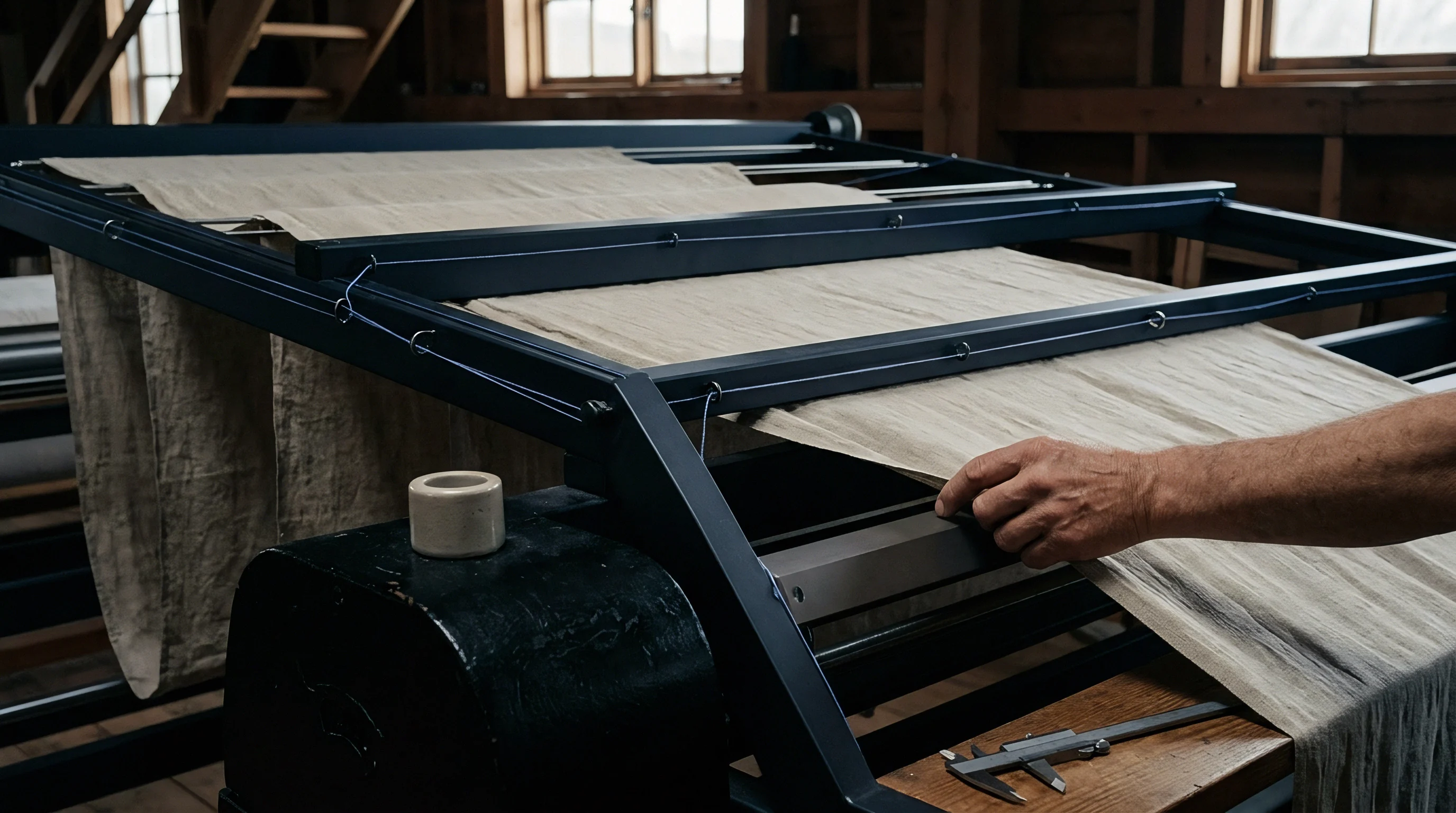
Wet spinning frames use weighted saddles to pinch fibers between fluted steel bottom rollers and elastomeric top cots. When roving cross-sectional density swings, drafting force follows. Maintaining control demands that top-roller nip pressure stay reliably above peak drafting force.
Once drafting force exceeds that clamping limit, fibers slip, delivery speed decouples from front-roller rotation, and yarn count wanders.
Saddle loads range from 180 Newtons to 350 Newtons per boss, depending on yarn count and roving weight. Loads of that magnitude concentrate severe stress in the rubber cot. Mills run hard compounds ~ typically 83 to 90 Shore A ~ to withstand grooving from abrasive bast bundles.
Softer compounds offer a wider nip footprint and better floating-fiber control, but they break down quickly under the abrasive scouring of wet shive and lignified edges.
| Cot Shore Hardness | Nip Contact Width | Drafting Slip Rate | Grooving Rate after 500 Hours | Finished Yarn Tenacity |
|---|---|---|---|---|
| 78 Shore A | 3.8 mm | 0.8 percent | 0.32 mm depth | 24.8 cN/tex |
| 83 Shore A | 3.1 mm | 1.4 percent | 0.14 mm depth | 24.1 cN/tex |
| 88 Shore A | 2.4 mm | 2.9 percent | 0.06 mm depth | 22.9 cN/tex |
| 92 Shore A | 1.8 mm | 5.7 percent | 0.02 mm depth | 21.3 cN/tex |
Inconsistent roving density distorts this nip profile. A thick roving segment levers the top roller upward against its spring or pneumatic loading arm, lifting the cot clear of the bottom flutes and dumping clamping pressure across the rest of the boss. On frames running two roves per saddle, a surge in one rove robs load from the other, sparking immediate slippage and drafting a severe thin spot into the companion yarn.
Fluted Roller Profile Interactions
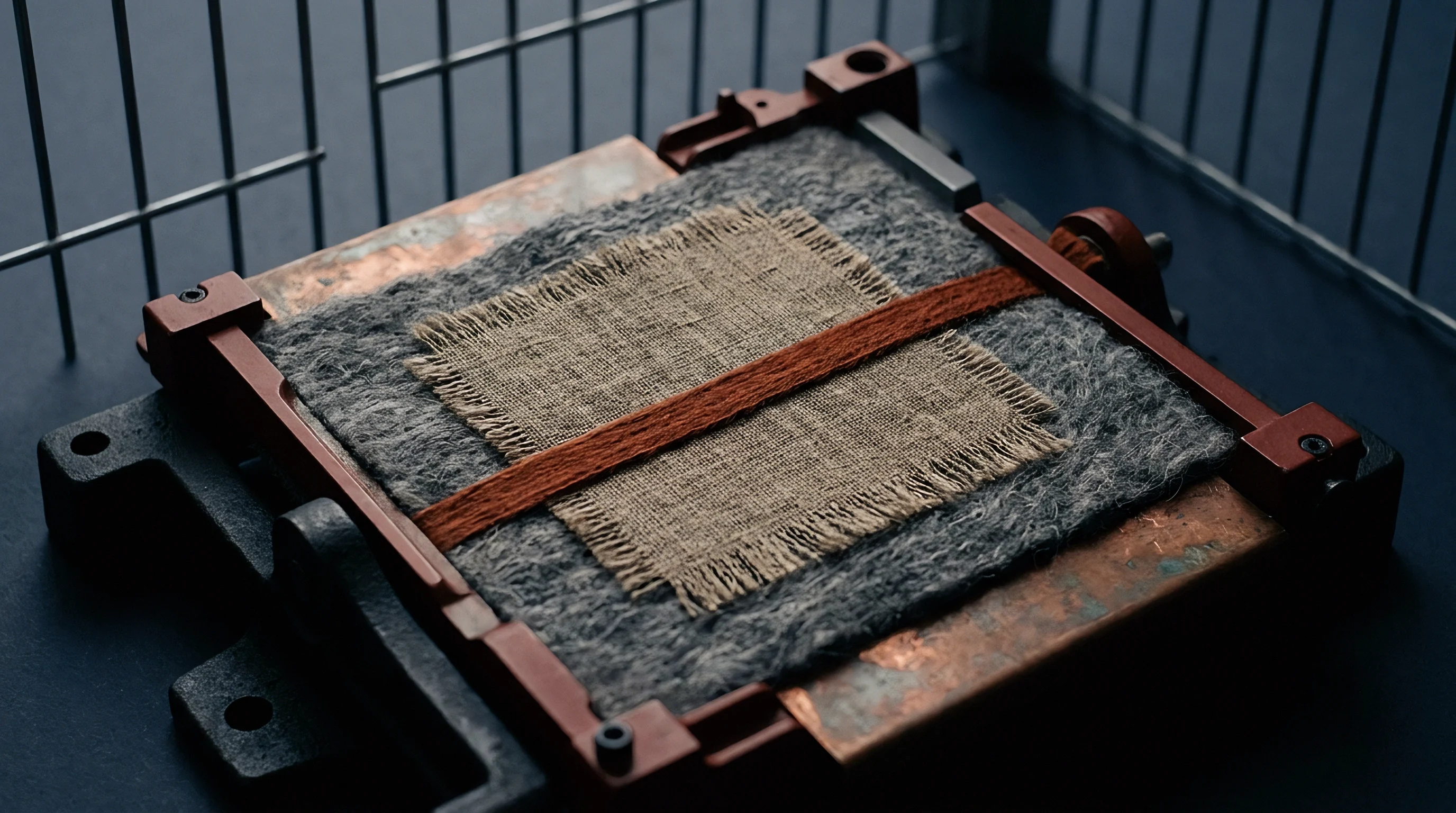
Bottom steel rollers are axially fluted to grip slick bast bundles through mechanical deformation. Tooth depths run between 0.6 mm and 1.2 mm, with pitches ground to penetrate the surface water film. When roving thins out, the ribbon fails to cushion the flute tips.
The cot deflects directly into the valleys, building internal heat through cyclic flexing until the polymer breaks down and cavitates.
Heavy sections trigger the reverse issue. Bulky bundles refuse to bed into the flute valleys under standard saddle loads, bridging across tooth crowns and cutting contact area down to isolated points. Grip drops into boundary friction.
Slippage jumps from a baseline of one percent up to seven percent, leaving soft, under-twisted lengths that fail at the traveler ring.
Checking top-roller loading requires load cells seated under the saddle tips. Static spring gauges miss dynamic losses caused by pivot slop, sludge under saddle hooks, and hydraulic cushioning from trough drag. When hunting down intermittent count surges, dynamic saddle loading should be verified before blaming upstream gill boxes.
Dropping below the dynamic pressure threshold causes widespread slippage, breaking lot uniformity and inflating rework costs.

Friction
Frictional behavior between fiber and steel ~ and between the fibers themselves ~ governs wet drafting. Bast fibers have irregular cellular surfaces marked by transverse nodes, slip planes, and growth dislocations. Unlike spiraled cotton or round synthetics, unretted and semi-retted flax ribbons present flat, polygonal cross-sections with steep static friction coefficients.
Water acts as a boundary lubricant during drafting, lowering the static friction coefficient of flax on steel from 0.45 dry down to roughly 0.22 wet. That transition follows standard Stribeck behavior, shifting with sliding velocity and normal load. When cut length density fluctuates, local velocities bounce constantly between boundary contact and partial hydrodynamic lubrication.
Dynamic inter-fiber cohesion varies inversely with the degree of retting, demanding higher saddle clamping pressures for water-retted stock than for dew-retted material.
Shifting density ruins this lubrication balance. Tight clusters of short fragments hold water like sponges, hydroplaning through the zone with minimal drag. Neighboring lengths of coarse, partially retted bundles press dry under nip pressure, reverting to boundary friction.
The resulting stick-slip cycles send vibration through roller shafts and accelerate gear backlash.
Surface Pectin Rheology and Slip Planes
Elementary flax fibers are cemented into technical bundles by an intercellular matrix of rhamnogalacturonans, xyloglucans, and structural proteins. In the hot, neutral-to-mildly-alkaline trough bath, these pectins swell into a viscous gel. Attenuation does not tear cellulose cell walls; it shears this softened pectin layer along established slip planes.
Wet pectin behaves pseudoplastically: effective resistance drops as shear rate climbs. As front drawing rollers accelerate fibers, the pectin gel thins and bundles slide more freely. But when roving density varies across its cross-section, this shear-thinning destabilizes:
- Initial shear concentration focuses drawing force onto the thinnest, most saturated zones, triggering immediate local acceleration.
- Pectin shear-thinning lowers viscosity right within that accelerated zone, causing localized fiber slippage while adjacent dense sections remain unsheared.
- Fiber depletion pulls elementary fibrils out of the advancing ribbon, creating severe structural necking and leaving behind an unattenuated dense plug.
- Plug impact occurs when the dense, unattenuated section hits the front roller nip, stalling shear and spiking drawing tension.
Managing this shearing action requires precise twist control at the flyer frame. Twist holds the bundle together through creeling and trough immersion, but high cut-length variance disrupts the twist distribution: long fibers gain excessive torsional rigidity while short ones get no radial binding. Flyer twist must be set against the lower quartile of the fiber length distribution to keep rove sections from turning into hard, water-resistant cords.
Frictional instability in the drafting zone ultimately undermines yarn elongation, producing fabric that fails tear tests following wet finishing and bleaching.


Waste
Fiber lost to the trough bed, scrapers, and suction flutes makes up wet spinning waste ~ cleared out as wet tow, droppings, and laps. Rove with erratic cut lengths drives these numbers up immediately. Uniform flax line rove runs between three and five percent total wet waste; widen the length distribution and fluctuate linear density, and waste rates climb past twelve percent, skewing the lot economics entirely.
Loose fragments outside nip control drift into the bath instead of entering the yarn path. These elementary fibers settle into sludge on the trough floor, clogging pumps, fouling drain lines, and wrapping submerged tension bars. Flushing it out means downtime, loss of heated water, and wasted wetting chemistry.
When sludge breaks free in clumps and feeds through the nips, it knocks down multiple ends at once.
Material Balance Calculations
The commercial cost shows clearly in a standard lot balance. Consider a 10,000-spindle installation producing Nm 39 (25.6 tex) wet-spun yarn from Nm 2.2 (454.5 tex) rove at a machine draft of 17.7. Delivering at 18 meters per minute, each spindle yields 1.84 kg over a 66-hour operating week, totaling 18,400 kg of finished yarn.
Compare performance metrics between two distinct roving sourcing lots across this production envelope:
- Uniform Roving Lot A carries a mean cut length of 60 mm with a standard deviation of 4.2 mm, short fiber content below 12 percent, and roving CVm of 3.8 percent.
- High Variance Roving Lot B carries a mean cut length of 58 mm with a standard deviation of 14.8 mm, short fiber content of 26 percent, and roving CVm of 8.4 percent.
With Lot A, the room averages 14 breaks per 1000 spindle hours. Wet waste holds at 4.2 percent: 0.8 percent trough droppings, 1.4 percent suction waste, and 2.0 percent roller laps. Producing the 18,400 kg yarn order requires 19,207 kg of rove.
At a landed price of 7.20 dollars per kg, fiber outlay runs 138,290 dollars, or 7.51 dollars per kg of yarn.
Under Lot B, drafting instability pushes breaks up to 46 per 1000 spindle hours, dropping machine efficiency from 92 percent down to 81 percent on piecing delays alone. Wet waste surges to 11.8 percent ~ 4.1 percent trough droppings, 3.2 percent suction waste, and 4.5 percent lapping. Generating the same 18,400 kg of yarn requires 20,862 kg of rove, pushing fiber costs to 150,206 dollars, or 8.16 dollars per kg of finished yarn.
None of this waste is recoverable. Saturated flax degrades quickly under bacterial action in warm bins, reducing resale value to zero. Unlike dry cotton or synthetic blowroom waste that can be blended back into open-end lines, wet flax droppings cannot re-enter the process.
Every kilo lost in the trough is prime hackled fiber written off entirely.
Downstream weaving absorbs the rest of the cost. Mass defects from drafting disturbances degrade yarn tensile consistency, lifting loom stops from 1.2 to 4.8 per 100,000 picks. That penalizes air-jet running speeds and tacks 0.38 dollars per finished linear meter onto conversion costs.

Verification
Incoming inspection has to catch roving variance before packages hit the creel. Relying on mill certificates of analysis is risky: standard commercial documents list average fineness and nominal hackled yield, ignoring staple length distribution and short-fiber fractions. Spinners running bought-in rove or pre-cut sliver require specific laboratory verification steps.
Testing starts with comb-sorter analysis adapted for long bast fibers. On an aligned dual-bed sorter, technicians draw five-gram rove samples into an end-aligned beard. Dropping successive combs sorts the sample into 10 mm length fractions to build a cumulative frequency curve.
Reliable drafting requires an upper quartile length within six percent of nominal target and sub-20 mm fragments capped at fifteen percent by weight.

Laboratory Evaluation Sequences
Acceptance protocols should also evaluate running mass density. Capacitive testers calibrated for bast fibers pull roving through the measuring slot at 25 meters per minute to generate continuous mass traces:
- Conditioning test packages for twenty-four hours in a standard atmosphere of 20 degrees Celsius and 65 percent relative humidity, ensuring uniform baseline moisture regain.
- Capacitive mass scanning across 500 meters of roving per sample bobbin, recording coefficient of variation of mass along with spectrogram wavelength profiles.
- Solvent wash extraction to verify residual wax, fat, and lignin contents, confirming that chemical retting uniformity meets processing specifications.
- Miniature bath pull tests measuring dynamic drafting force by pulling roving through a temperature-controlled water cell mounted directly inside a standard tensile tester.
Miniature drafting cells give the clearest preview of floor runnability. A rove length submerged in a 60-degree water cell draws through miniature nips at a draft ratio of fifteen while a tensile load cell records pulling resistance. Traces with high standard deviations point directly to uneven pectin breakdown and irregular staple lengths.
Peak forces exceeding 5.5 Newtons in this test reliably predict heavy end-breakage on the spinning floor.
Procurement teams rely on these numbers to back commercial contracts. Purchase specifications need to move past nominal count and breaking tenacity, adding explicit limits for short-distance roving mass CV, short-fiber fractions, and dynamic drafting force thresholds. When incoming roving fails these test gates, shipments are held at the warehouse dock before entering the spinning floor.
An automated, inline optical method capable of gauging wet ribbon geometry inside the trough remains an open challenge ~ specifically, resolving bundle attenuation at sixty frames per second without interference from surface turbulence.