Resolving Multi Cellular Technical Flax Bundle Splitting Behaviour under Wet Spinning Drafting Stress
Controlled hot water soaking leaches middle lamella pectins so drafting roller shear divides technical bundles into elementary fibrils without fibre fracture.

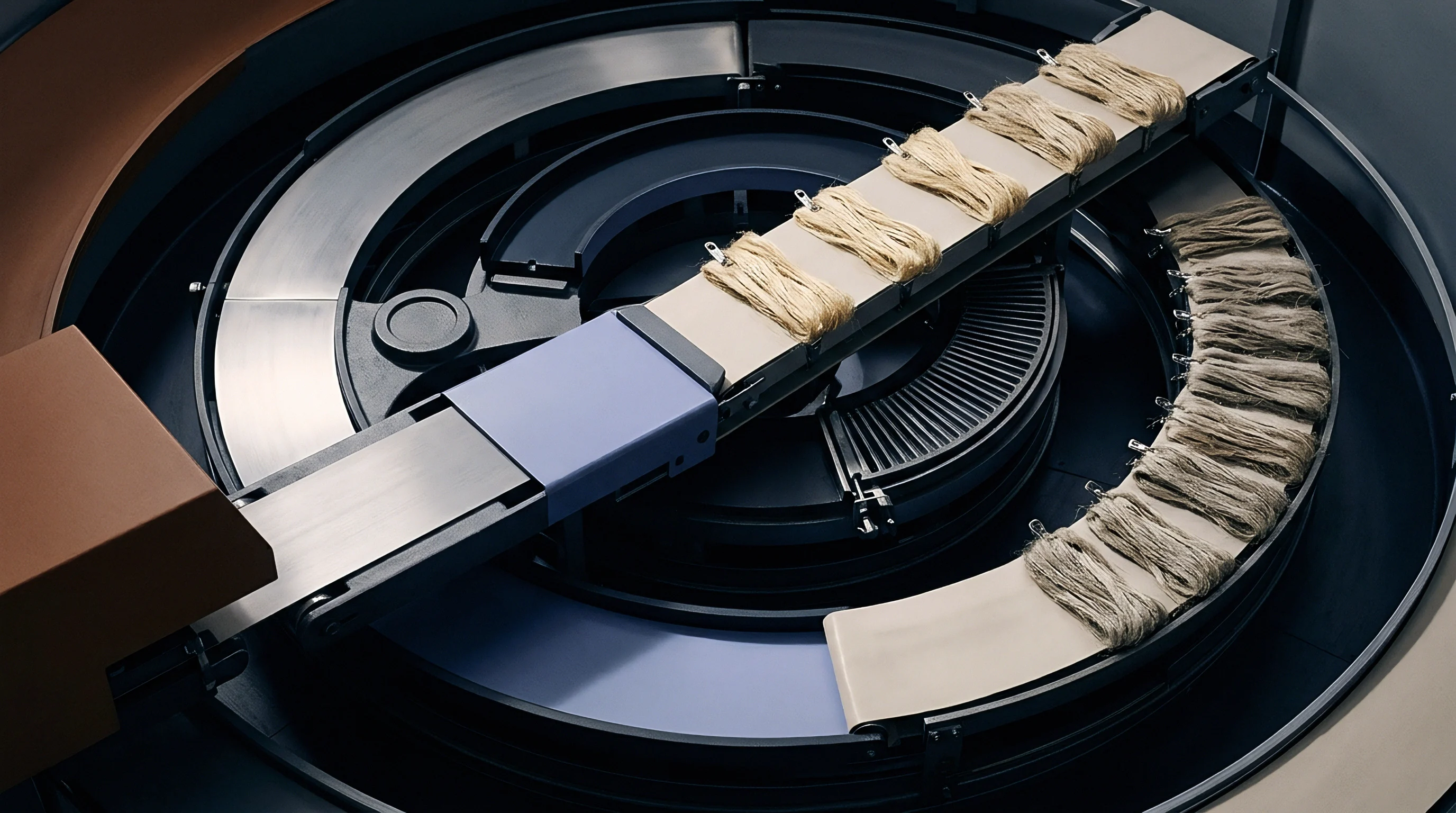
Mechanics
A delivered sliver of Grade 4 dew-retted flax displays an average linear density of 22 tex on the laboratory comb sorter, yet thirty percent of the cross section comprises unsplit technical bundles exceeding 45 micrometres in diameter. Technical flax bundles consist of individual elementary fibres, each roughly 10 to 30 millimetres in length and 12 to 20 micrometres in diameter, cemented laterally by an intercellular middle lamella rich in pectin, hemicellulose, and structural lignin. In wet spinning, yarn quality hinges on splitting these technical bundles into smaller, finer sub-units inside the drafting zone of the spinning frame.
As longitudinal shear transfers tension from the outer fibre perimeter into the internal middle lamella, elementary fibres release progressively. If cohesive shear strength in that lamella remains higher than the friction exerted by adjacent drafting aprons and fluted metal rollers, the entire bundle glides forward like an indivisible rod, producing coarse drafting waves, thick-thin defects, and yarn count instability.
Shifting from a cohesive composite bundle to an attenuated filament stream requires the middle lamella polysaccharides to yield under drafting stress. During drafting, the velocity gradient between the back feed rollers and the front delivery rollers forces adjacent elementary fibres within the bundle to slip axially relative to each other. That inter-fibre slippage requires the applied tensile drafting force to surpass the shear yield stress of the pectin matrix without exceeding the axial tensile breaking force of the individual elementary cellulose fibrils.
When drafting tension surpasses fibril tenacity before the middle lamella yields, transversal bundle fracture occurs instead of lateral cleavage. Fibre breakage generates short floating fibres inside the drafting field, which bunch into irregular neps and increase the yarn coefficient of variation.
Technical flax bundles separate along the pectic middle lamella when shear stresses exceed the viscous yield point of hydrated polygalacturonic acid chains.
Splitting failures produce measurable degradation patterns across yarn lots. Inspection of drafted sliver specimens under polarized light microscopy reveals four primary deformation responses:
- Intercellular Shear Cleavage occurs when hydrated pectin matrices yield cleanly along the longitudinal boundary of adjacent elementary fibres, yielding uniformly slender fibrils without fracturing primary cell walls.
- Transverse Fibrillar Rupture takes place when unsoftened middle lamella deposits transfer excessive axial tension directly into dry cellulose lumens, snapping twenty-millimetre elementary cells into stubby waste fragments.
- Sticky Clustered Agglomeration develops where localized concentrations of insoluble calcium pectate resist water penetration entirely, dragging three to five conjoined technical bundles across the nip line simultaneously.
- Surface Pellicle Peeling strips the outer parenchymal tissue from the bundle flank without dividing the core fibres, creating floating gummy debris that fouls drafting aprons and roller cots.
Because dry roving resists mechanical attenuation, the classer gauges bundle split potential by checking retting uniformity across the hackled line lot before drawing begins. Under-retted fibres retain heavy bark layers, secondary cortical tissues, and calcium-linked polyuronide complexes that lock elementary fibres into rigid plates. Over-retted flax displays microstructural cellulose breakdown where fungal hyphae have digested primary cell walls, causing fibre collapse under modest roller compression.
Stable bundle attenuation demands balanced dew retting where fungal enzymes have consumed non-structural pectic polymers while leaving structural cellulose microfibrils intact.

Bath
Flax roving enters the wet spinning frame by submerged passage through a hot water trough positioned directly above the drafting zone. Hot water immersion acts as a plasticizer, softening the intercellular pectin cement and reducing its shear modulus to permit lateral sliding under tension. Hydration disrupts hydrogen bonding within the amorphous hemicellulose network, swelling the cell walls and relaxing the internal stress built up during drawing and roving twist insertion.
Pectin dissolution begins above fifty degrees. Without this hydrothermal pretreatment, technical flax bundles enter the drafting nip with dry mechanical properties, causing high drafting force peaks that stall rollers and break roving ends.

Pectic Solubilization in Hot Water
The rate of middle lamella plasticization depends directly on bath temperature, residence time, and liquor composition. Unbranched homogalacturonan chains in the middle lamella carry carboxyl groups cross-linked by divalent calcium ions. These calcium pectate salt bridges produce water-insoluble junction zones that resist hydration below sixty degrees Celsius.
Heating the bath to seventy degrees Celsius increases thermal motion within the polysaccharide chains, expanding the polymer network and facilitating proton exchange. Softened pectin exhibits non-Newtonian, shear-thinning flow characteristics under rapid drafting deformation, lowering the required drafting force per unit mass.
| Trough Temperature (°C) | Submersion Dwell (s) | Additive Treatment | Extracted Pectin (%) | Cohesive Pull Force (cN) |
|---|---|---|---|---|
| 40 | 12 | Neutral demineralized water | 2.1 | 185 |
| 55 | 15 | Neutral demineralized water | 4.8 | 122 |
| 65 | 18 | 0.5 g/L sequestering agent | 8.6 | 74 |
| 75 | 22 | 1.0 g/L non-ionic wetting agent | 11.4 | 51 |
| 85 | 25 | 1.0 g/L sequestering and wetting | 15.2 | 38 |
Calcium ions anchor adjacent pectate chains together. Introducing a chelating agent into the spin trough sequesters divalent cations, shifting calcium pectate into soluble sodium salts. This chemical substitution accelerates bundle separation, lowering required drafting tension by over fifty percent at sixty-five degrees Celsius.
Spinning mills balancing production speed against chemical cost run neutral soft water at sixty to seventy degrees Celsius without additives. In hard water regions, unchecked calcium buildup in the trough hardens the roving, forcing operators to elevate temperatures toward eighty-five degrees Celsius to prevent catastrophic end-break surges.
Flax roving submerged in sixty-degree demineralized water for twenty seconds exhibits a forty-two percent reduction in peak cohesive pull force compared to unheated dry roving.
Does Water Bath Temperature Govern Cohesive Cleavage?
Controlled trials confirm that liquor temperature governs the boundary between ductile bundle splitting and brittle fibril snap. Raising the water temperature from fifty to seventy degrees Celsius drops peak drafting resistance from 145 centinewtons to 60 centinewtons on a 600 tex roving. At fifty degrees, the middle lamella remains glassy, transferring longitudinal shear stress directly into elementary fibrils and triggering transverse breaks.
At seventy degrees, viscous flow within the hydrated pectins permits continuous inter-fibre sliding along the axial plane, preserving elementary fibril lengths while reducing cross-sectional bundle dimensions.


Nip
The drafting zone of a wet spinning frame comprises a fluted bottom feed roller, a synthetic-coated top press roller, a drafting field, and a high-speed delivery nip. Ratch distance, which defines the span between the feed nip and the delivery nip, is adjusted between 45 and 75 millimetres depending on the average staple length of the elementary fibres within the technical bundle. Because individual elementary flax fibres average 20 to 30 millimetres in length, an unadjusted ratch shorter than 40 millimetres crushes elementary fibres between simultaneous roller grips, shattering cellulose cell walls and creating thick slubs.
A ratch exceeding 80 millimetres loses frictional control over floating fibre ends, causing drafting waves where bundles drift through without splitting.

Drafting Zone Kinematics and Ratch Settings
Drafting stress originates from the velocity differential between the front and back pairs of rollers. Break draft settings between 1.08 and 1.25 crack the initial roving twist, straightening crimped fibres and forcing liquor deep into the core bundles before main drafting begins. The main draft, set between 10 and 22 depending on target yarn count, applies intense longitudinal shear.
Fluted bottom rollers grip the wet bundle firmly while the polyurethane or synthetic rubber top roller cot deforms elastomeric borders to distribute clamping force across the bundle width.
| Draft Ratio | Ratch Gauge (mm) | Cot Hardness (Shore A) | Nip Load (daN/cm) | Uster Mass CV (%) |
|---|---|---|---|---|
| 10.5 | 52 | 83 | 6.0 | 14.8 |
| 12.8 | 55 | 85 | 6.5 | 15.4 |
| 15.2 | 58 | 88 | 7.2 | 16.9 |
| 18.0 | 62 | 90 | 7.8 | 19.2 |
| 21.5 | 68 | 92 | 8.5 | 23.4 |
Roller pressure crushes woody shive remnants, while cot hardness dictates nip footprint geometry. Softer cots at 83 Shore A yield an extended nip contact area that dampens localized pressure spikes, preventing bundle crushing while sustaining uniform friction. Harder cots at 92 Shore A concentrate mechanical force over a narrow contact band, which fractures coarse technical bundles if retting uniformity varies across the roving cross section.

Do Residual Pectins Dictate Maximum Draft Ratios?
Residual non-cellulosic gum levels directly limit the draft ratio a spinner can select on the machine frame. Roving containing more than four percent residual unhydrolyzed pectin by dry weight cannot sustain a draft ratio above twelve without generating periodic mass defects. At higher draft ratios, unplasticized middle lamella sections generate excessive cohesive resistance that pulls entire clumps of unsplit bundles past the drafting nip in periodic waves.
The transformation of a raw technical bundle into attenuated yarn proceeds through five physical stages across the drafting zone:
- Twist Release untwists the roving under minor break draft tension, opening internal bundle surfaces to water penetration.
- Hydrothermal Softening dissolves outer rhamnogalacturonan layers, converting brittle pectin deposits into a lubricated gel.
- Roller Cot Grip anchors the trailing ends of the bundles under six decanewtons per centimetre of linear nip pressure.
- Shear Attenuation pulls leading fibres forward at front roller delivery velocity, sliding elementary fibres past their neighbours.
- Twist Insertion binds the attenuated fibril array into a circular strand at the spinning ring traveler.
Whenever drafting stress outstrips the local cohesive threshold of the lubricated bundles without achieving complete splitting, irregular division inside the drafting zone creates cyclical mass variations ~ thick-thin drafting waves, slub clusters, and excessive loom stops during high-speed insertion.

Metric
Determining technical bundle splitting efficiency requires rigorous laboratory characterization of fibre fineness before and after wet drafting. Under ISO 2370, technicians measure the fineness of flax fibres using steady-state air permeametry on calibrated fibre plugs. A weighed mass of parallelized flax fibre is compressed into a cylindrical chamber of known dimensions, through which clean air passes under standardized pressure.
As technical bundles divide into elementary fibres, total fibre surface area per gram increases, creating resistance to air flow. A higher pressure drop corresponds to a higher metric fibre number (Nm), reflecting greater bundle division. Raw scutched flax exhibits an Nm between 200 and 450, hackled line sliver reaches 600 to 1,100, and drafted wet-spun yarn fibrils surpass 2,500 Nm.
Microscopic projection provides direct visual verification of bundle splitting behaviour. Cross-sectional microtomy of resin-embedded wet-spun roving captures the distribution of elementary fibres versus conjoined technical bundles across the strand. A fully optimized wet drafting sequence reduces the proportion of conjoined bundles exceeding 30 micrometres diameter to under eight percent of total yarn cross-sectional area.
Image analysis reveals whether diameter reduction occurred through lateral division along the middle lamella or through destructive fibril shaving.
Compliance with ISO 2370 linear density tolerances prevents spinning mills from billing coarse tow blends at fine line pricing.
Incoming inspection of spinning roving requires a strict technical dossier confirming mechanical and chemical attributes across each commercial batch:
- Metric Fibre Fineness documented by ISO 2370 airflow or gravimetric cut-and-weigh analysis across twenty representative samples.
- Residual Pectin Content determined by gravimetric extraction or enzymatic spectrophotometry, targeting values below 3.5 percent.
- Wet Drafting Tenacity measured on tensile testers equipped with fluid immersion clamps at sixty degrees Celsius.
- Retting Degree Uniformity quantified by Fried test copper number or colorimetric luminance spread across the lot.
Spinning trials expose latent batch variance. Tensile testing of single bundles extracted from roving reveals high coefficient of variation in breaking load when retting lacks field uniformity. While laboratories routinely measure dry tensile strength under ISO 5079, predicting wet drafting behaviour remains difficult because wet tensile properties depend on transient swelling kinetics in the hot water bath.
Whether non-destructive optical cross-sectioning can separate true pectin cohesive cleavage from longitudinal fibril fracture remains unresolved across production batches.

Ledger
Fibre grade selection fixes the upper boundary of spinnable yarn count long before a roving bobbin reaches the wet spinning frame. Line flax commands premium pricing because coarser bundles sharply restrict the spinning limit: fine French water-retted or dew-retted line flax with metric numbers exceeding 900 spins reliably down to Nm 50 (85 lea) and Nm 60 (102 lea), whereas coarse dew-retted tow with metric numbers below 400 fails on the ring rail when drafted past Nm 26 (44 lea). Spinners compensating for coarse bundle structures by elevating drafting bath temperatures above ninety degrees Celsius suffer high fibre dissolution losses, leaving valuable cellulose mass behind in the trough as insoluble slime.
Grade Selection Dictates Yarn Count Limits
Evaluating raw material options demands comparing fibre yield, drafting waste, and production limits across distinct grade categories. French scutched line flax delivers superior bundle splitting under drafting shear because long, parallel bast fibres separate along extended, uniform middle lamella planes. Heilongjiang dew-retted flax displays wider diameter variability and higher residual shive content, demanding heavier nip pressures and generating elevated comb waste during roving preparation.
Tow stocks contain broken, entangled bundles that undergo chaotic shear in the drafting zone, producing hairy yarns with low tensile strength.
| Grade Specification | Fibre Cost (USD/kg) | Hackling Yield (%) | Wet Drafting Loss (%) | Target Yarn Count | Cloth Cost (USD/m) |
|---|---|---|---|---|---|
| French Dew-Retted Line Grade 1 | 5.80 | 55 | 3.5 | Nm 39 (66 lea) | 3.85 |
| French Dew-Retted Line Grade 3 | 4.40 | 48 | 4.8 | Nm 26 (44 lea) | 3.20 |
| Heilongjiang Dew-Retted Line | 3.60 | 42 | 6.2 | Nm 26 (44 lea) | 2.95 |
| European Dew-Retted Tow Grade A | 2.40 | N/A (Carded) | 8.5 | Nm 14 (24 lea) | 2.35 |
Cold drafting tears technical bundles unevenly. Mills attempting to run lower-priced tow grades on fine-count wet frames face severe cost penalties in spinning waste and broken ends. Each broken end on a 400-spindle frame costs an average of 45 seconds of operator intervention, dropping machine efficiency and spiking labour costs per kilogram produced.
Under-retted flax demands excessive drafting heat that weakens the final yarn, while over-retted stock sheds its fibre into the trough as worthless sludge.
Worked Spinning Conversion and Metre Valuation
Consider a commercial production model converting a 10,000-kilogram lot of French Dew-Retted Line Grade 1 into plain weave shirting cloth. The raw scutched fibre lands at the mill gate at 5.80 USD per kilogram. Hackling processes generate a 55 percent line yield, producing 5,500 kilograms of hackled sliver while diverting 3,500 kilograms to lower-value tow and 1,000 kilograms to dust and woody shive.
The cost of raw fibre absorbed exclusively by the hackled line sliver rises to 8.75 USD per kilogram after crediting tow salvage at 1.40 USD per kilogram. Drawing and roving preparation add 1.20 USD per kilogram in conversion cost, producing 5,300 kilograms of 600 tex roving ready for the wet spinning floor.
Wet spinning to an Nm 39 yarn (25.6 tex) operates at a spindle speed of 6,200 revolutions per minute with a draft ratio of 15.2. During drafting, dissolution of water-soluble pectins and shedding of short fibrillar fragments inside the trough causes a 3.5 percent material mass loss, yielding 5,114 kilograms of delivered yarn on ring tubes. Winding, electronic yarn clearing, and cone packaging add 1.85 USD per kilogram, yielding a final landed yarn cost of 12.18 USD per kilogram.
Warping and weaving produce a finished plain weave cloth weighing 140 grams per square metre with a finished width of 145 centimetres. Every linear metre of cloth consumes 235 grams of yarn, translating into a direct yarn cost of 2.86 USD per finished linear metre. Factoring in weaving conversion at 0.99 USD per metre establishes a final landed production cost of 3.85 USD per finished linear metre.
Substituting a cheaper Grade 3 line drops initial fibre costs by 1.40 USD per kilogram, but elevated drafting breakages, higher waste, and mandatory count reductions to Nm 26 expand fabric weight to 185 grams per square metre, pushing final finished cloth costs right back up. Coarse sliver drafted through boiling water spins heavy, while well-retted fine line drafted cold cuts out on the frame.

Clause
Procurement agreements for flax roving destined for high-speed wet spinning frames require explicit contractual terms governing bundle cohesion and drafting performance. Standard commodity contracts describing fibre origin and hackling category leave buyers exposed to unspinnable lots characterized by stubborn pectic bonding. Specifying delivery tolerances for wet drafting force directly binds the supplier to verified physical behaviour inside the water trough.
When roving fails to split at specified drafting drafts, disputes resolve based on laboratory test reports rather than subjective hand grading on the sampling table.
Drafting Specifications in Commercial Contracts
Purchasing specifications for wet-spinning roving lots define quantitative parameters for roving linear density, wet cohesive strength, and maximum allowable variation in drafting force. Contracts specify testing protocols conducted under standardized conditions: roving specimens submerged in neutral demineralized water at sixty-five degrees Celsius for twenty seconds, tested at a crosshead displacement speed of 100 millimetres per minute on a constant rate of extension tester. Drafting force peaks exceeding 150 centinewtons indicate coarse bundle structures that resist attenuation, justifying immediate lot rejection before bobbins reach the spinning floor.
The contract stipulates that roving lots deliver a metric fibre number after hot water extraction that matches the target count bracket. For lots designated for Nm 39 wet spinning, the post-immersion airflow rating on the derived sliver cannot drop below 1,800 Nm. Shipments showing higher airflow resistance indicate deficient retting or coarse technical bundle survival, shifting responsibility for downtime onto the fibre supplier. Incorporating these physical benchmarks eliminates protracted debate over raw fibre color or field provenance.

Rejection Thresholds for Non Splitting Roving
Technical annexes govern the settlement of defective shipments through graded commercial remedies. Where incoming roving exhibits cohesive pull force between ten and twenty percent above specification, the purchasing mill applies a mandatory seven percent price deduction per kilogram to offset reduced frame speeds and increased spindle allocations. If cohesive pull force exceeds twenty percent above tolerance, or if the coefficient of variation in drafting force surpasses eighteen percent across twenty tested packages, the buyer holds the right of full batch rejection at the seller expense.
Inserting a five percent CV limit on wet drafting tenacity into the purchase annex bars the delivery of unevenly retted tow lots without formal financial restitution.