Translating Metric Fibre Number into Wet Spun Line Yarn Limits
Metric fibre number defines wet-spun line yarn limits by establishing the minimum cross-sectional elementary fibre count required to sustain drafting tension.

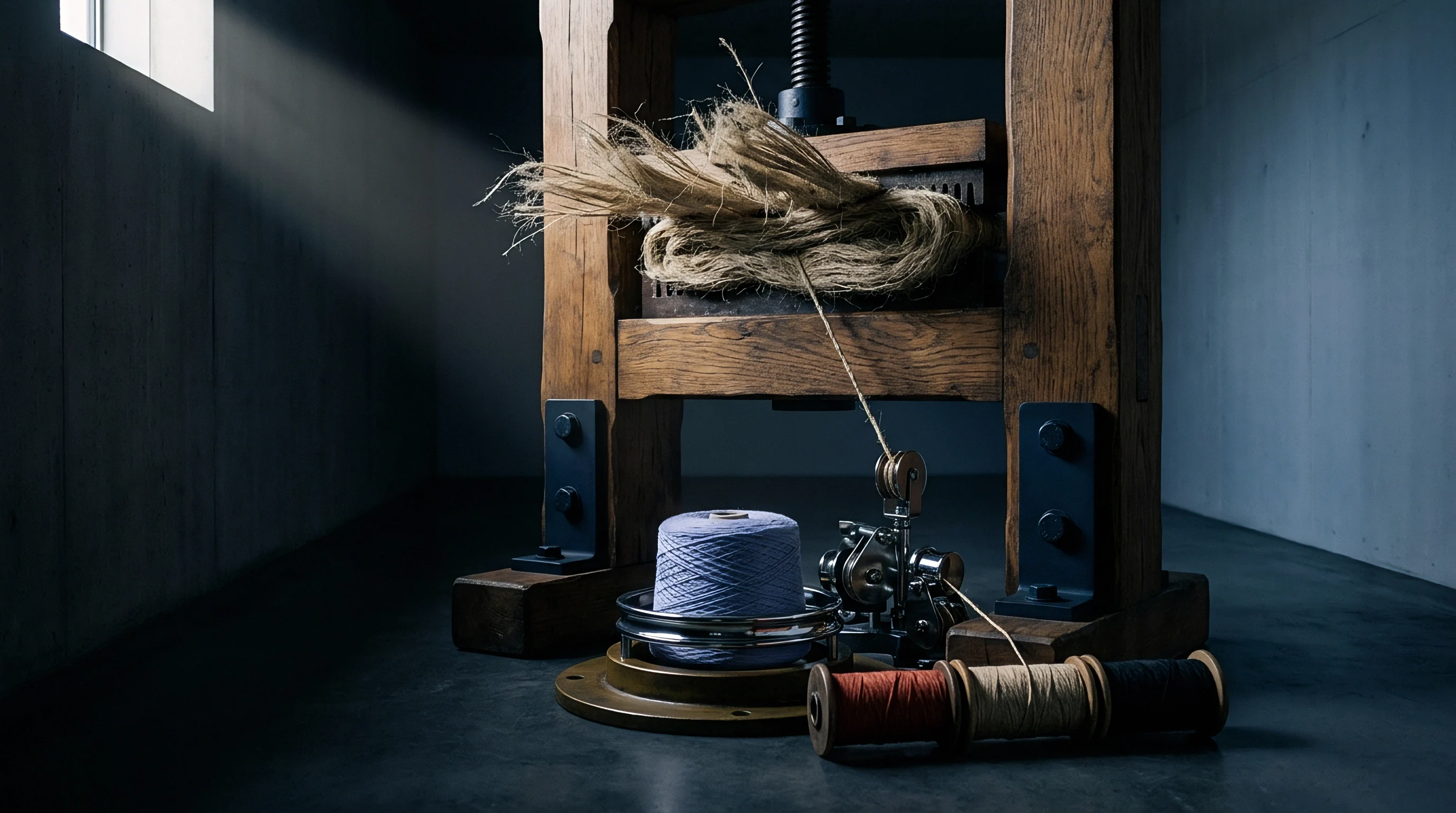
Comb
Scutched line flax arrives at the mill as coarse, glued ribbons of bast tissue that must be mechanically split before drafting. Metric fibre number (Nm fibre) measures length in metres per gram of unspun mass, so higher values indicate finer bundle cross-sections. Raw ribbons between 200 and 400 Nm fibre consist of coarse technical bundles bound by insoluble calcium pectate and cortical parenchyma.
Spinning fine wet-spun line yarn beyond 40 Lea (equivalent to 67.7 Nm yarn) requires splitting these bundles on a hackling machine until strands exceed 1,200 Nm fibre. Combing pins break the lateral pectin bridges, thinning the bundles while removing short fibres and residual shive.
ISO 2370 specifies fibre fineness testing based on air permeability through a compressed plug of set mass and volume. The instrument measures pressure drop across the plug, converting airflow resistance into a mean metric fibre number. Coarse bundles leave large voids, producing low resistance and lower metric values.
Well-split bundles create tight pore channels and high surface area, driving up pressure drop and reading as higher metric numbers. Because airflow testing returns only a single average, it hides variation across a lot. Dew-retted flax grown under patchy rainfall often exhibits wide variance, with coarse bundle cores mixed among over-retted, split filaments.
Water-retted and enzyme-retted stock yield much tighter standard deviations around that mean.
Hackling machines divide bundles using comb bars with increasing pin densities. Early passes run coarse round pins at two pins per centimetre to straighten tangled heads and tails. Intermediate passes step up to eight pins per centimetre, shearing secondary pectate bonds along the middle lamella.
Finishing passes use flat steel needles at eighteen to twenty-two pins per centimetre, reducing bast tissue to elementary bundle sizes. Hackling yield tracks the percentage of long line sliver recovered from the input scutched flax. Over-hackling coarse flax to hit an artificial fineness target destroys that yield, degrading long flax into cheap hackling tow.
| Flax Classification Grade | Retting Method | Scutched Metric Number (Nm_f) | Hackled Metric Number (Nm_f) | Hackling Line Yield (%) | Shive Content (%) |
|---|---|---|---|---|---|
| Superior French Line BK-1 | Dew Retted | 380 to 420 | 1450 to 1650 | 62.5 | 0.15 |
| Standard Belgian Line Courtrai | Water Retted | 410 to 460 | 1550 to 1750 | 65.0 | 0.08 |
| Medium Heilongjiang Line Grade 1 | Dew Retted | 290 to 340 | 1100 to 1250 | 54.0 | 0.45 |
| Coarse Baltic Line R-3 | Dew Retted | 220 to 260 | 850 to 980 | 48.0 | 0.80 |
Fibre length distribution governs how fineness translates into sliver cohesion. Long line flax averaging 450 to 600 millimetres gives fine bundles broad contact zones to overlap, generating the inter-fibre friction needed to sustain drafting tension during roving preparation. Short fibres under 100 millimetres lack enough contact area and slide past neighboring bundles without transferring draft force.
When hackling pins break brittle fibres, the accumulation of short fibres depresses the sliver’s effective metric number and creates periodic thin spots during drafting. Combing must balance bundle splitting against breakage to preserve fiber length.
Fibre bundle cohesion established during hackling dictates maximum draft limits long before mechanical spindle speed reaches its limit.
Combing defects directly destabilize downstream wet spinning. Splitting bundles without clearing bark fragments traps non-fibrous material in the sliver, disrupting alignment and causing localized variations in linear density.
- Under-retted bundle coarseness suppresses metric fibre numbers below 1,000 Nm fibre, preventing complete pin penetration during high-density hackling passes.
- Cortical tissue adhesion binds adjacent bast ribbons into flattened bands, causing wide cross-sectional mass variation in the finished sliver.
- Fibrillar ribbon splitting occurs when excessive pin impact fractures longitudinal cell walls, generating short debris and increasing nep count.
- Shive particle entrapment locks rigid woody stem core pieces inside the fine bundle matrix, causing instant yarn breakage at the spinning frame drafting nibs.
Increasing hackling intensity on dew-retted line flax illustrates how pin density shapes fineness distribution. High pin densities raise the mean metric fibre number from 320 to 1,380 Nm fibre, but standard deviation expands by forty-two percent across the fine bundle population. While thirty percent of the fibre reaches ultrafine dimensions above 1,800 Nm fibre, a persistent fraction remains locked in coarse 700 Nm bundles.
For mill managers setting frame draft limits, this poses a clear question: does the average metric number dictate spinning limits, or does the coarse tail of the distribution curve govern end breakage?
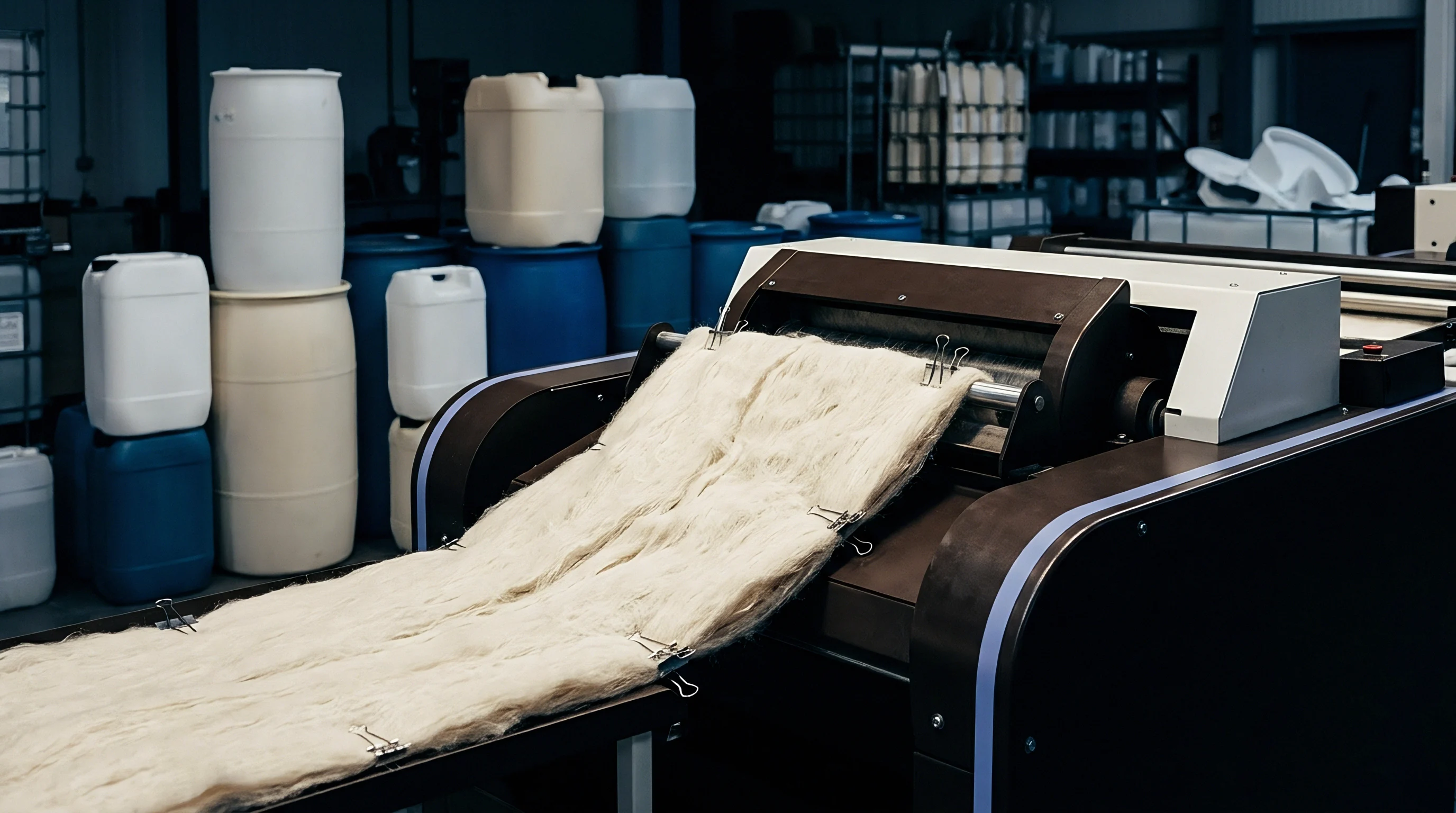
Trough
Thermal softening of intercellular pectin converts rigid ribbons into pliable elementary strands on the spinning frame. Wet spinning feeds twisted roving through a hot water bath directly above the drafting zone. The water dissolves residual water-soluble pectins and softens the insoluble calcium and magnesium pectates binding the elementary flax fibres.
These elementary fibres have individual metric numbers between 2,500 and 4,000 Nm fibre and mean diameters of 12 to 18 micrometres. Bath temperature and chemistry control how completely technical bundles break down into fine elementary units under drafting roller pressure.
Water temperature governs the rate of pectin softening. Below 50 degrees Celsius, calcium pectate stays rigid and restricts fibre division, causing intact technical bundles to pass through the rollers and forcing the frame into coarse counts. Running the bath between 60 and 70 degrees Celsius rapidly softens middle lamella pectins, enabling drafting rollers to slide elementary fibres past each other.
Above 85 degrees Celsius, excessive pectin loss weakens the wet matrix before twist insertion, leading to sliver drift as roving loses cohesion and pulls apart under light tension.
Dwell time in the bath determines how far water penetrates high-twist roving. Roving speed, path length through submerged guides, and twist density govern this duration. Hard-twisted roving resists water penetration, leaving core bundles dry and stiff.
Soft-twisted roving wets quickly but can disintegrate before hitting the nip rollers. Operators fine-tune submersion depth and chemical additives to optimize wetting ~ maintaining neutral pH to preserve strength, or adding mild acids to chelate calcium from insoluble pectates.
- Extract ten 100-millimetre roving specimens from incoming frame bobbins prior to trough immersion, recording dry mass on an analytical balance to four decimal places.
- Submerge specimens in a temp-controlled water bath at 65 degrees Celsius for exactly forty-five seconds to match production dwell times.
- Transfer wetted specimens immediately to a laboratory drafting tester, measuring peak pull-apart force at a constant speed of 100 millimetres per minute.
- Rinse drafted fibres in distilled water, dry at 105 degrees Celsius to constant mass, and weigh to determine water-soluble matter loss percentage.
- Calculate the softening index by dividing peak drafting force by net dry fibre mass, logging results to verify lot consistency across spinning shifts.
Dynamic friction changes as roving moves from the water bath into the drafting zone. Wet flax fibres carry higher friction coefficients than dry ones, preventing uncontrolled slip. Weighted rubber press rollers riding on fluted steel bottom rollers maintain grip.
The back rollers hold the softened roving and feed it into the drafting zone at speed V1, while the front rollers run at speed V2; the ratio of V2 to V1 establishes the mechanical draft ratio. Wet line spinning typically operates at draft ratios between 10 and 20, drawing out elementary fibres to yield finer yarns.
Line flax with a metric fibre number of 1400 yields less than two end breaks per thousand spindle hours when spun to 60 Lea under a 65 degree Celsius trough bath.
Poor bath chemistry creates clear operational failure modes. Over extended runs, dissolved pectins, hemicelluloses, and retting residues build up into viscous gel layers on immersion rollers. These deposits drag against the delicate roving, inducing tension spikes.
Regular bath changes and continuous overflow filtration keep the water clean, protecting fine yarn production from preventable mass variation.
Adequate water temperature and proper dwell time unlock the fineness potential of high metric number fibre. Inadequate bath heat wastes good stock by forcing frames onto coarser counts. Thorough pectin softening lets elementary fibres align smoothly, providing the structural base required for maximum yarn counts.
Boundary
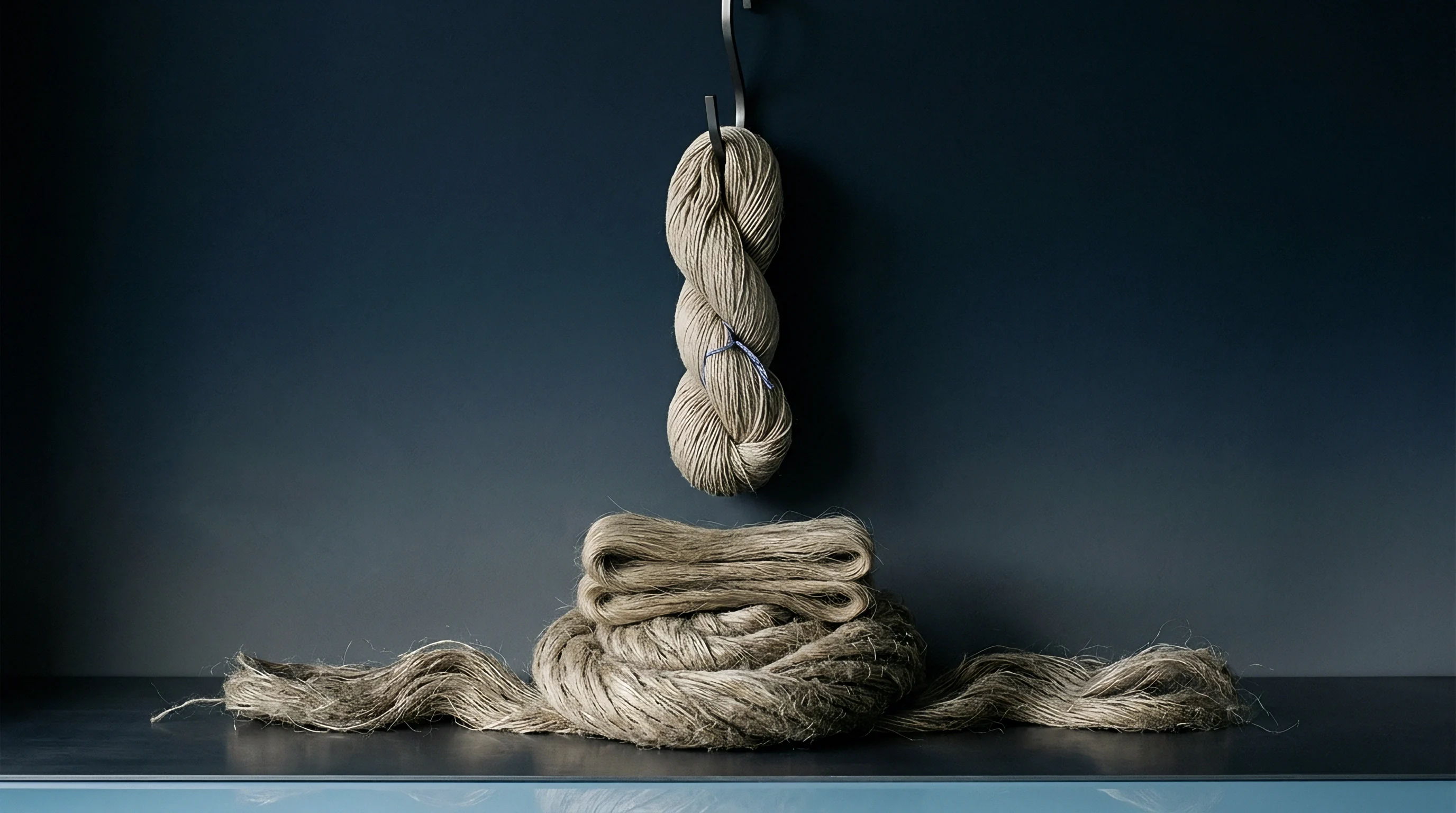
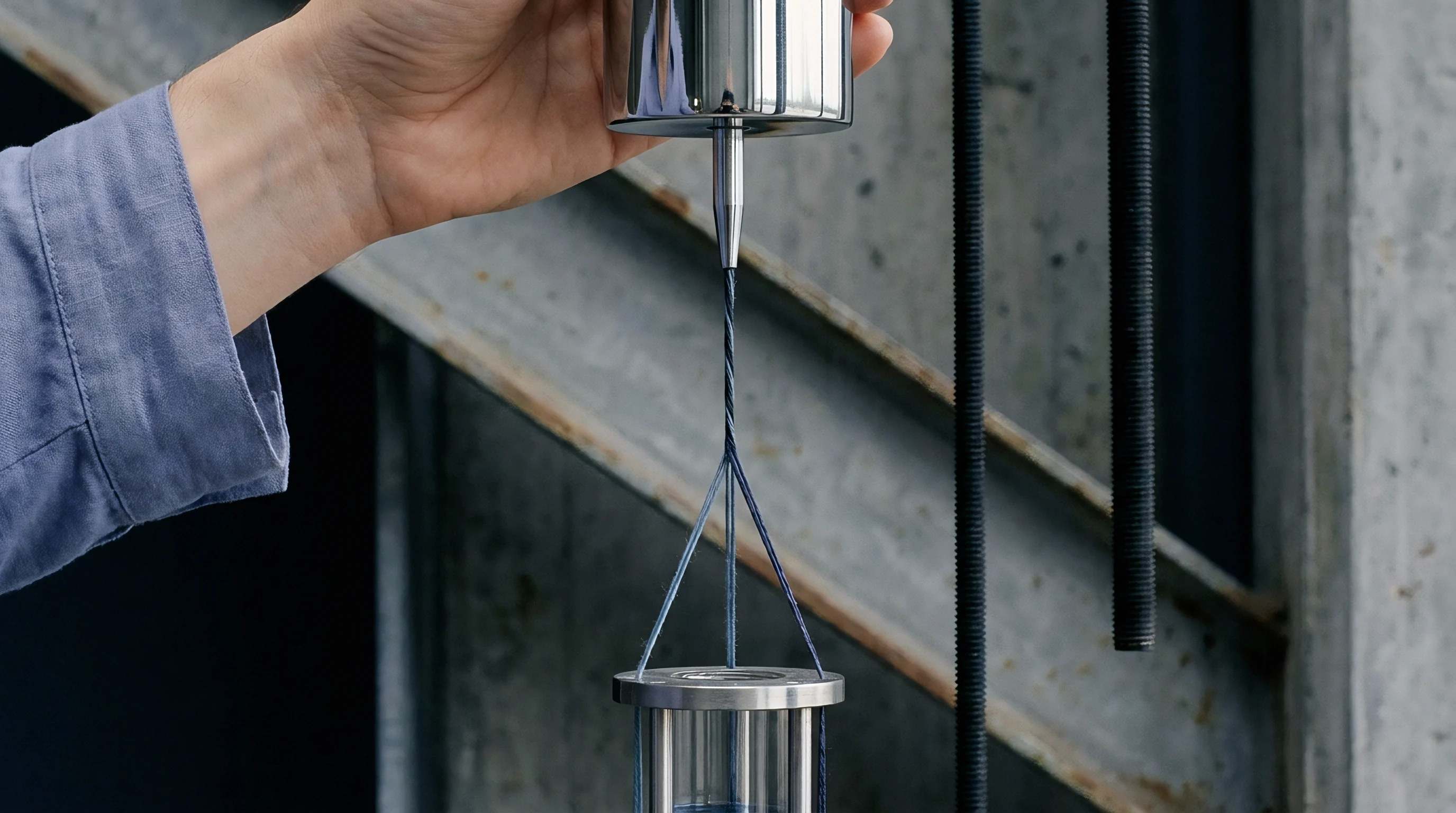
Determining the finest count a flax lot can sustain requires calculating the minimum cross-sectional fibre count needed to handle drafting tension. Wet-spun limits depend directly on the metric fibre number after hackling. While cotton spinning tolerates cross-sections of 60 to 80 fibres, wet-spun line flax works within tighter boundaries because of fibre length, surface friction, and pectin cohesion.
A wet-spun line yarn reaches structural equilibrium with 25 to 35 elementary fibres across its profile. Dropping below 20 fibres causes rapid strength loss and frequent end breaks at the thread guide.
Converting metric fibre number into maximum yarn count relies on a simple structural ratio. Defining Nm_f as the metric fibre number after hackling and softening, and Nm_y as the target metric yarn count, the average cross-sectional fibre count N equals Nm_y divided by Nm_f. Rearranging this yields the theoretical limit: Nm_y equals N times Nm_f, adjusted for structural efficiency.
In mill practice, Lea count replaces metric yarn count, with Lea calculated as Nm_y multiplied by 0.5905. For example, fine line flax with an Nm_f of 1,500 spun at an average cross-sectional count of 28 elementary fibres gives a theoretical limit of 53.3 Nm yarn, or 90 Lea.

Which Fibre Fineness Test Predicts Wet Spinning Limits?
Air-permeability testing under ISO 2370 provides a quick macro average for metric fibre numbers, but misses coarse bundle tail fractions. Gravimetric single-bundle sorting measures mass per unit length across discrete length fractions, catching residual coarse ribbons that slip through permeability plugs undetected. A sample registering 1,400 Nm fibre on an airflow test can easily conceal a ten percent mass fraction of coarse 600 Nm bundles.
In the drafting nip, those coarse bundles present only 8 to 12 thick fibres, creating thin zones immediately adjacent. Gravimetric single-bundle analysis reveals the actual fineness spread, providing a reliable basis for setting spinning limits.
| Hackled Fibre Metric Number (Nm_f) | Cross-Sectional Fibre Count (N) | Theoretical Limit (Nm_y) | Theoretical Limit (Lea) | Realized Mill Limit (Lea) | End Breakage Rate (Breaks/1000 sp-h) |
|---|---|---|---|---|---|
| 950 | 30 | 31.6 | 53.5 | 40 | 12.4 |
| 1200 | 28 | 42.8 | 72.4 | 60 | 14.1 |
| 1500 | 27 | 55.5 | 93.9 | 80 | 18.5 |
| 1800 | 25 | 72.0 | 121.9 | 100 | 24.2 |
| 2100 | 24 | 87.5 | 148.1 | 120 | 31.8 |
Drafting mechanics impose hard physical limits on fine yarn spinning. As target yarn count approaches the metric fibre limit, drafting force increases non-linearly. High draft ratios force wet elementary fibres to slide over long contact lengths against friction.
If required drafting force exceeds the upstream tensile strength of the wet bundle, the sliver breaks before twist can be inserted ~ marking the line between stable spinning and total frame failure.
Contract terms specifying ISO 2370 air permeability fineness without defining specimen preparation permit suppliers to deliver coarse outer stem ribbon under fine line pricing.
Four primary structural constraints dictate where stable wet spinning ends and yarn failure begins. These parameters govern the mechanical behavior of bast fibres inside the drafting zone.
- Critical cross-sectional count establishes the absolute lower boundary of 22 elementary fibres, below which tensile strength falls below frame winding tension.
- Inter-fibre friction dynamic dictates peak drafting force requirements, rising sharply when trough water temperatures drop below 60 degrees Celsius.
- Drafting force variance spikes when coarse bundle inclusions enter the front roller nip, causing instant mass reduction in adjacent yarn segments.
- Twist insertion rate limits frame delivery speed, as high count yarns require elevated twist levels to anchor short fibre ends securely.
Consider two flax shipments processed for 80 Lea wet-spun line production. Lot A arrives with a declared airflow rating of 1,450 Nm fibre and a narrow standard deviation of 180 Nm. Lot B carries a higher nominal rating of 1,520 Nm fibre, but its standard deviation is 410 Nm owing to irregular retting. Running Lot A gives stable frame performance at 80 Lea, averaging 15 end breaks per 1,000 spindle hours with a total yarn mass CV of 11.2 percent.
Running Lot B on the same frame at 80 Lea causes end breaks to jump to 48 per 1,000 spindle hours, forcing operators to cut frame speed by twenty-five percent and drop target count to 65 Lea to keep the line running.
A mill absorbed a sharp commercial loss on a 12-tonne contract after accepting flax lots based solely on mean metric fibre numbers without requesting fineness distribution curves. High average fineness concealed a fifteen percent coarse bundle fraction that forced target counts down from 70 Lea to 50 Lea across the order, wiping out projected margins per metre.

Spindle
Inserting twist into a wet, drafted sliver anchors the elementary fibres before the yarn package dries. The wet-spinning frame carries out drafting and twisting simultaneously under tight mechanical control. As wet fibres exit the front roller nip, they form a flat, untwisted ribbon.
The rotating traveler and spindle pull this ribbon downward, applying helical twist that binds outer fibres around the core. Because water lubricates adjacent strands, wet flax requires higher twist factors than cotton or dry-spun bast fibres. The metric twist multiplier alpha typically ranges from 45 to 60 for wet line spinning.
Spindle speed sets output rates while controlling thread line tension. Modern wet-spinning frames run spindles at 5,000 to 8,500 revolutions per minute. Higher speeds increase centrifugal balloon tension along the wet yarn segment between thread guide and traveler.
Because wet flax yarn has lower instantaneous tensile strength than dry finished yarn, excessive balloon tension can stretch the wet strand past its yield point, creating permanent thin spots or snapping the thread. Technicians adjust traveler weight and spindle speed to keep balloon tension below sixty percent of wet breaking strength.
Yarn evenness shows how effectively metric fibre fineness translates into uniform yarn mass. Mass variation is measured on Uster capacitive testers as coefficient of variation percentage (CV%). Fine line yarns spun near their metric limit show higher mass variation because fewer fibres per cross-section increase statistical fluctuation.
Hairiness remains much lower in wet spinning than dry spinning, as pectin films paste fibre ends onto the yarn core during twisting. However, incomplete pectin removal leaves loose tails that increase hairiness and cause threads to cling during bobbin winding.
| Spun Yarn Count (Lea) | Spindle Speed (RPM) | Mechanical Draft Ratio | Twist Multiplier (α_Nm) | Yarn Mass Evenness (Uster CV%) | Single-Strand Tenacity (cN/tex) |
|---|---|---|---|---|---|
| 30 | 7200 | 11.2 | 48.5 | 9.8 | 38.5 |
| 50 | 6800 | 13.8 | 52.0 | 11.4 | 34.2 |
| 70 | 6200 | 16.5 | 55.5 | 13.1 | 30.8 |
| 90 | 5500 | 18.9 | 58.0 | 15.2 | 27.1 |
| 110 | 4800 | 21.4 | 61.5 | 17.8 | 23.5 |
Monitoring machine floor indicators allows plant auditors to trace yarn defects back to specific mechanical or raw material roots. Systematic auditing protocols ensure every spindle operates within target tolerances.
- Front roller pressure alignment verifies nip clamping force across every spindle line, preventing local drafting slippage and heavy mass slubs.
- Traveler mass matching checks ring traveler mass against target spun count, controlling balloon shape and preventing yarn abrasion against bobbin shields.
- Trough water temperature monitoring logs individual bath cell heat, ensuring uniform pectin softening across multi-spindle frame sections.
- Roving guide traverse stroke confirms transverse distribution across rubber roller faces, preventing grooved roller wear that ruins yarn levelness.
Pushing yarn counts past physical fineness limits leads to immediate performance degradation on the spinning floor. End breaks rise above 40 per 1,000 spindle hours, overwhelming operators and forcing frequent stops. Balloon collapses multiply, tangling and shearing adjacent threads, while damp fly builds up on roller clearers and drops heavy slubs into active yarn channels.
These failures illustrate that frame adjustments cannot make up for deficient raw material fineness.
A mill audit team tracked persistent end breakage back to a ten-degree temperature drop along the back section of a sixty-spindle trough frame. Although raw fibre variation was initially blamed for poor fine-count performance at 80 Lea, calibrated thermocouple sensors proved the fibre met specifications and that cold water was preventing proper pectin softening before drafting.
Settlement
Commercial valuation of raw flax reflects the finest spinnable Lea count attainable without excessive frame stops, with prices scaling steeply alongside verified metric numbers. Scutched line flax at 1,000 Nm_f commands standard commodity pricing, whereas refined hackled line above 1,800 Nm_f commands premiums up to one hundred and fifty percent. The economics reflect yarn yield: fine counts enable weavers to produce lightweight, high-value fabrics that earn premium prices per metre.
Buying coarse fibre for fine spinning causes production failure, while using high-grade fine fibre for coarse counts wastes raw material margin.
Linking raw fibre purchase costs to finished yarn metrics requires accounting for mass loss at every processing step. Scutched flax priced at 4.20 Euros per kilogram loses weight during hackling, yielding sixty percent long line sliver and thirty-five percent lower-value tow. After crediting tow sales, the effective raw material cost entering the mill reaches 6.10 Euros per kilogram.
Wet spinning adds energy, labour, drying, and winding overhead, contributing another 3.80 Euros per kilogram of yarn produced. Landed yarn cost equals total material and conversion expenditure divided by net bobbin yield.
Missing target yarn counts significantly alters finished fabric economics. Spinning 40 Lea yarn produces 338 metres per 100 grams, yielding heavier fabric suited for upholstery or coarse shirting. An 80 Lea yarn yields 677 metres per 100 grams, enabling weavers to produce lightweight 120 gram per square metre linen.
If a lot rated for 80 Lea fails on the frame and must be spun at 50 Lea, running length per kilogram drops by 37.5 percent, forcing weavers to re-engineer fabric construction or default on contract volumes.
Commercial claims over sub-standard fibre fineness depend entirely on clear contract specifications. Origin or colour declarations offer no legal recourse when spinning fails. Effective procurement contracts establish explicit metric fibre thresholds, fineness distribution limits, and standardized testing protocols under defined sampling rules.
A standard contract clause specifies: Line flax delivered under this agreement shall maintain a minimum mean metric fibre number of 1,500 Nm_f measured in accordance with ISO 2370 across ten randomized bale samples per shipment lot. The coefficient of variation in fibre metric number shall not exceed fourteen percent, and short fibre content under 100 millimetres shall remain below eight percent by mass. Fibre failing to meet these fineness and variance parameters shall be subject to mandatory price adjustments matching the actual realized Lea count spun during certified mill verification trials.