Critical Residual Pectin Thresholds Governing Wet-Spinning Cohesion Limits in Ultra-Fine Count Yarns
Maintaining residual pectin between 0.8% and 1.4% prevents roving draft collapse while enabling fibre attenuation in wet-spinning ultra-fine linen yarns.


Gum
Chemical extraction under ASTM D629 or ISO 1833 confirms that unretted flax bast contains 4.0% to 6.0% pectin by dry mass, binding ultimate cortical cells into rigid technical fibre bundles. In coarse yarn processing, these macro-bundles pass intact through drafting. Spinning ultra-fine counts above Nm 80 (12.5 tex, 72 lea), however, requires splitting technical bundles down to elementary filaments of two to four ultimate fibres, each 12 to 18 micrometres in diameter.
Polygalacturonic acid chains cross-linked by divalent calcium and magnesium cations form the core of this inter-cellular matrix. The residual mass fraction of this polysaccharide determines whether technical fibres split smoothly in the drafting zone or shear under mechanical stress.
Polygalacturonic Degradation and Bundle Splitting Mechanics
Controlled removal of the non-cellulosic matrix occurs during field retting and subsequent roving bobbin boiling. Raw, under-retted flax with over 2.8% dry pectin retains cross-linked polymers that resist thermal softening. Technical bundles enter the drafting zone at effective diameters exceeding 35 micrometres, causing front roller nip failure, thick places, and frame end-breakage rates above 80 stops per 1,000 spindle hours.
Conversely, overly aggressive enzymatic or alkaline boiling that strips residual pectin below 0.5% destroys inter-filament shear resistance. Without a thin residual adhesive layer, individual ultimate fibres lose cohesion in the drafting field, floating out of the strand matrix and producing nep-laden, low-tenacity yarn.
At a water temperature of 68°C in the spinning trough, a residual pectin content between 0.9% and 1.2% by dry weight allows technical fibre bundles to attenuate into elementary filaments averaging 1.8 dtex without draft-zone slippage.

Residual Calcium Pectate Levels in Scutched Line Flax
Spectrophotometric carbazole testing and ammonium oxalate extraction measure the insoluble calcium pectate pool that governs fibre cohesion. Unbound water-soluble pectins dissolve rapidly during early roving wetting, but insoluble pectate salts require thermal plasticization to permit controlled inter-filament sliding. Keeping the residual calcium pectate fraction within 0.8% to 1.4% dry weight preserves structural integrity under draft while allowing ultimate units to slide without breaking crystalline cellulose chains.
Fibre lots with pectin values above 1.5% require additive chelating agents during roving preparation to convert rigid calcium bridges into soluble sodium pectate structures.
Whether enzymatic pre-treatments on roving bobbins can selectively cleave rhamnogalacturonan-I side chains without weakening the crystalline cellulose core of ultimate fibres remains an open debate among yarn technologists.
Trough
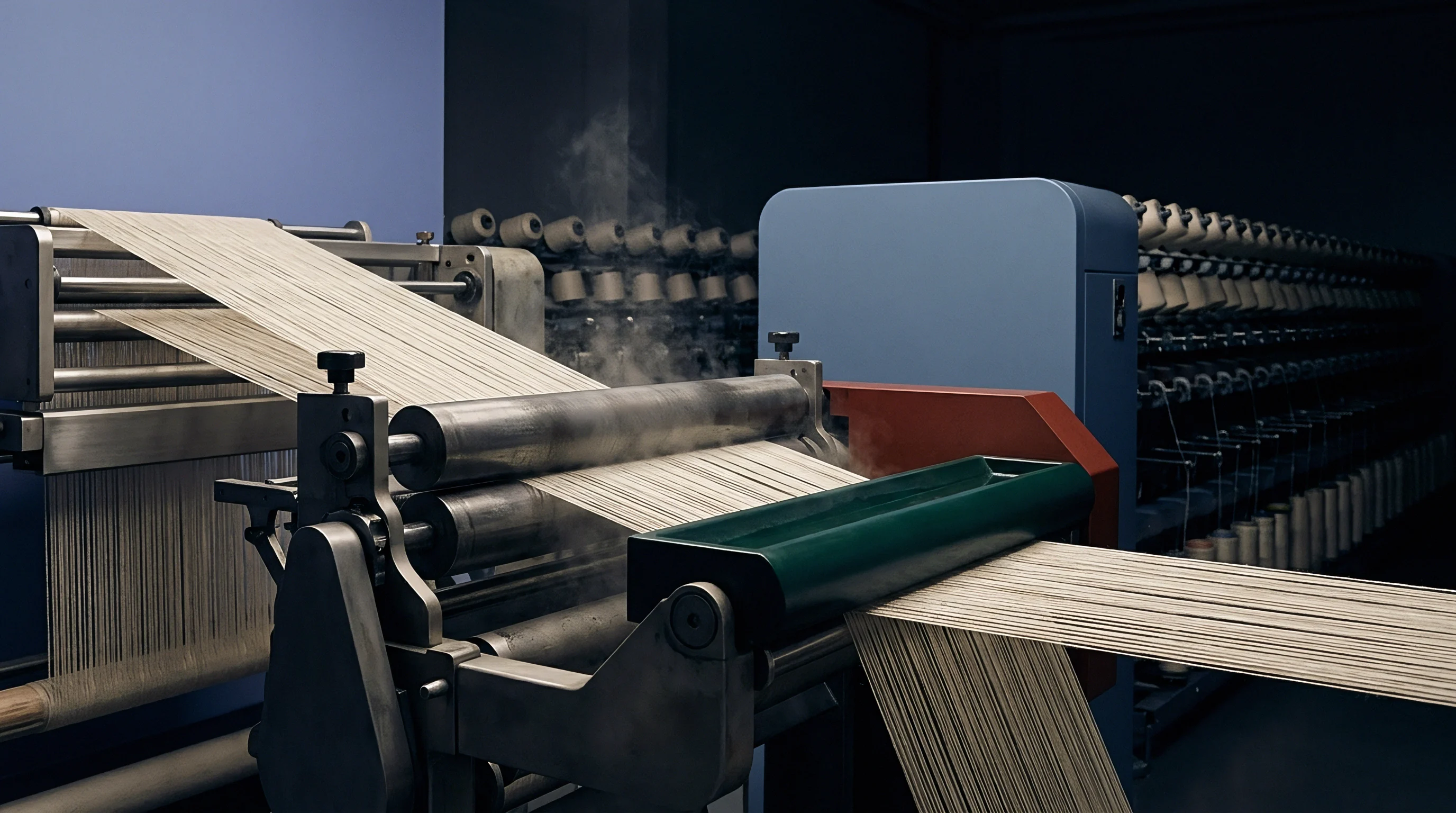
Operating temperatures in the wet-spinning bath control the rate at which calcium pectate bonds transition from rigid structural networks into soft visco-elastic gels. Water heated to between 60°C and 75°C penetrates the porous lumen of the flax strand, hydrating pectin molecules and reducing the yield stress of the inter-cellular lamella. Front drafting rollers apply linear velocity acceleration up to twenty times the back roller speed.
Under this mechanical draft, plasticized pectin acts as a boundary lubricant, allowing parallel ultimate filaments to slide relative to one another while maintaining continuous transverse pressure across the strand core.

Thermal Plasticization of Calcium Pectate Bridges
Drafting force measurements taken at the front roller nip show a direct relationship between bath temperature and pectin rheology. Cold water below 45°C fails to soften insoluble pectate polymers, producing drafting force spikes above 25 Newtons per kilotex. These force surges exceed the tensile strength of wet flax slivers, causing frequent roving line breaks.
Raising bath temperature to 70°C lowers required drafting force to a stable 8 to 12 Newtons per kilotex. This reduction allows ultra-fine strands of 12 tex to draw out evenly without localized necking or draft-wave mass variation.
| Residual Pectin Range | Trough Temp | Attainable Count | Drafting Force | End Breakage Rate | Yarn Mass CV% |
|---|---|---|---|---|---|
| > 2.2 | 55 | Nm 45 | 28.4 | 62 | 18.8 |
| 1.5 – 2.2 | 60 | Nm 60 | 19.1 | 34 | 16.2 |
| 0.8 – 1.4 | 68 | Nm 100 | 10.5 | 14 | 12.6 |
| 0.8 – 1.4 | 75 | Nm 120 | 8.2 | 18 | 13.8 |
| < 0.5 | 68 | Draft Collapse | 2.1 | 110 | 24.5 |
| Data collected on a 156-spindle wet-spinning frame using Courtrai long line flax at a spindle speed of 6,200 RPM and a draft ratio of 18.5. | |||||

Water Hardness and Trough Retention Dynamics
Dissolved mineral content in trough feed water alters residual pectin behaviour during continuous spinning runs. Water hardness above 10 German degrees introduces free calcium ions (Ca2+) into the bath. These cations exchange with soft sodium pectate structures, re-solidifying the pectin matrix mid-draft.
Spinning mills run water softening plants to keep total calcium concentrations below 15 parts per million. Sodium hexametaphosphate dosing at 0.5 grams per litre binds free metallic ions, preventing pectin re-calcification and holding drafting force variations within 5% across eight-hour production shifts.
Standard ISO 2062 tensile evaluation under wet conditions specifies a 200 millimeter gauge length where cohesive shear failure at low residual pectin manifests as continuous load drops below 18 centinewtons per tex.
Allowing trough pectin extraction to fall below the minimum cohesion boundary causes immediate strand collapse at the thread guide, converting an entire frame’s output into soft waste and tripling rewinding labor expense.
Clamp
Tensile testing of wet-drawn roving bundles reveals the transition point between inter-fibre friction failure and crystalline cellulose rupture. Standard mechanical testing uses pneumatically driven jaws lined with vulcanized rubber to prevent specimen slippage. When testing ultra-fine wet strands, jaw pressure must be calibrated to 0.4 bar per square millimetre.
Excessive pressure crushes the wet pectin gel, creating artificial stress concentration points that cause jaw breaks. Insufficient pressure allows the slippery, hydrated strand to slide out of the grips, yielding artificially low tenacity values.
- Over-retted bundle disintegration occurs when pectin content drops below 0.6%, causing line flax bundles to split prematurely into short ultimate fragments during hackling, raising short fibre content above 22%.
- Roving draft stall develops when residual pectin exceeds 1.8%, locking technical fibres together so that drafting rollers shear the cellulose core rather than sliding adjacent filaments apart.
- Trough gel accumulation arises when high water-soluble pectin fractions dissolve rapidly into the bath, raising bath viscosity beyond 12 centipoise and fouling yarn guides with sticky residue.
- Splice shear slip takes place in ultra-fine Nm 100 yarn splices when low residual pectin prevents wet entanglements from developing sufficient inter-filament capillary friction under spinning tension.
What Pectin Concentration Preserves Ultimate Fibre Cohesion?
Inter-fibre cohesion reaches peak stability when residual pectin measures 1.0% ± 0.15% by dry weight. At this level, sliding shear force between ultimate filaments balances the internal frictional resistance created by yarn insertion twist. Wet tensile strength tests conducted according to ISO 2062 show that strands within this pectin band maintain a tenacity of 32 to 38 centinewtons per tex.
Lower pectin levels drop inter-filament static friction below 0.18, causing individual fibres to pull apart under spinning tension before twist locks them into the yarn structure.
| Processing Stage | Residual Pectin | Linear Density | Tenacity | Friction Coeff | Primary Defect Mode |
|---|---|---|---|---|---|
| Scutched Hackled Line | 3.80 | 22.0 ktex | 42.5 | 0.45 | Coarse Bundle Rigidity |
| Boiled Roving Strand | 1.15 | 0.80 ktex | 18.2 | 0.26 | None (Target State) |
| Draft Zone Filament Strand | 0.95 | 10.0 tex | 12.4 | 0.21 | Drafting Friction Yield |
| Wet-Spun Single Yarn | 0.90 | 10.0 tex | 36.8 | 0.38 | End Breakage under Peak Tension |
Roving bundles that display a wet slip-to-rupture ratio below four to one will drop ends consistently across high-draft spinning frames.
Incorporating IWTO-38 moisture regain and residual non-cellulosic extractable limits directly into commercial purchasing contracts shifts financial liability for spinning frame end-breakage spikes back to the scutcher.

Skein
Spinning counts above Nm 80 shift the economic balance between raw fibre selection, chemical roving preparation, and frame productivity. Production of Nm 100 yarn (10 tex, 90 lea) requires long-staple dew-retted flax with an initial bundle fineness below 1.6 dtex. Mechanical processing must remove coarse non-cellulosic impurities while maintaining structural alignment.
Roving preparation relies on mild alkaline boiling in stainless steel pressure vessels to adjust pectin content precisely before material reaches the spinning bobbin.
Worked Conversion Dynamics for Nm 100 Wet-Spun Line Yarn
A standard production lot illustrates the yield and cohesion boundaries governing ultra-fine counts. Consider a 1,000 kilogram lot of scutched Courtrai line flax entering the mill at €9.20 per kilogram. Hackling operations achieve a 68% long line yield, producing 680 kilograms of dressed sliver while generating 280 kilograms of hackling tow valued at €3.10 per kilogram.
The long line sliver undergoes drawing and roving operations, where bobbins receive a chemical boiling treatment to reduce residual pectin from 3.6% down to 1.1%.
During wet-spinning on a high-draft frame operating at draft 18.2 and spindle speed 6,500 RPM, processing efficiency depends directly on pectin consistency. Under target conditions (1.1% pectin), the yarn end-breakage rate remains at 14 breaks per 1,000 spindle hours. Process waste during wet-spinning stays at 2.2%, yielding 636 kilograms of net Nm 100 yarn.
Total manufacturing cost per kilogram of finished yarn calculates to €28.40, translating to €4.26 per linear metre for a woven fabric weighing 150 grams per square metre at 150 centimetre width.
A stressed operational scenario reveals the cost impact of off-spec pectin control. If roving boiling achieves only 1.9% residual pectin, high drafting resistance causes the end-breakage rate to surge to 68 breaks per 1,000 spindle hours. Wet-spinning waste increases to 6.5%, while yarn mass variation (CV% 10m) degrades from 12.6% to 18.2%.
Net yarn production drops to 608 kilograms. High frame downtime and elevated waste raise yarn production cost to €33.80 per kilogram. This operational failure adds €0.81 per finished linear metre to fabric production costs, wiping out the weaver’s target margin.
- Bale sampling and chemical assay demands drawing five 50-gram core samples per 200-kilogram bale to measure residual pectin via ammonium oxalate extraction prior to roving bleaching.
- Roving boiling and enzyme dosing modifies the pectin structure by treating roving bobbins at 85°C with 0.4 grams per liter pectinase at pH 5.2 for 45 minutes to hit the target 1.1% residual threshold.
- Trough water chemistry regulation controls calcium ion concentration at 25 to 35 parts per million using sodium hexametaphosphate dosing to prevent pectin re-calcification during wet drafting.
- Draft zone tension calibration matches top roller pressure to the wet bundle friction profile, setting front roller nip force to 180 Newtons per spindle.
- Cone winding and yarn clearing monitors thin places (-40%), thick places (+35%), and neps (+200%) on capacitive sensor clearers set specifically for linen single yarns.
Ultra-fine linen spinning limits reflect the boundary where chemical extraction of the pectin matrix matches the mechanical shear strength of individual ultimate fibres.
High count variance frequently stems from seasonal field retting irregularity, where natural dew-retting variation makes consistent pectin control below 1.2 percent difficult to maintain across commercial bale lots.
Yield
Commercial valuation of fine-count flax raw material connects chemical purity metrics directly to finished fabric weight and metre-cost calculations. Scutched flax lots destined for fine counts cannot be evaluated on length and colour alone. Laboratory verification of residual pectin content, calcium ion concentration, and metric fibre number must occur before contract pricing is finalized.
Fiber suppliers charging premium prices for ultra-fine grades must provide certified test dossiers attached to individual bale numbers.
| Yarn Count | Target Pectin Content | Scutched Fibre Grade | Hackling Yield | Spinning Efficiency | Yarn Cost | Fabric Cost |
|---|---|---|---|---|---|---|
| Nm 60 / 54 Lea | 1.2 – 1.6 | Courtrai Grade 3.0 | 72.0 | 94.5 | 18.50 | 2.59 |
| Nm 80 / 72 Lea | 1.0 – 1.3 | Courtrai Grade 3.5 | 68.5 | 91.2 | 23.20 | 3.25 |
| Nm 100 / 90 Lea | 0.8 – 1.1 | Courtrai Grade 4.0 | 65.0 | 86.8 | 29.80 | 4.17 |
| Nm 120 / 108 Lea | 0.8 – 1.0 | Selected Line Grade 4.5 | 58.0 | 79.4 | 42.10 | 5.89 |
Achieving stable productivity at Nm 100 demands strict adherence to raw material selection thresholds. Chemical test reports must accompany every incoming raw flax shipment.
- Fibre bundle metric number exceeds Nm 650, corresponding to ultimate fibre fineness below 1.5 dtex, ensuring sufficient ultimate filaments per cross-section in fine yarn.
- Initial unretted pectin load remains below 4.8% dry mass so that mild enzymatic roving boiling achieves the target 1.0% threshold without cellulose degradation.
- Residual calcium content stays below 1,200 parts per million to ensure that trough water chelating agents can successfully plasticize the pectate matrix.
- Tenacity safety margin demands a minimum unretted bundle strength of 34 centinewtons per tex measured via Stelometer testing at zero gauge.

Contract Specifications for Fine Count Flax Supply
Procedures for fine flax procurement incorporate chemical and physical parameters into standard contract terms. Technical purchasing agreements mandate maximum allowable residual pectin limits of 1.2% by dry mass for roving bobbins supplied to spinning lines. Ash content limits are set below 1.5%, while wet bundle tenacity must exceed 32 centinewtons per tex under standard laboratory conditioning at 20°C and 65% relative humidity.
Shipments exceeding pectin limits incur automatic price deductions or rejection at the mill gate.
Buying raw flax on fibre length alone without specifying residual pectin limits guarantees that high hackling yields will be liquidated by low spinning frame efficiency.