Hand Classing Methods for Identifying Technical Fibre Bundle Division in Scutched Line Flax
Manual hand classing identifies technical fibre bundle division through thumb splitting, pull drafting, and tactile drag to predict hackling yield and yarn count.


Strick
Classing long flax manually comes down to opening hand-held bundles to see how decortication and retting affected the bast tissue. Within scutched fibre, elementary cells ten to thirty micrometres across stay bound by a pectinate middle lamella into composite structures known as technical fibre bundles. When evaluating a scutched lot, the main goal is to figure out if these bundles can split smoothly into finer sub-units during hackling and wet drafting.
Under-retted stock leaves rigid pectin bridges that lock bundles into coarse ribbons over one hundred micrometres wide, choking draft performance on the frame. If over-retted, the intercellular cement breaks down so far that technical bundles snap prematurely into weak short fibres, dropping out as scutching waste or hackling tow.
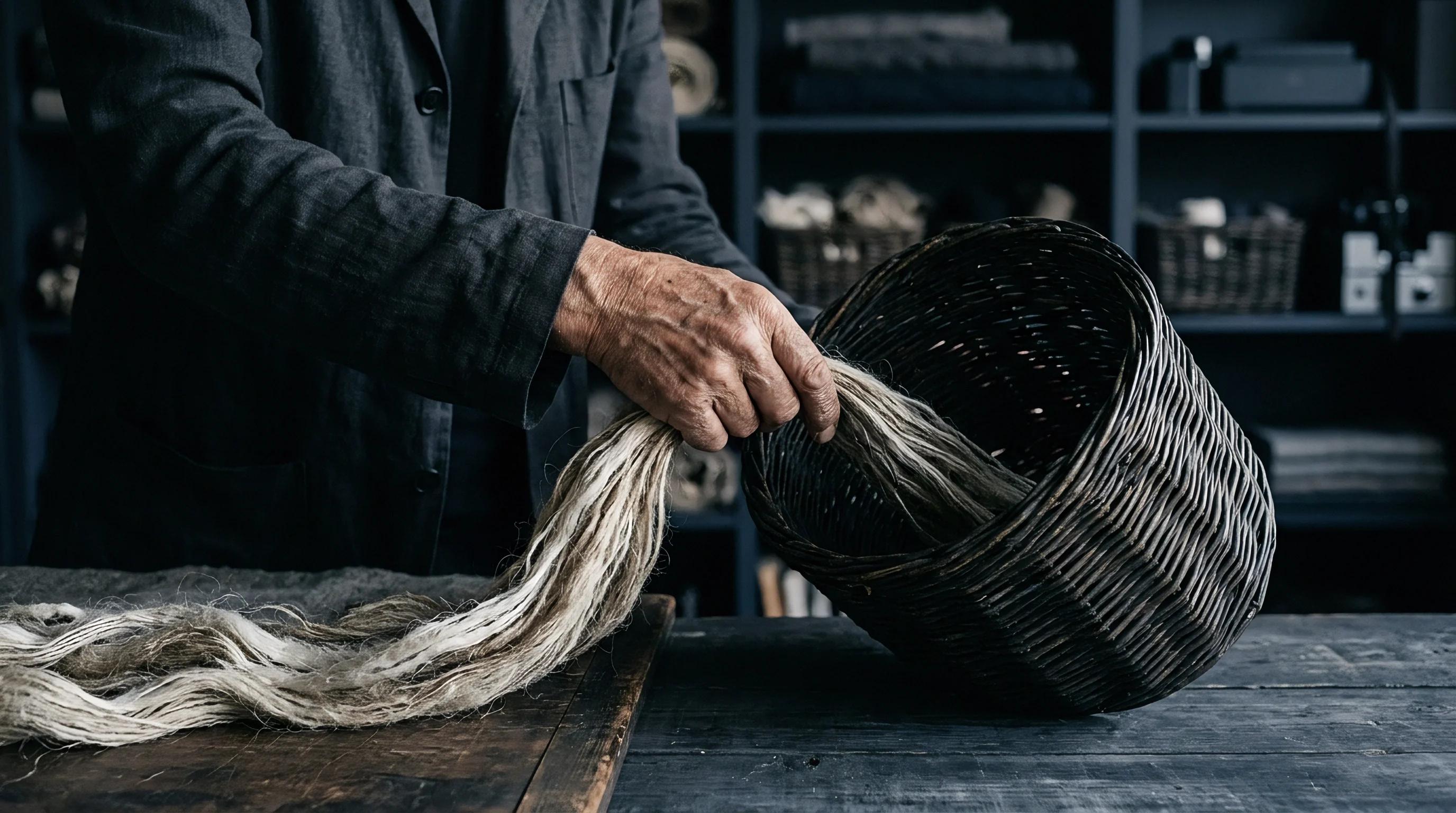
To inspect a bale, classers pull sample hanks from its center, grip the bundle five centimeters from the butt end, and sweep the free tail over a dark wooden table. Under diffused natural light, they check for un-cleaved shive fragments and raw outer bark glued to the bundles. Where retting is uniform, the fibrous sheath shows a silky sheen with separate filament bands that fan out freely under light hand tension.
If the bundles feel coarse and sticky, rigid filaments resist separation and make a harsh, straw-like crackle when flexed.
Dew-retted scutched line flax exhibiting a bundle linear density under 1.8 tex yields an average hackling loss below 14 percent at standard 65 percent relative humidity.
Structural anomalies in the bundles cut down mechanical processing efficiency whenever under-divided or over-retted hanks pass through to hackling unspotted.
- Bark Adhesion Strips outer cortical tissue remains glued to technical bundles from incomplete enzymatic retting, blocking bundle division and introducing dark, coarse neps into drawn slivers.
- Coarse Gummy Ribbons thick technical bundles bound by un-degraded calcium pectate resist combing pins, flexing the pins out of alignment and driving fine line flax into low-value tow.
- Brittle Over-Retted Filament severe fungal breakdown ruins the primary cell wall and middle lamella, causing bundles to snap crosswise during manual drafting instead of splitting lengthways.
- Twisted Strand Aggregates uneven drying or bad feed alignment at the scutching turbine twists parallel bundles into tight, rope-like knots that snap hackling combs and disrupt roller nip spacing.
Misjudging bundle division at the sampling table locks wrong draft ratios directly into the spinning schedule. Mills accepting under-divided line flax on surface shine alone run into high end-breakage rates, uneven mass across roving strands, and a drop in realized yarn count from target Nm 50 down to Nm 30, pushing fabric margins straight into a loss.

Ribbon
Bast structures inside scutched flax show different levels of longitudinal cleavage under mechanical shear. With lengths from fifteen to forty-five millimetres, individual elementary cells never act as standalone spinning units in long line processing. Draft lines rely on composite filaments made of dozens of elementary cells overlapping end-to-end, held sideways by middle lamella gums.
The width of these multi-cell strands sets the maximum fineness of wet-spun yarn. To test thumbnail cleavage, a classer picks out a single strand, presses the right thumbnail against the index finger pad, and draws the strand swiftly across the nail apex under steady pressure.
Bundles that split cleanly under thumb pressure divide into multiple silky sub-filaments without snapping along their main axis. Frictional drag is barely noticeable, yielding a soft slide rather than a sharp crack. Where the middle lamella stays firm, thumb shear fails to cleave the bundle, making the ribbon buckle, curl, or snap across its width.
This check pinpointing the mechanical cleavage threshold of the middle lamella offers an immediate readout of bundle division before stock hits the hackling mill.
Rejection of bales under ISO 2370 occurs automatically when mean technical bundle diameter exceeds 38 micrometres across a twenty-strick composite sample.
Comparing technical bundle geometry across commercial flax grades demonstrates how bundle fineness and division state govern wet-spinning capabilities.
| Flax Classification Grade | Mean Bundle Diameter (µm) | Bundle Linear Density (tex) | Division Index (%) | Maximum Wet-Spun Count (Nm) |
|---|---|---|---|---|
| Superfine Line (Water/Enzyme Retted) | 15 – 22 | 0.8 – 1.2 | 88 – 95 | Nm 80 – Nm 110 |
| Standard Fine Line (Dew Retted) | 23 – 30 | 1.3 – 1.8 | 75 – 87 | Nm 50 – Nm 70 |
| Medium Commercial Line | 31 – 40 | 1.9 – 2.6 | 60 – 74 | Nm 26 – Nm 40 |
| Coarse / Under-Retted Line | 41 – 65 | 2.7 – 4.5 | 40 – 59 | Nm 14 – Nm 24 |
Fibre ribbons splitting smoothly without a snap under thumb shear reliably hold together through hot-water wet-spinning troughs.

Grasp
Assessing fibre cohesion and draft resistance requires feeling the open bundle core. In the pull-draft check, a classer grips a ten-centimetre section of the strick in both hands, applies steady axial tension, and draws the hands apart at around ten centimetres per second. Resistance against the thumbs measures sliding friction between adjacent technical bundles as they shear along middle lamella boundaries.
When pectin bridges are weakened properly, filaments slide past each other cleanly, forming a smooth, uniform web of parallel fibres free of sudden necking or clumped slippage.
Frictional drag changes with relative humidity during manual classing. Damp bundles introduce surface tack that feels like under-retted pectin, which can mislead inexperienced classers into grading stock as coarse. Classing areas keep atmospheric conditions controlled at 65 percent relative humidity and 20 degrees Celsius so tactile feedback aligns with lab friction measurements.

Which Tactile Indicators Signal Excessive Middle Lamella Degradation?
Classers spot over-retted or chemically degraded flax through clear sensory signals while working the fibre by hand.
- Select three representative hanks from distinct depth layers of the sampled bale to capture moisture gradients.
- Grasp the upper third of the bundle firmly with the left hand while holding the tail gently between the right thumb and index finger.
- Stroke the right hand down the bundle length twice to remove loose short fibres and align the filaments.
- Flex the mid-span section incrementally, listening for faint micro-fracturing ticks that indicate brittle, over-degraded cell walls.
- Perform a quick pull-draft stroke to see if the web breaks apart into short debris instead of long parallel slivers.
Over-retted flax ribbons break cleanly across the thumb line without showing longitudinal fibrous splitting.
Although coarse, harsh-handling scutched flax is sometimes expected to soften and divide during wet-spinning trough immersion, un-cleaved pectinate lamellae remain insoluble at standard 60-degree bath temperatures unless caustic chemical additives are added, which in turn degrade yarn tenacity.

Sorting
Floor classing judgments undergo formal validation through standard laboratory procedures. Gravimetric linear density measurements under ISO 2370 provide the objective baseline for bundle division, measuring mass per unit length across isolated samples. Technicians cut five-centimetre sections from the middle of classed hanks, weigh the composite bundle on a microbalance to within 0.01 milligrams, and count technical bundles under an optical microscope to determine tex values.
Vibroscope testing per ISO 1973 confirms linear density by measuring the acoustic resonant frequency of single technical bundles under calibrated tension.
Tensile strength testing using a stelometer per ISO 3060 links manual elasticity checks with breaking tenacity in centinewtons per tex. Over-retted stock with complete bundle division often drops below 25 cN/tex in bundle tenacity, making the fibre unspinnable despite its fine gauge. Properly divided line flax combines low bundle linear density with high breaking strength, allowing filaments to endure mechanical drafting pin forces without breaking across the grain.
Sorting well-divided line flax from coarse, under-retted stock requires evaluating physical indicators against clear lab thresholds.
- Filament Softness Grade tactile flexural resistance under thumb-loop bending must fall below 12 millinewton-metres to prevent needle deflection during hackling operations.
- Longitudinal Cleavage Index percentage of technical bundles splitting into sub-20 micrometre ribbons under manual shear must exceed 80 percent for fine wet-spun yarns.
- Residual Shive Mass Share total un-retted wooden core particles remaining attached to technical filaments must measure under 1.2 percent by weight per ISO 6741 conditioning protocol.
- Stelometer Bundle Tenacity breaking load measured at zero gauge length must exceed 38 cN/tex to guarantee yarn tensile integrity during ring spinning operations.
Matching manual classing observations with lab instruments sets clear boundaries for accepting raw stock.
| Manual Classing Parameter | Visual / Tactile Field Assessment | Laboratory Test Method | Target Fine Line Value | Reject Threshold Value |
|---|---|---|---|---|
| Bundle Division Degree | Silky web, effortless thumb split | ISO 2370 Gravimetric Tex | 1.2 – 1.6 tex | > 2.8 tex |
| Filament Tenacity | High spring-back, firm tension resistance | ISO 3060 Stelometer (0 mm) | 40 – 52 cN/tex | < 28 cN/tex |
| Surface Tack / Pectin Content | Smooth slide, low frictional noise | Spectrophotometric Ruthenium Red | 0.15 – 0.25 abs units | > 0.45 abs units |
| Fibre Length Uniformity | Parallel alignment, minimal tail drop | Comb Sorter Staple Diagram | Mean length > 650 mm | Mean length < 450 mm |
Fibre bundles that split clean under thumbnail pressure without harsh snap sound produce smooth roving in wet spinning troughs.
Contracts for scutched line flax under international trade terms standardly specify that lots with mean bundle linear density over 2.2 tex under ISO 2370 testing entitle the buyer to renegotiate price or reject the shipment outright at the seller’s expense.
Valuation
Classing accuracy drives the financial return on scutched line flax purchases. Bundle division directly controls the material balance in the hackling shop, where raw flax passes through pinned aprons running at differential speeds. Coarse, under-divided bundles resist pin penetration, generating mechanical drag that snaps long filaments and degrades prime fibre into low-value tow.
Consider a twenty-tonne lot of scutched line flax bought at a base price of 4.50 EUR per kilogram. Grade A stock features good bundle division (mean 1.4 tex, high cleavage index), while Grade B stock shows poor division (mean 2.8 tex, high pectin retention). Grade A yields 72 percent hackled long line flax, 22 percent hackling tow, and 6 percent unrecoverable dust and shive waste.
Grade B yields 54 percent long line flax, 38 percent tow, and 8 percent waste.
Pricing the output products highlights the financial gap. Hackled long line flax transfers at 7.80 EUR per kilogram, whereas tow transfers at 1.80 EUR per kilogram. Processing twenty tonnes of Grade A material yields 14,400 kilograms of long line fibre (worth 112,320 EUR) and 4,400 kilograms of tow (worth 7,920 EUR), creating a total output value of 120,240 EUR against the 90,000 EUR raw fibre cost.
Processing twenty tonnes of Grade B material yields 10,800 kilograms of long line fibre (worth 84,240 EUR) and 7,600 kilograms of tow (worth 13,680 EUR), yielding an output value of 97,920 EUR against that same 90,000 EUR purchase cost. The net margin drops from 30,240 EUR down to 7,920 EUR per twenty-tonne lot purely because of poor bundle division.
| Processing Parameter / Financial Metric | Grade A (High Division, 1.4 tex) | Grade B (Poor Division, 2.8 tex) |
|---|---|---|
| Raw Scutched Flax Input (kg) | 20,000 | 20,000 |
| Raw Fibre Invoice Price (EUR/kg) | 4.50 | 4.50 |
| Hackled Long Line Yield (%) | 72.0% (14,400 kg) | 54.0% (10,800 kg) |
| Hackling Tow Yield (%) | 22.0% (4,400 kg) | 38.0% (7,600 kg) |
| Combing Waste Loss (%) | 6.0% (1,200 kg) | 8.0% (1,600 kg) |
| Long Line Realized Value (EUR) | 112,320 | 84,240 |
| Tow Realized Value (EUR) | 7,920 | 13,680 |
| Gross Material Margin (EUR) | 30,240 | 7,920 |
| Landed Yarn Metre Cost (Nm 50, EUR/m) | 0.142 | 0.218 |
Calculating landed fabric costs requires carrying these yields through wet-spinning draft efficiency. Grade A long line flax drafts smoothly to produce Nm 50 yarn at 96 percent frame efficiency, yielding a landed yarn cost of 0.142 EUR per woven metre at 150 grams per square metre fabric density. Grade B stock cannot reach Nm 50 without constant end-breakage, forcing the spinner to reduce target count to Nm 26 or take a frame efficiency hit down to 68 percent, pushing landed fabric cost to 0.218 EUR per metre.
How hand classers can reliably pinpoint the financial boundary between micro-cleavage friction and chemical pectin degradation in damp bale cores remains a practical problem for raw material sourcing.