Flax Fiber Gravimetric Linear Density Testing Methods and Standards
Cut-and-weigh gravimetric testing on conditioned bundles establishes the baseline tex that determines drafting limits, spinning counts, and invoice weights.


Cut
Bale inspection begins on a black velvet staging bench under direct north light. Technical flax arrives as composite strands held together by pectinaceous middle lamellae rather than solitary botanical cells. A technician draws five hundred aligned strands across three separate composite gross samples for each consignment lot.
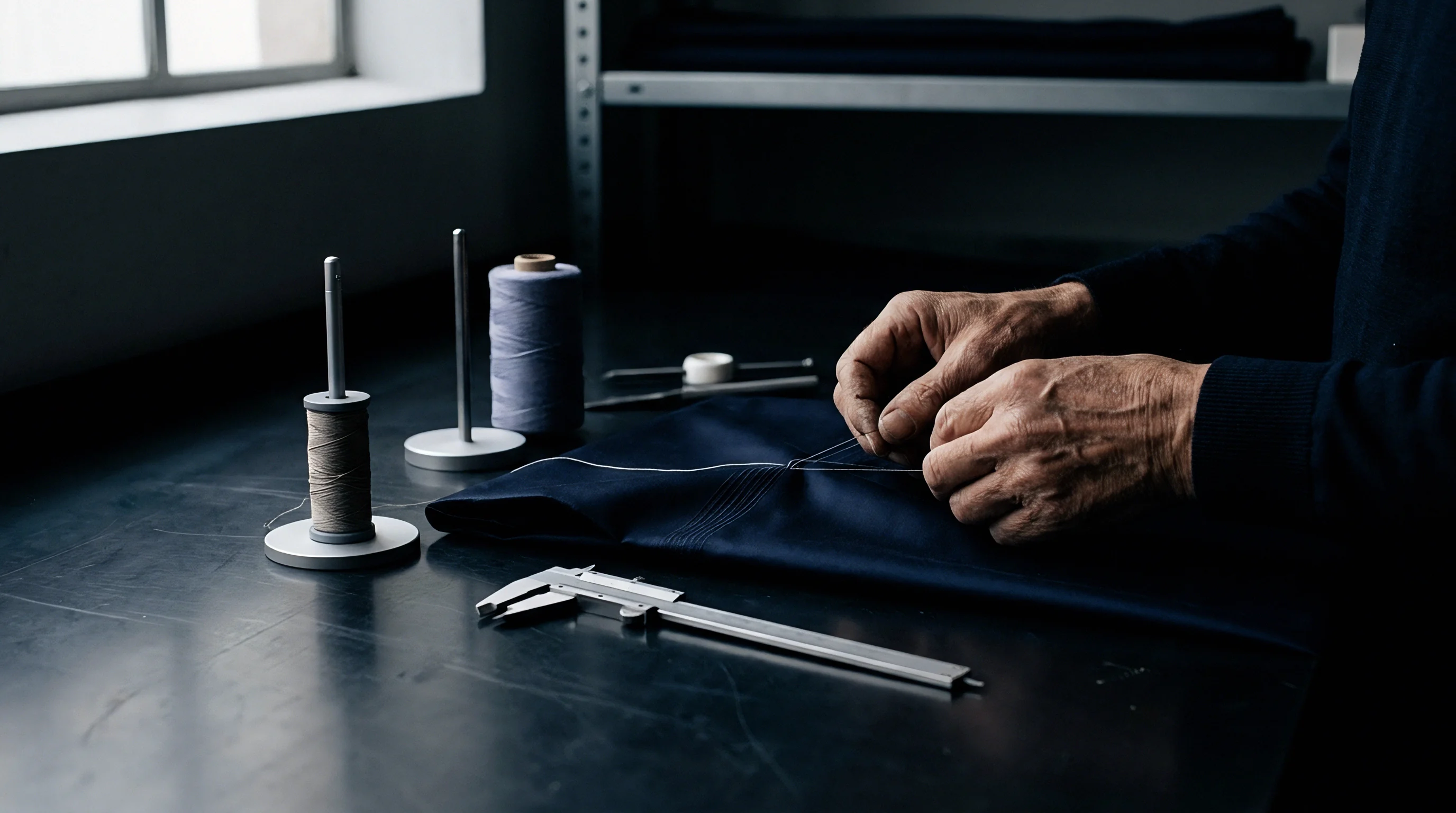
Parallel alignment is mandatory before taking quantitative measurements. Steel combs with needle spacings stepping down from two millimetres to zero point two millimetres remove entanglements, loose cortical tissue, and residual shive. The operator then clamps the parallelised ribbon into a dual-clamp steel mounting block set to a span of exactly thirty millimetres.
Two tempered surgical steel blades drop simultaneously under a regulated pneumatic load of forty newtons. Because the razor dulls after eighty cuts, blades require routine replacement to maintain clean shearing. Trimming the bundle ends isolates a central transverse segment matching the hardened anvil dimension to within ten micrometres.
Lateral play during shearing crushes bundle boundaries and throws short elementary fibres out of the perimeter. The resulting cut yields a parallel pack with defined geometric boundaries.
Under standard conditioning at sixty-five percent relative humidity, a thirty-millimetre test specimen cut from twenty-tex technical flax line weighs precisely zero point six zero milligrams.
Mechanical extraction introduces hazards that skew calculated weight per unit length across an inspection pass. Because flax is a bast fibre, grouping technical bundles by hand tends to collect the coarsest strands while dropping ultra-fine individual ultimates onto the bench. The following preparation defects compromise mass assessment:
- Transverse strand shearing occurs when blunt cutting edges crush technical filaments rather than cleaving cell walls cleanly, forcing dry parenchyma fragments out of the specimen envelope.
- Comb-induced filament splitting fractures pectin bonds during bundle preparation, reducing the apparent tex of the sampled pack below the true lot average.
- Uneven clamping tension across the holding jaws permits undulating peripheral bundles to slip, creating length variance across the cut segment.
- Static attraction losses scatter fractured ultimates when transfer forceps move the sheared segment to the weighing pan.
Cutting errors carry straight through into downstream spinning calculations. Overestimating bundle length by two percent drops calculated linear density by a full fineness tier. Dry spinning mills accept coarse technical bundles up to thirty-five dtex for heavy apparel canvases, whereas wet spinners require bundle fineness between sixteen and twenty-two dtex to reach metric yarn counts above Nm 39.
If perimeter fibre shedding causes gravimetric tests to understate actual bundle thickness, the mill drafts sliver against incorrect roller settings, crushing unseparated bundles, spiking end-breakage rates, and scattering slubs through the woven cloth.

Conditioning
Bast cell walls take up moisture through exposed hydroxyl groups within their cellulose microfibrils, with regain determined by ambient relative humidity. Technical flax fibres carry a commercial moisture regain standard of twelve percent under international trading rules, yet laboratory atmospheres drift considerably without active environmental controls. Specimens reach equilibrium in a conditioning chamber held strictly at twenty degrees Celsius plus or minus two degrees, and sixty-five percent relative humidity plus or minus four percent, per ISO 139.
Due to sorption hysteresis, flax arriving from a damp warehouse holds more water than fibre dried down from a saturated field state.
ISO 6741 mandates drying test specimens to absolute bone-dry mass in a ventilated oven at one hundred and five degrees Celsius before adding the official twelve percent commercial allowance to calculate commercial mass.
Reaching sorption equilibrium takes twenty-four hours for loose scutched line and forty-eight hours for dense, baled tow, keeping the chamber at twenty degrees. Weighing conditioned bundles requires a microbalance shielded from air currents by double glass draught panels and seated on an isolated granite balance slab.
- Bale core probes draw five samples from distinct depths within the pressed bale to capture internal moisture gradients.
- Operators manually comb each gross sample through a coarse bench hackle to discard cortical matter, dirt, and foreign straw fragments.
- Combed strands sit in perforated stainless steel trays inside the conditioning cabinet until two weighings spaced four hours apart differ by less than zero point one percent of total specimen mass.
- Trained technicians divide the conditioned strick into twenty smaller test tufts using sequential draw-and-lap manual divide motions.
- Precision cutters extract the thirty-millimetre central gauge segments while the ambient hygrometer remains locked within tolerance boundaries.
- The operator transfers the severed segments immediately to the microbalance pan inside a sealed tared aluminium weighing boat.
Bundle mass measurements show systematic discrepancies if testing proceeds under tensile load or without prior scouring and solvent extraction. Raw scutched flax contains between two and four percent natural waxes, fats, and residual intercellular pectins that register as non-fibrous mass on the balance pan. A gravimetric test on unwashed raw bast therefore produces an inflated linear density reading compared to chemically degummed or bleached fibres evaluated later on the roving line.
| Standard Designation | Air Temperature Target | Relative Humidity Target | Equilibrium Verification Threshold | Standard Moisture Regain Added |
|---|---|---|---|---|
| ISO 139 / ISO 2370 | 20.0 °C (± 2.0 °C) | 65.0% (± 4.0%) | 0.10% mass variance across 2 hours | 12.00% commercial allowance |
| ASTM D1577 / D1776 | 21.0 °C (± 1.0 °C) | 65.0% (± 2.0%) | 0.10% mass variance across 3 hours | 12.00% commercial allowance |
| GB/T 5882 Line Method | 20.0 °C (± 2.0 °C) | 65.0% (± 3.0%) | 0.08% mass variance across 2 hours | 12.50% domestic allowance |
Commercial settlement relies on delivery weight adjusted by laboratory conditioning data under standard contract terms. When an agreement stipulates payment based on conditioned weight under ISO 6741, an uncorrected three-percent surplus in ambient warehouse moisture hands tens of thousands of dollars in unearned margin to the seller on a single container load.


Dissection
Working under an illuminated stereomicroscope allows technicians to separate technical clusters into individual units, cutting through the pectin that cements single cells together. True elementary flax ultimates run between ten and forty millimetres long, with cross-sectional diameters between twelve and twenty-eight micrometres. Technical line flax traded on commercial markets consists of composite bundles containing ten to forty individual ultimates held in an intact middle lamella matrix.
Evaluating fineness by gravimetric dissection requires contending with bast fibre anatomy, where mechanical force cleaves bonds irregularly along the stem length.

Where Do Gravimetric Errors Skew Fineness Tiers?
Counting individual fibres within an excised thirty-millimetre bundle requires steady hands and optical magnification between twenty and forty power. Dissecting needles tipped with polished tungsten carbide tease apart the parallel array strand by strand over a matte glass stage. An excised pack of five hundred filaments inevitably contains a range of bundle thicknesses rather than an even set: some strands are single elementary fibres stripped bare during retting, while others remain heavy ribbons holding thirty individual cells.
Gravimetric linear density, recorded in tex (grams per kilometre) or decitex (grams per ten thousand metres), divides total dry or conditioned mass by the combined length of all counted elements. If an operator tallies a three-fibre cluster as a single unit, the calculated fineness skews coarse. If aggressive needle work splits technical units that would otherwise stay intact through the drawing frame, the assay records an artificially fine value that the spinning line cannot match.
| Morphological State | Mean Element Length | Mean Diameter | Typical Linear Density | Cohesion Mechanism |
|---|---|---|---|---|
| Elementary Ultimate | 15 to 35 mm | 14 to 22 µm | 1.8 to 3.2 dtex | Crystalline cellulose fibril wall |
| Fine Technical Line | 250 to 450 mm | 35 to 65 µm | 16.0 to 24.0 dtex | Partially degraded pectin matrix |
| Coarse Hackled Line | 300 to 500 mm | 70 to 120 µm | 28.0 to 45.0 dtex | Intact intercellular parenchymal gum |
| Carded Scutching Tow | 40 to 120 mm | 50 to 90 µm | 22.0 to 36.0 dtex | Fragmented bundles with cortical shive |
| Data determined by ISO 2370 gravimetric cut-and-weigh protocol with 30 mm cutting gauge across 1,000 counted elements per grade. | ||||
Clear laboratory records are essential during contract arbitrations. A certified gravimetric bast certificate must document specific parameters to hold up under legal review:
- Sampling origin documentation specifies the exact bale serial codes, container identification numbers, and depth coordinates of core extraction points.
- Environmental conditioning log records continuous temperature and relative humidity traces throughout the forty-eight-hour stabilization window.
- Gauge length verification certifies the micro-caliper measurement of the cutting anvil to within five decimal places of a millimetre.
- Specimen count census details the number of individual entities counted under magnification alongside the microbalance zero-point calibration record.
Disputes frequently turn on whether aggressive mechanical dissection during testing compromised specimen integrity or whether the underlying long-line crop lacked cohesive structure.
Distribution
Bast fibres show high coefficient of variation values in cross-sectional mass, largely because under-retted straw resists clean cleavage. While synthetic tow keeps diameter variation below six percent, scutched flax line runs between twenty-five and forty-five percent linear density variation within a single combed sliver. That spread reflects agronomic differences between the plant base, mid-stem, and upper branches, compounded by uneven dew retting across the field swaths.
Which Mechanical Cleavages Alter the Measured Tex?
Stresses applied during industrial scutching and hackling split bast bundles along longitudinal planes. Water-retted flax separates into finer bundles than dew-retted straw because anaerobic polygalacturonase enzymes break down calcium pectate in the parenchyma with greater selectivity. Dew retting relies on fungi like Cladosporium herbarum and Epicoccum nigrum, whose hyphae penetrate cortical tissue unevenly.
Sun-exposed areas dry out and pause enzymatic action, leaving coarse bundles that pull the lot’s gravimetric tex upward.
A coefficient of variation exceeding thirty-eight percent in bundle gravimetric density indicates severe retting heterogeneity that increases yarn thin-place defects.
The standard gravimetric formula derives the mean linear density directly from physical specimen metrics:
Linear Density (tex) = (Total conditioned mass of cut segments in milligrams) / (Number of segments counted multiplied by the cutting gauge length in metres).
The mean alone hides serious processing problems. Take an industrial lot of hackled line flax checked through ten replicate cut-and-weigh passes of one hundred bundles each with a twenty-millimetre blade. If total conditioned mass across one thousand technical bundles comes to twenty-two milligrams, calculated average linear density works out to eleven dtex, or one point one tex.
The distribution around that mean tells the real story. If seventy percent of the bundle population clusters between nine and thirteen dtex, sliver drafts cleanly on gill boxes during wet preparation. But if thirty percent forms an outlying group of coarse, forty-dtex barky bundles while forty percent sits as over-hackled four-dtex fibrils, drafting rollers lose consistent control.
Because sliver weight governs yarn count, thin ends pull ahead of the nip while heavy bundles drag in the pins, setting up periodic drafting waves that degrade yarn evenness.
| Bundle Mean Fineness | Linear Density CV% | Preparation Drafting Behavior | Max Practical Count | Finished 100% Linen Fabric Weight |
|---|---|---|---|---|
| 16.5 dtex | 22.0% | Smooth gill-box drafting, minimal faller bar lap | Nm 60 (16.6 tex) | 95 to 115 g/m² high-end shirting |
| 21.0 dtex | 28.5% | Stable drawing frame passage, moderate waste | Nm 39 (25.6 tex) | 140 to 175 g/m² summer suiting |
| 26.5 dtex | 36.0% | Intermittent roller slippage, elevated sliver neps | Nm 26 (38.5 tex) | 190 to 240 g/m² heavy upholstery |
| 34.0 dtex | 46.5% | Severe drafting waves, frequent front-roller wrapping | Nm 14 (71.4 tex) | 320 to 450 g/m² rustic home furnishings |
The degree to which industrial enzyme treatments can chemically narrow this bundle fineness distribution without destroying the native cellulose backbone remains an unresolved puzzle across the modern bast spinning sector.

Allowance
Commercial contracts price raw flax fibre on clean conditioned weight and declared fineness grades. During wet spinning, roving packages run through a water bath held between sixty and seventy degrees Celsius to dissolve inter-fibre gum. The hot water softens residual pectin across the technical bundles, allowing the front drafting rollers to draw the material down to elementary fibrils.
If gravimetric testing understates the proportion of unattenuated bundles, the assigned draft ratio fails to clear fibres properly through the spinning nip.
Costs track these numbers directly. Consider a forty-tonne consignment of French dew-retted scutched line flax quoted at six dollars and fifty cents per kilogram landed at an Asian dry-spinning port. The contract specifies a target gravimetric linear density of twenty-two dtex with a maximum variation coefficient of twenty-eight percent.
When the port lab tests the lot to ISO 2370, the test shows an actual mean of twenty-eight dtex with a coefficient of variation of forty-one percent.
The mill cannot spin this fibre into the contracted Nm 39 count intended for fine apparel and must divert the lot to a heavy Nm 18 furnishing yarn. That coarser count yields far fewer running metres per kilogram of purchased stock: a kilogram of Nm 39 yarn gives thirty-nine thousand metres of single strand, whereas Nm 18 yields only eighteen thousand metres. Because frames operate at fixed spindle speeds, running coarser yarn burns through the forty-tonne lot in less than half the time, yielding heavy yardage that sells for twenty-five to forty percent less per metre at wholesale.
A buyer faced with off-spec fineness claims contract remedies through direct mass allowances or total parcel rejection. Where the contract provides a graduated discount of one point five percent per dtex above specification, the six-dtex overrun triggers an immediate nine-percent invoice credit. On a forty-tonne shipment valued at two hundred and sixty thousand dollars, that single gravimetric finding recovers twenty-three thousand four hundred dollars before bales reach the blending hopper.
Coarse bast bundles force heavy yarn counts that immediately compress weaving margins on finished linen apparel yardage.
When gravimetric data is solid, the buyer holds leverage across every dispute on the mill floor.