Core Sampling Gravimetric Oven Testing Procedures for Raw Flax Bales
Core sampling and forced-air oven drying at 105°C establish true dry flax mass for calculating official 12% commercial regain invoice settlements.
Probe
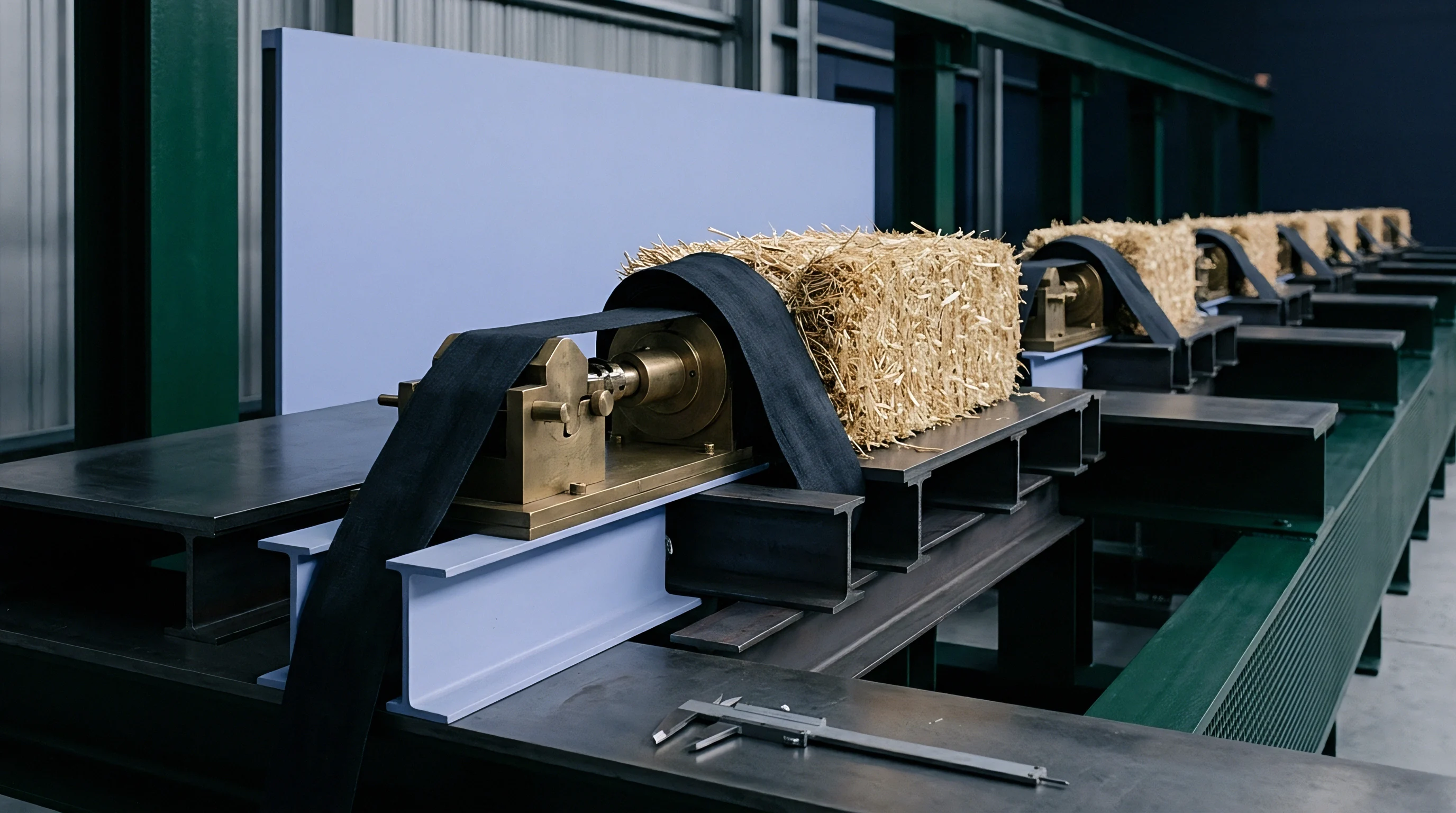
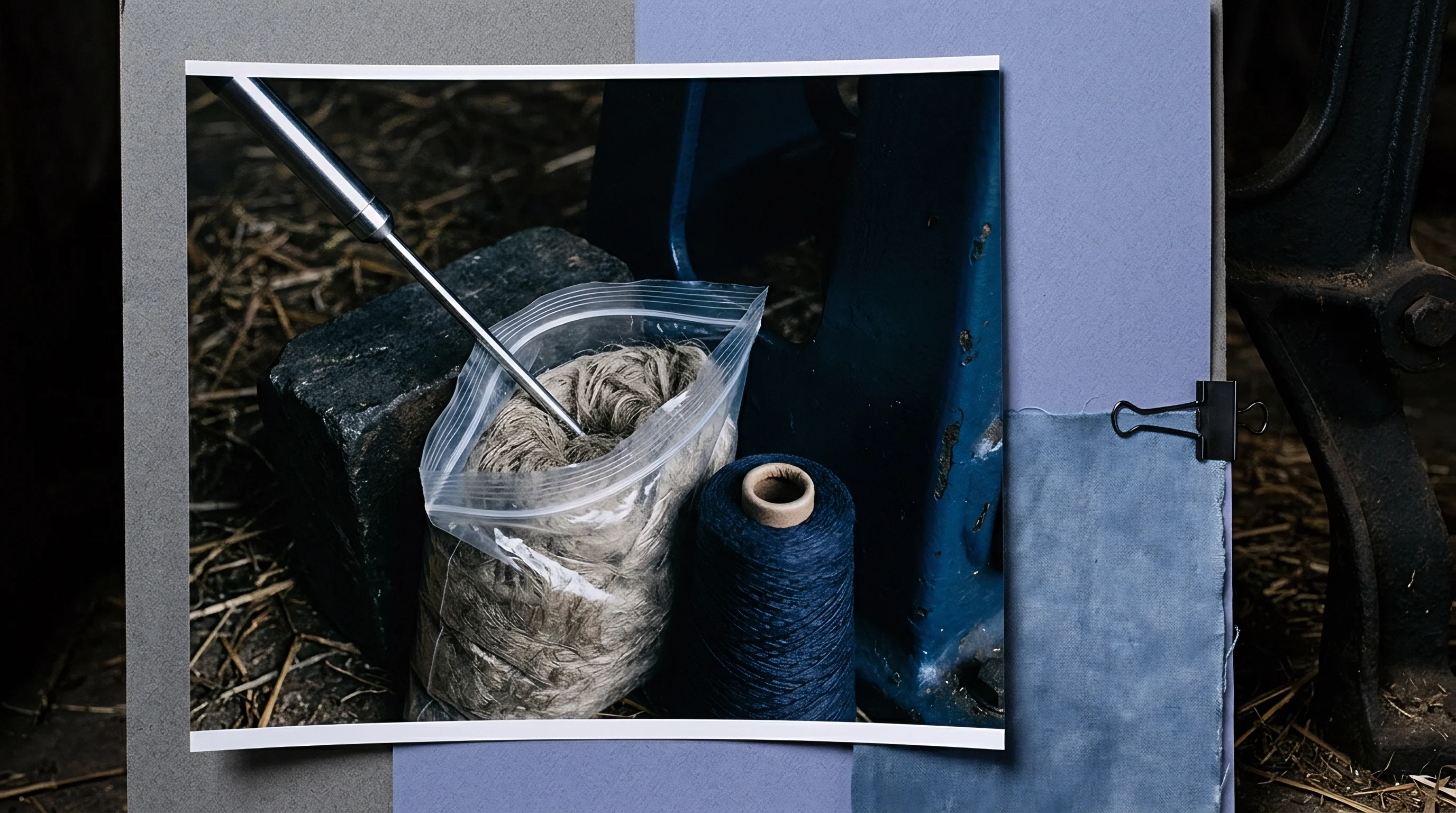
Extracting representative fiber samples from high-density raw flax packages demands specialized tube geometry capable of penetrating compressed fiber masses without generating friction heat. Raw scutched flax bales arriving at spinning mills or processing facilities present density gradients ranging from 220 to 380 kilograms per cubic meter. Core sampling tools extract uniform cross-sectional columns across these density bands to capture accurate moisture profiles.
Standard open-ended steel tubes equipped with scalloped or razor-ground leading edges cut through intertwined bast fibers rather than pushing them aside. Pushing fibers forward displaces water-bearing plant material, altering the localized mass ratio before the sample enters the extraction barrel.
Hydraulic coring rigs apply controlled linear force paired with low-speed rotation to advance the cutting tip through compressed packages. High rotational speed creates thermal friction against the steel cylinder walls, evaporating surface water from the extracted core before operators seal the sample container. The cutting edge inner diameter measures between 18 and 25 millimeters, while the internal wall relief expands by 0.5 to 1.0 millimeter behind the tip.
This relief angle minimizes wall friction on the entering fiber column, preserving structural integrity and preventing thermal moisture loss during penetration.
- Operators align the core tube perpendicular to the compressed bale face.
- Hydraulic cylinders drive the rotating tip through outer layers into the core center.
- Technicians extract the intact core column without applying axial tension.
- Sealed aluminum containers receive the sample mass immediately after extraction.
- Weighbridge scales register gross wet container mass before thermal processing.
Flax bales vary in density. External environmental exposure creates significant moisture differentials between outer bale shells and inner core zones. Core sampling protocols mandate penetrating at least 60 percent of total bale depth along predetermined grid points to sample both dense interior cores and ambient-exposed outer layers.
A single surface swab or shallow extraction misses internal moisture traps created during high-humidity baling operations. Sampling grids divide the bale face into nine symmetrical zones, selecting diagonal entry vectors that bypass perimeter steel strapping while capturing representative interior fiber populations.
Suppliers routinely object to deep hydraulic coring on high-density flax packages, claiming that barrel penetration severs long scutched fiber bundles and reduces the commercial spin value of the remaining bale stock.

Heat
Drying raw scutched flax to absolute dry mass relies on forced-air convection chambers maintained at strictly monitored thermodynamic boundaries. The gravimetric process measures the mass difference between the wet core sample immediately after extraction and the dry residue following complete water removal. Standard laboratory specifications establish oven chamber temperatures at 105 degrees Celsius with an allowable variance of plus or minus 2 degrees.
Exceeding 107 degrees Celsius triggers thermal degradation of structural pectins and hemicellulose within the flax cell wall, releasing gaseous breakdown products that register falsely as evaporated water weight.

Thermal Evaporation Boundaries
Water molecules bind to the cellulosic matrix through hydrogen bonds within non-crystalline cell wall regions. Removing free capillary water occurs rapidly within the first twenty minutes of thermal exposure at ambient pressure. Extracting tightly bound structural water requires sustained energy transfer through continuous forced-air exchange.
Convection fans circulate air across heating elements at velocity profiles between 0.5 and 1.5 meters per second, sweeping saturated boundary air away from core basket surfaces. Stagnant air zones inside poorly ventilated ovens slow evaporation rates, causing outer fiber layers to bake while internal bundle cores retain bound moisture.
Core samples dried at 105 degrees Celsius achieve constant dry state when consecutive weighing steps at fifteen-minute intervals vary by less than 0.05 percent total sample weight.
Oven drying cycles run until the fiber column reaches constant mass. Laboratory technicians record sample weight at set intervals during convection heating to construct a loss-on-drying curve. The initial mass loss proceeds steeply as free moisture escapes, flattening into an asymptotic line as bound capillary water depletes.
| Drying Duration (Minutes) | Oven Chamber Temp (°C) | Mass Loss Rate (%/min) | Cumulative Moisture Removed (%) | Core State Indicator |
|---|---|---|---|---|
| 0 | 21.5 | 0.00 | 0.00 | Raw Extracted Core |
| 15 | 104.8 | 0.42 | 6.30 | Free Water Evaporation |
| 30 | 105.1 | 0.18 | 9.00 | Capillary Release Phase |
| 45 | 105.0 | 0.04 | 9.60 | Bound Water Extraction |
| 60 | 104.9 | 0.01 | 9.75 | Asymptotic Equilibrium |
| 75 | 105.0 | 0.00 | 9.76 | Constant Dry Mass |
Flax fibers hold bound water. Thermal processing must avoid structural scorching.
- Thermal degradation of pectin ~ Oven temperatures exceeding 107 degrees Celsius break down intercellular binders, releasing volatile organic compounds that distort mass loss readings.
- Surface crusting phenomenon ~ Rapid initial evaporation seals outer fiber layers, trapping structural water inside dense bundle cores.
- Re-absorption during transfer ~ Unsealed sample transport across humid laboratory bays introduces atmospheric moisture prior to tare weighing.
- Incomplete convection flow ~ Uneven air distribution inside crowded drying chambers creates cold spots that delay constant mass attainment.
Oven convection drying continues until consecutive weight readings match, indicating that thermal removal of capillary water is complete without inducing polymer pyrolysis.

Mass
Converting dry core sample weights into commercial invoice weights relies on the standard allowance calculation. Trade specifications distinguish between moisture content, calculated against wet initial mass, and moisture regain, calculated against bone-dry fiber mass. Commercial transactions for raw scutched flax operate strictly on moisture regain figures.
Standard international commercial terms fix official flax regain at 12.00 percent. Deliveries exhibiting actual core regain below 12.00 percent entitle the seller to an upward weight adjustment, whereas moisture regain exceeding 12.00 percent results in financial deductions applied to the billed gross mass.

Commercial Regain Derivation
International commercial terms define raw scutched flax fiber at twelve percent standard moisture regain. Calculating the commercial invoice mass requires converting certified dock scale weights through gravimetric core lab results. The formula converts gross delivered mass into dry fiber mass, then adds the statutory twelve percent commercial allowance alongside agreed tare deductions.
Consider a 20,000 kilogram delivered lot of raw scutched flax bales subjected to core sampling upon dock arrival. The lab records an initial wet core sample mass of 150.00 grams. After forced-air convection drying at 105 degrees Celsius until reaching constant weight, the dry core mass measures 132.50 grams.
The actual moisture regain calculates as:
Regain = ((150.00 – 132.50) / 132.50) 100 = 13.207 percent.
Because the measured regain of 13.207 percent exceeds the contractual baseline of 12.00 percent, the consignment carries excess water. The true commercial weight calculations proceed as follows:
Dry Fiber Mass = Gross Delivered Mass / (1 + (Actual Regain / 100))
Dry Fiber Mass = 20,000 / (1 + 0.13207) = 17,666.72 kilograms.
Commercial Invoice Weight = Dry Fiber Mass (1 + (Standard Regain / 100))
Commercial Invoice Weight = 17,666.72 1.1200 = 19,786.73 kilograms.
The buyer receives a invoice mass adjustment deducting 213.27 kilograms from the billed weight, preventing payment for excess water weight.
Contracts specifying ISO 6741 allowance terms without adjusting for non-cellulosic tare additions force buyers into overpaying raw fiber shipments.
| Parameter / Variable | Contract Nominal Basis | Laboratory Measured Core Value | Adjusted Invoice Mass (kg) | Commercial Financial Variance (€) |
|---|---|---|---|---|
| Consignment Gross Mass | 20,000.00 kg | 20,000.00 kg | 20,000.00 | €0.00 |
| Core Sample Wet Weight | N/A | 150.00 g | N/A | N/A |
| Core Sample Dry Weight | N/A | 132.50 g | N/A | N/A |
| Calculated Fiber Regain | 12.00% | 13.21% | N/A | N/A |
| Calculated Dry Fiber Mass | 17,857.14 kg | 17,666.72 kg | N/A | N/A |
| Final Commercial Mass | 20,000.00 kg | 19,786.73 kg | 19,786.73 | -€1,066.35 |
| Financial variance calculated at a contractual baseline price of €5.00 per kilogram of scutched flax fiber. | ||||
Dry mass calculation governs invoices.
- Standard regain baseline ~ The contract stipulates twelve percent moisture regain based on dry fiber mass.
- Non-cellulosic mass allowance ~ Laboratory reports deduct non-fibrous shive and wax percentages prior to invoice adjustment.
- Batch moisture variation ~ Multiple core samples across the lot undergo statistical averaging to establish lot-level moisture.
- Weighbridge tare verification ~ Pallet and strapping weights receive explicit physical verification rather than nominal deduction.
Standard trading contracts incorporate ISO 6741-1 clauses stipulating that certified gravimetric core sample dry mass calculations supersede all export weighbridge slips for final billing reconciliation.
Draft
Analytical balances measuring dried core samples require isolated testing micro-environments to prevent aerodynamic uplift on hot weighing pans. Convection currents originating from hot weighing containers alter load cell response, introducing artificial mass fluctuations. Hot core samples placed on balance trays warm the surrounding air, generating upward convection draft forces that lighten the apparent mass reading.
Cooling core containers inside sealed desiccators before weighing eliminates thermal convection errors and blocks environmental moisture absorption during the measurement cycle.

How Do Buoyancy Currents Distort Analytical Weighing?
Thermal updrafts generated by hot sample containers inside balance enclosures reduce the apparent weight recorded by load cells. Air density decreases rapidly adjacent to hot aluminum core canisters, creating upward buoyant force vectors against the weighing pan assembly. An operator weighing a sample container at 80 degrees Celsius records a mass value significantly lower than the same container weighed at thermal equilibrium with the laboratory environment.
Allowing containers to cool inside desiccators containing active silica gel for 30 minutes restores ambient temperature symmetry without letting atmospheric humidity contaminate dry fiber bundles.
Silica gel color transitions from deep blue to pink signal immediate desiccator saturation.
Desiccator seals require silicone grease. Balances need level surfaces. Chamber airflow stays constant.
Core samples cool under vacuum.
Laboratory environmental controls mandate maintaining ambient bays at 20 degrees Celsius plus or minus 2 degrees and 65 percent relative humidity plus or minus 4 percent, per ISO 139 specifications. Removing a dry core sample from a desiccator into non-conditioned laboratory air triggers immediate moisture adsorption. Exposed dry flax fibers reabsorb atmospheric water vapor at rates up to 0.1 percent mass gain per minute during high-ambient-humidity conditions.
Weighing operations taking longer than ninety seconds outside desiccated chambers record corrupted dry mass baseline figures, artificially suppressing calculated moisture regain statistics.
Failing to control ambient air currents and thermal equilibrium during analytical weighing produces inaccurate dry mass figures, leading directly to unrecoverable billing errors on commercial fiber shipments.
Loss
Moisture redistribution within sealed shipping containers creates major discrepancies between origin certificates and destination arrival weighbridge receipts. High ambient temperatures inside ocean freight containers vaporize water from warm outer bale layers during transit. Vapor drifts toward cooler container ceilings and walls, condensing into droplets that fall back onto perimeter package tops.
Destination core sampling protocols must isolate localized container sweat from true baseline fiber moisture to prevent erroneous commercial claim filings.

Transit Condensation Dynamics
Condensation dripping from container ceilings under diurnal temperature swings systematically inflates outer bale moisture readings. Moisture migrates continuously inside closed transport volumes driven by thermal gradients. External solar heat converts internal liquid moisture into vapor, which collects in upper void spaces.
Nighttime cooling drops container roof steel temperatures below dew point, causing rain-down onto upper bale tiers. Core samples penetrating these top faces register wet outer crusts while internal fiber cores remain at original baling dryness levels.
Condensation dripping from container ceilings under diurnal temperature swings systematically inflates outer bale moisture readings.
| Moisture Regain Delta (%) | Sampling Variance Classification | Commercial Action Required | Re-Test Protocol Trigger | Cost Allocation Rule |
|---|---|---|---|---|
| 0.00 – 0.30 | Negligible Tolerance | Accept Origin Certificate Weight | None Required | Standard Contractual Terms |
| 0.31 – 0.80 | Minor Transport Drift | Apply Formula Mass Adjustment | Optional Duplicate Core Test | Shared Laboratory Fee |
| 0.81 – 1.50 | Significant Moisture Deviation | Issue Formal Debit/Credit Note | Mandatory Joint Re-Sampling | Losing Party Pays Testing |
| > 1.50 | Gross Consignment Dispute | Reject Lot / Full Quarantine | Independent Referee Lab Audit | Full Seller Indemnification |
Hysteresis alters fiber regain capacity. Scutched flax holds natural waxes. Shipping containers accumulate ceiling sweat.
Desorption curves differ from adsorption curves due to cellulosic hysteresis. Flax fiber drying in forced-air ovens loses moisture along a path that cannot be mirrored during re-hydration. Unheated raw fiber exposed to ambient moisture shifts equilibrium along different thermodynamic lines than thermally processed laboratory samples.
Commercial arbitration boards must decide whether core sample oven test discrepancies reflect physical water addition or structural hysteresis shifts induced during tropical ocean transport.
How do mills isolate transit sweat artifacts from true baling moisture when resolving cross-border commercial regain disputes?