Correlating Hackling Pin Geometry with Elementary Fibre Splitting and Roving Linear Density
Hackling pin tip radius and pitch dictate elementary fibre splitting fineness, directly establishing the minimum achievable roving linear density.

Tine
Scutched flax enters the hackling machine as coarse bundles bound together by middle lamella pectins. The mechanical combing process strips remaining shives, aligns long bast ribbons, and splits thick technical bundles into finer elementary units. Pin geometry determines whether this mechanical engagement cleanly cleaves intercellular interfaces or fractures structural cell walls.

Mechanical Action of Hackling Needles
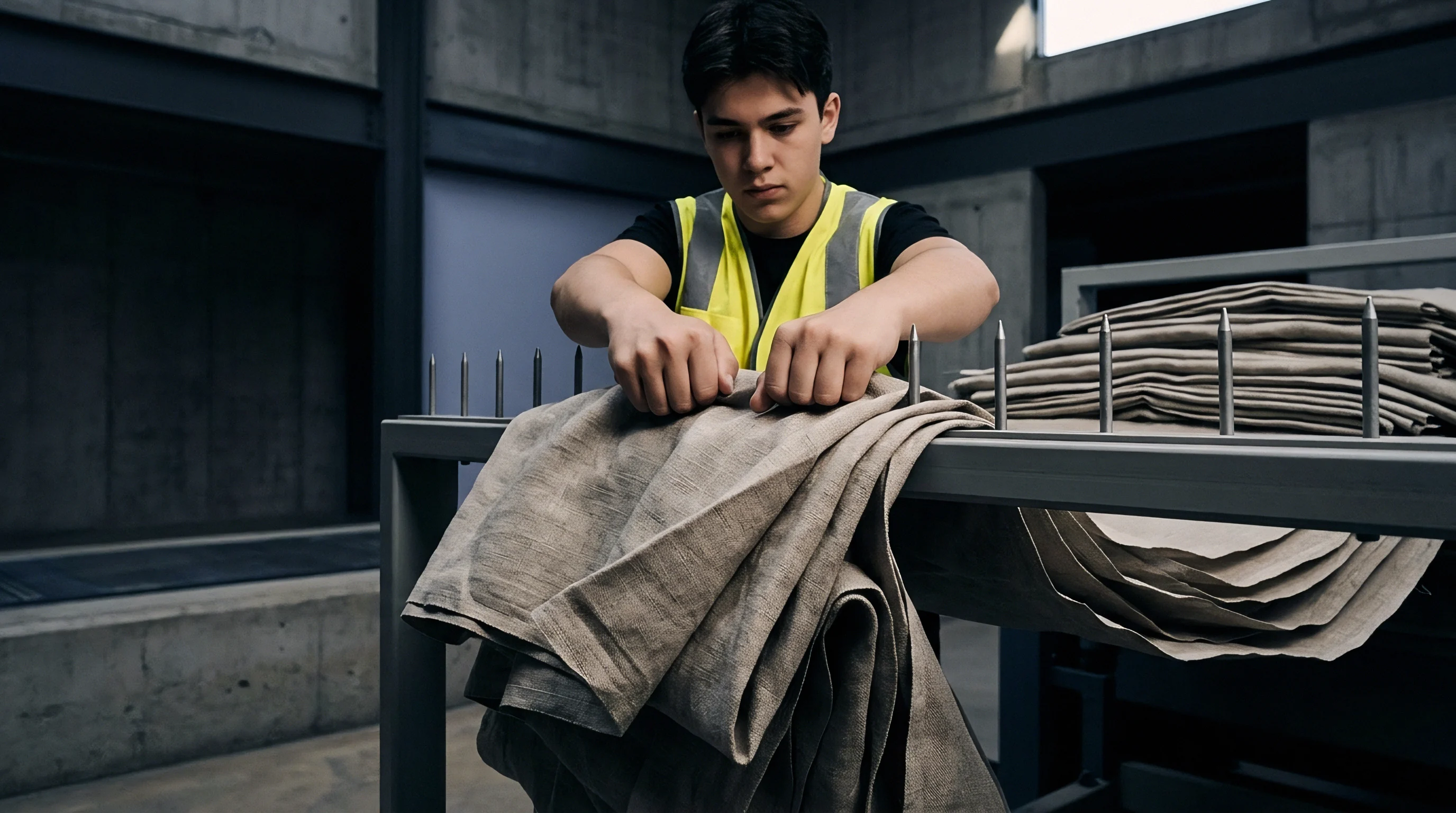
Combing bars mounted on endless aprons penetrate moving flax stricks at defined strike angles. Pin tip radius controls the stress concentration applied to pectin interfaces; a small tip radius forces entry between adjacent elementary fibres without tearing cellulosic walls, whereas rounded pin tips distribute impact energy across larger surface areas, crushing bast ribbons and generating short fragments.
Pin penetration depth modulates the drag force experienced by the fibre bundle. Shallow pin engagement combs only the outer mantle of the strick, leaving internal technical bundles unsplit. Deep penetration forces full strick immersion, maximizing shear friction along intercellular boundaries.
Excessive pin projection increases mechanical tension on individual fibres, triggering mid-span cell breakage when tensile resistance exceeds ultimate fibre strength.

Gradient Density across Progressive Combing Beds
Machine configurations employ serial combing fields arranged from low to high pin frequency. Early passages comb out loose shive remnants through wide pin spacing without catching long bundles. Middle passages initiate longitudinal bundle splitting as reducing pin diameter and narrowing pin pitch force large technical ribbons into smaller structural subdivisions.
Final passages apply dense pin arrangements that isolate fine technical structures suitable for drawing.
Flax hackling pins with dull point profiles crush intercellular pectin bonds, raising tow volume across subsequent dressing passages.
Commercial hackling machines utilize up to twenty-four distinct combing passages to achieve progressive splitting. Pin density escalates from two pins per centimetre at the feed end to twenty-four pins per centimetre at the delivery end. Wire diameter decreases proportionally from 1.40 millimetres down to 0.45 millimetres to prevent strick jam events and limit pin flexure during combing cycles.
| Combing Passage | Pin Density (pins/cm) | Wire Diameter (mm) | Tip Radius (µm) | Pin Pitch (mm) | Split Fibre Fineness (dtex) |
|---|---|---|---|---|---|
| Passage 1 (Coarse Break) | 2.5 | 1.40 | 75 | 4.00 | 12.5 |
| Passage 2 (Intermediate Dressing) | 6.0 | 1.00 | 50 | 1.67 | 7.2 |
| Passage 3 (Fine Splitting) | 14.0 | 0.65 | 30 | 0.71 | 3.4 |
| Passage 4 (Ultra-Fine Finishing) | 22.0 | 0.45 | 18 | 0.45 | 1.9 |
- Tip Radius Calibration maintains precise tip dimensions between fifteen and thirty micrometres to prevent transverse cell fracture.
- Pin Lineal Density increases systematically from two pins per centimetre to twenty-four pins per centimetre across successive combing fields.
- Penetration Depth Adjustment sets the immersion level of combing bars into the flax strick to balance bundle splitting against mechanical draft resistance.
- Wire Cross-Section Selection matches round or flat pin profiles to the retting state of incoming raw scutched stock.
Incorrect pin geometry choice reduces line yield by six percent, turning high-value long fibre into low-value hackling tow.

Fissure
Bast ribbons split along intercellular middle lamellae during mechanical dressing. Pectin polymers binding adjacent cell walls exhibit distinct shear resistance based on retting completeness. Under optimal combing forces, long cleavage planes propagate parallel to the fibre axis.

Middle Lamella Cleavage Kinetics
Enzymatic digestion during field retting degrades calcium pectate bonds between elementary structures. Combing pins exert lateral normal forces that trigger crack initiation within degraded pectin layers. Higher retting degrees lower shear resistance and reduce the energy required to separate adjacent cell walls.
Insufficiently retted stock resists shear cleavage, causing pins to snap elementary cell walls while leaving larger bundles intact.
Fibre moisture content modulates pectin viscoelasticity during hackling operations. Relative humidity levels below 50 percent harden pectin matrices, causing brittle fracture under pin impact. Relative humidity maintained between 65 and 70 percent softens middle lamellae, allowing pins to slide along intercellular boundaries without fracturing elementary cell walls.
Elementary Fibre Bundle Diameter Distribution
Effective splitting reduces technical bundle width from ninety micrometres down to fifteen micrometres. Individual elementary flax cells possess cross-sectional diameters between ten and twenty micrometres. Splitting technical bundles down to three or four elementary cells per cross-section establishes the foundation for high-count yarn spinning.
Water-retted flax processed at twelve pins per centimetre yields an average bundle fineness of 1.8 decitex when comb apron speed stays under forty metres per minute.
Narrower diameter distributions allow individual fibres to slide past each other smoothly during drawing operations once bundle diameters approach uniformity. Conversely, broad diameter distributions retain thick bundles alongside thin elementary strands, generating mass variation in downstream slivers.
| Apron Speed (m/min) | Mean Bundle Fineness (dtex) | Fineness CV (%) | Tensile Tenacity (cN/tex) | Nep Count (n/g) | Hackling Tow Ratio (%) |
|---|---|---|---|---|---|
| 25 | 2.8 | 22.4 | 54.2 | 12 | 28.5 |
| 35 | 2.1 | 18.6 | 51.8 | 18 | 31.0 |
| 45 | 1.7 | 16.2 | 47.5 | 34 | 35.8 |
| 55 | 1.5 | 19.8 | 42.1 | 62 | 41.2 |
Thorough retting combined with gradual pin pitch progression produces fine fibre bundles without generating excessive neps.

Grist
Roving linear density reflects the total cross-sectional mass of elementary fibres combined in a twisted strand prior to spinning. Technical fibre splitting directly limits how fine a roving can be drafted without introducing structural defects. When hackling pins achieve finer bundle divisions, spinning frames draft slivers down to lower linear densities without breaking continuity.
How Does Hackling Pin Pitch Dictate Roving Tex?
Distance between adjacent needle points in a hackling bar governs mechanical penetration. A narrow pitch forces flax stricks to separate into thinner parallel strands during each apron cycle. These split bundles pack closely together during sliver formation, creating high inter-fibre surface area.
High surface area increases friction during drafting, enabling control over individual fibre motion at draft ratios above twenty.
A worked construction illustrates the quantitative link between pin density, elementary splitting, and roving linear density. Consider a processing lot of 1,000 kilograms of scutched line flax evaluated for wet-spinning preparation. Initial technical bundle fineness averages 15 decitex.
Processing through a four-passage hackling machine equipped with pins graduating from 3 to 20 pins per centimetre reduces average bundle fineness to 2.2 decitex. At this fineness level, hackling yield delivers 620 kilograms of long line fibre and 380 kilograms of hackling tow.
The long line fibre enters the drawing section, undergoing three drafting passages to form a drawn sliver of 4.5 kilotex (g/m). During roving frame drafting with a draft ratio of 7.5 and a twist multiplier of 18 turns per metre, the drawn sliver yields a roving linear density of 600 tex (600 g/km). If hackling pin density stops at a maximum of 12 pins per centimetre, average bundle fineness reaches only 4.5 decitex.
Attempting to draft this coarser 4.5 decitex material to a target roving of 600 tex results in high drafting irregularity, forcing the machine operator to increase target roving linear density to 950 tex to maintain strand tenacity. This coarser 950 tex roving restricts final wet spinning to yarn counts coarser than Nm 26 (38.5 tex), missing the higher commercial value of fine Nm 40 (25 tex) linen yarns.
Contractual delivery specifications requiring roving linear densities below eight hundred tex impose a maximum five percent tolerance on roving coefficient of variation under ISO 2060 testing.
- Processors sample scutched line flax bundles across five points in the incoming bale to measure initial technical bundle thickness.
- Technicians set the initial dressing bed pin pitch to three pins per centimetre to eliminate shive remnants without straining middle lamellae.
- Combing speeds ramp to thirty-five metres per minute as bundle fineness drops below five decitex across middle passages.
- Final hackling passages engage pin densities of twenty-two pins per centimetre to achieve split bundle fineness of two decitex.
- Sourcing managers calculate sliver weight uniformity on drawn slivers before feeding the roving frame to verify draft allocations.
Spinning mills routinely blame high roving linear density variation on inconsistent field retting while ignoring misconfigured hackling pin gradients.


Bench
Laboratory verification connects mechanical hackling settings to physical yarn performance metrics. Standardized testing measures fibre bundle fineness, roving evenness, and tensile strength before committed production runs start. Accurate bench data protects sourcing practices from accepting lots that degrade during wet spinning.

Fineness Measurement via Airflow Permeability
Testing instruments evaluate specific surface area on cleaned flax fibre samples under ISO 2370. Compressed air flows through a calibrated specimen chamber containing a weighed mass of combed fibre. Higher flow resistance indicates smaller bundle diameters and superior splitting efficiency.
Sourcing laboratories use airflow readings to verify whether hackling pin passages achieved target bundle division prior to roving formation.

Linear Density Uniformity in High-Draft Roving
Capacitance testing on roving strands identifies mass variations along continuous production lengths under ISO 2060. Irregular roving linear density causes count variation and thin places in spun yarns. Fine pin hackling reduces the coefficient of mass variation by eliminating thick fibre bundles that slip unevenly through draft rollers.
| Quality Parameter | Standard Method | Sample Specimen Size | Target Range | Rejection Threshold |
|---|---|---|---|---|
| Fibre Fineness | ISO 2370 (Airflow) | 5.0 g bundle | 1.8 – 2.4 dtex | > 3.2 dtex |
| Roving Linear Density | ISO 2060 (Gravimetric) | 100 m skein | 550 – 650 tex | > 720 tex |
| Roving Irregularity | Uster Tester (Capacitance) | 500 m test length | 4.2 – 5.5 CV% | > 7.0 CV% |
| Roving Tenacity | ISO 2062 (CRE Tensile) | 500 mm gauge length | 6.5 – 8.5 cN/tex | < 5.0 cN/tex |
Coarse elementary fibre splits produce periodic drafting waves during wet spinning that manifest as thick places in the final yarn.
- Transverse Fibre Splintering occurs when blunt pin points break individual elementary walls, lowering strand tensile tenacity.
- Nep Generation develops when high combing speeds tumble fine split fibres into tight knots inside dense pin beds.
- Drafting Wave Insecurity emerges when broad bundle diameter distributions cause uncontrolled slippage between draft rollers.
- Roving Twist Accumulation restricts liquid penetration during wet spinning when coarse bundles require excessive twist for cohesion.
Purchase contracts stipulating compliance with ISO 2370 bundle fineness thresholds permit buyers to reject lots exhibiting linear density variations above seven percent CV.


Margin
Financial accounting links pin maintenance and machine adjustments directly to delivered yarn costs. Fine hackling increases short fibre separation, shifting mass from prime line flax into lower-value tow streams. Managing this yield loss against achievable yarn selling prices dictates profitability across wet-spinning operations.

Hackling Yield Losses and Tow Valuation
Scutched line flax purchased at $4.80 per kilogram undergoes yield degradation during dressing. A machine configuration yielding 65 percent line fibre and 35 percent tow yields an effective line fibre raw material cost of $7.38 per kilogram, offset by tow sales at $1.50 per kilogram. Increasing pin density to achieve ultra-fine bundle splitting shifts the yield split to 55 percent line fibre and 45 percent tow.
This shift increases effective line fibre cost to $8.72 per kilogram.
Natural retting quality in Normandy and Flanders fluctuates based on seasonal rainfall patterns during field retting windows. These agricultural variations force processors to adjust hackling pin settings dynamically to preserve line yield without sacrificing bundle fineness.

Finished Cloth Costing per Metre
Yarn spinning costs rise as target roving linear density drops. Drafting fine 400 tex roving into Nm 39 (25.6 tex) yarn requires slower frame speeds and higher twist insertion than drafting 800 tex roving into Nm 18 (55.5 tex) yarn. For a plain-weave linen fabric weighing 160 grams per square metre at 150 centimetres finished width, raw material and spinning yield losses represent 58 percent of total landed fabric cost per metre.
Optimizing pin geometry reduces yarn breakage on weaving looms, protecting weaving efficiency above 92 percent.
It remains uncertain whether real-time optical bundle scanning can dynamically adjust hackling bed pin engagement during continuous processing.