Dew Retted Heilongjiang Line Flax Fiber Grading Specifications
Heilongjiang dew-retted line flax grading depends on linear density, retting uniformity, bundle strength, and residual pectin for wet-spinning yarn count capacity.

Class
Commercial evaluation of long-staple bast strands in northeastern China relies on numerical indicators defined within domestic trade specifications. Line fiber yields higher strength. Chinese national classification standards for scutched flax, governed under standard GB/T 18132, establish numerical grade designations from Grade 1 through Grade 4 based on bundle linear density, breaking tenacity, residual shive content, and staple length uniformity.
High-latitude growing conditions in Heilongjiang produce distinct bundle morphology characterized by thick cortical cell walls and compact pectic middle lamellae. Evaluating these physical traits before mechanical hackling determines the maximum spinnable yarn count, expressed in metric count or standard English lea.
Chinese National Standard Grade Specifications
Domestic buyers purchase scutched material under GB T 18132 specifications that establish strict operational parameters for processing facilities across Harbin, Suihua, and Qiqihar. Moisture regain alters bundle weight. The classification system allocates raw scutched long flax into distinct numeric tiers, where Grade 1 represents long-staple, clean fiber suitable for fine yarn counts, while Grade 4 represents coarse, shive-laden material destined for coarse dry spinning or industrial textiles.
| Grade Designation | Linear Density (tex) | Bundle Tenacity (cN/tex) | Shive Content (%) | Mean Length (mm) | Spinnable Limit (Nm) |
|---|---|---|---|---|---|
| Grade 1 | 1.8 – 2.2 | ≥ 32.0 | ≤ 1.0 | ≥ 750 | Nm 40 – Nm 60 |
| Grade 2 | 2.3 – 2.8 | 28.0 – 31.9 | 1.1 – 1.8 | 680 – 749 | Nm 28 – Nm 39 |
| Grade 3 | 2.9 – 3.5 | 24.0 – 27.9 | 1.9 – 2.5 | 600 – 679 | Nm 18 – Nm 27 |
| Grade 4 | 3.6 – 4.5 | 20.0 – 23.9 | 2.6 – 3.8 | 500 – 599 | Nm 10 – Nm 17 |

Physical Metric Criteria
Linear density measures bundle fineness across prepared long-staple lots. Laboratory verification relies on ISO 2370 methods, where bundle samples undergo manual preparation and gravimetric analysis at standard atmosphere conditions of 20 degrees Celsius and 65 percent relative humidity. Lower tex values indicate finer bundles capable of sliding past one another during wet-spinning draft, producing smooth yarn with high tensile cohesion.
Tenacity testing requires conditioned bundle breaking under ISO 3060 standards using a clamp distance of 3.2 millimetres. Heilongjiang dew-retted stock displays high bundle strength when harvested at optimal yellow ripeness, though cold autumn weather often shifts harvest dates into late September, altering stem moisture dynamics.
At 12 percent regain, a Grade 1 line flax lot tested under ISO 2370 yields a linear density of 2.1 tex with a bundle tenacity of 32 cN per tex.
Shive content measures residual woody core fragments remaining inside the scutched bundle. High shive percentage interferes with drawing frame attenuation and introduces slubs into spun yarn. Inspectors extract shives manually from a 50-gram test sample, weighing the isolated non-fibrous woody tissue on an analytical balance to determine percentage mass.
Staple length distribution directly governs hackling pin layout and comb transfer speeds. Grade 1 lots demand minimum strand lengths of 750 millimetres, ensuring the fiber spans multiple pin bars during mechanical combing without dropping prematurely into the tow collector bin.
- Linear Density Inspection verifies bundle fineness in tex units using conditioned gravimetric weighing to set drafting frame speed ratios.
- Bundle Tenacity Testing measures breaking force per unit linear mass under ISO 3060 to ensure yarn survives spinning tension.
- Shive Content Analysis isolates non-fibrous core particles by manual separation to prevent drafting zone blockages.
- Staple Length Distribution maps fiber bundle length variations to establish pin density progressions on hackling machines.
- Moisture Regain Determination calculates water percentage by oven-drying methods under ISO 6741 to adjust commercial invoice mass.
Color and hand evaluation complement mechanical testing during raw material intake. Dew-retted Heilongjiang stock exhibits a silver-grey to dark slate shade caused by fungal colonization during field exposure. Bright, uniform grey coloration indicates balanced fungal retting without atmospheric weather damage.
Yellowish tones signal under-retting, where cortical pectin remains intact, while dark brown or black fibers indicate over-retting and severe cellulose degradation. Procuring under-graded bundles forces higher twist multipliers at the spinning frame, reducing yarn output speed by fifteen percent and increasing total weaving cost per finished metre.


Straw
Agricultural processing in Heilongjiang province relies on natural autumn precipitation and dew cycles. Cold autumn rain delays harvesting. Stem maturation occurs between late August and mid-September across the primary growing zones of the Songnen Plain.
Flax stems pulled during full yellow maturity carry optimal cellulose crystalline content within the primary bast cell walls. Atmospheric dew retting relies on ambient microflora, primarily saprophytic fungi including Epicoccum nigrum and Aureobasidium pullulans, to digest middle lamella pectins that bond fiber bundles to the inner woody core and outer epidermis.
Regional Atmospheric Retting Dynamics
Microbial action on field-spread stems dissolves pectin bonds during September harvests. Temperature and relative humidity profiles in northern Heilongjiang create narrow operational windows for field retting. Daily temperature fluctuations between 15 degrees Celsius at noon and 2 degrees Celsius at night generate condensation on laid straw swaths.
Low heat slows fungal growth. Fungal hyphae colonize the stem cuticle, entering stomatal openings to reach parenchyma cells. The microflora secretes polygalacturonase and pectin lyase enzymes, breaking down insoluble calcium pectate into soluble polygalacturonic acid compounds.
Contractual compliance with GB T 18132 standardizes maximum permissible shive content at 1.5 percent for premium wet-spinning line fiber.
Unfavourable autumn weather introduces severe quality variance across regional harvests. Prolonged dry spells halt fungal enzymatic activity, leaving stems under-retted with stubborn cortical adhesion. Conversely, heavy rainfall flushes enzymes through the soil, promoting secondary bacterial decay from Clostridium species that digest structural cellulose within individual fiber walls.
Over-retted straw turns brittle, collapsing during mechanical scutching and drastically lowering line fiber yield while elevating tow volumes.
Biological Retting Inconsistencies
Low ambient temperatures retard fungal activity in late autumn. Stems exposed to early snowfall in late October undergo freeze-thaw cycles that physically disrupt bark adhesion through ice crystal expansion rather than enzymatic degradation. This frost-assisted separation leaves high concentrations of un-degraded pectin within inner bundle junctions.
Scutched line fiber derived from frost-retted straw displays deceptive softness but suffers from severe strength loss when subjected to hot water drafting during wet spinning.
- Incomplete Enzymatic Cleavage leaves middle lamella pectins intact, producing heavy, coarse fiber bundles that resist attenuation.
- Cellulose Microfibril Hydrolysis weakens individual cell walls when over-retting permits cellulolytic fungi to digest structural microfibrils.
- Heterogeneous Field Retting creates lot variance when top swath layers dry rapidly while bottom stems remain saturated near wet soil.
- Epidermal Fungal Staining discolors bast bundles permanently when rain delays swathing and allows black mould spores to penetrate inner layers.
Field swathing equipment must rotate stem ribbons periodically to uniform moisture exposure across upper and lower straw layers. Mechanical turning ensures even microbial colonization, preventing localized over-retting where damp stems contact earth. The degree to which winter freezing halts enzyme degradation without weakening lower stalk bundle tenacity remains an open area of inquiry across northern Chinese agricultural regions.

Shift
Mechanical preparation transforms scutched long-staple bundles into aligned comb slivers. Hackling waste reduces comb efficiency. Raw line flax bales delivered from scutching mills undergo sorting, dressing, and hackling to align fiber bundles along a parallel axis, remove short fibers, and expel residual shive particles.
Hackling machines employ progressive pin bars, starting with coarse steel pins at 2 pins per centimetre and advancing to fine comb densities of 16 pins per centimetre. The process separates coarse technical bundles into fine elementary fiber groupings without severing structural length.
What Governs Retting Uniformity across Heilongjiang Late Autumn Straw?
Harvest timings determine moisture exposure before winter freezing interrupts fungal activity. Late-harvested Heilongjiang straw frequently exhibits structural variation along the stem axis, where base tissue shows higher retting maturity than tip sections. Hackling lines must adjust pin penetration depth and clamp dwell times to accommodate this gradient.
Improper pinning density breaks brittle stem tips while leaving root ends under-combed and laden with residual bark fragments.
- Bale core temperature and moisture levels are recorded across five sampling points using needle probe sensors prior to strap cutting.
- Raw scutched fiber bundles are sorted by physical length and color uniformities on manual dressing tables before feeding into automated hackling lines.
- Initial coarse comb pin bars strip loose bark debris and tangled short fibers while holding long-staple clamps at fixed mechanical pneumatic pressures.
- Progressive fine comb bars comb long bast strands at controlled linear speeds to achieve target bundle fineness without breaking long elementary fibers.
- Finished comb slivers are doubled and drawn into continuous sliver laps before packing into protective moisture-sealed shipping containers.

Hackling Machine Settings
Pin density sequences remove residual shive while preserving bundle length. Dry scutching leaves cortical bark. Machine operators adjust pin height, gill bar velocity, and clamp movement speeds based on initial lot grading reports.
Under-retted Heilongjiang parcels require wider pin spacing during initial comb cycles to prevent fiber snapping, followed by aggressive fine-pin treatment to split stubbornly bonded bundle clusters. Over-retted lots demand gentle combing speeds and reduced clamp pressure to minimize yield loss into tow categories.
Hackling yield serves as the direct operational metric evaluating scutched flax potential. Premium Grade 1 Heilongjiang raw fiber delivers hackling yield ratios exceeding 62 percent line fiber, with the balance converted into dressing tow and comb waste. Low-grade parcels yield under 45 percent line fiber, generating high volumes of low-value hackling tow.
Comb waste accumulation rate signals mechanical fiber damage, prompting immediate line shutdown and pin spacing recalibration. Suppliers frequently account for high comb loss by claiming that late autumn harvests required extended field dew drying that elevated raw stem brittleness.


Fiber
Bast cellular bundles contain individual ultimate cells linked by pectic substances. Secondary cell walls consist of highly crystalline cellulose arranged in a spiral architecture around a central lumen. Individual ultimate fibers measure between 15 and 30 millimetres in length with a diameter ranging from 12 to 25 micrometres.
Technical line fiber consists of dozens of ultimate cells glued together end-to-end and side-by-side by inter-cellular middle lamella compounds composed of pectins, hemicelluloses, and small quantities of lignin.
Laboratory Testing Standards
Gravimetric procedures under ISO 1973 isolate linear density. Fiber fineness determination requires absolute removal of surface moisture and standard conditioning. Testing laboratories extract fiber samples from hackled sliver rolls using precise cutting templates that isolate 50-millimetre central sections.
Gravimetric analysis yields metric fiber number, calculated as the length in metres per gram of fiber mass. High metric numbers indicate fine technical fibers capable of spinning into high-count yarns.
| Retting State | Residual Pectin (%) | Crystalline Index (%) | Bundle Tenacity (cN/tex) | Fineness (Nm) | Wet Spinning Draft Limit |
|---|---|---|---|---|---|
| Under-Retted | > 4.8 | 68 – 71 | 34.0 – 38.0 | 180 – 240 | Low (Max Nm 24) |
| Optimal Retted | 2.2 – 3.5 | 72 – 76 | 30.0 – 33.9 | 280 – 360 | High (Up to Nm 60) |
| Over-Retted | < 1.5 | 62 – 66 | 18.0 – 23.9 | 380 – 450 | Unstable (High End Breakage) |
Pectic Middle Lamella Behavior
Calcium pectate complexes hold elementary cells within bast bundles. Shive residue hampers drawing cohesion. Non-cellulosic constituents govern bundle flexibility and drafting behavior during yarn formation.
Optimal dew retting reduces pectin levels from an initial 8 percent in raw green stems down to a range between 2.2 and 3.5 percent in scutched line fiber. Residual pectin acts as the binding glue during roving preparation and wet spinning.
Coarser line fiber with residual bark under-retting requires higher wet-spinning trough temperatures to soften the middle lamella during drafting.
Fourier-transform infrared spectroscopy maps pectic acid carboxyl group absorbances at 1740 inverse centimetres, providing rapid quantification of residual middle lamella polymers. X-ray diffraction analysis measures cellulose crystallinity indices across tested lots. Over-retting reduces crystallinity by permitting microflora to attack amorphous cellulose domains within secondary walls, leading to drastic drops in bundle breaking tenacity.
Finer elementary fibers with low residual pectin permit higher drafting ratios and smoother yarn surface profiles.


Frame
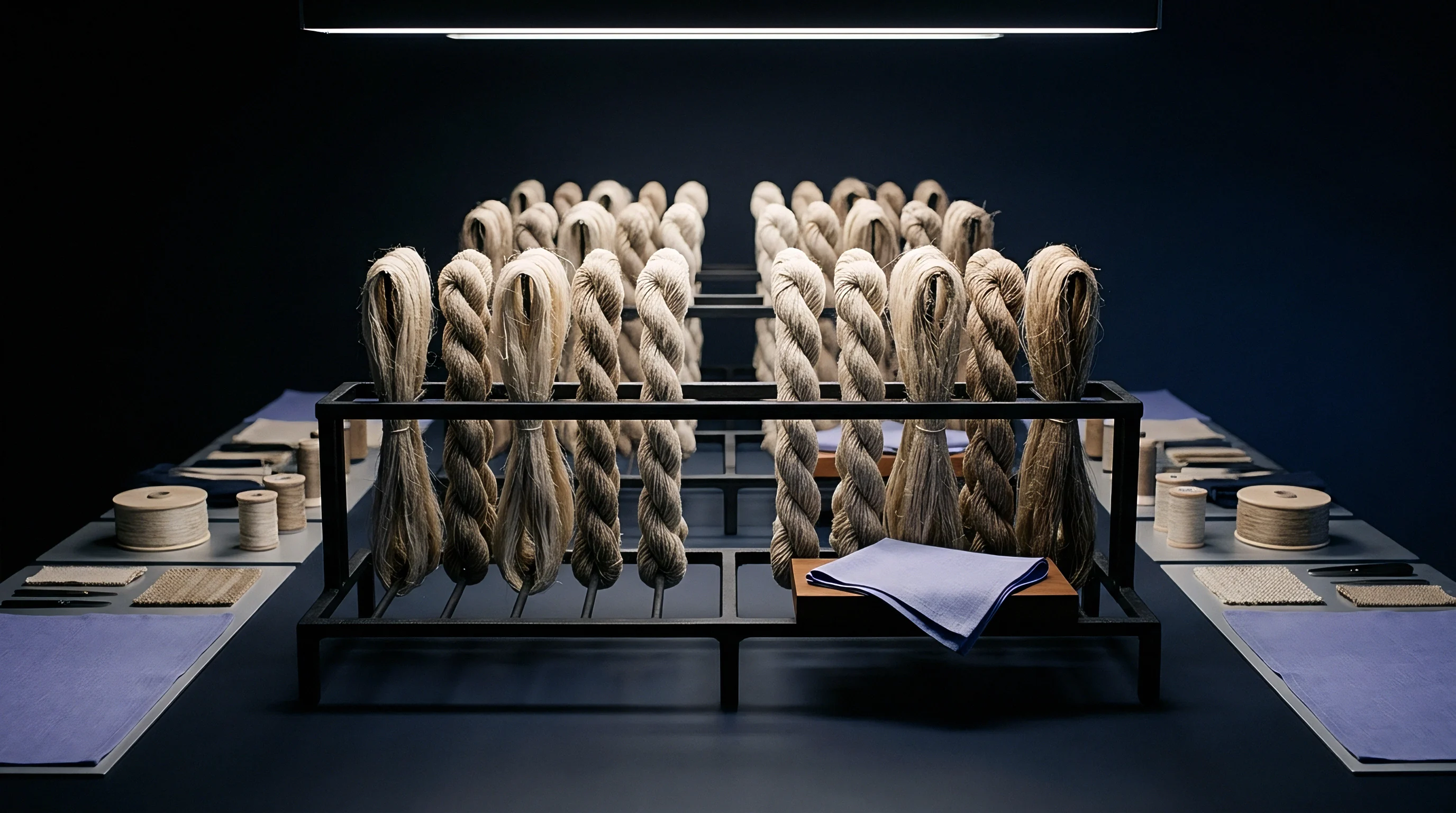
Wet-spinning machinery requires specific roving preparation to achieve high yarn counts. Hot troughs dissolve bark pectin. Combed hackling slivers undergo multiple drawing passes to create uniform roving packages.
Roving frames apply slight protective twist before winding material onto wooden bobbins. The roving packages enter wet-spinning frames where they submerge in hot water troughs maintained at temperatures between 60 and 70 degrees Celsius. Hot water softens residual calcium pectate middle lamellae, allowing individual ultimate fibers to slide smoothly past one another under draft roller acceleration.
Drafting Zone Mechanics
Hot water bath treatment at 65 degrees Celsius softens inter-cellular pectin. The drafting zone consists of back feed rollers and high-speed front delivery rollers separated by a fixed reach distance matched to maximum fiber length. The draft ratio, set between 10 and 20, accelerates fiber movement, thinning the strand down to its final yarn linear density.
Spinning tension snaps weak strands. Under-retted Heilongjiang line fiber, carrying firm pectic bonds, resists sliding in the draft zone, causing stick-slip movement that creates periodic thick-and-thin yarn defects known as draft waves.
Yarn evenness inspection relies on capacitive testing systems under ISO 2060, measuring coefficient of variation percentage in mass across continuous yarn lengths. Premium Grade 1 fiber spun to Nm 39 achieves mass CV values below 14 percent, ensuring minimal thick places and neps per thousand metres. End-breakage rates serve as the decisive operational test for yarn mill productivity.
Excess end breaks force operators to tie piecings manually, introducing knots that cause weaving machine stoppages.
- Raw Material Technical Dossier presents certified ISO testing metrics including bundle tenacity, linear density, and residual pectin percentage.
- Hackling Yield Verification Sheet details comb waste ratios, line fiber percentage, and short-staple tow retention mass.
- Wet-Spinning Performance Log records end-breakage counts per 1000 spindle-hours, trough water temperatures, and applied draft ratios.
- Yarn Mass Evenness Report displays capacitive CV percentage curves, thin place counts, and nep frequency distributions.
- Commercial Mass Certificate establishes final invoice weight calculated at official standard moisture regain percentages under ISO 6741.
Yarn Count Attainment
Metres per gram ratio dictates final fabric density and hand. Sliver weight governs yarn count. Line flax grades dictate spinnable count ceilings regardless of spinning frame adjustments.
Grade 1 Heilongjiang stock reliably yields fine yarns up to Nm 60 (16.6 tex), suitable for high-end apparel fabrics. Lower grades fail at fine counts because coarse bundle dimensions cause strand disintegration in the drafting zone when fiber count per cross-section drops below 25 ultimate fibers. A contract clause specifying maximum end-breakage thresholds per thousand spindle-hours transfers the financial burden of fiber draft failure back to the raw material vendor.

Parcel
Commercial valuation integrates raw material procurement cost with hackling yield calculations. Yield calculation determines net profitability before yarn spinning begins. Duty tariffs raise landed cost.
Purchasing decisions balance raw fiber price per metric ton against hackling room conversion efficiency and downstream spinning performance. Importing European water-retted or dew-retted line flax presents an alternative to domestic Heilongjiang supply, though import tariffs and cross-border freight alter landed cost balances.

Landed Cost Structure
Freight charges from Harbin processing hubs combine with domestic taxation. Base raw material pricing for Heilongjiang dew-retted line flax reflects seasonal crop yields and regional moisture conditions. Sourcing high-grade domestic stock eliminates import duties and international ocean freight fees, reducing initial capital commitment.
Bale cores store damp heat. Uncontrolled storage moisture causes fungal mold growth inside densely packed bales during transit, destroying fiber tenacity and leading to total lot rejection upon delivery.
| Cost Component | Heilongjiang Grade 1 | Heilongjiang Grade 3 | Imported European Line |
|---|---|---|---|
| Raw Scutched Fiber Price ($/kg) | $4.20 | $2.80 | $6.10 |
| Freight and Logistics ($/kg) | $0.25 | $0.25 | $0.85 |
| Import Tariff and Customs ($/kg) | $0.00 | $0.00 | $0.48 |
| Hackling Line Yield (%) | 64 % | 48 % | 72 % |
| Net Combed Line Fiber Cost ($/kg) | $6.95 | $6.35 | $10.32 |
| Wet Spinning Conversion Cost ($/kg) | $3.50 | $4.20 | $3.10 |
| Finished Nm 30 Yarn Cost ($/kg) | $10.45 | $10.55 | $13.42 |

Economic Yield Model
Hackling conversion losses determine net fibre cost per spun kilogram. High-grade raw fiber commands a higher initial purchase price but yields substantial savings during mechanical combing and wet spinning. A worked financial comparison illustrates this relationship.
High twist reduces bundle draft. Consider a 10-tonne processing lot of Heilongjiang Grade 1 raw flax priced at $4.20 per kilogram compared against a Grade 3 lot priced at $2.80 per kilogram. The Grade 1 lot delivers a 64 percent hackling yield, producing 6,400 kilograms of clean combed sliver at an effective raw material cost of $6.95 per kilogram of line fiber.
The Grade 3 lot delivers a 48 percent hackling yield, producing 4,800 kilograms of combed sliver at an effective raw material cost of $6.35 per kilogram, while generating excess low-value tow waste.
Fungal enzymatic activity during field exposure alters the cellulose crystalline structure before scutching separation completes.
Downstream spinning costs quickly reverse the apparent initial savings of lower-grade raw material. Grade 3 line fiber demands higher twist insertion rates, slowing spinning frame output speeds and elevating labor energy overhead per kilogram produced. High end-breakage rates on low-grade lots increase frame downtime and waste generation during roving piecing.
The total finished cost per kilogram for Nm 30 spun yarn comes out higher when using Grade 3 raw stock than when using Grade 1 stock. The final cost per woven metre reflects the combined impact of raw fiber purchasing price, hackling comb yield percentage, wet-spinning frame output efficiency, and fabric shrinkage allowances during finishing.